NSTP – CWTS 2 Orientation UERMMMC College of Nursing
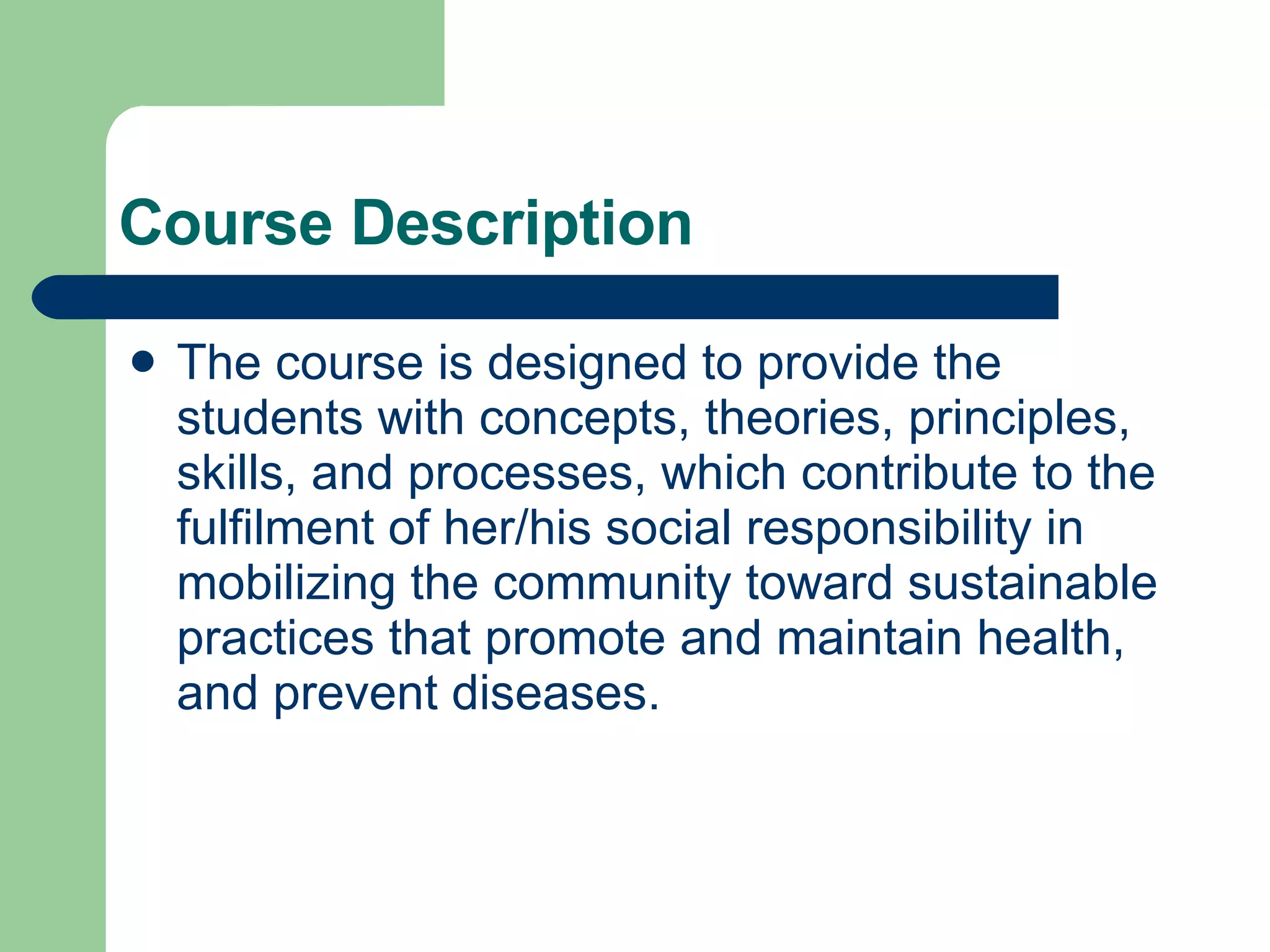
Course Description The course is designed to provide the students with concepts, theories, principles, skills, and processes, which contribute to the fulfilment of her/his social responsibility in mobilizing the community toward sustainable practices that promote and maintain health, and prevent diseases.
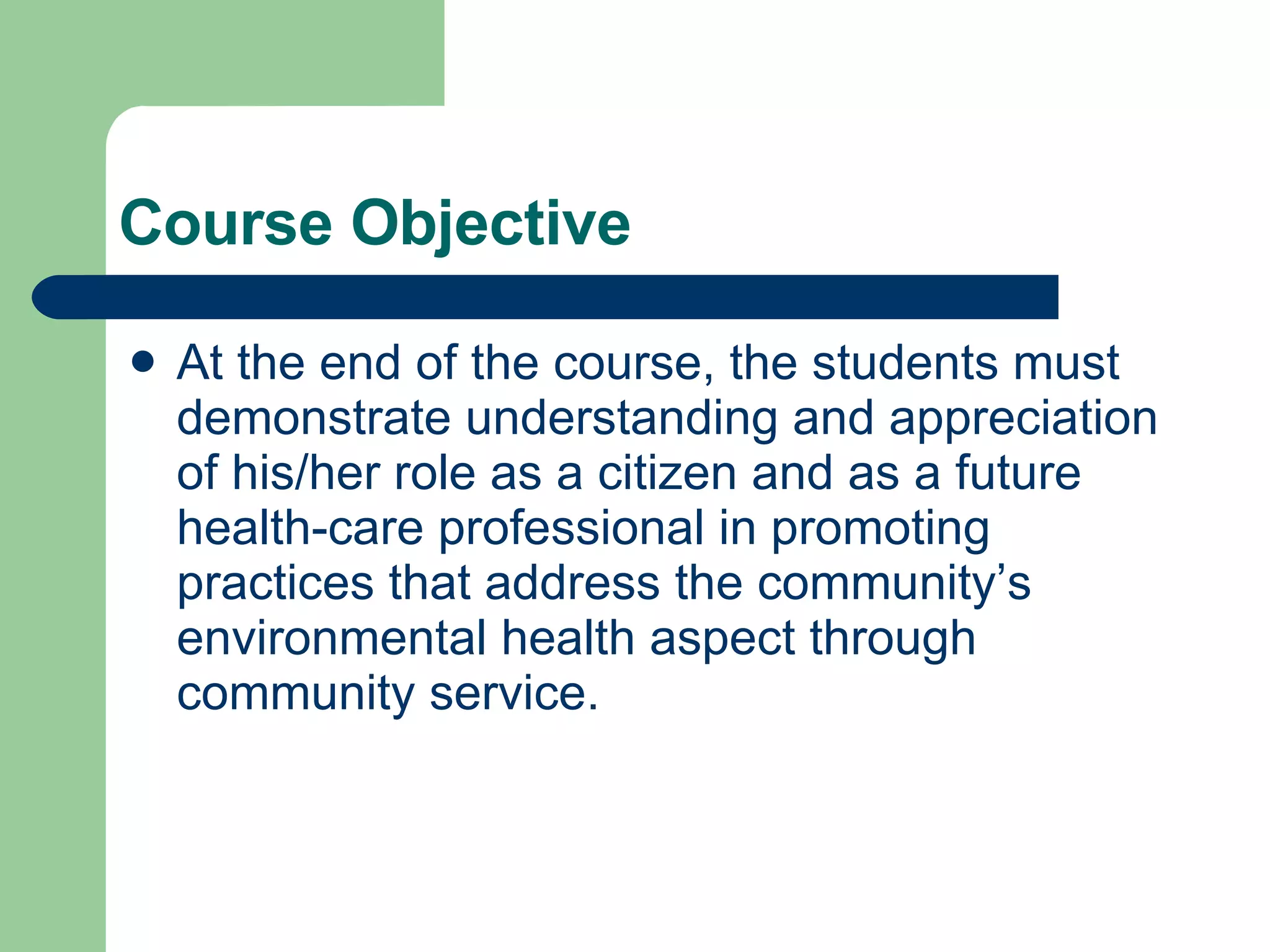
Course Objective At the end of the course, the students must demonstrate understanding and appreciation of his/her role as a citizen and as a future health-care professional in promoting practices that address the community’s environmental health aspect through community service.
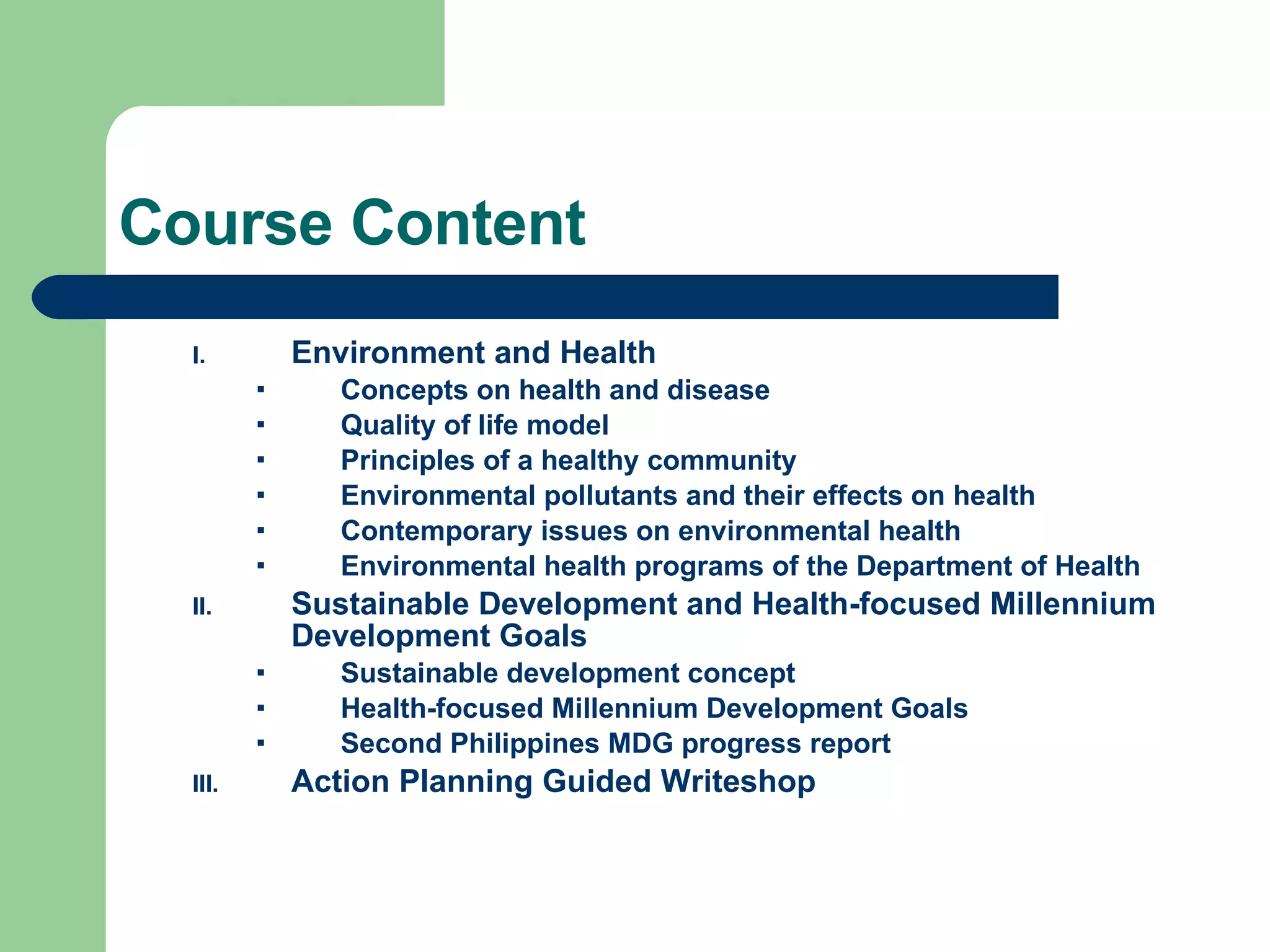
Course Content Environment and Health Concepts on health and disease Quality of life model Principles of a healthy community Environmental pollutants and their effects on health Contemporary issues on environmental health Environmental health programs of the Department of Health Sustainable Development and Health-focused Millennium Development Goals Sustainable development concept  Health-focused Millennium Development Goals Second Philippines MDG progress report Action Planning Guided Writeshop
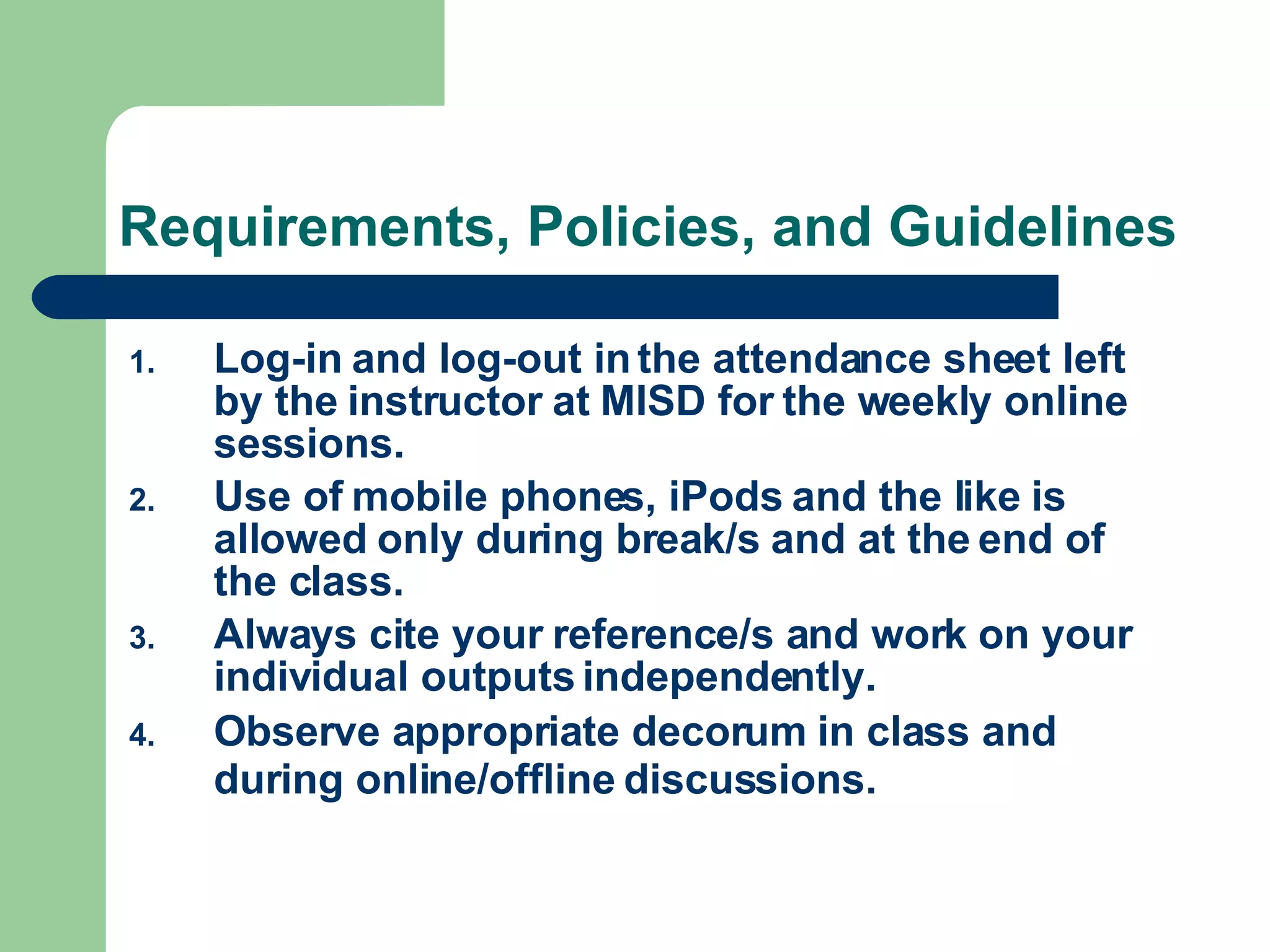
Requirements, Policies, and Guidelines Log-in and log-out in the attendance sheet left by the instructor at MISD for the weekly online sessions. Use of mobile phones, iPods and the like is allowed only during break/s and at the end of the class.   Always cite your reference/s and work on your individual outputs independently.   Observe appropriate decorum in class and during online/offline discussions.
Course Evaluation Your performance in the course shall be evaluated through the following:   Compliance with online and print requirements  25% Completeness, punctuality, and quality  Community Service Action plan  40% Implementation (Clinical Instructor), Presentation of results, & documentation Deportment  05% Attendance and behavior in class and online/offline   Self-assessment  30% Online portfolio, community service
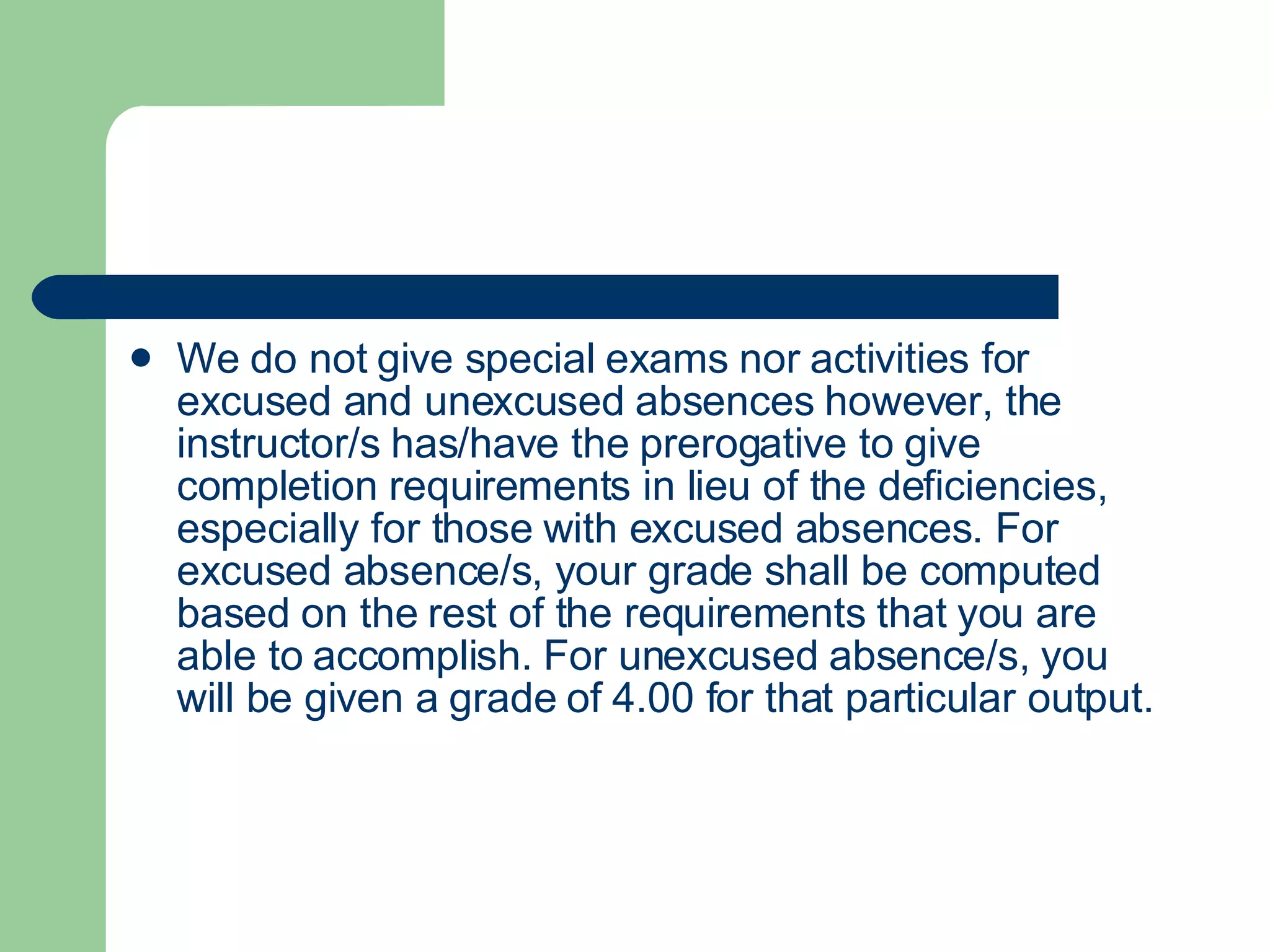
We do not give special exams nor activities for excused and unexcused absences however, the instructor/s has/have the prerogative to give completion requirements in lieu of the deficiencies, especially for those with excused absences. For excused absence/s, your grade shall be computed based on the rest of the requirements that you are able to accomplish. For unexcused absence/s, you will be given a grade of 4.00 for that particular output.
Review of Key Concepts from NSTP I Others integration Self integrity
On Servant Leadership… “ Leadership  springs from within; it’s who we are.”
On Servant Leadership… “ A leadership model that  puts  serving others as the number one priority .” The leader has responsibility for the followers. Leaders have a responsibility towards society and those who are disadvantaged. People who want to help others best do this by leading them.
On Community Engagement… EVERYONE HAS GIFTS. RELATIONSHIPS BUILD A COMMUNITY.  CITIZENS AT THE CENTER LEADERS INVOLVE OTHERS AS ACTIVE MEMBERS OF THE COMMUNITY. PEOPLE CARE ABOUT SOMETHING.  MOTIVATION TO ACT  LISTENING CONVERSATION ASK, ASK, ASK . ASKING QUESTIONS RATHER THAN GIVING ANSWERS INVITES STRONGER PARTICIPATION. A CITIZEN-CENTERED “inside-out” ORGANIZATION IS THE KEY TO COMMUNITY ENGAGEMENT INSTITUTIONS HAVE REACHED THEIR LIMITS IN PROBLEM-SOLVING.   INSTITUTIONS AS SERVANTS

Nstp – Cwts 2 Orientation 11.15.08

  • 1.
    NSTP – CWTS2 Orientation UERMMMC College of Nursing
  • 2.
    Course Description Thecourse is designed to provide the students with concepts, theories, principles, skills, and processes, which contribute to the fulfilment of her/his social responsibility in mobilizing the community toward sustainable practices that promote and maintain health, and prevent diseases.
  • 3.
    Course Objective Atthe end of the course, the students must demonstrate understanding and appreciation of his/her role as a citizen and as a future health-care professional in promoting practices that address the community’s environmental health aspect through community service.
  • 4.
    Course Content Environmentand Health Concepts on health and disease Quality of life model Principles of a healthy community Environmental pollutants and their effects on health Contemporary issues on environmental health Environmental health programs of the Department of Health Sustainable Development and Health-focused Millennium Development Goals Sustainable development concept Health-focused Millennium Development Goals Second Philippines MDG progress report Action Planning Guided Writeshop
  • 5.
    Requirements, Policies, andGuidelines Log-in and log-out in the attendance sheet left by the instructor at MISD for the weekly online sessions. Use of mobile phones, iPods and the like is allowed only during break/s and at the end of the class. Always cite your reference/s and work on your individual outputs independently. Observe appropriate decorum in class and during online/offline discussions.
  • 6.
    Course Evaluation Yourperformance in the course shall be evaluated through the following: Compliance with online and print requirements 25% Completeness, punctuality, and quality Community Service Action plan 40% Implementation (Clinical Instructor), Presentation of results, & documentation Deportment 05% Attendance and behavior in class and online/offline Self-assessment 30% Online portfolio, community service
  • 7.
    We do notgive special exams nor activities for excused and unexcused absences however, the instructor/s has/have the prerogative to give completion requirements in lieu of the deficiencies, especially for those with excused absences. For excused absence/s, your grade shall be computed based on the rest of the requirements that you are able to accomplish. For unexcused absence/s, you will be given a grade of 4.00 for that particular output.
  • 8.
    Review of KeyConcepts from NSTP I Others integration Self integrity
  • 9.
    On Servant Leadership…“ Leadership springs from within; it’s who we are.”
  • 10.
    On Servant Leadership…“ A leadership model that puts serving others as the number one priority .” The leader has responsibility for the followers. Leaders have a responsibility towards society and those who are disadvantaged. People who want to help others best do this by leading them.
  • 11.
    On Community Engagement…EVERYONE HAS GIFTS. RELATIONSHIPS BUILD A COMMUNITY. CITIZENS AT THE CENTER LEADERS INVOLVE OTHERS AS ACTIVE MEMBERS OF THE COMMUNITY. PEOPLE CARE ABOUT SOMETHING.  MOTIVATION TO ACT  LISTENING CONVERSATION ASK, ASK, ASK . ASKING QUESTIONS RATHER THAN GIVING ANSWERS INVITES STRONGER PARTICIPATION. A CITIZEN-CENTERED “inside-out” ORGANIZATION IS THE KEY TO COMMUNITY ENGAGEMENT INSTITUTIONS HAVE REACHED THEIR LIMITS IN PROBLEM-SOLVING.   INSTITUTIONS AS SERVANTS