SCHOOL, DIVISION,
REGIONAL, AND
NATIONAL SCIENCE AND
TECHNOLOGY FAIR
GUIDEBOOK
School-based LAC
Session
Engr. Lyndrian Shalom R.
SESSION
OBJECTIVES
At the end of this session, you are expected to:
• be informed about the NSTF Guidebook
• know about NSTF objectives
• familiarized different roles and responsibilities
• enumerate the fair features
• know the ISEF and required forms
• know Gelacio’s School-based Research
Agenda
WARM-UP
ACTIVITY
REBUS GAME
#
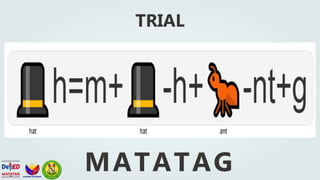
TRIAL
MATATAG
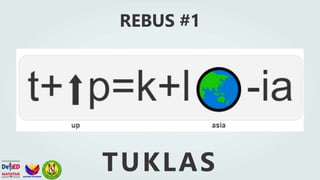
REBUS #1
TUKLAS
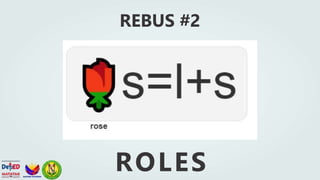
REBUS #2
ROLES
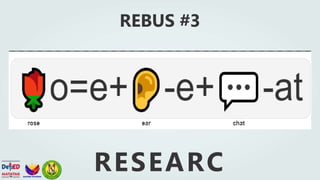
REBUS #3
RESEARC
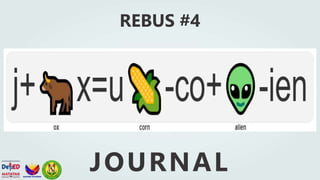
REBUS #4
JOURNAL
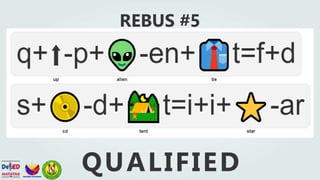
REBUS #5
QUALIFIED
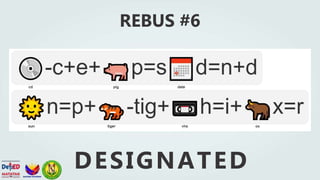
REBUS #6
DESIGNATED
HOW FAMILIAR ARE YOU WITH THE NATIONAL SCIENCE
AND TECHNOLOGY FAIR?
0
1
ABOUT THE
NSTF
GUIDEBOOK
School-based LAC Session
The official guidebook
used for SSTF, DSTF,
RSTF, and NSTF.
OBJECTIVES OF
NSTF
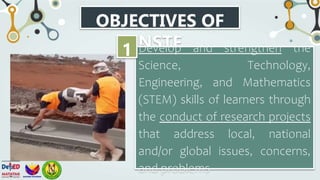
Develop and strengthen the
Science, Technology,
Engineering, and Mathematics
(STEM) skills of learners through
the conduct of research projects
that address local, national
and/or global issues, concerns,
and problems
1
OBJECTIVES OF
NSTF
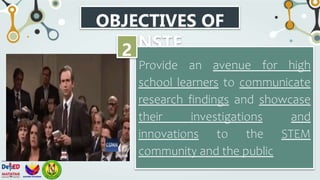
Provide an avenue for high
school learners to communicate
research findings and showcase
their investigations and
innovations to the STEM
community and the public
2
OBJECTIVES OF
NSTF
Foster a culture of creativity and
innovation among the youth
3
OBJECTIVES OF
NSTF
Promote STEM awareness and
interest among learners,
teachers, and the public
4
OBJECTIVES OF
NSTF
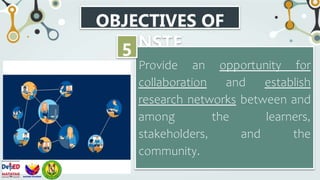
Provide an opportunity for
collaboration and establish
research networks between and
among the learners,
stakeholders, and the
community.
5
OBJECTIVES OF
NSTF
Provide an avenue for high
school learners to communicate
research findings and showcase
their investigations and
innovations to both the STEM
community and the public.
6
0
2
FAIR
FEATURES
School-based LAC Session
FAIR FEATURES
TUKL
AS
INNOVATION
EXPO
STEM
ACADEMY
AGHAMBAYANI
FAIR FEATURES
A STEM research competition that
provides opportunities for Junior and
Senior High School learners to
showcase their research projects
based on their field of interest and/or
real-world problems, issues, and
concerns.
TUKL
AS
A Research Project
Fair
FAIR FEATURES
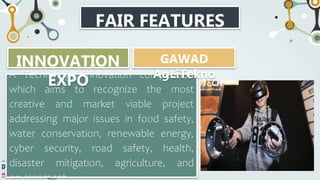
A Technology Innovation competition
which aims to recognize the most
creative and market viable project
addressing major issues in food safety,
water conservation, renewable energy,
cyber security, road safety, health,
disaster mitigation, agriculture, and
INNOVATION
EXPO
GAWAD
AgLiTekno
FAIR FEATURES
A conference designed to provide the
participants with learning opportunities
and experiences through various talks
promoting innovation, creativity, and
excellence in the fields of STEM.
STEM
ACADEMY
FAIR FEATURES
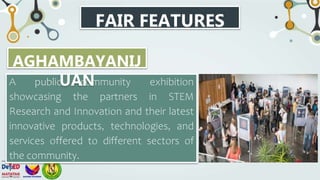
A public community exhibition
showcasing the partners in STEM
Research and Innovation and their latest
innovative products, technologies, and
services offered to different sectors of
the community.
AGHAMBAYANIJ
UAN
FAIR FEATURES
TUKL
AS
INNOVATION
EXPO
STEM
ACADEMY
AGHAMBAYANI
FAIR FEATURES
TUKL
AS
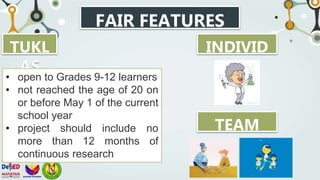
INDIVID
UAL
TEAM
• open to Grades 9-12 learners
• not reached the age of 20 on
or before May 1 of the current
school year
• project should include no
more than 12 months of
continuous research
TUKLAS
CATEGORIES
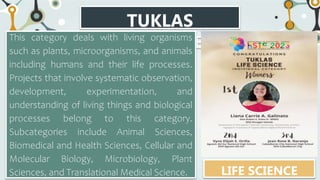
This category deals with living organisms
such as plants, microorganisms, and animals
including humans and their life processes.
Projects that involve systematic observation,
development, experimentation, and
understanding of living things and biological
processes belong to this category.
Subcategories include Animal Sciences,
Biomedical and Health Sciences, Cellular and
Molecular Biology, Microbiology, Plant
Sciences, and Translational Medical Science. LIFE SCIENCE
TUKLAS
CATEGORIES
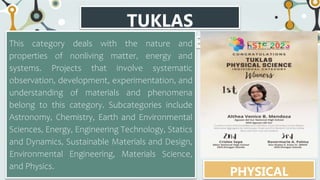
This category deals with the nature and
properties of nonliving matter, energy and
systems. Projects that involve systematic
observation, development, experimentation, and
understanding of materials and phenomena
belong to this category. Subcategories include
Astronomy, Chemistry, Earth and Environmental
Sciences, Energy, Engineering Technology, Statics
and Dynamics, Sustainable Materials and Design,
Environmental Engineering, Materials Science,
and Physics.
PHYSICAL
TUKLAS
CATEGORIES
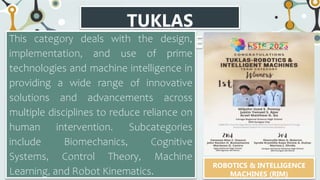
This category deals with the design,
implementation, and use of prime
technologies and machine intelligence in
providing a wide range of innovative
solutions and advancements across
multiple disciplines to reduce reliance on
human intervention. Subcategories
include Biomechanics, Cognitive
Systems, Control Theory, Machine
Learning, and Robot Kinematics.
ROBOTICS & INTELLIGENCE
MACHINES (RIM)
TUKLAS
CATEGORIES
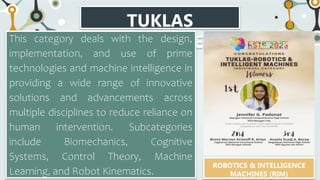
This category deals with the design,
implementation, and use of prime
technologies and machine intelligence in
providing a wide range of innovative
solutions and advancements across
multiple disciplines to reduce reliance on
human intervention. Subcategories
include Biomechanics, Cognitive
Systems, Control Theory, Machine
Learning, and Robot Kinematics.
ROBOTICS & INTELLIGENCE
MACHINES (RIM)
TUKLAS
CATEGORIES
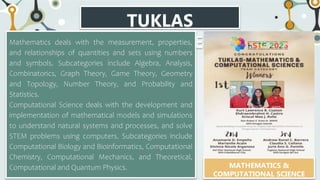
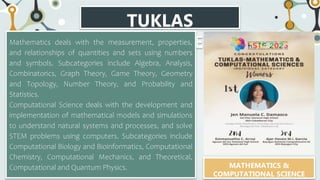
Mathematics deals with the measurement, properties,
and relationships of quantities and sets using numbers
and symbols. Subcategories include Algebra, Analysis,
Combinatorics, Graph Theory, Game Theory, Geometry
and Topology, Number Theory, and Probability and
Statistics.
Computational Science deals with the development and
implementation of mathematical models and simulations
to understand natural systems and processes, and solve
STEM problems using computers. Subcategories include
Computational Biology and Bioinformatics, Computational
Chemistry, Computational Mechanics, and Theoretical,
Computational and Quantum Physics. MATHEMATICS &
COMPUTATIONAL SCIENCE
TUKLAS
CATEGORIES
Mathematics deals with the measurement, properties,
and relationships of quantities and sets using numbers
and symbols. Subcategories include Algebra, Analysis,
Combinatorics, Graph Theory, Game Theory, Geometry
and Topology, Number Theory, and Probability and
Statistics.
Computational Science deals with the development and
implementation of mathematical models and simulations
to understand natural systems and processes, and solve
STEM problems using computers. Subcategories include
Computational Biology and Bioinformatics, Computational
Chemistry, Computational Mechanics, and Theoretical,
Computational and Quantum Physics. MATHEMATICS &
COMPUTATIONAL SCIENCE
0
3
ROLES AND
RESPONSIBI
LITIES
School-based LAC Session
ROLES AND
RESPONSIBILITIES
STUDENT
RESEARCHER
• Understands and abides by the ethical and safety considerations,
national laws, and updated rules and regulations set by the NSTF
and ISEF in planning and performing STEM research
investigations.
• Identifies a research topic/problem and formulates a plan to
address the problem.
• Conducts a comprehensive review of related literatures about
the topic/problem.
ROLES AND
RESPONSIBILITIES
STUDENT
RESEARCHER
• Writes a research plan using the prescribed format.
• Prepares other documents to support the project plan such as
budget plan, timeline of activities, risk assessment, and target
deliverables.
• Communicates with qualified scientists from regulated research institutions
(RRI) to ask for technical assistance to improve the research plan and request
for permission to conduct experimentation in the RRIs laboratory/ facility with
the supervision of a consultant/laboratory assistant.
ROLES AND
RESPONSIBILITIES
STUDENT
RESEARCHER
• Secures the original copies of signed ISEF forms and certification
from Scientific Review Committee (SRC), Institutional Review
Board (IRB) and/or Institutional Animal Care and Use Committee
(IACUC) before starting the research work.
• Records the details of the preliminary research project-related
activities, experimentation proper, raw data, and summary of the
consultations with the research adviser and qualified
scientist/laboratory assistant in a data logbook.
ROLES AND
RESPONSIBILITIES
STUDENT
RESEARCHER
• Performs the experimentation with the guidance of the research
adviser and qualified scientist/laboratory assistant.
• Takes necessary and appropriate photo-documentation.
• Conducts data analysis with the guidance of the research adviser
and/or statistician.
• Writes the research paper following the APA (American
Psychological Association) style formatting and citation.
ROLES AND
RESPONSIBILITIES
STUDENT
RESEARCHER
• Chooses the appropriate category that most accurately
fits the nature of the study and prepares a brief
presentation about the research project.
• Presents the project display poster and answers
questions and clarifications from the judges and the
general public.
ROLES AND
RESPONSIBILITIES
ADULT
ADVISOR/SPONSOR
• May be a teacher, parent, professor, and/or a qualified scientist who
will directly oversee student researchers throughout the course of the
STEM research project.
• Should have a solid background in the area of student research. If not,
carry out a literature review to know more about the pre-requisite
information regarding the main topic/problem, entities/test subjects,
variables, methodologies, and other relevant related literatures needed
to better understand the rationale and basics of the research project.
ROLES AND
RESPONSIBILITIES
ADULT
ADVISOR/SPONSOR
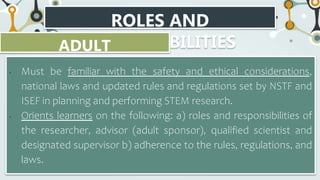
• Must be familiar with the safety and ethical considerations,
national laws and updated rules and regulations set by NSTF and
ISEF in planning and performing STEM research.
• Orients learners on the following: a) roles and responsibilities of
the researcher, advisor (adult sponsor), qualified scientist and
designated supervisor b) adherence to the rules, regulations, and
laws.
ROLES AND
RESPONSIBILITIES
ADULT
ADVISOR/SPONSOR
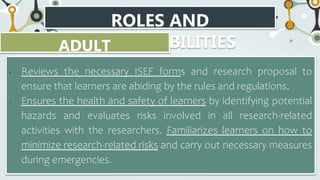
• Reviews the necessary ISEF forms and research proposal to
ensure that learners are abiding by the rules and regulations.
• Ensures the health and safety of learners by identifying potential
hazards and evaluates risks involved in all research-related
activities with the researchers. Familiarizes learners on how to
minimize research-related risks and carry out necessary measures
during emergencies.
ROLES AND
RESPONSIBILITIES
ADULT
ADVISOR/SPONSOR
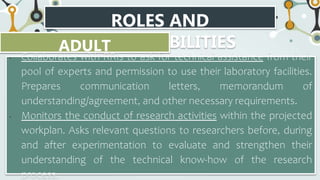
• Collaborates with RRIs to ask for technical assistance from their
pool of experts and permission to use their laboratory facilities.
Prepares communication letters, memorandum of
understanding/agreement, and other necessary requirements.
• Monitors the conduct of research activities within the projected
workplan. Asks relevant questions to researchers before, during
and after experimentation to evaluate and strengthen their
understanding of the technical know-how of the research
process.
ROLES AND
RESPONSIBILITIES
ADULT
ADVISOR/SPONSOR
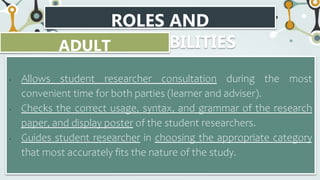
• Allows student researcher consultation during the most
convenient time for both parties (learner and adviser).
• Checks the correct usage, syntax, and grammar of the research
paper, and display poster of the student researchers.
• Guides student researcher in choosing the appropriate category
that most accurately fits the nature of the study.
ROLES AND
RESPONSIBILITIES
ADULT
ADVISOR/SPONSOR
• Conducts local oral defense presentations and provides
comments and suggestions to further improve the
content and delivery of the presentation.
• Ensures that the learner is physically, emotionally, and
mentally ready for the oral defense presentation.
ROLES AND
RESPONSIBILITIES
QUALIFIED
SCIENTIST
• A qualified scientist should have earned a doctorate
degree and/or at least 3 years of extensive experience
and expertise in a STEM discipline related to the
learner’s research investigation.
• Can also serve as the adult sponsor if the
abovementioned qualifications are met.
ROLES AND
RESPONSIBILITIES
QUALIFIED
SCIENTIST
• Needed for research involving human participants,
animals, hazardous chemicals, and/or other PHBAs.
• Must be thoroughly familiar with ethical and safety
considerations, national laws, and updated rules set by
NSTF and ISEF that relate to the nature of the research
project.
ROLES AND
RESPONSIBILITIES
QUALIFIED
SCIENTIST
• Reviews and provides comments and suggestions to
further refine the STEM project proposal. Approves the
learner’s project plan.
• Reviews and completes the required documentation in
the ISEF forms and data logbook.
ROLES AND
RESPONSIBILITIES
QUALIFIED
SCIENTIST
• May or may not come from the RRI where experimentation is to
be conducted; if not from RRI, a separate designated supervisor
from the RRI must be present to supervise the experimentation
conducted at the RRI.
• Ensures the proper training of student researchers and/ or
designated supervisors in carrying out the necessary procedures.
ROLES AND
RESPONSIBILITIES
DESIGNATE
SUPERVISOR
• Must be familiar with the learner’s project and
underwent/undergoes relevant trainings related to the area of
study of the researcher.
• May also serve as the adult sponsor for the project.
• If the project involves the use of vertebrate animals, the
designated supervisor must be well-equipped with the relevant
knowledge and skills on proper handling and ethical concerns
with the use of the test animals.
ROLES AND
RESPONSIBILITIES
INSTITUTIONAL REVIEW
BOARD
• An Institutional Review Board (IRB) is a committee that must evaluate the
potential physical or psychological risk of research involving human subjects.
All proposed human research must be approved prior to experimentation. This
includes any surveys or questionnaires to be used in a project. An IRB must
consist of at least three members: a science teacher, a school administrator,
and a psychologist, psychiatrist, medical doctor, physician’s assistant, or
registered nurse. The adult sponsor, parents, qualified scientist, or the
designated supervisor overseeing a project must not serve on the IRB
reviewing that project.
ROLES AND
RESPONSIBILITIES
SCIENTIFIC REVIEW
COMMITTEE
• An SRC must consist of a minimum of three individuals
with at least 3 years of extensive experience and
expertise in STEM research project and/or graduate
degrees in STEM related disciplines, whereas it is
recommended to diversify the expertise of the
committee (e.g., Life Science research SRC: agronomist,
STEM professor/educator, biomedical scientist).
ROLES AND
RESPONSIBILITIES
SCIENTIFIC REVIEW
COMMITTEE
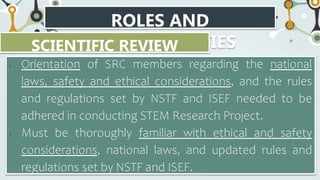
• Orientation of SRC members regarding the national
laws, safety and ethical considerations, and the rules
and regulations set by NSTF and ISEF needed to be
adhered in conducting STEM Research Project.
• Must be thoroughly familiar with ethical and safety
considerations, national laws, and updated rules and
regulations set by NSTF and ISEF.
ROLES AND
RESPONSIBILITIES
SCIENTIFIC REVIEW
COMMITTEE
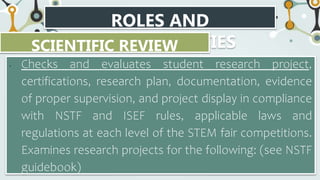
• Checks and evaluates student research project,
certifications, research plan, documentation, evidence
of proper supervision, and project display in compliance
with NSTF and ISEF rules, applicable laws and
regulations at each level of the STEM fair competitions.
Examines research projects for the following: (see NSTF
guidebook)
ROLES AND
RESPONSIBILITIES
SCIENTIFIC REVIEW
COMMITTEE
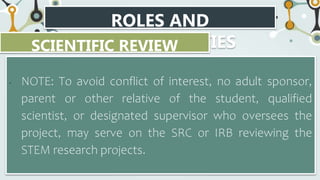
• NOTE: To avoid conflict of interest, no adult sponsor,
parent or other relative of the student, qualified
scientist, or designated supervisor who oversees the
project, may serve on the SRC or IRB reviewing the
STEM research projects.
0
3
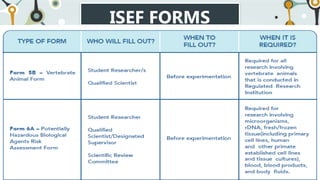
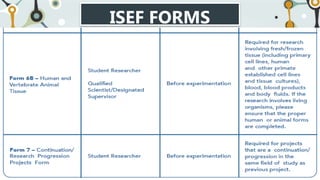
ISEF FORMS
School-based LAC Session
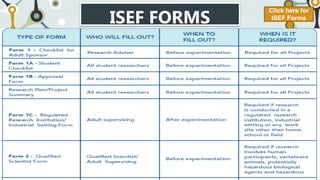
ISEF FORMS
Click here for
ISEF Forms
ISEF FORMS
ISEF FORMS
0
4
BASED
RESEARCH
AGENDA
School-based LAC Session
G UIDED
GELACIAN
G UIDED
GELACIAN
Researches
should be
aligned with
UN’s SDGs.
G UIDED
GELACIAN
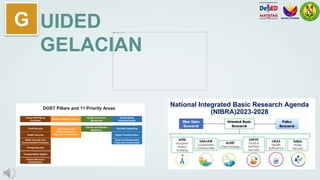
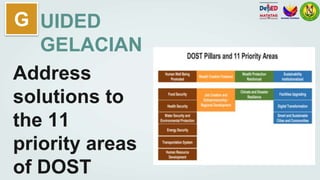
Address
solutions to
the 11
priority areas
of DOST
G UIDED
GELACIAN
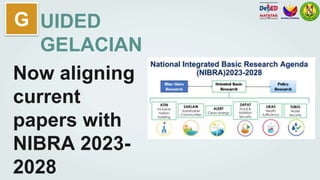
Now aligning
current
papers with
NIBRA 2023-
2028
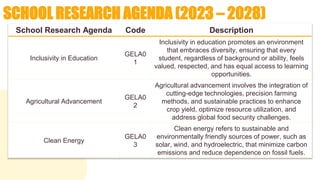
SCHOOL RESEARCH AGENDA (2023 – 2028)
School Research Agenda Code Description
Inclusivity in Education
GELA0
1
Inclusivity in education promotes an environment
that embraces diversity, ensuring that every
student, regardless of background or ability, feels
valued, respected, and has equal access to learning
opportunities.
Agricultural Advancement
GELA0
2
Agricultural advancement involves the integration of
cutting-edge technologies, precision farming
methods, and sustainable practices to enhance
crop yield, optimize resource utilization, and
address global food security challenges.
Clean Energy
GELA0
3
Clean energy refers to sustainable and
environmentally friendly sources of power, such as
solar, wind, and hydroelectric, that minimize carbon
emissions and reduce dependence on fossil fuels.
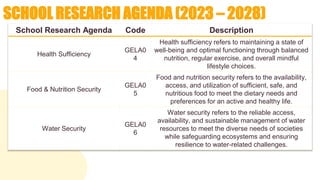
SCHOOL RESEARCH AGENDA (2023 – 2028)
School Research Agenda Code Description
Health Sufficiency
GELA0
4
Health sufficiency refers to maintaining a state of
well-being and optimal functioning through balanced
nutrition, regular exercise, and overall mindful
lifestyle choices.
Food & Nutrition Security
GELA0
5
Food and nutrition security refers to the availability,
access, and utilization of sufficient, safe, and
nutritious food to meet the dietary needs and
preferences for an active and healthy life.
Water Security
GELA0
6
Water security refers to the reliable access,
availability, and sustainable management of water
resources to meet the diverse needs of societies
while safeguarding ecosystems and ensuring
resilience to water-related challenges.
SCHOOL RESEARCH AGENDA (2023 – 2028)
School Research Agenda Code Description
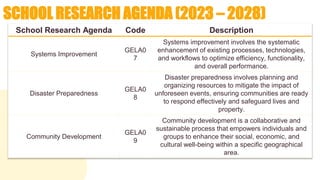
Systems Improvement
GELA0
7
Systems improvement involves the systematic
enhancement of existing processes, technologies,
and workflows to optimize efficiency, functionality,
and overall performance.
Disaster Preparedness
GELA0
8
Disaster preparedness involves planning and
organizing resources to mitigate the impact of
unforeseen events, ensuring communities are ready
to respond effectively and safeguard lives and
property.
Community Development
GELA0
9
Community development is a collaborative and
sustainable process that empowers individuals and
groups to enhance their social, economic, and
cultural well-being within a specific geographical
area.
SCHOOL RESEARCH AGENDA (2023 – 2028)
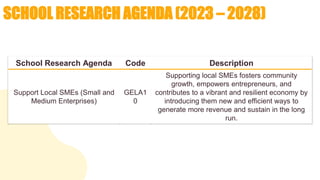
School Research Agenda Code Description
Support Local SMEs (Small and
Medium Enterprises)
GELA1
0
Supporting local SMEs fosters community
growth, empowers entrepreneurs, and
contributes to a vibrant and resilient economy by
introducing them new and efficient ways to
generate more revenue and sustain in the long
run.
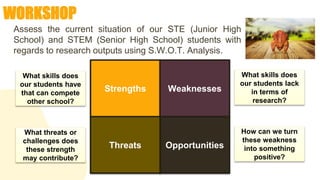
Assess the current situation of our STE (Junior High
School) and STEM (Senior High School) students with
regards to research outputs using S.W.O.T. Analysis.
WORKSHOP
Strengths Weaknesses
Opportunities
Threats
What skills does
our students have
that can compete
other school?
What threats or
challenges does
these strength
may contribute?
What skills does
our students lack
in terms of
research?
How can we turn
these weakness
into something
positive?
“There is always a
better way, better
than the best.”

NSTF Guidebook.pptx

  • 1.
    SCHOOL, DIVISION, REGIONAL, AND NATIONALSCIENCE AND TECHNOLOGY FAIR GUIDEBOOK School-based LAC Session Engr. Lyndrian Shalom R.
  • 2.
    SESSION OBJECTIVES At the endof this session, you are expected to: • be informed about the NSTF Guidebook • know about NSTF objectives • familiarized different roles and responsibilities • enumerate the fair features • know the ISEF and required forms • know Gelacio’s School-based Research Agenda
  • 3.
  • 4.
  • 6.
  • 7.
  • 8.
  • 9.
  • 10.
  • 11.
  • 12.
    HOW FAMILIAR AREYOU WITH THE NATIONAL SCIENCE AND TECHNOLOGY FAIR?
  • 13.
  • 14.
    The official guidebook usedfor SSTF, DSTF, RSTF, and NSTF.
  • 15.
    OBJECTIVES OF NSTF Develop andstrengthen the Science, Technology, Engineering, and Mathematics (STEM) skills of learners through the conduct of research projects that address local, national and/or global issues, concerns, and problems 1
  • 16.
    OBJECTIVES OF NSTF Provide anavenue for high school learners to communicate research findings and showcase their investigations and innovations to the STEM community and the public 2
  • 17.
    OBJECTIVES OF NSTF Foster aculture of creativity and innovation among the youth 3
  • 18.
    OBJECTIVES OF NSTF Promote STEMawareness and interest among learners, teachers, and the public 4
  • 19.
    OBJECTIVES OF NSTF Provide anopportunity for collaboration and establish research networks between and among the learners, stakeholders, and the community. 5
  • 20.
    OBJECTIVES OF NSTF Provide anavenue for high school learners to communicate research findings and showcase their investigations and innovations to both the STEM community and the public. 6
  • 21.
  • 22.
  • 23.
    FAIR FEATURES A STEMresearch competition that provides opportunities for Junior and Senior High School learners to showcase their research projects based on their field of interest and/or real-world problems, issues, and concerns. TUKL AS A Research Project Fair
  • 24.
    FAIR FEATURES A TechnologyInnovation competition which aims to recognize the most creative and market viable project addressing major issues in food safety, water conservation, renewable energy, cyber security, road safety, health, disaster mitigation, agriculture, and INNOVATION EXPO GAWAD AgLiTekno
  • 25.
    FAIR FEATURES A conferencedesigned to provide the participants with learning opportunities and experiences through various talks promoting innovation, creativity, and excellence in the fields of STEM. STEM ACADEMY
  • 26.
    FAIR FEATURES A publiccommunity exhibition showcasing the partners in STEM Research and Innovation and their latest innovative products, technologies, and services offered to different sectors of the community. AGHAMBAYANIJ UAN
  • 27.
  • 28.
    FAIR FEATURES TUKL AS INDIVID UAL TEAM • opento Grades 9-12 learners • not reached the age of 20 on or before May 1 of the current school year • project should include no more than 12 months of continuous research
  • 29.
    TUKLAS CATEGORIES This category dealswith living organisms such as plants, microorganisms, and animals including humans and their life processes. Projects that involve systematic observation, development, experimentation, and understanding of living things and biological processes belong to this category. Subcategories include Animal Sciences, Biomedical and Health Sciences, Cellular and Molecular Biology, Microbiology, Plant Sciences, and Translational Medical Science. LIFE SCIENCE
  • 30.
    TUKLAS CATEGORIES This category dealswith the nature and properties of nonliving matter, energy and systems. Projects that involve systematic observation, development, experimentation, and understanding of materials and phenomena belong to this category. Subcategories include Astronomy, Chemistry, Earth and Environmental Sciences, Energy, Engineering Technology, Statics and Dynamics, Sustainable Materials and Design, Environmental Engineering, Materials Science, and Physics. PHYSICAL
  • 31.
    TUKLAS CATEGORIES This category dealswith the design, implementation, and use of prime technologies and machine intelligence in providing a wide range of innovative solutions and advancements across multiple disciplines to reduce reliance on human intervention. Subcategories include Biomechanics, Cognitive Systems, Control Theory, Machine Learning, and Robot Kinematics. ROBOTICS & INTELLIGENCE MACHINES (RIM)
  • 32.
    TUKLAS CATEGORIES This category dealswith the design, implementation, and use of prime technologies and machine intelligence in providing a wide range of innovative solutions and advancements across multiple disciplines to reduce reliance on human intervention. Subcategories include Biomechanics, Cognitive Systems, Control Theory, Machine Learning, and Robot Kinematics. ROBOTICS & INTELLIGENCE MACHINES (RIM)
  • 33.
    TUKLAS CATEGORIES Mathematics deals withthe measurement, properties, and relationships of quantities and sets using numbers and symbols. Subcategories include Algebra, Analysis, Combinatorics, Graph Theory, Game Theory, Geometry and Topology, Number Theory, and Probability and Statistics. Computational Science deals with the development and implementation of mathematical models and simulations to understand natural systems and processes, and solve STEM problems using computers. Subcategories include Computational Biology and Bioinformatics, Computational Chemistry, Computational Mechanics, and Theoretical, Computational and Quantum Physics. MATHEMATICS & COMPUTATIONAL SCIENCE
  • 34.
    TUKLAS CATEGORIES Mathematics deals withthe measurement, properties, and relationships of quantities and sets using numbers and symbols. Subcategories include Algebra, Analysis, Combinatorics, Graph Theory, Game Theory, Geometry and Topology, Number Theory, and Probability and Statistics. Computational Science deals with the development and implementation of mathematical models and simulations to understand natural systems and processes, and solve STEM problems using computers. Subcategories include Computational Biology and Bioinformatics, Computational Chemistry, Computational Mechanics, and Theoretical, Computational and Quantum Physics. MATHEMATICS & COMPUTATIONAL SCIENCE
  • 35.
  • 36.
    ROLES AND RESPONSIBILITIES STUDENT RESEARCHER • Understandsand abides by the ethical and safety considerations, national laws, and updated rules and regulations set by the NSTF and ISEF in planning and performing STEM research investigations. • Identifies a research topic/problem and formulates a plan to address the problem. • Conducts a comprehensive review of related literatures about the topic/problem.
  • 37.
    ROLES AND RESPONSIBILITIES STUDENT RESEARCHER • Writesa research plan using the prescribed format. • Prepares other documents to support the project plan such as budget plan, timeline of activities, risk assessment, and target deliverables. • Communicates with qualified scientists from regulated research institutions (RRI) to ask for technical assistance to improve the research plan and request for permission to conduct experimentation in the RRIs laboratory/ facility with the supervision of a consultant/laboratory assistant.
  • 38.
    ROLES AND RESPONSIBILITIES STUDENT RESEARCHER • Securesthe original copies of signed ISEF forms and certification from Scientific Review Committee (SRC), Institutional Review Board (IRB) and/or Institutional Animal Care and Use Committee (IACUC) before starting the research work. • Records the details of the preliminary research project-related activities, experimentation proper, raw data, and summary of the consultations with the research adviser and qualified scientist/laboratory assistant in a data logbook.
  • 39.
    ROLES AND RESPONSIBILITIES STUDENT RESEARCHER • Performsthe experimentation with the guidance of the research adviser and qualified scientist/laboratory assistant. • Takes necessary and appropriate photo-documentation. • Conducts data analysis with the guidance of the research adviser and/or statistician. • Writes the research paper following the APA (American Psychological Association) style formatting and citation.
  • 40.
    ROLES AND RESPONSIBILITIES STUDENT RESEARCHER • Choosesthe appropriate category that most accurately fits the nature of the study and prepares a brief presentation about the research project. • Presents the project display poster and answers questions and clarifications from the judges and the general public.
  • 41.
    ROLES AND RESPONSIBILITIES ADULT ADVISOR/SPONSOR • Maybe a teacher, parent, professor, and/or a qualified scientist who will directly oversee student researchers throughout the course of the STEM research project. • Should have a solid background in the area of student research. If not, carry out a literature review to know more about the pre-requisite information regarding the main topic/problem, entities/test subjects, variables, methodologies, and other relevant related literatures needed to better understand the rationale and basics of the research project.
  • 42.
    ROLES AND RESPONSIBILITIES ADULT ADVISOR/SPONSOR • Mustbe familiar with the safety and ethical considerations, national laws and updated rules and regulations set by NSTF and ISEF in planning and performing STEM research. • Orients learners on the following: a) roles and responsibilities of the researcher, advisor (adult sponsor), qualified scientist and designated supervisor b) adherence to the rules, regulations, and laws.
  • 43.
    ROLES AND RESPONSIBILITIES ADULT ADVISOR/SPONSOR • Reviewsthe necessary ISEF forms and research proposal to ensure that learners are abiding by the rules and regulations. • Ensures the health and safety of learners by identifying potential hazards and evaluates risks involved in all research-related activities with the researchers. Familiarizes learners on how to minimize research-related risks and carry out necessary measures during emergencies.
  • 44.
    ROLES AND RESPONSIBILITIES ADULT ADVISOR/SPONSOR • Collaborateswith RRIs to ask for technical assistance from their pool of experts and permission to use their laboratory facilities. Prepares communication letters, memorandum of understanding/agreement, and other necessary requirements. • Monitors the conduct of research activities within the projected workplan. Asks relevant questions to researchers before, during and after experimentation to evaluate and strengthen their understanding of the technical know-how of the research process.
  • 45.
    ROLES AND RESPONSIBILITIES ADULT ADVISOR/SPONSOR • Allowsstudent researcher consultation during the most convenient time for both parties (learner and adviser). • Checks the correct usage, syntax, and grammar of the research paper, and display poster of the student researchers. • Guides student researcher in choosing the appropriate category that most accurately fits the nature of the study.
  • 46.
    ROLES AND RESPONSIBILITIES ADULT ADVISOR/SPONSOR • Conductslocal oral defense presentations and provides comments and suggestions to further improve the content and delivery of the presentation. • Ensures that the learner is physically, emotionally, and mentally ready for the oral defense presentation.
  • 47.
    ROLES AND RESPONSIBILITIES QUALIFIED SCIENTIST • Aqualified scientist should have earned a doctorate degree and/or at least 3 years of extensive experience and expertise in a STEM discipline related to the learner’s research investigation. • Can also serve as the adult sponsor if the abovementioned qualifications are met.
  • 48.
    ROLES AND RESPONSIBILITIES QUALIFIED SCIENTIST • Neededfor research involving human participants, animals, hazardous chemicals, and/or other PHBAs. • Must be thoroughly familiar with ethical and safety considerations, national laws, and updated rules set by NSTF and ISEF that relate to the nature of the research project.
  • 49.
    ROLES AND RESPONSIBILITIES QUALIFIED SCIENTIST • Reviewsand provides comments and suggestions to further refine the STEM project proposal. Approves the learner’s project plan. • Reviews and completes the required documentation in the ISEF forms and data logbook.
  • 50.
    ROLES AND RESPONSIBILITIES QUALIFIED SCIENTIST • Mayor may not come from the RRI where experimentation is to be conducted; if not from RRI, a separate designated supervisor from the RRI must be present to supervise the experimentation conducted at the RRI. • Ensures the proper training of student researchers and/ or designated supervisors in carrying out the necessary procedures.
  • 51.
    ROLES AND RESPONSIBILITIES DESIGNATE SUPERVISOR • Mustbe familiar with the learner’s project and underwent/undergoes relevant trainings related to the area of study of the researcher. • May also serve as the adult sponsor for the project. • If the project involves the use of vertebrate animals, the designated supervisor must be well-equipped with the relevant knowledge and skills on proper handling and ethical concerns with the use of the test animals.
  • 52.
    ROLES AND RESPONSIBILITIES INSTITUTIONAL REVIEW BOARD •An Institutional Review Board (IRB) is a committee that must evaluate the potential physical or psychological risk of research involving human subjects. All proposed human research must be approved prior to experimentation. This includes any surveys or questionnaires to be used in a project. An IRB must consist of at least three members: a science teacher, a school administrator, and a psychologist, psychiatrist, medical doctor, physician’s assistant, or registered nurse. The adult sponsor, parents, qualified scientist, or the designated supervisor overseeing a project must not serve on the IRB reviewing that project.
  • 53.
    ROLES AND RESPONSIBILITIES SCIENTIFIC REVIEW COMMITTEE •An SRC must consist of a minimum of three individuals with at least 3 years of extensive experience and expertise in STEM research project and/or graduate degrees in STEM related disciplines, whereas it is recommended to diversify the expertise of the committee (e.g., Life Science research SRC: agronomist, STEM professor/educator, biomedical scientist).
  • 54.
    ROLES AND RESPONSIBILITIES SCIENTIFIC REVIEW COMMITTEE •Orientation of SRC members regarding the national laws, safety and ethical considerations, and the rules and regulations set by NSTF and ISEF needed to be adhered in conducting STEM Research Project. • Must be thoroughly familiar with ethical and safety considerations, national laws, and updated rules and regulations set by NSTF and ISEF.
  • 55.
    ROLES AND RESPONSIBILITIES SCIENTIFIC REVIEW COMMITTEE •Checks and evaluates student research project, certifications, research plan, documentation, evidence of proper supervision, and project display in compliance with NSTF and ISEF rules, applicable laws and regulations at each level of the STEM fair competitions. Examines research projects for the following: (see NSTF guidebook)
  • 56.
    ROLES AND RESPONSIBILITIES SCIENTIFIC REVIEW COMMITTEE •NOTE: To avoid conflict of interest, no adult sponsor, parent or other relative of the student, qualified scientist, or designated supervisor who oversees the project, may serve on the SRC or IRB reviewing the STEM research projects.
  • 57.
  • 58.
    ISEF FORMS Click herefor ISEF Forms
  • 59.
  • 60.
  • 61.
  • 62.
  • 63.
  • 64.
  • 65.
  • 66.
    SCHOOL RESEARCH AGENDA(2023 – 2028) School Research Agenda Code Description Inclusivity in Education GELA0 1 Inclusivity in education promotes an environment that embraces diversity, ensuring that every student, regardless of background or ability, feels valued, respected, and has equal access to learning opportunities. Agricultural Advancement GELA0 2 Agricultural advancement involves the integration of cutting-edge technologies, precision farming methods, and sustainable practices to enhance crop yield, optimize resource utilization, and address global food security challenges. Clean Energy GELA0 3 Clean energy refers to sustainable and environmentally friendly sources of power, such as solar, wind, and hydroelectric, that minimize carbon emissions and reduce dependence on fossil fuels.
  • 67.
    SCHOOL RESEARCH AGENDA(2023 – 2028) School Research Agenda Code Description Health Sufficiency GELA0 4 Health sufficiency refers to maintaining a state of well-being and optimal functioning through balanced nutrition, regular exercise, and overall mindful lifestyle choices. Food & Nutrition Security GELA0 5 Food and nutrition security refers to the availability, access, and utilization of sufficient, safe, and nutritious food to meet the dietary needs and preferences for an active and healthy life. Water Security GELA0 6 Water security refers to the reliable access, availability, and sustainable management of water resources to meet the diverse needs of societies while safeguarding ecosystems and ensuring resilience to water-related challenges.
  • 68.
    SCHOOL RESEARCH AGENDA(2023 – 2028) School Research Agenda Code Description Systems Improvement GELA0 7 Systems improvement involves the systematic enhancement of existing processes, technologies, and workflows to optimize efficiency, functionality, and overall performance. Disaster Preparedness GELA0 8 Disaster preparedness involves planning and organizing resources to mitigate the impact of unforeseen events, ensuring communities are ready to respond effectively and safeguard lives and property. Community Development GELA0 9 Community development is a collaborative and sustainable process that empowers individuals and groups to enhance their social, economic, and cultural well-being within a specific geographical area.
  • 69.
    SCHOOL RESEARCH AGENDA(2023 – 2028) School Research Agenda Code Description Support Local SMEs (Small and Medium Enterprises) GELA1 0 Supporting local SMEs fosters community growth, empowers entrepreneurs, and contributes to a vibrant and resilient economy by introducing them new and efficient ways to generate more revenue and sustain in the long run.
  • 70.
    Assess the currentsituation of our STE (Junior High School) and STEM (Senior High School) students with regards to research outputs using S.W.O.T. Analysis. WORKSHOP Strengths Weaknesses Opportunities Threats What skills does our students have that can compete other school? What threats or challenges does these strength may contribute? What skills does our students lack in terms of research? How can we turn these weakness into something positive?
  • 71.
    “There is alwaysa better way, better than the best.”