REGIONAL, STATE
 AND INTEL
 INTERNATIONAL
 SCIENCE AND
 ENGINEERING FAIR
2012-2013
Rules and Guidelines
Adult roles and responsibilities

      Adult Sponsor
      Qualified Scientist
      Designated Supervisor
      Institutional Review Board (IRB)
      Scientific Review Committee (SRC)
Adult sponsor
     Oversees project to make sure that student
         is informed of ISEF Rules and Guidelines
         is aware of risks associated with project
         is aware of forms required for project
         will receive proper supervision during
          experimentation
         if required, submits project to IRB or SRC
     Teacher usually serves as Adult Sponsor
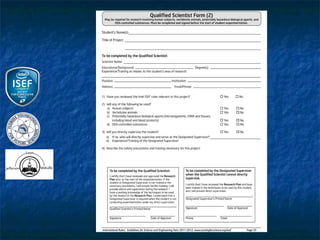
Qualified Scientist
   Required for some projects
   Doctoral/professional degree related
    to student research
                    or
     Masters degree with SRC approval

   Completes Form 2 – QS Form
Designated Supervisor
   Animal Care Supervisor for vertebrate
    animal projects
   Supervises projects involving hazardous
    chemicals, activities or devices
   Supervises projects requiring a Qualified
    Scientist when the Qualified Scientist
    cannot directly supervise the student
IRB (Institutional Review Board)
     Reviews human participants studies
     Membership must include:
         an educator
         a school administrator
         someone knowledgeable about
          evaluating physical and/or psychological
          risk: MD, PA, RN, psychiatrist,
          psychologist, licensed social worker or
          licensed clinical professional counselor
SRC (Scientific Review
        Committee)
   Reviews some projects before
    experimentation
   Reviews all projects just prior to
    competition
   Membership must include:
       a biomedical scientist (Ph.D., M.D.,
        D.V.M., D.D.S., D.O.)
       an educator
       one other member
Combined IRB/SRC
   a biomedical scientist (Ph.D., M.D.,
    D.V.M., D.D.S., D.O.)
   a school administrator
   an educator
   someone knowledgeable about
    evaluating physical and/or psychological
    risk: MD, PA, RN, psychiatrist,
    psychologist, licensed social worker or
    licensed clinical professional counselor
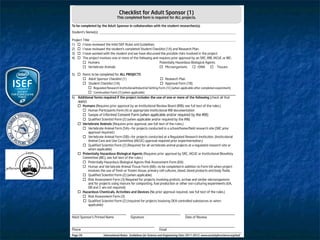
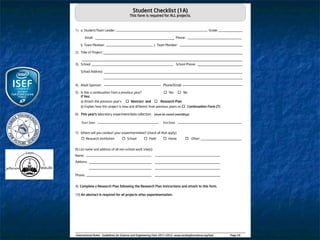
Forms required for all
      projects
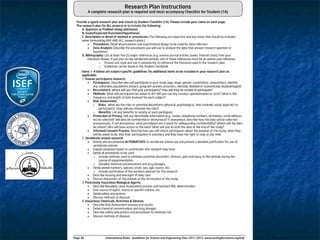
A Research Plan is required for
all projects. It must incorporate
all of the relevant topics listed in
the Research Plan Instructions.
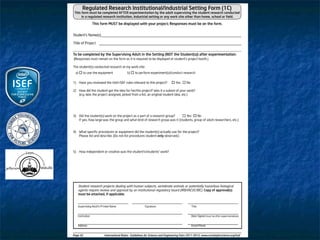
Studies conducted at a
research institution, industrial
setting or any work site other
than home, school or field
require Form 1C
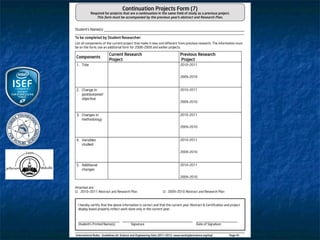
Continuation studies
   Project based on prior research in the
    same field of study
   Longitudinal studies are permitted
       Multi-year study
       Studies time-based change
   Require form 7
HUMAN PARTICIPANTS
What are human participants
         studies?
 Human participants studies involve
  living individuals where there is

    Intervention or interaction with
     participants
                    and/or
    Collection of identifiable private
     information
Exempt studies – do not
require IRB review nor human
      participants forms
   Product testing of a student invention,
    program, concept, etc.
      No health hazards

      No personal data collected

      Feedback directly related to product

   Studies using pre-existing, publicly
    available human data
Additional exempt studies

   Behavioral observations in unrestricted
    public settings
       No interaction
       No manipulation of environment
       No recording of any personal identifiers
   Studies using certified de-identified/
    anonymous data
Human participants research
   The IRB must review and approve the
    research plan before experimentation
    begins
   Research participants 18 years of age
    or older must give informed
    consent
   Research participants under 18 must
    give assent and their parents may be
    required to give permission
Human participants research, cont’d

      The IRB (at the school level)
       evaluates the project and determines
          Risk level
          Requirement for Qualified Scientist
          Requirement for written informed
           consent/assent/parental permission
Risk evaluation

   No more than minimal risk
       Anticipated harm and discomfort not
       greater than encountered in daily life
   More than minimal risk
       Anticipated harm or discomfort is
       greater than encountered in daily life
   More than minimal risk studies should
    require written consent/assent and parental
    permission. Final determination for this
    requirement made by the IRB
Types of Risk
   Physical risks
       Exercise
       Ingestion, tasting, smelling, application of
        substances
       Exposure to potentially hazardous material
   Psychological risks
   Invasion of privacy
   Participant is a member of an at-risk
    group
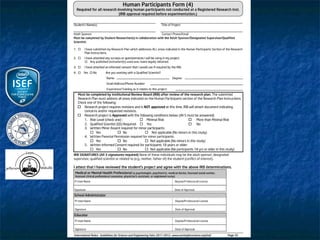
IRB decisions are
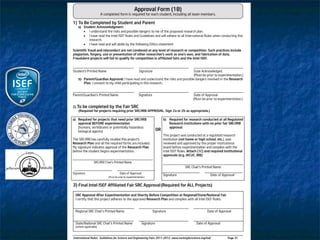
documented on Form 4
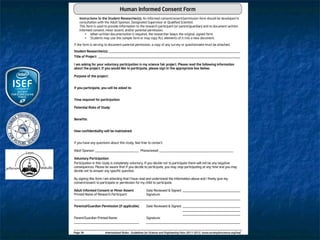
If IRB determines that written
informed consent/assent or
parental permission is required,
documentation is obtained on an
“informed consent” document
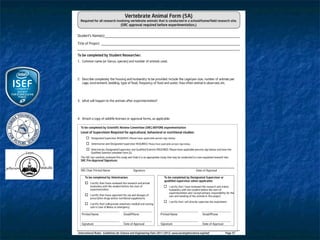
VERTEBRATE ANIMALS
What is a vertebrate animal?
    Live, nonhuman vertebrate
     mammalian embryos or fetuses
    Bird and reptile eggs within 3 days of
     hatching
    All other nonhuman vertebrates
     (including fish) at hatching or birth
    Zebrafish embryos 7 days (168 hours)
      post fertilization
Prohibited studies
   Induced toxicity studies involving
    known toxic substances that could
    impair health or destroy life
   Behavioral experiments with
       Conditioning using aversive stimuli
       Mother/infant separation
       Induced/learned helplessness
   Studies of pain
   Predator/vertebrate prey experiments
Additional restrictions
   Projects that cause more than
    momentary or slight pain or distress or
    which are designed to kill vertebrate
    animals are not permitted.
   A weight loss or growth retardation
    greater than 15% of any experimental
    or control animal is not permitted
   A death rate of 30% or greater in any
    group or subgroup is not permitted
Behavioral observations of animals
  are exempt from SRC review if
     There is no interaction with the
      animals
                and
     There is no manipulation of the
      environment
                and
     All federal or state fish, game and
      wildlife regulations are followed
Research sites
   School/Home/Field

   Regulated Research Institution (must
    have an IACUC review and approval process)
       Universities
       Government research agencies
       Private research laboratories
Requirements for studies at
   school/home/field
   Agricultural, behavioral, observational
    or supplemental nutritional studies
                     and
   Non-invasive and non-intrusive with
    no negative effect on animal’s health
    or well-being
                     and
   Require SRC pre-review and approval
Additional requirements for studies
       at school/home/field
     SRC determines level of supervision
      appropriate for the study:
         Designated supervisor
         Veterinarian
         Qualified scientist
     Form 5A required
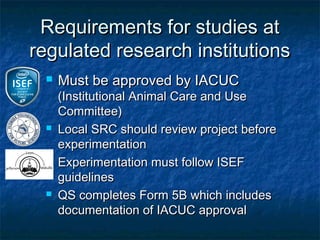
Requirements for studies at
regulated research institutions
    Must be approved by IACUC
     (Institutional Animal Care and Use
     Committee)
    Local SRC should review project before
     experimentation
    Experimentation must follow ISEF
     guidelines
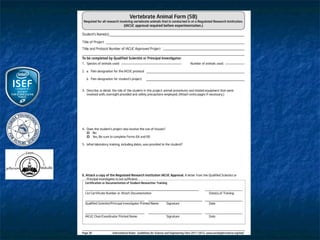
    QS completes Form 5B which includes
     documentation of IACUC approval
POTENTIALLY HAZARDOUS
  BIOLOGICAL AGENTS
Potentially hazardous biological
         agents include
     Microorganisms (including bacteria,
      viruses, fungi, etc.)
     Recombinant DNA
     Human or animal fresh/frozen tissues,
      blood or body fluids
All studies involving potentially
 hazardous biological agents
   Studies must have prior approval by
    SRC/IACUC/IBC
   Most studies are prohibited in a home
    environment
   Studies intended to genetically engineer
    bacteria with multiple antibiotic resistance
    are prohibited
   Lab studies utilizing MRSA, VRE and KPC
    must be conducted in a Regulated
    Research Institution under documented IBC
    review and approval
Risk assessment
   Required of all PHBA projects
   Defines potential level of harm, injury
    or disease to plants, animals or
    humans
   Involves
       Assignment of biological agent to risk
        group
       Determination of level of biological
        containment
       Assessment of expertise of adult(s)
       Assignment of final biosafety level
Risk assessment, cont’d
   BSL 1 studies can usually be conducted in
    a high school or college teaching
    laboratory.
   BSL 2 studies are usually conducted in a
    regulated research institution
   BSL 3 and BSL 4 studies are prohibited for
    ISEF projects
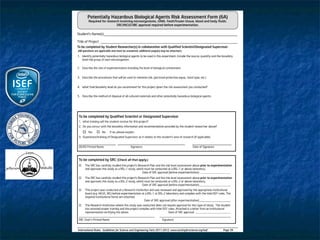
   Form 6A (Potentially Hazardous Biological
    Agents form) required for most projects
    involving microorganisms, and for all
    projects involving rDNA and fresh human
Studies exempt from prior
    SRC review and no additional
       PHBA forms required
   Studies using baker’s and brewer’s yeast
    (except rDNA studies)
   Studies using Lactobacillus, B. thurgensis,
    nitrogen-fixing bacteria, oil-eating bacteria,
    and algae-eating bacteria in natural
    environment. Not exempt if cultured in a
    petri dish environment
   Studies of mold growth on food items if
    experiment terminated at first sign of mold
Studies exempt from prior
SRC review that require Form
             3
   Studies involving protists, archae and
    similar microorganisms
   Research using manure for
    composting, fuel production, or other
    non-culturing experiments
   Studies using commercially available
    color change coliform water test kits
Studies involving unknown
             microorganisms
   BSL 1 if
       Organisms cultured in plastic petri dish
       Culture dish remains sealed throughout
        experiment
       Culture dish disposed of in appropriate
        manner
   BSL 2 if petri dish is opened
rDNA technologies
   Experiments with BSL 1 organisms
    can be done in BSL 1 lab with a QS or
    trained DS
   Experiments with BSL 2 organisms
    must be done in a regulated research
    institution with a QS
Tissues
   If animal is euthanized solely for
    student project – vertebrate animal
    study which requires IACUC approval
   If animal is euthanized for a purpose
    other than student project – tissue
    study
   Classification as BSL 1 or 2 based on
    source of tissue and possibility of
    containing infectious agents
   All studies with human or wild animal
    blood are BSL 2. Studies with
    domestic animal blood are BSL 1.
   Studies with human body fluids which
    can be associated with a person must
    have IRB approval
Exempt as PHBA tissues
    Plant tissues
    Established cell and tissue cultures
    Fresh or frozen meat, meat by-products,
     pasteurized milk, eggs – from grocery
     stores, restaurants, packing houses
    Hair
    Sterilized teeth
    Fossilized tissue/archeological specimens
    Prepared fixed tissue slides
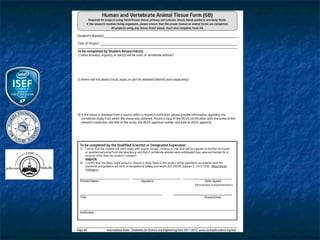
Form 6B
   Required for all projects using
       Fresh/frozen tissue
       Primary cell cultures
       Blood and blood products
       Body fluids
HAZARDOUS CHEMICALS,
 ACTIVITIES OR DEVICES
Hazardous chemicals, activities
      or devices include
     Chemicals
     Equipment
     DEA-Controlled Substances
     Prescription Drugs
     Alcohol and Tobacco
     Firearms and Explosives
     Radiation
General Rules
   Studies do not require prior SRC
    review and approval
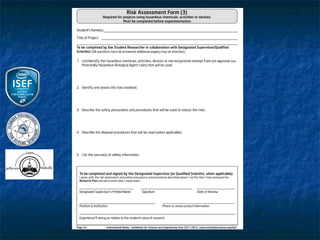
   All studies require a Risk Assessment
    documented on Form 3
   DEA - controlled substances require a
    Qualified Scientist
   All other studies require a Designated
    Supervisor
DEA-Controlled Substances
    Consult DEA list of controlled substances
    All studies require Qualified Scientist
    Controlled substances on Schedule 1
     require DEA protocol review


Firearms and Explosives
    Must adhere to local training and
     certification requirements
Alcohol and Tobacco
   Must follow local laws for purchase,
    possession and consumption
   Home production of ethyl alcohol (wine or
    beer) must follow U.S. Alcohol and Tobacco
    Tax and Trade Bureau (TTB) regulations
   Alcohol distillation for fuel production can be
    conducted at school with TTB permit obtained
    by school officials
Prescription Drugs
    Cannot be administered to human
     subjects
    Animal administration must follow ISEF
     vertebrate animal guidelines


Hazardous Chemicals
    Refer to MSDS Sheets for safety and
     handling guidelines
Hazardous Devices
    Involve level of risk beyond that
     encountered in student’s everyday life


Radiation
    Non-ionizing
    Ionizing
Form 3
   Required for all projects involving
       DEA-Controlled Substances
       Prescription Drugs
       Alcohol and Tobacco
       Hazardous Chemicals
       Hazardous Devices
       Hazardous Activities
       Radiation
For more information:
   Visit the SSP website:
    www.societyforscience.org/isef/rulesandguidelines

   Email the Regional , Intel ISEF SRC
    or SSP Staff:
       src@societyforscience.org
       sciedu@societyforscience.org
       Anicia Robinson, CRSEF Director:
        robinsona2@leonschools.net

Science fair rules and guidelines power point.

  • 1.
    REGIONAL, STATE ANDINTEL INTERNATIONAL SCIENCE AND ENGINEERING FAIR 2012-2013 Rules and Guidelines
  • 2.
    Adult roles andresponsibilities  Adult Sponsor  Qualified Scientist  Designated Supervisor  Institutional Review Board (IRB)  Scientific Review Committee (SRC)
  • 3.
    Adult sponsor  Oversees project to make sure that student  is informed of ISEF Rules and Guidelines  is aware of risks associated with project  is aware of forms required for project  will receive proper supervision during experimentation  if required, submits project to IRB or SRC  Teacher usually serves as Adult Sponsor
  • 4.
    Qualified Scientist  Required for some projects  Doctoral/professional degree related to student research or Masters degree with SRC approval  Completes Form 2 – QS Form
  • 5.
    Designated Supervisor  Animal Care Supervisor for vertebrate animal projects  Supervises projects involving hazardous chemicals, activities or devices  Supervises projects requiring a Qualified Scientist when the Qualified Scientist cannot directly supervise the student
  • 7.
    IRB (Institutional ReviewBoard)  Reviews human participants studies  Membership must include:  an educator  a school administrator  someone knowledgeable about evaluating physical and/or psychological risk: MD, PA, RN, psychiatrist, psychologist, licensed social worker or licensed clinical professional counselor
  • 8.
    SRC (Scientific Review Committee)  Reviews some projects before experimentation  Reviews all projects just prior to competition  Membership must include:  a biomedical scientist (Ph.D., M.D., D.V.M., D.D.S., D.O.)  an educator  one other member
  • 9.
    Combined IRB/SRC  a biomedical scientist (Ph.D., M.D., D.V.M., D.D.S., D.O.)  a school administrator  an educator  someone knowledgeable about evaluating physical and/or psychological risk: MD, PA, RN, psychiatrist, psychologist, licensed social worker or licensed clinical professional counselor
  • 10.
    Forms required forall projects
  • 13.
    A Research Planis required for all projects. It must incorporate all of the relevant topics listed in the Research Plan Instructions.
  • 16.
    Studies conducted ata research institution, industrial setting or any work site other than home, school or field require Form 1C
  • 18.
    Continuation studies  Project based on prior research in the same field of study  Longitudinal studies are permitted  Multi-year study  Studies time-based change  Require form 7
  • 20.
  • 21.
    What are humanparticipants studies? Human participants studies involve living individuals where there is  Intervention or interaction with participants and/or  Collection of identifiable private information
  • 22.
    Exempt studies –do not require IRB review nor human participants forms  Product testing of a student invention, program, concept, etc.  No health hazards  No personal data collected  Feedback directly related to product  Studies using pre-existing, publicly available human data
  • 23.
    Additional exempt studies  Behavioral observations in unrestricted public settings  No interaction  No manipulation of environment  No recording of any personal identifiers  Studies using certified de-identified/ anonymous data
  • 24.
    Human participants research  The IRB must review and approve the research plan before experimentation begins  Research participants 18 years of age or older must give informed consent  Research participants under 18 must give assent and their parents may be required to give permission
  • 25.
    Human participants research,cont’d  The IRB (at the school level) evaluates the project and determines  Risk level  Requirement for Qualified Scientist  Requirement for written informed consent/assent/parental permission
  • 26.
    Risk evaluation  No more than minimal risk Anticipated harm and discomfort not greater than encountered in daily life  More than minimal risk Anticipated harm or discomfort is greater than encountered in daily life  More than minimal risk studies should require written consent/assent and parental permission. Final determination for this requirement made by the IRB
  • 27.
    Types of Risk  Physical risks  Exercise  Ingestion, tasting, smelling, application of substances  Exposure to potentially hazardous material  Psychological risks  Invasion of privacy  Participant is a member of an at-risk group
  • 28.
  • 30.
    If IRB determinesthat written informed consent/assent or parental permission is required, documentation is obtained on an “informed consent” document
  • 32.
  • 33.
    What is avertebrate animal?  Live, nonhuman vertebrate mammalian embryos or fetuses  Bird and reptile eggs within 3 days of hatching  All other nonhuman vertebrates (including fish) at hatching or birth  Zebrafish embryos 7 days (168 hours) post fertilization
  • 34.
    Prohibited studies  Induced toxicity studies involving known toxic substances that could impair health or destroy life  Behavioral experiments with  Conditioning using aversive stimuli  Mother/infant separation  Induced/learned helplessness  Studies of pain  Predator/vertebrate prey experiments
  • 35.
    Additional restrictions  Projects that cause more than momentary or slight pain or distress or which are designed to kill vertebrate animals are not permitted.  A weight loss or growth retardation greater than 15% of any experimental or control animal is not permitted  A death rate of 30% or greater in any group or subgroup is not permitted
  • 36.
    Behavioral observations ofanimals are exempt from SRC review if  There is no interaction with the animals and  There is no manipulation of the environment and  All federal or state fish, game and wildlife regulations are followed
  • 37.
    Research sites  School/Home/Field  Regulated Research Institution (must have an IACUC review and approval process)  Universities  Government research agencies  Private research laboratories
  • 38.
    Requirements for studiesat school/home/field  Agricultural, behavioral, observational or supplemental nutritional studies and  Non-invasive and non-intrusive with no negative effect on animal’s health or well-being and  Require SRC pre-review and approval
  • 39.
    Additional requirements forstudies at school/home/field  SRC determines level of supervision appropriate for the study:  Designated supervisor  Veterinarian  Qualified scientist  Form 5A required
  • 41.
    Requirements for studiesat regulated research institutions  Must be approved by IACUC (Institutional Animal Care and Use Committee)  Local SRC should review project before experimentation  Experimentation must follow ISEF guidelines  QS completes Form 5B which includes documentation of IACUC approval
  • 43.
    POTENTIALLY HAZARDOUS BIOLOGICAL AGENTS
  • 44.
    Potentially hazardous biological agents include  Microorganisms (including bacteria, viruses, fungi, etc.)  Recombinant DNA  Human or animal fresh/frozen tissues, blood or body fluids
  • 45.
    All studies involvingpotentially hazardous biological agents  Studies must have prior approval by SRC/IACUC/IBC  Most studies are prohibited in a home environment  Studies intended to genetically engineer bacteria with multiple antibiotic resistance are prohibited  Lab studies utilizing MRSA, VRE and KPC must be conducted in a Regulated Research Institution under documented IBC review and approval
  • 46.
    Risk assessment  Required of all PHBA projects  Defines potential level of harm, injury or disease to plants, animals or humans  Involves  Assignment of biological agent to risk group  Determination of level of biological containment  Assessment of expertise of adult(s)  Assignment of final biosafety level
  • 47.
    Risk assessment, cont’d  BSL 1 studies can usually be conducted in a high school or college teaching laboratory.  BSL 2 studies are usually conducted in a regulated research institution  BSL 3 and BSL 4 studies are prohibited for ISEF projects  Form 6A (Potentially Hazardous Biological Agents form) required for most projects involving microorganisms, and for all projects involving rDNA and fresh human
  • 49.
    Studies exempt fromprior SRC review and no additional PHBA forms required  Studies using baker’s and brewer’s yeast (except rDNA studies)  Studies using Lactobacillus, B. thurgensis, nitrogen-fixing bacteria, oil-eating bacteria, and algae-eating bacteria in natural environment. Not exempt if cultured in a petri dish environment  Studies of mold growth on food items if experiment terminated at first sign of mold
  • 50.
    Studies exempt fromprior SRC review that require Form 3  Studies involving protists, archae and similar microorganisms  Research using manure for composting, fuel production, or other non-culturing experiments  Studies using commercially available color change coliform water test kits
  • 51.
    Studies involving unknown microorganisms  BSL 1 if  Organisms cultured in plastic petri dish  Culture dish remains sealed throughout experiment  Culture dish disposed of in appropriate manner  BSL 2 if petri dish is opened
  • 52.
    rDNA technologies  Experiments with BSL 1 organisms can be done in BSL 1 lab with a QS or trained DS  Experiments with BSL 2 organisms must be done in a regulated research institution with a QS
  • 53.
    Tissues  If animal is euthanized solely for student project – vertebrate animal study which requires IACUC approval  If animal is euthanized for a purpose other than student project – tissue study
  • 54.
    Classification as BSL 1 or 2 based on source of tissue and possibility of containing infectious agents  All studies with human or wild animal blood are BSL 2. Studies with domestic animal blood are BSL 1.  Studies with human body fluids which can be associated with a person must have IRB approval
  • 55.
    Exempt as PHBAtissues  Plant tissues  Established cell and tissue cultures  Fresh or frozen meat, meat by-products, pasteurized milk, eggs – from grocery stores, restaurants, packing houses  Hair  Sterilized teeth  Fossilized tissue/archeological specimens  Prepared fixed tissue slides
  • 56.
    Form 6B  Required for all projects using  Fresh/frozen tissue  Primary cell cultures  Blood and blood products  Body fluids
  • 58.
  • 59.
    Hazardous chemicals, activities or devices include  Chemicals  Equipment  DEA-Controlled Substances  Prescription Drugs  Alcohol and Tobacco  Firearms and Explosives  Radiation
  • 60.
    General Rules  Studies do not require prior SRC review and approval  All studies require a Risk Assessment documented on Form 3  DEA - controlled substances require a Qualified Scientist  All other studies require a Designated Supervisor
  • 61.
    DEA-Controlled Substances  Consult DEA list of controlled substances  All studies require Qualified Scientist  Controlled substances on Schedule 1 require DEA protocol review Firearms and Explosives  Must adhere to local training and certification requirements
  • 62.
    Alcohol and Tobacco  Must follow local laws for purchase, possession and consumption  Home production of ethyl alcohol (wine or beer) must follow U.S. Alcohol and Tobacco Tax and Trade Bureau (TTB) regulations  Alcohol distillation for fuel production can be conducted at school with TTB permit obtained by school officials
  • 63.
    Prescription Drugs  Cannot be administered to human subjects  Animal administration must follow ISEF vertebrate animal guidelines Hazardous Chemicals  Refer to MSDS Sheets for safety and handling guidelines
  • 64.
    Hazardous Devices  Involve level of risk beyond that encountered in student’s everyday life Radiation  Non-ionizing  Ionizing
  • 65.
    Form 3  Required for all projects involving  DEA-Controlled Substances  Prescription Drugs  Alcohol and Tobacco  Hazardous Chemicals  Hazardous Devices  Hazardous Activities  Radiation
  • 67.
    For more information:  Visit the SSP website: www.societyforscience.org/isef/rulesandguidelines  Email the Regional , Intel ISEF SRC or SSP Staff:  src@societyforscience.org  sciedu@societyforscience.org  Anicia Robinson, CRSEF Director: robinsona2@leonschools.net