Strategic Marketing and Communication                                             Minneapolis 2010
 2010 SPRE Research to Practice

Facilitators:
SPRE: Tatiana Vasileia Chalkidou - Ph.D. Candidate, Oklahoma State University
APRS: Barbara Young, Recreation Manager, City of Chandler, Arizona
Guest Presenter: Liam O’Mahony, Information Specialist, City of Chandler, Arizona


I. Definitions for Roundtable Discussion


 Marketing Communications


   •   Marketing is the activity, set of institutions, and processes for creating, communicating,
       delivering, and exchanging offerings that have value for customers, clients, partners, and
       society at large (American Marketing Association, 2007).
   •   Communication is defined as a process by which we assign and convey meaning in an attempt
       to create shared understanding. This process requires a vast repertoire of skills in intrapersonal
       and interpersonal processing, listening, observing, speaking, questioning, analyzing, and
       evaluating (Office of Superintendent of Public Instruction [OSPI], n.d.).
   •   The application of the marketing concept to an organization involves putting the customer at
       the centre of all decision-making processes. However, some organizations have difficulty in
       recognizing who the customers are, particularly if the product or service is offered free of
       charge, or if the organization supplying it is the sole supplier (Horner & Swarbrooke, 2005).
   •   Marketing communication utilizes all pertinent information tools (fliers, web site, word of
       mouth, etc) to deliver the value of the organization’s service offerings to the targeted customer
       groups. The greatest benefits are to be gained when e-communication tools are used alongside
       traditional methods to give additional contact points and a reinforced consistent message. The
       value of each separate tool is leveraged in this way to create a greater synergy and effectiveness
       (Masterman & Wood, 2005).


 Branding

   •   Branding begins by first understanding what others say about your organization (California
       Park & Recreation Society [CPRS], n.d.). It is a process by which parks and recreation can be
       positioned among its many publics (California Park & Recreation Society [CPRS], n.d.).
   •   The American Marketing Association (AMA) defines a brand as a name, term, sign, symbol or
       design, or a combination of them intended to identify the goods and services of one seller or
       group of sellers and to differentiate them from those of other sellers (n.d.).
   •   Brand loyalty results after users consider park and recreation facilities and programs, are aware
       of their benefits, uses them, and their initial perceptions are reinforced (California Park &
       Recreation Society [CPRS], n.d.).
Strategic Marketing and Communication                                             Minneapolis 2010

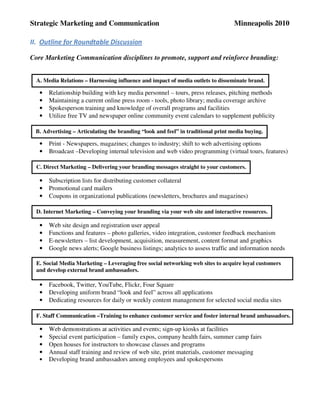
II. Outline for Roundtable Discussion

Core Marketing Communication disciplines to promote, support and reinforce branding:


  A. Media Relations – Harnessing influence and impact of media outlets to disseminate brand.

   •   Relationship building with key media personnel – tours, press releases, pitching methods
   •   Maintaining a current online press room - tools, photo library; media coverage archive
   •   Spokesperson training and knowledge of overall programs and facilities
   •   Utilize free TV and newspaper online community event calendars to supplement publicity

 B. Advertising – Articulating the branding “look and feel” in traditional print media buying.

   •   Print - Newspapers, magazines; changes to industry; shift to web advertising options
   •   Broadcast –Developing internal television and web video programming (virtual tours, features)

  C. Direct Marketing – Delivering your branding messages straight to your customers.

   •   Subscription lists for distributing customer collateral
   •   Promotional card mailers
   •   Coupons in organizational publications (newsletters, brochures and magazines)

  D. Internet Marketing – Conveying your branding via your web site and interactive resources.

   •   Web site design and registration user appeal
   •   Functions and features – photo galleries, video integration, customer feedback mechanism
   •   E-newsletters – list development, acquisition, measurement, content format and graphics
   •   Google news alerts; Google business listings; analytics to assess traffic and information needs

  E. Social Media Marketing – Leveraging free social networking web sites to acquire loyal customers
  and develop external brand ambassadors.

   •   Facebook, Twitter, YouTube, Flickr, Four Square
   •   Developing uniform brand “look and feel” across all applications
   •   Dedicating resources for daily or weekly content management for selected social media sites

  F. Staff Communication –Training to enhance customer service and foster internal brand ambassadors.

   •   Web demonstrations at activities and events; sign-up kiosks at facilities
   •   Special event participation – family expos, company health fairs, summer camp fairs
   •   Open houses for instructors to showcase classes and programs
   •   Annual staff training and review of web site, print materials, customer messaging
   •   Developing brand ambassadors among employees and spokespersons
Strategic Marketing and Communication                                             Minneapolis 2010

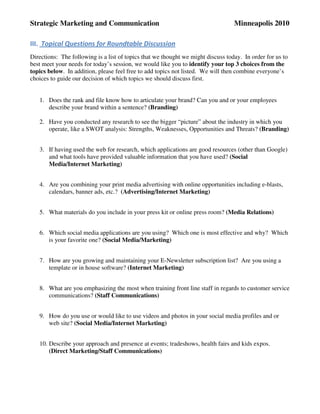
III. Topical Questions for Roundtable Discussion
Directions: The following is a list of topics that we thought we might discuss today. In order for us to
best meet your needs for today’s session, we would like you to identify your top 3 choices from the
topics below. In addition, please feel free to add topics not listed. We will then combine everyone’s
choices to guide our decision of which topics we should discuss first.


   1. Does the rank and file know how to articulate your brand? Can you and or your employees
      describe your brand within a sentence? (Branding)

   2. Have you conducted any research to see the bigger “picture” about the industry in which you
      operate, like a SWOT analysis: Strengths, Weaknesses, Opportunities and Threats? (Branding)


   3. If having used the web for research, which applications are good resources (other than Google)
      and what tools have provided valuable information that you have used? (Social
      Media/Internet Marketing)


   4. Are you combining your print media advertising with online opportunities including e-blasts,
      calendars, banner ads, etc.? (Advertising/Internet Marketing)


   5. What materials do you include in your press kit or online press room? (Media Relations)


   6. Which social media applications are you using? Which one is most effective and why? Which
      is your favorite one? (Social Media/Marketing)


   7. How are you growing and maintaining your E-Newsletter subscription list? Are you using a
      template or in house software? (Internet Marketing)


   8. What are you emphasizing the most when training front line staff in regards to customer service
      communications? (Staff Communications)


   9. How do you use or would like to use videos and photos in your social media profiles and or
      web site? (Social Media/Internet Marketing)


   10. Describe your approach and presence at events; tradeshows, health fairs and kids expos.
       (Direct Marketing/Staff Communications)

NRPA Marketing Roundtable 10-25-10

  • 1.
    Strategic Marketing andCommunication Minneapolis 2010 2010 SPRE Research to Practice Facilitators: SPRE: Tatiana Vasileia Chalkidou - Ph.D. Candidate, Oklahoma State University APRS: Barbara Young, Recreation Manager, City of Chandler, Arizona Guest Presenter: Liam O’Mahony, Information Specialist, City of Chandler, Arizona I. Definitions for Roundtable Discussion Marketing Communications • Marketing is the activity, set of institutions, and processes for creating, communicating, delivering, and exchanging offerings that have value for customers, clients, partners, and society at large (American Marketing Association, 2007). • Communication is defined as a process by which we assign and convey meaning in an attempt to create shared understanding. This process requires a vast repertoire of skills in intrapersonal and interpersonal processing, listening, observing, speaking, questioning, analyzing, and evaluating (Office of Superintendent of Public Instruction [OSPI], n.d.). • The application of the marketing concept to an organization involves putting the customer at the centre of all decision-making processes. However, some organizations have difficulty in recognizing who the customers are, particularly if the product or service is offered free of charge, or if the organization supplying it is the sole supplier (Horner & Swarbrooke, 2005). • Marketing communication utilizes all pertinent information tools (fliers, web site, word of mouth, etc) to deliver the value of the organization’s service offerings to the targeted customer groups. The greatest benefits are to be gained when e-communication tools are used alongside traditional methods to give additional contact points and a reinforced consistent message. The value of each separate tool is leveraged in this way to create a greater synergy and effectiveness (Masterman & Wood, 2005). Branding • Branding begins by first understanding what others say about your organization (California Park & Recreation Society [CPRS], n.d.). It is a process by which parks and recreation can be positioned among its many publics (California Park & Recreation Society [CPRS], n.d.). • The American Marketing Association (AMA) defines a brand as a name, term, sign, symbol or design, or a combination of them intended to identify the goods and services of one seller or group of sellers and to differentiate them from those of other sellers (n.d.). • Brand loyalty results after users consider park and recreation facilities and programs, are aware of their benefits, uses them, and their initial perceptions are reinforced (California Park & Recreation Society [CPRS], n.d.).
  • 2.
    Strategic Marketing andCommunication Minneapolis 2010 II. Outline for Roundtable Discussion Core Marketing Communication disciplines to promote, support and reinforce branding: A. Media Relations – Harnessing influence and impact of media outlets to disseminate brand. • Relationship building with key media personnel – tours, press releases, pitching methods • Maintaining a current online press room - tools, photo library; media coverage archive • Spokesperson training and knowledge of overall programs and facilities • Utilize free TV and newspaper online community event calendars to supplement publicity B. Advertising – Articulating the branding “look and feel” in traditional print media buying. • Print - Newspapers, magazines; changes to industry; shift to web advertising options • Broadcast –Developing internal television and web video programming (virtual tours, features) C. Direct Marketing – Delivering your branding messages straight to your customers. • Subscription lists for distributing customer collateral • Promotional card mailers • Coupons in organizational publications (newsletters, brochures and magazines) D. Internet Marketing – Conveying your branding via your web site and interactive resources. • Web site design and registration user appeal • Functions and features – photo galleries, video integration, customer feedback mechanism • E-newsletters – list development, acquisition, measurement, content format and graphics • Google news alerts; Google business listings; analytics to assess traffic and information needs E. Social Media Marketing – Leveraging free social networking web sites to acquire loyal customers and develop external brand ambassadors. • Facebook, Twitter, YouTube, Flickr, Four Square • Developing uniform brand “look and feel” across all applications • Dedicating resources for daily or weekly content management for selected social media sites F. Staff Communication –Training to enhance customer service and foster internal brand ambassadors. • Web demonstrations at activities and events; sign-up kiosks at facilities • Special event participation – family expos, company health fairs, summer camp fairs • Open houses for instructors to showcase classes and programs • Annual staff training and review of web site, print materials, customer messaging • Developing brand ambassadors among employees and spokespersons
  • 3.
    Strategic Marketing andCommunication Minneapolis 2010 III. Topical Questions for Roundtable Discussion Directions: The following is a list of topics that we thought we might discuss today. In order for us to best meet your needs for today’s session, we would like you to identify your top 3 choices from the topics below. In addition, please feel free to add topics not listed. We will then combine everyone’s choices to guide our decision of which topics we should discuss first. 1. Does the rank and file know how to articulate your brand? Can you and or your employees describe your brand within a sentence? (Branding) 2. Have you conducted any research to see the bigger “picture” about the industry in which you operate, like a SWOT analysis: Strengths, Weaknesses, Opportunities and Threats? (Branding) 3. If having used the web for research, which applications are good resources (other than Google) and what tools have provided valuable information that you have used? (Social Media/Internet Marketing) 4. Are you combining your print media advertising with online opportunities including e-blasts, calendars, banner ads, etc.? (Advertising/Internet Marketing) 5. What materials do you include in your press kit or online press room? (Media Relations) 6. Which social media applications are you using? Which one is most effective and why? Which is your favorite one? (Social Media/Marketing) 7. How are you growing and maintaining your E-Newsletter subscription list? Are you using a template or in house software? (Internet Marketing) 8. What are you emphasizing the most when training front line staff in regards to customer service communications? (Staff Communications) 9. How do you use or would like to use videos and photos in your social media profiles and or web site? (Social Media/Internet Marketing) 10. Describe your approach and presence at events; tradeshows, health fairs and kids expos. (Direct Marketing/Staff Communications)