GRADABLE & UNGRADABLE
ADJECTIVES
Gradable Adjectives




Gradable adjectives represent a point on
a scale. For example, cheap and
expensive are adjectives on the scale of
“how much something costs” .
Most English adjectives are gradable. We can
make comparative and superlative forms
from all gradable adjectives.
Intensifying gradable
adjectives:




We can make gradable adjectives stronger
using very, but not absolutely.
There are other adverbs we can use to
strengthen the meaning of these adjectives:
Extremely, rather, hugely, terribly,
incredibly, remarkably, …
To make gradable adjectives less
strong we use:
A BIT/ A LITTLE
The exercise is a bit /a little difficult.
It’s a bit of a difficult exercise.






(a bit of a /an + NP=Noun Phrase)

slightly
Ungradable adjectives




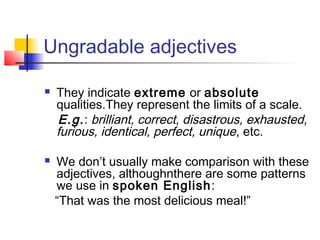
They indicate extreme or absolute
qualities.They represent the limits of a scale.
E.g. : brilliant, correct, disastrous, exhausted,
furious, identical, perfect, unique, etc.
We don’t usually make comparison with these
adjectives, althoughnthere are some patterns
we use in spoken English:
“That was the most delicious meal!”
Intensifying ungradable
adjectives:
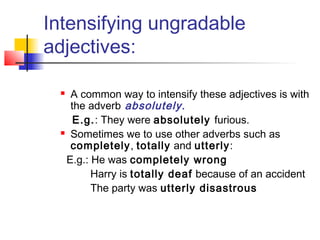
A common way to intensify these adjectives is with
the adverb absolutely.
E.g.: They were absolutely furious.
 Sometimes we to use other adverbs such as
completely, totally and utterly:
E.g.: He was completely wrong
Harry is totally deaf because of an accident
The party was utterly disastrous

Ungradable adjectives
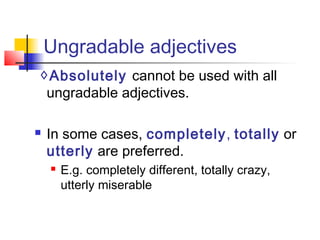
◊Absolutely cannot be used with all
ungradable adjectives.


In some cases, completely, totally or
utterly are preferred.


E.g. completely different, totally crazy,
utterly miserable
To weaken ungradable
adjectives:


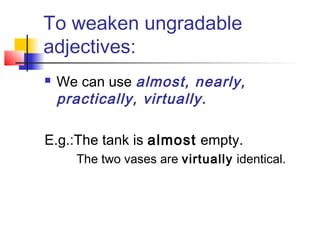
We can use almost, nearly,
practically, virtually .

E.g.:The tank is almost empty.
The two vases are virtually identical.
Compare



The beach was a bit empty.
The beach was absolutely empty.


Some adjectives can be gradable or
ungradable depending on the context.
Really and quite
These adverbs can usually be used
together with both gradable and
ungradable adjectives.
The meaning of quite changes:
• Quite warm/ quite a warm place (gradable=
fairly)
• Quite certain (ungradable= completely,
absolutely)
Adverb + adjective collocation













bitterly cold, disappointed, opposed
completely different, incomprehensible, new, sure
deeply ashamed, attached, divided, unhappy
entirely beneficial, different, satisfactory, unexpected.
heavily armed, dependent, polluted
highly contagious, critical, intelligent, likely, sensitive
painfully aware, obvious, sensitive, slow
perfectly balanced, normal, safe, serious
seriously damaged, hurt
totally harmless, inadequate, unbelievable
utterly different, disastrous, impossible, useless, miserable
widely available, held, publicized, used

Gradable & ungradable 2

  • 1.
  • 2.
    Gradable Adjectives   Gradable adjectivesrepresent a point on a scale. For example, cheap and expensive are adjectives on the scale of “how much something costs” . Most English adjectives are gradable. We can make comparative and superlative forms from all gradable adjectives.
  • 3.
    Intensifying gradable adjectives:   We canmake gradable adjectives stronger using very, but not absolutely. There are other adverbs we can use to strengthen the meaning of these adjectives: Extremely, rather, hugely, terribly, incredibly, remarkably, …
  • 4.
    To make gradableadjectives less strong we use: A BIT/ A LITTLE The exercise is a bit /a little difficult. It’s a bit of a difficult exercise.    (a bit of a /an + NP=Noun Phrase) slightly
  • 5.
    Ungradable adjectives   They indicateextreme or absolute qualities.They represent the limits of a scale. E.g. : brilliant, correct, disastrous, exhausted, furious, identical, perfect, unique, etc. We don’t usually make comparison with these adjectives, althoughnthere are some patterns we use in spoken English: “That was the most delicious meal!”
  • 6.
    Intensifying ungradable adjectives: A commonway to intensify these adjectives is with the adverb absolutely. E.g.: They were absolutely furious.  Sometimes we to use other adverbs such as completely, totally and utterly: E.g.: He was completely wrong Harry is totally deaf because of an accident The party was utterly disastrous 
  • 7.
    Ungradable adjectives ◊Absolutely cannotbe used with all ungradable adjectives.  In some cases, completely, totally or utterly are preferred.  E.g. completely different, totally crazy, utterly miserable
  • 8.
    To weaken ungradable adjectives:  Wecan use almost, nearly, practically, virtually . E.g.:The tank is almost empty. The two vases are virtually identical.
  • 9.
    Compare   The beach wasa bit empty. The beach was absolutely empty.  Some adjectives can be gradable or ungradable depending on the context.
  • 10.
    Really and quite Theseadverbs can usually be used together with both gradable and ungradable adjectives. The meaning of quite changes: • Quite warm/ quite a warm place (gradable= fairly) • Quite certain (ungradable= completely, absolutely)
  • 11.
    Adverb + adjectivecollocation             bitterly cold, disappointed, opposed completely different, incomprehensible, new, sure deeply ashamed, attached, divided, unhappy entirely beneficial, different, satisfactory, unexpected. heavily armed, dependent, polluted highly contagious, critical, intelligent, likely, sensitive painfully aware, obvious, sensitive, slow perfectly balanced, normal, safe, serious seriously damaged, hurt totally harmless, inadequate, unbelievable utterly different, disastrous, impossible, useless, miserable widely available, held, publicized, used