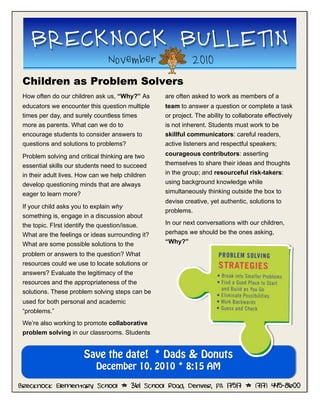
Children as Problem Solvers
BRECKNOCK BULLETIN
November 2010
Brecknock Elementary School * 361 School Road, Denver, PA 17517 * (717) 445-8600
How often do our children ask us, “Why?” As
educators we encounter this question multiple
times per day, and surely countless times
more as parents. What can we do to
encourage students to consider answers to
questions and solutions to problems?
Problem solving and critical thinking are two
essential skills our students need to succeed
in their adult lives. How can we help children
develop questioning minds that are always
eager to learn more?
If your child asks you to explain why
something is, engage in a discussion about
the topic. FIrst identify the question/issue.
What are the feelings or ideas surrounding it?
What are some possible solutions to the
problem or answers to the question? What
resources could we use to locate solutions or
answers? Evaluate the legitimacy of the
resources and the appropriateness of the
solutions. These problem solving steps can be
used for both personal and academic
“problems.”
We’re also working to promote collaborative
problem solving in our classrooms. Students
are often asked to work as members of a
team to answer a question or complete a task
or project. The ability to collaborate effectively
is not inherent. Students must work to be
skillful communicators: careful readers,
active listeners and respectful speakers;
courageous contributors: asserting
themselves to share their ideas and thoughts
in the group; and resourceful risk-takers:
using background knowledge while
simultaneously thinking outside the box to
devise creative, yet authentic, solutions to
problems.
In our next conversations with our children,
perhaps we should be the ones asking,
“Why?”
Save the date! * Dads & Donuts
December 10, 2010 * 8:15 AM

November Bulletin

  • 1.
    Children as ProblemSolvers BRECKNOCK BULLETIN November 2010 Brecknock Elementary School * 361 School Road, Denver, PA 17517 * (717) 445-8600 How often do our children ask us, “Why?” As educators we encounter this question multiple times per day, and surely countless times more as parents. What can we do to encourage students to consider answers to questions and solutions to problems? Problem solving and critical thinking are two essential skills our students need to succeed in their adult lives. How can we help children develop questioning minds that are always eager to learn more? If your child asks you to explain why something is, engage in a discussion about the topic. FIrst identify the question/issue. What are the feelings or ideas surrounding it? What are some possible solutions to the problem or answers to the question? What resources could we use to locate solutions or answers? Evaluate the legitimacy of the resources and the appropriateness of the solutions. These problem solving steps can be used for both personal and academic “problems.” We’re also working to promote collaborative problem solving in our classrooms. Students are often asked to work as members of a team to answer a question or complete a task or project. The ability to collaborate effectively is not inherent. Students must work to be skillful communicators: careful readers, active listeners and respectful speakers; courageous contributors: asserting themselves to share their ideas and thoughts in the group; and resourceful risk-takers: using background knowledge while simultaneously thinking outside the box to devise creative, yet authentic, solutions to problems. In our next conversations with our children, perhaps we should be the ones asking, “Why?” Save the date! * Dads & Donuts December 10, 2010 * 8:15 AM