Nouns
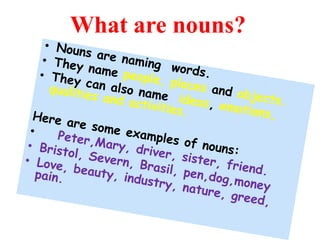
What are nouns?
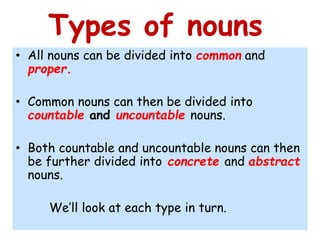
Types of nouns
• All nouns can be divided into common and
proper.
• Common nouns can then be divided into
countable and uncountable nouns.
• Both countable and uncountable nouns can then
be further divided into concrete and abstract
nouns.
We’ll look at each type in turn.
nouns
First, look again at those
types and how they related.
proper
common
countable
uncountable
abstract
concrete
abstract
Proper nouns
• Proper nouns start with capital letters.
• They are the names of people, places,
times, organisations etc.
• They refer to unique individuals.
• Most are not found in the dictionary.
• They often occur in pairs or groups.
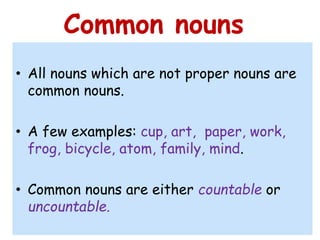
Common nouns
• All nouns which are not proper nouns are
common nouns.
• A few examples: cup, art, paper, work,
frog, bicycle, atom, family, mind.
• Common nouns are either countable or
uncountable.
Countable nouns
• Use these tests for countable nouns:
• Countable (or just “count”) nouns can be
made plural: a tree... Two trees; a man...
men; a pony... ponies.
• In the singular, they may have the
determiner a or an: a sausage; an asterisk.
• We ask: how many words/pages/chairs?
• We say: A few minutes/friends/chips?
Uncountable nouns
• Use these tests for uncountable nouns:
• Uncountable (or non-count) nouns cannot
be made plural. We cannot say: two funs,
three advices or five furnitures.
• We never use a or an with them.
• We ask: how much money/time/milk?
• We say:
Dual category nouns
• Some nouns may be countable or
uncountable, depending on how we use
them.
• We buy a box of chocolates(countable) or
a bar of chocolate(uncountable).
• We ask: How much time? But How many
times? (where times=occasions).
• We sit in front of a television (set) to
watch television(broadcasting).
Field-specific nouns
• Uncountable nouns are often turned into
countable nouns by specialists in a particular
field.
• They become part of the jargon of that
specialism.
• Grass is usually uncountable but botanists and
gardeners talk about grasses.
• Linguists sometimes talk about Englishes.
• Financiers refer to moneys or even monies.
• Teas may be used to mean types of tea.
Concrete nouns
• Concrete nouns are the words that most
people think of as nouns.
• They are mostly the names of objects and
animals(countable) and substances or
materials(uncountable).
• Cake, oxygen, iron, boy, dog, pen, glass,
pomegranate, earthworm and door are all
concrete nouns.
Abstract nouns
• Abstract nouns name ideas, feelings and
qualities.
• Most, though not all, are uncountable.
• Many are derived from adjectives and verbs
and have characteristic endings such as –ity, -
ness, -ence, -tion.
• They are harder to recognise as nouns than
the concrete variety.
Irregular plurals
• Some nouns retain plural endings from old
English:
• Men, geese, mice ,oxen, feet, teeth, knives.
• Loan words from Latin, Greek, French and
Italian sometimes keep their native ending:
• Media, bacteria, formulae, larvae, criteria,
phenomena, gateaux.
• Graffiti, an Italian plural, is now an
uncountable noun in English.
Noun phrases
• When we see a noun as performing a role
in a sentence, we think of it as a noun
phrase.
• A noun phrase may function as the
subject or object of a clause.
• A noun phrase may consist of a single
word (a noun or pronoun) or a group of
words.
• The most important noun in a noun phrase
is called the headword.
39728_2 common,proper,singular,plural nouns.pptx

39728_2 common,proper,singular,plural nouns.pptx

  • 1.
  • 2.
  • 3.
    Types of nouns •All nouns can be divided into common and proper. • Common nouns can then be divided into countable and uncountable nouns. • Both countable and uncountable nouns can then be further divided into concrete and abstract nouns. We’ll look at each type in turn.
  • 4.
    nouns First, look againat those types and how they related. proper common countable uncountable abstract concrete abstract
  • 5.
    Proper nouns • Propernouns start with capital letters. • They are the names of people, places, times, organisations etc. • They refer to unique individuals. • Most are not found in the dictionary. • They often occur in pairs or groups.
  • 6.
    Common nouns • Allnouns which are not proper nouns are common nouns. • A few examples: cup, art, paper, work, frog, bicycle, atom, family, mind. • Common nouns are either countable or uncountable.
  • 7.
    Countable nouns • Usethese tests for countable nouns: • Countable (or just “count”) nouns can be made plural: a tree... Two trees; a man... men; a pony... ponies. • In the singular, they may have the determiner a or an: a sausage; an asterisk. • We ask: how many words/pages/chairs? • We say: A few minutes/friends/chips?
  • 8.
    Uncountable nouns • Usethese tests for uncountable nouns: • Uncountable (or non-count) nouns cannot be made plural. We cannot say: two funs, three advices or five furnitures. • We never use a or an with them. • We ask: how much money/time/milk? • We say:
  • 9.
    Dual category nouns •Some nouns may be countable or uncountable, depending on how we use them. • We buy a box of chocolates(countable) or a bar of chocolate(uncountable). • We ask: How much time? But How many times? (where times=occasions). • We sit in front of a television (set) to watch television(broadcasting).
  • 10.
    Field-specific nouns • Uncountablenouns are often turned into countable nouns by specialists in a particular field. • They become part of the jargon of that specialism. • Grass is usually uncountable but botanists and gardeners talk about grasses. • Linguists sometimes talk about Englishes. • Financiers refer to moneys or even monies. • Teas may be used to mean types of tea.
  • 11.
    Concrete nouns • Concretenouns are the words that most people think of as nouns. • They are mostly the names of objects and animals(countable) and substances or materials(uncountable). • Cake, oxygen, iron, boy, dog, pen, glass, pomegranate, earthworm and door are all concrete nouns.
  • 12.
    Abstract nouns • Abstractnouns name ideas, feelings and qualities. • Most, though not all, are uncountable. • Many are derived from adjectives and verbs and have characteristic endings such as –ity, - ness, -ence, -tion. • They are harder to recognise as nouns than the concrete variety.
  • 13.
    Irregular plurals • Somenouns retain plural endings from old English: • Men, geese, mice ,oxen, feet, teeth, knives. • Loan words from Latin, Greek, French and Italian sometimes keep their native ending: • Media, bacteria, formulae, larvae, criteria, phenomena, gateaux. • Graffiti, an Italian plural, is now an uncountable noun in English.
  • 14.
    Noun phrases • Whenwe see a noun as performing a role in a sentence, we think of it as a noun phrase. • A noun phrase may function as the subject or object of a clause. • A noun phrase may consist of a single word (a noun or pronoun) or a group of words. • The most important noun in a noun phrase is called the headword.