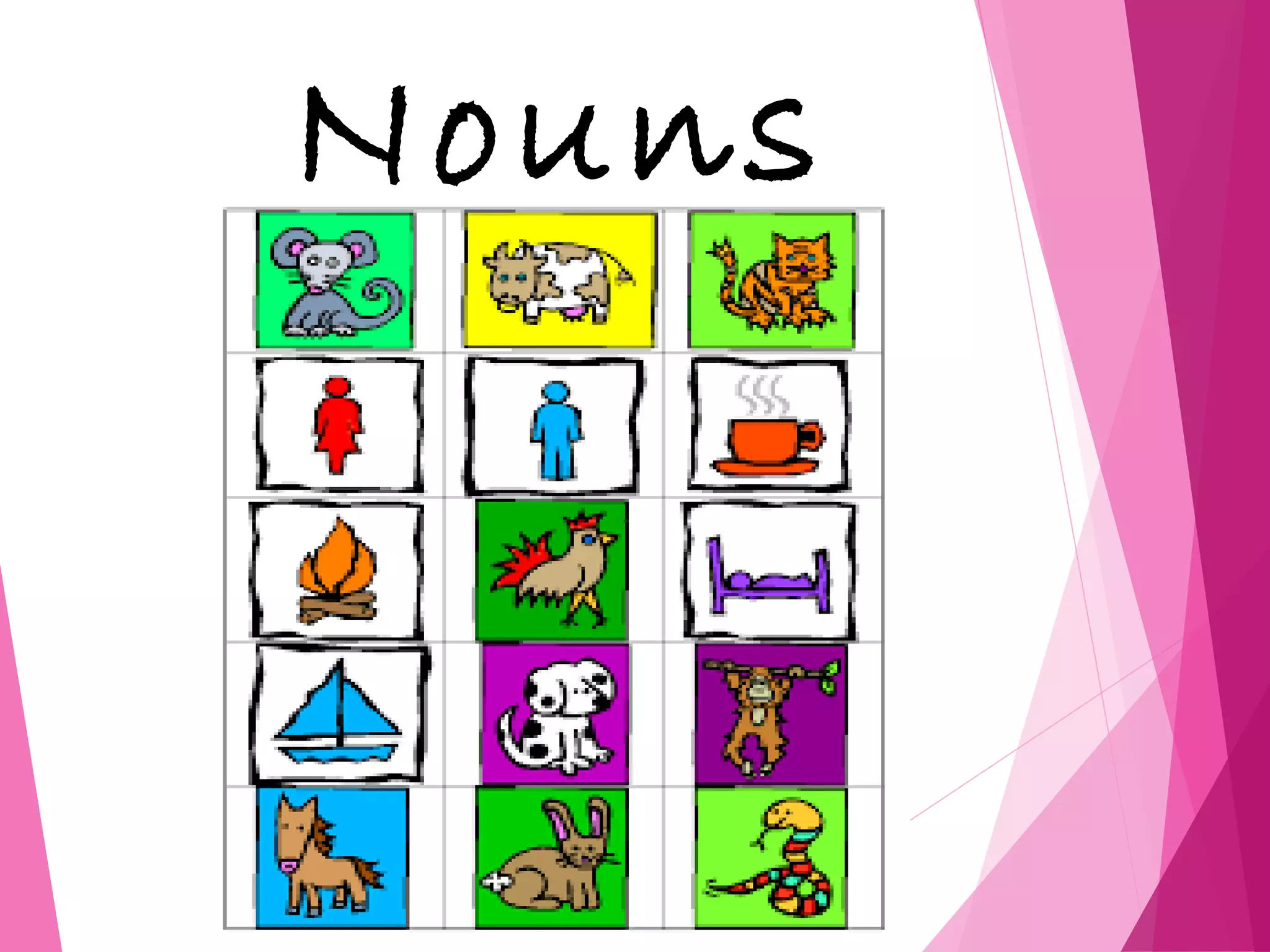
Nouns
WHAT ARE NOUNS?
 Nouns are naming words.
 They name people, places and objects.
 They can also name ideas, emotions,
qualities and activities.
 Here are some examples of nouns:
 Peter, Elizabeth, driver, sister, friend.
 Bristol, Severn, Brazil, pen, dog, money.
 Love, beauty, industry, nature, greed,
pain.
Types of noun
 All nouns can be divided into common and proper
nouns.
 Common nouns can then be divided into countable and
uncountable nouns.
Proper nouns
 Proper nouns start with capital letters.
 They are the names of people, places, times,
organisations etc.
 They refer to unique individuals.
 Most are not found in the dictionary.
 They often occur in pairs or groups.
 Here are some examples.
Countable nouns
 Use these tests for countable nouns:
 Countable (or just “count”) nouns can be
made plural: a tree… two trees; a man…
men; a pony… ponies.
 In the singular, they may have the
determiner a or an: a sausage; an
asterisk.
 We ask: How many words/pages/chairs?
 We say: A few minutes/friends/chips?
Countable nouns
 Use these tests for countable nouns:
 Countable (or just “count”) nouns can be
made plural: a tree… two trees; a man…
men; a pony… ponies.
 In the singular, they may have the
determiner a or an: a sausage; an
asterisk.
 We ask: How many words/pages/chairs?
 We say: A few minutes/friends/chips?

Nouns

  • 1.
  • 2.
    WHAT ARE NOUNS? Nouns are naming words.  They name people, places and objects.  They can also name ideas, emotions, qualities and activities.  Here are some examples of nouns:  Peter, Elizabeth, driver, sister, friend.  Bristol, Severn, Brazil, pen, dog, money.  Love, beauty, industry, nature, greed, pain.
  • 3.
    Types of noun All nouns can be divided into common and proper nouns.  Common nouns can then be divided into countable and uncountable nouns.
  • 4.
    Proper nouns  Propernouns start with capital letters.  They are the names of people, places, times, organisations etc.  They refer to unique individuals.  Most are not found in the dictionary.  They often occur in pairs or groups.  Here are some examples.
  • 5.
    Countable nouns  Usethese tests for countable nouns:  Countable (or just “count”) nouns can be made plural: a tree… two trees; a man… men; a pony… ponies.  In the singular, they may have the determiner a or an: a sausage; an asterisk.  We ask: How many words/pages/chairs?  We say: A few minutes/friends/chips?
  • 6.
    Countable nouns  Usethese tests for countable nouns:  Countable (or just “count”) nouns can be made plural: a tree… two trees; a man… men; a pony… ponies.  In the singular, they may have the determiner a or an: a sausage; an asterisk.  We ask: How many words/pages/chairs?  We say: A few minutes/friends/chips?