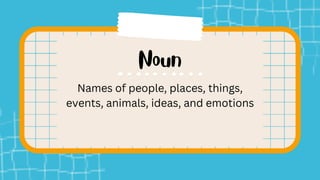
Names of people, places, things,
events, animals, ideas, and emotions
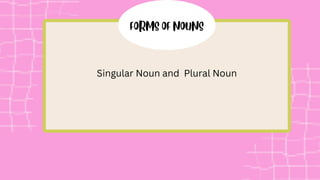
Singular Noun and Plural Noun
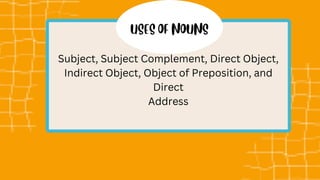
Subject, Subject Complement, Direct Object,
Indirect Object, Object of Preposition, and
Direct
Address
A singular noun names one person, place,
thing, animals, event, or idea.
A plural noun names two or more persons/people, places,
things, animals,
events, or ideas.
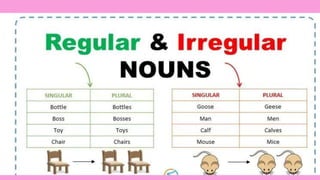
• These plural nouns are formed by changing a vowel,
adding the different suffix, or changing the spelling of
the words.
• Some irregular plural nouns have the same spelling as
their singular form.
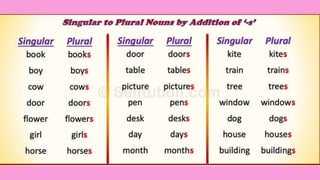
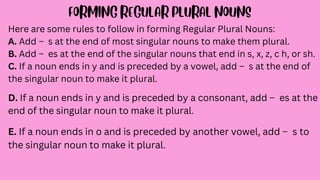
Here are some rules to follow in forming Regular Plural Nouns:
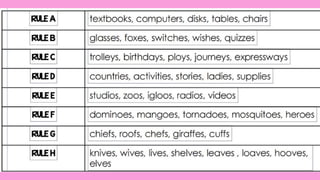
A. Add – s at the end of most singular nouns to make them plural.
B. Add – es at the end of the singular nouns that end in s, x, z, c h, or sh.
C. If a noun ends in y and is preceded by a vowel, add – s at the end of
the singular noun to make it plural.
D. If a noun ends in y and is preceded by a consonant, add – es at the
end of the singular noun to make it plural.
E. If a noun ends in o and is preceded by another vowel, add – s to
the singular noun to make it plural.
F. If a noun ends in o and is preceded by a consonant, add –
es at the end of the singular noun to make it plural.
G. For most nouns that end in f or fe, add – s to make them
plural.
H. For some nouns that end in f or fe, change f or f e to v and
add – es to make them plural.
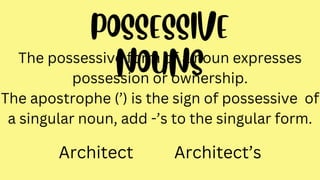
The possessive form of a noun expresses
possession or ownership.
The apostrophe (’) is the sign of possessive of
a singular noun, add -’s to the singular form.
Architect Architect’s
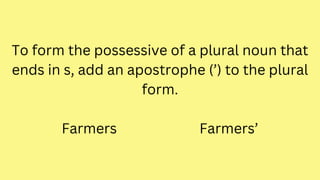
To form the possessive of a plural noun that
ends in s, add an apostrophe (’) to the plural
form.
Farmers Farmers’
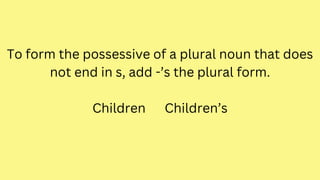
To form the possessive of a plural noun that does
not end in s, add -’s the plural form.
Children Children’s
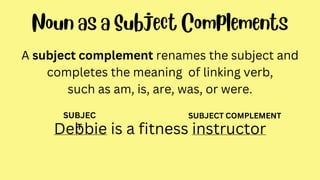
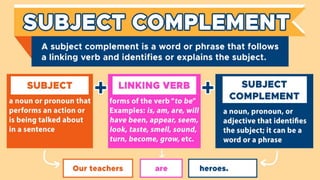
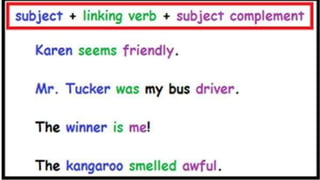
A subject complement renames the subject and
completes the meaning of linking verb,
such as am, is, are, was, or were.
Debbie is a fitness instructor
SUBJEC
T
SUBJECT COMPLEMENT
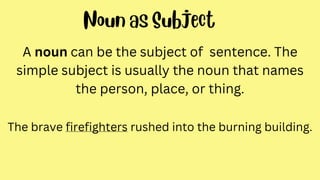
A noun can be the subject of sentence. The
simple subject is usually the noun that names
the person, place, or thing.
The brave firefighters rushed into the burning building.
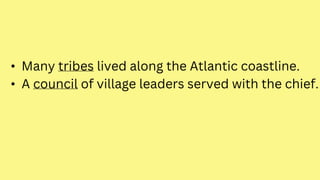
• Many tribes lived along the Atlantic coastline.
• A council of village leaders served with the chief.
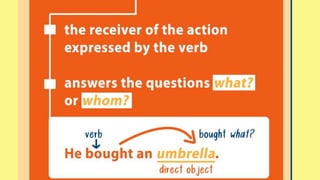
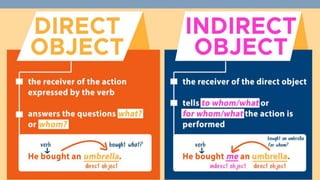
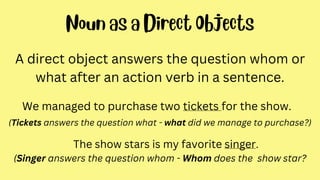
A direct object answers the question whom or
what after an action verb in a sentence.
We managed to purchase two tickets for the show.
(Tickets answers the question what - what did we manage to purchase?)
The show stars is my favorite singer.
(Singer answers the question whom - Whom does the show star?
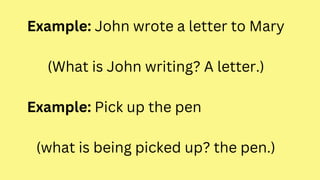
Example: John wrote a letter to Mary
(What is John writing? A letter.)
Example: Pick up the pen
(what is being picked up? the pen.)
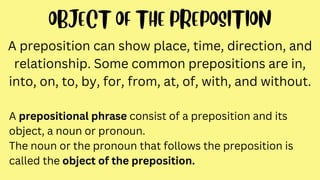
A preposition can show place, time, direction, and
relationship. Some common prepositions are in,
into, on, to, by, for, from, at, of, with, and without.
A prepositional phrase consist of a preposition and its
object, a noun or pronoun.
The noun or the pronoun that follows the preposition is
called the object of the preposition.
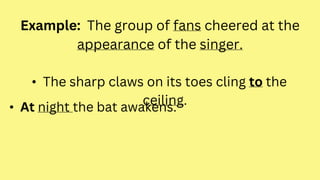
Example: The group of fans cheered at the
appearance of the singer.
• The sharp claws on its toes cling to the
ceiling.
• At night the bat awakens.
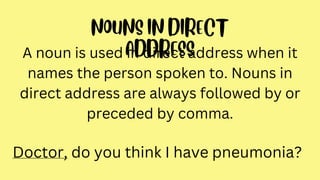
A noun is used in direct address when it
names the person spoken to. Nouns in
direct address are always followed by or
preceded by comma.
Doctor, do you think I have pneumonia?
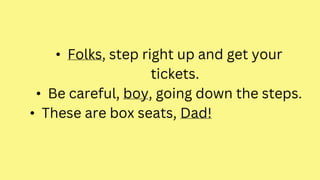
• Folks, step right up and get your
tickets.
• Be careful, boy, going down the steps.
• These are box seats, Dad!

ALL ABOUT NOUNS.pptx

  • 2.
    Names of people,places, things, events, animals, ideas, and emotions
  • 3.
    Singular Noun andPlural Noun
  • 4.
    Subject, Subject Complement,Direct Object, Indirect Object, Object of Preposition, and Direct Address
  • 5.
    A singular nounnames one person, place, thing, animals, event, or idea.
  • 6.
    A plural nounnames two or more persons/people, places, things, animals, events, or ideas.
  • 8.
    • These pluralnouns are formed by changing a vowel, adding the different suffix, or changing the spelling of the words. • Some irregular plural nouns have the same spelling as their singular form.
  • 10.
    Here are somerules to follow in forming Regular Plural Nouns: A. Add – s at the end of most singular nouns to make them plural. B. Add – es at the end of the singular nouns that end in s, x, z, c h, or sh. C. If a noun ends in y and is preceded by a vowel, add – s at the end of the singular noun to make it plural. D. If a noun ends in y and is preceded by a consonant, add – es at the end of the singular noun to make it plural. E. If a noun ends in o and is preceded by another vowel, add – s to the singular noun to make it plural.
  • 11.
    F. If anoun ends in o and is preceded by a consonant, add – es at the end of the singular noun to make it plural. G. For most nouns that end in f or fe, add – s to make them plural. H. For some nouns that end in f or fe, change f or f e to v and add – es to make them plural.
  • 20.
    The possessive formof a noun expresses possession or ownership. The apostrophe (’) is the sign of possessive of a singular noun, add -’s to the singular form. Architect Architect’s
  • 21.
    To form thepossessive of a plural noun that ends in s, add an apostrophe (’) to the plural form. Farmers Farmers’
  • 22.
    To form thepossessive of a plural noun that does not end in s, add -’s the plural form. Children Children’s
  • 23.
    A subject complementrenames the subject and completes the meaning of linking verb, such as am, is, are, was, or were. Debbie is a fitness instructor SUBJEC T SUBJECT COMPLEMENT
  • 24.
    A noun canbe the subject of sentence. The simple subject is usually the noun that names the person, place, or thing. The brave firefighters rushed into the burning building.
  • 25.
    • Many tribeslived along the Atlantic coastline. • A council of village leaders served with the chief.
  • 26.
    A direct objectanswers the question whom or what after an action verb in a sentence. We managed to purchase two tickets for the show. (Tickets answers the question what - what did we manage to purchase?) The show stars is my favorite singer. (Singer answers the question whom - Whom does the show star?
  • 27.
    Example: John wrotea letter to Mary (What is John writing? A letter.) Example: Pick up the pen (what is being picked up? the pen.)
  • 34.
    A preposition canshow place, time, direction, and relationship. Some common prepositions are in, into, on, to, by, for, from, at, of, with, and without. A prepositional phrase consist of a preposition and its object, a noun or pronoun. The noun or the pronoun that follows the preposition is called the object of the preposition.
  • 35.
    Example: The groupof fans cheered at the appearance of the singer. • The sharp claws on its toes cling to the ceiling. • At night the bat awakens.
  • 36.
    A noun isused in direct address when it names the person spoken to. Nouns in direct address are always followed by or preceded by comma. Doctor, do you think I have pneumonia?
  • 37.
    • Folks, stepright up and get your tickets. • Be careful, boy, going down the steps. • These are box seats, Dad!