Elements Of Note Taking
What goes into a good set of notes?
• Being Prepared
• Being Present
• Recording the Information
• Reviewing and Revising Notes
How do you prepare for class?
Being Prepared
•Have your note taking materials
•Do the readings
•Look at announcements
•Look to the syllabus
•Print off materials
What Does Being Present In
Class Mean?
Active Participation
Engage with the information
• Before Class Starts
• Turn off technology
• Get everything out that you’ll need
• During Class
• Look and listen for cues
• Vocal emphasis
• Visual emphasis
What’s wrong
with these notes?
What are some
improvements that
you could make to
your own notes?
• There is not a
title/date
• There isn’t any clear
distinction of
importance
• Nothing is
underlined or
highlighted
Organizing Your Notes
General strategies
• Label your notes
• This makes it easier for your future self
• Include the date!
• This is helpful if you miss a day and need to fill in
your notes
• Title them with the class and lecture
• This is really critical if you use one notebook for all of
your classes
What if I don’t like carrying
around notebooks?
• Take stack of loose leaf paper to your classes
• Make sure to label your notes
• Date each page
• An page numbers for easier organization
• At the end of the day put notes into individual
folders/binders for each class
Recording The Information
General strategies
• Paraphrase
• Restate the information in your own
words
• Identify the important information
• Key details need to be precise!
• Formulas, definitions, dates, and
locations
Recording The Information
STEM classes
• Learn the short hand for the subject
• Leave space for extra notes
• Include units when needed
• Include examples of important formulas
• Summarize what a formula/equation means
Recording The Information
Online classes
•Take notes on readings, videos, and recorded lectures
•Take notes from discussion boards and instructor
feedback
•Categorize class notes based on topic
•Keep up with lectures
• Try not to put everything off till the end on the
week
Recording The Information
Note taking methods
• Outlining
• Charting
• Cornell Method
• Mapping
Outlining
• Great method for all
types of subjects
• Creates a structure
of importance for
ideas
• This style doesn’t
require much prep
work
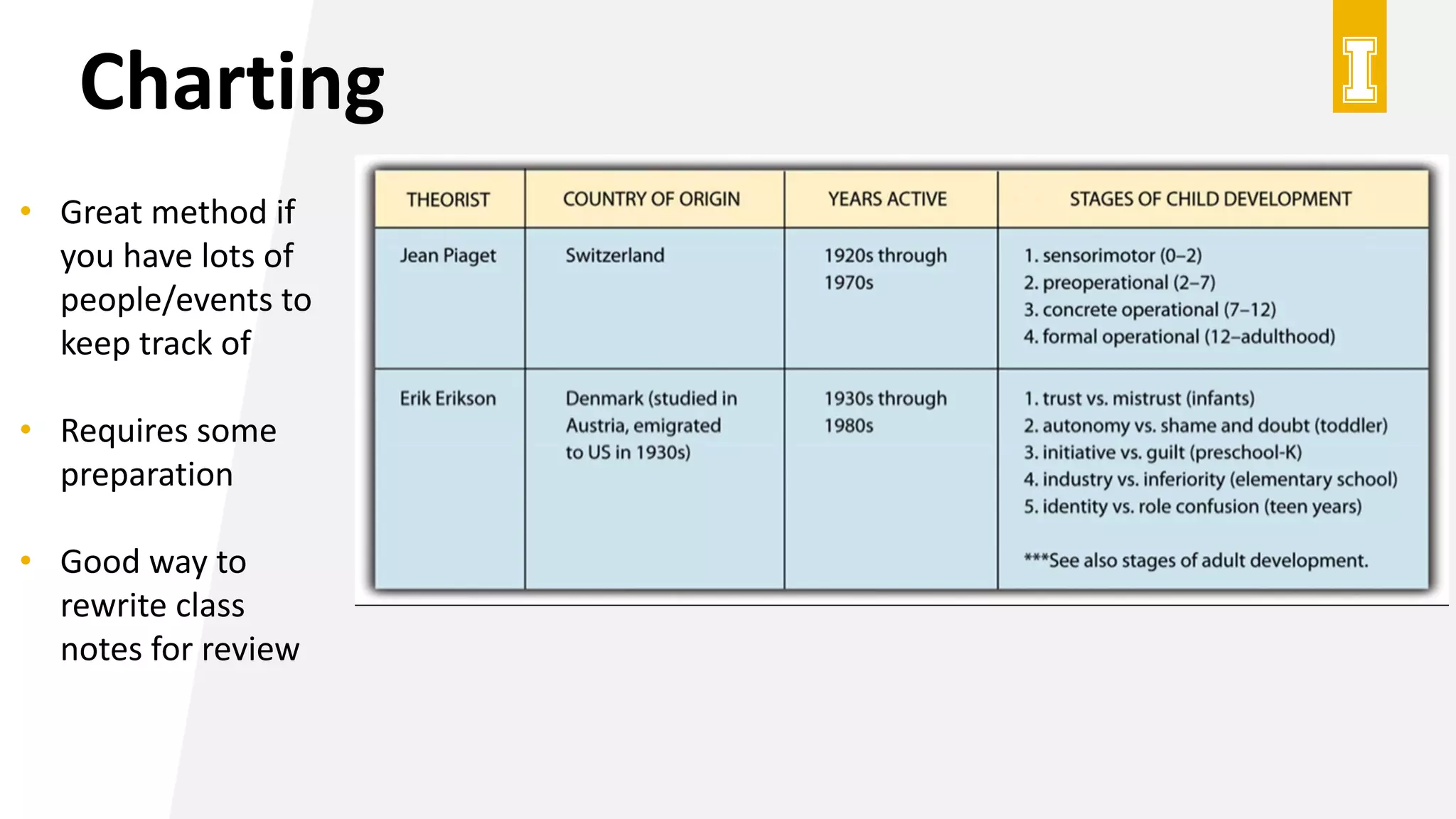
Charting
• Great method if
you have lots of
people/events to
keep track of
• Requires some
preparation
• Good way to
rewrite class
notes for review
Cornell Method
• Structure of notes that
separates main subjects and
details
• Includes summaries for each
page of notes
• It can be helpful to make the
sections on your page
before class starts
Mapping
• This method is great for
connecting ideas
• Difficult to do while in
class
• Great way to review
notes and study
Try Making A Map
• Find a topic in your notes that you could create a
concept map with
• Connect that topic with other things that you
have learned in that class
• Star topics or connections that you feel you need
more information on
Reviewing And Revising
•Revisit your notes after class
•Summarize key points
•Fill in any gaps in your notes
•Review notes before the next class
•Rewrite notes to solidify concepts
Summarize Your Notes
• For a couple sections of your notes write 2-3
sentence summaries for pages/sections
• List out important dates/details/equations
• Highlight sections that you have questions on
Your notes are a study tool –
they should be helpful!

INTR 101 04 Note taking Online

  • 2.
    Elements Of NoteTaking What goes into a good set of notes? • Being Prepared • Being Present • Recording the Information • Reviewing and Revising Notes
  • 3.
    How do youprepare for class?
  • 4.
    Being Prepared •Have yournote taking materials •Do the readings •Look at announcements •Look to the syllabus •Print off materials
  • 6.
    What Does BeingPresent In Class Mean?
  • 7.
    Active Participation Engage withthe information • Before Class Starts • Turn off technology • Get everything out that you’ll need • During Class • Look and listen for cues • Vocal emphasis • Visual emphasis
  • 8.
    What’s wrong with thesenotes? What are some improvements that you could make to your own notes? • There is not a title/date • There isn’t any clear distinction of importance • Nothing is underlined or highlighted
  • 9.
    Organizing Your Notes Generalstrategies • Label your notes • This makes it easier for your future self • Include the date! • This is helpful if you miss a day and need to fill in your notes • Title them with the class and lecture • This is really critical if you use one notebook for all of your classes
  • 10.
    What if Idon’t like carrying around notebooks? • Take stack of loose leaf paper to your classes • Make sure to label your notes • Date each page • An page numbers for easier organization • At the end of the day put notes into individual folders/binders for each class
  • 11.
    Recording The Information Generalstrategies • Paraphrase • Restate the information in your own words • Identify the important information • Key details need to be precise! • Formulas, definitions, dates, and locations
  • 12.
    Recording The Information STEMclasses • Learn the short hand for the subject • Leave space for extra notes • Include units when needed • Include examples of important formulas • Summarize what a formula/equation means
  • 13.
    Recording The Information Onlineclasses •Take notes on readings, videos, and recorded lectures •Take notes from discussion boards and instructor feedback •Categorize class notes based on topic •Keep up with lectures • Try not to put everything off till the end on the week
  • 14.
    Recording The Information Notetaking methods • Outlining • Charting • Cornell Method • Mapping
  • 15.
    Outlining • Great methodfor all types of subjects • Creates a structure of importance for ideas • This style doesn’t require much prep work
  • 16.
    Charting • Great methodif you have lots of people/events to keep track of • Requires some preparation • Good way to rewrite class notes for review
  • 17.
    Cornell Method • Structureof notes that separates main subjects and details • Includes summaries for each page of notes • It can be helpful to make the sections on your page before class starts
  • 18.
    Mapping • This methodis great for connecting ideas • Difficult to do while in class • Great way to review notes and study
  • 19.
    Try Making AMap • Find a topic in your notes that you could create a concept map with • Connect that topic with other things that you have learned in that class • Star topics or connections that you feel you need more information on
  • 20.
    Reviewing And Revising •Revisityour notes after class •Summarize key points •Fill in any gaps in your notes •Review notes before the next class •Rewrite notes to solidify concepts
  • 21.
    Summarize Your Notes •For a couple sections of your notes write 2-3 sentence summaries for pages/sections • List out important dates/details/equations • Highlight sections that you have questions on
  • 22.
    Your notes area study tool – they should be helpful!

Editor's Notes

  • #7 Active participation!
  • #8 Vocal emphasis: Repeating/stressing ideas. “This will be on the test” Visual emphasis: underlining things, bolded text in slides