PES/ENG/IX/107


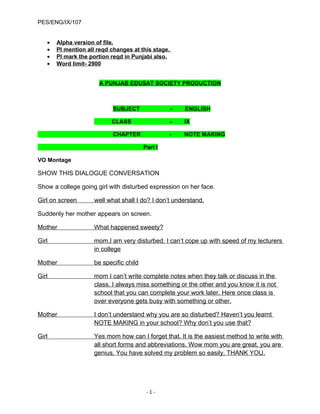
   •   Alpha version of file.
   •   Pl mention all reqd changes at this stage.
   •   Pl mark the portion reqd in Punjabi also.
   •   Word limit- 2900


                      A PUNJAB EDUSAT SOCIETY PRODUCTION


                           SUBJECT                  -   ENGLISH

                           CLASS                 -      IX

                           CHAPTER               -      NOTE MAKING

                                        Part I

VO Montage

SHOW THIS DIALOGUE CONVERSATION

Show a college going girl with disturbed expression on her face.

Girl on screen      well what shall I do? I don’t understand.

Suddenly her mother appears on screen.

Mother              What happened sweety?

Girl                mom,I am very disturbed. I can’t cope up with speed of my lecturers
                    in college

Mother              be specific child

Girl                mom I can’t write complete notes when they talk or discuss in the
                    class. I always miss something or the other and you know it is not
                    school that you can complete your work later. Here once class is
                    over everyone gets busy with something or other.

Mother              I don’t understand why you are so disturbed? Haven’t you learnt
                    NOTE MAKING in your school? Why don’t you use that?

Girl                Yes mom how can I forget that. It is the easiest method to write with
                    all short forms and abbreviations. Wow mom you are great, you are
                    genius. You have solved my problem so easily. THANK YOU.


                                         -1-
PES/ENG/IX/107


ANCHOR

Good morning students, how are you doing? You just now observed the conversation
between mother and daughter. Well, today students, we all face this difficulty of writing
notes in a less span of time. So let’s learn about our new writing topic called NOTE
MAKING.

Do you know its meaning? Well note making is when you return to some text and make
notes on them. This means you annotate them, put things into your own words or
summarise them and highlight key points. Do you have an idea of the meaning of note
taking?

Note-taking is when you are reading or hearing something for the first time and you are
trying to jot down the key information so you can use it later. It’s simple!

But we are going to study note making today. Let us see our learning objectives first.

LEARNING OBJECTIVES

This lesson will enable students

   •   To identify why it is important to have note-taking skills.

   •   To differentiate between note-taking and note-making.

   •   To recognize that there are different ways of taking effective notes.

ANCHOR

So students note making is something which will be of great help to you in future too.

Let us see how it is done. What is the purpose of taking notes? By making notes you
      actively process and interpret ideas and information. These aids

concentration and understanding so you learn more. Are they of any help?

Yes they are of great help. Notes help you to

   •   prepare and plan assignments and projects by helping you identify main points
       and organise your ideas into a logical order.

   •   At exam time, you won't be able to re-read lots of books, so notes will provide a
       concise record of information for you to revise from.

Is there any special method to make notes?


                                         -2-
PES/ENG/IX/107


Yes there is a way which we are going to study but Notes are for your own use, so
devise your own system for making notes and organising them.

Well students let us see the way.

VO WITH TEXT ON SCREEN

   •   First of all be very careful in reading of your text. First reading should be very
       careful with deep understanding.

   •   In the second reading underline the key points or main ideas.

Let us see one example

Exercise 1 Read the following text and make notes.

Now remember while reading underline the main points to.

VO WITH TEXT ON SCREEN

COFFEE AND ITS PROCESSING

The coffee plant, an evergreen shrub or small tree of African origin, begins to
produce fruit 3 or 4 years after being planted. The fruit is hand-gathered when it is
fully ripe and a reddish purple in colour. The ripened fruits of the coffee shrubs are
processed where they are produced to separate the coffee seeds from their
covering and from the pulp. Two different techniques are in use: a wet process and a
dry process.

The wet process First the fresh fruit is pulped by a pulping machine. Some pulp still
clings to the coffee, however, and this residue is removed by fermentation in tanks. The
few remaining traces of pulp are then removed by washing. The coffee seeds are then
dried to a moisture content of about 12 per cent either by exposure to the sun or by hot-
air driers. If dried in the sun, they must be turned by hand several times a day for even
drying.

The dry process In the dry process the fruits are immediately placed to dry either in the
sun or in hot-air driers. Considerably more time and equipment is needed for drying
than in the wet process. When the fruits have been dried to a water content of about 12
per cent the seeds are mechanically freed from their coverings.

The characteristic aroma and taste of coffee only appear later and are developed by
the high temperatures to which they are subjected during the course of the process
known as roasting. Temperatures are raised progressively to about 220-230�C. The


                                         -3-
PES/ENG/IX/107


seeds become rich brown in colour; their texture becomes porous and crumbly under
pressure.

 But the most important phenomenon of roasting is the appearance of the
characteristic aroma of coffee, which arises from very complex chemical
transformations within the beans. The coffee, on leaving the industrial roasters, is
rapidly cooled in a vat where it is stirred and subjected to cold air propelled by a
blower. Good quality coffees are then sorted by electronic sorters and sent to the
market for being sold.

ANCHOR

Now see in our first reading we have underlined only key points of the passage on
production of coffee and its processing.

Now let us see how to make notes from it. There is a way to do it. Please follow these
rules that are coming on the screen.

VO WITH TEXT ON SCREEN

Structure and organisation

   •   Always write a heading or title to your notes.

   •   Your topic may have a number of equally important sections with some minor
       sub-divisions so you need to use sub-headings.

   •   Write notes in a logical order to show how ideas are related or how themes
       developed.

   •   Use letters or numbers to show the order of your notes - either main points to
       minor points (structure) or first event to

   •   One of the most important jobs of good note making is highlighting these key
       words and main points

ANCHOR

So now we arrange important sections as like this

Side a will be read by super and side b by anchor

SIDE A              SIDE B

Heading             COFFEE AND ITS PROCESSING

Main point          details on coffee


                                        -4-
PES/ENG/IX/107


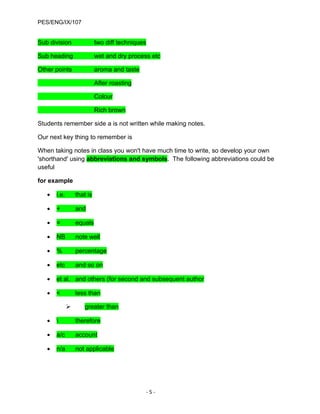
Sub division                two diff techniques

Sub heading                 wet and dry process etc

Other points                aroma and taste

                            After roasting

                            Colour

                            Rich brown

Students remember side a is not written while making notes.

Our next key thing to remember is

When taking notes in class you won't have much time to write, so develop your own
'shorthand' using abbreviations and symbols. The following abbreviations could be
useful

for example

   •   i.e.       that is

   •   +          and

   •   =          equals

   •   NB         note well

   •   %          percentage

   •   etc        and so on

   •   et al. and others (for second and subsequent author

   •   <          less than

                    greater than

   •             therefore

   •   a/c        account

   •   n/a        not applicable


                                                  -5-
PES/ENG/IX/107


Yes students when making notes we do not write complete words we use short forms
and abbreviation

Like in the above notes we should have written

Heading             COFFEE AND ITS PROCESSING

Main point          details on coffee

Sub division        two diff techs

Sub heading         wet and dry process etc

Other points        aroma and taste

                    After roastg

                    Colr

                    Rich brown

So did you see it appears to be almost doing rough work but it is done in a proper
manner.

SUPER

Are there any more points to keep in mind?

ANCHOR

Yes there are.

   •   Underline important points once,

   •   very important points twice.

   •   Use CAPITAL LETTERS

   •   Draw boxes around the keywords

   •   Draw an asterisk next to the main idea*

   •   Go over the important points with a highlighter pen

   •   Abbreviations


                                        -6-
PES/ENG/IX/107


   Always remember these points.

   So your final notes of the above passage will look like this

   VO WITH TEXT ON SCREEN

COFFEE AND ITS PROCESSING

   1. coffee plant

                 •   evergreen shrub / small tree

                 •   from Africa

                 •   fruits after 3/4 years

                 •   fruit - red/purple

                 •   gathered by hand


   2. processed             to separate seeds from covering

   3. two processes used

      A.wet process

             fruit pulped by machine

             fermentation in tanks

             washing

      `       seeds dried to 12% moisture

      `      ` by sun or hot air driers

              need to be turned by hand

      B. dry process

             dried immediately in sun or with driers

             when dried to 12% seeds freed from coverings


3.roasting at 220-230 oC


                                          -7-
PES/ENG/IX/107


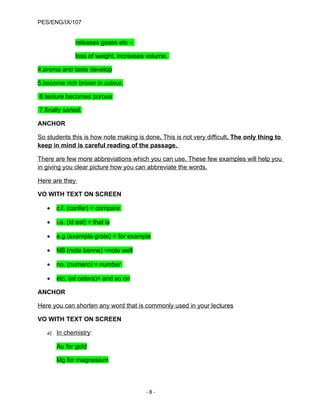
               releases gases etc –

               loss of weight, increases volume,

4.aroma and taste develop

5.become rich brown in colour,

6.texture becomes porous

7.finally sorted.

ANCHOR

So students this is how note making is done. This is not very difficult. The only thing to
keep in mind is careful reading of the passage.

There are few more abbreviations which you can use. These few examples will help you
in giving you clear picture how you can abbreviate the words.

Here are they

VO WITH TEXT ON SCREEN

   •   c.f. (confer) = compare

   •   i.e. (id est) = that is

   •   e.g (exempla grate) = for example

   •   NB (nota benne) =note well

   •   no. (numero) = number

   •   etc. (et cetera)= and so on

ANCHOR

Here you can shorten any word that is commonly used in your lectures

VO WITH TEXT ON SCREEN

   a) In chemistry:

       Au for gold

       Mg for magnesium


                                        -8-
PES/ENG/IX/107


   b) Some common ones are

       diff =different

       Gov = government

   c) NE In the case of quantities and concepts, these are represented by Greek
      letters in many fields.

       A or a (alpha) B or b (beta)

       C = necessary

ANCHOR

Well students these were some key points for your understanding. Well let us now see
few examples to understand it further.

First read this passage carefully.

VO WITH TEXT ON SCREEN

 There are three types of American rice.long grain is slender and the grain remain
separate when cooked.it is suited to main dishes,salads and soups. Medium grain is
plumper then long grain and more tender when cooked.short grain is almost round;;the
grains stick together when cooked.

Rice is also classified according to the ways, it is processed.brown rice retain the bran
and germ (and therefore more nutrient); par boiled rice and converted rice is soaked,
steamed ,and dried before milling. It retains more nutrients then white rice but takes five
to ten minutes longer to cook. Precooked white rice is cooked and dehydrated after
milling and needs little cooking.

ANCHOR

Re-read the passage and then underline the key points.

(For MM) Underline the words written in bold

VO WITH TEXT ON SCREEN

NOTE : never talk or mention any example given in the passage in your notes.

Let us make notes now.

Classification of rice


                                        -9-
PES/ENG/IX/107


      a. How it looks

               Long grain        slender

               Med grain       tender when cooked

               Short grain       round

      b. How it is processed

               Brown rice                    retains bran & germs

               Parboiled rice                soaked, steamed & dried

               Precooked white rice          cooked & dehydrated

ANCHOR

SO STUDENTS IT WAS SIMPLE. Well how many of you eat rice?

I think almost everyone. So did you notice how many types of rice are there and how
they are made?

See English subject is giving you so much of general knowledge too.

Well students listen to this conversation between Raj and Sunny.

(show two boys on screen)

Raj;           sunny have you ever worked on computer?

Sunny          ofcourse Raj, definitely. But why are you asking?

Raj            well actually yesterday when I was writing mail to my sister in London ,I
               realized one thing, the shorthand type of writing which we use on net is
               actually something which our English teacher was trying to teach us in
               notemaking. Isn’t it?

Sunny          oh yes, she is asking us to use short forms only. So now whenever we
               have to make notes we have to remember that as if we are writing on
               computer.

Raj            yes sunny. You are absolutely right.

Sunny          well thank you Raj for this great connectivity.

ANCHOR


                                           - 10 -
PES/ENG/IX/107


Well students I hope by now you must have understood

What is note making?

How it is done?

Why it is done?

SUMMARY

   •    Note taking is an important academic task that helps you to remember what you
       have learnt and helps you to review materials for re-use in revision and
       assignments.

   •   It is important that you are critical when note taking and that you only write or
       draw what you will need later on, and that you record the information in a format
       that is easy to understand.

   •   You should look out for clues about what is important.

   •   The lecturer or author will organise his or her material in a logical way so try to
       utilise their organisational skills when note taking.

   •   When taking notes you might like to try different study techniques such as the
       SQ3R approach or you might like to use a more visual approach such as a spray
       diagram.

   •   And most importantly, after taking effective notes, it is important to organise and
       store your notes effectively. Effective note taking should reduce your study time,
       should increase your retention of knowledge, and should provide you with a
       summarised list of resources for your future projects.


   Anchor

Children, we now come to the end of our module on Note making Part I. See you soon

again with another module on Note making. But before that, Happy Learning and hope

you will go back and try to make notes, following the rules you learnt today. Remember

children, to recall is very important! Good day.


                                         - 11 -
PES/ENG/IX/107


                                        ALPHA STAGE OF SCRIPT

Subject: _________________________________, Class: ________________________


Topic: _________________________________________________________________


Script ID: ______________________________________________________________


Date of Receiving by PES: ________________________________________________


Date of Receiving by Subject Specialist: ____________________________________


Name of Subject Specialist: _______________________________________________


Tick (√ ) any one of the following:


    1.      This Script is approved and frozen for Production.


    2.      Necessary corrections in the Script are suggested and submitted back to Service Provider for
            making its Beta file.


                                              - 12 -
PES/ENG/IX/107


                                                   Signature of the Subject Specialist


                                                   Date and Time: _______________


Countersigned by:


Dy. Director SISE


Submitted to Service Providers Date _____________________.


                                          - 13 -
PES/ENG/IX/107


                 - 14 -

Note making part i alpha

  • 1.
    PES/ENG/IX/107 • Alpha version of file. • Pl mention all reqd changes at this stage. • Pl mark the portion reqd in Punjabi also. • Word limit- 2900 A PUNJAB EDUSAT SOCIETY PRODUCTION SUBJECT - ENGLISH CLASS - IX CHAPTER - NOTE MAKING Part I VO Montage SHOW THIS DIALOGUE CONVERSATION Show a college going girl with disturbed expression on her face. Girl on screen well what shall I do? I don’t understand. Suddenly her mother appears on screen. Mother What happened sweety? Girl mom,I am very disturbed. I can’t cope up with speed of my lecturers in college Mother be specific child Girl mom I can’t write complete notes when they talk or discuss in the class. I always miss something or the other and you know it is not school that you can complete your work later. Here once class is over everyone gets busy with something or other. Mother I don’t understand why you are so disturbed? Haven’t you learnt NOTE MAKING in your school? Why don’t you use that? Girl Yes mom how can I forget that. It is the easiest method to write with all short forms and abbreviations. Wow mom you are great, you are genius. You have solved my problem so easily. THANK YOU. -1-
  • 2.
    PES/ENG/IX/107 ANCHOR Good morning students,how are you doing? You just now observed the conversation between mother and daughter. Well, today students, we all face this difficulty of writing notes in a less span of time. So let’s learn about our new writing topic called NOTE MAKING. Do you know its meaning? Well note making is when you return to some text and make notes on them. This means you annotate them, put things into your own words or summarise them and highlight key points. Do you have an idea of the meaning of note taking? Note-taking is when you are reading or hearing something for the first time and you are trying to jot down the key information so you can use it later. It’s simple! But we are going to study note making today. Let us see our learning objectives first. LEARNING OBJECTIVES This lesson will enable students • To identify why it is important to have note-taking skills. • To differentiate between note-taking and note-making. • To recognize that there are different ways of taking effective notes. ANCHOR So students note making is something which will be of great help to you in future too. Let us see how it is done. What is the purpose of taking notes? By making notes you actively process and interpret ideas and information. These aids concentration and understanding so you learn more. Are they of any help? Yes they are of great help. Notes help you to • prepare and plan assignments and projects by helping you identify main points and organise your ideas into a logical order. • At exam time, you won't be able to re-read lots of books, so notes will provide a concise record of information for you to revise from. Is there any special method to make notes? -2-
  • 3.
    PES/ENG/IX/107 Yes there isa way which we are going to study but Notes are for your own use, so devise your own system for making notes and organising them. Well students let us see the way. VO WITH TEXT ON SCREEN • First of all be very careful in reading of your text. First reading should be very careful with deep understanding. • In the second reading underline the key points or main ideas. Let us see one example Exercise 1 Read the following text and make notes. Now remember while reading underline the main points to. VO WITH TEXT ON SCREEN COFFEE AND ITS PROCESSING The coffee plant, an evergreen shrub or small tree of African origin, begins to produce fruit 3 or 4 years after being planted. The fruit is hand-gathered when it is fully ripe and a reddish purple in colour. The ripened fruits of the coffee shrubs are processed where they are produced to separate the coffee seeds from their covering and from the pulp. Two different techniques are in use: a wet process and a dry process. The wet process First the fresh fruit is pulped by a pulping machine. Some pulp still clings to the coffee, however, and this residue is removed by fermentation in tanks. The few remaining traces of pulp are then removed by washing. The coffee seeds are then dried to a moisture content of about 12 per cent either by exposure to the sun or by hot- air driers. If dried in the sun, they must be turned by hand several times a day for even drying. The dry process In the dry process the fruits are immediately placed to dry either in the sun or in hot-air driers. Considerably more time and equipment is needed for drying than in the wet process. When the fruits have been dried to a water content of about 12 per cent the seeds are mechanically freed from their coverings. The characteristic aroma and taste of coffee only appear later and are developed by the high temperatures to which they are subjected during the course of the process known as roasting. Temperatures are raised progressively to about 220-230�C. The -3-
  • 4.
    PES/ENG/IX/107 seeds become richbrown in colour; their texture becomes porous and crumbly under pressure. But the most important phenomenon of roasting is the appearance of the characteristic aroma of coffee, which arises from very complex chemical transformations within the beans. The coffee, on leaving the industrial roasters, is rapidly cooled in a vat where it is stirred and subjected to cold air propelled by a blower. Good quality coffees are then sorted by electronic sorters and sent to the market for being sold. ANCHOR Now see in our first reading we have underlined only key points of the passage on production of coffee and its processing. Now let us see how to make notes from it. There is a way to do it. Please follow these rules that are coming on the screen. VO WITH TEXT ON SCREEN Structure and organisation • Always write a heading or title to your notes. • Your topic may have a number of equally important sections with some minor sub-divisions so you need to use sub-headings. • Write notes in a logical order to show how ideas are related or how themes developed. • Use letters or numbers to show the order of your notes - either main points to minor points (structure) or first event to • One of the most important jobs of good note making is highlighting these key words and main points ANCHOR So now we arrange important sections as like this Side a will be read by super and side b by anchor SIDE A SIDE B Heading COFFEE AND ITS PROCESSING Main point details on coffee -4-
  • 5.
    PES/ENG/IX/107 Sub division two diff techniques Sub heading wet and dry process etc Other points aroma and taste After roasting Colour Rich brown Students remember side a is not written while making notes. Our next key thing to remember is When taking notes in class you won't have much time to write, so develop your own 'shorthand' using abbreviations and symbols. The following abbreviations could be useful for example • i.e. that is • + and • = equals • NB note well • % percentage • etc and so on • et al. and others (for second and subsequent author • < less than  greater than • therefore • a/c account • n/a not applicable -5-
  • 6.
    PES/ENG/IX/107 Yes students whenmaking notes we do not write complete words we use short forms and abbreviation Like in the above notes we should have written Heading COFFEE AND ITS PROCESSING Main point details on coffee Sub division two diff techs Sub heading wet and dry process etc Other points aroma and taste After roastg Colr Rich brown So did you see it appears to be almost doing rough work but it is done in a proper manner. SUPER Are there any more points to keep in mind? ANCHOR Yes there are. • Underline important points once, • very important points twice. • Use CAPITAL LETTERS • Draw boxes around the keywords • Draw an asterisk next to the main idea* • Go over the important points with a highlighter pen • Abbreviations -6-
  • 7.
    PES/ENG/IX/107 Always remember these points. So your final notes of the above passage will look like this VO WITH TEXT ON SCREEN COFFEE AND ITS PROCESSING 1. coffee plant • evergreen shrub / small tree • from Africa • fruits after 3/4 years • fruit - red/purple • gathered by hand 2. processed to separate seeds from covering 3. two processes used A.wet process fruit pulped by machine fermentation in tanks washing ` seeds dried to 12% moisture ` ` by sun or hot air driers need to be turned by hand B. dry process dried immediately in sun or with driers when dried to 12% seeds freed from coverings 3.roasting at 220-230 oC -7-
  • 8.
    PES/ENG/IX/107 releases gases etc – loss of weight, increases volume, 4.aroma and taste develop 5.become rich brown in colour, 6.texture becomes porous 7.finally sorted. ANCHOR So students this is how note making is done. This is not very difficult. The only thing to keep in mind is careful reading of the passage. There are few more abbreviations which you can use. These few examples will help you in giving you clear picture how you can abbreviate the words. Here are they VO WITH TEXT ON SCREEN • c.f. (confer) = compare • i.e. (id est) = that is • e.g (exempla grate) = for example • NB (nota benne) =note well • no. (numero) = number • etc. (et cetera)= and so on ANCHOR Here you can shorten any word that is commonly used in your lectures VO WITH TEXT ON SCREEN a) In chemistry: Au for gold Mg for magnesium -8-
  • 9.
    PES/ENG/IX/107 b) Some common ones are diff =different Gov = government c) NE In the case of quantities and concepts, these are represented by Greek letters in many fields. A or a (alpha) B or b (beta) C = necessary ANCHOR Well students these were some key points for your understanding. Well let us now see few examples to understand it further. First read this passage carefully. VO WITH TEXT ON SCREEN There are three types of American rice.long grain is slender and the grain remain separate when cooked.it is suited to main dishes,salads and soups. Medium grain is plumper then long grain and more tender when cooked.short grain is almost round;;the grains stick together when cooked. Rice is also classified according to the ways, it is processed.brown rice retain the bran and germ (and therefore more nutrient); par boiled rice and converted rice is soaked, steamed ,and dried before milling. It retains more nutrients then white rice but takes five to ten minutes longer to cook. Precooked white rice is cooked and dehydrated after milling and needs little cooking. ANCHOR Re-read the passage and then underline the key points. (For MM) Underline the words written in bold VO WITH TEXT ON SCREEN NOTE : never talk or mention any example given in the passage in your notes. Let us make notes now. Classification of rice -9-
  • 10.
    PES/ENG/IX/107 a. How it looks Long grain slender Med grain tender when cooked Short grain round b. How it is processed Brown rice retains bran & germs Parboiled rice soaked, steamed & dried Precooked white rice cooked & dehydrated ANCHOR SO STUDENTS IT WAS SIMPLE. Well how many of you eat rice? I think almost everyone. So did you notice how many types of rice are there and how they are made? See English subject is giving you so much of general knowledge too. Well students listen to this conversation between Raj and Sunny. (show two boys on screen) Raj; sunny have you ever worked on computer? Sunny ofcourse Raj, definitely. But why are you asking? Raj well actually yesterday when I was writing mail to my sister in London ,I realized one thing, the shorthand type of writing which we use on net is actually something which our English teacher was trying to teach us in notemaking. Isn’t it? Sunny oh yes, she is asking us to use short forms only. So now whenever we have to make notes we have to remember that as if we are writing on computer. Raj yes sunny. You are absolutely right. Sunny well thank you Raj for this great connectivity. ANCHOR - 10 -
  • 11.
    PES/ENG/IX/107 Well students Ihope by now you must have understood What is note making? How it is done? Why it is done? SUMMARY • Note taking is an important academic task that helps you to remember what you have learnt and helps you to review materials for re-use in revision and assignments. • It is important that you are critical when note taking and that you only write or draw what you will need later on, and that you record the information in a format that is easy to understand. • You should look out for clues about what is important. • The lecturer or author will organise his or her material in a logical way so try to utilise their organisational skills when note taking. • When taking notes you might like to try different study techniques such as the SQ3R approach or you might like to use a more visual approach such as a spray diagram. • And most importantly, after taking effective notes, it is important to organise and store your notes effectively. Effective note taking should reduce your study time, should increase your retention of knowledge, and should provide you with a summarised list of resources for your future projects. Anchor Children, we now come to the end of our module on Note making Part I. See you soon again with another module on Note making. But before that, Happy Learning and hope you will go back and try to make notes, following the rules you learnt today. Remember children, to recall is very important! Good day. - 11 -
  • 12.
    PES/ENG/IX/107 ALPHA STAGE OF SCRIPT Subject: _________________________________, Class: ________________________ Topic: _________________________________________________________________ Script ID: ______________________________________________________________ Date of Receiving by PES: ________________________________________________ Date of Receiving by Subject Specialist: ____________________________________ Name of Subject Specialist: _______________________________________________ Tick (√ ) any one of the following: 1. This Script is approved and frozen for Production. 2. Necessary corrections in the Script are suggested and submitted back to Service Provider for making its Beta file. - 12 -
  • 13.
    PES/ENG/IX/107 Signature of the Subject Specialist Date and Time: _______________ Countersigned by: Dy. Director SISE Submitted to Service Providers Date _____________________. - 13 -
  • 14.