Poem – Leisure
By: William Henry Davies
  Prepared by Nuurunnuha Md Hatta
     SAMBBST, Sepang, Selangor.
  http://teachernuha.blogspot.com/
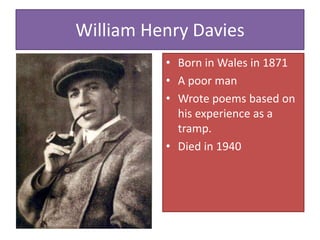
William Henry Davies
          • Born in Wales in 1871
          • A poor man
          • Wrote poems based on
            his experience as a
            tramp.
          • Died in 1940
What is this life if, full of care,
We have no time to stand and stare.           Couplet 1

No time to stand beneath the boughs
And stare as long as sheep or cows.           Couplet 2

No time to see, when woods we pass,
Where squirrels hide their nuts in grass.     Couplet 3

No time to see, in broad daylight,
Streams full of stars, like stars at night.   Couplet 4

No time to turn at Beauty's glance,
And watch her feet, how they can dance.       Couplet 5

No time to wait till her mouth can
Enrich that smile her eyes began.             Couplet 6

A poor life this is if, full of care,
We have no time to stand and stare            Couplet 7
What is the poem about?
• Reminds us to take time to appreciate the
  beauty of nature & be thankful to God.
• HOWEVER, if we are too busy with our daily
  life & worry too much, WE FORGET to watch
  & admire nature’s beauty.
• It is a sad life if we can’t find time to relax and
  appreciate the nature around us.
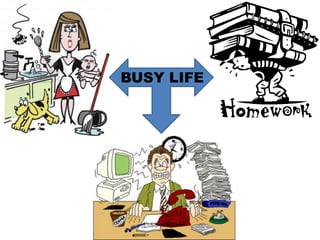
BUSY LIFE
The meaning of the poem
Couplet 1
What is this life if,
What is the purpose of life if
full of care,
full of worry (because too busy with work &
problems)
We have no time to stand and stare.
We do not have time to pause and admire
the nature around us.
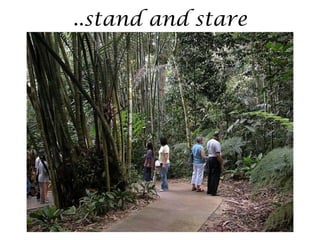
..stand and stare
Couplet 2
No time to stand beneath the boughs,
Busy people do not have time to stand under
the trees
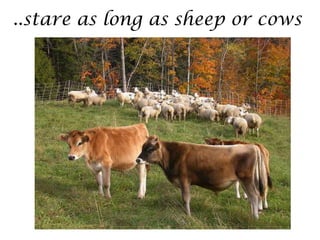
And stare as long as sheep or cows
Just like sheep and cows which graze in the
fields. They just stand and stare at their
surrounding.
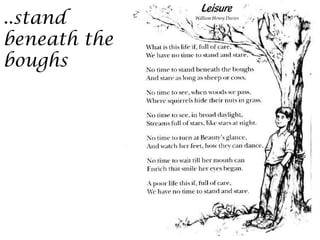
..stand
beneath the
boughs
..stare as long as sheep or cows
Couplet 3
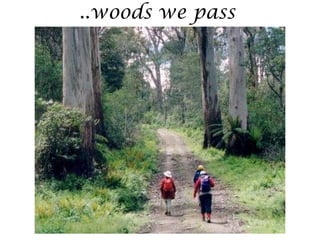
No time to see, when woods we pass,
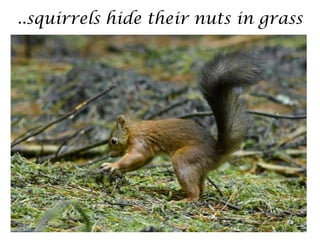
Where squirrels hide their nuts in grass.
Busy people do not see squirrels hide their
nuts in grass when they pass through the
forests.
..woods we pass
..squirrels hide their nuts in grass
Couplet 4
No time to see, in broad daylight,
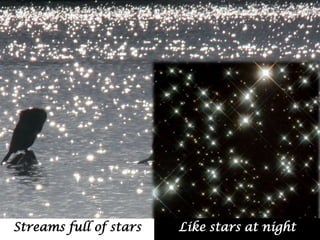
Streams full of stars, like stars at night.
Rivers sparkle in the sunlight. In the day, the
rivers look like stars at night. But, busy
people do not have time to see this.
Streams full of stars   Like stars at night
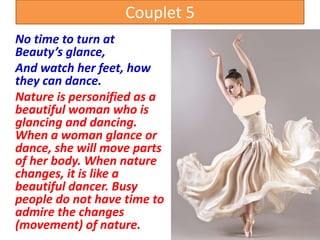
Couplet 5
No time to turn at
Beauty’s glance,
And watch her feet, how
they can dance.
Nature is personified as a
beautiful woman who is
glancing and dancing.
When a woman glance or
dance, she will move parts
of her body. When nature
changes, it is like a
beautiful dancer. Busy
people do not have time to
admire the changes
(movement) of nature.
Couplet 6
No time to wait till her mouth can
Enrich that smile her eyes began.
Busy people do not have time to watch the
changes in nature. When nature changes, it is
like a smile that starts from the eyes and
spreads slowly to the mouth.
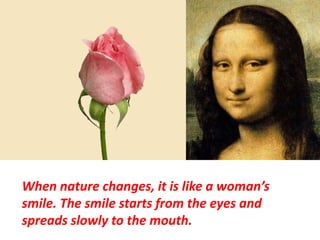
When nature changes, it is like a woman’s
smile. The smile starts from the eyes and
spreads slowly to the mouth.
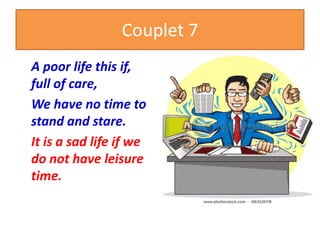
Couplet 7
A poor life this if,
full of care,
We have no time to
stand and stare.
It is a sad life if we
do not have leisure
time.
Poetic Devices
1. Rhyme
• The repetition of the same sound at the end
  of a line in poem.
2. Imagery
• The mental picture that attracts the senses
3. Alliteration
• The repetition of consonant sounds in the first
  syllables of a series of words
4. Rhetorical question
• A question which is asked, but not expected to
  get an answer.
5. Repetition
• The repetition of words or lines in a poem
6. Metaphor
• A comparison between 2 different things
  without using ‘like’ or ‘as’
7. Simile
• A comparison between 2 different things
  which uses ‘like’ or ‘as’
8. Personification
• Non-living things are given human qualities.

Poem leisure

  • 1.
    Poem – Leisure By:William Henry Davies Prepared by Nuurunnuha Md Hatta SAMBBST, Sepang, Selangor. http://teachernuha.blogspot.com/
  • 2.
    William Henry Davies • Born in Wales in 1871 • A poor man • Wrote poems based on his experience as a tramp. • Died in 1940
  • 3.
    What is thislife if, full of care, We have no time to stand and stare. Couplet 1 No time to stand beneath the boughs And stare as long as sheep or cows. Couplet 2 No time to see, when woods we pass, Where squirrels hide their nuts in grass. Couplet 3 No time to see, in broad daylight, Streams full of stars, like stars at night. Couplet 4 No time to turn at Beauty's glance, And watch her feet, how they can dance. Couplet 5 No time to wait till her mouth can Enrich that smile her eyes began. Couplet 6 A poor life this is if, full of care, We have no time to stand and stare Couplet 7
  • 4.
    What is thepoem about? • Reminds us to take time to appreciate the beauty of nature & be thankful to God. • HOWEVER, if we are too busy with our daily life & worry too much, WE FORGET to watch & admire nature’s beauty. • It is a sad life if we can’t find time to relax and appreciate the nature around us.
  • 5.
  • 6.
  • 7.
    Couplet 1 What isthis life if, What is the purpose of life if full of care, full of worry (because too busy with work & problems) We have no time to stand and stare. We do not have time to pause and admire the nature around us.
  • 8.
  • 9.
    Couplet 2 No timeto stand beneath the boughs, Busy people do not have time to stand under the trees And stare as long as sheep or cows Just like sheep and cows which graze in the fields. They just stand and stare at their surrounding.
  • 10.
  • 11.
    ..stare as longas sheep or cows
  • 12.
    Couplet 3 No timeto see, when woods we pass, Where squirrels hide their nuts in grass. Busy people do not see squirrels hide their nuts in grass when they pass through the forests.
  • 13.
  • 14.
  • 15.
    Couplet 4 No timeto see, in broad daylight, Streams full of stars, like stars at night. Rivers sparkle in the sunlight. In the day, the rivers look like stars at night. But, busy people do not have time to see this.
  • 16.
    Streams full ofstars Like stars at night
  • 17.
    Couplet 5 No timeto turn at Beauty’s glance, And watch her feet, how they can dance. Nature is personified as a beautiful woman who is glancing and dancing. When a woman glance or dance, she will move parts of her body. When nature changes, it is like a beautiful dancer. Busy people do not have time to admire the changes (movement) of nature.
  • 18.
    Couplet 6 No timeto wait till her mouth can Enrich that smile her eyes began. Busy people do not have time to watch the changes in nature. When nature changes, it is like a smile that starts from the eyes and spreads slowly to the mouth.
  • 19.
    When nature changes,it is like a woman’s smile. The smile starts from the eyes and spreads slowly to the mouth.
  • 20.
    Couplet 7 A poorlife this if, full of care, We have no time to stand and stare. It is a sad life if we do not have leisure time.
  • 21.
  • 22.
    1. Rhyme • Therepetition of the same sound at the end of a line in poem.
  • 23.
    2. Imagery • Themental picture that attracts the senses
  • 24.
    3. Alliteration • Therepetition of consonant sounds in the first syllables of a series of words
  • 25.
    4. Rhetorical question •A question which is asked, but not expected to get an answer.
  • 26.
    5. Repetition • Therepetition of words or lines in a poem
  • 27.
    6. Metaphor • Acomparison between 2 different things without using ‘like’ or ‘as’
  • 28.
    7. Simile • Acomparison between 2 different things which uses ‘like’ or ‘as’
  • 29.
    8. Personification • Non-livingthings are given human qualities.