
NoSQL


        By Perry Hoekstra
           Technical Consultant
           Perficient, Inc.

           perry.hoekstra@perficient.com
Why this topic?

  Client’s   Application Roadmap
    – “Reduction of cycle time for the document
      intake process. Currently, it can take anywhere
      from a few days to a few weeks from the time
      the documents are received to when they are
      available to the client.”
  New York Times used Hadoop/MapReduce to
   convert pre-1980 articles that were TIFF
   images to PDF.
Agenda

  Some  history
  What is NoSQL
  CAP Theorem
  What is lost
  Types of NoSQL
  Data Model
  Frameworks
  Demo
  Wrapup
History of the World, Part 1

  Relational
           Databases – mainstay of business
  Web-based applications caused spikes
    – Especially true for public-facing e-Commerce sites
  Developers  begin to front RDBMS with memcache or
   integrate other caching mechanisms within the
   application (ie. Ehcache)
Scaling Up

  Issues   with scaling up when the dataset is just too
   big
  RDBMS were not designed to be distributed
  Began to look at multi-node database solutions
  Known as ‘scaling out’ or ‘horizontal scaling’
  Different approaches include:
    – Master-slave
    – Sharding
Scaling RDBMS – Master/Slave

  Master-Slave
    – All writes are written to the master. All reads
      performed against the replicated slave databases
    – Critical reads may be incorrect as writes may not have
      been propagated down
    – Large data sets can pose problems as master needs to
      duplicate data to slaves
Scaling RDBMS - Sharding

  Partition   or sharding
    – Scales well for both reads and writes
    – Not transparent, application needs to be partition-
      aware
    – Can no longer have relationships/joins across
      partitions
    – Loss of referential integrity across shards
Other ways to scale RDBMS

  Multi-Masterreplication
  INSERT only, not UPDATES/DELETES
  No JOINs, thereby reducing query time
    – This involves de-normalizing data
  In-memory   databases
What is NoSQL?

  Stands  for Not Only SQL
  Class of non-relational data storage systems
  Usually do not require a fixed table schema nor do
   they use the concept of joins
  All NoSQL offerings relax one or more of the ACID
   properties (will talk about the CAP theorem)
Why NoSQL?

  For  data storage, an RDBMS cannot be the be-
   all/end-all
  Just as there are different programming languages,
   need to have other data storage tools in the toolbox
  A NoSQL solution is more acceptable to a client now
   than even a year ago
   – Think about proposing a Ruby/Rails or Groovy/Grails
     solution now versus a couple of years ago
How did we get here?

  Explosion  of social media sites (Facebook,
   Twitter) with large data needs
  Rise of cloud-based solutions such as Amazon
   S3 (simple storage solution)
  Just as moving to dynamically-typed
   languages (Ruby/Groovy), a shift to
   dynamically-typed data with frequent schema
   changes
  Open-source community
Dynamo and BigTable

  Three
      major papers were the seeds of the NoSQL
  movement
   – BigTable (Google)
   – Dynamo (Amazon)
      •   Gossip protocol (discovery and error detection)
      •   Distributed key-value data store
      •   Eventual consistency
   – CAP Theorem (discuss in a sec ..)
The Perfect Storm

  Large datasets, acceptance of alternatives, and
   dynamically-typed data has come together in a
   perfect storm
  Not a backlash/rebellion against RDBMS
  SQL is a rich query language that cannot be rivaled
   by the current list of NoSQL offerings
CAP Theorem

  Three  properties of a system: consistency,
   availability and partitions
  You can have at most two of these three properties
   for any shared-data system
  To scale out, you have to partition. That leaves
   either consistency or availability to choose from
   – In almost all cases, you would choose availability over
     consistency
Availability

  Traditionally,thought of as the server/process
   available five 9’s (99.999 %).
  However, for large node system, at almost any point
   in time there’s a good chance that a node is either
   down or there is a network disruption among the
   nodes.
     – Want a system that is resilient in the face of network
       disruption
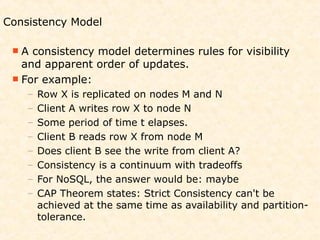
Consistency Model

 A  consistency model determines rules for visibility
   and apparent order of updates.
  For example:
    –   Row X is replicated on nodes M and N
    –   Client A writes row X to node N
    –   Some period of time t elapses.
    –   Client B reads row X from node M
    –   Does client B see the write from client A?
    –   Consistency is a continuum with tradeoffs
    –   For NoSQL, the answer would be: maybe
    –   CAP Theorem states: Strict Consistency can't be
        achieved at the same time as availability and partition-
        tolerance.
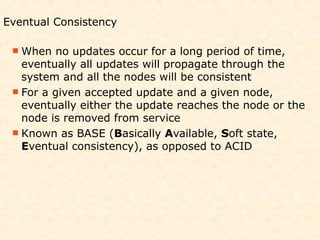
Eventual Consistency

  When   no updates occur for a long period of time,
   eventually all updates will propagate through the
   system and all the nodes will be consistent
  For a given accepted update and a given node,
   eventually either the update reaches the node or the
   node is removed from service
  Known as BASE (Basically Available, Soft state,
   Eventual consistency), as opposed to ACID
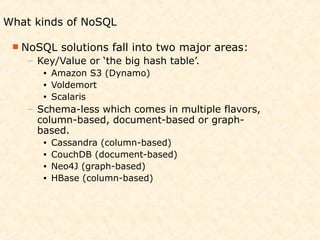
What kinds of NoSQL

  NoSQL    solutions fall into two major areas:
    – Key/Value or ‘the big hash table’.
       •   Amazon S3 (Dynamo)
       •   Voldemort
       •   Scalaris
    – Schema-less which comes in multiple flavors,
      column-based, document-based or graph-
      based.
       •   Cassandra (column-based)
       •   CouchDB (document-based)
       •   Neo4J (graph-based)
       •   HBase (column-based)
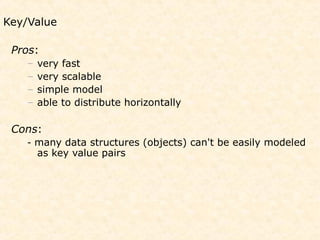
Key/Value

 Pros:
    –   very fast
    –   very scalable
    –   simple model
    –   able to distribute horizontally

 Cons:
    - many data structures (objects) can't be easily modeled
        as key value pairs
Schema-Less

 Pros:
   -   Schema-less data model is richer than key/value pairs
   -   eventual consistency
   -   many are distributed
   -   still provide excellent performance and scalability

 Cons:
   - typically no ACID transactions or joins
Common Advantages

  Cheap,  easy to implement (open source)
  Data are replicated to multiple nodes (therefore identical
   and fault-tolerant) and can be partitioned
    – Down nodes easily replaced
    – No single point of failure
  Easy to distribute
  Don't require a schema
  Can scale up and down
  Relax the data consistency requirement (CAP)
What am I giving up?

  joins
  group  by
  order by
  ACID transactions
  SQL as a sometimes frustrating but still powerful
   query language
  easy integration with other applications that support
   SQL
Cassandra

  Originallydeveloped at Facebook
  Follows the BigTable data model: column-oriented
  Uses the Dynamo Eventual Consistency model
  Written in Java
  Open-sourced and exists within the Apache family
  Uses Apache Thrift as it’s API
Thrift

  Created   at Facebook along with Cassandra
  Is a cross-language, service-generation framework
  Binary Protocol (like Google Protocol Buffers)
  Compiles to: C++, Java, PHP, Ruby, Erlang, Perl, ...
Searching

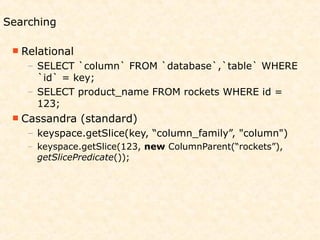
  Relational
    – SELECT `column` FROM `database`,`table` WHERE
      `id` = key;
    – SELECT product_name FROM rockets WHERE id =
      123;
  Cassandra    (standard)
    – keyspace.getSlice(key, “column_family”, "column")
    – keyspace.getSlice(123, new ColumnParent(“rockets”),
      getSlicePredicate());
Typical NoSQL API

  Basic   API access:
    – get(key) -- Extract the value given a key
    – put(key, value) -- Create or update the value given its
      key
    – delete(key) -- Remove the key and its associated
      value
    – execute(key, operation, parameters) -- Invoke an
      operation to the value (given its key) which is a
      special data structure (e.g. List, Set, Map .... etc).
Data Model

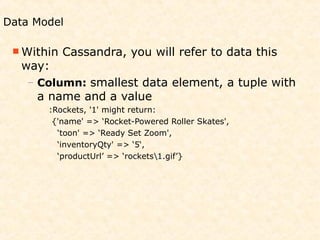
  Within   Cassandra, you will refer to data this
   way:
   – Column: smallest data element, a tuple with
     a name and a value
       :Rockets, '1' might return:
        {'name' => ‘Rocket-Powered Roller Skates',
         ‘toon' => ‘Ready Set Zoom',
         ‘inventoryQty' => ‘5‘,
         ‘productUrl’ => ‘rockets1.gif’}
Data Model Continued


    – ColumnFamily: There’s a single structure used to group
      both the Columns and SuperColumns. Called a
      ColumnFamily (think table), it has two types, Standard &
      Super.
       • Column families must be defined at startup

    – Key: the permanent name of the record
    – Keyspace: the outer-most level of organization. This
      is usually the name of the application. For example,
      ‘Acme' (think database name).
Cassandra and Consistency

  Talked previous about eventual consistency
  Cassandra has programmable read/writable
   consistency
    – One: Return from the first node that responds
    – Quorom: Query from all nodes and respond with the
      one that has latest timestamp once a majority of
      nodes responded
    – All: Query from all nodes and respond with the one
      that has latest timestamp once all nodes responded.
      An unresponsive node will fail the node
Cassandra and Consistency

    – Zero: Ensure nothing. Asynchronous write done in
      background
    – Any: Ensure that the write is written to at least 1
      node
    – One: Ensure that the write is written to at least 1
      node’s commit log and memory table before receipt to
      client
    – Quorom: Ensure that the write goes to node/2 + 1
    – All: Ensure that writes go to all nodes. An
      unresponsive node would fail the write
Consistent Hashing

  Partition using consistent hashing
    – Keys hash to a point on a
       fixed circular space
    – Ring is partitioned into a set of
       ordered slots and servers and
       keys hashed over these slots
  Nodes take positions on the circle.
  A, B, and D exists.
      – B responsible for AB range.
      – D responsible for BD range.
      – A responsible for DA range.
    C joins.
      – B, D split ranges.
      – C gets BC from D.
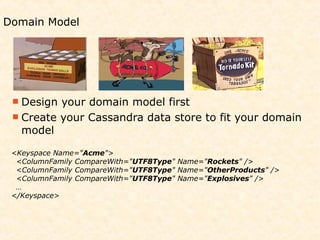
Domain Model


  Design your domain model first
  Create your Cassandra data store to fit your domain
   model

 <Keyspace Name="Acme">
   <ColumnFamily CompareWith="UTF8Type" Name="Rockets" />
   <ColumnFamily CompareWith="UTF8Type" Name="OtherProducts" />
   <ColumnFamily CompareWith="UTF8Type" Name="Explosives" />
  …
 </Keyspace>
Data Model

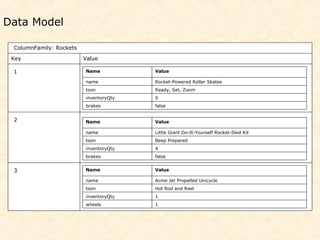
 ColumnFamily: Rockets

 Key                     Value

 1                       Name           Value

                         name           Rocket-Powered Roller Skates
                         toon           Ready, Set, Zoom
                         inventoryQty   5
                         brakes         false


 2                       Name           Value

                         name           Little Giant Do-It-Yourself Rocket-Sled Kit
                         toon           Beep Prepared
                         inventoryQty   4
                         brakes         false


 3                       Name           Value

                         name           Acme Jet Propelled Unicycle
                         toon           Hot Rod and Reel
                         inventoryQty   1
                         wheels         1
Data Model Continued

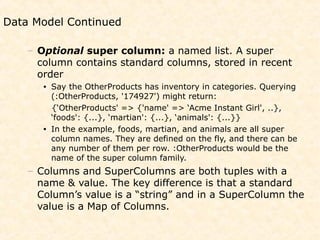
    – Optional super column: a named list. A super
      column contains standard columns, stored in recent
      order
       •   Say the OtherProducts has inventory in categories. Querying
           (:OtherProducts, '174927') might return:
           {‘OtherProducts' => {'name' => ‘Acme Instant Girl', ..},
           ‘foods': {...}, ‘martian': {...}, ‘animals': {...}}
       •   In the example, foods, martian, and animals are all super
           column names. They are defined on the fly, and there can be
           any number of them per row. :OtherProducts would be the
           name of the super column family.
    – Columns and SuperColumns are both tuples with a
      name & value. The key difference is that a standard
      Column’s value is a “string” and in a SuperColumn the
      value is a Map of Columns.
Data Model Continued

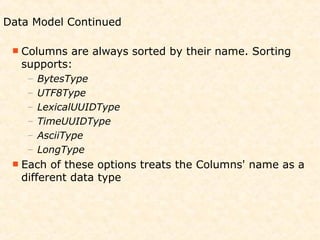
  Columns  are always sorted by their name. Sorting
   supports:
    –   BytesType
    –   UTF8Type
    –   LexicalUUIDType
    –   TimeUUIDType
    –   AsciiType
    –   LongType
  Each  of these options treats the Columns' name as a
   different data type
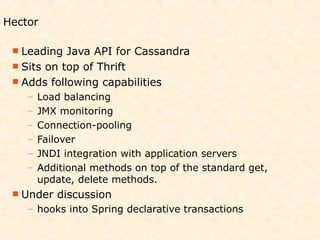
Hector

  Leading  Java API for Cassandra
  Sits on top of Thrift
  Adds following capabilities
    –   Load balancing
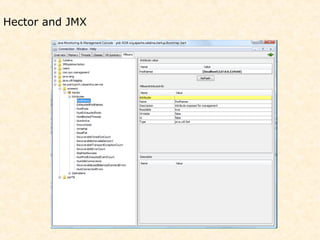
    –   JMX monitoring
    –   Connection-pooling
    –   Failover
    –   JNDI integration with application servers
    –   Additional methods on top of the standard get,
        update, delete methods.
  Under   discussion
    – hooks into Spring declarative transactions
Hector and JMX
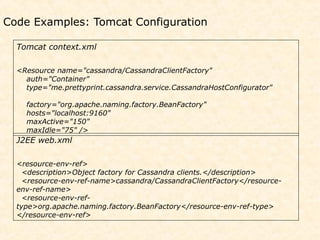
Code Examples: Tomcat Configuration

  Tomcat context.xml

  <Resource name="cassandra/CassandraClientFactory"
    auth="Container"
    type="me.prettyprint.cassandra.service.CassandraHostConfigurator"

    factory="org.apache.naming.factory.BeanFactory"
    hosts="localhost:9160"
    maxActive="150"
    maxIdle="75" />
  J2EE web.xml

  <resource-env-ref>
    <description>Object factory for Cassandra clients.</description>
    <resource-env-ref-name>cassandra/CassandraClientFactory</resource-
  env-ref-name>
    <resource-env-ref-
  type>org.apache.naming.factory.BeanFactory</resource-env-ref-type>
  </resource-env-ref>
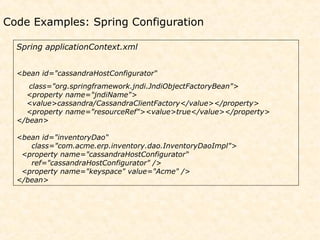
Code Examples: Spring Configuration

  Spring applicationContext.xml


  <bean id="cassandraHostConfigurator“
     class="org.springframework.jndi.JndiObjectFactoryBean">
    <property name="jndiName">
    <value>cassandra/CassandraClientFactory</value></property>
    <property name="resourceRef"><value>true</value></property>
  </bean>

  <bean id="inventoryDao“
     class="com.acme.erp.inventory.dao.InventoryDaoImpl">
   <property name="cassandraHostConfigurator“
     ref="cassandraHostConfigurator" />
   <property name="keyspace" value="Acme" />
  </bean>
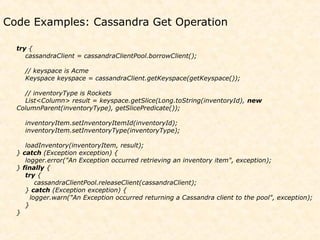
Code Examples: Cassandra Get Operation

  try {
     cassandraClient = cassandraClientPool.borrowClient();

    // keyspace is Acme
    Keyspace keyspace = cassandraClient.getKeyspace(getKeyspace());

    // inventoryType is Rockets
    List<Column> result = keyspace.getSlice(Long.toString(inventoryId), new
  ColumnParent(inventoryType), getSlicePredicate());

    inventoryItem.setInventoryItemId(inventoryId);
    inventoryItem.setInventoryType(inventoryType);

     loadInventory(inventoryItem, result);
  } catch (Exception exception) {
     logger.error("An Exception occurred retrieving an inventory item", exception);
  } finally {
     try {
         cassandraClientPool.releaseClient(cassandraClient);
     } catch (Exception exception) {
       logger.warn("An Exception occurred returning a Cassandra client to the pool", exception);
     }
  }
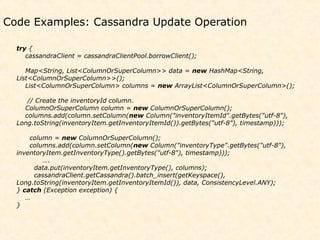
Code Examples: Cassandra Update Operation

  try {
     cassandraClient = cassandraClientPool.borrowClient();

     Map<String, List<ColumnOrSuperColumn>> data = new HashMap<String,
  List<ColumnOrSuperColumn>>();
     List<ColumnOrSuperColumn> columns = new ArrayList<ColumnOrSuperColumn>();

     // Create the inventoryId column.
    ColumnOrSuperColumn column = new ColumnOrSuperColumn();
    columns.add(column.setColumn(new Column("inventoryItemId".getBytes("utf-8"),
  Long.toString(inventoryItem.getInventoryItemId()).getBytes("utf-8"), timestamp)));

      column = new ColumnOrSuperColumn();
      columns.add(column.setColumn(new Column("inventoryType".getBytes("utf-8"),
  inventoryItem.getInventoryType().getBytes("utf-8"), timestamp)));
          ….
       data.put(inventoryItem.getInventoryType(), columns);
       cassandraClient.getCassandra().batch_insert(getKeyspace(),
  Long.toString(inventoryItem.getInventoryItemId()), data, ConsistencyLevel.ANY);
  } catch (Exception exception) {
     …
  }
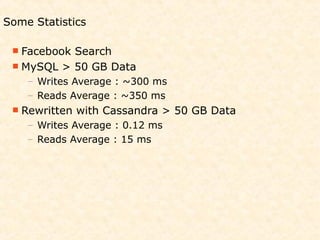
Some Statistics

  FacebookSearch
  MySQL > 50 GB Data
    – Writes Average : ~300 ms
    – Reads Average : ~350 ms
  Rewritten   with Cassandra > 50 GB Data
    – Writes Average : 0.12 ms
    – Reads Average : 15 ms
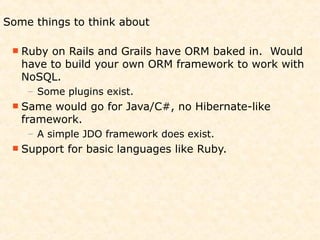
Some things to think about

  Ruby on Rails and Grails have ORM baked in. Would
   have to build your own ORM framework to work with
   NoSQL.
    – Some plugins exist.
  Same would go for Java/C#, no Hibernate-like
   framework.
    – A simple JDO framework does exist.
  Support   for basic languages like Ruby.
Some more things to think about

  Troubleshooting  performance problems
  Concurrency on non-key accesses
  Are the replicas working?
  No TOAD for Cassandra
    – though some NoSQL offerings have GUI tools
    – have SQLPlus-like capabilities using Ruby IRB
      interpreter.
Don’t forget about the DBA

  Itdoes not matter if the data is deployed on a
   NoSQL platform instead of an RDBMS.
  Still need to address:
    –   Backups & recovery
    –   Capacity planning
    –   Performance monitoring
    –   Data integration
    –   Tuning & optimization
  What happens when things don’t work as
   expected and nodes are out of sync or you
   have a data corruption occurring at 2am?
  Who you gonna call?
    – DBA and SysAdmin need to be on board
Where would I use it?

  For most of us, we work in corporate IT and a
   LinkedIn or Twitter is not in our future
  Where would I use a NoSQL database?
  Do you have somewhere a large set of uncontrolled,
   unstructured, data that you are trying to fit into a
   RDBMS?
    – Log Analysis
    – Social Networking Feeds (many firms hooked in
      through Facebook or Twitter)
    – External feeds from partners (EAI)
    – Data that is not easily analyzed in a RDBMS such as
      time-based data
    – Large data feeds that need to be massaged before
      entry into an RDBMS
Summary

  Leading users of NoSQL datastores are social
   networking sites such as Twitter, Facebook,
   LinkedIn, and Digg.
  To implement a single feature in Cassandra, Digg
   has a dataset that is 3 terabytes and 76 billion
   columns.
  Not every problem is a nail and not every solution is
   a hammer.
Questions
Resources

  Cassandra
   – http://cassandra.apache.org
  Hector
   – http://wiki.github.com/rantav/hector
   – http://prettyprint.me
  NoSQL    News websites
   – http://nosql.mypopescu.com
   – http://www.nosqldatabases.com
  High   Scalability
   – http://highscalability.com
  Video
   – http://www.infoq.com/presentations/Project-
     Voldemort-at-Gilt-Groupe

No sql

  • 1.
    NoSQL By Perry Hoekstra Technical Consultant Perficient, Inc. perry.hoekstra@perficient.com
  • 2.
    Why this topic?  Client’s Application Roadmap – “Reduction of cycle time for the document intake process. Currently, it can take anywhere from a few days to a few weeks from the time the documents are received to when they are available to the client.”  New York Times used Hadoop/MapReduce to convert pre-1980 articles that were TIFF images to PDF.
  • 3.
    Agenda  Some history  What is NoSQL  CAP Theorem  What is lost  Types of NoSQL  Data Model  Frameworks  Demo  Wrapup
  • 4.
    History of theWorld, Part 1  Relational Databases – mainstay of business  Web-based applications caused spikes – Especially true for public-facing e-Commerce sites  Developers begin to front RDBMS with memcache or integrate other caching mechanisms within the application (ie. Ehcache)
  • 5.
    Scaling Up Issues with scaling up when the dataset is just too big  RDBMS were not designed to be distributed  Began to look at multi-node database solutions  Known as ‘scaling out’ or ‘horizontal scaling’  Different approaches include: – Master-slave – Sharding
  • 6.
    Scaling RDBMS –Master/Slave  Master-Slave – All writes are written to the master. All reads performed against the replicated slave databases – Critical reads may be incorrect as writes may not have been propagated down – Large data sets can pose problems as master needs to duplicate data to slaves
  • 7.
    Scaling RDBMS -Sharding  Partition or sharding – Scales well for both reads and writes – Not transparent, application needs to be partition- aware – Can no longer have relationships/joins across partitions – Loss of referential integrity across shards
  • 8.
    Other ways toscale RDBMS  Multi-Masterreplication  INSERT only, not UPDATES/DELETES  No JOINs, thereby reducing query time – This involves de-normalizing data  In-memory databases
  • 9.
    What is NoSQL?  Stands for Not Only SQL  Class of non-relational data storage systems  Usually do not require a fixed table schema nor do they use the concept of joins  All NoSQL offerings relax one or more of the ACID properties (will talk about the CAP theorem)
  • 10.
    Why NoSQL? For data storage, an RDBMS cannot be the be- all/end-all  Just as there are different programming languages, need to have other data storage tools in the toolbox  A NoSQL solution is more acceptable to a client now than even a year ago – Think about proposing a Ruby/Rails or Groovy/Grails solution now versus a couple of years ago
  • 11.
    How did weget here?  Explosion of social media sites (Facebook, Twitter) with large data needs  Rise of cloud-based solutions such as Amazon S3 (simple storage solution)  Just as moving to dynamically-typed languages (Ruby/Groovy), a shift to dynamically-typed data with frequent schema changes  Open-source community
  • 12.
    Dynamo and BigTable  Three major papers were the seeds of the NoSQL movement – BigTable (Google) – Dynamo (Amazon) • Gossip protocol (discovery and error detection) • Distributed key-value data store • Eventual consistency – CAP Theorem (discuss in a sec ..)
  • 13.
    The Perfect Storm  Large datasets, acceptance of alternatives, and dynamically-typed data has come together in a perfect storm  Not a backlash/rebellion against RDBMS  SQL is a rich query language that cannot be rivaled by the current list of NoSQL offerings
  • 14.
    CAP Theorem Three properties of a system: consistency, availability and partitions  You can have at most two of these three properties for any shared-data system  To scale out, you have to partition. That leaves either consistency or availability to choose from – In almost all cases, you would choose availability over consistency
  • 15.
    Availability  Traditionally,thoughtof as the server/process available five 9’s (99.999 %).  However, for large node system, at almost any point in time there’s a good chance that a node is either down or there is a network disruption among the nodes. – Want a system that is resilient in the face of network disruption
  • 16.
    Consistency Model A consistency model determines rules for visibility and apparent order of updates.  For example: – Row X is replicated on nodes M and N – Client A writes row X to node N – Some period of time t elapses. – Client B reads row X from node M – Does client B see the write from client A? – Consistency is a continuum with tradeoffs – For NoSQL, the answer would be: maybe – CAP Theorem states: Strict Consistency can't be achieved at the same time as availability and partition- tolerance.
  • 17.
    Eventual Consistency When no updates occur for a long period of time, eventually all updates will propagate through the system and all the nodes will be consistent  For a given accepted update and a given node, eventually either the update reaches the node or the node is removed from service  Known as BASE (Basically Available, Soft state, Eventual consistency), as opposed to ACID
  • 18.
    What kinds ofNoSQL  NoSQL solutions fall into two major areas: – Key/Value or ‘the big hash table’. • Amazon S3 (Dynamo) • Voldemort • Scalaris – Schema-less which comes in multiple flavors, column-based, document-based or graph- based. • Cassandra (column-based) • CouchDB (document-based) • Neo4J (graph-based) • HBase (column-based)
  • 19.
    Key/Value Pros: – very fast – very scalable – simple model – able to distribute horizontally Cons: - many data structures (objects) can't be easily modeled as key value pairs
  • 20.
    Schema-Less Pros: - Schema-less data model is richer than key/value pairs - eventual consistency - many are distributed - still provide excellent performance and scalability Cons: - typically no ACID transactions or joins
  • 21.
    Common Advantages Cheap, easy to implement (open source)  Data are replicated to multiple nodes (therefore identical and fault-tolerant) and can be partitioned – Down nodes easily replaced – No single point of failure  Easy to distribute  Don't require a schema  Can scale up and down  Relax the data consistency requirement (CAP)
  • 22.
    What am Igiving up?  joins  group by  order by  ACID transactions  SQL as a sometimes frustrating but still powerful query language  easy integration with other applications that support SQL
  • 23.
    Cassandra  Originallydevelopedat Facebook  Follows the BigTable data model: column-oriented  Uses the Dynamo Eventual Consistency model  Written in Java  Open-sourced and exists within the Apache family  Uses Apache Thrift as it’s API
  • 24.
    Thrift  Created at Facebook along with Cassandra  Is a cross-language, service-generation framework  Binary Protocol (like Google Protocol Buffers)  Compiles to: C++, Java, PHP, Ruby, Erlang, Perl, ...
  • 25.
    Searching  Relational – SELECT `column` FROM `database`,`table` WHERE `id` = key; – SELECT product_name FROM rockets WHERE id = 123;  Cassandra (standard) – keyspace.getSlice(key, “column_family”, "column") – keyspace.getSlice(123, new ColumnParent(“rockets”), getSlicePredicate());
  • 26.
    Typical NoSQL API  Basic API access: – get(key) -- Extract the value given a key – put(key, value) -- Create or update the value given its key – delete(key) -- Remove the key and its associated value – execute(key, operation, parameters) -- Invoke an operation to the value (given its key) which is a special data structure (e.g. List, Set, Map .... etc).
  • 27.
    Data Model Within Cassandra, you will refer to data this way: – Column: smallest data element, a tuple with a name and a value :Rockets, '1' might return: {'name' => ‘Rocket-Powered Roller Skates', ‘toon' => ‘Ready Set Zoom', ‘inventoryQty' => ‘5‘, ‘productUrl’ => ‘rockets1.gif’}
  • 28.
    Data Model Continued – ColumnFamily: There’s a single structure used to group both the Columns and SuperColumns. Called a ColumnFamily (think table), it has two types, Standard & Super. • Column families must be defined at startup – Key: the permanent name of the record – Keyspace: the outer-most level of organization. This is usually the name of the application. For example, ‘Acme' (think database name).
  • 29.
    Cassandra and Consistency  Talked previous about eventual consistency  Cassandra has programmable read/writable consistency – One: Return from the first node that responds – Quorom: Query from all nodes and respond with the one that has latest timestamp once a majority of nodes responded – All: Query from all nodes and respond with the one that has latest timestamp once all nodes responded. An unresponsive node will fail the node
  • 30.
    Cassandra and Consistency – Zero: Ensure nothing. Asynchronous write done in background – Any: Ensure that the write is written to at least 1 node – One: Ensure that the write is written to at least 1 node’s commit log and memory table before receipt to client – Quorom: Ensure that the write goes to node/2 + 1 – All: Ensure that writes go to all nodes. An unresponsive node would fail the write
  • 31.
    Consistent Hashing Partition using consistent hashing – Keys hash to a point on a fixed circular space – Ring is partitioned into a set of ordered slots and servers and keys hashed over these slots  Nodes take positions on the circle.  A, B, and D exists. – B responsible for AB range. – D responsible for BD range. – A responsible for DA range.  C joins. – B, D split ranges. – C gets BC from D.
  • 32.
    Domain Model Design your domain model first  Create your Cassandra data store to fit your domain model <Keyspace Name="Acme">   <ColumnFamily CompareWith="UTF8Type" Name="Rockets" />   <ColumnFamily CompareWith="UTF8Type" Name="OtherProducts" />   <ColumnFamily CompareWith="UTF8Type" Name="Explosives" />  … </Keyspace>
  • 33.
    Data Model ColumnFamily:Rockets Key Value 1 Name Value name Rocket-Powered Roller Skates toon Ready, Set, Zoom inventoryQty 5 brakes false 2 Name Value name Little Giant Do-It-Yourself Rocket-Sled Kit toon Beep Prepared inventoryQty 4 brakes false 3 Name Value name Acme Jet Propelled Unicycle toon Hot Rod and Reel inventoryQty 1 wheels 1
  • 34.
    Data Model Continued – Optional super column: a named list. A super column contains standard columns, stored in recent order • Say the OtherProducts has inventory in categories. Querying (:OtherProducts, '174927') might return: {‘OtherProducts' => {'name' => ‘Acme Instant Girl', ..}, ‘foods': {...}, ‘martian': {...}, ‘animals': {...}} • In the example, foods, martian, and animals are all super column names. They are defined on the fly, and there can be any number of them per row. :OtherProducts would be the name of the super column family. – Columns and SuperColumns are both tuples with a name & value. The key difference is that a standard Column’s value is a “string” and in a SuperColumn the value is a Map of Columns.
  • 35.
    Data Model Continued  Columns are always sorted by their name. Sorting supports: – BytesType – UTF8Type – LexicalUUIDType – TimeUUIDType – AsciiType – LongType  Each of these options treats the Columns' name as a different data type
  • 36.
    Hector  Leading Java API for Cassandra  Sits on top of Thrift  Adds following capabilities – Load balancing – JMX monitoring – Connection-pooling – Failover – JNDI integration with application servers – Additional methods on top of the standard get, update, delete methods.  Under discussion – hooks into Spring declarative transactions
  • 37.
  • 38.
    Code Examples: TomcatConfiguration Tomcat context.xml <Resource name="cassandra/CassandraClientFactory" auth="Container" type="me.prettyprint.cassandra.service.CassandraHostConfigurator" factory="org.apache.naming.factory.BeanFactory" hosts="localhost:9160" maxActive="150" maxIdle="75" /> J2EE web.xml <resource-env-ref> <description>Object factory for Cassandra clients.</description> <resource-env-ref-name>cassandra/CassandraClientFactory</resource- env-ref-name> <resource-env-ref- type>org.apache.naming.factory.BeanFactory</resource-env-ref-type> </resource-env-ref>
  • 39.
    Code Examples: SpringConfiguration Spring applicationContext.xml <bean id="cassandraHostConfigurator“ class="org.springframework.jndi.JndiObjectFactoryBean"> <property name="jndiName"> <value>cassandra/CassandraClientFactory</value></property> <property name="resourceRef"><value>true</value></property> </bean> <bean id="inventoryDao“ class="com.acme.erp.inventory.dao.InventoryDaoImpl"> <property name="cassandraHostConfigurator“ ref="cassandraHostConfigurator" /> <property name="keyspace" value="Acme" /> </bean>
  • 40.
    Code Examples: CassandraGet Operation try { cassandraClient = cassandraClientPool.borrowClient(); // keyspace is Acme Keyspace keyspace = cassandraClient.getKeyspace(getKeyspace()); // inventoryType is Rockets List<Column> result = keyspace.getSlice(Long.toString(inventoryId), new ColumnParent(inventoryType), getSlicePredicate()); inventoryItem.setInventoryItemId(inventoryId); inventoryItem.setInventoryType(inventoryType); loadInventory(inventoryItem, result); } catch (Exception exception) { logger.error("An Exception occurred retrieving an inventory item", exception); } finally { try { cassandraClientPool.releaseClient(cassandraClient); } catch (Exception exception) { logger.warn("An Exception occurred returning a Cassandra client to the pool", exception); } }
  • 41.
    Code Examples: CassandraUpdate Operation try { cassandraClient = cassandraClientPool.borrowClient(); Map<String, List<ColumnOrSuperColumn>> data = new HashMap<String, List<ColumnOrSuperColumn>>(); List<ColumnOrSuperColumn> columns = new ArrayList<ColumnOrSuperColumn>(); // Create the inventoryId column. ColumnOrSuperColumn column = new ColumnOrSuperColumn(); columns.add(column.setColumn(new Column("inventoryItemId".getBytes("utf-8"), Long.toString(inventoryItem.getInventoryItemId()).getBytes("utf-8"), timestamp))); column = new ColumnOrSuperColumn(); columns.add(column.setColumn(new Column("inventoryType".getBytes("utf-8"), inventoryItem.getInventoryType().getBytes("utf-8"), timestamp))); …. data.put(inventoryItem.getInventoryType(), columns); cassandraClient.getCassandra().batch_insert(getKeyspace(), Long.toString(inventoryItem.getInventoryItemId()), data, ConsistencyLevel.ANY); } catch (Exception exception) { … }
  • 42.
    Some Statistics FacebookSearch  MySQL > 50 GB Data – Writes Average : ~300 ms – Reads Average : ~350 ms  Rewritten with Cassandra > 50 GB Data – Writes Average : 0.12 ms – Reads Average : 15 ms
  • 43.
    Some things tothink about  Ruby on Rails and Grails have ORM baked in. Would have to build your own ORM framework to work with NoSQL. – Some plugins exist.  Same would go for Java/C#, no Hibernate-like framework. – A simple JDO framework does exist.  Support for basic languages like Ruby.
  • 44.
    Some more thingsto think about  Troubleshooting performance problems  Concurrency on non-key accesses  Are the replicas working?  No TOAD for Cassandra – though some NoSQL offerings have GUI tools – have SQLPlus-like capabilities using Ruby IRB interpreter.
  • 45.
    Don’t forget aboutthe DBA  Itdoes not matter if the data is deployed on a NoSQL platform instead of an RDBMS.  Still need to address: – Backups & recovery – Capacity planning – Performance monitoring – Data integration – Tuning & optimization  What happens when things don’t work as expected and nodes are out of sync or you have a data corruption occurring at 2am?  Who you gonna call? – DBA and SysAdmin need to be on board
  • 46.
    Where would Iuse it?  For most of us, we work in corporate IT and a LinkedIn or Twitter is not in our future  Where would I use a NoSQL database?  Do you have somewhere a large set of uncontrolled, unstructured, data that you are trying to fit into a RDBMS? – Log Analysis – Social Networking Feeds (many firms hooked in through Facebook or Twitter) – External feeds from partners (EAI) – Data that is not easily analyzed in a RDBMS such as time-based data – Large data feeds that need to be massaged before entry into an RDBMS
  • 47.
    Summary  Leadingusers of NoSQL datastores are social networking sites such as Twitter, Facebook, LinkedIn, and Digg.  To implement a single feature in Cassandra, Digg has a dataset that is 3 terabytes and 76 billion columns.  Not every problem is a nail and not every solution is a hammer.
  • 48.
  • 49.
    Resources  Cassandra – http://cassandra.apache.org  Hector – http://wiki.github.com/rantav/hector – http://prettyprint.me  NoSQL News websites – http://nosql.mypopescu.com – http://www.nosqldatabases.com  High Scalability – http://highscalability.com  Video – http://www.infoq.com/presentations/Project- Voldemort-at-Gilt-Groupe