
“EPoC”:
The Art of Mixed Media


      Edwin J. Mallette
           04/21/2012
This Talk Will Cover:

(A Few) Drivers for the EPON Protocol
over a Coax (EPoC) PHY
Coaxial Network Types
EPoC Deployment Models
Coaxial Network Variability
Needed Flexibilities in the EPoC PHY
Closing Remarks.
(A Few) Drivers for EPoC
EPoC is the EPON Protocol over a Coax PHY. The
intent is that the EPON MAC is intended to be
common across EPoC and EPON.
Some operators have a strong desire for high line-rate
performance with features included in EPON (e.g. QoS
guarantees) where the drop to the subscriber happens
to be comprised (in full or in part) of coaxial cable.
Specific operator use cases include:
 Operators that use EPON to backhaul other Ethernet over
  Coax solutions which are used to reach subscribers over
  coaxial cable within a Multiple Dwelling Unit (MDU).
 Operators with DOCSIS deployments who are also
  deploying EPON for higher speed first mile access and are
  interested in EPON-like performance over a CxDN with
  DOCSIS Provisioning of EPON (DPoETM).
Coaxial Network Types
There are two general types of coaxial networks
 The first is the “Passive” coaxial plant; one that does not
  use line extenders, amplifiers, or other in-line powered
  devices.
 The second is the “Active” coaxial plant which uses
  amplifiers to extend reach, distance, supported number of
  splits on the coaxial plant.
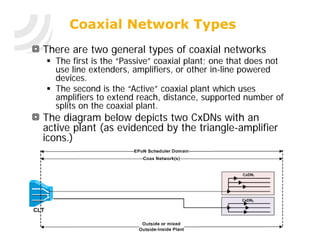
The diagram below depicts two CxDNs with an
active plant (as evidenced by the triangle-amplifier
icons.)
EPoC Deployment Model1
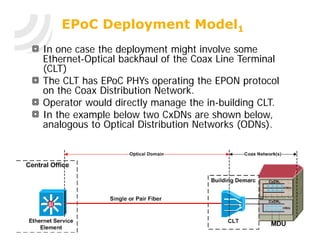
In one case the deployment might involve some
Ethernet-Optical backhaul of the Coax Line Terminal
(CLT)
The CLT has EPoC PHYs operating the EPON protocol
on the Coax Distribution Network.
Operator would directly manage the in-building CLT.
In the example below two CxDNs are shown below,
analogous to Optical Distribution Networks (ODNs).
EPoC Deployment Model2
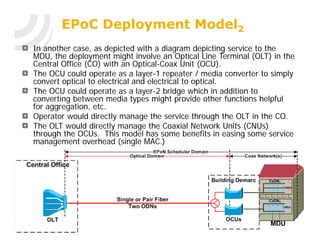
In another case, as depicted with a diagram depicting service to the
MDU, the deployment might involve an Optical Line Terminal (OLT) in the
Central Office (CO) with an Optical-Coax Unit (OCU).
The OCU could operate as a layer-1 repeater / media converter to simply
convert optical to electrical and electrical to optical.
The OCU could operate as a layer-2 bridge which in addition to
converting between media types might provide other functions helpful
for aggregation, etc.
Operator would directly manage the service through the OLT in the CO.
The OLT would directly manage the Coaxial Network Units (CNUs)
through the OCUs. This model has some benefits in easing some service
management overhead (single MAC.)
EPoC Deployment Model3

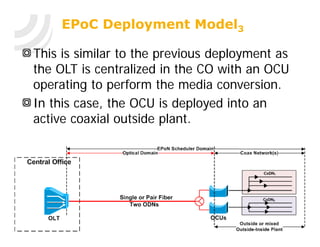
This is similar to the previous deployment as
the OLT is centralized in the CO with an OCU
operating to perform the media conversion.
In this case, the OCU is deployed into an
active coaxial outside plant.
CxDN Variability1
The coaxial plant is widely variable from operator to
operator, within an operator’s networks from market to
market, even within the same market.
The coaxial plant where the EPoC PHY has to live may
be active or passive.
 In active coaxial plants the amplified bands may be as high
  as 1000MHz or may be lower like 600MHz.
 This has implications W.R.T. how far amplifiers are spaced
  apart.
For EPoC, a single CxDN may pass 1000 subscribers or
may pass a much smaller number like 20.
The coaxial plant distance may be small – 200 meters
or less, or large – ~2 kilometers.
Specific plant conditions, depending on how well the
coaxial plant is maintained, what kind of spurious
noise is generated into the plant, etc, vary from
deployment to deployment.
CxDN Variability2
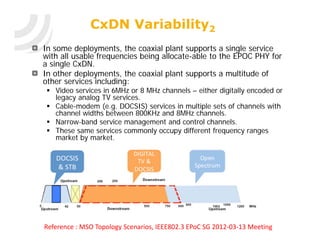
In some deployments, the coaxial plant supports a single service
with all usable frequencies being allocate-able to the EPOC PHY for
a single CxDN.
In other deployments, the coaxial plant supports a multitude of
other services including:
  Video services in 6MHz or 8 MHz channels – either digitally encoded or
   legacy analog TV services.
  Cable-modem (e.g. DOCSIS) services in multiple sets of channels with
   channel widths between 800KHz and 8MHz channels.
  Narrow-band service management and control channels.
  These same services commonly occupy different frequency ranges
   market by market.


Reference : MSO Topology Scenarios, IEEE802.3 EPoC SG 2012‐03‐13 Meeting 
PHY Flexibility
To account for this physical layer variability, the EPoC
PHY will need to support:
 Flexible (and configurable) Upstream and Downstream
  frequency placement and frequency band widths.
 Flexible (and configurable) bit-loading (bits per Hertz)
  within a sub-carrier.
 Flexible upstream and downstream MAC data rates.
 Traversing in-line amplification, equalization as well as
  “unimproved” (e.g. un-amplified) spectrum.
 Compatibility with other services.
 Robustness to survive in harsh (e.g. noisy) conditions even
  if the MAC data rate must be reduced.
With the goal of supporting up to 1Gbps+ Upstream
and Downstream in some amount of spectrum.
Closing Remarks
There are many Ethernet over Coax technologies out there.
Often in-MDU EoCs that use EPON as the loop to the MDU have
two MACs – one for the EoC and a separate MAC for EPON.
This commonly means separate provisioning of both the optical
and coaxial network devices.
EPoC provides efficiency in a common MAC, shared with the
most widely deployed FTTX technology in EPON.
EPoC is expected to simplify forwarding, reduce protocol
conversion, and simplify provisioning (over other EoC+EPON
solutions).
And coax drops aren’t going away any time soon (largely due to
time and money constraints.)
The ultimate desire with EPoC is to be able to leverage the vast
EPON supplier market to hold down the costs of future EPoC
products.
And provisioning of EPON with specifications like DPoE to also
provision EPoC access is KEY.
Thank You!!->

“EPoC”: The Art of Mixed Media

  • 1.
    “EPoC”: The Art ofMixed Media Edwin J. Mallette 04/21/2012
  • 2.
    This Talk WillCover: (A Few) Drivers for the EPON Protocol over a Coax (EPoC) PHY Coaxial Network Types EPoC Deployment Models Coaxial Network Variability Needed Flexibilities in the EPoC PHY Closing Remarks.
  • 3.
    (A Few) Driversfor EPoC EPoC is the EPON Protocol over a Coax PHY. The intent is that the EPON MAC is intended to be common across EPoC and EPON. Some operators have a strong desire for high line-rate performance with features included in EPON (e.g. QoS guarantees) where the drop to the subscriber happens to be comprised (in full or in part) of coaxial cable. Specific operator use cases include:  Operators that use EPON to backhaul other Ethernet over Coax solutions which are used to reach subscribers over coaxial cable within a Multiple Dwelling Unit (MDU).  Operators with DOCSIS deployments who are also deploying EPON for higher speed first mile access and are interested in EPON-like performance over a CxDN with DOCSIS Provisioning of EPON (DPoETM).
  • 4.
    Coaxial Network Types Thereare two general types of coaxial networks  The first is the “Passive” coaxial plant; one that does not use line extenders, amplifiers, or other in-line powered devices.  The second is the “Active” coaxial plant which uses amplifiers to extend reach, distance, supported number of splits on the coaxial plant. The diagram below depicts two CxDNs with an active plant (as evidenced by the triangle-amplifier icons.)
  • 5.
    EPoC Deployment Model1 Inone case the deployment might involve some Ethernet-Optical backhaul of the Coax Line Terminal (CLT) The CLT has EPoC PHYs operating the EPON protocol on the Coax Distribution Network. Operator would directly manage the in-building CLT. In the example below two CxDNs are shown below, analogous to Optical Distribution Networks (ODNs).
  • 6.
    EPoC Deployment Model2 Inanother case, as depicted with a diagram depicting service to the MDU, the deployment might involve an Optical Line Terminal (OLT) in the Central Office (CO) with an Optical-Coax Unit (OCU). The OCU could operate as a layer-1 repeater / media converter to simply convert optical to electrical and electrical to optical. The OCU could operate as a layer-2 bridge which in addition to converting between media types might provide other functions helpful for aggregation, etc. Operator would directly manage the service through the OLT in the CO. The OLT would directly manage the Coaxial Network Units (CNUs) through the OCUs. This model has some benefits in easing some service management overhead (single MAC.)
  • 7.
    EPoC Deployment Model3 Thisis similar to the previous deployment as the OLT is centralized in the CO with an OCU operating to perform the media conversion. In this case, the OCU is deployed into an active coaxial outside plant.
  • 8.
    CxDN Variability1 The coaxialplant is widely variable from operator to operator, within an operator’s networks from market to market, even within the same market. The coaxial plant where the EPoC PHY has to live may be active or passive.  In active coaxial plants the amplified bands may be as high as 1000MHz or may be lower like 600MHz.  This has implications W.R.T. how far amplifiers are spaced apart. For EPoC, a single CxDN may pass 1000 subscribers or may pass a much smaller number like 20. The coaxial plant distance may be small – 200 meters or less, or large – ~2 kilometers. Specific plant conditions, depending on how well the coaxial plant is maintained, what kind of spurious noise is generated into the plant, etc, vary from deployment to deployment.
  • 9.
    CxDN Variability2 In somedeployments, the coaxial plant supports a single service with all usable frequencies being allocate-able to the EPOC PHY for a single CxDN. In other deployments, the coaxial plant supports a multitude of other services including:  Video services in 6MHz or 8 MHz channels – either digitally encoded or legacy analog TV services.  Cable-modem (e.g. DOCSIS) services in multiple sets of channels with channel widths between 800KHz and 8MHz channels.  Narrow-band service management and control channels.  These same services commonly occupy different frequency ranges market by market. Reference : MSO Topology Scenarios, IEEE802.3 EPoC SG 2012‐03‐13 Meeting 
  • 10.
    PHY Flexibility To accountfor this physical layer variability, the EPoC PHY will need to support:  Flexible (and configurable) Upstream and Downstream frequency placement and frequency band widths.  Flexible (and configurable) bit-loading (bits per Hertz) within a sub-carrier.  Flexible upstream and downstream MAC data rates.  Traversing in-line amplification, equalization as well as “unimproved” (e.g. un-amplified) spectrum.  Compatibility with other services.  Robustness to survive in harsh (e.g. noisy) conditions even if the MAC data rate must be reduced. With the goal of supporting up to 1Gbps+ Upstream and Downstream in some amount of spectrum.
  • 11.
    Closing Remarks There aremany Ethernet over Coax technologies out there. Often in-MDU EoCs that use EPON as the loop to the MDU have two MACs – one for the EoC and a separate MAC for EPON. This commonly means separate provisioning of both the optical and coaxial network devices. EPoC provides efficiency in a common MAC, shared with the most widely deployed FTTX technology in EPON. EPoC is expected to simplify forwarding, reduce protocol conversion, and simplify provisioning (over other EoC+EPON solutions). And coax drops aren’t going away any time soon (largely due to time and money constraints.) The ultimate desire with EPoC is to be able to leverage the vast EPON supplier market to hold down the costs of future EPoC products. And provisioning of EPON with specifications like DPoE to also provision EPoC access is KEY.
  • 12.