IEEE 1904.1 (SIEPON)
Architecture and Model
      Marek Hajduczenia
       ZTE Corporation
     marek.hajduczenia@zte.pt
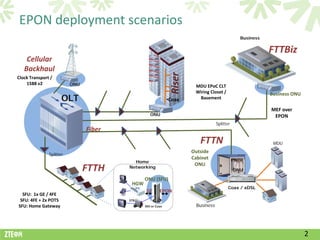
EPON deployment scenarios
                                                                                              Business

                                                                                                         FTTBiz
    Cellular
   Backhaul


                                                             Riser
Clock Transport /
    1588 v2               ONU                                         MDU EPoC CLT
                                                                      Wiring Closet /                    Business ONU
                      OLT                                    •Coax      Basement

                                                                                                         MEF over
                                                  ONU                                                     EPON
                                                                                 Splitter
                                Fiber
                                                                        FTTN                              MDU
                                                                     Outside
               Splitter
                                                                     Cabinet
                                          Home
                                                                      ONU
                                FTTH    Networking
                                                                                            ONU

                                               ONU (SFU)
                                         HGW
                                                                                        Coax / xDSL
                                               GE       EPON
  SFU: 1x GE / 4FE
 SFU: 4FE + 2x POTS                     STB
SFU: Home Gateway                              MII or Coax            Business


                                                                                                                        2
Service-layer interoperability …
•   IEEE 802.3 provides solid PHY standard guaranteeing interoperability at
    physical, MAC and MPCP/OAM levels
•   Service layer interoperability was enforced by individual operators, defining
    their own service layer requirements on top of 802.3 specs (e.g. CTC, NTT, KT
    etc.)
•   This approach leads to an explosive growth in number of parallel and similar
    specifications, leading to problems for
     – operators: equipment has to be customized to their needs, thus becomes more
       expensive; and
     – vendors: need to support multiple sets of options, leading to longer development
       cycles, increased manufacturing cost and incremental software complexity for
       management platforms
•   Clearly, this approach is not scalable to a larger number of carriers and
    prevents smaller operators from adopting EPON as transport solution for their
    access networks
•   A solution is needed to facilitate adoption of EPON by creating service layer
    interoperability standard


                                                                                          3
Various operators – one standard
                                                          Operator


                                                                                      O
                                                             B


                                                                                        pe
                                                                                           ra
    EPON is being used in


                                                                                                                 to
                                                                                              C
•


                                                                                                                    r
                                                                                                B ru e
                                                                                                 B
    various environments


                                                                                                  fo SL
                                                                                                   F sin nvi
                                                           S g m s
                                                              vi O ts


                                                                                                                        Ope
                                                         SI in e ab


                                                                                                    R g ro
                                                                  nm in


                                                                                                     D
                                                                       t
                                                            en EP en


                                                                                                     eq E n
                                                                    en
                                                        C s ir L


                                                                ro N
                                           Operator
     – Some would like to


                                                       O u u le


                                                                                                       ui PO me
                                                      D for Req ab


                                                                                                         re N n


                                                                                                                           rator
                                                                                                                            D
                                                                                                           m
                                                                C
       manage EPON as part


                                              A


                                                                                                             en in
                                                                                                               ts
       of DOCSIS network


                                                                                                                   t
     – Some would like to
                                                                      IEEE 802.3ah
       manage EPON like                                                 (1G-EPON)
       DSL network
•   Many external specifications                                      IEEE 802.3av
                                                                       (10G-EPON)
    supply requirements relevant
    to EPON technology
     – BBF (WT-200)


                                                                                                           r
                                                                                                      G ato
                                                        O
                                                         pe E


                                                                                                        r
     – CableLabs (DPoE)


                                                                                                   pe
                                                           ra


                                                                                                 O
                                                             to
     – Also, deployed solutions reflect


                                                                r
                                                                           Operator
       different regulatory or national                                       F
       environments
•   The goal of SIEPON project is to address these diverse requirements in a
    consistent and unified way
     – Improve system-level interoperability by specifying a common management and provisioning
       framework.

                                                                                                                          4
Main focus of SIEPON
• SIEPON provides interoperable service-layer specifications for the
  following features:
    – frame operations performed on ONU and OLT, including VLAN modes, tunneling modes
      and multicast distribution
    – bandwidth reporting and QoS enforcement
    – power saving
    – line and device protection and monitoring functions
    – alarms and warnings, including set and reset conditions and delivery mechanisms
    – authentication, privacy and encryption mechanisms
    – maintenance mechanisms, including software update, ONU discovery and registration
      processes
    – extended management (eOAM), including definition of protocol requirements, message
      format and their exchange sequences for specific functions (e.g., during authentication)
• These functions are defined in a sets (packages), which eliminate the need
  for options, facilitating development of compliant equipment and testing


                                                                                                 5
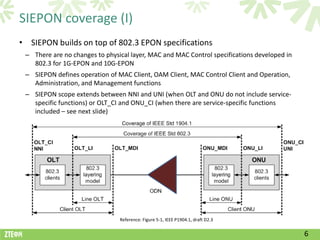
SIEPON coverage (I)
• SIEPON builds on top of 802.3 EPON specifications
 – There are no changes to physical layer, MAC and MAC Control specifications developed in
   802.3 for 1G-EPON and 10G-EPON
 – SIEPON defines operation of MAC Client, OAM Client, MAC Control Client and Operation,
   Administration, and Management functions
 – SIEPON scope extends between NNI and UNI (when OLT and ONU do not include service-
   specific functions) or OLT_CI and ONU_CI (when there are service-specific functions
   included – see next slide)


                                Reference: Figure 5-1, IEEE P1904.1, draft D2.3


                                                                                             6
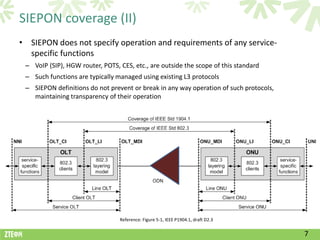
SIEPON coverage (II)
• SIEPON does not specify operation and requirements of any service-
  specific functions
 – VoIP (SIP), HGW router, POTS, CES, etc., are outside the scope of this standard
 – Such functions are typically managed using existing L3 protocols
 – SIEPON definitions do not prevent or break in any way operation of such protocols,
   maintaining transparency of their operation


                                 Reference: Figure 5-1, IEEE P1904.1, draft D2.3


                                                                                        7
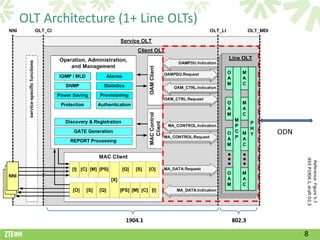
OLT Architecture (1+ Line OLTs)


                                          ODN


                                                IEEE P1904.1, draft D2.3
                                                  Reference: Figure 5-7
                  1904.1          802.3

                                                8
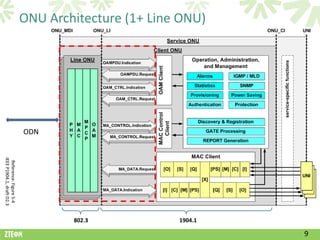
ONU Architecture (1+ Line ONU)


                           ODN
IEEE P1904.1, draft D2.3
  Reference: Figure 5-4


                                   802.3            1904.1

                                                             9
Line, Client, Service ONU / OLT …
• SIEPON clearly delineates bounds of specification
   – Line device = functions defined in 802.3, providing a set of
     standardized primitives for interaction with MAC Client, MAC Control
     Client and OAM Client,
     Line device cannot establish connectivity with link peer without
     support of functions defined by SIEPON,
   – Client device = Line device + additional functions and processes
     specified in SIEPON;
     Client device is capable of establishing bidirectional connectivity with
     link peer, sending and receiving user frames (with necessary
     processing), participating in MPCP and OAM processes (Discovery &
     Registration, OAM Discovery, etc.),
   – Service device = Client device + additional, service-specific functions
     outside of the scope of this standard,


                                                                                10
MAC Client
                                                                                                             Reference: Figure 6-1, IEEE P1904.1, draft D2.3

 SIEPON provides unified                             Legend
   provisioning model for the MAC                                          Path for data frames                                               Block controls connectivity

   Client data path:                                                       Path for control                                                   Block controls performance

    –   [C] = Classifier                                                   Path for management
    –   [M] = Modifier
    –   [PS] = Policer/Shaper
    –   [X] = CrossConnect


                                                                                                     Policer/Shaper [PS]


                                                                                                                           CrossConnect [X]
    –   [Q] = Queues


                                                                                                                                                               Scheduler [S]
                                                               Classifier [C]


                                                                                   Modifer [M]


                                                                                                                                                  Queues [Q]


                                                                                                                                                                               Output [O]
        [S] = Scheduler


                                          Input [I]
    –
 Each functional block has a
   dedicated set of functions
   (examples follow):
    – Classifier: identifies frames and
      controls their path through MAC
      Client
                                                                                   Provisioning / Alarms & Status
    – Modifier: operations on frames,
      changing VLAN tags, colour marking                                                         a) Functional blocks
      etc., as provisioned
    – Scheduler: polls queues for frames
      and delivers them to Output port.                                         [I] [C] [M] [PS] [X] [Q] [S] [O]

                                                                                         b) Compact representation


                                                                                                                                                                               11
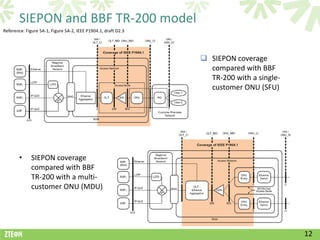
SIEPON and BBF TR-200 model
Reference: Figure 5A-1, Figure 5A-2, IEEE P1904.1, draft D2.3


                                                                 SIEPON coverage
                                                                  compared with BBF
                                                                  TR-200 with a single-
                                                                  customer ONU (SFU)


        •     SIEPON coverage
              compared with BBF
              TR-200 with a multi-
              customer ONU (MDU)


                                                                                          12
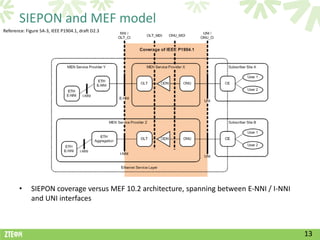
SIEPON and MEF model
Reference: Figure 5A-3, IEEE P1904.1, draft D2.3


        •     SIEPON coverage versus MEF 10.2 architecture, spanning between E-NNI / I-NNI
              and UNI interfaces


                                                                                             13
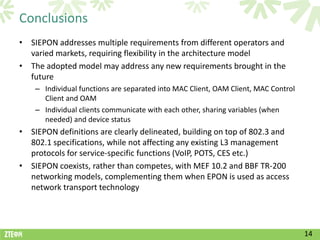
Conclusions
• SIEPON addresses multiple requirements from different operators and
  varied markets, requiring flexibility in the architecture model
• The adopted model may address any new requirements brought in the
  future
    – Individual functions are separated into MAC Client, OAM Client, MAC Control
      Client and OAM
    – Individual clients communicate with each other, sharing variables (when
      needed) and device status
• SIEPON definitions are clearly delineated, building on top of 802.3 and
  802.1 specifications, while not affecting any existing L3 management
  protocols for service-specific functions (VoIP, POTS, CES etc.)
• SIEPON coexists, rather than competes, with MEF 10.2 and BBF TR-200
  networking models, complementing them when EPON is used as access
  network transport technology


                                                                                    14
Thanks!

IEEE 1904.1 (SIEPON) Architecture and Model

  • 1.
    IEEE 1904.1 (SIEPON) Architectureand Model Marek Hajduczenia ZTE Corporation marek.hajduczenia@zte.pt
  • 2.
    EPON deployment scenarios Business FTTBiz Cellular Backhaul Riser Clock Transport / 1588 v2 ONU MDU EPoC CLT Wiring Closet / Business ONU OLT •Coax Basement MEF over ONU EPON Splitter Fiber FTTN MDU Outside Splitter Cabinet Home ONU FTTH Networking ONU ONU (SFU) HGW Coax / xDSL GE EPON SFU: 1x GE / 4FE SFU: 4FE + 2x POTS STB SFU: Home Gateway MII or Coax Business 2
  • 3.
    Service-layer interoperability … • IEEE 802.3 provides solid PHY standard guaranteeing interoperability at physical, MAC and MPCP/OAM levels • Service layer interoperability was enforced by individual operators, defining their own service layer requirements on top of 802.3 specs (e.g. CTC, NTT, KT etc.) • This approach leads to an explosive growth in number of parallel and similar specifications, leading to problems for – operators: equipment has to be customized to their needs, thus becomes more expensive; and – vendors: need to support multiple sets of options, leading to longer development cycles, increased manufacturing cost and incremental software complexity for management platforms • Clearly, this approach is not scalable to a larger number of carriers and prevents smaller operators from adopting EPON as transport solution for their access networks • A solution is needed to facilitate adoption of EPON by creating service layer interoperability standard 3
  • 4.
    Various operators –one standard Operator O B pe ra EPON is being used in to C • r B ru e B various environments fo SL F sin nvi S g m s vi O ts Ope SI in e ab R g ro nm in D t en EP en eq E n en C s ir L ro N Operator – Some would like to O u u le ui PO me D for Req ab re N n rator D m C manage EPON as part A en in ts of DOCSIS network t – Some would like to IEEE 802.3ah manage EPON like (1G-EPON) DSL network • Many external specifications IEEE 802.3av (10G-EPON) supply requirements relevant to EPON technology – BBF (WT-200) r G ato O pe E r – CableLabs (DPoE) pe ra O to – Also, deployed solutions reflect r Operator different regulatory or national F environments • The goal of SIEPON project is to address these diverse requirements in a consistent and unified way – Improve system-level interoperability by specifying a common management and provisioning framework. 4
  • 5.
    Main focus ofSIEPON • SIEPON provides interoperable service-layer specifications for the following features: – frame operations performed on ONU and OLT, including VLAN modes, tunneling modes and multicast distribution – bandwidth reporting and QoS enforcement – power saving – line and device protection and monitoring functions – alarms and warnings, including set and reset conditions and delivery mechanisms – authentication, privacy and encryption mechanisms – maintenance mechanisms, including software update, ONU discovery and registration processes – extended management (eOAM), including definition of protocol requirements, message format and their exchange sequences for specific functions (e.g., during authentication) • These functions are defined in a sets (packages), which eliminate the need for options, facilitating development of compliant equipment and testing 5
  • 6.
    SIEPON coverage (I) •SIEPON builds on top of 802.3 EPON specifications – There are no changes to physical layer, MAC and MAC Control specifications developed in 802.3 for 1G-EPON and 10G-EPON – SIEPON defines operation of MAC Client, OAM Client, MAC Control Client and Operation, Administration, and Management functions – SIEPON scope extends between NNI and UNI (when OLT and ONU do not include service- specific functions) or OLT_CI and ONU_CI (when there are service-specific functions included – see next slide) Reference: Figure 5-1, IEEE P1904.1, draft D2.3 6
  • 7.
    SIEPON coverage (II) •SIEPON does not specify operation and requirements of any service- specific functions – VoIP (SIP), HGW router, POTS, CES, etc., are outside the scope of this standard – Such functions are typically managed using existing L3 protocols – SIEPON definitions do not prevent or break in any way operation of such protocols, maintaining transparency of their operation Reference: Figure 5-1, IEEE P1904.1, draft D2.3 7
  • 8.
    OLT Architecture (1+Line OLTs) ODN IEEE P1904.1, draft D2.3 Reference: Figure 5-7 1904.1 802.3 8
  • 9.
    ONU Architecture (1+Line ONU) ODN IEEE P1904.1, draft D2.3 Reference: Figure 5-4 802.3 1904.1 9
  • 10.
    Line, Client, ServiceONU / OLT … • SIEPON clearly delineates bounds of specification – Line device = functions defined in 802.3, providing a set of standardized primitives for interaction with MAC Client, MAC Control Client and OAM Client, Line device cannot establish connectivity with link peer without support of functions defined by SIEPON, – Client device = Line device + additional functions and processes specified in SIEPON; Client device is capable of establishing bidirectional connectivity with link peer, sending and receiving user frames (with necessary processing), participating in MPCP and OAM processes (Discovery & Registration, OAM Discovery, etc.), – Service device = Client device + additional, service-specific functions outside of the scope of this standard, 10
  • 11.
    MAC Client Reference: Figure 6-1, IEEE P1904.1, draft D2.3  SIEPON provides unified Legend provisioning model for the MAC Path for data frames Block controls connectivity Client data path: Path for control Block controls performance – [C] = Classifier Path for management – [M] = Modifier – [PS] = Policer/Shaper – [X] = CrossConnect Policer/Shaper [PS] CrossConnect [X] – [Q] = Queues Scheduler [S] Classifier [C] Modifer [M] Queues [Q] Output [O] [S] = Scheduler Input [I] –  Each functional block has a dedicated set of functions (examples follow): – Classifier: identifies frames and controls their path through MAC Client Provisioning / Alarms & Status – Modifier: operations on frames, changing VLAN tags, colour marking a) Functional blocks etc., as provisioned – Scheduler: polls queues for frames and delivers them to Output port. [I] [C] [M] [PS] [X] [Q] [S] [O] b) Compact representation 11
  • 12.
    SIEPON and BBFTR-200 model Reference: Figure 5A-1, Figure 5A-2, IEEE P1904.1, draft D2.3  SIEPON coverage compared with BBF TR-200 with a single- customer ONU (SFU) • SIEPON coverage compared with BBF TR-200 with a multi- customer ONU (MDU) 12
  • 13.
    SIEPON and MEFmodel Reference: Figure 5A-3, IEEE P1904.1, draft D2.3 • SIEPON coverage versus MEF 10.2 architecture, spanning between E-NNI / I-NNI and UNI interfaces 13
  • 14.
    Conclusions • SIEPON addressesmultiple requirements from different operators and varied markets, requiring flexibility in the architecture model • The adopted model may address any new requirements brought in the future – Individual functions are separated into MAC Client, OAM Client, MAC Control Client and OAM – Individual clients communicate with each other, sharing variables (when needed) and device status • SIEPON definitions are clearly delineated, building on top of 802.3 and 802.1 specifications, while not affecting any existing L3 management protocols for service-specific functions (VoIP, POTS, CES etc.) • SIEPON coexists, rather than competes, with MEF 10.2 and BBF TR-200 networking models, complementing them when EPON is used as access network transport technology 14
  • 15.