1IEEE 802.3 EPoC Study Group – July 2012
FDD VS. TDD COMPARISON
Avi Kliger, Broadcom
Rich Prodan, Broadcom
2IEEE 802.3 EPoC Study Group – July 2012
OUTLINE
 EPoC installation options
 TDD and FDD in the Coax plants
 A respond to the “TDD and FDD a path forward” contribution from
Minneapolis meeting
 Assumptions
 Performance comparison
 Complexity considerations
 Conclusions
 Summary
3IEEE 802.3 EPoC Study Group – July 2012
FREQUENCY ALLOCATION OPTIONS FOR EPOC - 1
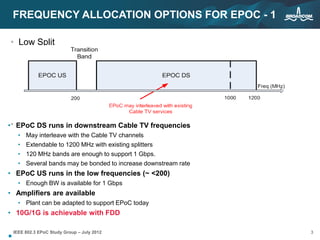
• Low Split
•• EPoC DS runs in downstream Cable TV frequencies
• May interleave with the Cable TV channels
• Extendable to 1200 MHz with existing splitters
• 120 MHz bands are enough to support 1 Gbps.
• Several bands may be bonded to increase downstream rate
• EPoC US runs in the low frequencies (~ <200)
• Enough BW is available for 1 Gbps
• Amplifiers are available
• Plant can be adapted to support EPoC today
• 10G/1G is achievable with FDD

4IEEE 802.3 EPoC Study Group – July 2012
FREQUENCY ALLOCATION OPTIONS FOR EPOC - 2
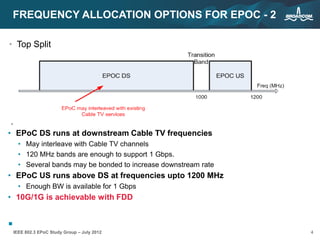
• Top Split
•
• EPoC DS runs at downstream Cable TV frequencies
• May interleave with Cable TV channels
• 120 MHz bands are enough to support 1 Gbps.
• Several bands may be bonded to increase downstream rate
• EPoC US runs above DS at frequencies upto 1200 MHz
• Enough BW is available for 1 Gbps
• 10G/1G is achievable with FDD

5IEEE 802.3 EPoC Study Group – July 2012
FREQUENCY ALLOCATION OPTIONS FOR EPOC - 3
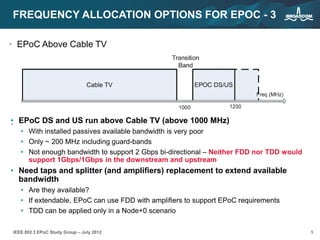
• EPoC Above Cable TV
•• EPoC DS and US run above Cable TV (above 1000 MHz)
• With installed passives available bandwidth is very poor
• Only ~ 200 MHz including guard-bands
• Not enough bandwidth to support 2 Gbps bi-directional – Neither FDD nor TDD would
support 1Gbps/1Gbps in the downstream and upstream
• Need taps and splitter (and amplifiers) replacement to extend available
bandwidth
• Are they available?
• If extendable, EPoC can use FDD with amplifiers to support EPoC requirements
• TDD can be applied only in a Node+0 scenario
6IEEE 802.3 EPoC Study Group – July 2012
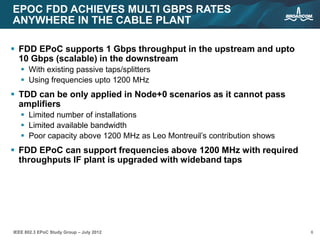
EPOC FDD ACHIEVES MULTI GBPS RATES
ANYWHERE IN THE CABLE PLANT
 FDD EPoC supports 1 Gbps throughput in the upstream and upto
10 Gbps (scalable) in the downstream
 With existing passive taps/splitters
 Using frequencies upto 1200 MHz
 TDD can be only applied in Node+0 scenarios as it cannot pass
amplifiers
 Limited number of installations
 Limited available bandwidth
 Poor capacity above 1200 MHz as Leo Montreuil’s contribution shows
 FDD EPoC can support frequencies above 1200 MHz with required
throughputs IF plant is upgraded with wideband taps
7IEEE 802.3 EPoC Study Group – July 2012
RESPOND TO “TDD AND FDD A PATH FORWARD “ CALL FROM
MINNEAPOLIS MEETING
 Comparison conditions
 EPoC assumptions for the comparison
 Performance comparison
 Complexity considerations
 Conclusions
8IEEE 802.3 EPoC Study Group – July 2012
EPOC FDD AND TDD – ASSUMPTIONS
 EPoC frequencies 1000–1300 MHz
 Node +0 -> No amplifiers
 Loop length: 1000 ft
 40 CNUs
 DS/US rates : 1 Gbps on each direction
 Each CNU runs a CBR 25 Mbps service
 Queues on each CNU are always loaded at the rate 25 Mbps
9IEEE 802.3 EPoC Study Group – July 2012
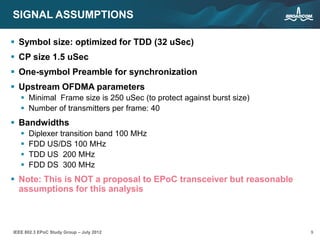
SIGNAL ASSUMPTIONS
 Symbol size: optimized for TDD (32 uSec)
 CP size 1.5 uSec
 One-symbol Preamble for synchronization
 Upstream OFDMA parameters
 Minimal Frame size is 250 uSec (to protect against burst size)
 Number of transmitters per frame: 40
 Bandwidths
 Diplexer transition band 100 MHz
 FDD US/DS 100 MHz
 TDD US 200 MHz
 FDD DS 300 MHz
 Note: This is NOT a proposal to EPoC transceiver but reasonable
assumptions for this analysis
10IEEE 802.3 EPoC Study Group – July 2012
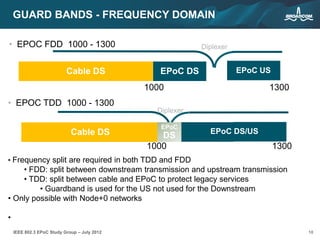
GUARD BANDS - FREQUENCY DOMAIN
Cable DS EPoC DS EPoC US
Diplexer
Cable DS EPoC DS/US
Diplexer
• EPOC FDD 1000 - 1300
• EPOC TDD 1000 - 1300
• Frequency split are required in both TDD and FDD
• FDD: split between downstream transmission and upstream transmission
• TDD: split between cable and EPoC to protect legacy services
• Guardband is used for the US not used for the Downstream
• Only possible with Node+0 networks
•
EPoC
DS
1000 1300
1000 1300
11IEEE 802.3 EPoC Study Group – July 2012
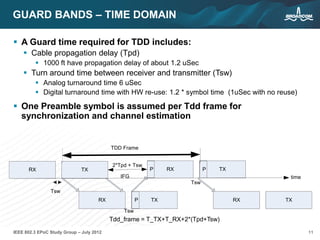
GUARD BANDS – TIME DOMAIN
 A Guard time required for TDD includes:
 Cable propagation delay (Tpd)
 1000 ft have propagation delay of about 1.2 uSec
 Turn around time between receiver and transmitter (Tsw)
 Analog turnaround time 6 uSec
 Digital turnaround time with HW re-use: 1.2 * symbol time (1uSec with no reuse)
 One Preamble symbol is assumed per Tdd frame for
synchronization and channel estimation
RX TX RX TX
RX TXRX TXRX TX
TDD Frame
2*Tpd + Tsw
P
PP
Tsw
IFG
Tsw
time
Tsw
Tdd_frame = T_TX+T_RX+2*(Tpd+Tsw)
12IEEE 802.3 EPoC Study Group – July 2012
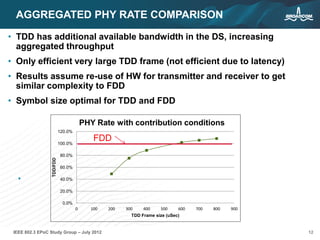
AGGREGATED PHY RATE COMPARISON
• TDD has additional available bandwidth in the DS, increasing
aggregated throughput
• Only efficient very large TDD frame (not efficient due to latency)
• Results assume re-use of HW for transmitter and receiver to get
similar complexity to FDD
• Symbol size optimal for TDD and FDD
•
0.0%
20.0%
40.0%
60.0%
80.0%
100.0%
120.0%
0 100 200 300 400 500 600 700 800 900
TDD/FDD
TDD Frame size (uSec)
PHY Rate with contribution conditions
FDD
13IEEE 802.3 EPoC Study Group – July 2012
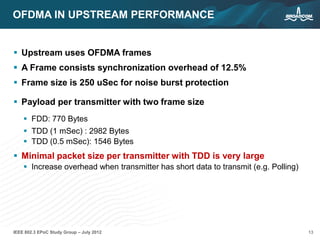
OFDMA IN UPSTREAM PERFORMANCE
 Upstream uses OFDMA frames
 A Frame consists synchronization overhead of 12.5%
 Frame size is 250 uSec for noise burst protection
 Payload per transmitter with two frame size
 FDD: 770 Bytes
 TDD (1 mSec) : 2982 Bytes
 TDD (0.5 mSec): 1546 Bytes
 Minimal packet size per transmitter with TDD is very large
 Increase overhead when transmitter has short data to transmit (e.g. Polling)
14IEEE 802.3 EPoC Study Group – July 2012
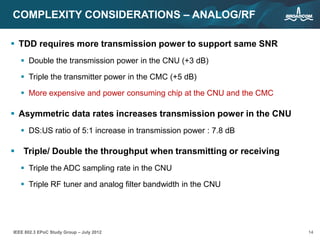
COMPLEXITY CONSIDERATIONS – ANALOG/RF
 TDD requires more transmission power to support same SNR
 Double the transmission power in the CNU (+3 dB)
 Triple the transmitter power in the CMC (+5 dB)
 More expensive and power consuming chip at the CNU and the CMC
 Asymmetric data rates increases transmission power in the CNU
 DS:US ratio of 5:1 increase in transmission power : 7.8 dB
 Triple/ Double the throughput when transmitting or receiving
 Triple the ADC sampling rate in the CNU
 Triple RF tuner and analog filter bandwidth in the CNU
15IEEE 802.3 EPoC Study Group – July 2012
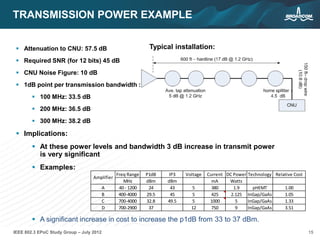
TRANSMISSION POWER EXAMPLE
 Attenuation to CNU: 57.5 dB
 Required SNR (for 12 bits) 45 dB
 CNU Noise Figure: 10 dB
 1dB point per transmission bandwidth :
 100 MHz: 33.5 dB
 200 MHz: 36.5 dB
 300 MHz: 38.2 dB
 Implications:
 At these power levels and bandwidth 3 dB increase in transmit power
is very significant
 Examples:
 A significant increase in cost to increase the p1dB from 33 to 37 dBm.
Typical installation:
Freq Range P1dB IP3 Voltage Current DC Power Technology Relative Cost
MHz dBm dBm mA Watts
A 40 - 1200 24 43 5 380 1.9 pHEMT 1.00
B 400-4000 29.5 45 5 425 2.125 InGap/GaAs 1.05
C 700-4000 32.8 49.5 5 1000 5 InGap/GaAs 1.33
D 700-2900 37 12 750 9 InGap/GaAs 3.51
Amplifier
16IEEE 802.3 EPoC Study Group – July 2012
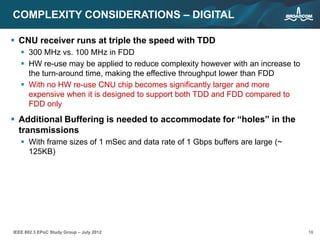
COMPLEXITY CONSIDERATIONS – DIGITAL
 CNU receiver runs at triple the speed with TDD
 300 MHz vs. 100 MHz in FDD
 HW re-use may be applied to reduce complexity however with an increase to
the turn-around time, making the effective throughput lower than FDD
 With no HW re-use CNU chip becomes significantly larger and more
expensive when it is designed to support both TDD and FDD compared to
FDD only
 Additional Buffering is needed to accommodate for “holes” in the
transmissions
 With frame sizes of 1 mSec and data rate of 1 Gbps buffers are large (~
125KB)
17IEEE 802.3 EPoC Study Group – July 2012
CONCLUSION OF COMPARISON
 TDD aggregated throughput equivalent or lower than FDD
 With HW re-use (depending on the TDD frame size)
 TDD may provide throughput benefit with no HW re-use
 Significant increase of HW complexity (triple the processing power in the
CNU!) is required
 May not be economical
 Upstream TDD OFDMA frame has additional overheads due to
bandwidth increase
 Reduce average throughput
18IEEE 802.3 EPoC Study Group – July 2012
SUMMARY
 FDD provides EPoC target throughput over all possible installation
scenarios over existing Coax infrastructure
 Low split or High split
 Can start deployment immediately with technology available
 TDD may be beneficial in the narrow case of Node+0 at frequencies
above 1 GHz
 Improvement over FDD if exists is not significant with increased complexity
 Support TDD in addition to FDD adds significant complexity/cost
 Is it justified economically wise? We have concerns it does not
 Should we start a new EPoC TDD development if market requires?
19IEEE 802.3 EPoC Study Group – July 2012
THANK YOU

Fdd vs tdd lte

  • 1.
    1IEEE 802.3 EPoCStudy Group – July 2012 FDD VS. TDD COMPARISON Avi Kliger, Broadcom Rich Prodan, Broadcom
  • 2.
    2IEEE 802.3 EPoCStudy Group – July 2012 OUTLINE  EPoC installation options  TDD and FDD in the Coax plants  A respond to the “TDD and FDD a path forward” contribution from Minneapolis meeting  Assumptions  Performance comparison  Complexity considerations  Conclusions  Summary
  • 3.
    3IEEE 802.3 EPoCStudy Group – July 2012 FREQUENCY ALLOCATION OPTIONS FOR EPOC - 1 • Low Split •• EPoC DS runs in downstream Cable TV frequencies • May interleave with the Cable TV channels • Extendable to 1200 MHz with existing splitters • 120 MHz bands are enough to support 1 Gbps. • Several bands may be bonded to increase downstream rate • EPoC US runs in the low frequencies (~ <200) • Enough BW is available for 1 Gbps • Amplifiers are available • Plant can be adapted to support EPoC today • 10G/1G is achievable with FDD 
  • 4.
    4IEEE 802.3 EPoCStudy Group – July 2012 FREQUENCY ALLOCATION OPTIONS FOR EPOC - 2 • Top Split • • EPoC DS runs at downstream Cable TV frequencies • May interleave with Cable TV channels • 120 MHz bands are enough to support 1 Gbps. • Several bands may be bonded to increase downstream rate • EPoC US runs above DS at frequencies upto 1200 MHz • Enough BW is available for 1 Gbps • 10G/1G is achievable with FDD 
  • 5.
    5IEEE 802.3 EPoCStudy Group – July 2012 FREQUENCY ALLOCATION OPTIONS FOR EPOC - 3 • EPoC Above Cable TV •• EPoC DS and US run above Cable TV (above 1000 MHz) • With installed passives available bandwidth is very poor • Only ~ 200 MHz including guard-bands • Not enough bandwidth to support 2 Gbps bi-directional – Neither FDD nor TDD would support 1Gbps/1Gbps in the downstream and upstream • Need taps and splitter (and amplifiers) replacement to extend available bandwidth • Are they available? • If extendable, EPoC can use FDD with amplifiers to support EPoC requirements • TDD can be applied only in a Node+0 scenario
  • 6.
    6IEEE 802.3 EPoCStudy Group – July 2012 EPOC FDD ACHIEVES MULTI GBPS RATES ANYWHERE IN THE CABLE PLANT  FDD EPoC supports 1 Gbps throughput in the upstream and upto 10 Gbps (scalable) in the downstream  With existing passive taps/splitters  Using frequencies upto 1200 MHz  TDD can be only applied in Node+0 scenarios as it cannot pass amplifiers  Limited number of installations  Limited available bandwidth  Poor capacity above 1200 MHz as Leo Montreuil’s contribution shows  FDD EPoC can support frequencies above 1200 MHz with required throughputs IF plant is upgraded with wideband taps
  • 7.
    7IEEE 802.3 EPoCStudy Group – July 2012 RESPOND TO “TDD AND FDD A PATH FORWARD “ CALL FROM MINNEAPOLIS MEETING  Comparison conditions  EPoC assumptions for the comparison  Performance comparison  Complexity considerations  Conclusions
  • 8.
    8IEEE 802.3 EPoCStudy Group – July 2012 EPOC FDD AND TDD – ASSUMPTIONS  EPoC frequencies 1000–1300 MHz  Node +0 -> No amplifiers  Loop length: 1000 ft  40 CNUs  DS/US rates : 1 Gbps on each direction  Each CNU runs a CBR 25 Mbps service  Queues on each CNU are always loaded at the rate 25 Mbps
  • 9.
    9IEEE 802.3 EPoCStudy Group – July 2012 SIGNAL ASSUMPTIONS  Symbol size: optimized for TDD (32 uSec)  CP size 1.5 uSec  One-symbol Preamble for synchronization  Upstream OFDMA parameters  Minimal Frame size is 250 uSec (to protect against burst size)  Number of transmitters per frame: 40  Bandwidths  Diplexer transition band 100 MHz  FDD US/DS 100 MHz  TDD US 200 MHz  FDD DS 300 MHz  Note: This is NOT a proposal to EPoC transceiver but reasonable assumptions for this analysis
  • 10.
    10IEEE 802.3 EPoCStudy Group – July 2012 GUARD BANDS - FREQUENCY DOMAIN Cable DS EPoC DS EPoC US Diplexer Cable DS EPoC DS/US Diplexer • EPOC FDD 1000 - 1300 • EPOC TDD 1000 - 1300 • Frequency split are required in both TDD and FDD • FDD: split between downstream transmission and upstream transmission • TDD: split between cable and EPoC to protect legacy services • Guardband is used for the US not used for the Downstream • Only possible with Node+0 networks • EPoC DS 1000 1300 1000 1300
  • 11.
    11IEEE 802.3 EPoCStudy Group – July 2012 GUARD BANDS – TIME DOMAIN  A Guard time required for TDD includes:  Cable propagation delay (Tpd)  1000 ft have propagation delay of about 1.2 uSec  Turn around time between receiver and transmitter (Tsw)  Analog turnaround time 6 uSec  Digital turnaround time with HW re-use: 1.2 * symbol time (1uSec with no reuse)  One Preamble symbol is assumed per Tdd frame for synchronization and channel estimation RX TX RX TX RX TXRX TXRX TX TDD Frame 2*Tpd + Tsw P PP Tsw IFG Tsw time Tsw Tdd_frame = T_TX+T_RX+2*(Tpd+Tsw)
  • 12.
    12IEEE 802.3 EPoCStudy Group – July 2012 AGGREGATED PHY RATE COMPARISON • TDD has additional available bandwidth in the DS, increasing aggregated throughput • Only efficient very large TDD frame (not efficient due to latency) • Results assume re-use of HW for transmitter and receiver to get similar complexity to FDD • Symbol size optimal for TDD and FDD • 0.0% 20.0% 40.0% 60.0% 80.0% 100.0% 120.0% 0 100 200 300 400 500 600 700 800 900 TDD/FDD TDD Frame size (uSec) PHY Rate with contribution conditions FDD
  • 13.
    13IEEE 802.3 EPoCStudy Group – July 2012 OFDMA IN UPSTREAM PERFORMANCE  Upstream uses OFDMA frames  A Frame consists synchronization overhead of 12.5%  Frame size is 250 uSec for noise burst protection  Payload per transmitter with two frame size  FDD: 770 Bytes  TDD (1 mSec) : 2982 Bytes  TDD (0.5 mSec): 1546 Bytes  Minimal packet size per transmitter with TDD is very large  Increase overhead when transmitter has short data to transmit (e.g. Polling)
  • 14.
    14IEEE 802.3 EPoCStudy Group – July 2012 COMPLEXITY CONSIDERATIONS – ANALOG/RF  TDD requires more transmission power to support same SNR  Double the transmission power in the CNU (+3 dB)  Triple the transmitter power in the CMC (+5 dB)  More expensive and power consuming chip at the CNU and the CMC  Asymmetric data rates increases transmission power in the CNU  DS:US ratio of 5:1 increase in transmission power : 7.8 dB  Triple/ Double the throughput when transmitting or receiving  Triple the ADC sampling rate in the CNU  Triple RF tuner and analog filter bandwidth in the CNU
  • 15.
    15IEEE 802.3 EPoCStudy Group – July 2012 TRANSMISSION POWER EXAMPLE  Attenuation to CNU: 57.5 dB  Required SNR (for 12 bits) 45 dB  CNU Noise Figure: 10 dB  1dB point per transmission bandwidth :  100 MHz: 33.5 dB  200 MHz: 36.5 dB  300 MHz: 38.2 dB  Implications:  At these power levels and bandwidth 3 dB increase in transmit power is very significant  Examples:  A significant increase in cost to increase the p1dB from 33 to 37 dBm. Typical installation: Freq Range P1dB IP3 Voltage Current DC Power Technology Relative Cost MHz dBm dBm mA Watts A 40 - 1200 24 43 5 380 1.9 pHEMT 1.00 B 400-4000 29.5 45 5 425 2.125 InGap/GaAs 1.05 C 700-4000 32.8 49.5 5 1000 5 InGap/GaAs 1.33 D 700-2900 37 12 750 9 InGap/GaAs 3.51 Amplifier
  • 16.
    16IEEE 802.3 EPoCStudy Group – July 2012 COMPLEXITY CONSIDERATIONS – DIGITAL  CNU receiver runs at triple the speed with TDD  300 MHz vs. 100 MHz in FDD  HW re-use may be applied to reduce complexity however with an increase to the turn-around time, making the effective throughput lower than FDD  With no HW re-use CNU chip becomes significantly larger and more expensive when it is designed to support both TDD and FDD compared to FDD only  Additional Buffering is needed to accommodate for “holes” in the transmissions  With frame sizes of 1 mSec and data rate of 1 Gbps buffers are large (~ 125KB)
  • 17.
    17IEEE 802.3 EPoCStudy Group – July 2012 CONCLUSION OF COMPARISON  TDD aggregated throughput equivalent or lower than FDD  With HW re-use (depending on the TDD frame size)  TDD may provide throughput benefit with no HW re-use  Significant increase of HW complexity (triple the processing power in the CNU!) is required  May not be economical  Upstream TDD OFDMA frame has additional overheads due to bandwidth increase  Reduce average throughput
  • 18.
    18IEEE 802.3 EPoCStudy Group – July 2012 SUMMARY  FDD provides EPoC target throughput over all possible installation scenarios over existing Coax infrastructure  Low split or High split  Can start deployment immediately with technology available  TDD may be beneficial in the narrow case of Node+0 at frequencies above 1 GHz  Improvement over FDD if exists is not significant with increased complexity  Support TDD in addition to FDD adds significant complexity/cost  Is it justified economically wise? We have concerns it does not  Should we start a new EPoC TDD development if market requires?
  • 19.
    19IEEE 802.3 EPoCStudy Group – July 2012 THANK YOU