Finansdepartementet
Towards a sustainable
financial system
The Swedish Perspective
Mr Peter Norman
Minister for Financial Markets
12 September 2013
Finansdepartementet
Agenda
• Financial stability and the economic situation in
Europe
• Swedish reforms since 2008
• The government’s new proposals
Finansdepartementet
Financial stability –
a necessity for a European recovery
• European monetary policies need more support
from fiscal policies
• Especially in countries where the banking
sector is still fragile
• Financial stability a prerequisite both for a
recovery and for long term growth
Finansdepartementet
Lessons from the crisis
• Large costs to society from financial crises -
mainly internationally but also in Sweden
• Sweden is highly exposed with its large
financial sector
• Extensive measures taken at both national
and EU level to strengthen financial stability
Finansdepartementet
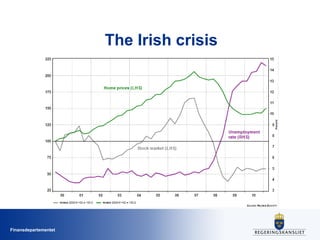
The Irish crisis
Finansdepartementet
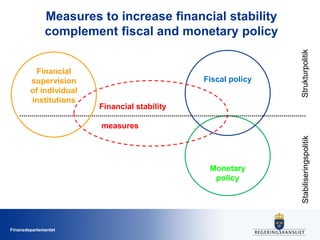
Measures to increase financial stability
complement fiscal and monetary policy
Monetary
policy
Fiscal policy
StrukturpolitikStabiliseringspolitik
Financial stability
measures
Financial
supervision
of individual
institutions
Finansdepartementet
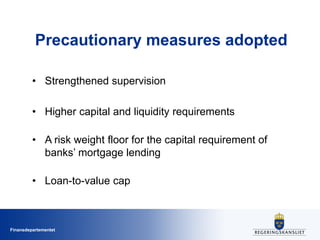
Precautionary measures adopted
• Strengthened supervision
• Higher capital and liquidity requirements
• A risk weight floor for the capital requirement of
banks’ mortgage lending
• Loan-to-value cap
Finansdepartementet
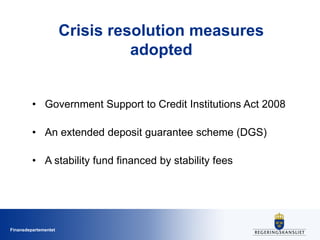
Crisis resolution measures
adopted
• Government Support to Credit Institutions Act 2008
• An extended deposit guarantee scheme (DGS)
• A stability fund financed by stability fees
Finansdepartementet
Further action motivated
• The balance sheet of the Swedish financial sector
is four times as large as GDP
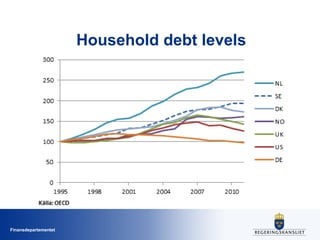
• Since the mid 1990s, dramatic increases in
household debt levels and house prices
Finansdepartementet
Household debt levels
Finansdepartementet
The government’s proposals
• The FSA is given the main responsibility of the financial
stability tool box
• Banks to shoulder cost of Sweden’s extra large foreign
exchange reserves
• Creating a Financial Stability Council
• Stabilisation Fund is made into a proper fund with own
financial resources
• A sounder amortization culture
Finansdepartementet
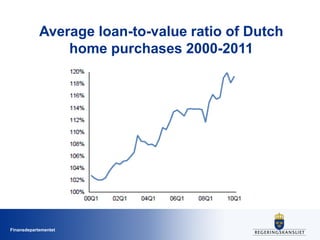
Average loan-to-value ratio of Dutch
home purchases 2000-2011
Finansdepartementet
Why give the responsibility to the FSA?
• Provides democratic accountability
• Easier - the FSA is presently in charge of
assessing capital and liquidity requirements for
individual institutions
• Lessens a potential conflict of interest
• The Riksbank's mandate unchanged
Finansdepartementet
A Financial Stability Council
• Improved cooperation in preventive work and
improved coordination during crises
• Not decision making body
• Minister for Financial Markets Chairman,
includes heads of FSA, the Riksbank and
National Debt Office
• Set up as a committee with its own secretariat
Finansdepartementet
Prudence is key
• The overall objective is to avoid a boom-bust
scenario like the Irish
• However, delicate balance –
do not want to kill a fledging recovery and
trigger a contraction
Finansdepartementet
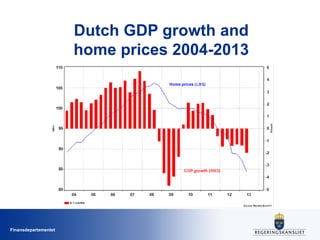
Dutch GDP growth and
home prices 2004-2013
Finansdepartementet
Activity at the EU level
• New capital requirements
CRR / CRD 4 enter into effect in 2014
• Bank Recovery and Resolution Directive
Negotiations continue
• Banking Union
Single Supervisory Mechanism agreed, Single
Resolution Mechanism being negotiated
Finansdepartementet
Risks remain
The Government continues to closely monitor the
developments in the financial sector…
… as well as household debt levels
Always ready to take further action if motivated

Peter Norman: "The Swedish Perspective"