CROSS-BORDER COOPERATION IN
THE ELECTRICITY SECTOR -
THE NORDIC EXAMPLE
In the very beginning …
1
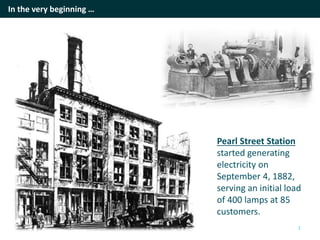
Pearl Street Station
started generating
electricity on
September 4, 1882,
serving an initial load
of 400 lamps at 85
customers.
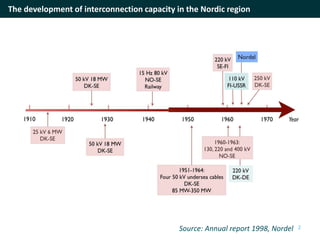
The development of interconnection capacity in the Nordic region
2Source: Annual report 1998, Nordel
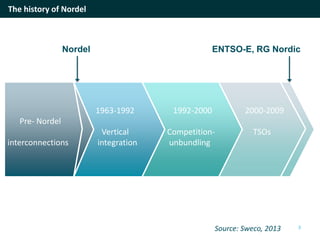
The history of Nordel
3
2000-2009
TSOs
1992-2000
Competition-
unbundling
1963-1992
Vertical
integration
Pre- Nordel
interconnections
Nordel ENTSO-E, RG Nordic
Source: Sweco, 2013
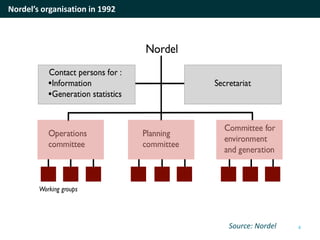
Nordel’s organisation in 1992
4Source: Nordel
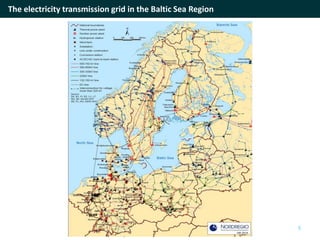
The electricity transmission grid in the Baltic Sea Region
5
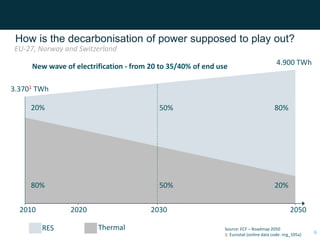
How is the decarbonisation of power supposed to play out?
6
2010 2020 2030 2050
50%
50%
20%
80%
80%
20%
3.3701 TWh
4.900 TWh
Source: ECF – Roadmap 2050
1: Eurostat (online data code: nrg_105a)
EU-27, Norway and Switzerland
RES Thermal
New wave of electrification - from 20 to 35/40% of end use
7
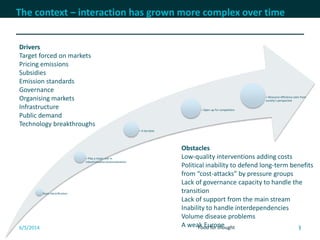
The context – interaction has grown more complex over time
Basic electrification
+ Play a major role in
industrialisation/automatisation
+ A tax base
+ Open up for competition
+ Resource efficiency seen from
society’s perspective
6/5/2014 Food for thought 7
Drivers
Target forced on markets
Pricing emissions
Subsidies
Emission standards
Governance
Organising markets
Infrastructure
Public demand
Technology breakthroughs
Obstacles
Low-quality interventions adding costs
Political inability to defend long-term benefits
from “cost-attacks” by pressure groups
Lack of governance capacity to handle the
transition
Lack of support from the main stream
Inability to handle interdependencies
Volume disease problems
A weak Europe

Cross-border cooperation in the electricity sector - the Nordic example

  • 1.
    CROSS-BORDER COOPERATION IN THEELECTRICITY SECTOR - THE NORDIC EXAMPLE
  • 2.
    In the verybeginning … 1 Pearl Street Station started generating electricity on September 4, 1882, serving an initial load of 400 lamps at 85 customers.
  • 3.
    The development ofinterconnection capacity in the Nordic region 2Source: Annual report 1998, Nordel
  • 4.
    The history ofNordel 3 2000-2009 TSOs 1992-2000 Competition- unbundling 1963-1992 Vertical integration Pre- Nordel interconnections Nordel ENTSO-E, RG Nordic Source: Sweco, 2013
  • 5.
    Nordel’s organisation in1992 4Source: Nordel
  • 6.
    The electricity transmissiongrid in the Baltic Sea Region 5
  • 7.
    How is thedecarbonisation of power supposed to play out? 6 2010 2020 2030 2050 50% 50% 20% 80% 80% 20% 3.3701 TWh 4.900 TWh Source: ECF – Roadmap 2050 1: Eurostat (online data code: nrg_105a) EU-27, Norway and Switzerland RES Thermal New wave of electrification - from 20 to 35/40% of end use
  • 8.
    7 The context –interaction has grown more complex over time Basic electrification + Play a major role in industrialisation/automatisation + A tax base + Open up for competition + Resource efficiency seen from society’s perspective 6/5/2014 Food for thought 7 Drivers Target forced on markets Pricing emissions Subsidies Emission standards Governance Organising markets Infrastructure Public demand Technology breakthroughs Obstacles Low-quality interventions adding costs Political inability to defend long-term benefits from “cost-attacks” by pressure groups Lack of governance capacity to handle the transition Lack of support from the main stream Inability to handle interdependencies Volume disease problems A weak Europe