The EU & its Partners
Attracting International Investors
This document is issued by the Swiss Finance Council, an association established under Swiss law, solely for information purposes and for the
recipient’s sole use. The terms listed herein are only indicative and may be amended any time without notice. The opinions expressed herein
are those of the Swiss Finance Council at the time of editing and may be amended any time without notice. Neither the Swiss Finance Council,
its members nor the contributors named in this document make any representation either express or implied as to the accuracy or complete-
ness of this document and assume no liability for any loss or damage arising from the use of or reliance on, all or part of this document. This
document does not constitute an offer, a recommendation, or an invitation to purchase or sell investment instruments or to execute transac-
tions of any kind. Nothing in this document is or is intended to be investment advice or otherwise based on a consideration of the personal
circumstances of recipients or other investors nor is it the result of independent research. Neither this document nor any copy, either wholly
or in part, may be sent, taken into or distributed in any other jurisdiction outside the European Union and Switzerland except under circum-
stances that will result in compliance with the applicable laws thereof.
Copyright © 2016, Swiss Finance Council and/or its members and affiliates. All rights reserved.
3
The EU and its Partners: Attracting International Investors
Executive Summary
Attracting investment: is Europe fit for the future?
An economic introduction
Conclusions
How international investment can help make the Capital Markets
Union a success
Case study
Attracting corporate investments: the view from Swiss SMEs
Case study
Reviving investment by institutional investors – focusing on
infrastructure financing
Case study
Making Europe more attractive for international private investors
Foreword
Attracting international investment: the case of corporate,
private and institutional investors
4
5
6
13
14
20
31
39
4
Alexis P. Lautenberg
Chairman
Swiss Finance Council
Urs Rohner
Chairman of the Board
Credit Suisse Group AG
Axel A. Weber
Chairman of the Board
UBS Group AG
The EU and its Partners: Attracting International Investors
Foreword
We are pleased to introduce the Swiss Finance Council’s second Discussion Paper on the topic
‘The EU and its Partners: Attracting International Investors.’ Following on from our 2015 report,
which discussed ‘Defending Open Markets in Challenging Times’, our most recent work aims to
contribute to the policy debate around international investors’ and the financial services sector’s
contribution to fostering economic growth in the European Union.
We are launching this report in awareness of the gradual, yet slow economic recovery in Europe.
Several EU Member States have implemented demanding reforms, but there is still too much
reliance on the hope that the European Central Bank's expansionary monetary policy will lead to a
strengthening in Europe’s economic growth. Concerns remain as to several structural issues,
including youth unemployment. It remains crucial that the EU continues to address its economic
growth challenge and we fully support the investment initiative of Jean-Claude Juncker, Presi-
dent of the European Commission, to complement the ongoing reforms through the European
Fund for Strategic Investment and by realising the potential of the private sector through a Capital
Markets Union.
We strongly support the Capital Markets Union initiative and in our recent Discussion Paper, we
show that international investors can play a vital role in its success. At the same time, our
research explores examples of continued barriers in corporate, institutional and private invest-
ment in Europe. Finally, our report articulates several recommendations of how existing and new
policies can help address these challenges and take greater account of the international dimen-
sion when legislating.
The CMU Action plan and the Commission’s Call for Evidence provide great opportunities to take
the EU’s growth agenda forward. We hope you will find our Discussion Paper a valuable contribu-
tion to this policy debate and hope you enjoy reading it.
5
The EU and its Partners: Attracting International Investors
Executive Summary
Since the financial crisis, economic growth in the EU and its Member States has picked up.
However, the pace is still slow and investment activity remains weak. For this reason, growth and
jobs have been put at the forefront of EU policy-making. While the progress on fiscal and structur-
al reforms has been slow in many Member States, the European Commission’s Investment Plan
for Europe (the Juncker Plan) constitutes an important initiative aiming at unlocking public and
private investments, which also is a critical part of the EU's Capital Markets Union project.
This Discussion Paper examines how international investors can contribute to the economic
recovery in Europe and to boosting the EU’s growth potential in the long run. In addition to provid-
ing an analysis of the general drivers of investment, the Paper presents three case studies which
detail the motivations and requirements of international investors, be they corporates, private or
institutional investors. Based on the findings from these case studies, the Discussion Paper
proposes ideas on how to stimulate international investments to support growth.
• Our first case study is based on an exclusive survey of Swiss SMEs, many of whom invest in
the EU. When investing internationally, the surveyed SMEs indicated a clear preference for the
EU as destination for their international investments. As their predominant concern time-con-
suming bureaucracy was mentioned. Despite their limited use of capital markets, about one
fifth of the Swiss SMEs consider a common capital market in Europe to be important.
• Our second case study looks at private investors. One of the key aims of the CMU is to channel
private savings into European investment to a much greater extent than in the past. We looked
specifically at how to mobilise the savings of sophisticated investors who often show a strong
interest for private equity investments. Private equity is an important source of funding, typical-
ly used for financing long-term projects, particularly for SMEs in sectors that are less likely to
attract traditional funding. While cultural and historical differences explain the different
approaches to investment in Europe and the US, there are a number of EU policies that should
be adjusted to encourage private investments. Our Paper recommends that the Commission
looks at enhancing regulation, better taxation, and procedural enhancements regarding the
registration and distribution of alternative investment products.
• Our last case study examines two large infrastructure projects in the UK and the lessons
learnt from a financing perspective. The IMF argued strongly, in its 2014 World Economic
Outlook, that time is ripe for an "infrastructure push" to stimulate growth. To this end, we
discuss multiple funding strategies, including more innovative forms of public involvement,
such as contingent guarantees that leave the private sector incentivised for in-plan completion
and operation.
Our Discussion Paper develops a number of policy and regulatory recommendations with a focus
on removing obstacles which prevent international investors from contributing to the economic
recovery of the EU. This includes taking account of the international dimension in its policy-mak-
ing, based on the following steps:
1. Pursuing an enhanced approach to equivalence determinations for third countries.
2. Communicating the EU’s openness to investment from the outside world.
3. Championing consistent international standards.
4. Establishing formal regulatory dialogues with relevant third country authorities.
6
-12
-10
-8
-6
-4
-2
0
2
4
6
8
Mar-99 Mar-01 Mar-03 Mar-05 Mar-07 Mar-09 Mar-11 Mar-13 Mar-15
Real GDP, % y/y Fixed investment, % y/y
-6
-4
-2
0
2
4
Q1-1999 Q1-2001 Q1-2003 Q1-2005 Q1-2007 Q1-2009 Q1-2011 Q1-2013 Q1-2015
Household consumption Govt expenditure Net exports
Fixed investment Real GDP growth, % y/y
!"#$%&'($&"#)*$"*+##(+,*-./*0%"1$23*44$
100
105
110
115
120
125
130
Potential GDP Actual GDP
Figure 1: Eurozone investment still subdued
Source: Haver
Figure 2: Investment: the crucial swing factor in the
business cycle
Source: Haver
The EU and its Partners: Attracting International Investors
The European Union (EU) has historically been
an important destination for international
investment. However, investment remains
below its pre-crisis level and economic
recovery has been slow, and, as a result, the
EU is slipping in league tables of competitive-
ness. Before considering in more detail which
policy measures the EU can take to promote
investment in Chapter 2, we take a look at the
economic context and the challenges Europe
faces.
On a global perspective, Europe – and the
Euro area in particular – is a low growth area.
The problem is partly cyclical, as the region
still has not fully recovered from the crisis. But
the problem is also structural as Europe's
underlying trend growth rate is relatively low.
Weak investment plays a key role in both the
cyclical and the structural weakness of
Europe's growth. To illustrate the cyclical
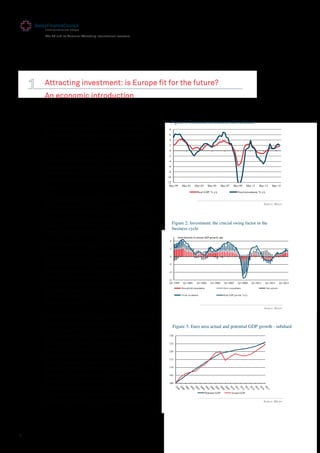
dimension, Figure 1 shows that fixed invest-
ment in Europe is still subdued. Figure 2
shows that whenever European growth shifted
into a higher gear in past business cycles,
stronger investment (in red) was a key ingredi-
ent – but it is still largely missing in the
current upswing.
The structural (i.e. longer-term) growth rate of
an economy is best described by its potential
output growth rate, which in the Euro area is
only around 1% per year (see Figure 3).
Conceptually, potential output growth is
driven by the growth of (a) the labour force; (b)
the capital stock; and (c) total factor produc-
tivity. Investment plays a crucial role in two of
the three variables: it contributes to the
growth of the capital stock, but it also raises
productivity. Consequently, if Europe were
able to boost investment, it would strengthen
not just the short-term growth momentum,
but also the longer-term growth potential.
Figure 3: Euro area actual and potential GDP growth - subdued
Source: Haver
Attracting investment: is Europe fit for the future?
An economic introduction
7
0
10
20
30
40
50
60
70
80
90
Switzerland
Singapore
US
Finland
Germany
Japan
HongKong
Netherlands
UK
Sweden
Norway
UAE
Denmark
Taiwan
Canada
Qatar
NZ
Belgium
Luxembourg
Malaysia
Austria
Australia
France
SaudiArabia
Ireland
SKorea
Israel
China
Estonia
Thailand
Chile
Indonesia
Spain
Portugal
CzechRepublic
Lithuania
Latvia
Poland
Turkey
Malta
Italy
Kazakhstan
Russia
Bulgaria
SouthAfrica
Brazil
Cyprus
Romania
Hungary
Mexico
Macedonia
Montenegro
Slovenia
India
Morocco
Slovakia
Ukraine
Croatia
Greece
1.1 Boosting Europe's attractiveness for
investment
The EU and its Partners: Attracting International Investors
What determines a country's attractiveness
for investment, from domestic and foreign
corporates? There is an extensive body of
research that sheds light on this question and
a number of quantitative indicators have been
developed to facilitate cross-country compari-
sons, such as:
• The Global Competitiveness Index, by the
World Economic Forum;
• The Global Opportunity Index, by the
Milken Institute;
• The Ease of Doing Business Index, by the
World Bank;
• The Corruption Perceptions Index, by
Transparency International;
• Ernst and Young's Attractiveness Survey.
What can we learn from these surveys?
The Global Competitiveness Index1
takes
perhaps the broadest view. It defines competi-
tiveness as the set of "institutions, policies
and factors that determine the level of
productivity of a country". Productivity, in turn,
is a key determinant of the return on invest-
ment and hence the strength of investment
itself.
The Global Competitiveness Index consists of
12 pillars. The first four (Institutions, Infra-
structure, Macroeconomic environment,
Health and primary education) are grouped
into the "Basic requirements subindex".
Pillars 5 to 10 (Higher Education and Training;
Goods market efficiency; Labour market
efficiency; Financial market development;
Technological readiness; Market size) are
grouped into the "Efficiency enhancers
subindex". Pillars 11 and 12 measure Busi-
ness Sophistication and Innovation. The 12
pillars are not independent, but often
inter-related.
The Global Opportunity Index2
is also rather
broad, specifically adopting the views of a
foreign investor. It is divided into four catego-
ries, with various sub-factors: 1. Economic
fundamentals3
; 2. Ease of Doing Business4
; 3.
Quality of regulation5
; and 4. Rule of Law.6
The perspective of the World Bank's Ease of
Doing Business Index7
is narrower; it focuses
on ten areas of business regulation.8
More
fundamental factors, such as macroeconomic
stability or the quality of the workforce, do not
feature.
The Corruption Perceptions Index by Trans-
parency International (TI) measures the
perceived levels of public sector corruption
worldwide, based on expert opinion. According
to TI "Top performers share key characteris-
tics: high levels of press freedom; access to
budget information so the public knows where
money comes from and how it is spent; high
levels of integrity among people in power; and
Figure 4: Global competitiveness index, 2014-2015
Source: Global competitiveness report, World Economic Forum
Note: Numbers represent ranking in index; the lower the number the higher in the ranking.
8
5%
3%
5%
6%
9%
10%
11%
13%
17%
20%
0% 5% 10% 15% 20% 25%
Others
Low innovation capacity
High unemployment rates
Strong dependency on energy imports
Competition among European countries
High public debt
Geopolitical unrest at its frontiers
Lack of political governance at EU level
Low economic growth
Too much bureaucracy
Internal
factors
1%
<1%
2%
19%
20%
26%
29%
29%
48%
0% 10% 20% 30% 40% 50% 60%
Can't say
None
Other
Give back more power to European countries
Complete the single market (including for
services)
Invest in improving its infrastructure
Pursue further economic integration
Pursue further political integration
Implement business-friendly reforms within the
areas of competition, tax and labour market
The EU and its Partners: Attracting International Investors
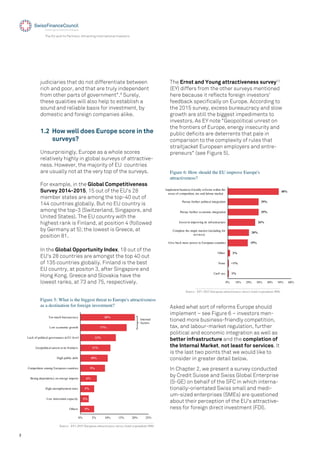
The Ernst and Young attractiveness survey10
(EY) differs from the other surveys mentioned
here because it reflects foreign investors'
feedback specifically on Europe. According to
the 2015 survey, excess bureaucracy and slow
growth are still the biggest impediments to
investors. As EY note "Geopolitical unrest on
the frontiers of Europe, energy insecurity and
public deficits are deterrents that pale in
comparison to the complexity of rules that
straitjacket European employers and entre-
preneurs" (see Figure 5).
Figure 5: What is the biggest threat to Europe's attractiveness
as a destination for foreign investment?
Source: EY's 2015 European attractiveness survey (total respondents 808)
Figure 6: How should the EU improve Europe's
attractiveness?
Source: EY's 2015 European attractiveness survey (total respondents 808)
Asked what sort of reforms Europe should
implement – see Figure 6 – investors men-
tioned more business-friendly competition,
tax, and labour-market regulation, further
political and economic integration as well as
better infrastructure and the completion of
the Internal Market, not least for services. It
is the last two points that we would like to
consider in greater detail below.
In Chapter 2, we present a survey conducted
by Credit Suisse and Swiss Global Enterprise
(S-GE) on behalf of the SFC in which interna-
tionally-orientated Swiss small and medi-
um-sized enterprises (SMEs) are questioned
about their perception of the EU's attractive-
ness for foreign direct investment (FDI).
1.2 How well does Europe score in the
surveys?
Unsurprisingly, Europe as a whole scores
relatively highly in global surveys of attractive-
ness. However, the majority of EU countries
are usually not at the very top of the surveys.
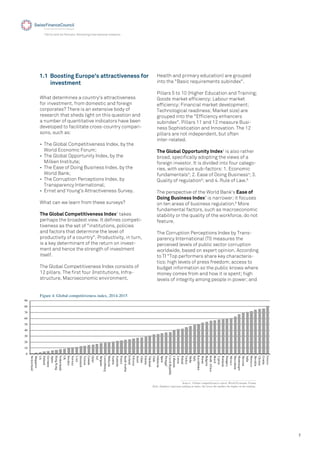
For example, in the Global Competitiveness
Survey 2014-2015, 15 out of the EU's 28
member states are among the top-40 out of
144 countries globally. But no EU country is
among the top-3 (Switzerland, Singapore, and
United States). The EU country with the
highest rank is Finland, at position 4 (followed
by Germany at 5); the lowest is Greece, at
position 81.
judiciaries that do not differentiate between
rich and poor, and that are truly independent
from other parts of government".9
Surely,
these qualities will also help to establish a
sound and reliable basis for investment, by
domestic and foreign companies alike.
In the Global Opportunity Index, 18 out of the
EU's 28 countries are amongst the top 40 out
of 135 countries globally. Finland is the best
EU country, at positon 3, after Singapore and
Hong Kong. Greece and Slovakia have the
lowest ranks, at 73 and 75, respectively.
9
0
10
20
30
40
50
60
70
80
90
HongKong
Singapore
NZ
Malaysia
Finland
Australia
SouthAfrica
Canada
US
Norway
Switzerland
Sweden
Qatar
Luxembourg
UK
Japan
UAE
Taiwan
Israel
France
Germany
Denmark
Oman
Estonia
SaudiArabia
Bahrain
Latvia
Thailand
Poland
Malta
Netherlands
Belgium
Slovakia
Macedonia
Indonesia
Austria
CzechRepublic
India
Brazil
China
Montenegro
Turkey
Bulgaria
Ireland
Mexico
Romania
Lithuania
Nigeria
Iceland
Morocco
Hungary
Croatia
SKorea
Cyprus
The EU and its Partners: Attracting International Investors
Figure 7: Global Competitiveness Index 2014-2015: sub-index - Financial market development
Source: Global competitiveness report, World Economic Forum
Note: Numbers represent ranking in index; the lower the number the higher in the ranking.
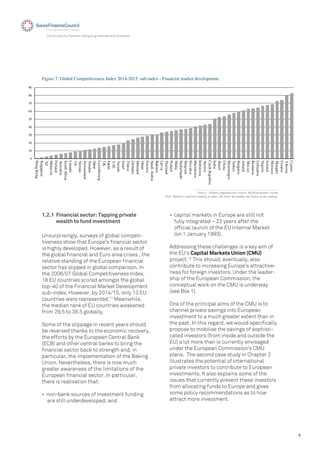
Unsurprisingly, surveys of global competi-
tiveness show that Europe's financial sector
is highly developed. However, as a result of
the global financial and Euro area crises , the
relative standing of the European financial
sector has slipped in global comparison. In
the 2006/07 Global Competitiveness Index,
18 EU countries scored amongst the global
top-40 of the Financial Market Development
sub-index. However, by 2014/15, only 13 EU
countries were represented.11
Meanwhile,
the median rank of EU countries weakened
from 29.5 to 38.5 globally.
Some of the slippage in recent years should
be reversed thanks to the economic recovery,
the efforts by the European Central Bank
(ECB) and other central banks to bring the
financial sector back to strength and, in
particular, the implementation of the Baking
Union. Nevertheless, there is now much
greater awareness of the limitations of the
European financial sector. In particular,
there is realisation that:
• non-bank sources of investment funding
are still underdeveloped; and
• capital markets in Europe are still not
fully integrated – 23 years after the
official launch of the EU Internal Market
(on 1 January 1993).
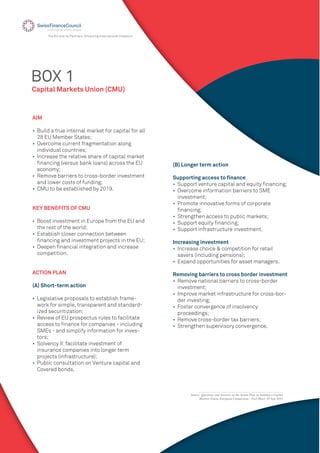
Addressing these challenges is a key aim of
the EU's Capital Markets Union (CMU)
project.12
This should, eventually, also
contribute to increasing Europe's attractive-
ness for foreign investors. Under the leader-
ship of the European Commission, the
conceptual work on the CMU is underway
(see Box 1).
One of the principal aims of the CMU is to
channel private savings into European
investment to a much greater extent than in
the past. In this regard, we would specifically
propose to mobilise the savings of sophisti-
cated investors (from inside and outside the
EU) a lot more than is currently envisaged
under the European Commission's CMU
plans. The second case study in Chapter 2
illustrates the potential of international
private investors to contribute to European
investments. It also explains some of the
issues that currently prevent these investors
from allocating funds to Europe and gives
some policy recommendations as to how
attract more investment.
1.2.1 Financial sector: Tapping private
wealth to fund investment
10
Capital Markets Union (CMU)
The EU and its Partners: Attracting International Investors
AIM
• Build a true internal market for capital for all
28 EU Member States;
• Overcome current fragmentation along
individual countries;
• Increase the relative share of capital market
financing (versus bank loans) across the EU
economy;
• Remove barriers to cross-border investment
and lower costs of funding;
• CMU to be established by 2019.
KEY BENEFITS OF CMU
• Boost investment in Europe from the EU and
the rest of the world;
• Establish closer connection between
financing and investment projects in the EU;
• Deepen financial integration and increase
competition.
ACTION PLAN
(A) Short-term action
• Legislative proposals to establish frame-
work for simple, transparent and standard-
ized securitization;
• Review of EU prospectus rules to facilitate
access to finance for companies - including
SMEs - and simplify information for inves-
tors;
• Solvency II: facilitate investment of
insurance companies into longer term
projects (infrastructure);
• Public consultation on Venture capital and
Covered bonds.
BOX 1
(B) Longer term action
Supporting access to finance
• Support venture capital and equity financing;
• Overcome information barriers to SME
investment;
• Promote innovative forms of corporate
financing;
• Strengthen access to public markets;
• Support equity financing;
• Support infrastructure investment.
Increasing investment
• Increase choice & competition for retail
savers (including pensions);
• Expand opportunities for asset managers.
Removing barriers to cross border investment
• Remove national barriers to cross-border
investment;
• Improve market infrastructure for cross-bor-
der investing;
• Foster convergence of insolvency
proceedings;
• Remove cross-border tax barriers;
• Strengthen supervisory convergence.
Source: Questions and Answers on the Action Plan on building a Capital
Markets Union, European Commission – Fact Sheet, 30 Sept 2015
11
0
10
20
30
40
50
60
70
80
90
HongKong
Singapore
UAE
Netherlands
Switzerland
Japan
Germany
France
Spain
UK
Taiwan
US
Austria
SKorea
Canada
Luxembourg
Portugal
Belgium
Finland
Australia
Denmark
Sweden
Malaysia
Italy
Ireland
NZ
Norway
Israel
Slovenia
Greece
Malta
Estonia
Russia
Czech…
Lithuania
Croatia
Cyprus
China
Latvia
Thailand
Chile
Hungary
Turkey
Morocco
Indonesia
SouthAfrica
Kazakhstan
Poland
Slovakia
Mexico
Ukraine
Iran
Montenegro
Bulgaria
Brazil
Serbia
Tunisia
Macedonia
Romania
The EU and its Partners: Attracting International Investors
Figure 8: Eurozone investment decline1.2.2 Infrastructure – greater investment
through private funding
From an international perspective, Europe's
highly developed infrastructure has tradi-
tionally been seen as a source of competitive
advantage. However, due to the global
financial and Euro area crises, there is a
perception that many European countries
have not invested as much in infrastructure
as would have been required to maintain, or
raise standards further to satisfy the needs
of the modern economy.
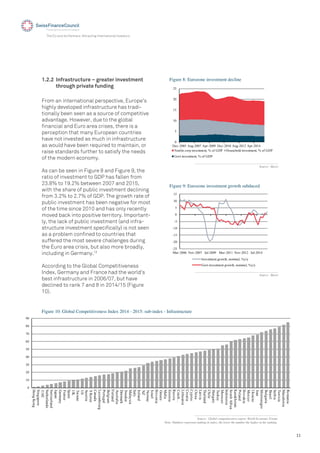
As can be seen in Figure 8 and Figure 9, the
ratio of investment to GDP has fallen from
23.8% to 19.2% between 2007 and 2015,
with the share of public investment declining
from 3.2% to 2.7% of GDP. The growth rate of
public investment has been negative for most
of the time since 2010 and has only recently
moved back into positive territory. Important-
ly, the lack of public investment (and infra-
structure investment specifically) is not seen
as a problem confined to countries that
suffered the most severe challenges during
the Euro area crisis, but also more broadly,
including in Germany.13
According to the Global Competitiveness
Index, Germany and France had the world's
best infrastructure in 2006/07, but have
declined to rank 7 and 8 in 2014/15 (Figure
10).
0
5
10
15
20
25
Dec-2005 Aug-2007 Apr-2009 Dec-2010 Aug-2012 Apr-2014
Nonfin corp investment, % of GDP Household investment, % of GDP
Govt investment, % of GDP
Source: Haver
-25
-20
-15
-10
-5
0
5
10
15
Mar-2006 Nov-2007 Jul-2009 Mar-2011 Nov-2012 Jul-2014
Investment growth, nominal, %y/y
Govt investment growth, nominal, %y/y
Figure 9: Eurozone investment growth subduced
Source: Haver
Figure 10: Global Competitiveness Index 2014 - 2015: sub-index - Infrastructure
Source: Global competitiveness report, World Economic Forum
Note: Numbers represent ranking in index; the lower the number the higher in the ranking.
12
The EU and its Partners: Attracting International Investors
In its October 2014 World Economic Outlook,
the International Monetary Fund (IMF)
argued strongly that the time was ripe for a
big "infrastructure push" to lift growth.14
While the IMF argued in favour of debt-fi-
nanced infrastructure spending (to benefit
from low interest rates), multiple funding
strategies should be considered, including
greater participation of private investors in
funding public investment, above all infra-
structure investment. After all, the fiscal
space of many European countries is limited,
given ongoing challenges in public finances,
and in those countries where fiscal space
does exist the political acceptance of higher
borrowing is often limited.
This makes it all the more pressing, in our
view, to consider options for greater private
funding of infrastructure investment, as we
do in the third case study presented in the
following chapter.
13
The EU and its Partners: Attracting International Investors
Attracting International Investment:
the case of corporate, private and institutional investors
As we have seen in the previous chapter, weak
investment activity is a significant hindrance to
Europe's long-term economic growth. The most
relevant factors affecting investor decisions
are a lack of business-friendly competition,
tax, and labour-market regulation. Political and
economic integration, better infrastructure,
and the completion of the Internal Market - not
least for services - were also cited by investors
as important considerations.
This second chapter therefore explores in three
case studies, in more detail, the different
investor perspectives:
1. Our first case study is based on a survey of
Swiss SMEs, many of whom invest in the EU.
2. the second looks at the potential of private
investment as a source of funding.
3. the third looks at two large infrastructure
projects in the UK and the lessons learnt
from a financing perspective.
Each study shows the need for the EU to take
more account of the international dimension to
attract investment and suggests a number of
concrete recommendations that the EU could
take to address this.
14
The EU and its Partners: Attracting International Investors
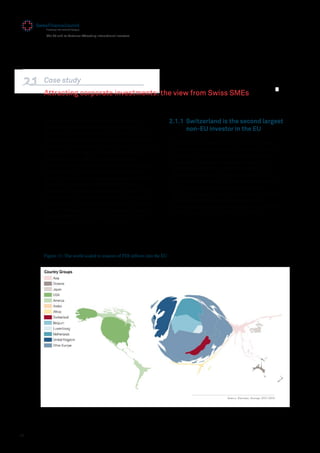
Figure 11: The world scaled to sources of FDI inflows into the EU
As the preceding chapter argues, foreign
investment can contribute significantly to
growth and welfare in the EU. The EU will be
able to attract added capital from its partners
if internal market conditions – both "real" and
financial – are "right". The current section
provides an outside, though admittedly
partial, view of the attractiveness of the EU as
a location for foreign direct investment, by
presenting a survey amongst Swiss SMEs who
have been polled on the matter for the
purpose of this year’s Discussion Paper. The
chapter also provides an update of last year's
paper which presented a statistical, top-down
view of the close partnership between Swit-
zerland and the EU in matters of trade and
investment.
2.1.1 Switzerland is the second largest
non-EU investor in the EU
Foreign direct investment (FDI) is a key mea-
sure of integration and a key driver of growth.
The ability to attract investment is also an
important indicator and determinant of the
competitiveness of a region.15
In the EU28,
total inbound FDI stock amounted to €13.7
trillion at the end of 2014 (the latest data point
from Eurostat). According to data from
UNCTAD, about 34% of the total world stock of
FDI is allocated to the European Union.
Europe's share thus exceeds the share of Asia
(24%) as well as that of the USA (18%).
Case study
Attracting corporate investments: the view from Swiss SMEs
Source: Eurostat; Average 2013-2014
15
The EU and its Partners: Attracting International Investors
Fifty-nine percent of the €13.7 trillion invested
in the EU, or €8.1 trillion, originated from
inside the EU – a reflection of the integrative
force of the EU’s Internal Market. Moreover, in
excess of half of the intra-EU FDI is originated
from three countries: Luxembourg, Nether-
lands and the United Kingdom (see Figure 11).
A significant share of the investments from
these FDI-hubs originates from other coun-
tries however, and is channelled through
these FDI distributors.
Forty-one percent, or €2.3 trillion, of the direct
investments from outside the EU originated
from the United States. The second largest
non-EU investor is Switzerland with €0.6
trillion; next comes Canada with €0.2 trillion.
This makes Switzerland a more important
source of FDI for the EU than Asia, whose
aggregated FDI in the EU amounted to €0.5
trillion. Figure 11 illustrates graphically the
significance of Switzerland as a source of FDI
in the EU. The scale used in this map is not
geographical size, but the importance of
countries as sources of FDI flows for the EU
(areas correspond to shares of FDI in EU in the
2013-2014 period).
At first sight, the importance of Switzerland
might come as a surprise, given its small size
in GDP terms. However, the very close trade
integration between Switzerland and the EU,
especially of an intra-industry nature, tends to
boost FDI flows. Even when trade barriers are
already very low for goods, as is the case
between Switzerland and the EU, companies
may benefit substantially from being
geographically closer to their customers.
Other factors that intensify relationships
between countries, such as the sharing of a
language or other political, cultural, and legal
affinities have also been shown to facilitate
FDI as well as trade. Switzerland and the EU
have both a long history of economic integra-
tion and very intense trade relationship. These
ties deepened further since the Free Trade
Agreement between Switzerland and the EU
was concluded in 1972, and the various other
treaties that followed. In large part due to
these ties, industries in the EU and Switzer-
land have integrated via joint supply chains,
as shown in the latest OECD data discussed
later in this chapter.
We have updated last year's investigation on
the determinants of FDI flows for highly
developed countries based on an econometric
model. The model resembles a "gravity model"
often used in the analysis of bilateral trade
flows. Our sample comprises 245 bilateral
investment relationships between 19 OECD
countries as well as China and Brazil over the
period from 1991 to 2012 (tax data only up to
2005). Obtaining relevant tax data is one of the
greatest challenges in this regard. To gauge
the tax benefits of investing abroad versus
investing at home, we used so-called "effec-
tive" tax rates. Effective rates calculate the
difference between the pre and post-tax
earnings of a project and are thus better
suited than "raw" statutory tax rates. Howev-
er, even the effective tax data based on
Devereux, Griffith and Klemm (2002) is unable
to account for all special tax regimes. Never-
theless, the results of our analysis suggest
that the following factors are important
drivers of FDI:
• Tax rates: A one percentage point increase
in "effective" average tax rate (EATR) of the
FDI host country lowers the amount of
incoming FDI by 0.2% on average. Devereux
Griffith and Klemm estimate EATRs of 30%,
24% and 11% for Germany, Switzer-
land/Netherlands and Ireland respectively
for 2005. In reality, Switzerland and the
Netherlands are likely to be just as attrac-
tive as Ireland for specific investment
projects which suggest that the shortcom-
ings of tax data tend to lead to an underes-
timation of the effects of FDI.
• Stability: A one percentage point higher
unemployment rate lowers incoming FDI on
average by 0.5%. The unemployment rate
can be read as a proxy for both economic
and political stability. That said, stable and
intense trade relationships should facilitate
FDI flows, too.
• Population: A 1% larger population attracts
on average 0.03% more FDI.
• Other factors affecting FDI significantly are
geographical distance, the cultural affinity
with the FDI sender and the market size
(measured e.g. by credit volumes outstand-
ing).
16
The EU and its Partners: Attracting International Investors
Figure 12: The 15 most important export destinations for EU exporters
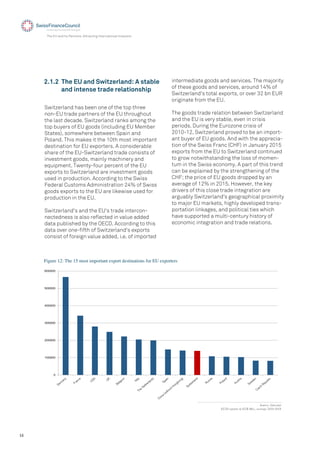
Switzerland has been one of the top three
non-EU trade partners of the EU throughout
the last decade. Switzerland ranks among the
top buyers of EU goods (including EU Member
States), somewhere between Spain and
Poland. This makes it the 10th most important
destination for EU exporters. A considerable
share of the EU-Switzerland trade consists of
investment goods, mainly machinery and
equipment. Twenty-four percent of the EU
exports to Switzerland are investment goods
used in production. According to the Swiss
Federal Customs Administration 24% of Swiss
goods exports to the EU are likewise used for
production in the EU.
Switzerland's and the EU's trade intercon-
nectedness is also reflected in value added
data published by the OECD. According to this
data over one-fifth of Switzerland's exports
consist of foreign value added, i.e. of imported
2.1.2 The EU and Switzerland: A stable
and intense trade relationship
intermediate goods and services. The majority
of these goods and services, around 14% of
Switzerland's total exports, or over 32 bn EUR
originate from the EU.
The goods trade relation between Switzerland
and the EU is very stable, even in crisis
periods. During the Eurozone crisis of
2010-12, Switzerland proved to be an import-
ant buyer of EU goods. And with the apprecia-
tion of the Swiss Franc (CHF) in January 2015
exports from the EU to Switzerland continued
to grow notwithstanding the loss of momen-
tum in the Swiss economy. A part of this trend
can be explained by the strengthening of the
CHF; the price of EU goods dropped by an
average of 12% in 2015. However, the key
drivers of this close trade integration are
arguably Switzerland's geographical proximity
to major EU markets, highly developed trans-
portation linkages, and political ties which
have supported a multi-century history of
economic integration and trade relations.
!
"!!!!!
#!!!!!
$!!!!!
%!!!!!
&!!!!!
'!!!!!
Source: Eurostat
EU28 exports in EUR Mio., average 2010-2014
17
The EU and its Partners: Attracting International Investors
More than 20% of the Swiss SMEs that
participated in a survey of Switzerland Global
Enterprise (S-GE) and Credit Suisse plan to
invest abroad in 2016; 56% (also) intend to
invest in Switzerland.16
With a share of 63%
the EU will be the most important target
region for the planned investments. Almost
one third of the SMEs plans to increase its FDI
flows into the EU, while about two thirds plans
to maintain the current pace. Only 8% intend
to invest less in the near term future. The
strong focus on the EU does not come as a
surprise given the close trade relationship:
About 90% of the participating SMEs export
products or services to the EU and 80% source
products or services from abroad – with
products and services from the EU command-
ing a share of 78%. Clearly, as a result of the
significant appreciation of the CHF against the
EUR shifting production or services facilities
abroad has become even more attractive.
2.1.3 Swiss SMEs have a clear
preference for investing in the EU
With their investments in the EU the SMEs
that participated in the survey aim first of all
to improve their supply chains (34%), secondly
to save production costs (22%), or thirdly to
enter into new markets (6%). Accordingly,
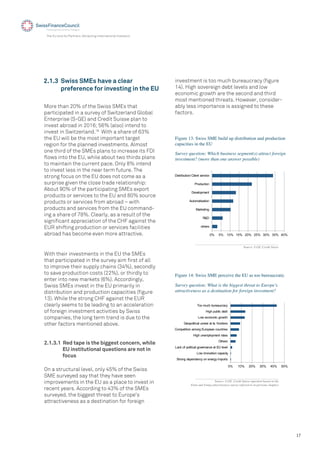
Swiss SMEs invest in the EU primarily in
distribution and production capacities (figure
13). While the strong CHF against the EUR
clearly seems to be leading to an acceleration
of foreign investment activities by Swiss
companies, the long term trend is due to the
other factors mentioned above.
!" #" $!" $#" %!" %#" &!" &#" '!"
()*+,)-.+)/01 23)40+5*4,6)74
8,/9.7+)/0
(4643/:;40+
<.+/;=+)*=+)/0
>=,?4+)0@
AB(
/+C4,*
Figure 13: Swiss SME build up distribution and production
capacities in the EU
Survey question: Which business segment(s) attract foreign
investment? (more than one answer possible)
Source: S-GE, Credit Suisse
2.1.3.1 Red tape is the biggest concern, while
EU institutional questions are not in
focus
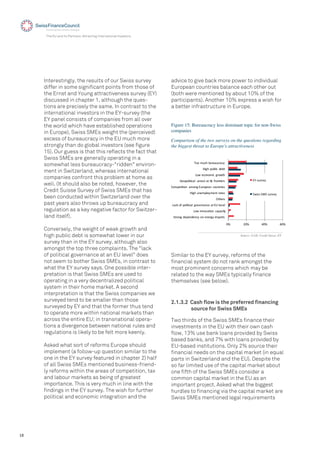
investment is too much bureaucracy (figure
14). High sovereign debt levels and low
economic growth are the second and third
most mentioned threats. However, consider-
ably less importance is assigned to these
factors.
!" #!" $!" %!" &!" '!"
()*+,-./010,/0,23.+,.0,0*-3.451+*)6
7+8.4,,+9:)4+,.2:1:243
7:2;.+<.1+=4)42:=.-+90*,:,20.:).>?.=090=
@)A0*6
B4-A.C,051=+350,).*:)06
D+510)4)4+,.:5+,-.>C*+10:,.2+C,)*406
E0+1+=4)42:=.C,*06).:).46).<*+,)40*6
7+8.02+,+542.-*+8)A
B4-A.1CF=42./0F)
G++.5C2A.FC*0:C2*:23
ts
ty
Figure 14: Swiss SME perceive the EU as too bureaucratic
Survey question: What is the biggest threat to Europe's
attractiveness as a destination for foreign investment?
Source: S-GE, Credit Suisse (question based on the
Ernst and Young attractiveness survey referred to in previous chapter)
On a structural level, only 45% of the Swiss
SME surveyed say that they have seen
improvements in the EU as a place to invest in
recent years. According to 43% of the SMEs
surveyed, the biggest threat to Europe's
attractiveness as a destination for foreign
18
The EU and its Partners: Attracting International Investors
Interestingly, the results of our Swiss survey
differ in some significant points from those of
the Ernst and Young attractiveness survey (EY)
discussed in chapter 1, although the ques-
tions are precisely the same. In contrast to the
international investors in the EY-survey (the
EY panel consists of companies from all over
the world which have established operations
in Europe), Swiss SMEs weight the (perceived)
excess of bureaucracy in the EU much more
strongly than do global investors (see figure
15). Our guess is that this reflects the fact that
Swiss SMEs are generally operating in a
somewhat less bureaucracy-"ridden" environ-
ment in Switzerland, whereas international
companies confront this problem at home as
well. (It should also be noted, however, the
Credit Suisse Survey of Swiss SMEs that has
been conducted within Switzerland over the
past years also throws up bureaucracy and
regulation as a key negative factor for Switzer-
land itself).
Conversely, the weight of weak growth and
high public debt is somewhat lower in our
survey than in the EY survey, although also
amongst the top three complaints. The "lack
of political governance at an EU level" does
not seem to bother Swiss SMEs, in contrast to
what the EY survey says. One possible inter-
pretation is that Swiss SMEs are used to
operating in a very decentralized political
system in their home market. A second
interpretation is that the Swiss companies we
surveyed tend to be smaller than those
surveyed by EY and that the former thus tend
to operate more within national markets than
across the entire EU; in transnational opera-
tions a divergence between national rules and
regulations is likely to be felt more keenly.
Asked what sort of reforms Europe should
implement (a follow-up question similar to the
one in the EY survey featured in chapter 2) half
of all Swiss SMEs mentioned business-friend-
ly reforms within the areas of competition, tax
and labour markets as being of greatest
importance. This is very much in line with the
findings in the EY survey. The wish for further
political and economic integration and the
advice to give back more power to individual
European countries balance each other out
(both were mentioned by about 10% of the
participants). Another 10% express a wish for
a better infrastructure in Europe.
2.1.3.2 Cash flow is the preferred financing
source for Swiss SMEs
!" #!" $!" %!"
&'()*+,-./.*-.*01,)*,.*.(+1,23/)('4
5)6,2**)78'2)*, 08/8021
5809,):,/);2'208;, +)7.(*8*0.,8',<=,;.7.;
>'?.(4
@2+?,A*.3/;)13.*',(8'.4
B)3/.'2'2)*, 83)*+,<A()/.8*, 0)A*'(2.4
C.)/);2'208;, A*(.4',8',24',:()*'2.(4
5)6,.0)*)320, +()6'?
@2+?,/AD;20, -.D'
E)),3A0?,DA(.8A0(801
<FG4A(7.1
&6244,&H<,4A(7.1
ts
ty
Figure 15: Bureaucracy less dominant topic for non-Swiss
companies
Comparison of the two surveys on the questions regarding
the biggest threat to Europe's attractiveness
Source: S-GE, Credit Suisse, EY
Similar to the EY survey, reforms of the
financial system do not rank amongst the
most prominent concerns which may be
related to the way SMEs typically finance
themselves (see below).
Two thirds of the Swiss SMEs finance their
investments in the EU with their own cash
flow, 13% use bank loans provided by Swiss
based banks, and 7% with loans provided by
EU-based institutions. Only 2% source their
financial needs on the capital market (in equal
parts in Switzerland and the EU). Despite the
so far limited use of the capital market about
one fifth of the Swiss SMEs consider a
common capital market in the EU as an
important project. Asked what the biggest
hurdles to financing via the capital market are
Swiss SMEs mentioned legal requirements
19
The EU and its Partners: Attracting International Investors
(31%) and higher capital costs (29%) as the
most important, followed by the need to adapt
accounting standards if capital markets were
to be accessed (22%). A single and well-de-
signed capital market which would lower the
costs of capital would thus be highly appreci-
ated by Swiss SMEs.
2.1.4 Recommendations
2.1.4.1 Reduce red tape within member
economies by promoting best practices
Small and medium-sized enterprises form the
backbone of Europe’s economies. They are at
the heart of job creation, investments and
innovation. SMEs can also play a crucial role
in cross-border investments. This is particu-
larly true for SMEs from Switzerland which are
very integrated into the European economy.
What are the key conclusions of our survey?
Swiss SMEs believe that the biggest threat to
Europe's attractiveness as a destination for
foreign investment are unnecessary layers of
bureaucracy. Less ‘red tape’ would stimulate
third-country SME investment. Such barriers
are not necessarily of an EU-wide nature.
Nevertheless, our survey shows that often EU
regulation adds further constraints to those
already existing within the Internal Market. EU
authorities should seek to develop a mecha-
nism which would promote best practices
based on the experiences of the different
member states, as well as non EU countries.
2.1.4.2 Enhance SME access to finance by
promoting CMU and Banking Union
implementation and completion
High sovereign debt levels and low economic
growth are the second and third most men-
tioned threats. SMEs need a stable mac-
ro-economic environment. Today, most SMEs
finance their investments from own funds (i.e.
retained earnings) rather than from capital
markets. Despite the limited use of the capital
market about one fifth of the Swiss SMEs
consider a common capital market in the EU
as an important project. A single and well-de-
signed capital market would lower the costs of
funds and would be highly appreciated by
Swiss SMEs. From their perspective, it is
therefore important to develop alternative
flexible funding mechanisms in the context of
the CMU. In addition, strong banks can add to
the funding sources of SMEs. A key recom-
mendation is thus to both complete and
strengthen the European Banking Union and
to achieve a well-developed CMU which will,
over the longer-term also support investment
activities of domestic as well as foreign SMEs.
2.1.4.3 'Think Small First' to foster overall
conditions favourable to SME
investments
Half of all Swiss SMEs mentioned busi-
ness-friendly reforms within the areas of
competition, tax and labour markets as being
of greatest importance. Going forward,
investment opportunities would improve if
European policies focussed more resolutely
on Small and Midcap companies. European
and national policy makers are thus encour-
aged to improve the overall conditions in
which SME businesses can thrive. This is
because small companies are disproportion-
ally impacted by ill-conceived regulations and
bureaucracy. Our findings underline the
importance of the Commission’s 'Small
Business Act' which encourages policy makers
to 'Think Small First'. Legislation, administra-
tive rules and procedures should be simple,
easy to understand and to apply. SMEs'
interests should be taken into account at the
very early stages of policy making in order to
make legislation more SME friendly.
20
The EU and its Partners: Attracting International Investors
Investment activity in recent years has
increasingly been focussed on short term
opportunities, as companies, institutional
investors, governments and private investors
have all seemed reluctant to commit to
long-term projects. Globally, cash holdings in
the portfolios of High Net Worth Individuals
(HNWI) still account for 25.6% of total wealth
and remained fairly stable over the last three
years.17
The low interest rate environment
indeed offered few fixed-income investment
alternatives, yet the global stock market has
had a very strong performance until recently.
Especially at a time when the need for invest-
ment is acute and in an environment where
financing multi-year ventures that will further
boost economic growth and investment
returns seems attractive, the current invest-
ment drought comes unexpected, not only
from an economic perspective but also given
the high percentage of cash deposit in inves-
tors' portfolios in a low-interest rate environ-
ment.
The case study outlines how Europe could
become more attractive to international
private investors with a focus on the fast
growing Ultra High Net Worth Individuals
(UHNWI) population and their interest to
invest in alternative investment products, in
particular private equity investments18
that
are typically used for financing long-term
projects. Private equity invests for the long
term and backs over 25'000 companies in
Europe, 83%19
of which are small and medium
enterprises (SMEs), in sectors as diverse as
life sciences, retail and energy. It also backs
impact investing projects that are designed to
achieve a positive social impact as well as a
financial return in sectors like healthcare. In
order to encourage international investors to
commit to long-term financing, however, such
2.2.1 Introduction investments need to be accessible and the
overall investment framework needs to be
attractive. This requires for example the
Internal Market to function so that companies
in one Member State can receive investment
from another and can use the Internal Market
as a springboard to exploit international
opportunities. Also the EU has to be open to
investors across the world. This case study
will address these topics and is structured
along three sections.
Section 1 outlines characteristics of the
UHNWI market and latest developments from
a client as well as an offering perspective.
Section 2 compares the overall investment
framework for private equity investments in
European companies with the US market and
outlines what the SFC considers to be the
main issues preventing international private
investors from engaging in European private
equity investments.
Section 3 then concludes with some policy
recommendations on how to attract private
investments with regards to the overall
investment framework as well as specific
recommendations for improving EU policies.
Case study
Making Europe more attractive for international private investors
21
The EU and its Partners: Attracting International Investors
Vehicles providing non-accredited investors with exposure to alternatives strategies via registered vehicles: mutual funds, closed-end funds and ETFs.
Source: McKinsey Global Asset Management Growth Cube; Preqin;HFR
UHNWI are commonly considered to be clients
with USD 30 million or more investable
assets.20
While UHNWI make up only 1.0% of
all HNWIs, they account for roughly 35% of
HNWI wealth and are significant drivers of the
overall global HNWI population and wealth
growth. Their growth rates in recent years
surpassed those of the HNWI. In 2014, for
example, global UHNW growth in investable
assets reached 9.3% (excluding Brazil).21
Asia
thereby overtook North America in terms of
UHNW growth. The UHNWI in Asia now hold
more in total wealth, with net assets of USD
5.9tn, than those in North America with USD
5.5tn. However, even if wealth creation is
stronger outside Europe, European UHNWIs
still control the most wealth with USD 6.4tn.22
For wealth managers providing cross-border
services out of Switzerland, Europe is there-
fore an important UHNW market.
UHNW clients vary in type but have in many
cases an entrepreneurial background and
their investment risk profile is generally well
suited for long term private equity invest-
ments. The active entrepreneur may thereby
actively participate in the creation of wealth,
whereas for others wealth could be managed
via a Family Office. Generally UHNWI with a
strong wealth / investments focus have a
stronger interest in Private Equity investments
compared to clients with a stronger focus on
wealth creation through their family or own
business.
From a client perspective, it is important first
of all to understand their investment objec-
tives. After several years of focusing on wealth
preservation post-2008, portfolio perfor-
mance has become top of mind for UHNWIs.
The alternative investment industry overall,
including the private equity market, has
matured over the last 30 years and is gradual-
ly becoming part of the mainstream financial
industry.
2.2.2 The UHNW market and latest
developments
1.0
1.1
1.1
1.6
1.9
1.4
2.1
2.3
2.0
2.4
2.1
2.6
$3.2
$4.9
$6.3
$7.2
2005 2008 2011 2013
$0.5
$0.8
$0.8
$1.1
$0.9
$1.7
$0.9
$2.0
Global AUM of key alternative asset classes, 2005 - 2013
$ trillions
Total
Real assests
Private equity
Hedge funds
Fund of funds 5.6%
Retail alternatives 12.6%
*
CAGR
2005-13
10.7%
11.3%
9.1%
11.4%
Growth of
traditional
assets =
5.4%
*
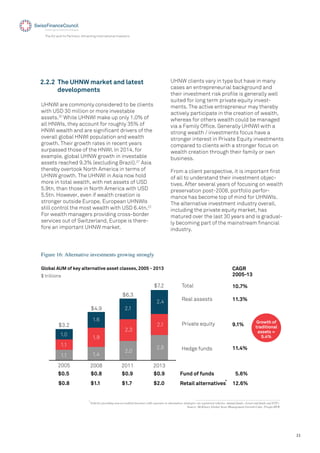
Figure 16: Alternative investments growing strongly
22
The EU and its Partners: Attracting International Investors
Private equity consists of both direct invest-
ments in companies, which are often sought
by entrepreneurial clients, and investments
through private equity funds, which are
generally used as part of portfolio manage-
ment solutions. The interest in private equity
as an asset class has surged in recent years
as is shown in figure 16 and new trends are
developing. For example, UHNWIs who are
interested in generating a positive social
impact as well as a financial return are looking
to private equity-type impact investing collab-
orations. Single family offices are increasingly
interested to participate in networks that
allow them to access direct and co—invest-
ment opportunities alongside other families.
Co-investment opportunities offering more
than just capital participation are in high
demand particularly with Asian UHNWI
wanting to take a direct stake in companies.23
For clients who were or still are entrepreneurs
themselves, this echoes their own experience.
Partnering with private equity can hence bring
mutual gains and help businesses to grow
faster.
From an offering perspective wealth manag-
ers providing investment advice build on the
client demand and are expanding their
platform of capabilities to include private
equity. This includes facilitating direct invest-
ment in companies or offering fund struc-
tures. Facilitating direct investments, howev-
er, requires technical skills and knowledge
which is often limited to large houses. As such
the focus of the wealth managers is mainly on
offering fund structures via specialist private
equity firms.
From the perspective of wealth managers
providing discretionary portfolio management
services, proper diversification is an essential
element of a sound investing strategy. Hence,
alternative investments such as private
equity, where properly implemented in a
portfolio, are viewed to help lower overall
portfolio risk thereby keeping the risk-return
relationship attractive. Because their returns
typically have low correlation with returns of
the broader stock market, these instruments
2.2.3 Private equity investments in
Europe, main issues and comparison
with the US
can provide increased portfolio diversification.
With an average allocation of over 10% in
alternative investments not unusual for
UHNWI portfolios,24
wealth managers are
important investors of alternative products
globally including private equity on behalf of
their clients.
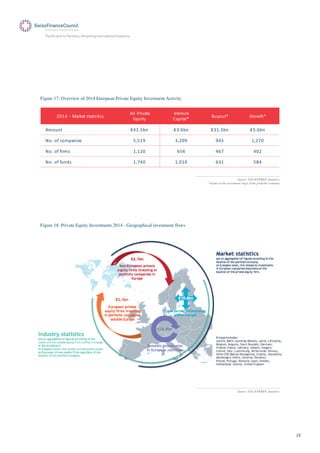
In 2014, the total amount of private equity
investments25
in European companies
increased by 14% to EUR 41.5bn with more
than 5'500 companies receiving funding as
investments (Figure 17).26
While investment in private equity in Europe is
growing, the market is small in comparison to
the US where over the past 10 years US firms
managed to raise almost USD 2 trillion,
significantly more than the USD 641bn raised
in Europe. In 2014, the number of US based
private equity firms amounted to 3'641 versus
1'740 in the EU. The EU private equity invest-
ment market is also small in terms of percent-
age of European GDP compared to the US. In
2014, European Venture Capital investments –
a subset of the Private Equity market –
equalled 0.05% of EU GDP, while US VC
investments were at 0.29% of US GDP.27
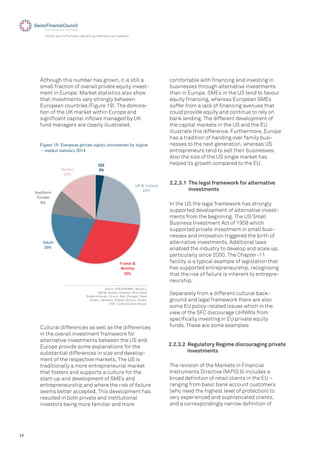
Figure 18 illustrates that private equity firms
predominantly invest in their domestic market
("home bias"). The 2014 industry statistics
(investments made by European private equity
firms regardless of the location of portfolio
companies28
aggregated according to the
country of the private equity firm's office)
show that EUR 39.5 bn are invested by Euro-
pean private equity firms in portfolio compa-
nies throughout Europe with EUR 28.9 bn
domestic and EUR 10.6 bn cross-border
investments within Europe.29
At the same
time, non-European private equity firms only
invest EUR 2.1bn in portfolio companies in
Europe.
23
The EU and its Partners: Attracting International Investors
Figure 17: Overview of 2014 European Private Equity Investment Activity
!"#$%& '()*+,%-,(,.-,./-
011%2).3(,+%
456.,7
8+9,6)+
:(;.,(1<
=67>6,< ?)>@,A<
0B>69, C$#DEF9 CGDHF9 CG#DGF9 CEDHF9
I>D%>J />B;(9.+- EKE#L GK!"L L$E #K!M"
I>D%>J%J.)B- #K#!" HEH $HM $"!
I>D%>J%J69N- #KM$" #K"#" HG# EO$
Figure 18: Private Equity Investments 2014 - Geographical investment flows
Source: EVCA/PEREP_Analytics
*relates to the investment stage of the portfolio company
Source: EVCA/PEREP_Analytics
24
The EU and its Partners: Attracting International Investors
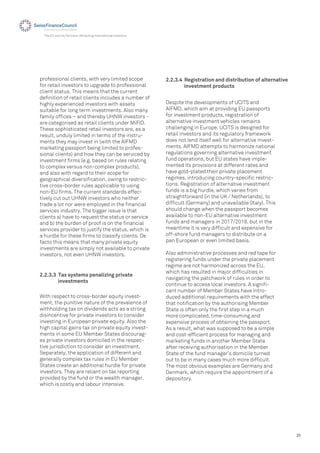
Figure 19: European private equity investments by region
– market statistics 2014
Although this number has grown, it is still a
small fraction of overall private equity invest-
ment in Europe. Market statistics also show
that investments vary strongly between
European countries (Figure 19). The domina-
tion of the UK market within Europe and
significant capital inflows managed by UK
fund managers are clearly illustrated.
!""
#$
%&'(')*+,-./
01$
2*-.3+'('
4+.+,56
#7$
89!:
07$
;<5=>+*.'
"5*<?+
@$
A<*/B3C
D1$
Source: EVCA/PEREP_Analytics
DACH: Austria, Germany, Switzerland
Southern Europe: Greece, Italy, Portugal, Spain
Nordics: Denmark, Finland, Norway, Sweden
CEE: Central Eastern Europe
Cultural differences as well as the differences
in the overall investment framework for
alternative investments between the US and
Europe provide some explanations for the
substantial differences in size and develop-
ment of the respective markets. The US is
traditionally a more entrepreneurial market
that fosters and supports a culture for the
start-up and development of SMEs and
entrepreneurship and where the risk of failure
seems better accepted. This development has
resulted in both private and institutional
investors being more familiar and more
comfortable with financing and investing in
businesses through alternative investments
than in Europe. SMEs in the US tend to favour
equity financing, whereas European SMEs
suffer from a lack of financing avenues that
could provide equity and continue to rely on
bank lending. The different development of
the capital markets in the US and the EU
illustrate this difference. Furthermore, Europe
has a tradition of handing over family busi-
nesses to the next generation, whereas US
entrepreneurs tend to sell their businesses.
Also the size of the US single market has
helped its growth compared to the EU.
2.2.3.1 The legal framework for alternative
investments
In the US the legal framework has strongly
supported development of alternative invest-
ments from the beginning. The US Small
Business Investment Act of 1958 which
supported private investment in small busi-
nesses and innovation triggered the birth of
alternative investments. Additional laws
enabled the industry to develop and scale up,
particularly since 2000. The Chapter-11
facility is a typical example of legislation that
has supported entrepreneurship, recognising
that the risk of failure is inherent to entrepre-
neurship.
Separately from a different cultural back-
ground and legal framework there are also
some EU policy-related issues which in the
view of the SFC discourage UHNWIs from
specifically investing in EU private equity
funds. These are some examples:
2.2.3.2 Regulatory Regime discouraging private
investments
The revision of the Markets in Financial
Instruments Directive (MiFID II) includes a
broad definition of retail clients in the EU –
ranging from basic bank account customers
(who need the highest level of protection) to
very experienced and sophisticated clients,
and a correspondingly narrow definition of
25
The EU and its Partners: Attracting International Investors
professional clients, with very limited scope
for retail investors to upgrade to professional
client status. This means that the current
definition of retail clients includes a number of
highly experienced investors with assets
suitable for long term investments. Also many
family offices – and thereby UHNW investors -
are categorised as retail clients under MiFID.
These sophisticated retail investors are, as a
result, unduly limited in terms of the instru-
ments they may invest in (with the AIFMD
marketing passport being limited to profes-
sional clients) and how they can be serviced by
investment firms (e.g. based on rules relating
to complex versus non-complex products),
and also with regard to their scope for
geographical diversification, owing to restric-
tive cross-border rules applicable to using
non-EU firms. The current standards effec-
tively cut out UHNW investors who neither
trade a lot nor were employed in the financial
services industry. The bigger issue is that
clients a) have to request the status or service
and b) the burden of proof is on the financial
services provider to justify the status, which is
a hurdle for these firms to classify clients. De
facto this means that many private equity
investments are simply not available to private
investors, not even UHNW investors.
Despite the developments of UCITS and
AIFMD, which aim at providing EU passports
for investment products, registration of
alternative investment vehicles remains
challenging in Europe. UCITS is designed for
retail investors and its regulatory framework
does not lend itself well for alternative invest-
ments. AIFMD attempts to harmonize national
regulations governing alternative investment
fund operations, but EU states have imple-
mented its provisions at different rates and
have gold-plated their private placement
regimes, introducing country-specific restric-
tions. Registration of alternative investment
funds is a big hurdle, which varies from
straightforward (in the UK / Netherlands), to
difficult (Germany) and unavailable (Italy). This
should change when the passport becomes
available to non-EU alternative investment
funds and managers in 2017/2018, but in the
meantime it is very difficult and expensive for
off-shore fund managers to distribute on a
pan European or even limited basis.
Also administrative processes and red tape for
registering funds under the private placement
regime are not harmonized across the EU,
which has resulted in major difficulties in
navigating the patchwork of rules in order to
continue to access local investors. A signifi-
cant number of Member States have intro-
duced additional requirements with the effect
that notification by the authorising Member
State is often only the first step in a much
more complicated, time-consuming and
expensive process of obtaining the passport.
As a result, what was supposed to be a simple
and cost-efficient process for managing and
marketing funds in another Member State
after receiving authorisation in the Member
State of the fund manager’s domicile turned
out to be in many cases much more difficult.
The most obvious examples are Germany and
Denmark, which require the appointment of a
depository.
2.2.3.3 Tax systems penalizing private
investments
With respect to cross-border equity invest-
ment, the punitive nature of the prevalence of
withholding tax on dividends acts as a strong
disincentive for private investors to consider
investing in European private equity. Also the
high capital gains tax on private equity invest-
ments in some EU Member States discourag-
es private investors domiciled in the respec-
tive jurisdiction to consider an investment.
Separately, the application of different and
generally complex tax rules in EU Member
States create an additional hurdle for private
investors. They are reliant on tax reporting
provided by the fund or the wealth manager,
which is costly and labour intensive.
2.2.3.4 Registration and distribution of alternative
investment products
26
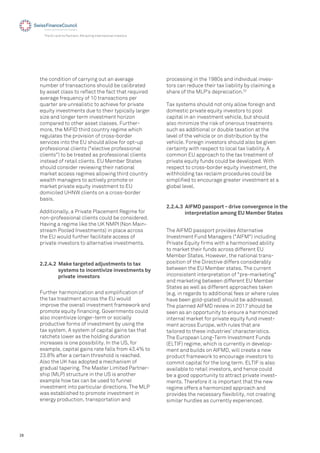
The MiFID client classification foresees three
categories of clients: Eligible counterparties,
professional clients and retail clients. The
definition of ‘professional client’ includes all of
the entities that fall within the eligible coun-
terparty category. Furthermore, retail clients
may be treated as professionals on request
(Opt-up professionals). All clients not falling
within these categories are considered to be
retail clients.
The level of investor protection varies between
these client categories. Clients may, either on
the initiative of an investment firm or at the
client’s request and with the consent of the
firm, be opted down to a more protective client
classification.
The eligible counterparty status is relevant
for certain types of investment business,
mainly dealing and arranging deals in invest-
ments. It is not relevant to, for example,
portfolio management or investment advice.
Per-se professional clients possess the
experience, knowledge and expertise to make
own investment decisions and properly assess
risks involved. Clients include (i) entities
authorised or regulated to operate in the
financial markets, such as credit institutions,
investment firms, and collective investment
schemes, (ii) large undertakings meeting
minimum size requirements in regards to their
balance sheet, net turnover and own funds,
(iii) international and supranational institu-
tions such as central banks, national and
MIFID client classificationBOX 2
regional governments and others as well as
(iv) other institutional investors whose main
activity is to invest in financial instruments.
Opt-up professional clients refer to retail
clients who are allowed to waive some of the
protections afforded by the conduct of busi-
ness rules upon their request. For the identifi-
cation of such clients, assessment criteria – of
which two need to be satisfied – are pre-de-
fined and include (i) transactions carried out
in significant size on the relevant market at an
average frequency of 10 per quarter over the
previous four quarters, (ii) the size of the
client’s financial instrument portfolio exceed-
ing EUR 500’000, (iii) a professional position in
the financial sector for at least one year which
requires knowledge of the transactions or
services envisaged.
Retail clients are all clients which do not meet
the definitions set out above, hence receiving
the highest level of investor protection.
The MiFID client categories are not mutually
exclusive. Professional clients may be treated
as eligible counterparties depending on the
type of business. Retail clients may be treated
as professional clients only in regards to
services and transactions related to a specific
asset class.
The MiFID client classification is used as a
reference in several EU financial product
regimes, such as AIFMD, UCITS and the
Prospectus Directive. Typically, these regimes
offer relaxation of conditions when distribut-
ing products to professional clients.
!"#$%&'( )$(*+',#$'," )$(*,-./,+"#,&0
1/,%,2/$*
+&30#$'."'#(* 41!56
!""#$%&'#() *+)&)%(,*&$-)./'.(*)+0)"(,1.()",+0(..$+-&#) %#$(-*.)$-)
,(#&*$+-)*+)(#$2$'#() %+/-*(,"&,*3)'/.$-(..) 4$5(5)",+6$.$+-) +0)*7()
.(,6$%()+0),(%("*$+-)&-8)*,&-.9$..$+-) +0)+,8(,.)+-)'(7&#0)+0)
%#$(-*.:) (;(%/*$+-)+0)./%7)+,8(,.)&-8<+,)8(&#$-2)+-)+=-)&%%+/-*>
?&-3)+0)*7()$-6(.*+,)",+*(%*$+-)
,(@/$,(9(-*.) 8+)-+*)&""#3)0+,)*,&-.&%*$+-.)
=$*7)&-)ABC
5$'78$*.'&9$88,&0"/*
+/,$0#
• !/*7+,$.(8<,(2/#&*(8) 0$-&-%$&#)9&,D(*)(-*$*$(.
• E&,2()/-8(,*&D$-2.)&'+6()%(,*&$-).$F(
• G-*(,-&*$+-&#)&-8)./",&-&*$+-&#)$-.*$*/*$+-.) 4(525)B(-*,&#)'&-D.>
• H*7(,)$-.*$*/*$+-&#) $-6(.*+,.
B#$(-*) %&-)'()&../9(8)*+)"+..(..) *7()
(;"(,$(-%(:)D-+=#(82()&-8)(;"(,*$.()*+)
9&D()$-6(.*9(-*)8(%$.$+-.)&-8)&..(..) ,$.D.)
$-6+#6(8
:.#73.*
.'&9$88,&0"/*+/,$0#
I=+)+0)*7()0+##+=$-2)%,$*(,$&).&*$.0$(8J
• ?$-$9/9)-/9'(,)+0)*,&-.&%*$+-.)%&,,$(8)+/*
• K$F()+0)"+,*0+#$+) (;%((8.)ALM)NOOPOOO
• C,+0(..$+-&#) $-)*7()0$-&-%$&#).(,6$%(.).(%*+,
B#$(-*) $.)&##+=(8)*+)=&$6().+9()+0)*7()
",+*(%*$+-.)&00+,8(8)'3)*7()%+-8/%*)+0)
'/.$-(..) ,/#(.
;$#",/*+/,$0# !##) +*7(,)%#$(-*. B#$(-*) ,(%($6(.)7$27(.*)#(6(#)+0)$-6(.*+,)
",+*(%*$+-:),(.*,$%*(8)&%%(..)*+)$-6(.*9(-*)
",+8/%*.
MiFID client categories by level of investor protection from low to high
Eligible
counterparty
(ECP)
Per-se
professional
client
Opt-up
professional
client
Retail client
Applicable to a certain subset of per-se professional clients
in relation to eligible counterparty business (i.e. provision of
the service of reception and transmission of orders on
behalf of clients, execution of such orders and/or dealing on
own account)
• Authorised/regulated financial market entities
• Large undertakings above certain size
• International and supranational institutions (e.g. Central
banks)
• Other institutional investors
Two of the following criteria satisfied:
• Minimum number of transactions carried out
• Size of portfolio exceeds EUR 500’000
• Professional in the financial services sector
All other clients
Many of the investor protection
requirements do not apply for transac-
tions with an ECP
Client can be assumed to possess the
experience, knowledge and expertise to
make investment decisions and assess
risks involved
Client is allowed to waive some of the
protections afforded by the conduct of
business rules
Client receives highest level of investor
protection, restricted access to
investment products
27
The EU and its Partners: Attracting International Investors
2.2.4 Recommendations how to attract
international private investments
Other jurisdictions like France or Italy have in
effect made it very difficult to market funds on
any type of private placement basis, either to
protect domestic providers or because of the
complete lack of a suitable legal framework
for private placement. Whereas the UCITS
passporting fees have been minimal, with
AIFMD the national regulators seem to have
adopted more divergent approaches and
consequently there is a divergence in cost,
and time taken, to register a fund. As a result,
the total cost of registering, including legal,
tax and regulatory fees, vary substantially
across the EU; in the UK registration can be
done for £250 with a total expected fees of
maybe up to £5'000, whereas registration of a
fund in Germany could cost up to EUR 30'000
(or more depending on the complexity of the
structure).
This has deterred smaller fund managers from
marketing in many countries and quite a
number of non-EU based private fund manag-
ers who invest in Europe are opting to avoid
marketing their funds in the EU completely, or
only focus on a few jurisdictions. As a result
European private investors miss out on
investment opportunities, as these are simply
not made available to them due to regulatory
hurdles.
In comparison, investment companies in the
US, including alternative investment funds,
are generally subject to the jurisdiction of the
Securities and Exchange Commission (SEC).
Generally, advisers having at least $100
million in assets under management are
required to register with the SEC, which is a
straightforward process. Alternative Invest-
ment Funds themselves are regulated pursu-
ant to the Investment Company Act, but most
funds qualify for an exemption from registra-
tion. Although the Dodd-Frank Wall Street
Reform and Consumer Protection Act revised
the exemptions applicable to investment
advisers, overall the regulatory framework for
offering Alternative Investments in the US
remains straightforward.
This section provides a number of recommen-
dations on how to attract international private
investments, both from an overall framework
as well as specific recommendations for
improving EU policies.
2.2.3.5 Size of European funds
In Europe the landscape is composed of a
large range of smaller funds and many of them
don't have the track records that attract many
new investors. UHNWI as any other investor
are looking for competitive returns and profits
gained by private equity investments in
Europe have been consistently lower in
Europe compared to the US. Industry research
shows that there is a positive relationship
between fund size and performance.30
Euro-
pean venture capital funds are on average
30% smaller than US funds.31
This is in partic-
ular true for funds with a national focus. Due
to the smaller size, they are unable to attract
investors who are looking to invest higher
amounts. Furthermore, the national focus of
many small, largely government-funded
venture capital funds discourages private
investors, who are wary of the lack of scale
effects and the increased risks that stem from
low regional diversification.
2.2.4.1 Ease regulatory restrictions on investors
by reviewing the retail client classification
in the EU
The current client classification under MiFID
and conditions for sophisticated private clients
to be able to opt up to professional clients
should be reviewed with the aim to facilitate
investments into private equity. In particular
28
The EU and its Partners: Attracting International Investors
the condition of carrying out an average
number of transactions should be calibrated
by asset class to reflect the fact that required
average frequency of 10 transactions per
quarter are unrealistic to achieve for private
equity investments due to their typically larger
size and longer term investment horizon
compared to other asset classes. Further-
more, the MiFID third country regime which
regulates the provision of cross-border
services into the EU should allow for opt-up
professional clients ("elective professional
clients") to be treated as professional clients
instead of retail clients. EU Member States
should consider reviewing their national
market access regimes allowing third country
wealth managers to actively promote or
market private equity investment to EU
domiciled UHNW clients on a cross-border
basis.
Additionally, a Private Placement Regime for
non-professional clients could be considered.
Having a regime like the UK NMPI (Non Main-
stream Pooled Investments) in place across
the EU would further facilitate access of
private investors to alternative investments.
processing in the 1980s and individual inves-
tors can reduce their tax liability by claiming a
share of the MLP's depreciation.32
Tax systems should not only allow foreign and
domestic private equity investors to pool
capital in an investment vehicle, but should
also minimize the risk of onerous treatments
such as additional or double taxation at the
level of the vehicle or on distribution by the
vehicle. Foreign investors should also be given
certainty with respect to local tax liability. A
common EU approach to the tax treatment of
private equity funds could be developed. With
respect to cross-border equity investment, the
withholding tax reclaim procedures could be
simplified to encourage greater investment at a
global level.
2.2.4.2 Make targeted adjustments to tax
systems to incentivize investments by
private investors
Further harmonization and simplification of
the tax treatment across the EU would
improve the overall investment framework and
promote equity financing. Governments could
also incentivize longer-term or socially
productive forms of investment by using the
tax system. A system of capital gains tax that
ratchets lower as the holding duration
increases is one possibility. In the US, for
example, capital gains rate falls from 43.4% to
23.8% after a certain threshold is reached.
Also the UK has adopted a mechanism of
gradual tapering. The Master Limited Partner-
ship (MLP) structure in the US is another
example how tax can be used to funnel
investment into particular directions. The MLP
was established to promote investment in
energy production, transportation and
2.2.4.3 AIFMD passport - drive convergence in the
interpretation among EU Member States
The AIFMD passport provides Alternative
Investment Fund Managers ("AIFM") including
Private Equity firms with a harmonised ability
to market their funds across different EU
Member States. However, the national trans-
position of the Directive differs considerably
between the EU Member states. The current
inconsistent interpretation of "pre-marketing"
and marketing between different EU Member
States as well as different approaches taken
(e.g. in regards to additional fees or where rules
have been gold-plated) should be addressed.
The planned AIFMD review in 2017 should be
seen as an opportunity to ensure a harmonized
internal market for private equity fund invest-
ment across Europe, with rules that are
tailored to these industries’ characteristics.
The European Long-Term Investment Funds
(ELTIF) regime, which is currently in develop-
ment and builds on AIFMD, will create a new
product framework to encourage investors to
commit capital for the long term. ELTIF is also
available to retail investors, and hence could
be a good opportunity to attract private invest-
ments. Therefore it is important that the new
regime offers a harmonized approach and
provides the necessary flexibility, not creating
similar hurdles as currently experienced.
29
The EU and its Partners: Attracting International Investors
The pan-European marketing passport which
is currently only available to EU AIFMs should
also be made available to non-EU AIFMs and
AIFs to increase internal market competition
and efficiency. Currently non-EU AIFMs are
only allowed to market AIFs within EU Member
States when complying with the national
private placement regimes ("NPPR") of the
respective EU Member States. Non-EU AIFMs
wishing to market their AIFs throughout the
EU today are required to comply with a
difficult patchwork of divergent national
regulations. As a result a variety of different
fee structures and requirements may be
imposed by different Member States on a
single fund. The non-availability of a passport
is a clear entry barrier to non-EU AIFMs as
very few, if any, have the bandwidth to register
in multiple countries. Following the positive
equivalence assessment of Switzerland,
Guernsey and Jersey, the regulatory regimes
of the US, Hong Kong and Singapore should be
assessed as soon as possible (see box for
further explanation on equivalence). In this
respect, we make some overall recommenda-
tions, in the concluding chapter to our Discus-
sion Paper, on how the EU could enhanced the
process for making equivalence determina-
tions.
2.2.4.4 Availability of a pan-European marketing
passport to non-EU AIFMs
2.2.4.5 Stimulate the development of EU private
equity investment funds
A good example of how to make the European
market more accessible is the Canadian
Venture Capital Action Plan, an initiative to
increase private-sector investment in innova-
tive businesses. The plan has made available
C$350 million to establish four large-scale
private-sector-led funds of funds in partner-
ship with institutional and corporate inves-
tors. The role of the government consisted in
defining the structure of the action plan and
providing financial support to the fund of
funds in form of loans.33
A similar approach
could be applied in the EU, whereby fund
strategies should privilege and encourage
cross-border investment.
The European Commission recognizes the
long-term benefits of private equity and the
action plan for the Capital Market Union
(CMU) also recognises that Europe’s alterna-
tive investment funds tend to be small and
mainly focused on early start-ups. The devel-
opment of the private placement markets and
the review of the Prospectus Directive are
indeed important actions. The proposed
action to widen the investor base for SMEs
also has its merit, but this should also include
encouraging equity investment.
The SFC appreciates that the Commission is
looking at ways to increase the flow of funds
into later-stage companies and small and
medium-sized enterprises (SMEs). This might
be achieved through tax incentives, allowing
larger fund managers to establish funds under
the EU Venture Capital Fund Management
Regulation (EuVECA) umbrella. Also the new
European Long-Term Investment Funds
(ELTIF) will contribute to attract private
investors to invest in Europe, provided that the
regulatory and overall investment framework
of this initiative is geared to the characteris-
tics of the UHNW market.
30
Equivalence assessments are a tool for provid-
ing international companies regulated to the
same high standards as those in the EU with
access to the EU market. A positive equivalence
assessment of a third country’s regulatory
regime confirms that it manages risk in the
financial system, delivers consistent investor
protection and market integrity, and checks
that the regime ensures effective oversight and
enforcement. Correspondingly, while waiting for
a positive equivalence assessment, EU busi-
nesses and consumers are shut-off from
service providers and investment opportunities
from abroad.
An efficient and timely process for making
equivalence assessments therefore would be an
advantage to the EU economy, especially while
the recovery is weak. However, experience to
date has been mixed, with assessments taking
a long time, and only a handful having been
completed. There are a number of substantive
and procedural reasons for this:
• There has been no overriding standard in the
different legislative measures, with
approaches varying from one to the next.
While this is to an extent necessary to take
account of the nature of each piece of
legislation, the process has developed ad
hoc, with little account taken of crosscutting
issues or opportunities to simplify processes.
• The criteria have not always been precise,
with too much leeway for interpretation,
while the basis of comparison has not always
Equivalence
BOX 3
been clear. Assessing whether or not third
country legislation achieves the same
regulatory objectives is often difficult to do.
• The choice of which countries to assess
seems arbitrary and unclear. Third countries
cannot initiate the process but have to wait
for the European Commission to do so, and
there are no clear timeframes or deadlines.
As such, the Commission retains consider-
able discretion over the process, reducing
certainty for all involved.
• In most cases, EU legislation does not
include transitional provisions to address
issues raised by possible equivalence
assessment delays.
These practical problems put into question
market access, even when equivalent regula-
tion is actually in place, or when third coun-
tries are willing to implement equivalent rules.
Consequently, there have been a number of
calls for reform, including from the European
Parliament, which in its Report on Stocktaking
and Challenges of the EU Financial Services
Regulation asked the Commission “to propose
a consistent, coherent, transparent and
practical framework for procedures and
decisions on third-country equivalence, taking
into account an outcome-based analysis and
international standards or agreements.” 34
31
The EU and its Partners: Attracting International Investors
This case study aims to, first, summarise the
initiatives already undertaken or in the pipe-
line to address improved incentives for
investments by institutional investors in
infrastructure projects. Second, it outlines,
based on two recent successful infrastructure
projects in Europe, the regulatory challenges
for infrastructure projects, concluding with
recommendations for the regulatory frame-
work.
As stated before, estimates show that the
public sector has reduced investment in
infrastructure, falling as a share of GDP in
Germany, Italy and the UK since the financial
crisis. Capital spending on infrastructure in
the UK, for example, is down by a third in real
terms from its peak in 2009, according to
figures from the UK’s National Audit Office.35
Estimates suggest infrastructure investment
of up to $3 trillion a year for OECD members
alone may be needed to maintain and extend
infrastructure up to 2030, double the current
rate of spending.36
With many infrastructure
projects being public goods, it is important
that the public sector retains a strong role in
both the construction and financing of these
projects. However, in order to raise the levels
of capital needed, enhancing the role of the
private sector could offer a significant oppor-
tunity for Europe’s financing needs.
Institutional investors, such as pension funds,
insurance companies and sovereign wealth
funds, are the investor class with the longest
investment horizons, making them an ideal
partner for the public sector in respect of
infrastructure investments. In the past years,
institutional investors have increasingly
replaced banks in their role in the financing of
the (long-maturity) debt part of infrastructure
2.3.1 Introduction projects. They represent a customer base that
is interested in long-term revenues rather
than short-term profit.
2.3.2 Recent policy developments:
The European Fund for Strategic
Investment and Capital Markets
Union
In 2014, the incoming European Commission
identified the lack of infrastructure invest-
ments as a significant impediment for growth
in the EU. To help tackle this challenge, it
proposed a European Fund for Strategic
Investment, which came to be known as the
Juncker Plan.
In addition to promoting targeted use of the
European Structural Funds, the European
Commission proposed the European Fund for
Strategic Investment (EFSI). The EFSI was
quickly endorsed by the Member States, and
has been operational since September 2015. It
aims to trigger at least €315 billion of addi-
tional investment in Europe, by levering EU
and European Investment Bank funds of €16
billion and €5 billion respectively three times
and then used as a 20% credit enhancement
over the next three years. The EFSI targets
strategic investment projects (subject to
certain selection criteria) in infrastructure as
well as risk finance for SMEs. According to
latest numbers published by the European
Commission, the EIB/EIF have approved
financing for infrastructure and innovation
projects in the amount of €5.7 billion since
January 2016 indicating that the Juncker Plan
might gain traction.
Another action of the European Commission
was to address under the project of the
Case study
Reviving private investments by institutional investors – focusing on
infrastructure investments
32
The EU and its Partners: Attracting International Investors
Improved investment
environment at EU
and national level
Better use of the European
Structural and
Investment Funds
Possible Member States*
contributions to the Fund
European Funds for
Strategic Investments:
EUR 21 bn (initially)
Over three years
EUR
20 bn
(at least)
W
ill depend on com
m
itm
ent
EUR 75 bn
EUR 240 bn
Positive impact on
investment throughout the
economy
Priorities at national and regional
level (e.g. SMEs, research, transport,
environment)
Impact of Member States’
contributions to the Fund *
SMEs and mid-cap companies
Strategic investments of European
significance in energy, transport,
broadband, education, research and
innovation
EUR 315 bn
Figure 20: Mobilising Finance for Investment - leverage
*In the context of the assessment of public finances under the Stability and Growth Pact, the Commission will take a favourable position towards such capital contributions to the Fund.
Source: European Investment Bank, Factsheet 2 – Where does the money come from?, http://www.eib.org/attachments/efsi_factsheet2_where_from_en.pdf
Capital Markets Union (CMU) the treatment of
infrastructure investments in EU capital
requirements legislation for insurers, Solven-
cy II.37
The goal is to ensure that Solvency II
does not impose inadequate or punitive
capital requirements by establishing a distinct
infrastructure asset class for which the
amount of capital which insurers must hold
against the debt and equity of qualifying
infrastructure projects will be reduced.
The SFC believes that these initiatives are very
significant measures to tackle the lack of
infrastructure financing. Further enhance-
ments to the regulatory framework and
improving the incentives for institutional
investors will be crucial to leverage the full
potential of Commission's initiatives with the
aim of substantially growing the market for
infrastructure investments.
Infrastructure projects require attractive
value propositions for both the public and the
private sector. The SFC believes that it is
decisive to strike the right balance between
involvement of the public sector and incen-
tives for engagement of institutional investors.
Experience shows that the right balance might
be very different depending on the type of
investment, i.e. for ‘greenfield’ projects that
require funding in the construction phase and
‘brownfield’ projects; that require financing in
the post-construction phase.38
Greenfield
projects are characterised by a high risk
structure from construction risks to misjudg-
ing cash and capital flows in the initial operat-
ing phase. Brownfield projects are typically
2.3.3 Successfully placing infrastructure
projects in the private market
33
The EU and its Partners: Attracting International Investors
characterized less by these risks, but are still
different from secondary market investments
in Fixed Income or Equity instruments as their
revenues depend on the management of an
ongoing project. This holds particularly true
for greenfield transport and social infrastruc-
ture projects where the infrastructure needs
public financial support.
We looked at two recent infrastructure
projects, one greenfield, the Thames Tideway
Tunnel project to modernise London’s sewer-
age system, and one brownfield, the High
Speed rail link between London and the
Channel Tunnel. We analysed the specific
characteristics with a particular focus on their
attractiveness for private investors.
social infrastructure like hospitals, schools,
government buildings where the construc-
tion/completion risks are modest, and the
period of construction short (2-3 years).
Consequently, major projects with higher
than normal risks can often offer better
value for money to taxpayers when financed
without private capital as simple public
sector procurement.
• The financing size of the TTT was significant
and the equity part is greater than usual for
traditional greenfield projects. In addition,
on the debt financing side, the debt needed
to be investment grade to ensure any
financing plan was sufficiently robust.
These parameters forced the involved parties
to find more innovative solutions compared to
their 'simpler' infrastructure projects. Figure
21 illustrates the TTT project structure.
To address the high financing need, the TTT
project was deliberately structured to attract
large institutional investors, such as pension
funds, insurance and sovereign wealth funds.
To do this the risk transfer was carefully
calibrated to ensure that risks inside the
industry norm were assumed by the private
investors, whereas risks outside the industry
norm were shared with government and
end-customers.
Government support (i.e. taxpayer risk shar-
ing) and regulatory mitigants (i.e. customer
risk sharing) were used to reduce risks within
the TTT project such that the overall risk
transfer to the private sector equity and debt
providers was similar to that of an operational
water investment, i.e. the very low cost part of
the infrastructure market. The emphasis was
on incentivisation of equity by achieving an
Internal Rate of Return (IRR) similar to opera-
tional core infrastructure assets.39
For exam-
ple if construction costs overrun a pre-agreed
amount, Government would cap the funding
requirement ensuring that the loss of IRR for
private investors is not too high. However, up
to that pre-agreed amount, private investors
are not getting full return on the additional
capital they are required to inject, ensuring
2.3.3.1 Greenfield Project: Thames Tideway
Tunnel
The Thames Tideway Tunnel (TTT) project aims
to modernize the sewerage system in London
by building a new tunnel underneath the River
Thames through the heart of London. The
procurement phase started in mid-2014. The
project presented a number of specific
challenges due to its financing size, the
duration of the construction period, the
construction risk and the specific regulatory
environment applicable to the project, all of
which required innovative answers we believe
hold lessons for the broader policy framework.
The TTT project has a total investment of
£4.2bn, and the construction period is
estimated to last 10 years. The tunnelling risk
under a metropolitan area like London is
considered to be very high. Timely and on
budget completion is a priority for the
project’s stakeholders – the UK Government,
regulator, and water supply company as the
old sewerage systems date from the 1860s.
For the project this meant the following:
• Traditional public-private-partnership
programs (PPP) were not suitable for TTT.
Evidence from PPP programmes points to
such models working well for simpler,
standardised and smaller projects, such as
34
The EU and its Partners: Attracting International Investors
2.3.3.2 Brownfield Project: High Speed 1
EquityDebt Secretary of State
Ofwat
IP
West Central East
Construction
Contractors
Project
Manager
Thames Water Utilities
Limited (”TWUL”)
Insurers
100% ownership
Project Licence
Government Support Package
Revenue collection/
operator of sewage network
2
3
1
Figure 21: IP structure at a glance
high incentives to make the project work. On
the debt side it was crucial to have a structure
capable of supporting a BBB rating. Part of the
enhanced regulation framework allows for a
sharing of risk should the cost of debt exceed
the estimation after the start of the construc-
tion phase, reflecting the difficulty of raising
all finance up-front with such a long construc-
tion period.
Other risk mitigants addressed the problem of
the long and expensive procurement process-
es that have made other PPPs unattractive to
investors and were responsible for delays.
They were focused on efficient project man-
agement features – tasks transferred to a
separately created project entity (referred to
'IP' in the above chart) - where again control
and transparency of risk were crucial.
Furthermore, an additional element contribut-
ing to the success of the TTT in terms of
attracting competitive private sector capital
was the continuous engagement of public
authorities throughout the life of the project
based on an existing regulatory model for the
privatised water sector. This allows for
dynamic reactions to the project terms during
the construction or operation phases, with the
involvement of the public sector guaranteeing
continuity.
The financing of the £6 billion Channel Tunnel
Rail Link, today known as High Speed 1 (HS1),
had to undergo several significant restructur-
ings since the original concession in 1996. in
2010, following the successful completion of
its construction phase three years earlier, the
involved parties were able to successfully
privatise HS1. HS1, therefore, is a good
example of how an infrastructure project
needs public sector support in its construction
phase, but allows the public sector to mone-
tise (part of) its investment in the (successful)
operational phase.
In 1996, London & Continental Railways (LCR),
a private sector consortium, won the conces-
sion to design, build, finance and operate HS1
and the UK interest in Eurostar. The original
financing plan was based on a private sector
equity investment and a debt bridge leading to
an Initial Public Offering of LCR and long-term
project finance debt.
However, this financing plan could not be
realised with Eurostar passenger and yield
forecasts turning out to be overly optimistic,
which made it impossible to raise sufficient
private sector finance. In the revised financing
plan the UK Government agreed to guarantee
the debt financing requirement.
35
The EU and its Partners: Attracting International Investors
Figure 22: Structure chart
In addition, while the private sector investors
continued to be involved, the equity upside
was capped and a risk transfer package put in
place to incentivise each relevant contrac-
tor/operator and to share upside and down-
side risks. The resulting significant reduction
in the cost of capital avoided the need for
additional subsidies and grants from the UK
government, and provided the stability and
certainty for the construction project to be
delivered on time and within the original target
cost.
After the successful completion of HS1 and
several years of operation, LCR and the UK
Government reassessed the rationale for
integrated ownership of rail infrastructure and
train operations, and decided to restructure
LCR in mid-2010. The UK Government also
wanted to monetise some of its investment in
HS1 by re-introducing further private sector
capital and risk transfer. The Government
created a new 30-year concession and regula-
tory framework for HS1, and decided to
change the underlying economics of the HS1
system to make it commercially viable on a
standalone basis. This also involved the UK
government assuming most of the construc-
tion debt to enable a clean and successful
privatisation without any ongoing government
support of the capital structure.
In November 2010, the UK Government was
able to complete within less than 5 months
the sale of HS1 to international institutional
investors, namely two Canadian pension
funds, for a value of £2.1bn. The terms of the
sale were competitive, supported by a favour-
able regulatory environment for infrastructure
investments by pension funds in Canada. The
new owners of HS1 are incentivised to ensure
safe operation of the railway and grow its
usage. At the end of the concession period, the
asset will revert to the UK government, which
will then be able to let another concession to
recoup more of the original investment.
Even if not by original design, the HS1 model
offers an example of how governments can
support the construction phase of a project to
optimise the risk transfer and reduce the cost
of capital and therefore the subsidy require-
ment, followed by a monetisation once it has
been completed and institutional investors
are better placed to value the asset.
Shareholders
HS1
Concession
HMG
LCR
Bond/bank
Financing
Eurostar UK LCR Properties
Borealis and Ontario
Teachers
CDPQ and Hermes AustralianSuper
Guarantee
Converted into preference
shares post restructuring
Sold toSold to
King’s Cross
interest sold to
ConstructionperiodPostconstruction
Note: Simplified structure
36
The EU and its Partners: Attracting International Investors
2.3.4 Lessons learned 2.3.5 Recommendations for an enhanced
regulatory framework
Improving the environment for infrastructure
investments has been the subject of several
studies since the start of the financial crisis.
In 2013, the Group of Thirty (G30)40
issued a
report on 'Long-term Finance and Economic
Growth' in which they observed that the
current framework for long-term finance
increasingly constrained private long-term
investors in their ability to provide long-term
financing. This development calls, in its view,
for multifaceted policy responses inter alia by
the FSB, IMF, the World Bank and the OECD in
favour of long-term investments. In order to
incentivise the demand side the G30 recom-
mended more specifically:
• A review of the regulatory and accounting
treatments of assets held with long-term
horizons,
• measures to better differentiate between
short and long-term debt, and
• consideration of a phase-out of the
preferential treatment of sovereign debts.
Furthermore, the G30 advocated in favour of
developing new long-term finance products
such as savings programs as well as debt and
equity capital markets that support long-term
investments, e.g. by providing appropriate
means of securitisations of long-term debt.
Finally, the G30 emphasised the importance of
cross-border capital flows for an international
diversification of investment.
These recommendations were broadly in line
with recommendations published in October
2014 by the European Financial Services
Round Table (EFR).41
The EFR defined a set of
best practice recommendations intended to
make infrastructure investments more
accessible. Similarly, the Institute of Interna-
tional Finance (IIF) approved in October 2015 a
set of Principles for enhancing investor rights
in Long-Term Investment outlining the top ten
principles to strengthen the legal and regula-
tory framework for the protection of investor
rights with regard to infrastructure invest-
ments.42
As with the TTT project, HS1 was of exception-
al scale and thus both were, to a certain
extent, outliers in the infrastructure-financing
world. The public sector therefore could not
rely on existing standardisation, but needed to
lever experience gained with other infrastruc-
ture classes for tailoring the investment case
and process to the preferences of the private
investors. Achieving comparability to a
well-known infrastructure class with control-
lable risks involved, therefore, was one of the
key success factors in both TTT and HS1.
Common to both projects was that in the
construction phase the financing inevitably
included a restricted risk transfer to the public
sector, i.e. not in the form of public debt, but
contingent guarantees leaving a significant
share of responsibility to the private sector.
Consequently, the private sector was incentiv-
ised for an in-plan completion and operation
of the infrastructure asset. The remaining risk
for debt investors could be placed thanks to
an investment grade rating and/or risk trans-
parency partially achieved through intensive
preparation of the projects, including analysis
of the risks involved.
Finally, an efficient regulatory process on the
public sector side also significantly contribut-
ed to the success of both projects. Private
institutional investors were attracted by
mitigating risks through a fair and stable
regulatory framework with clear and transpar-
ent legal procedures and efficient government
coordination at all involved levels.
37
The EU and its Partners: Attracting International Investors
2.3.5.1 Encourage efficient risk-sharing
Firstly, in our view the success of an infra-
structure project lies in the right balance of
cooperation between both public and private
sectors, considering and identifying public
support measures the private sector currently
needs in order to improve accessibility for
infrastructure financing, e.g. through credit
enhancement and guarantee programs. This
cooperation is particularly important for
greenfield projects, but also in the brownfield
stage when the engagement of the public
sector could be reduced through privatization.
In this respect, a robust risk-sharing arrange-
ment such as in the TTT and HS1 projects
could serve as a model for elsewhere in
Europe and could result in a well calibrated
public sector engagement which leaves room
to market forces and sets right incentives for
the private sector.
This approach could support infrastructure
investments especially since the last financial
crisis has resulted in the disappearance of
monoline-wrapped capital market instru-
ments where investors were drawing comfort
from debt service guarantees (wraps) to senior
debt/senior bonds issued by project compa-
nies. The use of contingent guarantees, for
example could be a viable and cost efficient
complement to the Juncker Plan for bringing
more private capital to invest in the infrastruc-
ture sector. In this respect, faster progress
should be aimed for in making available
'Project Bonds' and/or schemes similar to
so-called 'Loan Guarantee Instruments for
Ten-T Projects' (LGTT) for large-scale infra-
structure projects.43
The following recommendations support the
above mentioned conclusions, attempting at
the same time to leverage the lessons learned
from the TTT and HS1 projects to develop
further, more concrete ideas for a successful
infrastructure financing framework in the
European Union.
2.3.5.2 Promote increased standardisation
Secondly, having comparability of different
infrastructure projects to achieve risk trans-
parency for private institutional investors is
crucial, as it helps the capital market under-
stand the economic valuation of the invest-
ment needed, both for the equity and debt
component (e.g. via the use of credit rating
assessment, clear regulatory framework for
the specific business, and reference vending
financing). We believe that this could be
achieved with the following steps:
• Create a new standardised asset class by:
a. Fostering assignment of credit rating;
b. Defining a performance benchmark;
c. Further aligning national legal and
operational requirements.
• Harmonize financing documentation (for
loans and bonds) – as highlighted already
by the EFR and the IIF – by:
a. Creating regular standardised reporting,
and developing documentation and
disclosure based transparency on
best-practice framework;
b. Using covenants and accelerated due
diligence processes;
c. Creating elements to strengthen inves-
tors’ rights.
2.3.5.3 Enhance comparability and transparency
Transparency is also a major driver for our
third recommendation. By establishing and
making accessible national/regional/local
infrastructure pipelines, information asymme-
try could be avoided and better alignment of
interest among the different players in the
financing markets could be promoted. The
possibility to benchmark one infrastructure
project against another requires the existence
of other projects or the predictability of
upcoming projects as well as transparency of
38
The EU and its Partners: Attracting International Investors
2.3.5.4 Address further legislative and
regulatory burdens
their respective risk structures. As the EFR
puts it, a pipeline would 'improve public sector
confidence in PPPs and provide a road-map to
commercially viable and successful projects'.
The success of both TTT and HS1 was also due
to the UK Government providing a clear
definition about the scope and future of the
infrastructure project.
Broadening information on national/region-
al/local pipelines by expanding the spectrum
of available investment opportunities in terms
of risk and return profile is crucial to increase
the attractiveness of infrastructure among a
higher number of potential institutional
investors. Demand for infrastructure assets
among institutional investors differs in terms
of return expectation, risk profile, tenor, etc.
So far, only a limited number of institutions
have looked at opportunities in this asset
class; a broadening of the project pipelines
would raise interest and ultimately increase
demand.
Infrastructure debt could well be included, in
consideration of its lower risk profile in terms
of historical default rates (compared for
instance to liquid high-yield bonds), in such a
semi-liquid class which would contribute
significantly to the attractiveness of these
assets among institutional investors for their
long-oriented portfolio tranches which can be
invested into less liquid assets.
2.3.5.5 Create public competence centres and
strive further towards efficient
procurement processes
Both TTT and HS1 also showed that a continu-
ous involvement of well-informed public
authorities based on transparent and fair
processes – for which the UK is well known in
the infrastructure field - was an essential
success factor. It ensured not only an effective
and efficient promotion of value for money
towards the private sector, but also an appro-
priate protection of public interests.
In order to apply this idea across Europe we
see benefits in centralising the procurement
process within a Member State’s government
to share lessons learned and investment in
leading talent.Whereas the European Commission has
recently proposed changes to the Solvency II
regulation addressing unintended disincen-
tives caused by specific capital charges,
(national) regulations will continue to have to
classify infrastructure debts – as they are
regularly in the form of loans rather than
bonds - as illiquid assets rather than as fixed
income assets. This limits significantly the
possibility for institutional investors to invest
in infrastructure. This could be addressed by
classifying all infrastructure debt as an asset
class that is distinct from both traditional
liquid asset classes such as listed stock and
bonds (demanding lower capital charges), and
alternative illiquid asset classes such as
private equity or infrastructure equity
(demanding higher capital charges). With
regard to their strategic asset allocation, this
is in fact already common practice among
institutional investors where three distinct
asset classes are considered: liquid, semi-liq-
uid and illiquid.
2.3.5.6 A transparent and reliable framework
for dispute resolution
The SFC concurs with the IIF which has
highlighted the importance of a robust frame-
work for dispute resolution. As disputes may
occasionally arise in connection with infra-
structure investments, procedures should be
established to resolve disputes in a transpar-
ent and reliable manner. International settle-
ment mechanisms such as the World Bank's
International Centre for Settlement of Invest-
ment Disputes or the London Court of Interna-
tional Arbitration may be relevant, and in
Europe the European Court of Human Rights
should prove, over time, as an important tool
to enhance confidence and stability as a
precondition for long-term investment.44
39
The EU and its Partners: Attracting International Investors
Conclusions: how international investment can help make the
Capital Markets Union a success
The SFC strongly supports the Commission’s ambition to strengthen economic activity and job
creation in Europe and is convinced that a Capital Markets Union (CMU) can complement a strong
banking sector in the financing of the economy. In the first chapter we explored the significant
contribution investment from countries outside of the EU can make to this ambition and to the
economy in general. As Lord Hill, the European Commissioner responsible for the CMU initiative
said to an audience in Hong Kong last September, “We want a Europe that is open for business
and open to investment.” The SFC very much shares this goal, and has submitted contributions to
the Green Paper consultation on the CMU and the Commission’s Call for Evidence, with practical
suggestions on how to achieve this.
RECOMMENDATIONS AT A GLANCE
Corporate investment
• Reducing red tape within member economies by promoting best practices
• Enhancing SME access to finance by promoting CMU and BU implementation and completion
• ‘Think Small First’ to foster overall conditions favourable to SME investments
Private investment
• Reviewing the retail client classification in MiFID
• Making targeted adjustments to tax systems
• Driving convergence in the interpretation of the AIFMD passport among EU Member States
• Making a pan-European marketing passport available to non-EU AIFMs
• Stimulating the development of EU private equity investment funds
Institutional investment
• Encouraging efficient risk-sharing
• Promoting increased standardisation
• Enhancing comparability and transparency
• Addressing further legislative and regulatory burdens
• Creating public competence centres and strive further towards efficient procurement processes
• Ensuring a transparent and reliable framework for dispute resolution
Enhancing the international dimension in EU policy-making
• Pursuing an enhanced approach to equivalence determinations
• Communicating the EU’s openness to investment from the outside world
• Championing international standards
• Establishing formal regulatory dialogues with relevant third country authorities
40
The EU and its Partners: Attracting International Investors
sectors that are less likely to attract more
traditional sources of financing. Private equity
backs over 25,000 companies in the EU, 83%
of which are SMEs in sectors such as life
sciences, energy and retail. Nevertheless,
while investment in private equity in Europe is
growing, the market is still small in compari-
son to the US where over the past 10 years US
firms managed to raise almost $2 trillion,
compared with $641 billion raised in Europe.
This is despite, for instance, European UHNWI
controlling 900 billion dollars more in net
assets than their US counterparts do.
We concluded that cultural differences in the
approach to investment, as well as the differ-
ences in the overall investment framework for
alternative investments between the US and
Europe provided some explanation for the
substantial differences in size and develop-
ment of the respective markets. However,
there are a number of EU policy measures that
should be adjusted to encourage investments
in private equity. These include better regula-
tion, non-discriminating taxation systems,
enhancements in the registration and distri-
bution of alternative investment products, and
measures to allow economies of scale.
3.1.2 Private investment
Examining two large-scale infrastructure
investment projects in the UK, we found, in
our last case study, that while public sector
involvement was essential in the construction
phase, well-calibrated arrangements for
co-operation between the public and private
sectors underpinned by a fair and stable
regulatory framework was the key to success.
This was particularly the case for ‘greenfield’
projects where the public sector needed to
lever experience gained with other infrastruc-
ture classes for tailoring the investment case
and process to the preferences of the private
investors.
We found that risk-sharing by the public
sector through contingent guarantees, rather
than in the form of public debt, contributed to
attract private capital while still leaving a
3.1.3 Institutional investment
3.1 Attracting international investment
Drawing on the evidence found in our case
studies in the second chapter, we considered
what concrete steps the EU could reasonably
take to facilitate investment from internation-
al corporates, institutional investors, and
private wealth. Increasing investment from
these sources outside the EU will contribute to
job creation and economic growth, and help
make the CMU project a success.
3.1.1 Corporate investment
Our first case study highlighted the contribu-
tion made by Switzerland to the EU stock of
inward investment. Between them, Swiss
firms provide the second highest amount of
foreign direct investment after the US. We
surveyed 146 internationally orientated Swiss
SMEs, a fifth of whom intend to make over-
seas investments during the course of 2016.
Reflecting the close trading and cultural links
between Switzerland and the EU, two thirds of
the planned investments will be in the EU.
Almost half, 43%, of the businesses, we
surveyed cited red tape as the biggest obsta-
cle to the EU’s attractiveness as a destination
for foreign investment, and only a third of
them intended to increase their levels of
investment in the current year. The vast
majority finance their investments with their
own cash, and just a fifth avail themselves of
bank loans; just 2% source their financial
needs on the capital market, yet 20% would
like to see a common EU capital market.
Asked what the biggest hurdles to financing
via capital markets were, 31% said legal cost,
and 29% higher capital costs. A successful
CMU would therefore appear to be highly
appreciated by Swiss firms, the second
biggest providers of the EU’s inward FDI.
In our second case study, we showed that
private investment is a hugely important
source of funding, particularly for SMEs in
41
The EU and its Partners: Attracting International Investors
significant share of responsibility with the
private sector. Consequently, the private
sector was incentivised for an in-plan comple-
tion and operation of the infrastructure asset.
Further measures to strengthen infrastruc-
ture investments include promoting increased
standardisation, enhancing comparability and
transparency, addressing further legislative
and regulatory burdens, and creating public
competence centres and efficient procure-
ment processes. Equivalence assessments are a tool for
providing international companies regulated
to the same high standards as those in the EU
with access to the EU market. A positive
equivalence assessment of a third country’s
regulatory regime provides for legal certainty,
confirms that the third country legal frame-
work manages risk in the financial system,
delivers consistent investor protection and
market integrity, and checks that the third
country regime ensures effective oversight
and enforcement.
3.2.1 Pursuing an enhanced approach to
equivalence determinations for third
countries
Figure 23: Stage by stage: An enhanced approach to
equivalence
When the
Commission first
starts to prepare
draft legislation
EU legislative
process
Undertaking the
assessment
Equivalence
decision
Follow as closely as possible international
standards. Engage in dialogue with
international partners and institutions, and
take account of third-country access in
impact assessment.
EU legislation, should define clear
results-based criteria for the assessments,
specify transitional arrangements, and
provide timelines. Tailored to the legislation
in question, avoiding a one-size-fits-all
approach.
Horizontal guidelines specifying criteria for
prioritising 3rd
countries, fast tracking those
with approaches similar to the EU. Clear
methodology, two-way dialogue and
timelines, with adequate resources for
those making the assessment.
Stick to timelines mandated in the
legislation, fast-track positive assessments
where ESAs have made them. Avoiding
grouping countries if this means all have to
happen at pace of the slowest.
3.2 Enhancing the international
dimension in EU policy-making
Reforming the regulatory regime in these
areas will help enhance the EU’s ability to
attract investment from beyond its borders,
and complement the measures already being
taken to complete the Capital Market Union
and improve the EU’s regulatory framework
based on the feedback to the Commission’s
Call for Evidence exercise. Combined with Vice
President Timmermans’ Better Regulation
agenda, both of these initiatives have the
potential to make a considerable contribution
to the functioning of EU capital markets and
the ability of the financial services industry to
contribute to growth and jobs. However, the
impact could be greater still if there were an
increased emphasis on the international
dimension.
In its February 2015 Green Paper on Capital
Market Union, the Commission noted that
“European capital markets must be open and
globally competitive, well-regulated and
integrated to attract foreign investment...” and
further, “given the global nature of capital
markets, it is important that the Capital
Markets Union is developed taking into
account the wider global context.” However, by
the time the Action Plan itself was published
last September, the international dimension
had a less prominent role. Similarly, improving
market access and investment from outside
the EU was not a specific theme in the Call for
Evidence exercise.
To complement the specific recommendations
identified in our case studies outlined above,
we believe additional measures should be
taken as part of the Call for Evidence and CMU
follow-up.
42
The EU and its Partners: Attracting International Investors
The recent decision by the Council to exclude
third-country originated securitisations from
the new Simple, Transparent, and Stan-
dardised regime is particularly egregious,
especially so as it is the first proposal result-
ing from the CMU initiative. This comes in
addition to the limitations on third country
investors we have already noted in respect of
MiFID, AIFMD, and ELTIFs.
Once these reforms have been undertaken,
the EU could do more to market itself as ‘open
for business’ abroad, and overcome percep-
tions that EU markets are difficult to access.
3.2.2 Communicating the EU’s openness to
investment from the outside world
3.2.3 Championing consistent international
standards
Alongside specific reforms to the regulatory
framework to facilitate investment from the
rest of the world and a new approach to
equivalence, we believe the EU could do more
to signal its openness to investment by
communicating better with the rest of the
world. While important steps are being taken,
e.g. by the EU's expressed desire to include
financial services in TTIP and the Commis-
sion’s engagement with the US more general-
ly, we are concerned that the cumulative
impact of a number of recent measures sends
out the wrong signal to international investors
and policymakers.
Equivalence thus ensures regulatory stan-
dards are not undermined, and facilitates
market access, which in turn allows for deeper
and more efficient capital flows, increased
access to capital for businesses and consum-
ers, diversified investor choice and enhanced
competition. Correspondingly, in the absence
of an effective framework for equivalence
assessment, EU businesses and consumers
are shut-off from service providers and
investment opportunities from abroad.
The SFC suggests that as part of the CMU
project, the EU should establish an enhanced
process for making equivalence determina-
tion, as highlighted in Figure 23. This should
be based on identifying best practice to be
applied at each stage of the process; right
through from when the Commission consults
on the initial legislation to the final decision.
The idea is to strike a balance between a
common transparent approach to equivalence
assessments, while avoiding a one
size-fits-all method, with insufficient flexibili-
ty to adapt the process to a range of forthcom-
ing legislation. Finally, to address possible
equivalence assessment delays, EU legisla-
tion should always include appropriate
transitional provisions to provide market
participants with the required legal certainty
and predictability and prevent possible
disruption to EU market access.
At the same time, the EU should continue and
step-up its engagement in international fora
promoting globally consistent standards.
Given the urgent need to enhance the quality
of regulation in the wake of the financial crisis,
and the unfeasibility of defining and enforcing
detailed regulatory standards at a global level,
the original intention of the G20 was to agree
coherent priorities and principles, which
would then be put into practice at national
and, in the EU’s case, regional levels.
However, domestic considerations came to
dominate in the implementation, and in large
jurisdictions like the US and the EU,
time-scales and approaches diverged. New
regulations, such as that concerning the
treatment of CCPs in EMIR and Dodd-Frank,
were often drawn up in isolation, and incom-
patible approaches to the third country
dimension emerged.
The resulting regulatory fragmentation has
gone against the original intentions of the
G20, and contributed to a reduction in capital
flows around the world. The EU should take
the lead in trying to reverse this trend, advo-
cating for globally consistent standards
abroad. At the same time, the EU should be
leading by example at home through consis-
tent implementation both within the Banking
Union and between the Banking Union and the
rest of the EU.
43
The EU and its Partners: Attracting International Investors
To avoid divergences in approach, and facili-
tate a better understanding of regulatory and
supervisory approaches, the SFC calls on the
Commission and ESAs to establish formal and
regular dialogues with third country authori-
ties. These should be co-operative discus-
sions based on finding mutually beneficial and
common solutions to shared problems, thus
enabling public authorities to tackle problems
and promote financial stability while preserv-
ing the flow of capital for investment. Many of
the problems making equivalence determina-
tion difficult stem from divergences of
approach that could be avoided by more
discussion taking place between jurisdictions
before regulations are drafted and imple-
mented.
The European Parliament has stressed ‘the
need for international regulatory cooperation
in a global framework with improved coopera-
tion and increased accountability.’45
3.2.4 Establishing formal regulatory dialogues
with relevant third country authorities
44
The EU and its Partners: Attracting International Investors
Endnotes
1
See "The Global Competitiveness Report 2014-2015", World
Economic Forum 2014
2
See "Global Opportunity index. Attracting Foreign Investment,
Milken Institute, Second Edition, June 2015
3
Sub-components: Macroperformance; Openness to trade and
FDI; Quality and structure of the labour force; Physical
infrastructure.
4
Accounting and disclosure requirements; costs of terrorism
and crime; tax burden; costs of starting a business, enforcing
contracts, resolving insolvency.
5
Extent and burden of regulation; corruption; transparency;
extent of controls on capital.
6
Legal infrastructure; protection of property right and investor
rights.
7
See "Doing Business 2016. Measuring Regulatory Quality and
Efficiency"; The World Bank 2015
8
1. Starting a business; 2. Dealing with construction permits; 3.
Getting electricity; 4. Registering property; 5. Getting credit; 6.
Protecting minority investors; 7. Paying taxes; 8. Trading
across borders; 9. Enforcing contracts; 10. Resolving
insolvency.
9
Transparency International: Corruption Perceptions Index
2015: Corruption still rife but 2015 saw pockets of hope.
http://www.transparency.org/news/pressrelease/corruption_
perceptions_index_2015_corruption_still_rife_but_2015_
saw_pocket
10
EY's attractiveness survey: Europe 2015. Comeback time
11
The financial market development index consists of eight
sub-components: 1. Availability of financial services; 2.
Affordability of financial services; 3. Financing through local
equity market; 4. Ease of access to loans; 5. Venture capital
availability; 6. Soundness of banks; 7. Regulation of securities
exchanges; 8. Legal protection of borrows and lender.
12
See our report "The EU & its Partners: Defending Open Markets
in Challenging Times"; Swiss Finance Council 2015
13
See, for example: "Increasing investment in Germany, Report
prepared by the Expert Commission on behalf of the Federal
Minister of Economic Affairs and Energy, April 2015.
14
"Is it time for an infrastructure push? The Macroeconomic
effects of public investment"; IMF, World Economic Outlook
October 2014, p. 75-114.
15
Another measure is trade. See the preceding study: The EU &
its Partners: Defending Open Markets in Challenging Times;
Swiss Finance Council 2015
16
In order to examine the FDI behavior of Swiss SMEs, Switzer-
land Global Enterprise and Credit Suisse undertook a survey
among about 2000 internationally oriented SMEs in Switzer-
land. A total of a 146 SMEs of all major industries and regions
in Switzerland responded to the survey conducted between
December 7 and December 23, 2015. In Switzerland 99.7% of
all firms are SMEs and they employ 66.6% of all employees. In
the EU, 99.8% of businesses are SMEs and at 67.4% they
account for an important share of employment too.
17
Capgemini, World Wealth Report 2015.
18
Common investments strategies in private equity include
leveraged buyouts, venture capital, growth capital, distressed
investments and mezzanine capital.
19
EVCA, "European Private Equity Activity Report 2014".
20
Capgemini, World Wealth Report 2015.
21
Capgemini, World Wealth Report 2015.
22
Knight Frank, The Wealth Report, 2015.
23
CNBC, Private equity "Asias's wealthy choose to partner, not
invest in, private equity", 3 March 2014
24
Capgemini, World Wealth Report 2015.
25
Private equity industry activity can be broken down into
fundraising, investment and divestment. The focus in this
paper is put on private equity investment activity.
26
EVCA, "European Private Equity Activity Report 2014".
27
BCG and IESE study: "A rise in good deals, but an investor
drought – The state of European Venture Capital", October 2015.
28
A portfolio company is a company in which a private equity firm
invests in. The portfolio company is thereby a part of the total
holdings of a private equity fund.
29
EVCA, "European Private Equity Activity Report 2014".
30
BCG and IESE study: "A rise in good deals, but an investor
drought – The state of European Venture Capital", October 2015.
31
BCG and IESE study: "A rise in good deals, but an investor
drought – The state of European Venture Capital", October 2015.
32
UBS white paper "The investment drought: How can the
problem of weak investment be fixed?", September 2015, Issue 1.
33
BCG and IESE study: "A rise in good deals, but an investor
drought – The state of European Venture Capital", October 2015.
34
http://www.europarl.europa.eu/sides/getDoc.do?pubRef=
-//EP//NONSGML+REPORT+A8-2015-0360+0+DOC+PDF
+V0//EN, page 12
35
UBS, The investment drought, p. 12
36
”The investment drought: How can the problem of weak invest-
ment be fixed”, UBS White Paper, 1 September 2015, Issue 1.
37
EU Directive 2009/138/EC (Solvency II) and its implementing
rules in the Delegated Regulation (EU) 2015/35 of 10 October
2014 setting out inter alia parameters of the standard formula to
calculate the Solvency Capital Requirement, including the
specific calibrations for risk factors to be applied on different
types of insurers' investments; these rules have been fully
applicable since 1 January 2016.
38
In many disciplines, including in finance, a greenfield project is
one that lacks constraints imposed by prior work.
39
The IRR is frequently used by corporations to calculate a rate of
return on an investment, i.e. to measure and compare the
profitability of investments based on an interest rate that will
bring a series of cash flows (positive and negative) to a net
present value (NPV) of zero.
40
See http://group30.org/
41
“Facilitating European Infrastructure Investment”, European
Financial Services Round Table, October 2014.
42
See http://www.iif.com
43
LGTT is an innovative financial instrument set up and developed
jointly by the European Commission and the European
Investment Bank, see http://www.eib.org/about/documents/lgtt
-fact-sheet.htm?lang=en
44
See " Principles to enhance the protection of investor rights in
Long-Term Infrastructure Investment"; IIF, October 2015
45
Balz report on stocktaking and challenges of the EU Financial
Services Regulation: impact and the way forward towards a more
efficient and effective EU framework for Financial Regulation and
a Capital Markets Union (2015/2106(INI))
www.swissfinancecouncil.org

2016 SFC Discussion Paper

  • 1.
    The EU &its Partners Attracting International Investors
  • 2.
    This document isissued by the Swiss Finance Council, an association established under Swiss law, solely for information purposes and for the recipient’s sole use. The terms listed herein are only indicative and may be amended any time without notice. The opinions expressed herein are those of the Swiss Finance Council at the time of editing and may be amended any time without notice. Neither the Swiss Finance Council, its members nor the contributors named in this document make any representation either express or implied as to the accuracy or complete- ness of this document and assume no liability for any loss or damage arising from the use of or reliance on, all or part of this document. This document does not constitute an offer, a recommendation, or an invitation to purchase or sell investment instruments or to execute transac- tions of any kind. Nothing in this document is or is intended to be investment advice or otherwise based on a consideration of the personal circumstances of recipients or other investors nor is it the result of independent research. Neither this document nor any copy, either wholly or in part, may be sent, taken into or distributed in any other jurisdiction outside the European Union and Switzerland except under circum- stances that will result in compliance with the applicable laws thereof. Copyright © 2016, Swiss Finance Council and/or its members and affiliates. All rights reserved.
  • 3.
    3 The EU andits Partners: Attracting International Investors Executive Summary Attracting investment: is Europe fit for the future? An economic introduction Conclusions How international investment can help make the Capital Markets Union a success Case study Attracting corporate investments: the view from Swiss SMEs Case study Reviving investment by institutional investors – focusing on infrastructure financing Case study Making Europe more attractive for international private investors Foreword Attracting international investment: the case of corporate, private and institutional investors 4 5 6 13 14 20 31 39
  • 4.
    4 Alexis P. Lautenberg Chairman SwissFinance Council Urs Rohner Chairman of the Board Credit Suisse Group AG Axel A. Weber Chairman of the Board UBS Group AG The EU and its Partners: Attracting International Investors Foreword We are pleased to introduce the Swiss Finance Council’s second Discussion Paper on the topic ‘The EU and its Partners: Attracting International Investors.’ Following on from our 2015 report, which discussed ‘Defending Open Markets in Challenging Times’, our most recent work aims to contribute to the policy debate around international investors’ and the financial services sector’s contribution to fostering economic growth in the European Union. We are launching this report in awareness of the gradual, yet slow economic recovery in Europe. Several EU Member States have implemented demanding reforms, but there is still too much reliance on the hope that the European Central Bank's expansionary monetary policy will lead to a strengthening in Europe’s economic growth. Concerns remain as to several structural issues, including youth unemployment. It remains crucial that the EU continues to address its economic growth challenge and we fully support the investment initiative of Jean-Claude Juncker, Presi- dent of the European Commission, to complement the ongoing reforms through the European Fund for Strategic Investment and by realising the potential of the private sector through a Capital Markets Union. We strongly support the Capital Markets Union initiative and in our recent Discussion Paper, we show that international investors can play a vital role in its success. At the same time, our research explores examples of continued barriers in corporate, institutional and private invest- ment in Europe. Finally, our report articulates several recommendations of how existing and new policies can help address these challenges and take greater account of the international dimen- sion when legislating. The CMU Action plan and the Commission’s Call for Evidence provide great opportunities to take the EU’s growth agenda forward. We hope you will find our Discussion Paper a valuable contribu- tion to this policy debate and hope you enjoy reading it.
  • 5.
    5 The EU andits Partners: Attracting International Investors Executive Summary Since the financial crisis, economic growth in the EU and its Member States has picked up. However, the pace is still slow and investment activity remains weak. For this reason, growth and jobs have been put at the forefront of EU policy-making. While the progress on fiscal and structur- al reforms has been slow in many Member States, the European Commission’s Investment Plan for Europe (the Juncker Plan) constitutes an important initiative aiming at unlocking public and private investments, which also is a critical part of the EU's Capital Markets Union project. This Discussion Paper examines how international investors can contribute to the economic recovery in Europe and to boosting the EU’s growth potential in the long run. In addition to provid- ing an analysis of the general drivers of investment, the Paper presents three case studies which detail the motivations and requirements of international investors, be they corporates, private or institutional investors. Based on the findings from these case studies, the Discussion Paper proposes ideas on how to stimulate international investments to support growth. • Our first case study is based on an exclusive survey of Swiss SMEs, many of whom invest in the EU. When investing internationally, the surveyed SMEs indicated a clear preference for the EU as destination for their international investments. As their predominant concern time-con- suming bureaucracy was mentioned. Despite their limited use of capital markets, about one fifth of the Swiss SMEs consider a common capital market in Europe to be important. • Our second case study looks at private investors. One of the key aims of the CMU is to channel private savings into European investment to a much greater extent than in the past. We looked specifically at how to mobilise the savings of sophisticated investors who often show a strong interest for private equity investments. Private equity is an important source of funding, typical- ly used for financing long-term projects, particularly for SMEs in sectors that are less likely to attract traditional funding. While cultural and historical differences explain the different approaches to investment in Europe and the US, there are a number of EU policies that should be adjusted to encourage private investments. Our Paper recommends that the Commission looks at enhancing regulation, better taxation, and procedural enhancements regarding the registration and distribution of alternative investment products. • Our last case study examines two large infrastructure projects in the UK and the lessons learnt from a financing perspective. The IMF argued strongly, in its 2014 World Economic Outlook, that time is ripe for an "infrastructure push" to stimulate growth. To this end, we discuss multiple funding strategies, including more innovative forms of public involvement, such as contingent guarantees that leave the private sector incentivised for in-plan completion and operation. Our Discussion Paper develops a number of policy and regulatory recommendations with a focus on removing obstacles which prevent international investors from contributing to the economic recovery of the EU. This includes taking account of the international dimension in its policy-mak- ing, based on the following steps: 1. Pursuing an enhanced approach to equivalence determinations for third countries. 2. Communicating the EU’s openness to investment from the outside world. 3. Championing consistent international standards. 4. Establishing formal regulatory dialogues with relevant third country authorities.
  • 6.
    6 -12 -10 -8 -6 -4 -2 0 2 4 6 8 Mar-99 Mar-01 Mar-03Mar-05 Mar-07 Mar-09 Mar-11 Mar-13 Mar-15 Real GDP, % y/y Fixed investment, % y/y -6 -4 -2 0 2 4 Q1-1999 Q1-2001 Q1-2003 Q1-2005 Q1-2007 Q1-2009 Q1-2011 Q1-2013 Q1-2015 Household consumption Govt expenditure Net exports Fixed investment Real GDP growth, % y/y !"#$%&'($&"#)*$"*+##(+,*-./*0%"1$23*44$ 100 105 110 115 120 125 130 Potential GDP Actual GDP Figure 1: Eurozone investment still subdued Source: Haver Figure 2: Investment: the crucial swing factor in the business cycle Source: Haver The EU and its Partners: Attracting International Investors The European Union (EU) has historically been an important destination for international investment. However, investment remains below its pre-crisis level and economic recovery has been slow, and, as a result, the EU is slipping in league tables of competitive- ness. Before considering in more detail which policy measures the EU can take to promote investment in Chapter 2, we take a look at the economic context and the challenges Europe faces. On a global perspective, Europe – and the Euro area in particular – is a low growth area. The problem is partly cyclical, as the region still has not fully recovered from the crisis. But the problem is also structural as Europe's underlying trend growth rate is relatively low. Weak investment plays a key role in both the cyclical and the structural weakness of Europe's growth. To illustrate the cyclical dimension, Figure 1 shows that fixed invest- ment in Europe is still subdued. Figure 2 shows that whenever European growth shifted into a higher gear in past business cycles, stronger investment (in red) was a key ingredi- ent – but it is still largely missing in the current upswing. The structural (i.e. longer-term) growth rate of an economy is best described by its potential output growth rate, which in the Euro area is only around 1% per year (see Figure 3). Conceptually, potential output growth is driven by the growth of (a) the labour force; (b) the capital stock; and (c) total factor produc- tivity. Investment plays a crucial role in two of the three variables: it contributes to the growth of the capital stock, but it also raises productivity. Consequently, if Europe were able to boost investment, it would strengthen not just the short-term growth momentum, but also the longer-term growth potential. Figure 3: Euro area actual and potential GDP growth - subdued Source: Haver Attracting investment: is Europe fit for the future? An economic introduction
  • 7.
    7 0 10 20 30 40 50 60 70 80 90 Switzerland Singapore US Finland Germany Japan HongKong Netherlands UK Sweden Norway UAE Denmark Taiwan Canada Qatar NZ Belgium Luxembourg Malaysia Austria Australia France SaudiArabia Ireland SKorea Israel China Estonia Thailand Chile Indonesia Spain Portugal CzechRepublic Lithuania Latvia Poland Turkey Malta Italy Kazakhstan Russia Bulgaria SouthAfrica Brazil Cyprus Romania Hungary Mexico Macedonia Montenegro Slovenia India Morocco Slovakia Ukraine Croatia Greece 1.1 Boosting Europe'sattractiveness for investment The EU and its Partners: Attracting International Investors What determines a country's attractiveness for investment, from domestic and foreign corporates? There is an extensive body of research that sheds light on this question and a number of quantitative indicators have been developed to facilitate cross-country compari- sons, such as: • The Global Competitiveness Index, by the World Economic Forum; • The Global Opportunity Index, by the Milken Institute; • The Ease of Doing Business Index, by the World Bank; • The Corruption Perceptions Index, by Transparency International; • Ernst and Young's Attractiveness Survey. What can we learn from these surveys? The Global Competitiveness Index1 takes perhaps the broadest view. It defines competi- tiveness as the set of "institutions, policies and factors that determine the level of productivity of a country". Productivity, in turn, is a key determinant of the return on invest- ment and hence the strength of investment itself. The Global Competitiveness Index consists of 12 pillars. The first four (Institutions, Infra- structure, Macroeconomic environment, Health and primary education) are grouped into the "Basic requirements subindex". Pillars 5 to 10 (Higher Education and Training; Goods market efficiency; Labour market efficiency; Financial market development; Technological readiness; Market size) are grouped into the "Efficiency enhancers subindex". Pillars 11 and 12 measure Busi- ness Sophistication and Innovation. The 12 pillars are not independent, but often inter-related. The Global Opportunity Index2 is also rather broad, specifically adopting the views of a foreign investor. It is divided into four catego- ries, with various sub-factors: 1. Economic fundamentals3 ; 2. Ease of Doing Business4 ; 3. Quality of regulation5 ; and 4. Rule of Law.6 The perspective of the World Bank's Ease of Doing Business Index7 is narrower; it focuses on ten areas of business regulation.8 More fundamental factors, such as macroeconomic stability or the quality of the workforce, do not feature. The Corruption Perceptions Index by Trans- parency International (TI) measures the perceived levels of public sector corruption worldwide, based on expert opinion. According to TI "Top performers share key characteris- tics: high levels of press freedom; access to budget information so the public knows where money comes from and how it is spent; high levels of integrity among people in power; and Figure 4: Global competitiveness index, 2014-2015 Source: Global competitiveness report, World Economic Forum Note: Numbers represent ranking in index; the lower the number the higher in the ranking.
  • 8.
    8 5% 3% 5% 6% 9% 10% 11% 13% 17% 20% 0% 5% 10%15% 20% 25% Others Low innovation capacity High unemployment rates Strong dependency on energy imports Competition among European countries High public debt Geopolitical unrest at its frontiers Lack of political governance at EU level Low economic growth Too much bureaucracy Internal factors 1% <1% 2% 19% 20% 26% 29% 29% 48% 0% 10% 20% 30% 40% 50% 60% Can't say None Other Give back more power to European countries Complete the single market (including for services) Invest in improving its infrastructure Pursue further economic integration Pursue further political integration Implement business-friendly reforms within the areas of competition, tax and labour market The EU and its Partners: Attracting International Investors The Ernst and Young attractiveness survey10 (EY) differs from the other surveys mentioned here because it reflects foreign investors' feedback specifically on Europe. According to the 2015 survey, excess bureaucracy and slow growth are still the biggest impediments to investors. As EY note "Geopolitical unrest on the frontiers of Europe, energy insecurity and public deficits are deterrents that pale in comparison to the complexity of rules that straitjacket European employers and entre- preneurs" (see Figure 5). Figure 5: What is the biggest threat to Europe's attractiveness as a destination for foreign investment? Source: EY's 2015 European attractiveness survey (total respondents 808) Figure 6: How should the EU improve Europe's attractiveness? Source: EY's 2015 European attractiveness survey (total respondents 808) Asked what sort of reforms Europe should implement – see Figure 6 – investors men- tioned more business-friendly competition, tax, and labour-market regulation, further political and economic integration as well as better infrastructure and the completion of the Internal Market, not least for services. It is the last two points that we would like to consider in greater detail below. In Chapter 2, we present a survey conducted by Credit Suisse and Swiss Global Enterprise (S-GE) on behalf of the SFC in which interna- tionally-orientated Swiss small and medi- um-sized enterprises (SMEs) are questioned about their perception of the EU's attractive- ness for foreign direct investment (FDI). 1.2 How well does Europe score in the surveys? Unsurprisingly, Europe as a whole scores relatively highly in global surveys of attractive- ness. However, the majority of EU countries are usually not at the very top of the surveys. For example, in the Global Competitiveness Survey 2014-2015, 15 out of the EU's 28 member states are among the top-40 out of 144 countries globally. But no EU country is among the top-3 (Switzerland, Singapore, and United States). The EU country with the highest rank is Finland, at position 4 (followed by Germany at 5); the lowest is Greece, at position 81. judiciaries that do not differentiate between rich and poor, and that are truly independent from other parts of government".9 Surely, these qualities will also help to establish a sound and reliable basis for investment, by domestic and foreign companies alike. In the Global Opportunity Index, 18 out of the EU's 28 countries are amongst the top 40 out of 135 countries globally. Finland is the best EU country, at positon 3, after Singapore and Hong Kong. Greece and Slovakia have the lowest ranks, at 73 and 75, respectively.
  • 9.
    9 0 10 20 30 40 50 60 70 80 90 HongKong Singapore NZ Malaysia Finland Australia SouthAfrica Canada US Norway Switzerland Sweden Qatar Luxembourg UK Japan UAE Taiwan Israel France Germany Denmark Oman Estonia SaudiArabia Bahrain Latvia Thailand Poland Malta Netherlands Belgium Slovakia Macedonia Indonesia Austria CzechRepublic India Brazil China Montenegro Turkey Bulgaria Ireland Mexico Romania Lithuania Nigeria Iceland Morocco Hungary Croatia SKorea Cyprus The EU andits Partners: Attracting International Investors Figure 7: Global Competitiveness Index 2014-2015: sub-index - Financial market development Source: Global competitiveness report, World Economic Forum Note: Numbers represent ranking in index; the lower the number the higher in the ranking. Unsurprisingly, surveys of global competi- tiveness show that Europe's financial sector is highly developed. However, as a result of the global financial and Euro area crises , the relative standing of the European financial sector has slipped in global comparison. In the 2006/07 Global Competitiveness Index, 18 EU countries scored amongst the global top-40 of the Financial Market Development sub-index. However, by 2014/15, only 13 EU countries were represented.11 Meanwhile, the median rank of EU countries weakened from 29.5 to 38.5 globally. Some of the slippage in recent years should be reversed thanks to the economic recovery, the efforts by the European Central Bank (ECB) and other central banks to bring the financial sector back to strength and, in particular, the implementation of the Baking Union. Nevertheless, there is now much greater awareness of the limitations of the European financial sector. In particular, there is realisation that: • non-bank sources of investment funding are still underdeveloped; and • capital markets in Europe are still not fully integrated – 23 years after the official launch of the EU Internal Market (on 1 January 1993). Addressing these challenges is a key aim of the EU's Capital Markets Union (CMU) project.12 This should, eventually, also contribute to increasing Europe's attractive- ness for foreign investors. Under the leader- ship of the European Commission, the conceptual work on the CMU is underway (see Box 1). One of the principal aims of the CMU is to channel private savings into European investment to a much greater extent than in the past. In this regard, we would specifically propose to mobilise the savings of sophisti- cated investors (from inside and outside the EU) a lot more than is currently envisaged under the European Commission's CMU plans. The second case study in Chapter 2 illustrates the potential of international private investors to contribute to European investments. It also explains some of the issues that currently prevent these investors from allocating funds to Europe and gives some policy recommendations as to how attract more investment. 1.2.1 Financial sector: Tapping private wealth to fund investment
  • 10.
    10 Capital Markets Union(CMU) The EU and its Partners: Attracting International Investors AIM • Build a true internal market for capital for all 28 EU Member States; • Overcome current fragmentation along individual countries; • Increase the relative share of capital market financing (versus bank loans) across the EU economy; • Remove barriers to cross-border investment and lower costs of funding; • CMU to be established by 2019. KEY BENEFITS OF CMU • Boost investment in Europe from the EU and the rest of the world; • Establish closer connection between financing and investment projects in the EU; • Deepen financial integration and increase competition. ACTION PLAN (A) Short-term action • Legislative proposals to establish frame- work for simple, transparent and standard- ized securitization; • Review of EU prospectus rules to facilitate access to finance for companies - including SMEs - and simplify information for inves- tors; • Solvency II: facilitate investment of insurance companies into longer term projects (infrastructure); • Public consultation on Venture capital and Covered bonds. BOX 1 (B) Longer term action Supporting access to finance • Support venture capital and equity financing; • Overcome information barriers to SME investment; • Promote innovative forms of corporate financing; • Strengthen access to public markets; • Support equity financing; • Support infrastructure investment. Increasing investment • Increase choice & competition for retail savers (including pensions); • Expand opportunities for asset managers. Removing barriers to cross border investment • Remove national barriers to cross-border investment; • Improve market infrastructure for cross-bor- der investing; • Foster convergence of insolvency proceedings; • Remove cross-border tax barriers; • Strengthen supervisory convergence. Source: Questions and Answers on the Action Plan on building a Capital Markets Union, European Commission – Fact Sheet, 30 Sept 2015
  • 11.
    11 0 10 20 30 40 50 60 70 80 90 HongKong Singapore UAE Netherlands Switzerland Japan Germany France Spain UK Taiwan US Austria SKorea Canada Luxembourg Portugal Belgium Finland Australia Denmark Sweden Malaysia Italy Ireland NZ Norway Israel Slovenia Greece Malta Estonia Russia Czech… Lithuania Croatia Cyprus China Latvia Thailand Chile Hungary Turkey Morocco Indonesia SouthAfrica Kazakhstan Poland Slovakia Mexico Ukraine Iran Montenegro Bulgaria Brazil Serbia Tunisia Macedonia Romania The EU andits Partners: Attracting International Investors Figure 8: Eurozone investment decline1.2.2 Infrastructure – greater investment through private funding From an international perspective, Europe's highly developed infrastructure has tradi- tionally been seen as a source of competitive advantage. However, due to the global financial and Euro area crises, there is a perception that many European countries have not invested as much in infrastructure as would have been required to maintain, or raise standards further to satisfy the needs of the modern economy. As can be seen in Figure 8 and Figure 9, the ratio of investment to GDP has fallen from 23.8% to 19.2% between 2007 and 2015, with the share of public investment declining from 3.2% to 2.7% of GDP. The growth rate of public investment has been negative for most of the time since 2010 and has only recently moved back into positive territory. Important- ly, the lack of public investment (and infra- structure investment specifically) is not seen as a problem confined to countries that suffered the most severe challenges during the Euro area crisis, but also more broadly, including in Germany.13 According to the Global Competitiveness Index, Germany and France had the world's best infrastructure in 2006/07, but have declined to rank 7 and 8 in 2014/15 (Figure 10). 0 5 10 15 20 25 Dec-2005 Aug-2007 Apr-2009 Dec-2010 Aug-2012 Apr-2014 Nonfin corp investment, % of GDP Household investment, % of GDP Govt investment, % of GDP Source: Haver -25 -20 -15 -10 -5 0 5 10 15 Mar-2006 Nov-2007 Jul-2009 Mar-2011 Nov-2012 Jul-2014 Investment growth, nominal, %y/y Govt investment growth, nominal, %y/y Figure 9: Eurozone investment growth subduced Source: Haver Figure 10: Global Competitiveness Index 2014 - 2015: sub-index - Infrastructure Source: Global competitiveness report, World Economic Forum Note: Numbers represent ranking in index; the lower the number the higher in the ranking.
  • 12.
    12 The EU andits Partners: Attracting International Investors In its October 2014 World Economic Outlook, the International Monetary Fund (IMF) argued strongly that the time was ripe for a big "infrastructure push" to lift growth.14 While the IMF argued in favour of debt-fi- nanced infrastructure spending (to benefit from low interest rates), multiple funding strategies should be considered, including greater participation of private investors in funding public investment, above all infra- structure investment. After all, the fiscal space of many European countries is limited, given ongoing challenges in public finances, and in those countries where fiscal space does exist the political acceptance of higher borrowing is often limited. This makes it all the more pressing, in our view, to consider options for greater private funding of infrastructure investment, as we do in the third case study presented in the following chapter.
  • 13.
    13 The EU andits Partners: Attracting International Investors Attracting International Investment: the case of corporate, private and institutional investors As we have seen in the previous chapter, weak investment activity is a significant hindrance to Europe's long-term economic growth. The most relevant factors affecting investor decisions are a lack of business-friendly competition, tax, and labour-market regulation. Political and economic integration, better infrastructure, and the completion of the Internal Market - not least for services - were also cited by investors as important considerations. This second chapter therefore explores in three case studies, in more detail, the different investor perspectives: 1. Our first case study is based on a survey of Swiss SMEs, many of whom invest in the EU. 2. the second looks at the potential of private investment as a source of funding. 3. the third looks at two large infrastructure projects in the UK and the lessons learnt from a financing perspective. Each study shows the need for the EU to take more account of the international dimension to attract investment and suggests a number of concrete recommendations that the EU could take to address this.
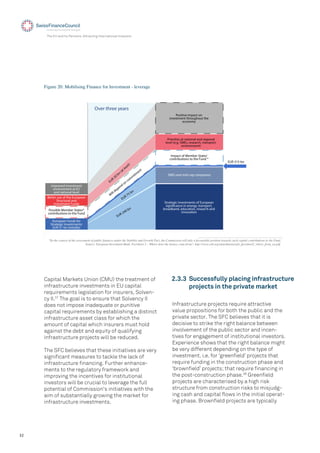
  • 14.
    14 The EU andits Partners: Attracting International Investors Figure 11: The world scaled to sources of FDI inflows into the EU As the preceding chapter argues, foreign investment can contribute significantly to growth and welfare in the EU. The EU will be able to attract added capital from its partners if internal market conditions – both "real" and financial – are "right". The current section provides an outside, though admittedly partial, view of the attractiveness of the EU as a location for foreign direct investment, by presenting a survey amongst Swiss SMEs who have been polled on the matter for the purpose of this year’s Discussion Paper. The chapter also provides an update of last year's paper which presented a statistical, top-down view of the close partnership between Swit- zerland and the EU in matters of trade and investment. 2.1.1 Switzerland is the second largest non-EU investor in the EU Foreign direct investment (FDI) is a key mea- sure of integration and a key driver of growth. The ability to attract investment is also an important indicator and determinant of the competitiveness of a region.15 In the EU28, total inbound FDI stock amounted to €13.7 trillion at the end of 2014 (the latest data point from Eurostat). According to data from UNCTAD, about 34% of the total world stock of FDI is allocated to the European Union. Europe's share thus exceeds the share of Asia (24%) as well as that of the USA (18%). Case study Attracting corporate investments: the view from Swiss SMEs Source: Eurostat; Average 2013-2014
  • 15.
    15 The EU andits Partners: Attracting International Investors Fifty-nine percent of the €13.7 trillion invested in the EU, or €8.1 trillion, originated from inside the EU – a reflection of the integrative force of the EU’s Internal Market. Moreover, in excess of half of the intra-EU FDI is originated from three countries: Luxembourg, Nether- lands and the United Kingdom (see Figure 11). A significant share of the investments from these FDI-hubs originates from other coun- tries however, and is channelled through these FDI distributors. Forty-one percent, or €2.3 trillion, of the direct investments from outside the EU originated from the United States. The second largest non-EU investor is Switzerland with €0.6 trillion; next comes Canada with €0.2 trillion. This makes Switzerland a more important source of FDI for the EU than Asia, whose aggregated FDI in the EU amounted to €0.5 trillion. Figure 11 illustrates graphically the significance of Switzerland as a source of FDI in the EU. The scale used in this map is not geographical size, but the importance of countries as sources of FDI flows for the EU (areas correspond to shares of FDI in EU in the 2013-2014 period). At first sight, the importance of Switzerland might come as a surprise, given its small size in GDP terms. However, the very close trade integration between Switzerland and the EU, especially of an intra-industry nature, tends to boost FDI flows. Even when trade barriers are already very low for goods, as is the case between Switzerland and the EU, companies may benefit substantially from being geographically closer to their customers. Other factors that intensify relationships between countries, such as the sharing of a language or other political, cultural, and legal affinities have also been shown to facilitate FDI as well as trade. Switzerland and the EU have both a long history of economic integra- tion and very intense trade relationship. These ties deepened further since the Free Trade Agreement between Switzerland and the EU was concluded in 1972, and the various other treaties that followed. In large part due to these ties, industries in the EU and Switzer- land have integrated via joint supply chains, as shown in the latest OECD data discussed later in this chapter. We have updated last year's investigation on the determinants of FDI flows for highly developed countries based on an econometric model. The model resembles a "gravity model" often used in the analysis of bilateral trade flows. Our sample comprises 245 bilateral investment relationships between 19 OECD countries as well as China and Brazil over the period from 1991 to 2012 (tax data only up to 2005). Obtaining relevant tax data is one of the greatest challenges in this regard. To gauge the tax benefits of investing abroad versus investing at home, we used so-called "effec- tive" tax rates. Effective rates calculate the difference between the pre and post-tax earnings of a project and are thus better suited than "raw" statutory tax rates. Howev- er, even the effective tax data based on Devereux, Griffith and Klemm (2002) is unable to account for all special tax regimes. Never- theless, the results of our analysis suggest that the following factors are important drivers of FDI: • Tax rates: A one percentage point increase in "effective" average tax rate (EATR) of the FDI host country lowers the amount of incoming FDI by 0.2% on average. Devereux Griffith and Klemm estimate EATRs of 30%, 24% and 11% for Germany, Switzer- land/Netherlands and Ireland respectively for 2005. In reality, Switzerland and the Netherlands are likely to be just as attrac- tive as Ireland for specific investment projects which suggest that the shortcom- ings of tax data tend to lead to an underes- timation of the effects of FDI. • Stability: A one percentage point higher unemployment rate lowers incoming FDI on average by 0.5%. The unemployment rate can be read as a proxy for both economic and political stability. That said, stable and intense trade relationships should facilitate FDI flows, too. • Population: A 1% larger population attracts on average 0.03% more FDI. • Other factors affecting FDI significantly are geographical distance, the cultural affinity with the FDI sender and the market size (measured e.g. by credit volumes outstand- ing).
  • 16.
    16 The EU andits Partners: Attracting International Investors Figure 12: The 15 most important export destinations for EU exporters Switzerland has been one of the top three non-EU trade partners of the EU throughout the last decade. Switzerland ranks among the top buyers of EU goods (including EU Member States), somewhere between Spain and Poland. This makes it the 10th most important destination for EU exporters. A considerable share of the EU-Switzerland trade consists of investment goods, mainly machinery and equipment. Twenty-four percent of the EU exports to Switzerland are investment goods used in production. According to the Swiss Federal Customs Administration 24% of Swiss goods exports to the EU are likewise used for production in the EU. Switzerland's and the EU's trade intercon- nectedness is also reflected in value added data published by the OECD. According to this data over one-fifth of Switzerland's exports consist of foreign value added, i.e. of imported 2.1.2 The EU and Switzerland: A stable and intense trade relationship intermediate goods and services. The majority of these goods and services, around 14% of Switzerland's total exports, or over 32 bn EUR originate from the EU. The goods trade relation between Switzerland and the EU is very stable, even in crisis periods. During the Eurozone crisis of 2010-12, Switzerland proved to be an import- ant buyer of EU goods. And with the apprecia- tion of the Swiss Franc (CHF) in January 2015 exports from the EU to Switzerland continued to grow notwithstanding the loss of momen- tum in the Swiss economy. A part of this trend can be explained by the strengthening of the CHF; the price of EU goods dropped by an average of 12% in 2015. However, the key drivers of this close trade integration are arguably Switzerland's geographical proximity to major EU markets, highly developed trans- portation linkages, and political ties which have supported a multi-century history of economic integration and trade relations. ! "!!!!! #!!!!! $!!!!! %!!!!! &!!!!! '!!!!! Source: Eurostat EU28 exports in EUR Mio., average 2010-2014
  • 17.
    17 The EU andits Partners: Attracting International Investors More than 20% of the Swiss SMEs that participated in a survey of Switzerland Global Enterprise (S-GE) and Credit Suisse plan to invest abroad in 2016; 56% (also) intend to invest in Switzerland.16 With a share of 63% the EU will be the most important target region for the planned investments. Almost one third of the SMEs plans to increase its FDI flows into the EU, while about two thirds plans to maintain the current pace. Only 8% intend to invest less in the near term future. The strong focus on the EU does not come as a surprise given the close trade relationship: About 90% of the participating SMEs export products or services to the EU and 80% source products or services from abroad – with products and services from the EU command- ing a share of 78%. Clearly, as a result of the significant appreciation of the CHF against the EUR shifting production or services facilities abroad has become even more attractive. 2.1.3 Swiss SMEs have a clear preference for investing in the EU With their investments in the EU the SMEs that participated in the survey aim first of all to improve their supply chains (34%), secondly to save production costs (22%), or thirdly to enter into new markets (6%). Accordingly, Swiss SMEs invest in the EU primarily in distribution and production capacities (figure 13). While the strong CHF against the EUR clearly seems to be leading to an acceleration of foreign investment activities by Swiss companies, the long term trend is due to the other factors mentioned above. !" #" $!" $#" %!" %#" &!" &#" '!" ()*+,)-.+)/01 23)40+5*4,6)74 8,/9.7+)/0 (4643/:;40+ <.+/;=+)*=+)/0 >=,?4+)0@ AB( /+C4,* Figure 13: Swiss SME build up distribution and production capacities in the EU Survey question: Which business segment(s) attract foreign investment? (more than one answer possible) Source: S-GE, Credit Suisse 2.1.3.1 Red tape is the biggest concern, while EU institutional questions are not in focus investment is too much bureaucracy (figure 14). High sovereign debt levels and low economic growth are the second and third most mentioned threats. However, consider- ably less importance is assigned to these factors. !" #!" $!" %!" &!" '!" ()*+,-./010,/0,23.+,.0,0*-3.451+*)6 7+8.4,,+9:)4+,.2:1:243 7:2;.+<.1+=4)42:=.-+90*,:,20.:).>?.=090= @)A0*6 B4-A.C,051=+350,).*:)06 D+510)4)4+,.:5+,-.>C*+10:,.2+C,)*406 E0+1+=4)42:=.C,*06).:).46).<*+,)40*6 7+8.02+,+542.-*+8)A B4-A.1CF=42./0F) G++.5C2A.FC*0:C2*:23 ts ty Figure 14: Swiss SME perceive the EU as too bureaucratic Survey question: What is the biggest threat to Europe's attractiveness as a destination for foreign investment? Source: S-GE, Credit Suisse (question based on the Ernst and Young attractiveness survey referred to in previous chapter) On a structural level, only 45% of the Swiss SME surveyed say that they have seen improvements in the EU as a place to invest in recent years. According to 43% of the SMEs surveyed, the biggest threat to Europe's attractiveness as a destination for foreign
  • 18.
    18 The EU andits Partners: Attracting International Investors Interestingly, the results of our Swiss survey differ in some significant points from those of the Ernst and Young attractiveness survey (EY) discussed in chapter 1, although the ques- tions are precisely the same. In contrast to the international investors in the EY-survey (the EY panel consists of companies from all over the world which have established operations in Europe), Swiss SMEs weight the (perceived) excess of bureaucracy in the EU much more strongly than do global investors (see figure 15). Our guess is that this reflects the fact that Swiss SMEs are generally operating in a somewhat less bureaucracy-"ridden" environ- ment in Switzerland, whereas international companies confront this problem at home as well. (It should also be noted, however, the Credit Suisse Survey of Swiss SMEs that has been conducted within Switzerland over the past years also throws up bureaucracy and regulation as a key negative factor for Switzer- land itself). Conversely, the weight of weak growth and high public debt is somewhat lower in our survey than in the EY survey, although also amongst the top three complaints. The "lack of political governance at an EU level" does not seem to bother Swiss SMEs, in contrast to what the EY survey says. One possible inter- pretation is that Swiss SMEs are used to operating in a very decentralized political system in their home market. A second interpretation is that the Swiss companies we surveyed tend to be smaller than those surveyed by EY and that the former thus tend to operate more within national markets than across the entire EU; in transnational opera- tions a divergence between national rules and regulations is likely to be felt more keenly. Asked what sort of reforms Europe should implement (a follow-up question similar to the one in the EY survey featured in chapter 2) half of all Swiss SMEs mentioned business-friend- ly reforms within the areas of competition, tax and labour markets as being of greatest importance. This is very much in line with the findings in the EY survey. The wish for further political and economic integration and the advice to give back more power to individual European countries balance each other out (both were mentioned by about 10% of the participants). Another 10% express a wish for a better infrastructure in Europe. 2.1.3.2 Cash flow is the preferred financing source for Swiss SMEs !" #!" $!" %!" &'()*+,-./.*-.*01,)*,.*.(+1,23/)('4 5)6,2**)78'2)*, 08/8021 5809,):,/);2'208;, +)7.(*8*0.,8',<=,;.7.; >'?.(4 @2+?,A*.3/;)13.*',(8'.4 B)3/.'2'2)*, 83)*+,<A()/.8*, 0)A*'(2.4 C.)/);2'208;, A*(.4',8',24',:()*'2.(4 5)6,.0)*)320, +()6'? @2+?,/AD;20, -.D' E)),3A0?,DA(.8A0(801 <FG4A(7.1 &6244,&H<,4A(7.1 ts ty Figure 15: Bureaucracy less dominant topic for non-Swiss companies Comparison of the two surveys on the questions regarding the biggest threat to Europe's attractiveness Source: S-GE, Credit Suisse, EY Similar to the EY survey, reforms of the financial system do not rank amongst the most prominent concerns which may be related to the way SMEs typically finance themselves (see below). Two thirds of the Swiss SMEs finance their investments in the EU with their own cash flow, 13% use bank loans provided by Swiss based banks, and 7% with loans provided by EU-based institutions. Only 2% source their financial needs on the capital market (in equal parts in Switzerland and the EU). Despite the so far limited use of the capital market about one fifth of the Swiss SMEs consider a common capital market in the EU as an important project. Asked what the biggest hurdles to financing via the capital market are Swiss SMEs mentioned legal requirements
  • 19.
    19 The EU andits Partners: Attracting International Investors (31%) and higher capital costs (29%) as the most important, followed by the need to adapt accounting standards if capital markets were to be accessed (22%). A single and well-de- signed capital market which would lower the costs of capital would thus be highly appreci- ated by Swiss SMEs. 2.1.4 Recommendations 2.1.4.1 Reduce red tape within member economies by promoting best practices Small and medium-sized enterprises form the backbone of Europe’s economies. They are at the heart of job creation, investments and innovation. SMEs can also play a crucial role in cross-border investments. This is particu- larly true for SMEs from Switzerland which are very integrated into the European economy. What are the key conclusions of our survey? Swiss SMEs believe that the biggest threat to Europe's attractiveness as a destination for foreign investment are unnecessary layers of bureaucracy. Less ‘red tape’ would stimulate third-country SME investment. Such barriers are not necessarily of an EU-wide nature. Nevertheless, our survey shows that often EU regulation adds further constraints to those already existing within the Internal Market. EU authorities should seek to develop a mecha- nism which would promote best practices based on the experiences of the different member states, as well as non EU countries. 2.1.4.2 Enhance SME access to finance by promoting CMU and Banking Union implementation and completion High sovereign debt levels and low economic growth are the second and third most men- tioned threats. SMEs need a stable mac- ro-economic environment. Today, most SMEs finance their investments from own funds (i.e. retained earnings) rather than from capital markets. Despite the limited use of the capital market about one fifth of the Swiss SMEs consider a common capital market in the EU as an important project. A single and well-de- signed capital market would lower the costs of funds and would be highly appreciated by Swiss SMEs. From their perspective, it is therefore important to develop alternative flexible funding mechanisms in the context of the CMU. In addition, strong banks can add to the funding sources of SMEs. A key recom- mendation is thus to both complete and strengthen the European Banking Union and to achieve a well-developed CMU which will, over the longer-term also support investment activities of domestic as well as foreign SMEs. 2.1.4.3 'Think Small First' to foster overall conditions favourable to SME investments Half of all Swiss SMEs mentioned busi- ness-friendly reforms within the areas of competition, tax and labour markets as being of greatest importance. Going forward, investment opportunities would improve if European policies focussed more resolutely on Small and Midcap companies. European and national policy makers are thus encour- aged to improve the overall conditions in which SME businesses can thrive. This is because small companies are disproportion- ally impacted by ill-conceived regulations and bureaucracy. Our findings underline the importance of the Commission’s 'Small Business Act' which encourages policy makers to 'Think Small First'. Legislation, administra- tive rules and procedures should be simple, easy to understand and to apply. SMEs' interests should be taken into account at the very early stages of policy making in order to make legislation more SME friendly.
  • 20.
    20 The EU andits Partners: Attracting International Investors Investment activity in recent years has increasingly been focussed on short term opportunities, as companies, institutional investors, governments and private investors have all seemed reluctant to commit to long-term projects. Globally, cash holdings in the portfolios of High Net Worth Individuals (HNWI) still account for 25.6% of total wealth and remained fairly stable over the last three years.17 The low interest rate environment indeed offered few fixed-income investment alternatives, yet the global stock market has had a very strong performance until recently. Especially at a time when the need for invest- ment is acute and in an environment where financing multi-year ventures that will further boost economic growth and investment returns seems attractive, the current invest- ment drought comes unexpected, not only from an economic perspective but also given the high percentage of cash deposit in inves- tors' portfolios in a low-interest rate environ- ment. The case study outlines how Europe could become more attractive to international private investors with a focus on the fast growing Ultra High Net Worth Individuals (UHNWI) population and their interest to invest in alternative investment products, in particular private equity investments18 that are typically used for financing long-term projects. Private equity invests for the long term and backs over 25'000 companies in Europe, 83%19 of which are small and medium enterprises (SMEs), in sectors as diverse as life sciences, retail and energy. It also backs impact investing projects that are designed to achieve a positive social impact as well as a financial return in sectors like healthcare. In order to encourage international investors to commit to long-term financing, however, such 2.2.1 Introduction investments need to be accessible and the overall investment framework needs to be attractive. This requires for example the Internal Market to function so that companies in one Member State can receive investment from another and can use the Internal Market as a springboard to exploit international opportunities. Also the EU has to be open to investors across the world. This case study will address these topics and is structured along three sections. Section 1 outlines characteristics of the UHNWI market and latest developments from a client as well as an offering perspective. Section 2 compares the overall investment framework for private equity investments in European companies with the US market and outlines what the SFC considers to be the main issues preventing international private investors from engaging in European private equity investments. Section 3 then concludes with some policy recommendations on how to attract private investments with regards to the overall investment framework as well as specific recommendations for improving EU policies. Case study Making Europe more attractive for international private investors
  • 21.
    21 The EU andits Partners: Attracting International Investors Vehicles providing non-accredited investors with exposure to alternatives strategies via registered vehicles: mutual funds, closed-end funds and ETFs. Source: McKinsey Global Asset Management Growth Cube; Preqin;HFR UHNWI are commonly considered to be clients with USD 30 million or more investable assets.20 While UHNWI make up only 1.0% of all HNWIs, they account for roughly 35% of HNWI wealth and are significant drivers of the overall global HNWI population and wealth growth. Their growth rates in recent years surpassed those of the HNWI. In 2014, for example, global UHNW growth in investable assets reached 9.3% (excluding Brazil).21 Asia thereby overtook North America in terms of UHNW growth. The UHNWI in Asia now hold more in total wealth, with net assets of USD 5.9tn, than those in North America with USD 5.5tn. However, even if wealth creation is stronger outside Europe, European UHNWIs still control the most wealth with USD 6.4tn.22 For wealth managers providing cross-border services out of Switzerland, Europe is there- fore an important UHNW market. UHNW clients vary in type but have in many cases an entrepreneurial background and their investment risk profile is generally well suited for long term private equity invest- ments. The active entrepreneur may thereby actively participate in the creation of wealth, whereas for others wealth could be managed via a Family Office. Generally UHNWI with a strong wealth / investments focus have a stronger interest in Private Equity investments compared to clients with a stronger focus on wealth creation through their family or own business. From a client perspective, it is important first of all to understand their investment objec- tives. After several years of focusing on wealth preservation post-2008, portfolio perfor- mance has become top of mind for UHNWIs. The alternative investment industry overall, including the private equity market, has matured over the last 30 years and is gradual- ly becoming part of the mainstream financial industry. 2.2.2 The UHNW market and latest developments 1.0 1.1 1.1 1.6 1.9 1.4 2.1 2.3 2.0 2.4 2.1 2.6 $3.2 $4.9 $6.3 $7.2 2005 2008 2011 2013 $0.5 $0.8 $0.8 $1.1 $0.9 $1.7 $0.9 $2.0 Global AUM of key alternative asset classes, 2005 - 2013 $ trillions Total Real assests Private equity Hedge funds Fund of funds 5.6% Retail alternatives 12.6% * CAGR 2005-13 10.7% 11.3% 9.1% 11.4% Growth of traditional assets = 5.4% * Figure 16: Alternative investments growing strongly
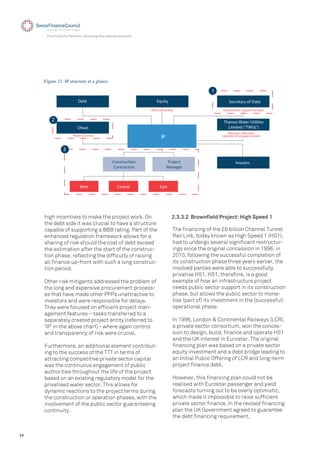
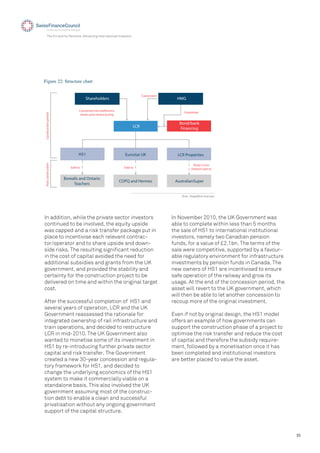
  • 22.
    22 The EU andits Partners: Attracting International Investors Private equity consists of both direct invest- ments in companies, which are often sought by entrepreneurial clients, and investments through private equity funds, which are generally used as part of portfolio manage- ment solutions. The interest in private equity as an asset class has surged in recent years as is shown in figure 16 and new trends are developing. For example, UHNWIs who are interested in generating a positive social impact as well as a financial return are looking to private equity-type impact investing collab- orations. Single family offices are increasingly interested to participate in networks that allow them to access direct and co—invest- ment opportunities alongside other families. Co-investment opportunities offering more than just capital participation are in high demand particularly with Asian UHNWI wanting to take a direct stake in companies.23 For clients who were or still are entrepreneurs themselves, this echoes their own experience. Partnering with private equity can hence bring mutual gains and help businesses to grow faster. From an offering perspective wealth manag- ers providing investment advice build on the client demand and are expanding their platform of capabilities to include private equity. This includes facilitating direct invest- ment in companies or offering fund struc- tures. Facilitating direct investments, howev- er, requires technical skills and knowledge which is often limited to large houses. As such the focus of the wealth managers is mainly on offering fund structures via specialist private equity firms. From the perspective of wealth managers providing discretionary portfolio management services, proper diversification is an essential element of a sound investing strategy. Hence, alternative investments such as private equity, where properly implemented in a portfolio, are viewed to help lower overall portfolio risk thereby keeping the risk-return relationship attractive. Because their returns typically have low correlation with returns of the broader stock market, these instruments 2.2.3 Private equity investments in Europe, main issues and comparison with the US can provide increased portfolio diversification. With an average allocation of over 10% in alternative investments not unusual for UHNWI portfolios,24 wealth managers are important investors of alternative products globally including private equity on behalf of their clients. In 2014, the total amount of private equity investments25 in European companies increased by 14% to EUR 41.5bn with more than 5'500 companies receiving funding as investments (Figure 17).26 While investment in private equity in Europe is growing, the market is small in comparison to the US where over the past 10 years US firms managed to raise almost USD 2 trillion, significantly more than the USD 641bn raised in Europe. In 2014, the number of US based private equity firms amounted to 3'641 versus 1'740 in the EU. The EU private equity invest- ment market is also small in terms of percent- age of European GDP compared to the US. In 2014, European Venture Capital investments – a subset of the Private Equity market – equalled 0.05% of EU GDP, while US VC investments were at 0.29% of US GDP.27 Figure 18 illustrates that private equity firms predominantly invest in their domestic market ("home bias"). The 2014 industry statistics (investments made by European private equity firms regardless of the location of portfolio companies28 aggregated according to the country of the private equity firm's office) show that EUR 39.5 bn are invested by Euro- pean private equity firms in portfolio compa- nies throughout Europe with EUR 28.9 bn domestic and EUR 10.6 bn cross-border investments within Europe.29 At the same time, non-European private equity firms only invest EUR 2.1bn in portfolio companies in Europe.
  • 23.
    23 The EU andits Partners: Attracting International Investors Figure 17: Overview of 2014 European Private Equity Investment Activity !"#$%& '()*+,%-,(,.-,./- 011%2).3(,+% 456.,7 8+9,6)+ :(;.,(1< =67>6,< ?)>@,A< 0B>69, C$#DEF9 CGDHF9 CG#DGF9 CEDHF9 I>D%>J />B;(9.+- EKE#L GK!"L L$E #K!M" I>D%>J%J.)B- #K#!" HEH $HM $"! I>D%>J%J69N- #KM$" #K"#" HG# EO$ Figure 18: Private Equity Investments 2014 - Geographical investment flows Source: EVCA/PEREP_Analytics *relates to the investment stage of the portfolio company Source: EVCA/PEREP_Analytics
  • 24.
    24 The EU andits Partners: Attracting International Investors Figure 19: European private equity investments by region – market statistics 2014 Although this number has grown, it is still a small fraction of overall private equity invest- ment in Europe. Market statistics also show that investments vary strongly between European countries (Figure 19). The domina- tion of the UK market within Europe and significant capital inflows managed by UK fund managers are clearly illustrated. !"" #$ %&'(')*+,-./ 01$ 2*-.3+'(' 4+.+,56 #7$ 89!: 07$ ;<5=>+*.' "5*<?+ @$ A<*/B3C D1$ Source: EVCA/PEREP_Analytics DACH: Austria, Germany, Switzerland Southern Europe: Greece, Italy, Portugal, Spain Nordics: Denmark, Finland, Norway, Sweden CEE: Central Eastern Europe Cultural differences as well as the differences in the overall investment framework for alternative investments between the US and Europe provide some explanations for the substantial differences in size and develop- ment of the respective markets. The US is traditionally a more entrepreneurial market that fosters and supports a culture for the start-up and development of SMEs and entrepreneurship and where the risk of failure seems better accepted. This development has resulted in both private and institutional investors being more familiar and more comfortable with financing and investing in businesses through alternative investments than in Europe. SMEs in the US tend to favour equity financing, whereas European SMEs suffer from a lack of financing avenues that could provide equity and continue to rely on bank lending. The different development of the capital markets in the US and the EU illustrate this difference. Furthermore, Europe has a tradition of handing over family busi- nesses to the next generation, whereas US entrepreneurs tend to sell their businesses. Also the size of the US single market has helped its growth compared to the EU. 2.2.3.1 The legal framework for alternative investments In the US the legal framework has strongly supported development of alternative invest- ments from the beginning. The US Small Business Investment Act of 1958 which supported private investment in small busi- nesses and innovation triggered the birth of alternative investments. Additional laws enabled the industry to develop and scale up, particularly since 2000. The Chapter-11 facility is a typical example of legislation that has supported entrepreneurship, recognising that the risk of failure is inherent to entrepre- neurship. Separately from a different cultural back- ground and legal framework there are also some EU policy-related issues which in the view of the SFC discourage UHNWIs from specifically investing in EU private equity funds. These are some examples: 2.2.3.2 Regulatory Regime discouraging private investments The revision of the Markets in Financial Instruments Directive (MiFID II) includes a broad definition of retail clients in the EU – ranging from basic bank account customers (who need the highest level of protection) to very experienced and sophisticated clients, and a correspondingly narrow definition of
  • 25.
    25 The EU andits Partners: Attracting International Investors professional clients, with very limited scope for retail investors to upgrade to professional client status. This means that the current definition of retail clients includes a number of highly experienced investors with assets suitable for long term investments. Also many family offices – and thereby UHNW investors - are categorised as retail clients under MiFID. These sophisticated retail investors are, as a result, unduly limited in terms of the instru- ments they may invest in (with the AIFMD marketing passport being limited to profes- sional clients) and how they can be serviced by investment firms (e.g. based on rules relating to complex versus non-complex products), and also with regard to their scope for geographical diversification, owing to restric- tive cross-border rules applicable to using non-EU firms. The current standards effec- tively cut out UHNW investors who neither trade a lot nor were employed in the financial services industry. The bigger issue is that clients a) have to request the status or service and b) the burden of proof is on the financial services provider to justify the status, which is a hurdle for these firms to classify clients. De facto this means that many private equity investments are simply not available to private investors, not even UHNW investors. Despite the developments of UCITS and AIFMD, which aim at providing EU passports for investment products, registration of alternative investment vehicles remains challenging in Europe. UCITS is designed for retail investors and its regulatory framework does not lend itself well for alternative invest- ments. AIFMD attempts to harmonize national regulations governing alternative investment fund operations, but EU states have imple- mented its provisions at different rates and have gold-plated their private placement regimes, introducing country-specific restric- tions. Registration of alternative investment funds is a big hurdle, which varies from straightforward (in the UK / Netherlands), to difficult (Germany) and unavailable (Italy). This should change when the passport becomes available to non-EU alternative investment funds and managers in 2017/2018, but in the meantime it is very difficult and expensive for off-shore fund managers to distribute on a pan European or even limited basis. Also administrative processes and red tape for registering funds under the private placement regime are not harmonized across the EU, which has resulted in major difficulties in navigating the patchwork of rules in order to continue to access local investors. A signifi- cant number of Member States have intro- duced additional requirements with the effect that notification by the authorising Member State is often only the first step in a much more complicated, time-consuming and expensive process of obtaining the passport. As a result, what was supposed to be a simple and cost-efficient process for managing and marketing funds in another Member State after receiving authorisation in the Member State of the fund manager’s domicile turned out to be in many cases much more difficult. The most obvious examples are Germany and Denmark, which require the appointment of a depository. 2.2.3.3 Tax systems penalizing private investments With respect to cross-border equity invest- ment, the punitive nature of the prevalence of withholding tax on dividends acts as a strong disincentive for private investors to consider investing in European private equity. Also the high capital gains tax on private equity invest- ments in some EU Member States discourag- es private investors domiciled in the respec- tive jurisdiction to consider an investment. Separately, the application of different and generally complex tax rules in EU Member States create an additional hurdle for private investors. They are reliant on tax reporting provided by the fund or the wealth manager, which is costly and labour intensive. 2.2.3.4 Registration and distribution of alternative investment products
  • 26.
    26 The MiFID clientclassification foresees three categories of clients: Eligible counterparties, professional clients and retail clients. The definition of ‘professional client’ includes all of the entities that fall within the eligible coun- terparty category. Furthermore, retail clients may be treated as professionals on request (Opt-up professionals). All clients not falling within these categories are considered to be retail clients. The level of investor protection varies between these client categories. Clients may, either on the initiative of an investment firm or at the client’s request and with the consent of the firm, be opted down to a more protective client classification. The eligible counterparty status is relevant for certain types of investment business, mainly dealing and arranging deals in invest- ments. It is not relevant to, for example, portfolio management or investment advice. Per-se professional clients possess the experience, knowledge and expertise to make own investment decisions and properly assess risks involved. Clients include (i) entities authorised or regulated to operate in the financial markets, such as credit institutions, investment firms, and collective investment schemes, (ii) large undertakings meeting minimum size requirements in regards to their balance sheet, net turnover and own funds, (iii) international and supranational institu- tions such as central banks, national and MIFID client classificationBOX 2 regional governments and others as well as (iv) other institutional investors whose main activity is to invest in financial instruments. Opt-up professional clients refer to retail clients who are allowed to waive some of the protections afforded by the conduct of busi- ness rules upon their request. For the identifi- cation of such clients, assessment criteria – of which two need to be satisfied – are pre-de- fined and include (i) transactions carried out in significant size on the relevant market at an average frequency of 10 per quarter over the previous four quarters, (ii) the size of the client’s financial instrument portfolio exceed- ing EUR 500’000, (iii) a professional position in the financial sector for at least one year which requires knowledge of the transactions or services envisaged. Retail clients are all clients which do not meet the definitions set out above, hence receiving the highest level of investor protection. The MiFID client categories are not mutually exclusive. Professional clients may be treated as eligible counterparties depending on the type of business. Retail clients may be treated as professional clients only in regards to services and transactions related to a specific asset class. The MiFID client classification is used as a reference in several EU financial product regimes, such as AIFMD, UCITS and the Prospectus Directive. Typically, these regimes offer relaxation of conditions when distribut- ing products to professional clients. !"#$%&'( )$(*+',#$'," )$(*,-./,+"#,&0 1/,%,2/$* +&30#$'."'#(* 41!56 !""#$%&'#() *+)&)%(,*&$-)./'.(*)+0)"(,1.()",+0(..$+-&#) %#$(-*.)$-) ,(#&*$+-)*+)(#$2$'#() %+/-*(,"&,*3)'/.$-(..) 4$5(5)",+6$.$+-) +0)*7() .(,6$%()+0),(%("*$+-)&-8)*,&-.9$..$+-) +0)+,8(,.)+-)'(7&#0)+0) %#$(-*.:) (;(%/*$+-)+0)./%7)+,8(,.)&-8<+,)8(&#$-2)+-)+=-)&%%+/-*> ?&-3)+0)*7()$-6(.*+,)",+*(%*$+-) ,(@/$,(9(-*.) 8+)-+*)&""#3)0+,)*,&-.&%*$+-.) =$*7)&-)ABC 5$'78$*.'&9$88,&0"/* +/,$0# • !/*7+,$.(8<,(2/#&*(8) 0$-&-%$&#)9&,D(*)(-*$*$(. • E&,2()/-8(,*&D$-2.)&'+6()%(,*&$-).$F( • G-*(,-&*$+-&#)&-8)./",&-&*$+-&#)$-.*$*/*$+-.) 4(525)B(-*,&#)'&-D.> • H*7(,)$-.*$*/*$+-&#) $-6(.*+,. B#$(-*) %&-)'()&../9(8)*+)"+..(..) *7() (;"(,$(-%(:)D-+=#(82()&-8)(;"(,*$.()*+) 9&D()$-6(.*9(-*)8(%$.$+-.)&-8)&..(..) ,$.D.) $-6+#6(8 :.#73.* .'&9$88,&0"/*+/,$0# I=+)+0)*7()0+##+=$-2)%,$*(,$&).&*$.0$(8J • ?$-$9/9)-/9'(,)+0)*,&-.&%*$+-.)%&,,$(8)+/* • K$F()+0)"+,*0+#$+) (;%((8.)ALM)NOOPOOO • C,+0(..$+-&#) $-)*7()0$-&-%$&#).(,6$%(.).(%*+, B#$(-*) $.)&##+=(8)*+)=&$6().+9()+0)*7() ",+*(%*$+-.)&00+,8(8)'3)*7()%+-8/%*)+0) '/.$-(..) ,/#(. ;$#",/*+/,$0# !##) +*7(,)%#$(-*. B#$(-*) ,(%($6(.)7$27(.*)#(6(#)+0)$-6(.*+,) ",+*(%*$+-:),(.*,$%*(8)&%%(..)*+)$-6(.*9(-*) ",+8/%*. MiFID client categories by level of investor protection from low to high Eligible counterparty (ECP) Per-se professional client Opt-up professional client Retail client Applicable to a certain subset of per-se professional clients in relation to eligible counterparty business (i.e. provision of the service of reception and transmission of orders on behalf of clients, execution of such orders and/or dealing on own account) • Authorised/regulated financial market entities • Large undertakings above certain size • International and supranational institutions (e.g. Central banks) • Other institutional investors Two of the following criteria satisfied: • Minimum number of transactions carried out • Size of portfolio exceeds EUR 500’000 • Professional in the financial services sector All other clients Many of the investor protection requirements do not apply for transac- tions with an ECP Client can be assumed to possess the experience, knowledge and expertise to make investment decisions and assess risks involved Client is allowed to waive some of the protections afforded by the conduct of business rules Client receives highest level of investor protection, restricted access to investment products
  • 27.
    27 The EU andits Partners: Attracting International Investors 2.2.4 Recommendations how to attract international private investments Other jurisdictions like France or Italy have in effect made it very difficult to market funds on any type of private placement basis, either to protect domestic providers or because of the complete lack of a suitable legal framework for private placement. Whereas the UCITS passporting fees have been minimal, with AIFMD the national regulators seem to have adopted more divergent approaches and consequently there is a divergence in cost, and time taken, to register a fund. As a result, the total cost of registering, including legal, tax and regulatory fees, vary substantially across the EU; in the UK registration can be done for £250 with a total expected fees of maybe up to £5'000, whereas registration of a fund in Germany could cost up to EUR 30'000 (or more depending on the complexity of the structure). This has deterred smaller fund managers from marketing in many countries and quite a number of non-EU based private fund manag- ers who invest in Europe are opting to avoid marketing their funds in the EU completely, or only focus on a few jurisdictions. As a result European private investors miss out on investment opportunities, as these are simply not made available to them due to regulatory hurdles. In comparison, investment companies in the US, including alternative investment funds, are generally subject to the jurisdiction of the Securities and Exchange Commission (SEC). Generally, advisers having at least $100 million in assets under management are required to register with the SEC, which is a straightforward process. Alternative Invest- ment Funds themselves are regulated pursu- ant to the Investment Company Act, but most funds qualify for an exemption from registra- tion. Although the Dodd-Frank Wall Street Reform and Consumer Protection Act revised the exemptions applicable to investment advisers, overall the regulatory framework for offering Alternative Investments in the US remains straightforward. This section provides a number of recommen- dations on how to attract international private investments, both from an overall framework as well as specific recommendations for improving EU policies. 2.2.3.5 Size of European funds In Europe the landscape is composed of a large range of smaller funds and many of them don't have the track records that attract many new investors. UHNWI as any other investor are looking for competitive returns and profits gained by private equity investments in Europe have been consistently lower in Europe compared to the US. Industry research shows that there is a positive relationship between fund size and performance.30 Euro- pean venture capital funds are on average 30% smaller than US funds.31 This is in partic- ular true for funds with a national focus. Due to the smaller size, they are unable to attract investors who are looking to invest higher amounts. Furthermore, the national focus of many small, largely government-funded venture capital funds discourages private investors, who are wary of the lack of scale effects and the increased risks that stem from low regional diversification. 2.2.4.1 Ease regulatory restrictions on investors by reviewing the retail client classification in the EU The current client classification under MiFID and conditions for sophisticated private clients to be able to opt up to professional clients should be reviewed with the aim to facilitate investments into private equity. In particular
  • 28.
    28 The EU andits Partners: Attracting International Investors the condition of carrying out an average number of transactions should be calibrated by asset class to reflect the fact that required average frequency of 10 transactions per quarter are unrealistic to achieve for private equity investments due to their typically larger size and longer term investment horizon compared to other asset classes. Further- more, the MiFID third country regime which regulates the provision of cross-border services into the EU should allow for opt-up professional clients ("elective professional clients") to be treated as professional clients instead of retail clients. EU Member States should consider reviewing their national market access regimes allowing third country wealth managers to actively promote or market private equity investment to EU domiciled UHNW clients on a cross-border basis. Additionally, a Private Placement Regime for non-professional clients could be considered. Having a regime like the UK NMPI (Non Main- stream Pooled Investments) in place across the EU would further facilitate access of private investors to alternative investments. processing in the 1980s and individual inves- tors can reduce their tax liability by claiming a share of the MLP's depreciation.32 Tax systems should not only allow foreign and domestic private equity investors to pool capital in an investment vehicle, but should also minimize the risk of onerous treatments such as additional or double taxation at the level of the vehicle or on distribution by the vehicle. Foreign investors should also be given certainty with respect to local tax liability. A common EU approach to the tax treatment of private equity funds could be developed. With respect to cross-border equity investment, the withholding tax reclaim procedures could be simplified to encourage greater investment at a global level. 2.2.4.2 Make targeted adjustments to tax systems to incentivize investments by private investors Further harmonization and simplification of the tax treatment across the EU would improve the overall investment framework and promote equity financing. Governments could also incentivize longer-term or socially productive forms of investment by using the tax system. A system of capital gains tax that ratchets lower as the holding duration increases is one possibility. In the US, for example, capital gains rate falls from 43.4% to 23.8% after a certain threshold is reached. Also the UK has adopted a mechanism of gradual tapering. The Master Limited Partner- ship (MLP) structure in the US is another example how tax can be used to funnel investment into particular directions. The MLP was established to promote investment in energy production, transportation and 2.2.4.3 AIFMD passport - drive convergence in the interpretation among EU Member States The AIFMD passport provides Alternative Investment Fund Managers ("AIFM") including Private Equity firms with a harmonised ability to market their funds across different EU Member States. However, the national trans- position of the Directive differs considerably between the EU Member states. The current inconsistent interpretation of "pre-marketing" and marketing between different EU Member States as well as different approaches taken (e.g. in regards to additional fees or where rules have been gold-plated) should be addressed. The planned AIFMD review in 2017 should be seen as an opportunity to ensure a harmonized internal market for private equity fund invest- ment across Europe, with rules that are tailored to these industries’ characteristics. The European Long-Term Investment Funds (ELTIF) regime, which is currently in develop- ment and builds on AIFMD, will create a new product framework to encourage investors to commit capital for the long term. ELTIF is also available to retail investors, and hence could be a good opportunity to attract private invest- ments. Therefore it is important that the new regime offers a harmonized approach and provides the necessary flexibility, not creating similar hurdles as currently experienced.
  • 29.
    29 The EU andits Partners: Attracting International Investors The pan-European marketing passport which is currently only available to EU AIFMs should also be made available to non-EU AIFMs and AIFs to increase internal market competition and efficiency. Currently non-EU AIFMs are only allowed to market AIFs within EU Member States when complying with the national private placement regimes ("NPPR") of the respective EU Member States. Non-EU AIFMs wishing to market their AIFs throughout the EU today are required to comply with a difficult patchwork of divergent national regulations. As a result a variety of different fee structures and requirements may be imposed by different Member States on a single fund. The non-availability of a passport is a clear entry barrier to non-EU AIFMs as very few, if any, have the bandwidth to register in multiple countries. Following the positive equivalence assessment of Switzerland, Guernsey and Jersey, the regulatory regimes of the US, Hong Kong and Singapore should be assessed as soon as possible (see box for further explanation on equivalence). In this respect, we make some overall recommenda- tions, in the concluding chapter to our Discus- sion Paper, on how the EU could enhanced the process for making equivalence determina- tions. 2.2.4.4 Availability of a pan-European marketing passport to non-EU AIFMs 2.2.4.5 Stimulate the development of EU private equity investment funds A good example of how to make the European market more accessible is the Canadian Venture Capital Action Plan, an initiative to increase private-sector investment in innova- tive businesses. The plan has made available C$350 million to establish four large-scale private-sector-led funds of funds in partner- ship with institutional and corporate inves- tors. The role of the government consisted in defining the structure of the action plan and providing financial support to the fund of funds in form of loans.33 A similar approach could be applied in the EU, whereby fund strategies should privilege and encourage cross-border investment. The European Commission recognizes the long-term benefits of private equity and the action plan for the Capital Market Union (CMU) also recognises that Europe’s alterna- tive investment funds tend to be small and mainly focused on early start-ups. The devel- opment of the private placement markets and the review of the Prospectus Directive are indeed important actions. The proposed action to widen the investor base for SMEs also has its merit, but this should also include encouraging equity investment. The SFC appreciates that the Commission is looking at ways to increase the flow of funds into later-stage companies and small and medium-sized enterprises (SMEs). This might be achieved through tax incentives, allowing larger fund managers to establish funds under the EU Venture Capital Fund Management Regulation (EuVECA) umbrella. Also the new European Long-Term Investment Funds (ELTIF) will contribute to attract private investors to invest in Europe, provided that the regulatory and overall investment framework of this initiative is geared to the characteris- tics of the UHNW market.
  • 30.
    30 Equivalence assessments area tool for provid- ing international companies regulated to the same high standards as those in the EU with access to the EU market. A positive equivalence assessment of a third country’s regulatory regime confirms that it manages risk in the financial system, delivers consistent investor protection and market integrity, and checks that the regime ensures effective oversight and enforcement. Correspondingly, while waiting for a positive equivalence assessment, EU busi- nesses and consumers are shut-off from service providers and investment opportunities from abroad. An efficient and timely process for making equivalence assessments therefore would be an advantage to the EU economy, especially while the recovery is weak. However, experience to date has been mixed, with assessments taking a long time, and only a handful having been completed. There are a number of substantive and procedural reasons for this: • There has been no overriding standard in the different legislative measures, with approaches varying from one to the next. While this is to an extent necessary to take account of the nature of each piece of legislation, the process has developed ad hoc, with little account taken of crosscutting issues or opportunities to simplify processes. • The criteria have not always been precise, with too much leeway for interpretation, while the basis of comparison has not always Equivalence BOX 3 been clear. Assessing whether or not third country legislation achieves the same regulatory objectives is often difficult to do. • The choice of which countries to assess seems arbitrary and unclear. Third countries cannot initiate the process but have to wait for the European Commission to do so, and there are no clear timeframes or deadlines. As such, the Commission retains consider- able discretion over the process, reducing certainty for all involved. • In most cases, EU legislation does not include transitional provisions to address issues raised by possible equivalence assessment delays. These practical problems put into question market access, even when equivalent regula- tion is actually in place, or when third coun- tries are willing to implement equivalent rules. Consequently, there have been a number of calls for reform, including from the European Parliament, which in its Report on Stocktaking and Challenges of the EU Financial Services Regulation asked the Commission “to propose a consistent, coherent, transparent and practical framework for procedures and decisions on third-country equivalence, taking into account an outcome-based analysis and international standards or agreements.” 34
  • 31.
    31 The EU andits Partners: Attracting International Investors This case study aims to, first, summarise the initiatives already undertaken or in the pipe- line to address improved incentives for investments by institutional investors in infrastructure projects. Second, it outlines, based on two recent successful infrastructure projects in Europe, the regulatory challenges for infrastructure projects, concluding with recommendations for the regulatory frame- work. As stated before, estimates show that the public sector has reduced investment in infrastructure, falling as a share of GDP in Germany, Italy and the UK since the financial crisis. Capital spending on infrastructure in the UK, for example, is down by a third in real terms from its peak in 2009, according to figures from the UK’s National Audit Office.35 Estimates suggest infrastructure investment of up to $3 trillion a year for OECD members alone may be needed to maintain and extend infrastructure up to 2030, double the current rate of spending.36 With many infrastructure projects being public goods, it is important that the public sector retains a strong role in both the construction and financing of these projects. However, in order to raise the levels of capital needed, enhancing the role of the private sector could offer a significant oppor- tunity for Europe’s financing needs. Institutional investors, such as pension funds, insurance companies and sovereign wealth funds, are the investor class with the longest investment horizons, making them an ideal partner for the public sector in respect of infrastructure investments. In the past years, institutional investors have increasingly replaced banks in their role in the financing of the (long-maturity) debt part of infrastructure 2.3.1 Introduction projects. They represent a customer base that is interested in long-term revenues rather than short-term profit. 2.3.2 Recent policy developments: The European Fund for Strategic Investment and Capital Markets Union In 2014, the incoming European Commission identified the lack of infrastructure invest- ments as a significant impediment for growth in the EU. To help tackle this challenge, it proposed a European Fund for Strategic Investment, which came to be known as the Juncker Plan. In addition to promoting targeted use of the European Structural Funds, the European Commission proposed the European Fund for Strategic Investment (EFSI). The EFSI was quickly endorsed by the Member States, and has been operational since September 2015. It aims to trigger at least €315 billion of addi- tional investment in Europe, by levering EU and European Investment Bank funds of €16 billion and €5 billion respectively three times and then used as a 20% credit enhancement over the next three years. The EFSI targets strategic investment projects (subject to certain selection criteria) in infrastructure as well as risk finance for SMEs. According to latest numbers published by the European Commission, the EIB/EIF have approved financing for infrastructure and innovation projects in the amount of €5.7 billion since January 2016 indicating that the Juncker Plan might gain traction. Another action of the European Commission was to address under the project of the Case study Reviving private investments by institutional investors – focusing on infrastructure investments
  • 32.
    32 The EU andits Partners: Attracting International Investors Improved investment environment at EU and national level Better use of the European Structural and Investment Funds Possible Member States* contributions to the Fund European Funds for Strategic Investments: EUR 21 bn (initially) Over three years EUR 20 bn (at least) W ill depend on com m itm ent EUR 75 bn EUR 240 bn Positive impact on investment throughout the economy Priorities at national and regional level (e.g. SMEs, research, transport, environment) Impact of Member States’ contributions to the Fund * SMEs and mid-cap companies Strategic investments of European significance in energy, transport, broadband, education, research and innovation EUR 315 bn Figure 20: Mobilising Finance for Investment - leverage *In the context of the assessment of public finances under the Stability and Growth Pact, the Commission will take a favourable position towards such capital contributions to the Fund. Source: European Investment Bank, Factsheet 2 – Where does the money come from?, http://www.eib.org/attachments/efsi_factsheet2_where_from_en.pdf Capital Markets Union (CMU) the treatment of infrastructure investments in EU capital requirements legislation for insurers, Solven- cy II.37 The goal is to ensure that Solvency II does not impose inadequate or punitive capital requirements by establishing a distinct infrastructure asset class for which the amount of capital which insurers must hold against the debt and equity of qualifying infrastructure projects will be reduced. The SFC believes that these initiatives are very significant measures to tackle the lack of infrastructure financing. Further enhance- ments to the regulatory framework and improving the incentives for institutional investors will be crucial to leverage the full potential of Commission's initiatives with the aim of substantially growing the market for infrastructure investments. Infrastructure projects require attractive value propositions for both the public and the private sector. The SFC believes that it is decisive to strike the right balance between involvement of the public sector and incen- tives for engagement of institutional investors. Experience shows that the right balance might be very different depending on the type of investment, i.e. for ‘greenfield’ projects that require funding in the construction phase and ‘brownfield’ projects; that require financing in the post-construction phase.38 Greenfield projects are characterised by a high risk structure from construction risks to misjudg- ing cash and capital flows in the initial operat- ing phase. Brownfield projects are typically 2.3.3 Successfully placing infrastructure projects in the private market
  • 33.
    33 The EU andits Partners: Attracting International Investors characterized less by these risks, but are still different from secondary market investments in Fixed Income or Equity instruments as their revenues depend on the management of an ongoing project. This holds particularly true for greenfield transport and social infrastruc- ture projects where the infrastructure needs public financial support. We looked at two recent infrastructure projects, one greenfield, the Thames Tideway Tunnel project to modernise London’s sewer- age system, and one brownfield, the High Speed rail link between London and the Channel Tunnel. We analysed the specific characteristics with a particular focus on their attractiveness for private investors. social infrastructure like hospitals, schools, government buildings where the construc- tion/completion risks are modest, and the period of construction short (2-3 years). Consequently, major projects with higher than normal risks can often offer better value for money to taxpayers when financed without private capital as simple public sector procurement. • The financing size of the TTT was significant and the equity part is greater than usual for traditional greenfield projects. In addition, on the debt financing side, the debt needed to be investment grade to ensure any financing plan was sufficiently robust. These parameters forced the involved parties to find more innovative solutions compared to their 'simpler' infrastructure projects. Figure 21 illustrates the TTT project structure. To address the high financing need, the TTT project was deliberately structured to attract large institutional investors, such as pension funds, insurance and sovereign wealth funds. To do this the risk transfer was carefully calibrated to ensure that risks inside the industry norm were assumed by the private investors, whereas risks outside the industry norm were shared with government and end-customers. Government support (i.e. taxpayer risk shar- ing) and regulatory mitigants (i.e. customer risk sharing) were used to reduce risks within the TTT project such that the overall risk transfer to the private sector equity and debt providers was similar to that of an operational water investment, i.e. the very low cost part of the infrastructure market. The emphasis was on incentivisation of equity by achieving an Internal Rate of Return (IRR) similar to opera- tional core infrastructure assets.39 For exam- ple if construction costs overrun a pre-agreed amount, Government would cap the funding requirement ensuring that the loss of IRR for private investors is not too high. However, up to that pre-agreed amount, private investors are not getting full return on the additional capital they are required to inject, ensuring 2.3.3.1 Greenfield Project: Thames Tideway Tunnel The Thames Tideway Tunnel (TTT) project aims to modernize the sewerage system in London by building a new tunnel underneath the River Thames through the heart of London. The procurement phase started in mid-2014. The project presented a number of specific challenges due to its financing size, the duration of the construction period, the construction risk and the specific regulatory environment applicable to the project, all of which required innovative answers we believe hold lessons for the broader policy framework. The TTT project has a total investment of £4.2bn, and the construction period is estimated to last 10 years. The tunnelling risk under a metropolitan area like London is considered to be very high. Timely and on budget completion is a priority for the project’s stakeholders – the UK Government, regulator, and water supply company as the old sewerage systems date from the 1860s. For the project this meant the following: • Traditional public-private-partnership programs (PPP) were not suitable for TTT. Evidence from PPP programmes points to such models working well for simpler, standardised and smaller projects, such as
  • 34.
    34 The EU andits Partners: Attracting International Investors 2.3.3.2 Brownfield Project: High Speed 1 EquityDebt Secretary of State Ofwat IP West Central East Construction Contractors Project Manager Thames Water Utilities Limited (”TWUL”) Insurers 100% ownership Project Licence Government Support Package Revenue collection/ operator of sewage network 2 3 1 Figure 21: IP structure at a glance high incentives to make the project work. On the debt side it was crucial to have a structure capable of supporting a BBB rating. Part of the enhanced regulation framework allows for a sharing of risk should the cost of debt exceed the estimation after the start of the construc- tion phase, reflecting the difficulty of raising all finance up-front with such a long construc- tion period. Other risk mitigants addressed the problem of the long and expensive procurement process- es that have made other PPPs unattractive to investors and were responsible for delays. They were focused on efficient project man- agement features – tasks transferred to a separately created project entity (referred to 'IP' in the above chart) - where again control and transparency of risk were crucial. Furthermore, an additional element contribut- ing to the success of the TTT in terms of attracting competitive private sector capital was the continuous engagement of public authorities throughout the life of the project based on an existing regulatory model for the privatised water sector. This allows for dynamic reactions to the project terms during the construction or operation phases, with the involvement of the public sector guaranteeing continuity. The financing of the £6 billion Channel Tunnel Rail Link, today known as High Speed 1 (HS1), had to undergo several significant restructur- ings since the original concession in 1996. in 2010, following the successful completion of its construction phase three years earlier, the involved parties were able to successfully privatise HS1. HS1, therefore, is a good example of how an infrastructure project needs public sector support in its construction phase, but allows the public sector to mone- tise (part of) its investment in the (successful) operational phase. In 1996, London & Continental Railways (LCR), a private sector consortium, won the conces- sion to design, build, finance and operate HS1 and the UK interest in Eurostar. The original financing plan was based on a private sector equity investment and a debt bridge leading to an Initial Public Offering of LCR and long-term project finance debt. However, this financing plan could not be realised with Eurostar passenger and yield forecasts turning out to be overly optimistic, which made it impossible to raise sufficient private sector finance. In the revised financing plan the UK Government agreed to guarantee the debt financing requirement.
  • 35.
    35 The EU andits Partners: Attracting International Investors Figure 22: Structure chart In addition, while the private sector investors continued to be involved, the equity upside was capped and a risk transfer package put in place to incentivise each relevant contrac- tor/operator and to share upside and down- side risks. The resulting significant reduction in the cost of capital avoided the need for additional subsidies and grants from the UK government, and provided the stability and certainty for the construction project to be delivered on time and within the original target cost. After the successful completion of HS1 and several years of operation, LCR and the UK Government reassessed the rationale for integrated ownership of rail infrastructure and train operations, and decided to restructure LCR in mid-2010. The UK Government also wanted to monetise some of its investment in HS1 by re-introducing further private sector capital and risk transfer. The Government created a new 30-year concession and regula- tory framework for HS1, and decided to change the underlying economics of the HS1 system to make it commercially viable on a standalone basis. This also involved the UK government assuming most of the construc- tion debt to enable a clean and successful privatisation without any ongoing government support of the capital structure. In November 2010, the UK Government was able to complete within less than 5 months the sale of HS1 to international institutional investors, namely two Canadian pension funds, for a value of £2.1bn. The terms of the sale were competitive, supported by a favour- able regulatory environment for infrastructure investments by pension funds in Canada. The new owners of HS1 are incentivised to ensure safe operation of the railway and grow its usage. At the end of the concession period, the asset will revert to the UK government, which will then be able to let another concession to recoup more of the original investment. Even if not by original design, the HS1 model offers an example of how governments can support the construction phase of a project to optimise the risk transfer and reduce the cost of capital and therefore the subsidy require- ment, followed by a monetisation once it has been completed and institutional investors are better placed to value the asset. Shareholders HS1 Concession HMG LCR Bond/bank Financing Eurostar UK LCR Properties Borealis and Ontario Teachers CDPQ and Hermes AustralianSuper Guarantee Converted into preference shares post restructuring Sold toSold to King’s Cross interest sold to ConstructionperiodPostconstruction Note: Simplified structure
  • 36.
    36 The EU andits Partners: Attracting International Investors 2.3.4 Lessons learned 2.3.5 Recommendations for an enhanced regulatory framework Improving the environment for infrastructure investments has been the subject of several studies since the start of the financial crisis. In 2013, the Group of Thirty (G30)40 issued a report on 'Long-term Finance and Economic Growth' in which they observed that the current framework for long-term finance increasingly constrained private long-term investors in their ability to provide long-term financing. This development calls, in its view, for multifaceted policy responses inter alia by the FSB, IMF, the World Bank and the OECD in favour of long-term investments. In order to incentivise the demand side the G30 recom- mended more specifically: • A review of the regulatory and accounting treatments of assets held with long-term horizons, • measures to better differentiate between short and long-term debt, and • consideration of a phase-out of the preferential treatment of sovereign debts. Furthermore, the G30 advocated in favour of developing new long-term finance products such as savings programs as well as debt and equity capital markets that support long-term investments, e.g. by providing appropriate means of securitisations of long-term debt. Finally, the G30 emphasised the importance of cross-border capital flows for an international diversification of investment. These recommendations were broadly in line with recommendations published in October 2014 by the European Financial Services Round Table (EFR).41 The EFR defined a set of best practice recommendations intended to make infrastructure investments more accessible. Similarly, the Institute of Interna- tional Finance (IIF) approved in October 2015 a set of Principles for enhancing investor rights in Long-Term Investment outlining the top ten principles to strengthen the legal and regula- tory framework for the protection of investor rights with regard to infrastructure invest- ments.42 As with the TTT project, HS1 was of exception- al scale and thus both were, to a certain extent, outliers in the infrastructure-financing world. The public sector therefore could not rely on existing standardisation, but needed to lever experience gained with other infrastruc- ture classes for tailoring the investment case and process to the preferences of the private investors. Achieving comparability to a well-known infrastructure class with control- lable risks involved, therefore, was one of the key success factors in both TTT and HS1. Common to both projects was that in the construction phase the financing inevitably included a restricted risk transfer to the public sector, i.e. not in the form of public debt, but contingent guarantees leaving a significant share of responsibility to the private sector. Consequently, the private sector was incentiv- ised for an in-plan completion and operation of the infrastructure asset. The remaining risk for debt investors could be placed thanks to an investment grade rating and/or risk trans- parency partially achieved through intensive preparation of the projects, including analysis of the risks involved. Finally, an efficient regulatory process on the public sector side also significantly contribut- ed to the success of both projects. Private institutional investors were attracted by mitigating risks through a fair and stable regulatory framework with clear and transpar- ent legal procedures and efficient government coordination at all involved levels.
  • 37.
    37 The EU andits Partners: Attracting International Investors 2.3.5.1 Encourage efficient risk-sharing Firstly, in our view the success of an infra- structure project lies in the right balance of cooperation between both public and private sectors, considering and identifying public support measures the private sector currently needs in order to improve accessibility for infrastructure financing, e.g. through credit enhancement and guarantee programs. This cooperation is particularly important for greenfield projects, but also in the brownfield stage when the engagement of the public sector could be reduced through privatization. In this respect, a robust risk-sharing arrange- ment such as in the TTT and HS1 projects could serve as a model for elsewhere in Europe and could result in a well calibrated public sector engagement which leaves room to market forces and sets right incentives for the private sector. This approach could support infrastructure investments especially since the last financial crisis has resulted in the disappearance of monoline-wrapped capital market instru- ments where investors were drawing comfort from debt service guarantees (wraps) to senior debt/senior bonds issued by project compa- nies. The use of contingent guarantees, for example could be a viable and cost efficient complement to the Juncker Plan for bringing more private capital to invest in the infrastruc- ture sector. In this respect, faster progress should be aimed for in making available 'Project Bonds' and/or schemes similar to so-called 'Loan Guarantee Instruments for Ten-T Projects' (LGTT) for large-scale infra- structure projects.43 The following recommendations support the above mentioned conclusions, attempting at the same time to leverage the lessons learned from the TTT and HS1 projects to develop further, more concrete ideas for a successful infrastructure financing framework in the European Union. 2.3.5.2 Promote increased standardisation Secondly, having comparability of different infrastructure projects to achieve risk trans- parency for private institutional investors is crucial, as it helps the capital market under- stand the economic valuation of the invest- ment needed, both for the equity and debt component (e.g. via the use of credit rating assessment, clear regulatory framework for the specific business, and reference vending financing). We believe that this could be achieved with the following steps: • Create a new standardised asset class by: a. Fostering assignment of credit rating; b. Defining a performance benchmark; c. Further aligning national legal and operational requirements. • Harmonize financing documentation (for loans and bonds) – as highlighted already by the EFR and the IIF – by: a. Creating regular standardised reporting, and developing documentation and disclosure based transparency on best-practice framework; b. Using covenants and accelerated due diligence processes; c. Creating elements to strengthen inves- tors’ rights. 2.3.5.3 Enhance comparability and transparency Transparency is also a major driver for our third recommendation. By establishing and making accessible national/regional/local infrastructure pipelines, information asymme- try could be avoided and better alignment of interest among the different players in the financing markets could be promoted. The possibility to benchmark one infrastructure project against another requires the existence of other projects or the predictability of upcoming projects as well as transparency of
  • 38.
    38 The EU andits Partners: Attracting International Investors 2.3.5.4 Address further legislative and regulatory burdens their respective risk structures. As the EFR puts it, a pipeline would 'improve public sector confidence in PPPs and provide a road-map to commercially viable and successful projects'. The success of both TTT and HS1 was also due to the UK Government providing a clear definition about the scope and future of the infrastructure project. Broadening information on national/region- al/local pipelines by expanding the spectrum of available investment opportunities in terms of risk and return profile is crucial to increase the attractiveness of infrastructure among a higher number of potential institutional investors. Demand for infrastructure assets among institutional investors differs in terms of return expectation, risk profile, tenor, etc. So far, only a limited number of institutions have looked at opportunities in this asset class; a broadening of the project pipelines would raise interest and ultimately increase demand. Infrastructure debt could well be included, in consideration of its lower risk profile in terms of historical default rates (compared for instance to liquid high-yield bonds), in such a semi-liquid class which would contribute significantly to the attractiveness of these assets among institutional investors for their long-oriented portfolio tranches which can be invested into less liquid assets. 2.3.5.5 Create public competence centres and strive further towards efficient procurement processes Both TTT and HS1 also showed that a continu- ous involvement of well-informed public authorities based on transparent and fair processes – for which the UK is well known in the infrastructure field - was an essential success factor. It ensured not only an effective and efficient promotion of value for money towards the private sector, but also an appro- priate protection of public interests. In order to apply this idea across Europe we see benefits in centralising the procurement process within a Member State’s government to share lessons learned and investment in leading talent.Whereas the European Commission has recently proposed changes to the Solvency II regulation addressing unintended disincen- tives caused by specific capital charges, (national) regulations will continue to have to classify infrastructure debts – as they are regularly in the form of loans rather than bonds - as illiquid assets rather than as fixed income assets. This limits significantly the possibility for institutional investors to invest in infrastructure. This could be addressed by classifying all infrastructure debt as an asset class that is distinct from both traditional liquid asset classes such as listed stock and bonds (demanding lower capital charges), and alternative illiquid asset classes such as private equity or infrastructure equity (demanding higher capital charges). With regard to their strategic asset allocation, this is in fact already common practice among institutional investors where three distinct asset classes are considered: liquid, semi-liq- uid and illiquid. 2.3.5.6 A transparent and reliable framework for dispute resolution The SFC concurs with the IIF which has highlighted the importance of a robust frame- work for dispute resolution. As disputes may occasionally arise in connection with infra- structure investments, procedures should be established to resolve disputes in a transpar- ent and reliable manner. International settle- ment mechanisms such as the World Bank's International Centre for Settlement of Invest- ment Disputes or the London Court of Interna- tional Arbitration may be relevant, and in Europe the European Court of Human Rights should prove, over time, as an important tool to enhance confidence and stability as a precondition for long-term investment.44
  • 39.
    39 The EU andits Partners: Attracting International Investors Conclusions: how international investment can help make the Capital Markets Union a success The SFC strongly supports the Commission’s ambition to strengthen economic activity and job creation in Europe and is convinced that a Capital Markets Union (CMU) can complement a strong banking sector in the financing of the economy. In the first chapter we explored the significant contribution investment from countries outside of the EU can make to this ambition and to the economy in general. As Lord Hill, the European Commissioner responsible for the CMU initiative said to an audience in Hong Kong last September, “We want a Europe that is open for business and open to investment.” The SFC very much shares this goal, and has submitted contributions to the Green Paper consultation on the CMU and the Commission’s Call for Evidence, with practical suggestions on how to achieve this. RECOMMENDATIONS AT A GLANCE Corporate investment • Reducing red tape within member economies by promoting best practices • Enhancing SME access to finance by promoting CMU and BU implementation and completion • ‘Think Small First’ to foster overall conditions favourable to SME investments Private investment • Reviewing the retail client classification in MiFID • Making targeted adjustments to tax systems • Driving convergence in the interpretation of the AIFMD passport among EU Member States • Making a pan-European marketing passport available to non-EU AIFMs • Stimulating the development of EU private equity investment funds Institutional investment • Encouraging efficient risk-sharing • Promoting increased standardisation • Enhancing comparability and transparency • Addressing further legislative and regulatory burdens • Creating public competence centres and strive further towards efficient procurement processes • Ensuring a transparent and reliable framework for dispute resolution Enhancing the international dimension in EU policy-making • Pursuing an enhanced approach to equivalence determinations • Communicating the EU’s openness to investment from the outside world • Championing international standards • Establishing formal regulatory dialogues with relevant third country authorities
  • 40.
    40 The EU andits Partners: Attracting International Investors sectors that are less likely to attract more traditional sources of financing. Private equity backs over 25,000 companies in the EU, 83% of which are SMEs in sectors such as life sciences, energy and retail. Nevertheless, while investment in private equity in Europe is growing, the market is still small in compari- son to the US where over the past 10 years US firms managed to raise almost $2 trillion, compared with $641 billion raised in Europe. This is despite, for instance, European UHNWI controlling 900 billion dollars more in net assets than their US counterparts do. We concluded that cultural differences in the approach to investment, as well as the differ- ences in the overall investment framework for alternative investments between the US and Europe provided some explanation for the substantial differences in size and develop- ment of the respective markets. However, there are a number of EU policy measures that should be adjusted to encourage investments in private equity. These include better regula- tion, non-discriminating taxation systems, enhancements in the registration and distri- bution of alternative investment products, and measures to allow economies of scale. 3.1.2 Private investment Examining two large-scale infrastructure investment projects in the UK, we found, in our last case study, that while public sector involvement was essential in the construction phase, well-calibrated arrangements for co-operation between the public and private sectors underpinned by a fair and stable regulatory framework was the key to success. This was particularly the case for ‘greenfield’ projects where the public sector needed to lever experience gained with other infrastruc- ture classes for tailoring the investment case and process to the preferences of the private investors. We found that risk-sharing by the public sector through contingent guarantees, rather than in the form of public debt, contributed to attract private capital while still leaving a 3.1.3 Institutional investment 3.1 Attracting international investment Drawing on the evidence found in our case studies in the second chapter, we considered what concrete steps the EU could reasonably take to facilitate investment from internation- al corporates, institutional investors, and private wealth. Increasing investment from these sources outside the EU will contribute to job creation and economic growth, and help make the CMU project a success. 3.1.1 Corporate investment Our first case study highlighted the contribu- tion made by Switzerland to the EU stock of inward investment. Between them, Swiss firms provide the second highest amount of foreign direct investment after the US. We surveyed 146 internationally orientated Swiss SMEs, a fifth of whom intend to make over- seas investments during the course of 2016. Reflecting the close trading and cultural links between Switzerland and the EU, two thirds of the planned investments will be in the EU. Almost half, 43%, of the businesses, we surveyed cited red tape as the biggest obsta- cle to the EU’s attractiveness as a destination for foreign investment, and only a third of them intended to increase their levels of investment in the current year. The vast majority finance their investments with their own cash, and just a fifth avail themselves of bank loans; just 2% source their financial needs on the capital market, yet 20% would like to see a common EU capital market. Asked what the biggest hurdles to financing via capital markets were, 31% said legal cost, and 29% higher capital costs. A successful CMU would therefore appear to be highly appreciated by Swiss firms, the second biggest providers of the EU’s inward FDI. In our second case study, we showed that private investment is a hugely important source of funding, particularly for SMEs in
  • 41.
    41 The EU andits Partners: Attracting International Investors significant share of responsibility with the private sector. Consequently, the private sector was incentivised for an in-plan comple- tion and operation of the infrastructure asset. Further measures to strengthen infrastruc- ture investments include promoting increased standardisation, enhancing comparability and transparency, addressing further legislative and regulatory burdens, and creating public competence centres and efficient procure- ment processes. Equivalence assessments are a tool for providing international companies regulated to the same high standards as those in the EU with access to the EU market. A positive equivalence assessment of a third country’s regulatory regime provides for legal certainty, confirms that the third country legal frame- work manages risk in the financial system, delivers consistent investor protection and market integrity, and checks that the third country regime ensures effective oversight and enforcement. 3.2.1 Pursuing an enhanced approach to equivalence determinations for third countries Figure 23: Stage by stage: An enhanced approach to equivalence When the Commission first starts to prepare draft legislation EU legislative process Undertaking the assessment Equivalence decision Follow as closely as possible international standards. Engage in dialogue with international partners and institutions, and take account of third-country access in impact assessment. EU legislation, should define clear results-based criteria for the assessments, specify transitional arrangements, and provide timelines. Tailored to the legislation in question, avoiding a one-size-fits-all approach. Horizontal guidelines specifying criteria for prioritising 3rd countries, fast tracking those with approaches similar to the EU. Clear methodology, two-way dialogue and timelines, with adequate resources for those making the assessment. Stick to timelines mandated in the legislation, fast-track positive assessments where ESAs have made them. Avoiding grouping countries if this means all have to happen at pace of the slowest. 3.2 Enhancing the international dimension in EU policy-making Reforming the regulatory regime in these areas will help enhance the EU’s ability to attract investment from beyond its borders, and complement the measures already being taken to complete the Capital Market Union and improve the EU’s regulatory framework based on the feedback to the Commission’s Call for Evidence exercise. Combined with Vice President Timmermans’ Better Regulation agenda, both of these initiatives have the potential to make a considerable contribution to the functioning of EU capital markets and the ability of the financial services industry to contribute to growth and jobs. However, the impact could be greater still if there were an increased emphasis on the international dimension. In its February 2015 Green Paper on Capital Market Union, the Commission noted that “European capital markets must be open and globally competitive, well-regulated and integrated to attract foreign investment...” and further, “given the global nature of capital markets, it is important that the Capital Markets Union is developed taking into account the wider global context.” However, by the time the Action Plan itself was published last September, the international dimension had a less prominent role. Similarly, improving market access and investment from outside the EU was not a specific theme in the Call for Evidence exercise. To complement the specific recommendations identified in our case studies outlined above, we believe additional measures should be taken as part of the Call for Evidence and CMU follow-up.
  • 42.
    42 The EU andits Partners: Attracting International Investors The recent decision by the Council to exclude third-country originated securitisations from the new Simple, Transparent, and Stan- dardised regime is particularly egregious, especially so as it is the first proposal result- ing from the CMU initiative. This comes in addition to the limitations on third country investors we have already noted in respect of MiFID, AIFMD, and ELTIFs. Once these reforms have been undertaken, the EU could do more to market itself as ‘open for business’ abroad, and overcome percep- tions that EU markets are difficult to access. 3.2.2 Communicating the EU’s openness to investment from the outside world 3.2.3 Championing consistent international standards Alongside specific reforms to the regulatory framework to facilitate investment from the rest of the world and a new approach to equivalence, we believe the EU could do more to signal its openness to investment by communicating better with the rest of the world. While important steps are being taken, e.g. by the EU's expressed desire to include financial services in TTIP and the Commis- sion’s engagement with the US more general- ly, we are concerned that the cumulative impact of a number of recent measures sends out the wrong signal to international investors and policymakers. Equivalence thus ensures regulatory stan- dards are not undermined, and facilitates market access, which in turn allows for deeper and more efficient capital flows, increased access to capital for businesses and consum- ers, diversified investor choice and enhanced competition. Correspondingly, in the absence of an effective framework for equivalence assessment, EU businesses and consumers are shut-off from service providers and investment opportunities from abroad. The SFC suggests that as part of the CMU project, the EU should establish an enhanced process for making equivalence determina- tion, as highlighted in Figure 23. This should be based on identifying best practice to be applied at each stage of the process; right through from when the Commission consults on the initial legislation to the final decision. The idea is to strike a balance between a common transparent approach to equivalence assessments, while avoiding a one size-fits-all method, with insufficient flexibili- ty to adapt the process to a range of forthcom- ing legislation. Finally, to address possible equivalence assessment delays, EU legisla- tion should always include appropriate transitional provisions to provide market participants with the required legal certainty and predictability and prevent possible disruption to EU market access. At the same time, the EU should continue and step-up its engagement in international fora promoting globally consistent standards. Given the urgent need to enhance the quality of regulation in the wake of the financial crisis, and the unfeasibility of defining and enforcing detailed regulatory standards at a global level, the original intention of the G20 was to agree coherent priorities and principles, which would then be put into practice at national and, in the EU’s case, regional levels. However, domestic considerations came to dominate in the implementation, and in large jurisdictions like the US and the EU, time-scales and approaches diverged. New regulations, such as that concerning the treatment of CCPs in EMIR and Dodd-Frank, were often drawn up in isolation, and incom- patible approaches to the third country dimension emerged. The resulting regulatory fragmentation has gone against the original intentions of the G20, and contributed to a reduction in capital flows around the world. The EU should take the lead in trying to reverse this trend, advo- cating for globally consistent standards abroad. At the same time, the EU should be leading by example at home through consis- tent implementation both within the Banking Union and between the Banking Union and the rest of the EU.
  • 43.
    43 The EU andits Partners: Attracting International Investors To avoid divergences in approach, and facili- tate a better understanding of regulatory and supervisory approaches, the SFC calls on the Commission and ESAs to establish formal and regular dialogues with third country authori- ties. These should be co-operative discus- sions based on finding mutually beneficial and common solutions to shared problems, thus enabling public authorities to tackle problems and promote financial stability while preserv- ing the flow of capital for investment. Many of the problems making equivalence determina- tion difficult stem from divergences of approach that could be avoided by more discussion taking place between jurisdictions before regulations are drafted and imple- mented. The European Parliament has stressed ‘the need for international regulatory cooperation in a global framework with improved coopera- tion and increased accountability.’45 3.2.4 Establishing formal regulatory dialogues with relevant third country authorities
  • 44.
    44 The EU andits Partners: Attracting International Investors Endnotes 1 See "The Global Competitiveness Report 2014-2015", World Economic Forum 2014 2 See "Global Opportunity index. Attracting Foreign Investment, Milken Institute, Second Edition, June 2015 3 Sub-components: Macroperformance; Openness to trade and FDI; Quality and structure of the labour force; Physical infrastructure. 4 Accounting and disclosure requirements; costs of terrorism and crime; tax burden; costs of starting a business, enforcing contracts, resolving insolvency. 5 Extent and burden of regulation; corruption; transparency; extent of controls on capital. 6 Legal infrastructure; protection of property right and investor rights. 7 See "Doing Business 2016. Measuring Regulatory Quality and Efficiency"; The World Bank 2015 8 1. Starting a business; 2. Dealing with construction permits; 3. Getting electricity; 4. Registering property; 5. Getting credit; 6. Protecting minority investors; 7. Paying taxes; 8. Trading across borders; 9. Enforcing contracts; 10. Resolving insolvency. 9 Transparency International: Corruption Perceptions Index 2015: Corruption still rife but 2015 saw pockets of hope. http://www.transparency.org/news/pressrelease/corruption_ perceptions_index_2015_corruption_still_rife_but_2015_ saw_pocket 10 EY's attractiveness survey: Europe 2015. Comeback time 11 The financial market development index consists of eight sub-components: 1. Availability of financial services; 2. Affordability of financial services; 3. Financing through local equity market; 4. Ease of access to loans; 5. Venture capital availability; 6. Soundness of banks; 7. Regulation of securities exchanges; 8. Legal protection of borrows and lender. 12 See our report "The EU & its Partners: Defending Open Markets in Challenging Times"; Swiss Finance Council 2015 13 See, for example: "Increasing investment in Germany, Report prepared by the Expert Commission on behalf of the Federal Minister of Economic Affairs and Energy, April 2015. 14 "Is it time for an infrastructure push? The Macroeconomic effects of public investment"; IMF, World Economic Outlook October 2014, p. 75-114. 15 Another measure is trade. See the preceding study: The EU & its Partners: Defending Open Markets in Challenging Times; Swiss Finance Council 2015 16 In order to examine the FDI behavior of Swiss SMEs, Switzer- land Global Enterprise and Credit Suisse undertook a survey among about 2000 internationally oriented SMEs in Switzer- land. A total of a 146 SMEs of all major industries and regions in Switzerland responded to the survey conducted between December 7 and December 23, 2015. In Switzerland 99.7% of all firms are SMEs and they employ 66.6% of all employees. In the EU, 99.8% of businesses are SMEs and at 67.4% they account for an important share of employment too. 17 Capgemini, World Wealth Report 2015. 18 Common investments strategies in private equity include leveraged buyouts, venture capital, growth capital, distressed investments and mezzanine capital. 19 EVCA, "European Private Equity Activity Report 2014". 20 Capgemini, World Wealth Report 2015. 21 Capgemini, World Wealth Report 2015. 22 Knight Frank, The Wealth Report, 2015. 23 CNBC, Private equity "Asias's wealthy choose to partner, not invest in, private equity", 3 March 2014 24 Capgemini, World Wealth Report 2015. 25 Private equity industry activity can be broken down into fundraising, investment and divestment. The focus in this paper is put on private equity investment activity. 26 EVCA, "European Private Equity Activity Report 2014". 27 BCG and IESE study: "A rise in good deals, but an investor drought – The state of European Venture Capital", October 2015. 28 A portfolio company is a company in which a private equity firm invests in. The portfolio company is thereby a part of the total holdings of a private equity fund. 29 EVCA, "European Private Equity Activity Report 2014". 30 BCG and IESE study: "A rise in good deals, but an investor drought – The state of European Venture Capital", October 2015. 31 BCG and IESE study: "A rise in good deals, but an investor drought – The state of European Venture Capital", October 2015. 32 UBS white paper "The investment drought: How can the problem of weak investment be fixed?", September 2015, Issue 1. 33 BCG and IESE study: "A rise in good deals, but an investor drought – The state of European Venture Capital", October 2015. 34 http://www.europarl.europa.eu/sides/getDoc.do?pubRef= -//EP//NONSGML+REPORT+A8-2015-0360+0+DOC+PDF +V0//EN, page 12 35 UBS, The investment drought, p. 12 36 ”The investment drought: How can the problem of weak invest- ment be fixed”, UBS White Paper, 1 September 2015, Issue 1. 37 EU Directive 2009/138/EC (Solvency II) and its implementing rules in the Delegated Regulation (EU) 2015/35 of 10 October 2014 setting out inter alia parameters of the standard formula to calculate the Solvency Capital Requirement, including the specific calibrations for risk factors to be applied on different types of insurers' investments; these rules have been fully applicable since 1 January 2016. 38 In many disciplines, including in finance, a greenfield project is one that lacks constraints imposed by prior work. 39 The IRR is frequently used by corporations to calculate a rate of return on an investment, i.e. to measure and compare the profitability of investments based on an interest rate that will bring a series of cash flows (positive and negative) to a net present value (NPV) of zero. 40 See http://group30.org/ 41 “Facilitating European Infrastructure Investment”, European Financial Services Round Table, October 2014. 42 See http://www.iif.com 43 LGTT is an innovative financial instrument set up and developed jointly by the European Commission and the European Investment Bank, see http://www.eib.org/about/documents/lgtt -fact-sheet.htm?lang=en 44 See " Principles to enhance the protection of investor rights in Long-Term Infrastructure Investment"; IIF, October 2015 45 Balz report on stocktaking and challenges of the EU Financial Services Regulation: impact and the way forward towards a more efficient and effective EU framework for Financial Regulation and a Capital Markets Union (2015/2106(INI))
  • 45.