1
Cyclical investing
2
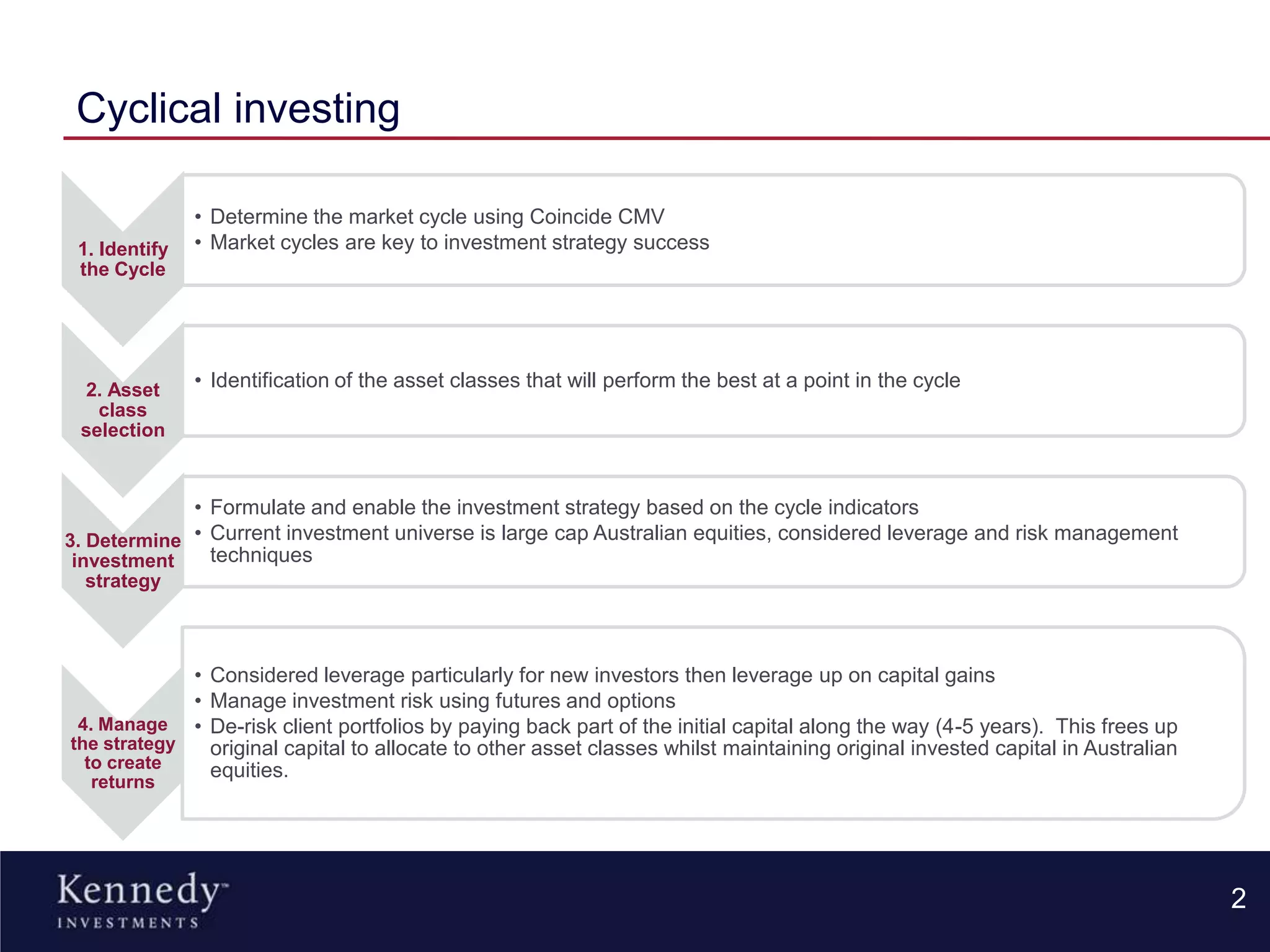
1. Identify
the Cycle
• Determine the market cycle using Coincide CMV
• Market cycles are key to investment strategy success
2. Asset
class
selection
• Identification of the asset classes that will perform the best at a point in the cycle
3. Determine
investment
strategy
• Formulate and enable the investment strategy based on the cycle indicators
• Current investment universe is large cap Australian equities, considered leverage and risk management
techniques
4. Manage
the strategy
to create
returns
• Considered leverage particularly for new investors then leverage up on capital gains
• Manage investment risk using futures and options
• De-risk client portfolios by paying back part of the initial capital along the way (4-5 years). This frees up
original capital to allocate to other asset classes whilst maintaining original invested capital in Australian
equities.
Discretionary Managed Equity Account (DMEA)
3
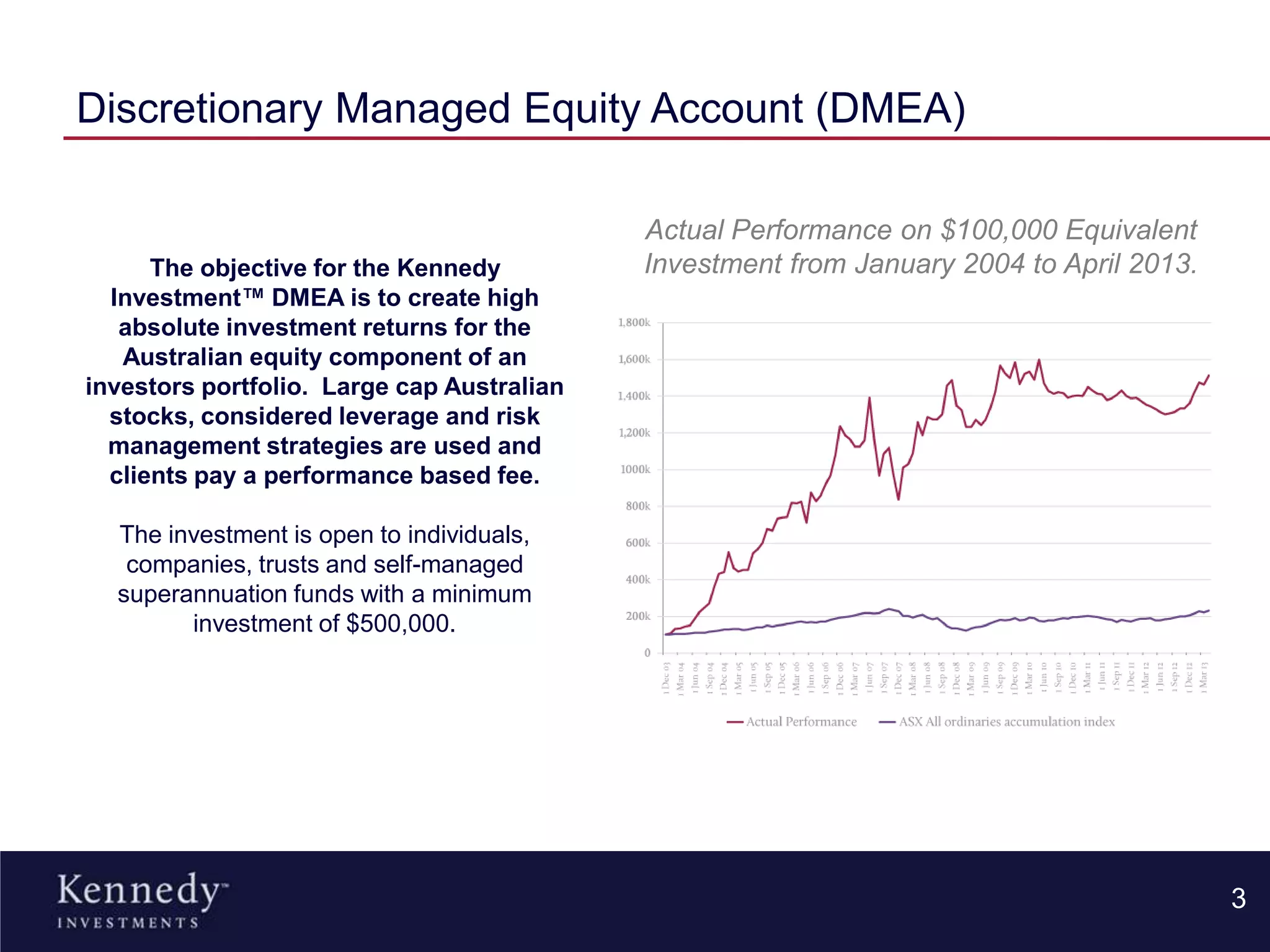
The objective for the Kennedy
Investment™ DMEA is to create high
absolute investment returns for the
Australian equity component of an
investors portfolio. Large cap Australian
stocks, considered leverage and risk
management strategies are used and
clients pay a performance based fee.
The investment is open to individuals,
companies, trusts and self-managed
superannuation funds with a minimum
investment of $500,000.
Actual Performance on $100,000 Equivalent
Investment from January 2004 to April 2013.
Kennedy Investments Recent Performance
4
90.00
95.00
100.00
105.00
110.00
115.00
120.00
Feb-13 Mar-13 Apr-13 May-13 Jun-13 Jul-13 Aug-13 Sep-13
Kennedy Investments
XJOAI
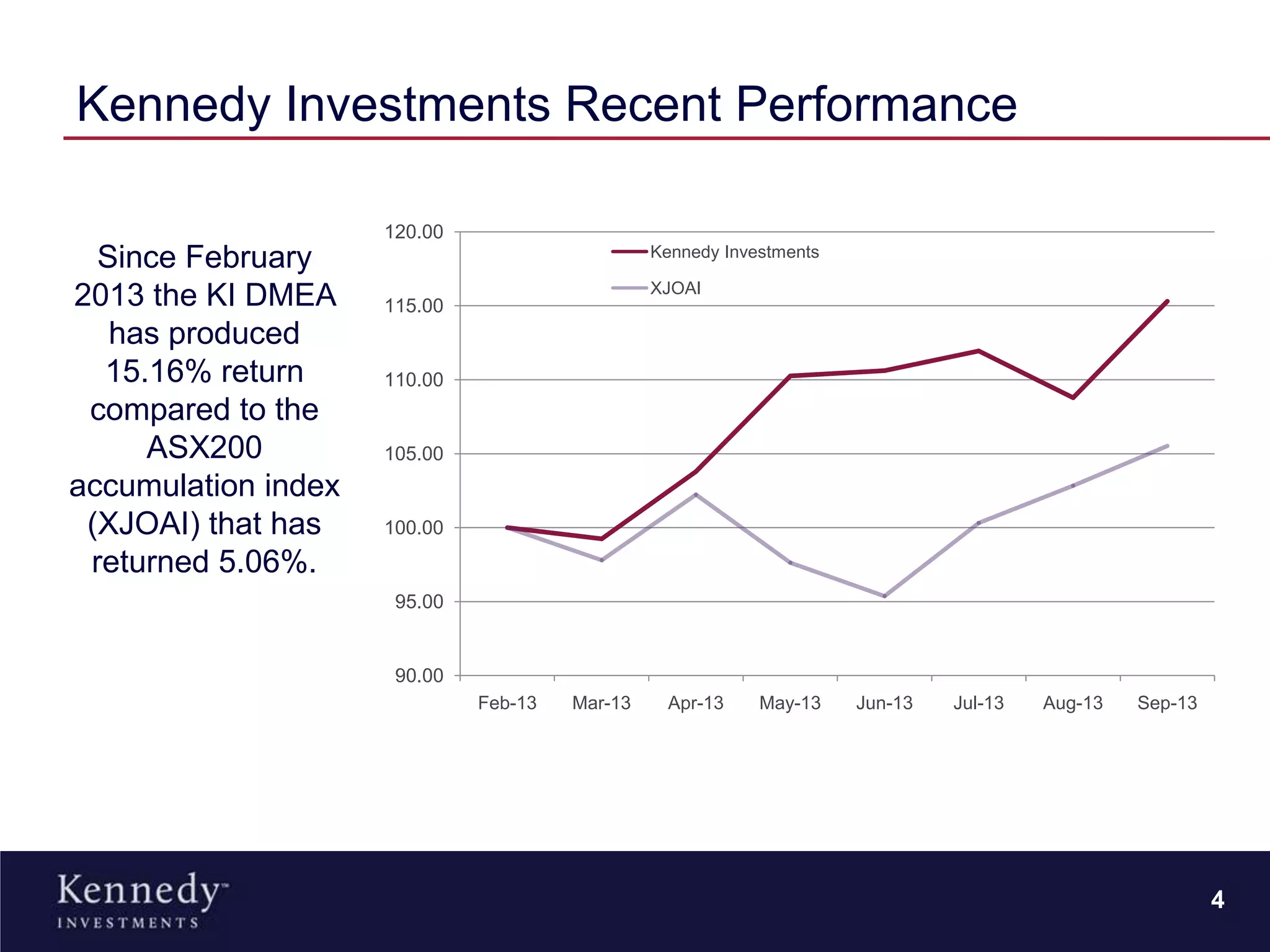
Since February
2013 the KI DMEA
has produced
15.16% return
compared to the
ASX200
accumulation index
(XJOAI) that has
returned 5.06%.
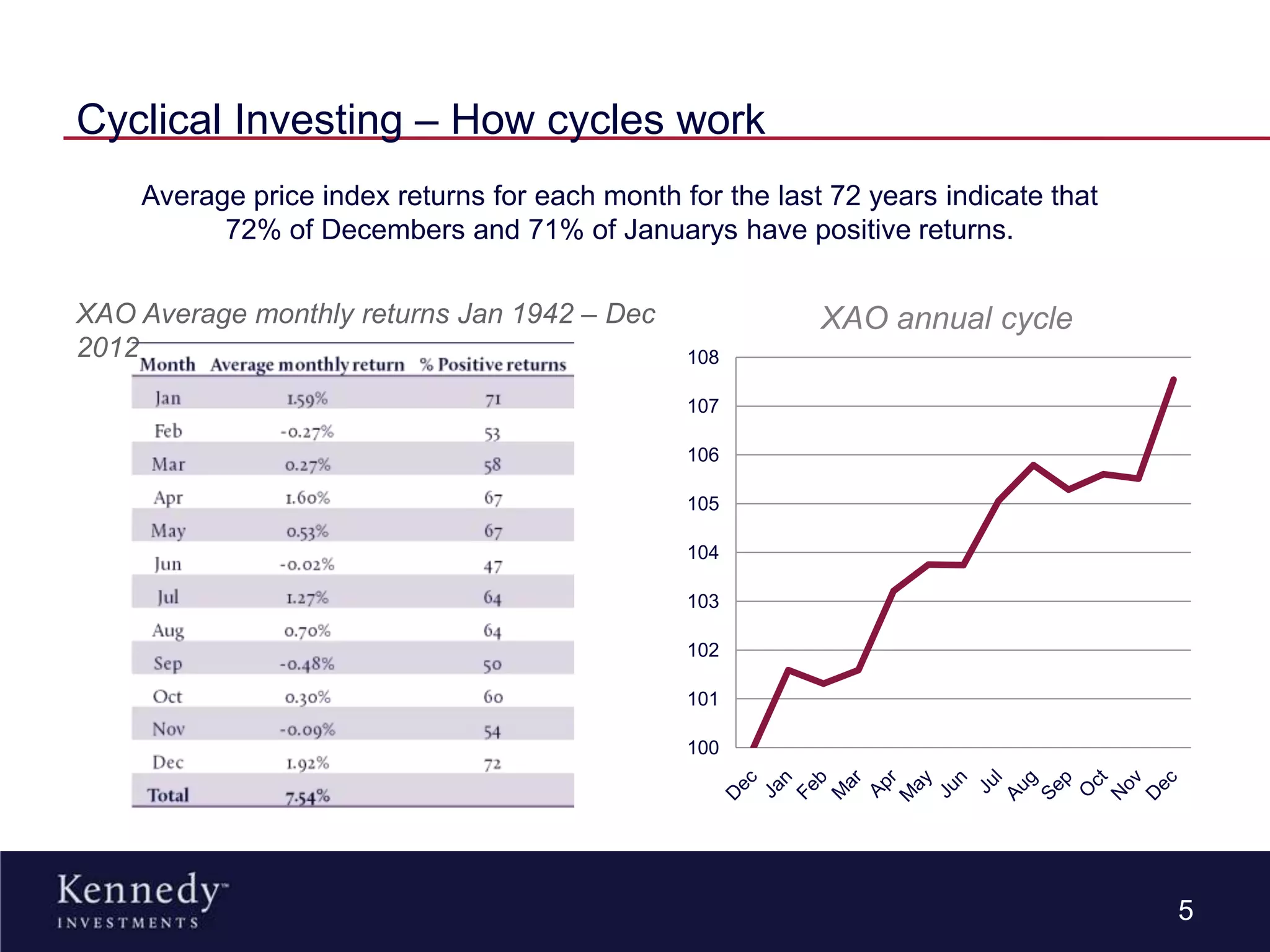
Cyclical Investing – How cycles work
XAO annual cycle
5
100
101
102
103
104
105
106
107
108
XAO Average monthly returns Jan 1942 – Dec
2012
Average price index returns for each month for the last 72 years indicate that
72% of Decembers and 71% of Januarys have positive returns.
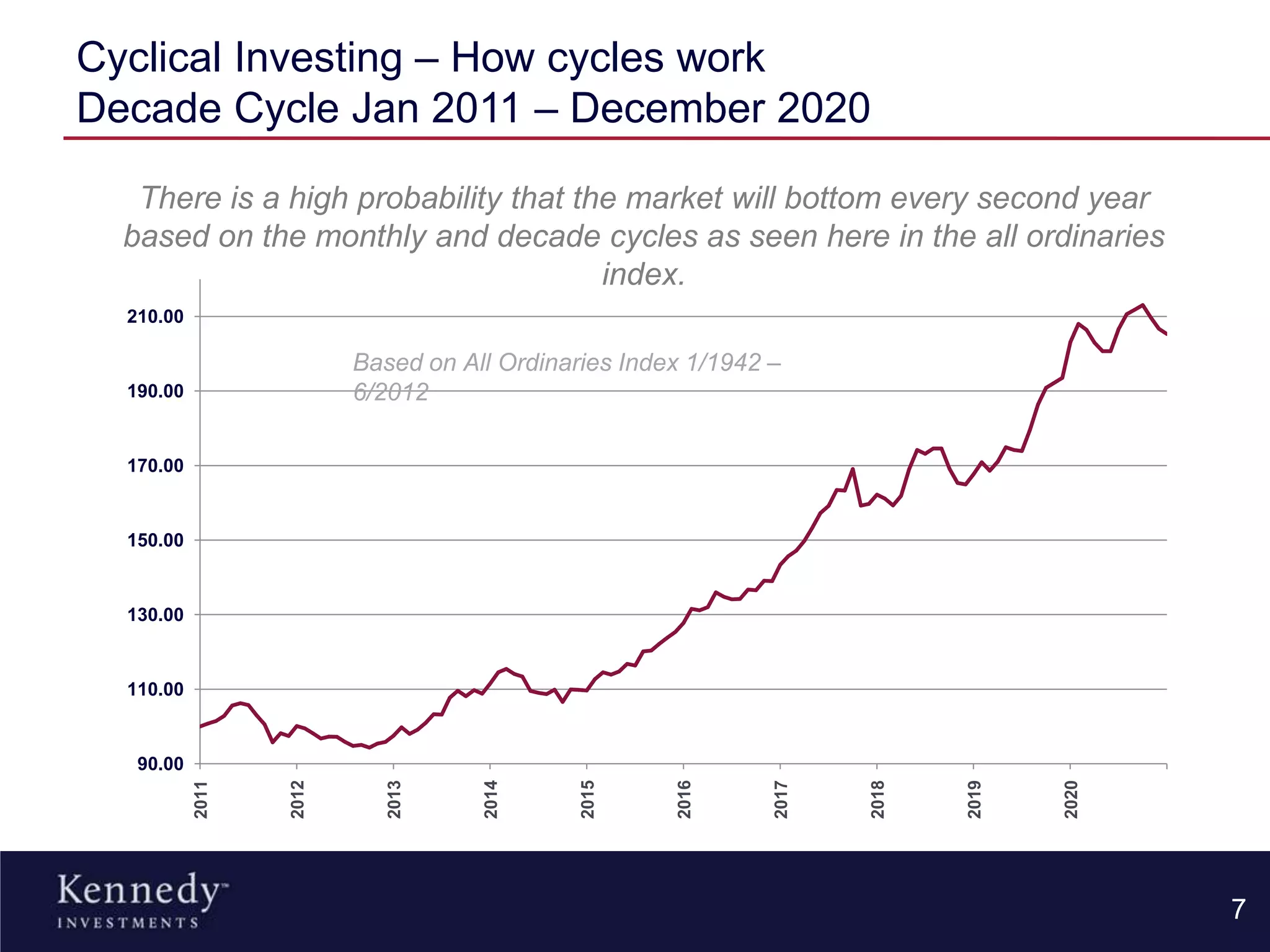
Cyclical Investing – How cycles work
Decade Cycle Jan 2011 – December 2020
90.00
110.00
130.00
150.00
170.00
190.00
210.00
2011
2012
2013
2014
2015
2016
2017
2018
2019
2020
Based on All Ordinaries Index 1/1942 –
6/2012
7
There is a high probability that the market will bottom every second year
based on the monthly and decade cycles as seen here in the all ordinaries
index.
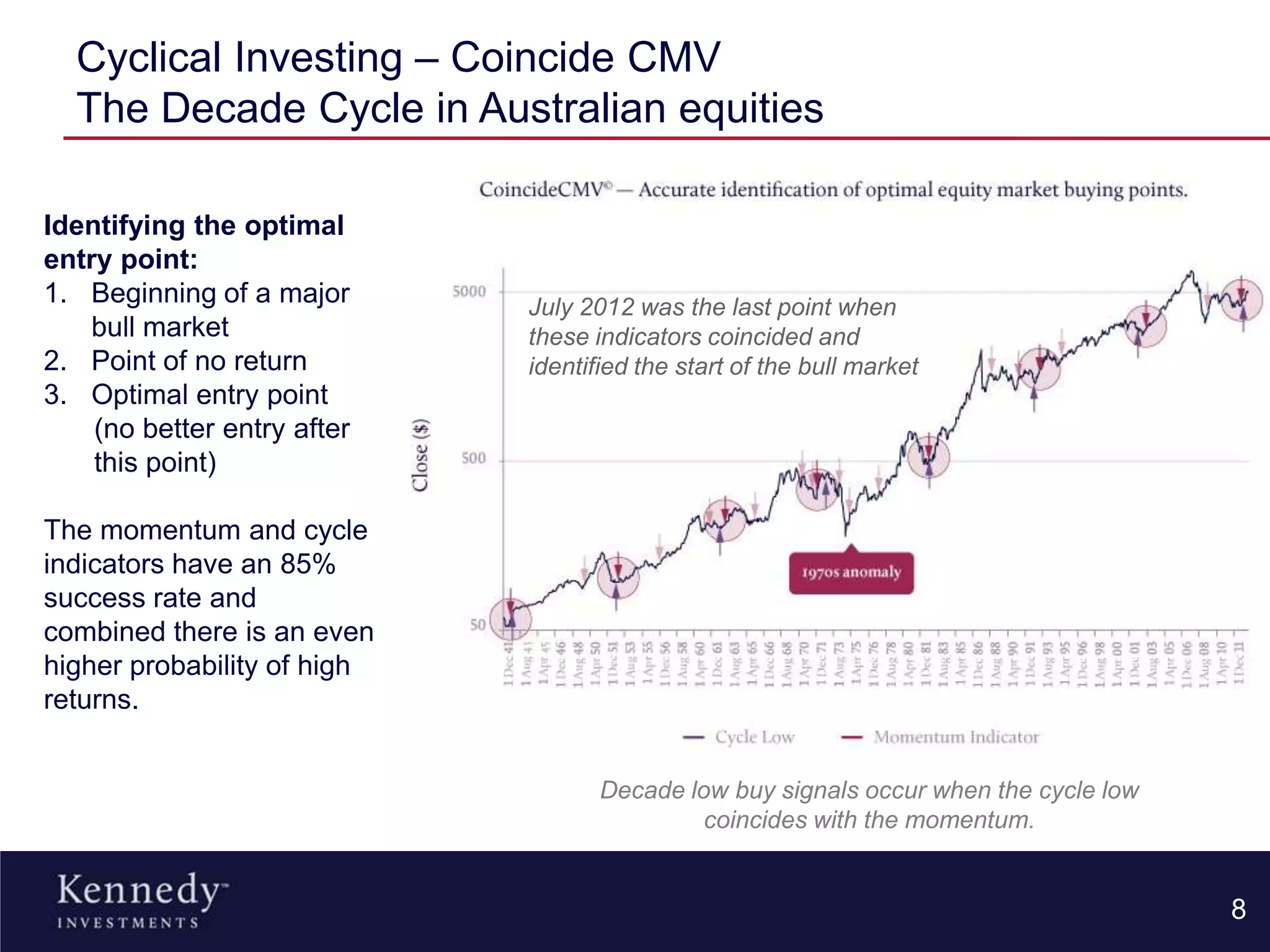
Cyclical Investing – Coincide CMV
The Decade Cycle in Australian equities
8
Decade low buy signals occur when the cycle low
coincides with the momentum.
Identifying the optimal
entry point:
1. Beginning of a major
bull market
2. Point of no return
3. Optimal entry point
(no better entry after
this point)
The momentum and cycle
indicators have an 85%
success rate and
combined there is an even
higher probability of high
returns.
July 2012 was the last point when
these indicators coincided and
identified the start of the bull market
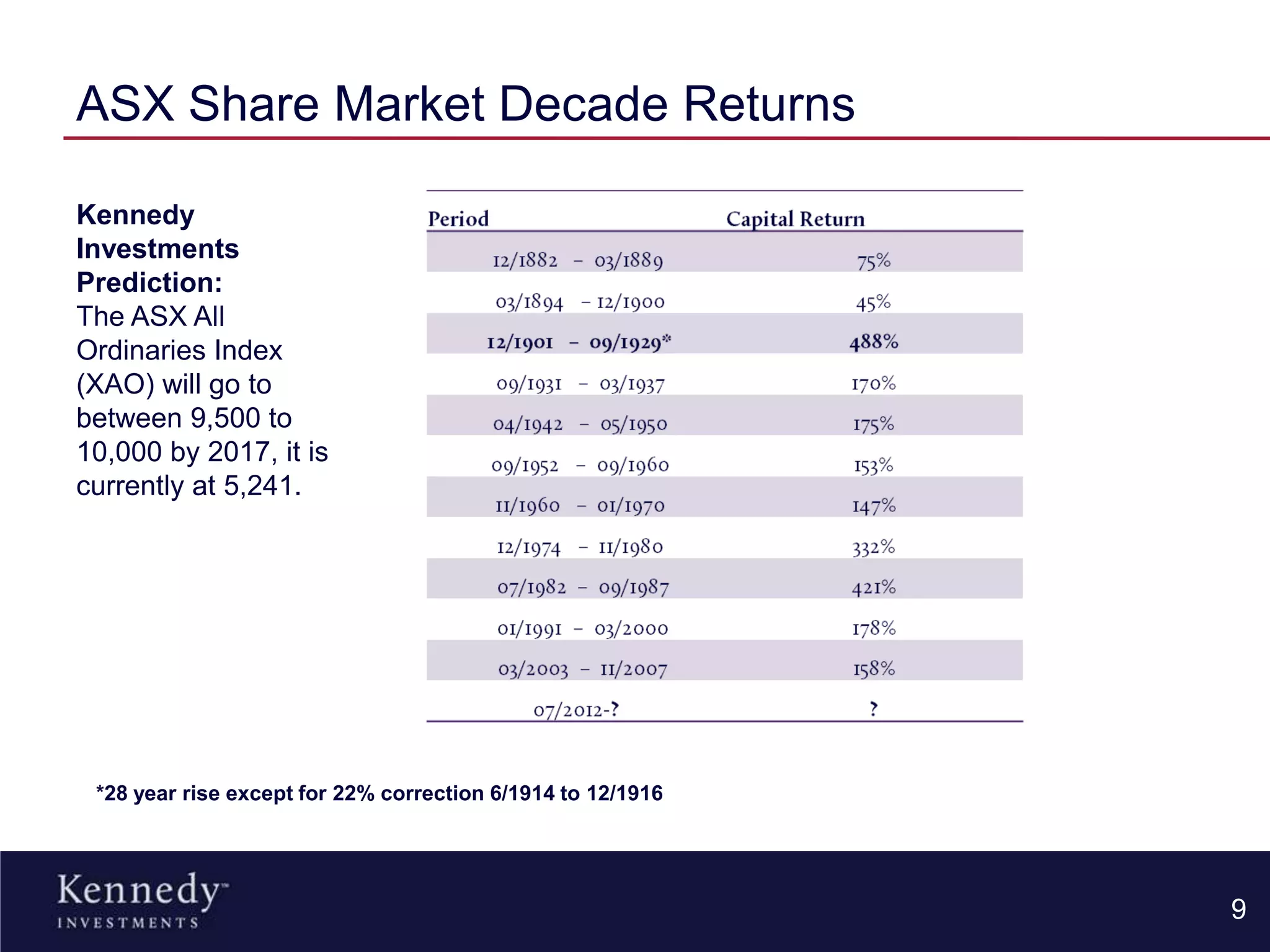
ASX Share Market Decade Returns
*28 year rise except for 22% correction 6/1914 to 12/1916
9
Kennedy
Investments
Prediction:
The ASX All
Ordinaries Index
(XAO) will go to
between 9,500 to
10,000 by 2017, it is
currently at 5,241.
Considered Leverage & De-risking the Portfolio
10
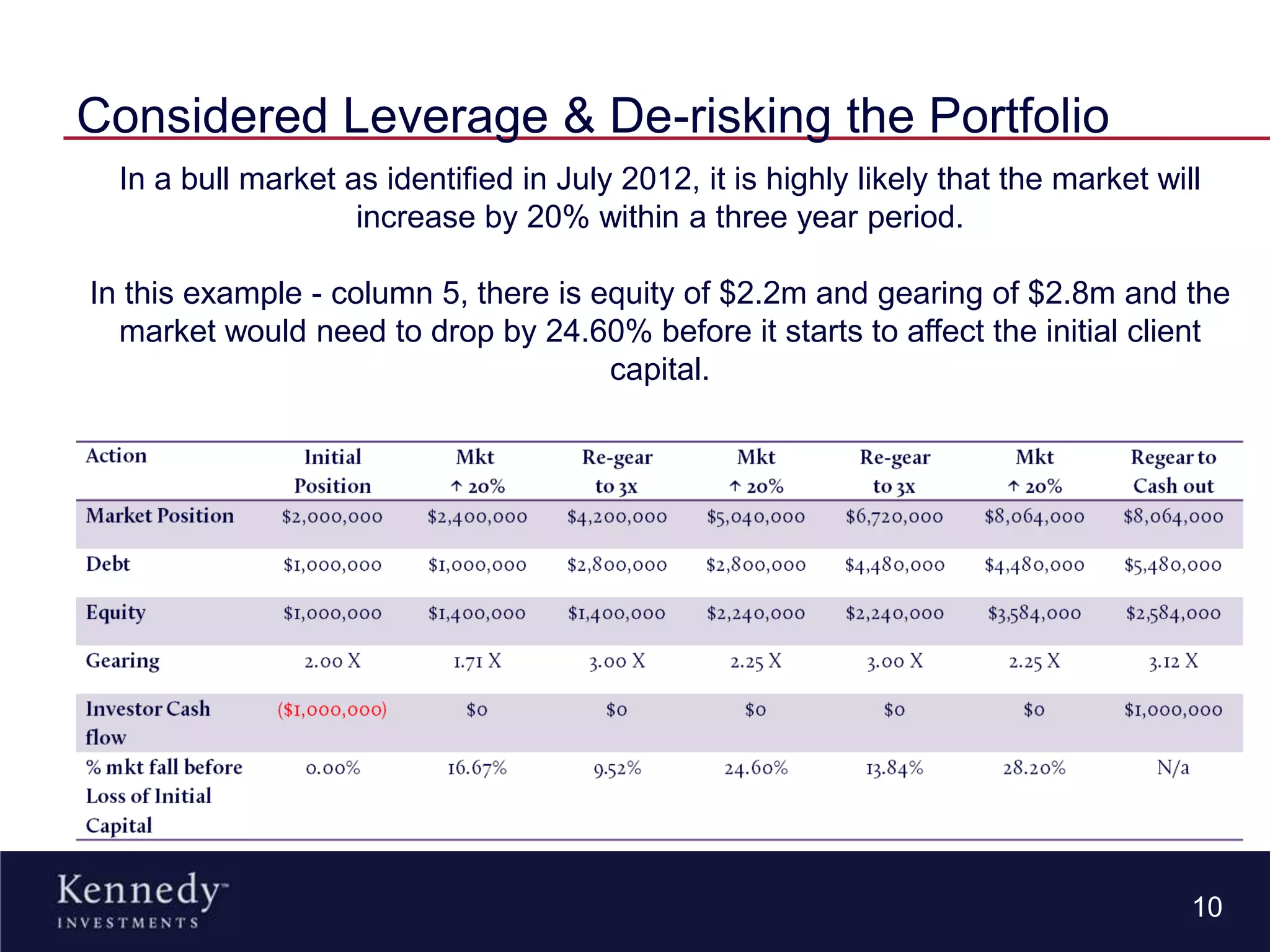
In a bull market as identified in July 2012, it is highly likely that the market will
increase by 20% within a three year period.
In this example - column 5, there is equity of $2.2m and gearing of $2.8m and the
market would need to drop by 24.60% before it starts to affect the initial client
capital.
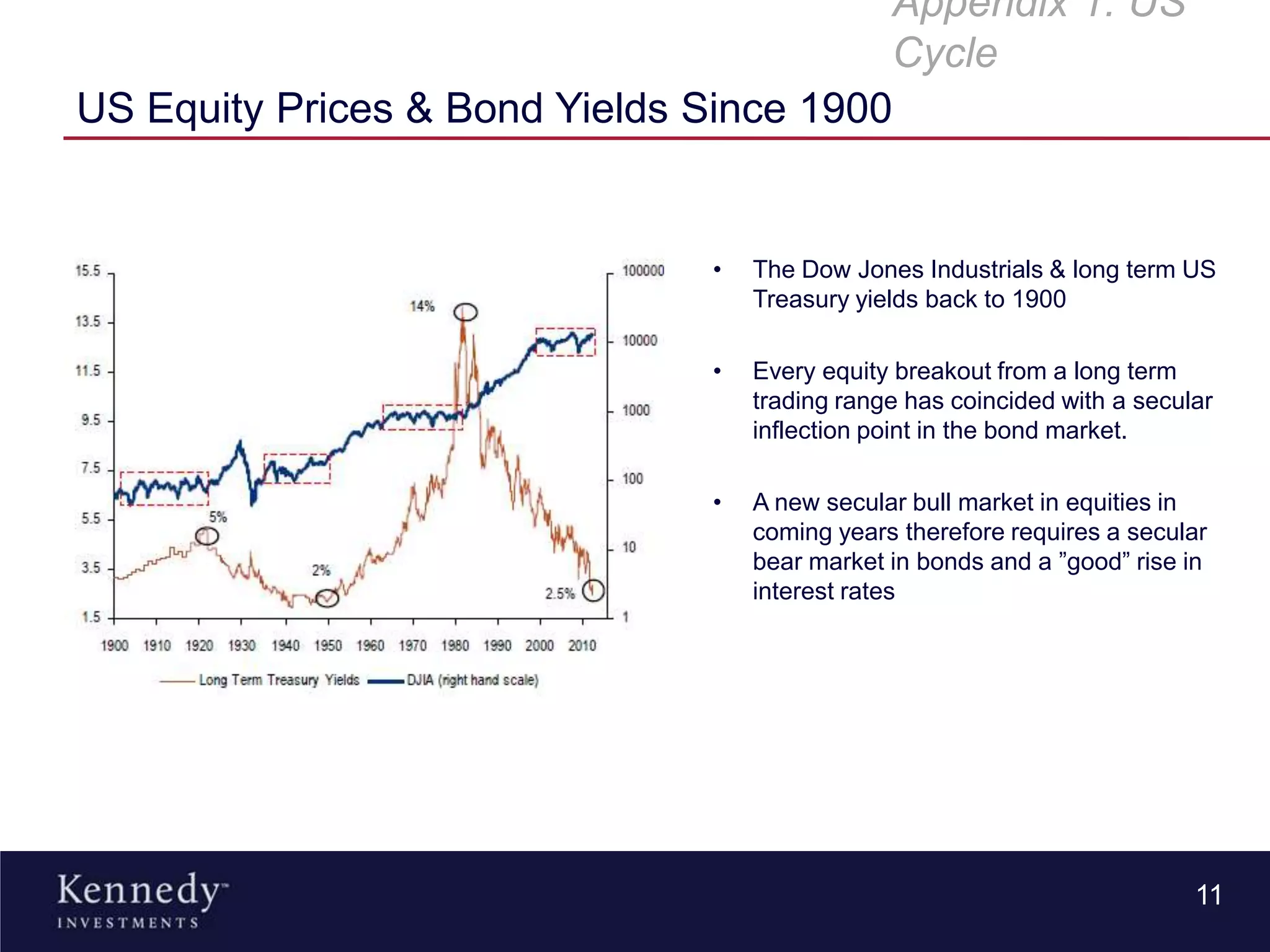
US Equity Prices & Bond Yields Since 1900
• The Dow Jones Industrials & long term US
Treasury yields back to 1900
• Every equity breakout from a long term
trading range has coincided with a secular
inflection point in the bond market.
• A new secular bull market in equities in
coming years therefore requires a secular
bear market in bonds and a ”good” rise in
interest rates
11
Appendix 1: US
Cycle
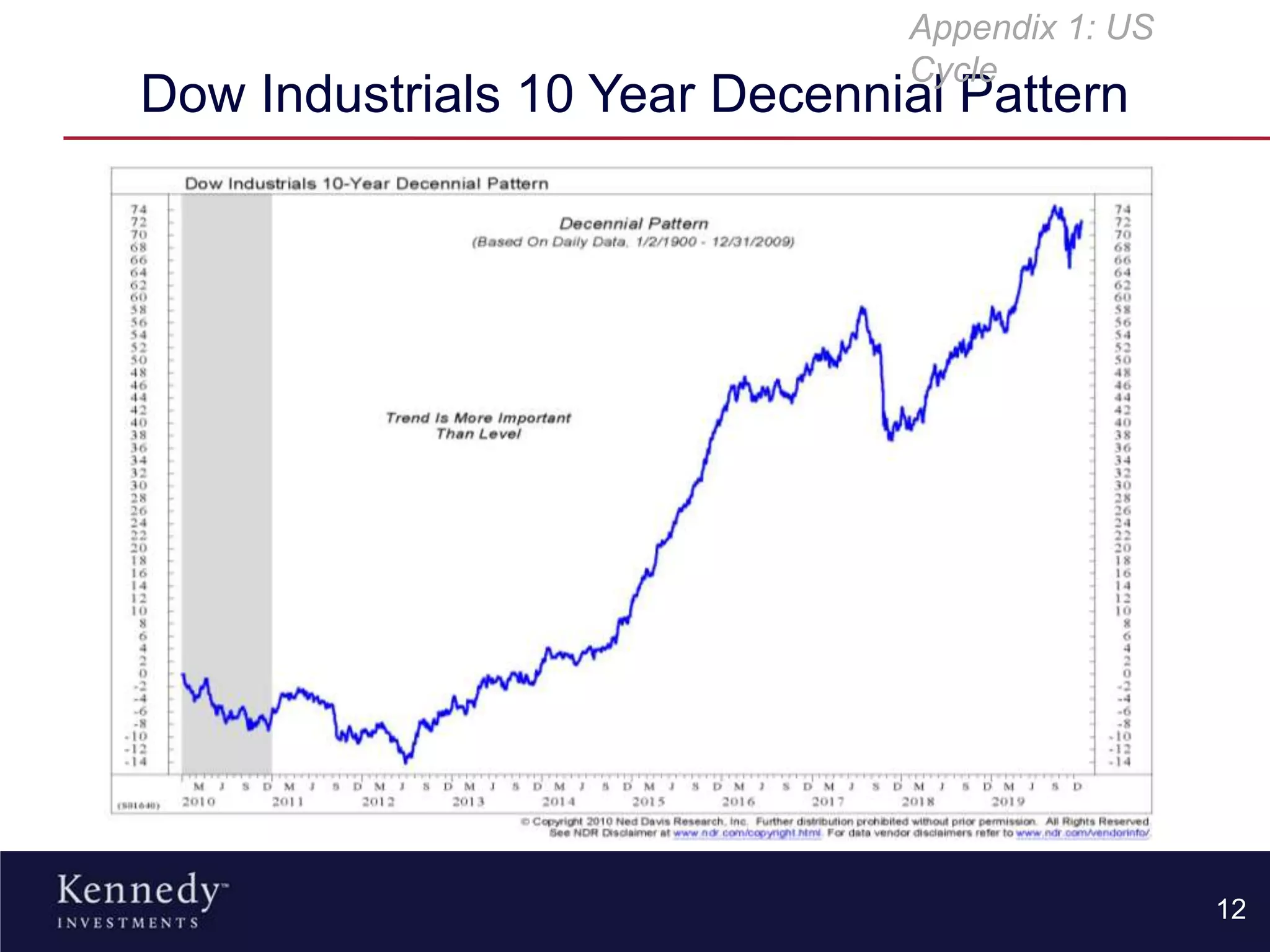
Dow Industrials 10 Year Decennial Pattern
12
Appendix 1: US
Cycle
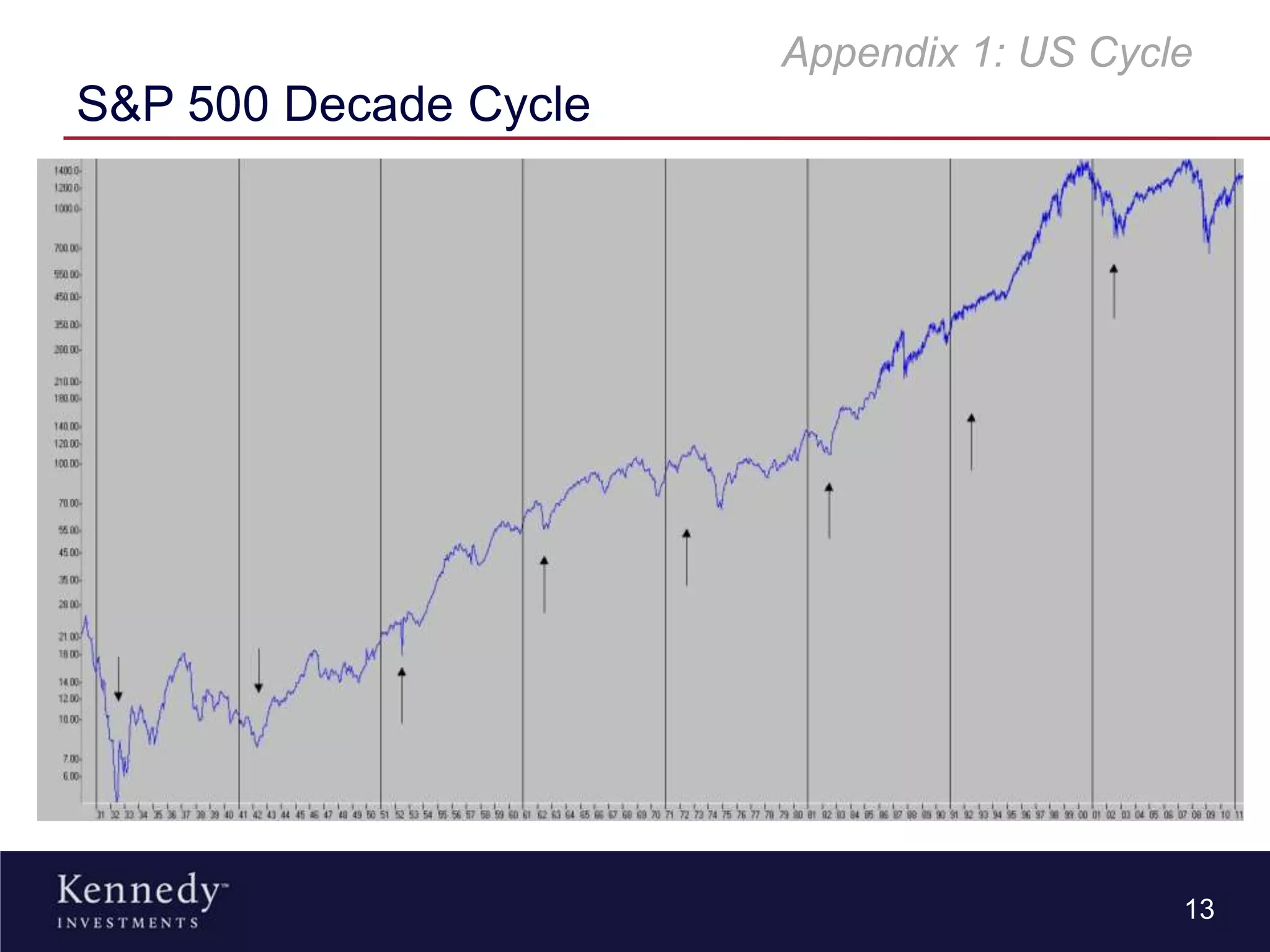
S&P 500 Decade Cycle
13
Appendix 1: US Cycle

Cyclical Investing Presentation

  • 1.
  • 2.
    Cyclical investing 2 1. Identify theCycle • Determine the market cycle using Coincide CMV • Market cycles are key to investment strategy success 2. Asset class selection • Identification of the asset classes that will perform the best at a point in the cycle 3. Determine investment strategy • Formulate and enable the investment strategy based on the cycle indicators • Current investment universe is large cap Australian equities, considered leverage and risk management techniques 4. Manage the strategy to create returns • Considered leverage particularly for new investors then leverage up on capital gains • Manage investment risk using futures and options • De-risk client portfolios by paying back part of the initial capital along the way (4-5 years). This frees up original capital to allocate to other asset classes whilst maintaining original invested capital in Australian equities.
  • 3.
    Discretionary Managed EquityAccount (DMEA) 3 The objective for the Kennedy Investment™ DMEA is to create high absolute investment returns for the Australian equity component of an investors portfolio. Large cap Australian stocks, considered leverage and risk management strategies are used and clients pay a performance based fee. The investment is open to individuals, companies, trusts and self-managed superannuation funds with a minimum investment of $500,000. Actual Performance on $100,000 Equivalent Investment from January 2004 to April 2013.
  • 4.
    Kennedy Investments RecentPerformance 4 90.00 95.00 100.00 105.00 110.00 115.00 120.00 Feb-13 Mar-13 Apr-13 May-13 Jun-13 Jul-13 Aug-13 Sep-13 Kennedy Investments XJOAI Since February 2013 the KI DMEA has produced 15.16% return compared to the ASX200 accumulation index (XJOAI) that has returned 5.06%.
  • 5.
    Cyclical Investing –How cycles work XAO annual cycle 5 100 101 102 103 104 105 106 107 108 XAO Average monthly returns Jan 1942 – Dec 2012 Average price index returns for each month for the last 72 years indicate that 72% of Decembers and 71% of Januarys have positive returns.
  • 7.
    Cyclical Investing –How cycles work Decade Cycle Jan 2011 – December 2020 90.00 110.00 130.00 150.00 170.00 190.00 210.00 2011 2012 2013 2014 2015 2016 2017 2018 2019 2020 Based on All Ordinaries Index 1/1942 – 6/2012 7 There is a high probability that the market will bottom every second year based on the monthly and decade cycles as seen here in the all ordinaries index.
  • 8.
    Cyclical Investing –Coincide CMV The Decade Cycle in Australian equities 8 Decade low buy signals occur when the cycle low coincides with the momentum. Identifying the optimal entry point: 1. Beginning of a major bull market 2. Point of no return 3. Optimal entry point (no better entry after this point) The momentum and cycle indicators have an 85% success rate and combined there is an even higher probability of high returns. July 2012 was the last point when these indicators coincided and identified the start of the bull market
  • 9.
    ASX Share MarketDecade Returns *28 year rise except for 22% correction 6/1914 to 12/1916 9 Kennedy Investments Prediction: The ASX All Ordinaries Index (XAO) will go to between 9,500 to 10,000 by 2017, it is currently at 5,241.
  • 10.
    Considered Leverage &De-risking the Portfolio 10 In a bull market as identified in July 2012, it is highly likely that the market will increase by 20% within a three year period. In this example - column 5, there is equity of $2.2m and gearing of $2.8m and the market would need to drop by 24.60% before it starts to affect the initial client capital.
  • 11.
    US Equity Prices& Bond Yields Since 1900 • The Dow Jones Industrials & long term US Treasury yields back to 1900 • Every equity breakout from a long term trading range has coincided with a secular inflection point in the bond market. • A new secular bull market in equities in coming years therefore requires a secular bear market in bonds and a ”good” rise in interest rates 11 Appendix 1: US Cycle
  • 12.
    Dow Industrials 10Year Decennial Pattern 12 Appendix 1: US Cycle
  • 13.
    S&P 500 DecadeCycle 13 Appendix 1: US Cycle