Statistics
Further Math
REVIEW CHAPTER
Normal distribution
Dr. KhoeYao Tung, MSc.Ed., M.Ed.
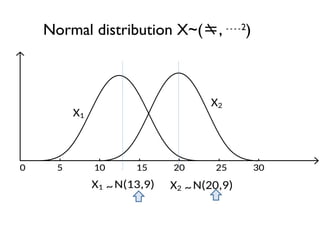
The normal is a family of
 Bell-shaped and symmetric distributions. because
the distribution is symmetric, one-half (.50 or
50%) lies on either side of the mean.
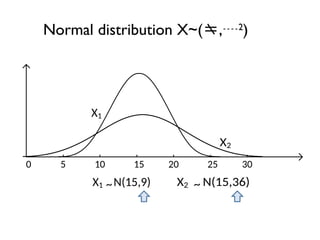
 Each is characterized by a different pair of mean
, and the variance, ² That is: [X~N(, ²)].
 Each is asymptotic to the horizontal axis.
Normal distribution
Normal distribution X~(, 2
)
5 10 15 20 25 30
X1 ~N(13,9)
X1
0
X2 ~N(20,9)
X2
Normal distribution X~(,2
)
5 10 15 20 25 30
X1 ~N(15,9)
X1
0
X2 ~ N(15,36)
X2
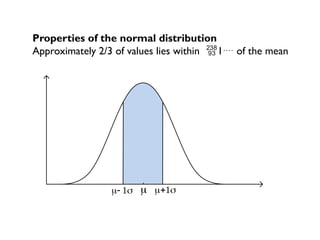
Properties of the normal distribution
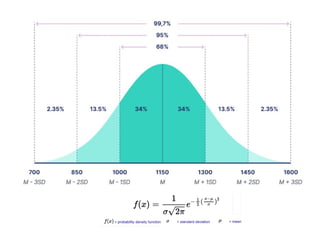
Approximately 2/3 of values lies within 1 of the mean
(68.27%)
  

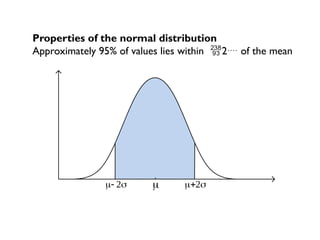
Properties of the normal distribution
Approximately 95% of values lies within 2 of the mean
(95.45%)
  

Properties of the normal distribution
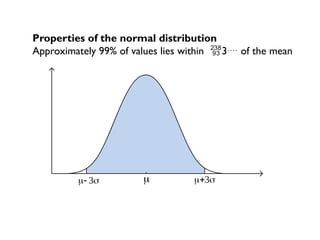
Approximately 99% of values lies within 3 of the mean
(99.73%)
  

Properties of the normal distribution
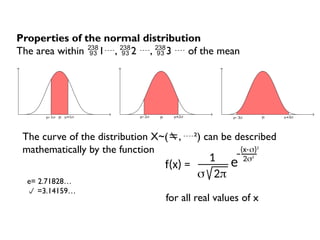
The area within 1, 2 , 3  of the mean
The curve of the distribution X~(, ²) can be described
mathematically by the function
f(x) =
s 2p
1 e 2s2
(x- )2
s
for all real values of x
e= 2.71828…
 =3.14159…
  
   
   

Standard Normal distribution
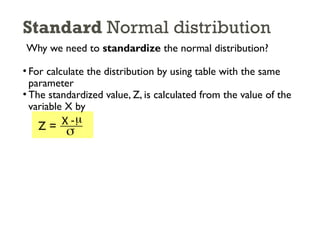
Why we need to standardize the normal distribution?
• For calculate the distribution by using table with the same
parameter
• The standardized value, Z, is calculated from the value of the
variable X by
Z = X -
s
m
Standard Normal distribution
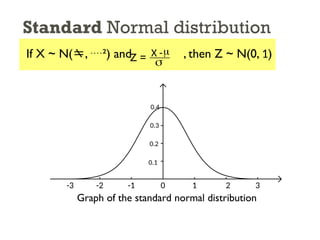
If X ~ N(, ²) and , then Z ~ N(0, 1)
Z = X -
s
m
-2 -1 0 1 2 3
Graph of the standard normal distribution
-3
0.1
0.2
0.3
0.4
0
Y


-
X

-  
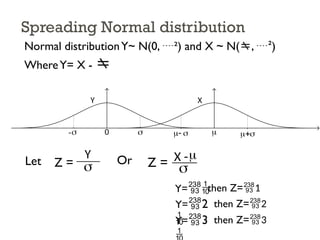
Spreading Normal distribution
Normal distributionY~ N(0, ²) and X ~ N(, ²)
WhereY= X - 
Let Z =
Y
s Or Z = X -
s
m
then Z=1
Y=
then Z=2
Y=2
 then Z=3
Y=3

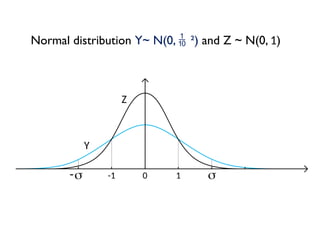
Normal distribution Y~ N(0,  ²) and Z ~ N(0, 1)
-1 0 1
Z
Y


-
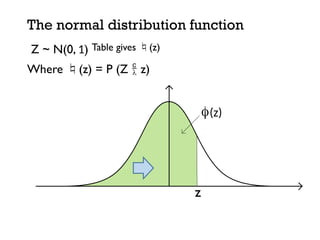
The normal distribution function
z
f(z)
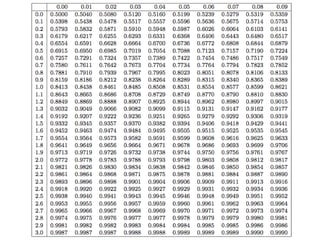
Table gives (z)
Where (z) = P (Z  z)
Z ~ N(0, 1)
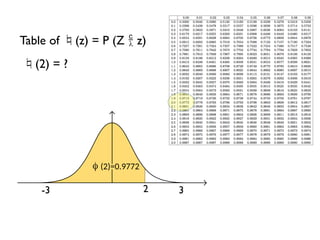
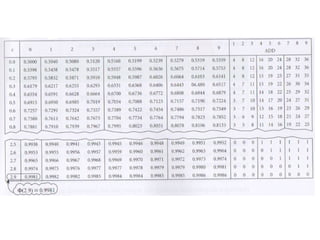
Table of (z) = P (Z  z)
(2) = ?
2
f (2)=0.9772
3
-3
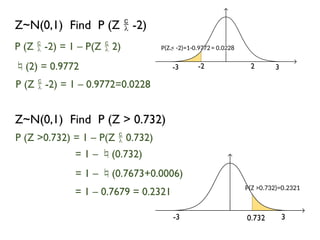
Z~N(0,1) Find P (Z  -2)
(2) = 0.9772
P (Z  -2) = 1 – P(Z  2)
Z~N(0,1) Find P (Z > 0.732)
P (Z >0.732) = 1 – P(Z  0.732)
= 1 – (0.732)
= 1 – (0.7673+0.0006)
= 1 – 0.7679 = 0.2321
P(Z < -2)=1-0.9772
-2
= 0.0228
2 3
-3
0.732 3
-3
P(Z >0.732)=0.2321
P (Z  -2) = 1 – 0.9772=0.0228
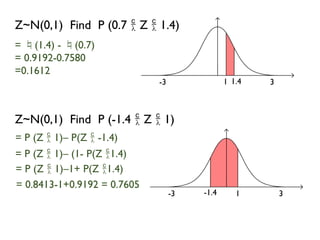
Z~N(0,1) Find P (0.7  Z  1.4)
= (1.4) - (0.7)
= 0.9192-0.7580
=0.1612
= P (Z  1)– P(Z  -1.4)
1.4 3
-3 1
Z~N(0,1) Find P (-1.4  Z  1)
= P (Z  1)– (1- P(Z 1.4)
= P (Z  1)–1+ P(Z 1.4)
= 0.8413-1+0.9192 = 0.7605
-1.4 3
-3 1
2
0.7
3
-3 z
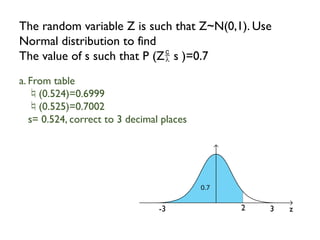
The random variable Z is such that Z~N(0,1). Use
Normal distribution to find
The value of s such that P (Z s )=0.7
a. From table
(0.524)=0.6999
(0.525)=0.7002
s= 0.524, correct to 3 decimal places
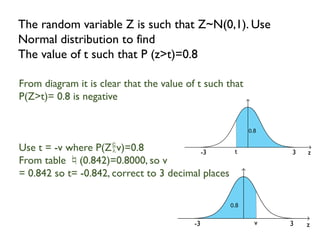
The random variable Z is such that Z~N(0,1). Use
Normal distribution to find
The value of t such that P (z>t)=0.8
From diagram it is clear that the value of t such that
P(Z>t)= 0.8 is negative
Use t = -v where P(Zv)=0.8
From table (0.842)=0.8000, so v
= 0.842 so t= -0.842, correct to 3 decimal places
t
0.8
3
-3 z
v
0.8
3
-3 z
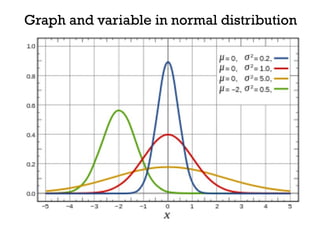
Graph and variable in normal distribution
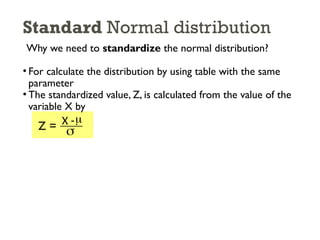
Standard Normal distribution
Why we need to standardize the normal distribution?
• For calculate the distribution by using table with the same
parameter
• The standardized value, Z, is calculated from the value of the
variable X by
Z = X -
s
m
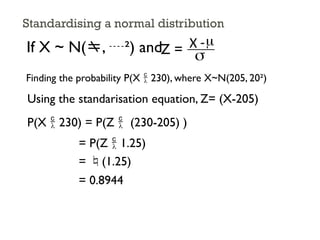
Standardising a normal distribution
If X ~ N(, ²) andZ = X -
s
m
Finding the probability P(X  230), where X~N(205, 20²)
Using the standarisation equation, Z= (X-205)
P(X  230) = P(Z  (230-205) )
= P(Z  1.25)
= (1.25)
= 0.8944
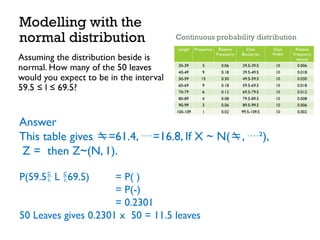
Modelling with the
normal distribution
Assuming the distribution beside is
normal. How many of the 50 leaves
would you expect to be in the interval
59.5 ≤ l ≤ 69.5?
Answer
This table gives =61.4, =16.8, If X ~ N(, ²),
Z = then Z~(N, 1).
P(59.5 L 69.5) = P( )
= P(-)
= 0.2301
50 Leaves gives 0.2301 x 50 = 11.5 leaves
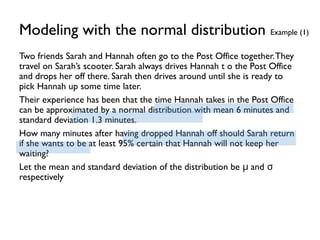
Modeling with the normal distribution Example (1)
Two friends Sarah and Hannah often go to the Post Office together.They
travel on Sarah’s scooter. Sarah always drives Hannah t o the Post Office
and drops her off there. Sarah then drives around until she is ready to
pick Hannah up some time later.
Their experience has been that the time Hannah takes in the Post Office
can be approximated by a normal distribution with mean 6 minutes and
standard deviation 1.3 minutes.
How many minutes after having dropped Hannah off should Sarah return
if she wants to be at least 95% certain that Hannah will not keep her
waiting?
Let the mean and standard deviation of the distribution be and
μ σ
respectively
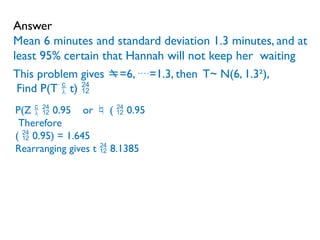
This problem gives =6, =1.3, then T~ N(6, 1.3²),
Find P(T  t) 
P(Z   0.95 or  (  0.95
Therefore
(  0.95) = 1.645
Rearranging gives t  8.1385
Answer
Mean 6 minutes and standard deviation 1.3 minutes, and at
least 95% certain that Hannah will not keep her waiting
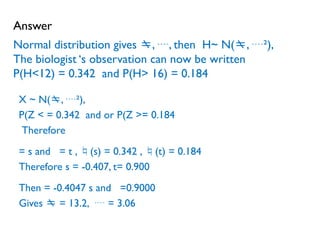
A Biologist has been collecting data on the heights of a particular species
of cactus. He has observed that 34.2% of the cacti are below 12 cm in
height and 18.4% of the cacti are above 16 cm in height. He assumes that
the heights are normally distributed. Find the mean and standard deviation
of the distribution.
Let the mean and standard deviation of the distribution be and
μ σ
respectively
Modeling with the normal distribution
Example (2)
Normal distribution gives , , then H~ N(, ²),
The biologist ‘s observation can now be written
P(H<12) = 0.342 and P(H> 16) = 0.184
X ~ N(, ²),
P(Z < = 0.342 and or P(Z >= 0.184
Therefore
= s and = t , (s) = 0.342 , (t) = 0.184
Therefore s = -0.407, t= 0.900
Then = -0.4047 s and =0.9000
Gives  = 13.2,  = 3.06
Answer
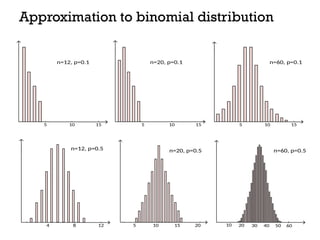
5 10 15
n=12, p=0.1
5 10 15
n=20, p=0.1
5 10 15
n=60, p=0.1
Approximation to binomial distribution
4 8 12
n=12, p=0.5
5 10 20
n=20, p=0.5
20 30 60
n=60, p=0.5
40 50
10
15
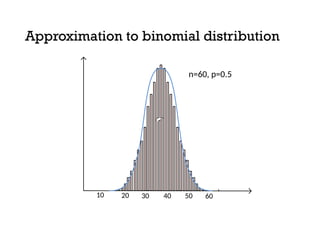
20 30 60
n=60, p=0.5
40 50
10
Approximation to binomial distribution
Normal distribution as an approximation to
binomial distribution
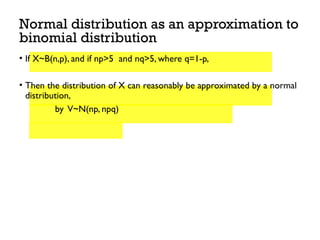
• If X~B(n,p), and if np>5 and nq>5, where q=1-p,
• Then the distribution of X can reasonably be approximated by a normal
distribution,
by V~N(np, npq)
Approximation to binomial distribution
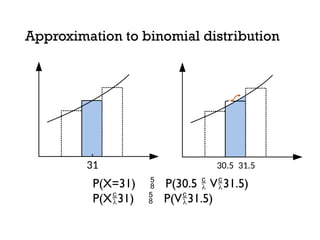
31 30.5 31.5
P(X=31)  P(30.5  V31.5)
P(X31)  P(V31.5)
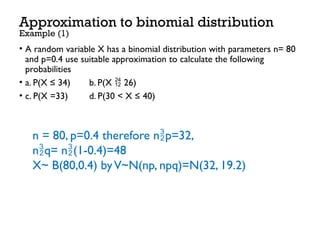
• A random variable X has a binomial distribution with parameters n= 80
and p=0.4 use suitable approximation to calculate the following
probabilities
• a. P(X ≤ 34) b. P(X  26)
• c. P(X =33) d. P(30 < X ≤ 40)
Approximation to binomial distribution
Example (1)
n = 80, p=0.4 therefore np=32,
nq= n(1-0.4)=48
X~ B(80,0.4) byV~N(np, npq)=N(32, 19.2)

, then Z~N(0,1)
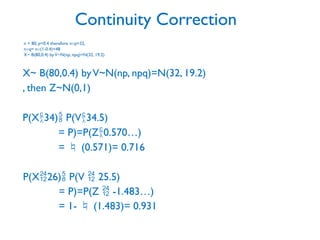
P(X34) P(V34.5)
= P)=P(Z0.570…)
=  (0.571)= 0.716
P(X26) P(V  25.5)
= P)=P(Z  -1.483…)
= 1-  (1.483)= 0.931
Continuity Correction
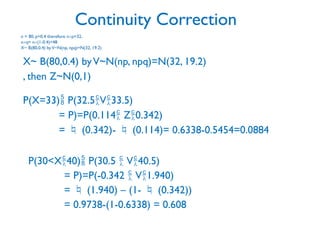
X~ B(80,0.4) byV~N(np, npq)=N(32, 19.2)

, then Z~N(0,1)
P(X=33) P(32.5V33.5)
= P)=P(0.114 Z0.342)
=  (0.342)-  (0.114)= 0.6338-0.5454=0.0884
P(30<X40) P(30.5  V40.5)
= P)=P(-0.342  V1.940)
=  (1.940) – (1-  (0.342))
= 0.9738-(1-0.6338) = 0.608
Continuity Correction
Statistics_further_00 Normal Distribution.pptx

Statistics_further_00 Normal Distribution.pptx

  • 1.
    Statistics Further Math REVIEW CHAPTER Normaldistribution Dr. KhoeYao Tung, MSc.Ed., M.Ed.
  • 4.
    The normal isa family of  Bell-shaped and symmetric distributions. because the distribution is symmetric, one-half (.50 or 50%) lies on either side of the mean.  Each is characterized by a different pair of mean , and the variance, ² That is: [X~N(, ²)].  Each is asymptotic to the horizontal axis. Normal distribution
  • 5.
    Normal distribution X~(,2 ) 5 10 15 20 25 30 X1 ~N(13,9) X1 0 X2 ~N(20,9) X2
  • 6.
    Normal distribution X~(,2 ) 510 15 20 25 30 X1 ~N(15,9) X1 0 X2 ~ N(15,36) X2
  • 7.
    Properties of thenormal distribution Approximately 2/3 of values lies within 1 of the mean (68.27%)    
  • 8.
    Properties of thenormal distribution Approximately 95% of values lies within 2 of the mean (95.45%)    
  • 9.
    Properties of thenormal distribution Approximately 99% of values lies within 3 of the mean (99.73%)    
  • 10.
    Properties of thenormal distribution The area within 1, 2 , 3  of the mean The curve of the distribution X~(, ²) can be described mathematically by the function f(x) = s 2p 1 e 2s2 (x- )2 s for all real values of x e= 2.71828…  =3.14159…            
  • 11.
    Standard Normal distribution Whywe need to standardize the normal distribution? • For calculate the distribution by using table with the same parameter • The standardized value, Z, is calculated from the value of the variable X by Z = X - s m
  • 12.
    Standard Normal distribution IfX ~ N(, ²) and , then Z ~ N(0, 1) Z = X - s m -2 -1 0 1 2 3 Graph of the standard normal distribution -3 0.1 0.2 0.3 0.4
  • 13.
    0 Y   - X  -   SpreadingNormal distribution Normal distributionY~ N(0, ²) and X ~ N(, ²) WhereY= X -  Let Z = Y s Or Z = X - s m then Z=1 Y= then Z=2 Y=2  then Z=3 Y=3 
  • 14.
    Normal distribution Y~N(0,  ²) and Z ~ N(0, 1) -1 0 1 Z Y   -
  • 15.
    The normal distributionfunction z f(z) Table gives (z) Where (z) = P (Z  z) Z ~ N(0, 1)
  • 16.
    Table of (z)= P (Z  z) (2) = ? 2 f (2)=0.9772 3 -3
  • 19.
    Z~N(0,1) Find P(Z  -2) (2) = 0.9772 P (Z  -2) = 1 – P(Z  2) Z~N(0,1) Find P (Z > 0.732) P (Z >0.732) = 1 – P(Z  0.732) = 1 – (0.732) = 1 – (0.7673+0.0006) = 1 – 0.7679 = 0.2321 P(Z < -2)=1-0.9772 -2 = 0.0228 2 3 -3 0.732 3 -3 P(Z >0.732)=0.2321 P (Z  -2) = 1 – 0.9772=0.0228
  • 20.
    Z~N(0,1) Find P(0.7  Z  1.4) = (1.4) - (0.7) = 0.9192-0.7580 =0.1612 = P (Z  1)– P(Z  -1.4) 1.4 3 -3 1 Z~N(0,1) Find P (-1.4  Z  1) = P (Z  1)– (1- P(Z 1.4) = P (Z  1)–1+ P(Z 1.4) = 0.8413-1+0.9192 = 0.7605 -1.4 3 -3 1
  • 21.
    2 0.7 3 -3 z The randomvariable Z is such that Z~N(0,1). Use Normal distribution to find The value of s such that P (Z s )=0.7 a. From table (0.524)=0.6999 (0.525)=0.7002 s= 0.524, correct to 3 decimal places
  • 22.
    The random variableZ is such that Z~N(0,1). Use Normal distribution to find The value of t such that P (z>t)=0.8 From diagram it is clear that the value of t such that P(Z>t)= 0.8 is negative Use t = -v where P(Zv)=0.8 From table (0.842)=0.8000, so v = 0.842 so t= -0.842, correct to 3 decimal places t 0.8 3 -3 z v 0.8 3 -3 z
  • 23.
    Graph and variablein normal distribution
  • 24.
    Standard Normal distribution Whywe need to standardize the normal distribution? • For calculate the distribution by using table with the same parameter • The standardized value, Z, is calculated from the value of the variable X by Z = X - s m
  • 25.
    Standardising a normaldistribution If X ~ N(, ²) andZ = X - s m Finding the probability P(X  230), where X~N(205, 20²) Using the standarisation equation, Z= (X-205) P(X  230) = P(Z  (230-205) ) = P(Z  1.25) = (1.25) = 0.8944
  • 26.
    Modelling with the normaldistribution Assuming the distribution beside is normal. How many of the 50 leaves would you expect to be in the interval 59.5 ≤ l ≤ 69.5? Answer This table gives =61.4, =16.8, If X ~ N(, ²), Z = then Z~(N, 1). P(59.5 L 69.5) = P( ) = P(-) = 0.2301 50 Leaves gives 0.2301 x 50 = 11.5 leaves
  • 27.
    Modeling with thenormal distribution Example (1) Two friends Sarah and Hannah often go to the Post Office together.They travel on Sarah’s scooter. Sarah always drives Hannah t o the Post Office and drops her off there. Sarah then drives around until she is ready to pick Hannah up some time later. Their experience has been that the time Hannah takes in the Post Office can be approximated by a normal distribution with mean 6 minutes and standard deviation 1.3 minutes. How many minutes after having dropped Hannah off should Sarah return if she wants to be at least 95% certain that Hannah will not keep her waiting? Let the mean and standard deviation of the distribution be and μ σ respectively
  • 28.
    This problem gives=6, =1.3, then T~ N(6, 1.3²), Find P(T  t)  P(Z   0.95 or  (  0.95 Therefore (  0.95) = 1.645 Rearranging gives t  8.1385 Answer Mean 6 minutes and standard deviation 1.3 minutes, and at least 95% certain that Hannah will not keep her waiting
  • 29.
    A Biologist hasbeen collecting data on the heights of a particular species of cactus. He has observed that 34.2% of the cacti are below 12 cm in height and 18.4% of the cacti are above 16 cm in height. He assumes that the heights are normally distributed. Find the mean and standard deviation of the distribution. Let the mean and standard deviation of the distribution be and μ σ respectively Modeling with the normal distribution Example (2)
  • 30.
    Normal distribution gives, , then H~ N(, ²), The biologist ‘s observation can now be written P(H<12) = 0.342 and P(H> 16) = 0.184 X ~ N(, ²), P(Z < = 0.342 and or P(Z >= 0.184 Therefore = s and = t , (s) = 0.342 , (t) = 0.184 Therefore s = -0.407, t= 0.900 Then = -0.4047 s and =0.9000 Gives  = 13.2,  = 3.06 Answer
  • 31.
    5 10 15 n=12,p=0.1 5 10 15 n=20, p=0.1 5 10 15 n=60, p=0.1 Approximation to binomial distribution 4 8 12 n=12, p=0.5 5 10 20 n=20, p=0.5 20 30 60 n=60, p=0.5 40 50 10 15
  • 32.
    20 30 60 n=60,p=0.5 40 50 10 Approximation to binomial distribution
  • 33.
    Normal distribution asan approximation to binomial distribution • If X~B(n,p), and if np>5 and nq>5, where q=1-p, • Then the distribution of X can reasonably be approximated by a normal distribution, by V~N(np, npq)
  • 34.
    Approximation to binomialdistribution 31 30.5 31.5 P(X=31)  P(30.5  V31.5) P(X31)  P(V31.5)
  • 35.
    • A randomvariable X has a binomial distribution with parameters n= 80 and p=0.4 use suitable approximation to calculate the following probabilities • a. P(X ≤ 34) b. P(X  26) • c. P(X =33) d. P(30 < X ≤ 40) Approximation to binomial distribution Example (1) n = 80, p=0.4 therefore np=32, nq= n(1-0.4)=48 X~ B(80,0.4) byV~N(np, npq)=N(32, 19.2)
  • 36.
    X~ B(80,0.4) byV~N(np,npq)=N(32, 19.2) , then Z~N(0,1) P(X34) P(V34.5) = P)=P(Z0.570…) =  (0.571)= 0.716 P(X26) P(V  25.5) = P)=P(Z  -1.483…) = 1-  (1.483)= 0.931 Continuity Correction
  • 37.
    X~ B(80,0.4) byV~N(np,npq)=N(32, 19.2) , then Z~N(0,1) P(X=33) P(32.5V33.5) = P)=P(0.114 Z0.342) =  (0.342)-  (0.114)= 0.6338-0.5454=0.0884 P(30<X40) P(30.5  V40.5) = P)=P(-0.342  V1.940) =  (1.940) – (1-  (0.342)) = 0.9738-(1-0.6338) = 0.608 Continuity Correction