Welcome!
Nonverbal
Communication
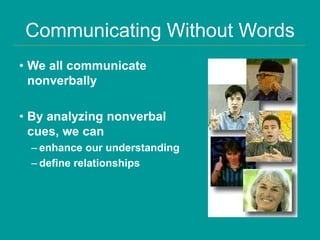
Communicating Without Words
• We all communicate
nonverbally
• By analyzing nonverbal
cues, we can
– enhance our understanding
– define relationships
Cues and Contexts
 We communicate nonverbally
through
 our bodies and appearance
 the environment we create
and live in
Cues and Contexts
 Nonverbal communication
Perpetual
Frequently involuntary
 Verbal and nonverbal messages
Clear messages
Mixed messages –words and actions contradiction
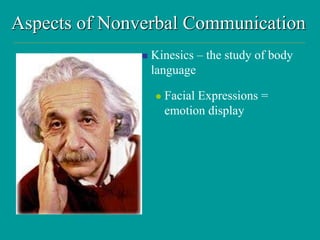
Aspects of Nonverbal Communication
 Kinesics – the study of body
language
 Facial Expressions =
emotion display
Posture and Gestures
 Posture sends messages:
 Content and confident? Angry and belligerent? Worried
and discouraged?
 Flight or Fight
 The way you feel about those with whom you are
communicating
 Gestures sends messages:
 Movements of arms, legs, hands, and feet send messages
about us
 Gestures do not have universal meanings
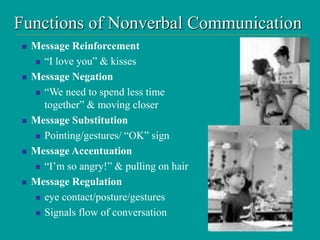
Functions of Nonverbal Communication
 Message Reinforcement
 “I love you” & kisses
 Message Negation
 “We need to spend less time
together” & moving closer
 Message Substitution
 Pointing/gestures/ “OK” sign
 Message Accentuation
 “I’m so angry!” & pulling on hair
 Message Regulation
 eye contact/posture/gestures
 Signals flow of conversation
Clothing and Artifacts
 Artifactual communication – the use of personal
adornments
 Extremely important in creating a first impression
 Dress and chosen images should change as our roles
change
 Sometimes the basis for judgments regarding success,
character, dominance, and competence
Paralanguage
 Paralanguage – vocal cues that accompany language
 Pitch
 Habitual pitch
 Volume
 Rate
 Pauses
 Nonfluencies
 Silence
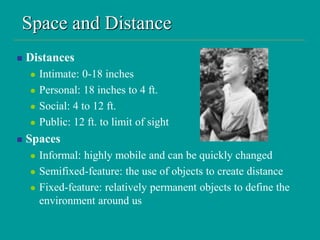
Space and Distance
 Distances
 Intimate: 0-18 inches
 Personal: 18 inches to 4 ft.
 Social: 4 to 12 ft.
 Public: 12 ft. to limit of sight
 Spaces
 Informal: highly mobile and can be quickly changed
 Semifixed-feature: the use of objects to create distance
 Fixed-feature: relatively permanent objects to define the
environment around us
Territoriality and Personal Space
 Territoriality – the need to demonstrate a
possessive or ownership relationship to
space
 Markers – used to establish territory or
reserve one’s space
Colors
 Color affects us emotionally and physiologically
 Some of the emotions colors can trigger:
 Excitement
 Warmth
 Passion and sensuality
 Happiness
 Relaxation
 Persuasion
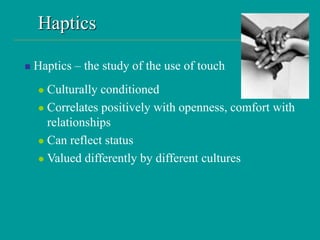
Haptics
 Haptics – the study of the use of touch
 Culturally conditioned
 Correlates positively with openness, comfort with
relationships
 Can reflect status
 Valued differently by different cultures
Olfactics
• Sense of smell
• Perceptions of
odors/scents
– Good
– Bad
– Yucky!
• Curry
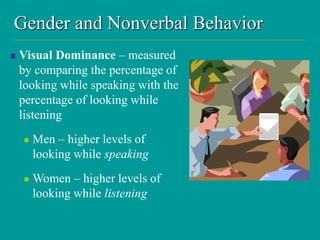
Gender and Nonverbal Behavior
 Visual Dominance – measured
by comparing the percentage of
looking while speaking with the
percentage of looking while
listening
 Men – higher levels of
looking while speaking
 Women – higher levels of
looking while listening
Cross Cultural Communication
• Video: A world of food tastes and taboos
in different cultures
Diversity and Nonverbal Behavior
 Contact cultures vs. Low-contact cultures
 Different cultures may express emotion or
intimacy in different ways
 Cultural background also affects their use of
touch and personal space
 Identical nonverbal cues may still convey
different meanings in different cultures
Diversity and Nonverbal Behavior
High-context cultures
 Information drawn from
surroundings
 Environment
 Warmer climates
 Gestures
 Mood
Low-context cultures
 Emphasis is on words
 Nonverbal less important
 Segment/compartmentalize
communication
 Knowledge is commodity
 Need to know basis
 Environment
 Cooler climates
Chronemics
 Using time to communicate
 The meaning of time differs around the world
 “Time talks”
 Last minute invitations
 Habitual tardiness
 Leaving early
 Allocation of certain activities to appropriate times
 Structure time differently
Diversity and Nonverbal Behavior
Western Cultures:
 Time is manipulated
 Time is
 Present
 Past
 Future
 Time is resource
 Time is aspect of
history
Eastern Cultures:
 Time simply exists
 Time in present is more
important than past or
future
 Time is a limited pool
 Time has a ripple effect
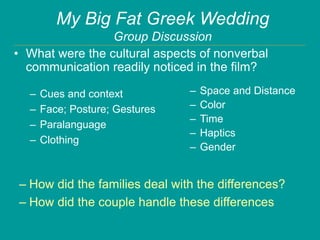
My Big Fat Greek Wedding
Group Discussion
– Cues and context
– Face; Posture; Gestures
– Paralanguage
– Clothing
– Space and Distance
– Color
– Time
– Haptics
– Gender
• What were the cultural aspects of nonverbal
communication readily noticed in the film?
– How did the families deal with the differences?
– How did the couple handle these differences
end of presentation

Nonverbal communication intercultural

  • 1.
  • 2.
    Communicating Without Words •We all communicate nonverbally • By analyzing nonverbal cues, we can – enhance our understanding – define relationships
  • 4.
    Cues and Contexts We communicate nonverbally through  our bodies and appearance  the environment we create and live in
  • 5.
    Cues and Contexts Nonverbal communication Perpetual Frequently involuntary  Verbal and nonverbal messages Clear messages Mixed messages –words and actions contradiction
  • 6.
    Aspects of NonverbalCommunication  Kinesics – the study of body language  Facial Expressions = emotion display
  • 7.
    Posture and Gestures Posture sends messages:  Content and confident? Angry and belligerent? Worried and discouraged?  Flight or Fight  The way you feel about those with whom you are communicating  Gestures sends messages:  Movements of arms, legs, hands, and feet send messages about us  Gestures do not have universal meanings
  • 8.
    Functions of NonverbalCommunication  Message Reinforcement  “I love you” & kisses  Message Negation  “We need to spend less time together” & moving closer  Message Substitution  Pointing/gestures/ “OK” sign  Message Accentuation  “I’m so angry!” & pulling on hair  Message Regulation  eye contact/posture/gestures  Signals flow of conversation
  • 9.
    Clothing and Artifacts Artifactual communication – the use of personal adornments  Extremely important in creating a first impression  Dress and chosen images should change as our roles change  Sometimes the basis for judgments regarding success, character, dominance, and competence
  • 10.
    Paralanguage  Paralanguage –vocal cues that accompany language  Pitch  Habitual pitch  Volume  Rate  Pauses  Nonfluencies  Silence
  • 11.
    Space and Distance Distances  Intimate: 0-18 inches  Personal: 18 inches to 4 ft.  Social: 4 to 12 ft.  Public: 12 ft. to limit of sight  Spaces  Informal: highly mobile and can be quickly changed  Semifixed-feature: the use of objects to create distance  Fixed-feature: relatively permanent objects to define the environment around us
  • 12.
    Territoriality and PersonalSpace  Territoriality – the need to demonstrate a possessive or ownership relationship to space  Markers – used to establish territory or reserve one’s space
  • 13.
    Colors  Color affectsus emotionally and physiologically  Some of the emotions colors can trigger:  Excitement  Warmth  Passion and sensuality  Happiness  Relaxation  Persuasion
  • 14.
    Haptics  Haptics –the study of the use of touch  Culturally conditioned  Correlates positively with openness, comfort with relationships  Can reflect status  Valued differently by different cultures
  • 15.
    Olfactics • Sense ofsmell • Perceptions of odors/scents – Good – Bad – Yucky! • Curry
  • 16.
    Gender and NonverbalBehavior  Visual Dominance – measured by comparing the percentage of looking while speaking with the percentage of looking while listening  Men – higher levels of looking while speaking  Women – higher levels of looking while listening
  • 17.
    Cross Cultural Communication •Video: A world of food tastes and taboos in different cultures
  • 18.
    Diversity and NonverbalBehavior  Contact cultures vs. Low-contact cultures  Different cultures may express emotion or intimacy in different ways  Cultural background also affects their use of touch and personal space  Identical nonverbal cues may still convey different meanings in different cultures
  • 19.
    Diversity and NonverbalBehavior High-context cultures  Information drawn from surroundings  Environment  Warmer climates  Gestures  Mood Low-context cultures  Emphasis is on words  Nonverbal less important  Segment/compartmentalize communication  Knowledge is commodity  Need to know basis  Environment  Cooler climates
  • 20.
    Chronemics  Using timeto communicate  The meaning of time differs around the world  “Time talks”  Last minute invitations  Habitual tardiness  Leaving early  Allocation of certain activities to appropriate times  Structure time differently
  • 21.
    Diversity and NonverbalBehavior Western Cultures:  Time is manipulated  Time is  Present  Past  Future  Time is resource  Time is aspect of history Eastern Cultures:  Time simply exists  Time in present is more important than past or future  Time is a limited pool  Time has a ripple effect
  • 22.
    My Big FatGreek Wedding Group Discussion – Cues and context – Face; Posture; Gestures – Paralanguage – Clothing – Space and Distance – Color – Time – Haptics – Gender • What were the cultural aspects of nonverbal communication readily noticed in the film? – How did the families deal with the differences? – How did the couple handle these differences
  • 23.