2014 – Year of Broken
Name Generator(s)
Miroslav Štampar
(mstampar@zsis.hr)
2014 – Year of Broken
Name Generator(s)
Miroslav Štampar
(mstampar@zsis.hr)
FER 2015, Zagreb (Croatia) January 16th, 2015 2
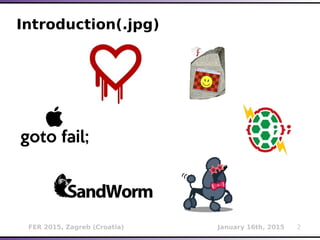
Introduction(.jpg)
FER 2015, Zagreb (Croatia) January 16th, 2015 3
goto fail (1)
CVE-2014-1266 (6.8)
Discovered by @CrowdStrike by reverse
engineering security update for iOS (7.0.6)
Public disclosure on February 21, 2014
SSL/TLS vulnerability in iOS and OS X
Signature is inaccurately being verified in
ServerKeyExchange message
Allows MiTM attacks with full transparent
interception of HTTPS traffic
The bug has been in the wild for more than a year
Later, a similar bug has been found in GnuTLS
FER 2015, Zagreb (Croatia) January 16th, 2015 4
goto fail (2)
Attacker has to be in position to intercept and
change traffic between victim and target (MiTM)
Attacker sends fake (chosen) Diffie-Hellman
parameters to victim, along with valid server's
certificate and forced Ephemeral Diffie Hellman
(EDH/DHE) cipher suite – triggering vulnerable
code
Provided parameters' signature is not properly
being checked against server's certificate
Allows attacker to generate same session key(s) as
the client (purpose of Diffie-Hellman)
Once the secure connection is established between
victim and attacker, attacker plays MiTM proxy role
FER 2015, Zagreb (Croatia) January 16th, 2015 5
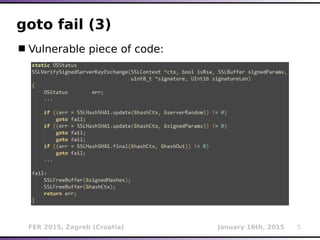
goto fail (3)
Vulnerable piece of code:
FER 2015, Zagreb (Croatia) January 16th, 2015 6
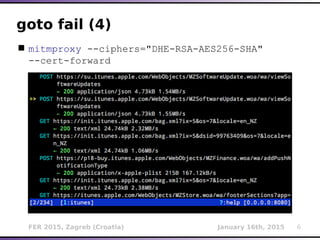
goto fail (4)
 mitmproxy --ciphers="DHE-RSA-AES256-SHA"
--cert-forward
FER 2015, Zagreb (Croatia) January 16th, 2015 7
Heartbleed (1)
CVE-2014-0160 (5.0)
Discovered independently by Neel Mehta
(@Google) and @Codenomicon in rough the same
time (while bug was there for years :)
Public disclosure on April 7, 2014
OpenSSL's (1.0.1 before 1.0.1g) TLS heartbeat
extension (RFC6520) buffer over-read vulnerability
Allows attackers to retrieve private cryptographic
keys and private user data
It is estimated that 24-55% HTTPS servers in Alexa
Top 1 Million were initially vulnerable
FER 2015, Zagreb (Croatia) January 16th, 2015 8
Heartbleed (2)
Heartbeat extension provides a mean to test and
keep alive the secure communication connections
“Heartbeat Request” message is being sent
consisting of a payload (typically a text value),
while the receiver has to send exactly the same
payload back to sender
Message returned is based on length field (max.
64KB in case of attack) in the requesting message,
without properly checking the actual payload's
length (e.g. “foobar”)
FER 2015, Zagreb (Croatia) January 16th, 2015 9
Heartbleed (3)
Response consists of payload, followed by
whatever else happened to be in the allocated
memory buffer (in case of faked payload length)
Attack is performed repeatedly in hope to read a
chunk previously used by OpenSSL (e.g. server
private key, session cookies, credentials, etc.)
OpenSSL uses custom memory allocator making
exploitation far easier (non-random/reusable
memory chunks are being allocated)
Lots of criticism followed, especially against
OpenSSL's “sloppy coding” style (e.g. LibreSSL
developers removed half of the OpenSSL source
tree in a week)
FER 2015, Zagreb (Croatia) January 16th, 2015 10
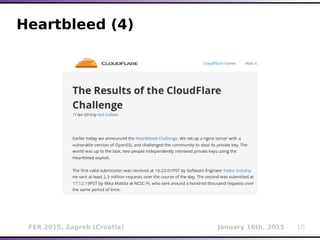
Heartbleed (4)
FER 2015, Zagreb (Croatia) January 16th, 2015 11
Heartbleed (5)
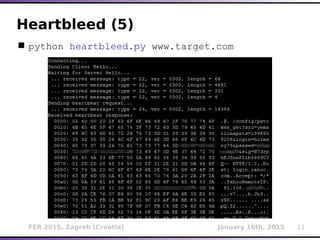
 python heartbleed.py www.target.com
FER 2015, Zagreb (Croatia) January 16th, 2015 12
Rosetta Flash (1)
CVE-2014-4671 (6.8) and CVE-2014-5333 (6.8)
Discovered by Michele Spagnuolo (@Google)
Public disclosure on July 8, 2014
JSONP (JSON with padding) is a communication
technique used in JavaScript programs to request
data from a server in a different domain
Basically, it's a script tag injection method passing
the response from the server in to a user specified
function “callback” (different domain context)
Website with a JSONP endpoint accepting only
alphanumeric callback (for security reasons) can be
abused (against client's Adobe Flash Player) with
specially crafted SWF files
FER 2015, Zagreb (Croatia) January 16th, 2015 13
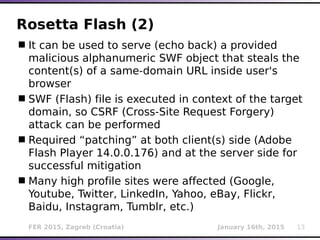
Rosetta Flash (2)
It can be used to serve (echo back) a provided
malicious alphanumeric SWF object that steals the
content(s) of a same-domain URL inside user's
browser
SWF (Flash) file is executed in context of the target
domain, so CSRF (Cross-Site Request Forgery)
attack can be performed
Required “patching” at both client(s) side (Adobe
Flash Player 14.0.0.176) and at the server side for
successful mitigation
Many high profile sites were affected (Google,
Youtube, Twitter, LinkedIn, Yahoo, eBay, Flickr,
Baidu, Instagram, Tumblr, etc.)
FER 2015, Zagreb (Croatia) January 16th, 2015 14
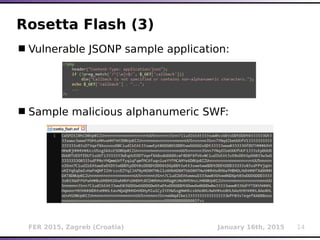
Rosetta Flash (3)
Vulnerable JSONP sample application:
Sample malicious alphanumeric SWF:
FER 2015, Zagreb (Croatia) January 16th, 2015 15
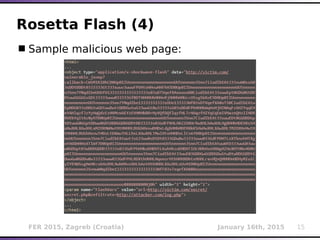
Rosetta Flash (4)
Sample malicious web page:
FER 2015, Zagreb (Croatia) January 16th, 2015 16
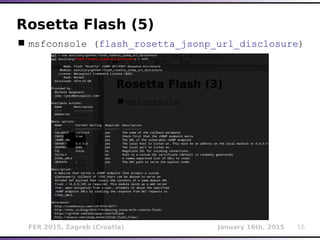
Rosetta Flash (5)
 msfconsole (flash_rosetta_jsonp_url_disclosure)
FER 2015, Zagreb (Croatia) January 16th, 2015 17
Shellshock (1)
CVE-2014-6271 (10.0), CVE-2014-6277 (10.0), CVE-
2014-6278 (10.0), CVE-2014-7169 (10.0), CVE-
2014-7186 (10.0) and CVE-2014-7187 (10.0)
Discovered by Stéphane Chazelas
Public disclosure on September 24, 2014
Remote code execution through Bash
Many *nix and *BSD Internet-facing systems
expose Bash to client requests (e.g. HTTP (CGI),
DHCP, SSH, CUPS, etc.)
Bash supports exporting not just shell variables,
but also shell functions to other bash instances
FER 2015, Zagreb (Croatia) January 16th, 2015 18
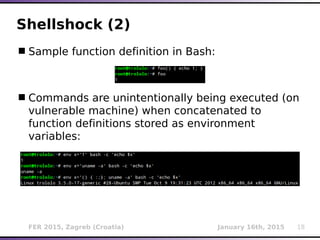
Shellshock (2)
Sample function definition in Bash:
Commands are unintentionally being executed (on
vulnerable machine) when concatenated to
function definitions stored as environment
variables:
FER 2015, Zagreb (Croatia) January 16th, 2015 19
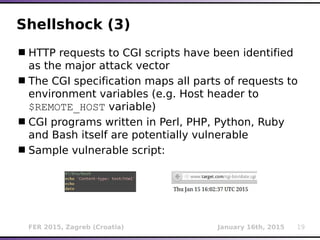
Shellshock (3)
HTTP requests to CGI scripts have been identified
as the major attack vector
The CGI specification maps all parts of requests to
environment variables (e.g. Host header to
$REMOTE_HOST variable)
CGI programs written in Perl, PHP, Python, Ruby
and Bash itself are potentially vulnerable
Sample vulnerable script:
FER 2015, Zagreb (Croatia) January 16th, 2015 20
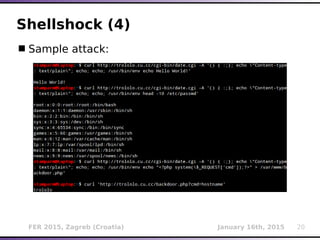
Shellshock (4)
Sample attack:
FER 2015, Zagreb (Croatia) January 16th, 2015 21
POODLE (1)
CVE-2014-3566 (4.3)
Discovered by Bodo Möller, Thai Duong and
Krzysztof Kotowicz (@Google)
Public disclosure on October 14, 2014
“Padding Oracle On Downgraded Legacy
Encryption”
Padding Oracle attack against CBC mode of
operation in SSL 3.0 (exploiting same flaw as in
BEAST attack)
In case of TLS usage, forced version downgrade
from TLS to SSL 3.0 MiTM attack is performed
Major browsers voluntary downgrade to SSL 3.0 if
TLS handshakes fail
FER 2015, Zagreb (Croatia) January 16th, 2015 22
POODLE (2)
SSL 3.0 (deprecated 15 years ago) uses non-
deterministic CBC padding, which makes padding
oracle attacks possible in MiTM environment
Padding is performed to make input plaintext
length equal to a multiple of the cipher's block size
(e.g. 8 bytes in case of 3DES and 16 bytes in case
of AES)
SSL 3.0 adds padding filled with single byte
denoting the length of padding itself
In padding oracle attack server leaks data whether
the padding of an encrypted message is correct or
not
FER 2015, Zagreb (Croatia) January 16th, 2015 23
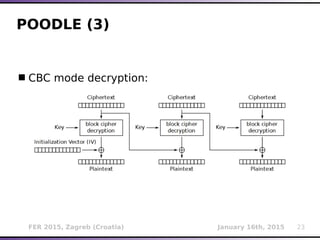
POODLE (3)
CBC mode decryption:
FER 2015, Zagreb (Croatia) January 16th, 2015 24
POODLE (4)
In POODLE attack presumption is that victim runs
malicious Javascript in a browser which causes the
browser to make attacker controlled requests (with
cookies) to the origin of interest (e.g. google.com)
Attacker intercepts one such controlled encrypted
request, takes block which contains value of
interest (e.g. one “shifted” cookie byte followed by
spaces), replaces last (padding) block with its
content and forwards it to the server
If server doesn't drop such “skewed” request, it can
be concluded that the last byte of decrypted block
that was duplicated, XORed with the ciphertext of
the previous block, equals to the known padding
block
FER 2015, Zagreb (Croatia) January 16th, 2015 25
Sandworm (1)
CVE-2014-4114 (9.3)
Identified by @iSIGHT from same named “cyber-
attack” campaign
Public disclosure on October 15, 2014
Microsoft Windows OLE arbitrary code execution
Windows Vista SP2, Windows 7/8, Windows Server
2008/2012 are known to be vulnerable
Problem lies in how Object Packager 2 component
(packager.dll) handles an INF file that contains
malicious registry changes (e.g. RunOnce)
INF can't be loaded (and executed) directly but can
be forced by embedding the file path as a remote
share in an OLE object
FER 2015, Zagreb (Croatia) January 16th, 2015 26
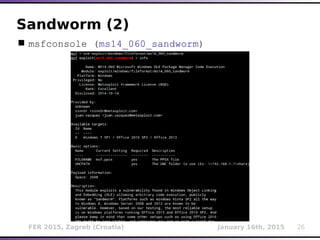
Sandworm (2)
 msfconsole (ms14_060_sandworm)
FER 2015, Zagreb (Croatia) January 16th, 2015 27
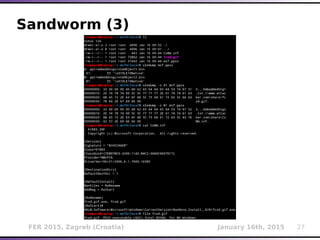
Sandworm (3)
FER 2015, Zagreb (Croatia) January 16th, 2015 28
Questions?

2014 – Year of Broken Name Generator(s)

  • 1.
    2014 – Yearof Broken Name Generator(s) Miroslav Štampar (mstampar@zsis.hr) 2014 – Year of Broken Name Generator(s) Miroslav Štampar (mstampar@zsis.hr)
  • 2.
    FER 2015, Zagreb(Croatia) January 16th, 2015 2 Introduction(.jpg)
  • 3.
    FER 2015, Zagreb(Croatia) January 16th, 2015 3 goto fail (1) CVE-2014-1266 (6.8) Discovered by @CrowdStrike by reverse engineering security update for iOS (7.0.6) Public disclosure on February 21, 2014 SSL/TLS vulnerability in iOS and OS X Signature is inaccurately being verified in ServerKeyExchange message Allows MiTM attacks with full transparent interception of HTTPS traffic The bug has been in the wild for more than a year Later, a similar bug has been found in GnuTLS
  • 4.
    FER 2015, Zagreb(Croatia) January 16th, 2015 4 goto fail (2) Attacker has to be in position to intercept and change traffic between victim and target (MiTM) Attacker sends fake (chosen) Diffie-Hellman parameters to victim, along with valid server's certificate and forced Ephemeral Diffie Hellman (EDH/DHE) cipher suite – triggering vulnerable code Provided parameters' signature is not properly being checked against server's certificate Allows attacker to generate same session key(s) as the client (purpose of Diffie-Hellman) Once the secure connection is established between victim and attacker, attacker plays MiTM proxy role
  • 5.
    FER 2015, Zagreb(Croatia) January 16th, 2015 5 goto fail (3) Vulnerable piece of code:
  • 6.
    FER 2015, Zagreb(Croatia) January 16th, 2015 6 goto fail (4)  mitmproxy --ciphers="DHE-RSA-AES256-SHA" --cert-forward
  • 7.
    FER 2015, Zagreb(Croatia) January 16th, 2015 7 Heartbleed (1) CVE-2014-0160 (5.0) Discovered independently by Neel Mehta (@Google) and @Codenomicon in rough the same time (while bug was there for years :) Public disclosure on April 7, 2014 OpenSSL's (1.0.1 before 1.0.1g) TLS heartbeat extension (RFC6520) buffer over-read vulnerability Allows attackers to retrieve private cryptographic keys and private user data It is estimated that 24-55% HTTPS servers in Alexa Top 1 Million were initially vulnerable
  • 8.
    FER 2015, Zagreb(Croatia) January 16th, 2015 8 Heartbleed (2) Heartbeat extension provides a mean to test and keep alive the secure communication connections “Heartbeat Request” message is being sent consisting of a payload (typically a text value), while the receiver has to send exactly the same payload back to sender Message returned is based on length field (max. 64KB in case of attack) in the requesting message, without properly checking the actual payload's length (e.g. “foobar”)
  • 9.
    FER 2015, Zagreb(Croatia) January 16th, 2015 9 Heartbleed (3) Response consists of payload, followed by whatever else happened to be in the allocated memory buffer (in case of faked payload length) Attack is performed repeatedly in hope to read a chunk previously used by OpenSSL (e.g. server private key, session cookies, credentials, etc.) OpenSSL uses custom memory allocator making exploitation far easier (non-random/reusable memory chunks are being allocated) Lots of criticism followed, especially against OpenSSL's “sloppy coding” style (e.g. LibreSSL developers removed half of the OpenSSL source tree in a week)
  • 10.
    FER 2015, Zagreb(Croatia) January 16th, 2015 10 Heartbleed (4)
  • 11.
    FER 2015, Zagreb(Croatia) January 16th, 2015 11 Heartbleed (5)  python heartbleed.py www.target.com
  • 12.
    FER 2015, Zagreb(Croatia) January 16th, 2015 12 Rosetta Flash (1) CVE-2014-4671 (6.8) and CVE-2014-5333 (6.8) Discovered by Michele Spagnuolo (@Google) Public disclosure on July 8, 2014 JSONP (JSON with padding) is a communication technique used in JavaScript programs to request data from a server in a different domain Basically, it's a script tag injection method passing the response from the server in to a user specified function “callback” (different domain context) Website with a JSONP endpoint accepting only alphanumeric callback (for security reasons) can be abused (against client's Adobe Flash Player) with specially crafted SWF files
  • 13.
    FER 2015, Zagreb(Croatia) January 16th, 2015 13 Rosetta Flash (2) It can be used to serve (echo back) a provided malicious alphanumeric SWF object that steals the content(s) of a same-domain URL inside user's browser SWF (Flash) file is executed in context of the target domain, so CSRF (Cross-Site Request Forgery) attack can be performed Required “patching” at both client(s) side (Adobe Flash Player 14.0.0.176) and at the server side for successful mitigation Many high profile sites were affected (Google, Youtube, Twitter, LinkedIn, Yahoo, eBay, Flickr, Baidu, Instagram, Tumblr, etc.)
  • 14.
    FER 2015, Zagreb(Croatia) January 16th, 2015 14 Rosetta Flash (3) Vulnerable JSONP sample application: Sample malicious alphanumeric SWF:
  • 15.
    FER 2015, Zagreb(Croatia) January 16th, 2015 15 Rosetta Flash (4) Sample malicious web page:
  • 16.
    FER 2015, Zagreb(Croatia) January 16th, 2015 16 Rosetta Flash (5)  msfconsole (flash_rosetta_jsonp_url_disclosure)
  • 17.
    FER 2015, Zagreb(Croatia) January 16th, 2015 17 Shellshock (1) CVE-2014-6271 (10.0), CVE-2014-6277 (10.0), CVE- 2014-6278 (10.0), CVE-2014-7169 (10.0), CVE- 2014-7186 (10.0) and CVE-2014-7187 (10.0) Discovered by Stéphane Chazelas Public disclosure on September 24, 2014 Remote code execution through Bash Many *nix and *BSD Internet-facing systems expose Bash to client requests (e.g. HTTP (CGI), DHCP, SSH, CUPS, etc.) Bash supports exporting not just shell variables, but also shell functions to other bash instances
  • 18.
    FER 2015, Zagreb(Croatia) January 16th, 2015 18 Shellshock (2) Sample function definition in Bash: Commands are unintentionally being executed (on vulnerable machine) when concatenated to function definitions stored as environment variables:
  • 19.
    FER 2015, Zagreb(Croatia) January 16th, 2015 19 Shellshock (3) HTTP requests to CGI scripts have been identified as the major attack vector The CGI specification maps all parts of requests to environment variables (e.g. Host header to $REMOTE_HOST variable) CGI programs written in Perl, PHP, Python, Ruby and Bash itself are potentially vulnerable Sample vulnerable script:
  • 20.
    FER 2015, Zagreb(Croatia) January 16th, 2015 20 Shellshock (4) Sample attack:
  • 21.
    FER 2015, Zagreb(Croatia) January 16th, 2015 21 POODLE (1) CVE-2014-3566 (4.3) Discovered by Bodo Möller, Thai Duong and Krzysztof Kotowicz (@Google) Public disclosure on October 14, 2014 “Padding Oracle On Downgraded Legacy Encryption” Padding Oracle attack against CBC mode of operation in SSL 3.0 (exploiting same flaw as in BEAST attack) In case of TLS usage, forced version downgrade from TLS to SSL 3.0 MiTM attack is performed Major browsers voluntary downgrade to SSL 3.0 if TLS handshakes fail
  • 22.
    FER 2015, Zagreb(Croatia) January 16th, 2015 22 POODLE (2) SSL 3.0 (deprecated 15 years ago) uses non- deterministic CBC padding, which makes padding oracle attacks possible in MiTM environment Padding is performed to make input plaintext length equal to a multiple of the cipher's block size (e.g. 8 bytes in case of 3DES and 16 bytes in case of AES) SSL 3.0 adds padding filled with single byte denoting the length of padding itself In padding oracle attack server leaks data whether the padding of an encrypted message is correct or not
  • 23.
    FER 2015, Zagreb(Croatia) January 16th, 2015 23 POODLE (3) CBC mode decryption:
  • 24.
    FER 2015, Zagreb(Croatia) January 16th, 2015 24 POODLE (4) In POODLE attack presumption is that victim runs malicious Javascript in a browser which causes the browser to make attacker controlled requests (with cookies) to the origin of interest (e.g. google.com) Attacker intercepts one such controlled encrypted request, takes block which contains value of interest (e.g. one “shifted” cookie byte followed by spaces), replaces last (padding) block with its content and forwards it to the server If server doesn't drop such “skewed” request, it can be concluded that the last byte of decrypted block that was duplicated, XORed with the ciphertext of the previous block, equals to the known padding block
  • 25.
    FER 2015, Zagreb(Croatia) January 16th, 2015 25 Sandworm (1) CVE-2014-4114 (9.3) Identified by @iSIGHT from same named “cyber- attack” campaign Public disclosure on October 15, 2014 Microsoft Windows OLE arbitrary code execution Windows Vista SP2, Windows 7/8, Windows Server 2008/2012 are known to be vulnerable Problem lies in how Object Packager 2 component (packager.dll) handles an INF file that contains malicious registry changes (e.g. RunOnce) INF can't be loaded (and executed) directly but can be forced by embedding the file path as a remote share in an OLE object
  • 26.
    FER 2015, Zagreb(Croatia) January 16th, 2015 26 Sandworm (2)  msfconsole (ms14_060_sandworm)
  • 27.
    FER 2015, Zagreb(Croatia) January 16th, 2015 27 Sandworm (3)
  • 28.
    FER 2015, Zagreb(Croatia) January 16th, 2015 28 Questions?