Hash DoS Attack
Miroslav Štampar
(mstampar@zsis.hr)
Hash DoS Attack
Miroslav Štampar
(mstampar@zsis.hr)
FER 2014, Zagreb (Croatia) January 17th, 2014 2
What is DoS (Denial of Service)?
“...attack where an attacker attempts
to prevent legitimate users from
accessing information or services...”
(source: US-CERT)
FER 2014, Zagreb (Croatia) January 17th, 2014 3
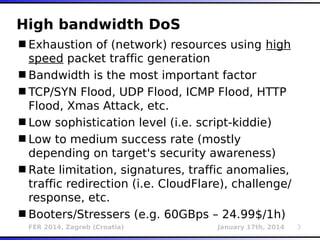
High bandwidth DoS
Exhaustion of (network) resources using high
speed packet traffic generation
Bandwidth is the most important factor
TCP/SYN Flood, UDP Flood, ICMP Flood, HTTP
Flood, Xmas Attack, etc.
Low sophistication level (i.e. script-kiddie)
Low to medium success rate (mostly
depending on target's security awareness)
Rate limitation, signatures, traffic anomalies,
traffic redirection (i.e. CloudFlare), challenge/
response, etc.
Booters/Stressers (e.g. 60GBps – 24.99$/1h)
FER 2014, Zagreb (Croatia) January 17th, 2014 4
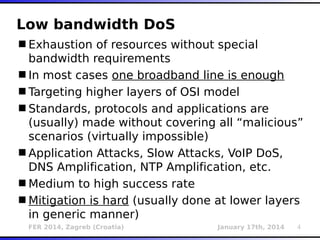
Low bandwidth DoS
Exhaustion of resources without special
bandwidth requirements
In most cases one broadband line is enough
Targeting higher layers of OSI model
Standards, protocols and applications are
(usually) made without covering all “malicious”
scenarios (virtually impossible)
Application Attacks, Slow Attacks, VoIP DoS,
DNS Amplification, NTP Amplification, etc.
Medium to high success rate
Mitigation is hard (usually done at lower layers
in generic manner)
FER 2014, Zagreb (Croatia) January 17th, 2014 5
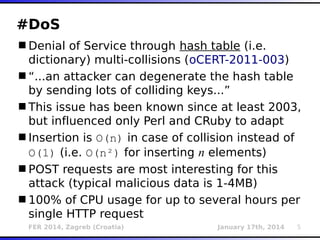
#DoS
Denial of Service through hash table (i.e.
dictionary) multi-collisions (oCERT-2011-003)
“...an attacker can degenerate the hash table
by sending lots of colliding keys...”
This issue has been known since at least 2003,
but influenced only Perl and CRuby to adapt
Insertion is O(n) in case of collision instead of
O(1) (i.e. O(n²) for inserting n elements)
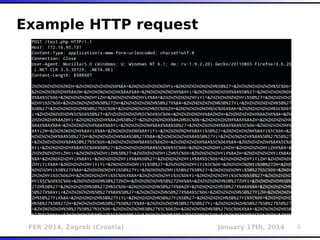
POST requests are most interesting for this
attack (typical malicious data is 1-4MB)
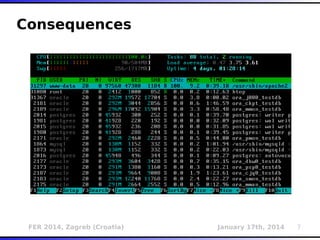
100% of CPU usage for up to several hours per
single HTTP request
FER 2014, Zagreb (Croatia) January 17th, 2014 6
Example HTTP request
FER 2014, Zagreb (Croatia) January 17th, 2014 7
Consequences
FER 2014, Zagreb (Croatia) January 17th, 2014 8
Affected versions
Apache Tomcat – 5.5.34 and prior, 6.0.34 and
prior, 7.0.22 and prior
Java – all versions
JRuby – 1.6.5 and prior
Microsoft ASP.NET – all versions (if unpatched
with MS11-100)
PHP – 5.3.8 and prior, 5.4.0RC3 and prior
Python – 3.3.0 and prior (inadequate fix in
2.7.3 and 3.2.3)
Ruby – 1.8.7-p356 and prior
...
FER 2014, Zagreb (Croatia) January 17th, 2014 9
Dictionary / Hash table
HTTP request parameters are stored in a
dictionary (i.e. {}) for fast and easy lookup
Most common implementation of the dictionary
is a hash table
Insert, delete and lookup are (normally) being
made with O(1)
Hash tables must be able to deal with hash
collisions (expected phenomenon)
Used algorithms have to be fast and provide
reasonable distribution of hashes
No need for “cryptographically secure”
properties (like in algorithms MD5 or SHA1)
FER 2014, Zagreb (Croatia) January 17th, 2014 10
Library analogy
Imagine a librarian in a (huge) new library
He wants to be able to do the lookups as fast
as possible
Instead of sequential (i.e. alphabetical) fill up,
he programs a clever little “black box” that
gives the location based on a book's title
Result is (mostly) unique and calculated in a
highly dispersed manner
In case of collision he'll just put the book
beside the existing or run another iteration
In programming world that “black box” is called
a hash algorithm
FER 2014, Zagreb (Croatia) January 17th, 2014 11
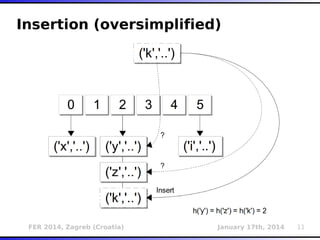
Insertion (oversimplified)
FER 2014, Zagreb (Croatia) January 17th, 2014 12
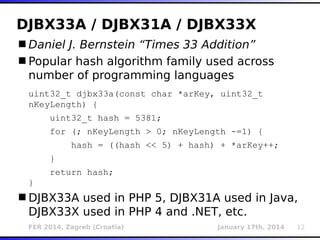
DJBX33A / DJBX31A / DJBX33X
Daniel J. Bernstein “Times 33 Addition”
Popular hash algorithm family used across
number of programming languages
uint32_t djbx33a(const char *arKey, uint32_t
nKeyLength) {
uint32_t hash = 5381;
for (; nKeyLength > 0; nKeyLength -=1) {
hash = ((hash << 5) + hash) + *arKey++;
}
return hash;
}
DJBX33A used in PHP 5, DJBX31A used in Java,
DJBX33X used in PHP 4 and .NET, etc.
FER 2014, Zagreb (Croatia) January 17th, 2014 13
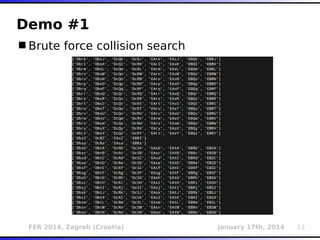
Demo #1
Brute force collision search
FER 2014, Zagreb (Croatia) January 17th, 2014 14
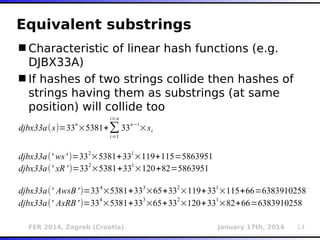
Equivalent substrings
Characteristic of linear hash functions (e.g.
DJBX33A)
If hashes of two strings collide then hashes of
strings having them as substrings (at same
position) will collide too
djbx33a(s)=33
n
×5381+∑
i=1
i=n
33
n−i
×si
djbx33a(' ws' )=332
×5381+331
×119+115=5863951
djbx33a(' xR ')=332
×5381+331
×120+82=5863951
djbx33a(' AwsB')=334
×5381+333
×65+332
×119+331
×115+66=6383910258
djbx33a(' AxRB')=33
4
×5381+33
3
×65+33
2
×120+33
1
×82+66=6383910258
FER 2014, Zagreb (Croatia) January 17th, 2014 15
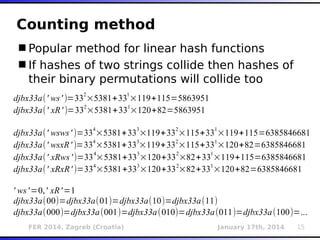
Counting method
Popular method for linear hash functions
If hashes of two strings collide then hashes of
their binary permutations will collide too
djbx33a(' ws' )=33
2
×5381+33
1
×119+115=5863951
djbx33a(' xR' )=332
×5381+331
×120+82=5863951
djbx33a(' wsws' )=33
4
×5381+33
3
×119+33
2
×115+33
1
×119+115=6385846681
djbx33a(' wsxR' )=334
×5381+333
×119+332
×115+331
×120+82=6385846681
djbx33a(' xRws')=33
4
×5381+33
3
×120+33
2
×82+33
1
×119+115=6385846681
djbx33a(' xRxR' )=334
×5381+333
×120+332
×82+331
×120+82=6385846681
' ws'=0,' xR'=1
djbx33a(00)=djbx33a(01)=djbx33a(10)=djbx33a(11)
djbx33a(000)=djbx33a(001)=djbx33a(010)=djbx33a(011)=djbx33a(100)=...
FER 2014, Zagreb (Croatia) January 17th, 2014 16
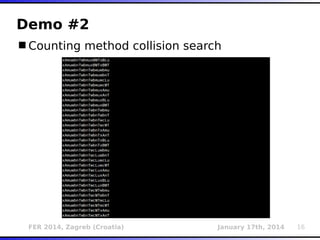
Demo #2
Counting method collision search
FER 2014, Zagreb (Croatia) January 17th, 2014 17
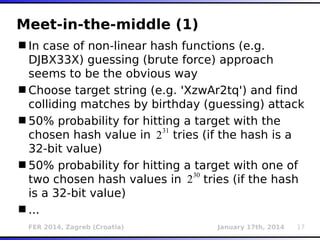
Meet-in-the-middle (1)
In case of non-linear hash functions (e.g.
DJBX33X) guessing (brute force) approach
seems to be the obvious way
Choose target string (e.g. 'XzwAr2tq') and find
colliding matches by birthday (guessing) attack
50% probability for hitting a target with the
chosen hash value in tries (if the hash is a
32-bit value)
50% probability for hitting a target with one of
two chosen hash values in tries (if the hash
is a 32-bit value)
...
2
31
230
FER 2014, Zagreb (Croatia) January 17th, 2014 18
Meet-in-the-middle (2)
This method tries to attack more than one
(intermediate) target at a time
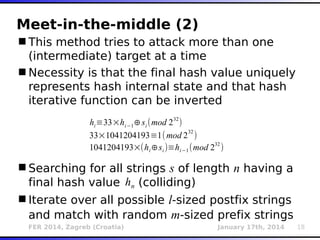
Necessity is that the final hash value uniquely
represents hash internal state and that hash
iterative function can be inverted
Searching for all strings s of length n having a
final hash value (colliding)
Iterate over all possible l-sized postfix strings
and match with random m-sized prefix strings
hi≡33×hi−1⊕si (mod 232
)
33×1041204193≡1(mod 2
32
)
1041204193×(hi⊕si )≡hi−1(mod 232
)
hn
FER 2014, Zagreb (Croatia) January 17th, 2014 19
Meet-in-the-middle (3)
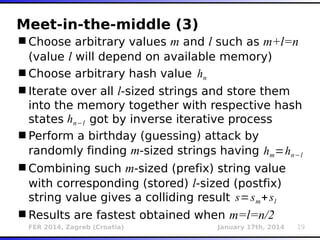
Choose arbitrary values m and l such as m+l=n
(value l will depend on available memory)
Choose arbitrary hash value
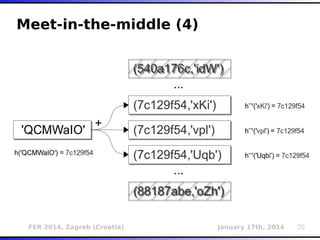
Iterate over all l-sized strings and store them
into the memory together with respective hash
states got by inverse iterative process
Perform a birthday (guessing) attack by
randomly finding m-sized strings having
Combining such m-sized (prefix) string value
with corresponding (stored) l-sized (postfix)
string value gives a colliding result
Results are fastest obtained when m=l=n/2
hn−l
hn
hm=hn−l
s=sm+sl
FER 2014, Zagreb (Croatia) January 17th, 2014 20
Meet-in-the-middle (4)
FER 2014, Zagreb (Croatia) January 17th, 2014 21
Meet-in-the-middle (5)
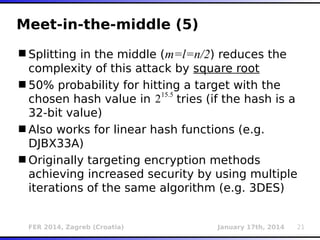
Splitting in the middle (m=l=n/2) reduces the
complexity of this attack by square root
50% probability for hitting a target with the
chosen hash value in tries (if the hash is a
32-bit value)
Also works for linear hash functions (e.g.
DJBX33A)
Originally targeting encryption methods
achieving increased security by using multiple
iterations of the same algorithm (e.g. 3DES)
215.5
FER 2014, Zagreb (Croatia) January 17th, 2014 22
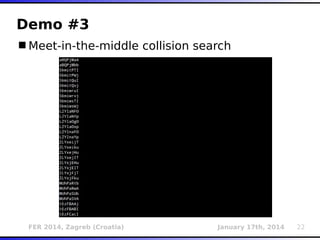
Demo #3
Meet-in-the-middle collision search
FER 2014, Zagreb (Croatia) January 17th, 2014 23
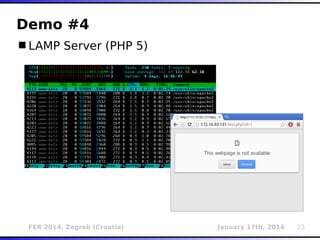
Demo #4
LAMP Server (PHP 5)
FER 2014, Zagreb (Croatia) January 17th, 2014 24
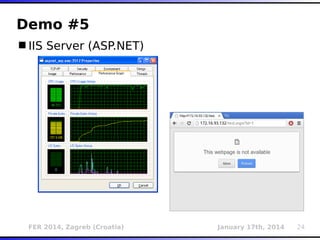
Demo #5
IIS Server (ASP.NET)
FER 2014, Zagreb (Croatia) January 17th, 2014 25
Mitigation (low level)
Hash (seed) randomization
new seed is generated on every interpreter,
application and/or system start
breaking code that incorrectly relies on specific
ordering of dictionary keys (official explanation
from Python team)
CPython (-R) random seed has been successfully
remotely recovered (by Jean-Philippe Aumasson
and Daniel J. Bernstein :)
Changing hash algorithm (e.g. to SipHash
chosen by Python, Ruby, Perl, Rust, FreeBSD,
Redis, etc.)
FER 2014, Zagreb (Croatia) January 17th, 2014 26
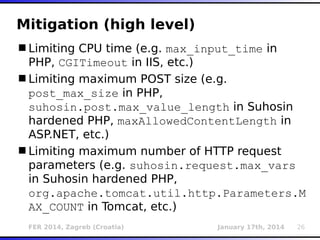
Mitigation (high level)
Limiting CPU time (e.g. max_input_time in
PHP, CGITimeout in IIS, etc.)
Limiting maximum POST size (e.g.
post_max_size in PHP,
suhosin.post.max_value_length in Suhosin
hardened PHP, maxAllowedContentLength in
ASP.NET, etc.)
Limiting maximum number of HTTP request
parameters (e.g. suhosin.request.max_vars
in Suhosin hardened PHP,
org.apache.tomcat.util.http.Parameters.M
AX_COUNT in Tomcat, etc.)
FER 2014, Zagreb (Croatia) January 17th, 2014 27
Questions?

Hash DoS Attack

  • 1.
    Hash DoS Attack MiroslavŠtampar (mstampar@zsis.hr) Hash DoS Attack Miroslav Štampar (mstampar@zsis.hr)
  • 2.
    FER 2014, Zagreb(Croatia) January 17th, 2014 2 What is DoS (Denial of Service)? “...attack where an attacker attempts to prevent legitimate users from accessing information or services...” (source: US-CERT)
  • 3.
    FER 2014, Zagreb(Croatia) January 17th, 2014 3 High bandwidth DoS Exhaustion of (network) resources using high speed packet traffic generation Bandwidth is the most important factor TCP/SYN Flood, UDP Flood, ICMP Flood, HTTP Flood, Xmas Attack, etc. Low sophistication level (i.e. script-kiddie) Low to medium success rate (mostly depending on target's security awareness) Rate limitation, signatures, traffic anomalies, traffic redirection (i.e. CloudFlare), challenge/ response, etc. Booters/Stressers (e.g. 60GBps – 24.99$/1h)
  • 4.
    FER 2014, Zagreb(Croatia) January 17th, 2014 4 Low bandwidth DoS Exhaustion of resources without special bandwidth requirements In most cases one broadband line is enough Targeting higher layers of OSI model Standards, protocols and applications are (usually) made without covering all “malicious” scenarios (virtually impossible) Application Attacks, Slow Attacks, VoIP DoS, DNS Amplification, NTP Amplification, etc. Medium to high success rate Mitigation is hard (usually done at lower layers in generic manner)
  • 5.
    FER 2014, Zagreb(Croatia) January 17th, 2014 5 #DoS Denial of Service through hash table (i.e. dictionary) multi-collisions (oCERT-2011-003) “...an attacker can degenerate the hash table by sending lots of colliding keys...” This issue has been known since at least 2003, but influenced only Perl and CRuby to adapt Insertion is O(n) in case of collision instead of O(1) (i.e. O(n²) for inserting n elements) POST requests are most interesting for this attack (typical malicious data is 1-4MB) 100% of CPU usage for up to several hours per single HTTP request
  • 6.
    FER 2014, Zagreb(Croatia) January 17th, 2014 6 Example HTTP request
  • 7.
    FER 2014, Zagreb(Croatia) January 17th, 2014 7 Consequences
  • 8.
    FER 2014, Zagreb(Croatia) January 17th, 2014 8 Affected versions Apache Tomcat – 5.5.34 and prior, 6.0.34 and prior, 7.0.22 and prior Java – all versions JRuby – 1.6.5 and prior Microsoft ASP.NET – all versions (if unpatched with MS11-100) PHP – 5.3.8 and prior, 5.4.0RC3 and prior Python – 3.3.0 and prior (inadequate fix in 2.7.3 and 3.2.3) Ruby – 1.8.7-p356 and prior ...
  • 9.
    FER 2014, Zagreb(Croatia) January 17th, 2014 9 Dictionary / Hash table HTTP request parameters are stored in a dictionary (i.e. {}) for fast and easy lookup Most common implementation of the dictionary is a hash table Insert, delete and lookup are (normally) being made with O(1) Hash tables must be able to deal with hash collisions (expected phenomenon) Used algorithms have to be fast and provide reasonable distribution of hashes No need for “cryptographically secure” properties (like in algorithms MD5 or SHA1)
  • 10.
    FER 2014, Zagreb(Croatia) January 17th, 2014 10 Library analogy Imagine a librarian in a (huge) new library He wants to be able to do the lookups as fast as possible Instead of sequential (i.e. alphabetical) fill up, he programs a clever little “black box” that gives the location based on a book's title Result is (mostly) unique and calculated in a highly dispersed manner In case of collision he'll just put the book beside the existing or run another iteration In programming world that “black box” is called a hash algorithm
  • 11.
    FER 2014, Zagreb(Croatia) January 17th, 2014 11 Insertion (oversimplified)
  • 12.
    FER 2014, Zagreb(Croatia) January 17th, 2014 12 DJBX33A / DJBX31A / DJBX33X Daniel J. Bernstein “Times 33 Addition” Popular hash algorithm family used across number of programming languages uint32_t djbx33a(const char *arKey, uint32_t nKeyLength) { uint32_t hash = 5381; for (; nKeyLength > 0; nKeyLength -=1) { hash = ((hash << 5) + hash) + *arKey++; } return hash; } DJBX33A used in PHP 5, DJBX31A used in Java, DJBX33X used in PHP 4 and .NET, etc.
  • 13.
    FER 2014, Zagreb(Croatia) January 17th, 2014 13 Demo #1 Brute force collision search
  • 14.
    FER 2014, Zagreb(Croatia) January 17th, 2014 14 Equivalent substrings Characteristic of linear hash functions (e.g. DJBX33A) If hashes of two strings collide then hashes of strings having them as substrings (at same position) will collide too djbx33a(s)=33 n ×5381+∑ i=1 i=n 33 n−i ×si djbx33a(' ws' )=332 ×5381+331 ×119+115=5863951 djbx33a(' xR ')=332 ×5381+331 ×120+82=5863951 djbx33a(' AwsB')=334 ×5381+333 ×65+332 ×119+331 ×115+66=6383910258 djbx33a(' AxRB')=33 4 ×5381+33 3 ×65+33 2 ×120+33 1 ×82+66=6383910258
  • 15.
    FER 2014, Zagreb(Croatia) January 17th, 2014 15 Counting method Popular method for linear hash functions If hashes of two strings collide then hashes of their binary permutations will collide too djbx33a(' ws' )=33 2 ×5381+33 1 ×119+115=5863951 djbx33a(' xR' )=332 ×5381+331 ×120+82=5863951 djbx33a(' wsws' )=33 4 ×5381+33 3 ×119+33 2 ×115+33 1 ×119+115=6385846681 djbx33a(' wsxR' )=334 ×5381+333 ×119+332 ×115+331 ×120+82=6385846681 djbx33a(' xRws')=33 4 ×5381+33 3 ×120+33 2 ×82+33 1 ×119+115=6385846681 djbx33a(' xRxR' )=334 ×5381+333 ×120+332 ×82+331 ×120+82=6385846681 ' ws'=0,' xR'=1 djbx33a(00)=djbx33a(01)=djbx33a(10)=djbx33a(11) djbx33a(000)=djbx33a(001)=djbx33a(010)=djbx33a(011)=djbx33a(100)=...
  • 16.
    FER 2014, Zagreb(Croatia) January 17th, 2014 16 Demo #2 Counting method collision search
  • 17.
    FER 2014, Zagreb(Croatia) January 17th, 2014 17 Meet-in-the-middle (1) In case of non-linear hash functions (e.g. DJBX33X) guessing (brute force) approach seems to be the obvious way Choose target string (e.g. 'XzwAr2tq') and find colliding matches by birthday (guessing) attack 50% probability for hitting a target with the chosen hash value in tries (if the hash is a 32-bit value) 50% probability for hitting a target with one of two chosen hash values in tries (if the hash is a 32-bit value) ... 2 31 230
  • 18.
    FER 2014, Zagreb(Croatia) January 17th, 2014 18 Meet-in-the-middle (2) This method tries to attack more than one (intermediate) target at a time Necessity is that the final hash value uniquely represents hash internal state and that hash iterative function can be inverted Searching for all strings s of length n having a final hash value (colliding) Iterate over all possible l-sized postfix strings and match with random m-sized prefix strings hi≡33×hi−1⊕si (mod 232 ) 33×1041204193≡1(mod 2 32 ) 1041204193×(hi⊕si )≡hi−1(mod 232 ) hn
  • 19.
    FER 2014, Zagreb(Croatia) January 17th, 2014 19 Meet-in-the-middle (3) Choose arbitrary values m and l such as m+l=n (value l will depend on available memory) Choose arbitrary hash value Iterate over all l-sized strings and store them into the memory together with respective hash states got by inverse iterative process Perform a birthday (guessing) attack by randomly finding m-sized strings having Combining such m-sized (prefix) string value with corresponding (stored) l-sized (postfix) string value gives a colliding result Results are fastest obtained when m=l=n/2 hn−l hn hm=hn−l s=sm+sl
  • 20.
    FER 2014, Zagreb(Croatia) January 17th, 2014 20 Meet-in-the-middle (4)
  • 21.
    FER 2014, Zagreb(Croatia) January 17th, 2014 21 Meet-in-the-middle (5) Splitting in the middle (m=l=n/2) reduces the complexity of this attack by square root 50% probability for hitting a target with the chosen hash value in tries (if the hash is a 32-bit value) Also works for linear hash functions (e.g. DJBX33A) Originally targeting encryption methods achieving increased security by using multiple iterations of the same algorithm (e.g. 3DES) 215.5
  • 22.
    FER 2014, Zagreb(Croatia) January 17th, 2014 22 Demo #3 Meet-in-the-middle collision search
  • 23.
    FER 2014, Zagreb(Croatia) January 17th, 2014 23 Demo #4 LAMP Server (PHP 5)
  • 24.
    FER 2014, Zagreb(Croatia) January 17th, 2014 24 Demo #5 IIS Server (ASP.NET)
  • 25.
    FER 2014, Zagreb(Croatia) January 17th, 2014 25 Mitigation (low level) Hash (seed) randomization new seed is generated on every interpreter, application and/or system start breaking code that incorrectly relies on specific ordering of dictionary keys (official explanation from Python team) CPython (-R) random seed has been successfully remotely recovered (by Jean-Philippe Aumasson and Daniel J. Bernstein :) Changing hash algorithm (e.g. to SipHash chosen by Python, Ruby, Perl, Rust, FreeBSD, Redis, etc.)
  • 26.
    FER 2014, Zagreb(Croatia) January 17th, 2014 26 Mitigation (high level) Limiting CPU time (e.g. max_input_time in PHP, CGITimeout in IIS, etc.) Limiting maximum POST size (e.g. post_max_size in PHP, suhosin.post.max_value_length in Suhosin hardened PHP, maxAllowedContentLength in ASP.NET, etc.) Limiting maximum number of HTTP request parameters (e.g. suhosin.request.max_vars in Suhosin hardened PHP, org.apache.tomcat.util.http.Parameters.M AX_COUNT in Tomcat, etc.)
  • 27.
    FER 2014, Zagreb(Croatia) January 17th, 2014 27 Questions?