Verbal and
Nonverbal
Communication
Oral Communication 11 Jim Ellis Valerio
Learning
Targets
01
02
03
The students should be able to
compare and contrast verbal and
nonverbal communication.
The students should be able to identify
the different types of nonverbal
communication.
The students should be able to use
appropriate nonverbal cues for
effective communication.
Learning
Agenda
01 A discussion on the previous lesson
on the nature and process of
communication
Recall
A discussion on the definition and
characteristics of verbal
communication
Verbal
02
03 A discussion on the definition and
characteristics of nonverbal
communication
Nonverbal
A discussion on the types of
nonverbal, namely proxemics,
kinesics, chronemics, and haptics.
Types
04
Verbal
Communicati
on
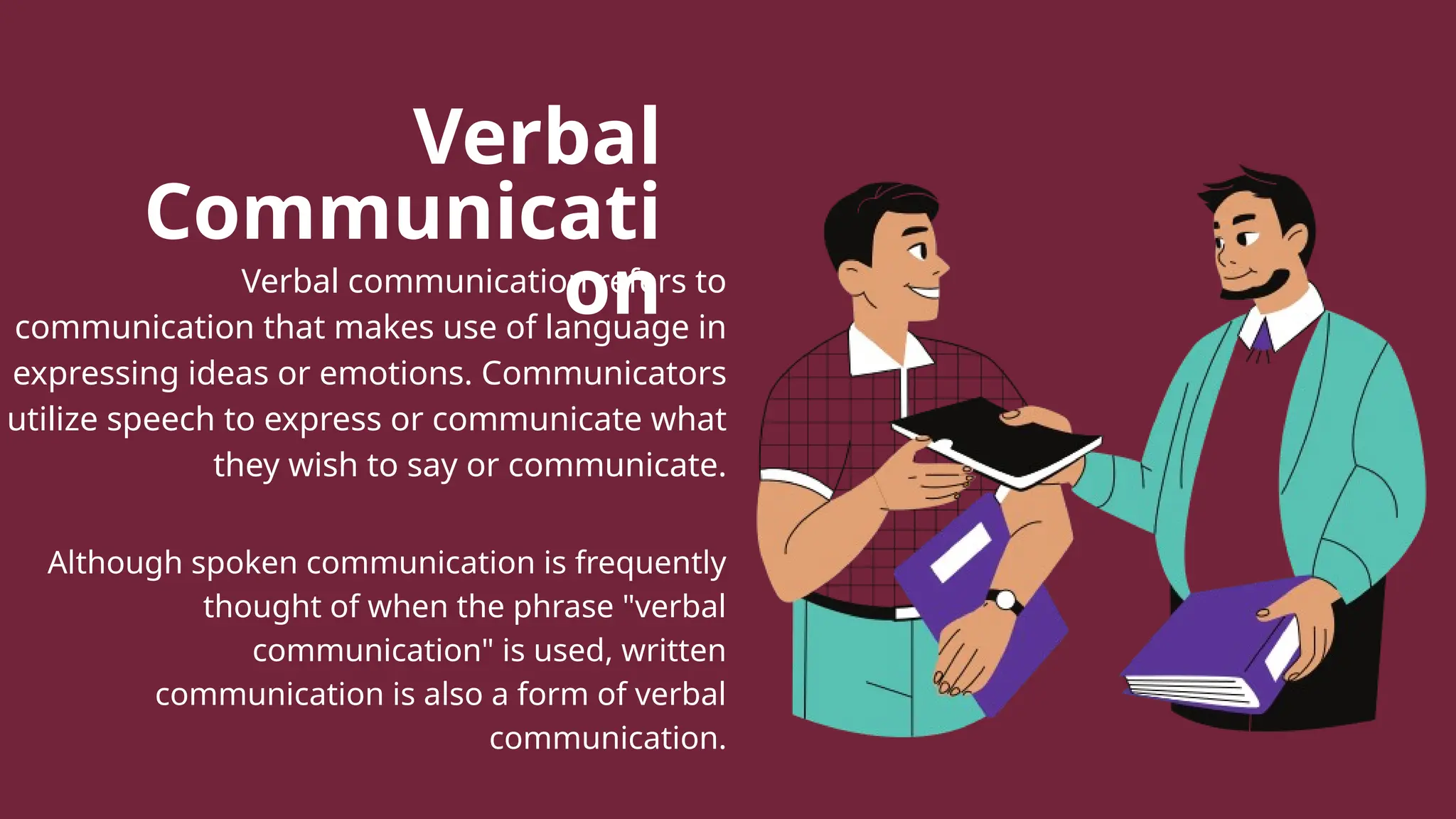
Verbal communication refers to
communication that makes use of language in
expressing ideas or emotions. Communicators
utilize speech to express or communicate what
they wish to say or communicate.
Although spoken communication is frequently
thought of when the phrase "verbal
communication" is used, written
communication is also a form of verbal
communication.
Qualities of Verbal
Communication
The language that you use should be
appropriate to the environment or occasion
(i.e., whether formal or informal).
Example:
In a job interview, saying:
“Good morning, Sir/Ma'am. Thank you for the
opportunity to speak with you today.”
is more appropriate than:
“Hey! What’s up?”
Appropriatenes
s
Qualities of Verbal
Communication
Speakers who often use simple yet precise and
powerful words are found to be more credible.
Try to achieve brevity by being more direct with
your words. Avoid fillers and insubstantial
expressions which do not add to the message,
such as “uh,” “you know,” “I guess,” and others.
Example:
Instead of saying:
“Well, you know, like, basically I was just kinda
wondering if maybe you could possibly help me
with this.”
Say:
“Can you please help me with this?”
Brevity
Qualities of Verbal
Communication
The meanings of words, feelings, or ideas may
be interpreted differently by a listener; hence,
it is essential for you to clearly state your
message and express your ideas and feelings
Example:
Instead of saying:
“The agenda needs to be contextualized through a
strategic procedural lens.”
Say:
“We need to review and simplify our plan.”
Clarity
Qualities of Verbal
Communication
Words should be carefully chosen in
consideration of the gender, roles, ethnicity,
preferences, and status of the person or
people you are talking to.
Example:
Instead of saying:
“That idea is stupid.”
Say:
“I think there may be a better approach we can
consider.”
Ethics
Qualities of Verbal
Communication
Words that vividly or creatively describe things
or feelings usually add color and spice to
communication. Hence, you are encouraged to
find ways to charm your audience through the
use of vivid words.
Example:
Instead of saying:
“It was a nice sunset.”
Say:
“The sky exploded in hues of gold and crimson as
the sun dipped behind the hills.”
Vividness
Nonverbal
Communicati
on
Nonverbal communication refers to
communication that does not make use
of language to communicate. Other than
words, nonverbal communication involves
body language, gestures, appearance,
and silence.
There are types of nonverbal
communication, namely proxemics,
kinesics, chronemics, and haptics.
Nonverbal
Communication
Mastery of nonverbal communication is important for several reasons:
1. It enhances and emphasizes the message of your speech, thus
making it more meaningful, truthful, and relevant.
2. It can communicate feelings, attitudes, and perceptions without you
saying a word.
3. It can sustain the attention of listeners and keep them engaged in the
speech.
4. It gives the audience a preview to the type of speaker you are.
5. It makes you appear more dynamic and animated in your delivery.
Nonverbal
Communication
Mastery of nonverbal communication is important for several reasons:
6. It serves as a channel to release tension and nervousness.
7. It helps make your speech more dramatic.
8. It can build a connection with listeners.
9. It makes you a credible speaker.
10. It helps you vary your speaking style and avoid a monotonous
delivery.
Proxemics Kinesics Chronemics Haptics
Types of Nonverbal
Communication
Proxemics
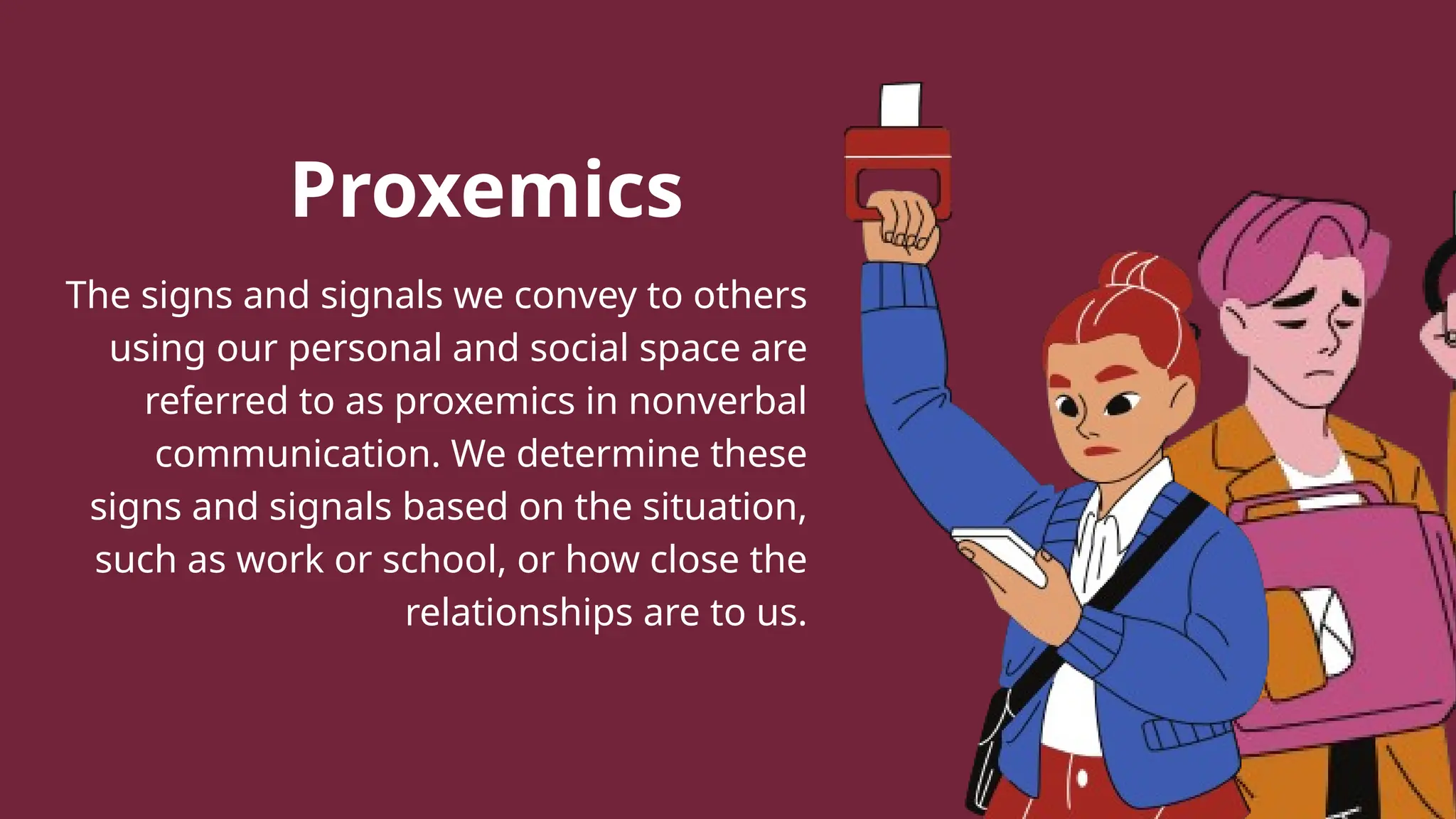
The signs and signals we convey to others
using our personal and social space are
referred to as proxemics in nonverbal
communication. We determine these
signs and signals based on the situation,
such as work or school, or how close the
relationships are to us.
Proxemics
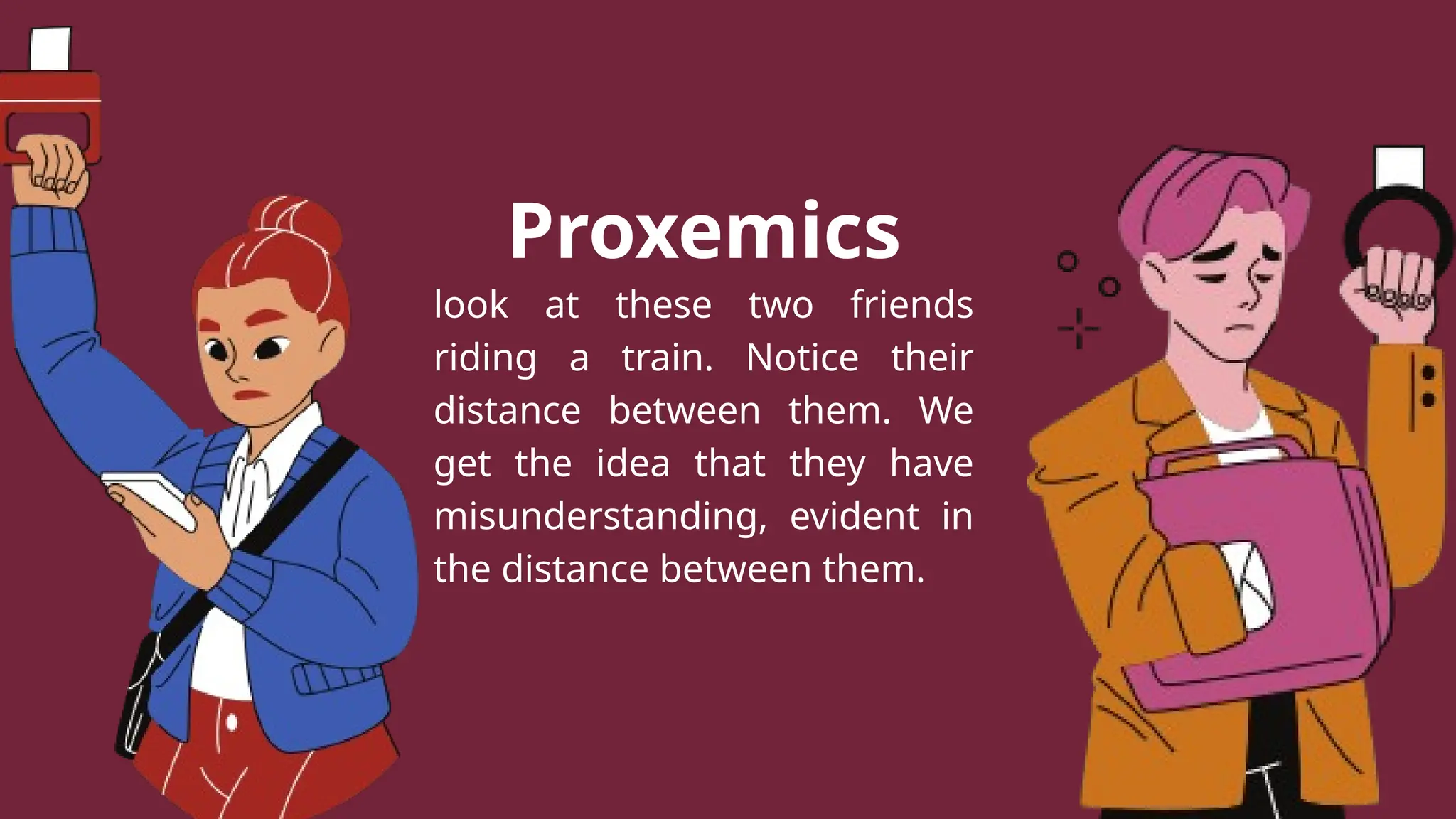
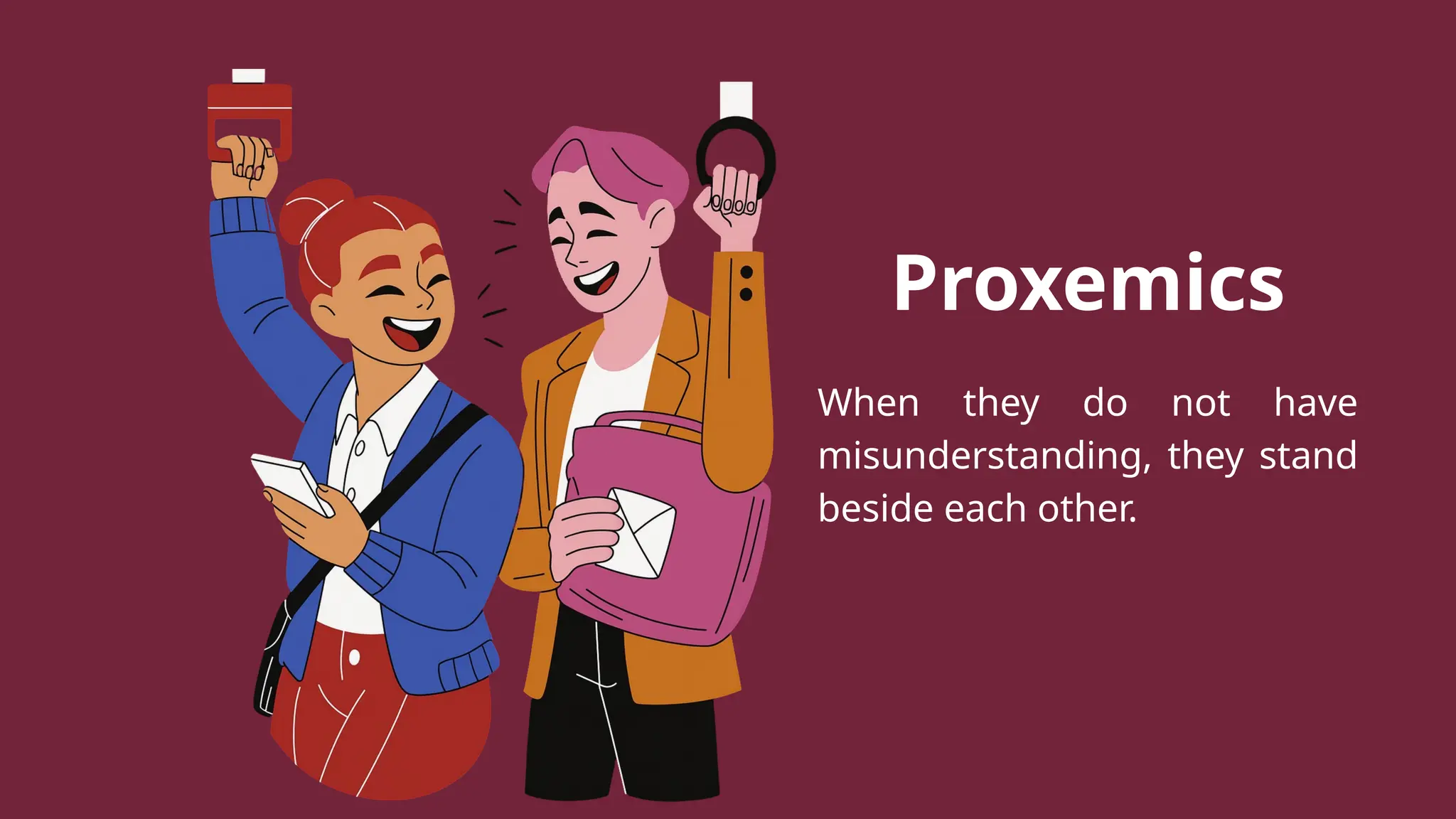
look at these two friends
riding a train. Notice their
distance between them. We
get the idea that they have
misunderstanding, evident in
the distance between them.
Proxemics
When they do not have
misunderstanding, they stand
beside each other.
Examples of
Proxemics
1. Personal Space in a Conversation
Situation:
Two friends are having a casual conversation at a coffee shop. They sit close to each
other, about 1 to 1.5 feet apart. Their close distance shows comfort and familiarity,
falling within personal distance in proxemics.
2. Public Speaking in a Large Hall
Situation:
A motivational speaker is addressing an audience of 200 people in a conference hall.
The speaker stands on stage several feet away from the front row. This public distance is
appropriate for formal settings where the speaker needs to maintain authority and
reach a larger audience.
3. Invasion of Intimate Space
Situation:
A new coworker stands just a few inches away while talking to you in the office pantry.
You feel uncomfortable and instinctively step back. This is an example of someone
violating intimate space, which is typically reserved for close relationships like family or
partners.
Kinesics
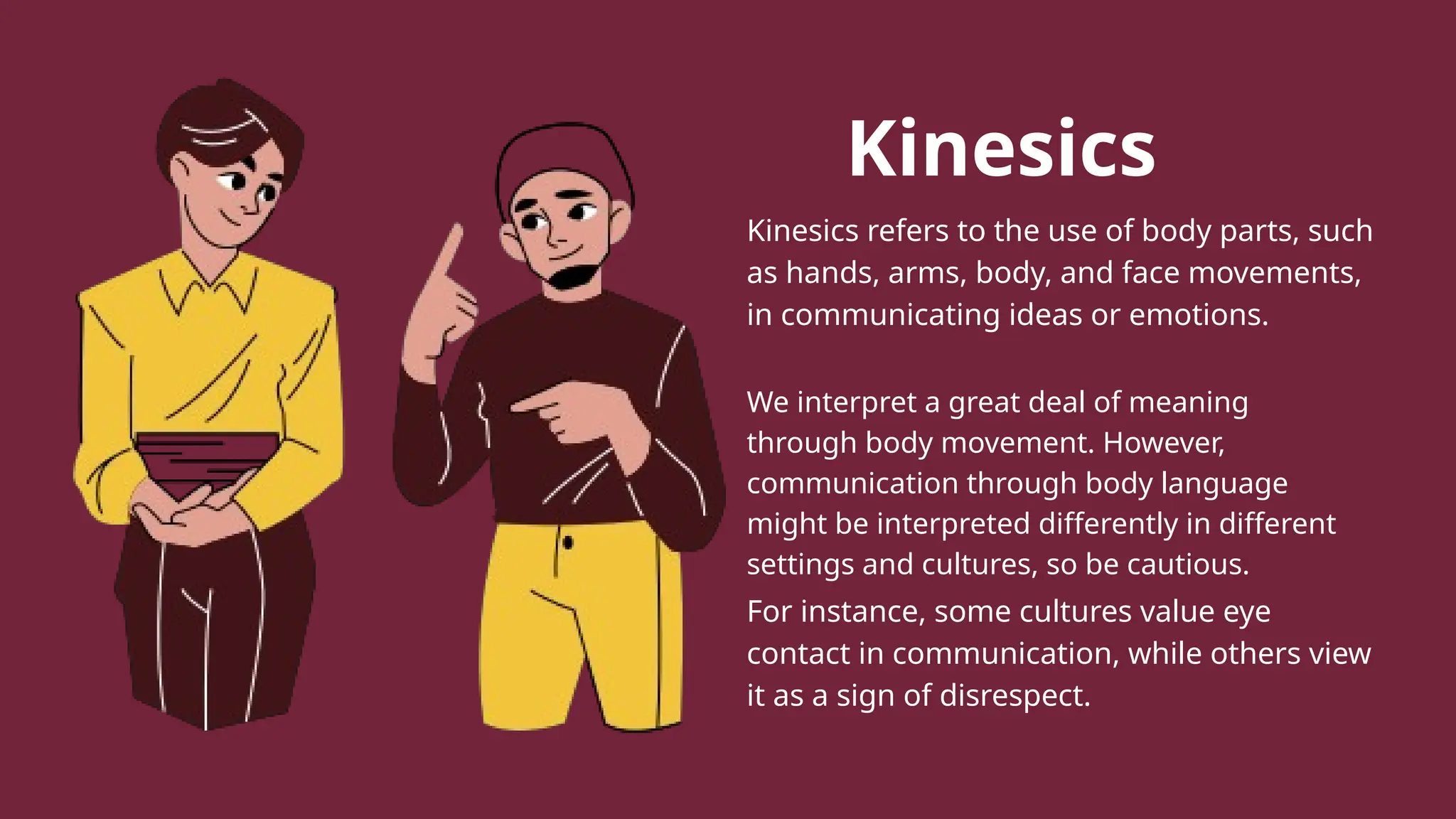
Kinesics refers to the use of body parts, such
as hands, arms, body, and face movements,
in communicating ideas or emotions.
We interpret a great deal of meaning
through body movement. However,
communication through body language
might be interpreted differently in different
settings and cultures, so be cautious.
For instance, some cultures value eye
contact in communication, while others view
it as a sign of disrespect.
Examples of Kinesics
1. Nodding to Show Understanding
Situation:
During a classroom discussion, a student nods their head while the teacher explains a concept.
Explanation:
The nodding indicates that the student understands and agrees—this nonverbal gesture is a clear
example of kinesics used for feedback.
2. Crossed Arms During a Meeting
Situation:
An employee sits in a meeting with their arms crossed, leaning slightly back in their chair.
Explanation:
This body posture may suggest defensiveness, discomfort, or disagreement—showing how body
positioning communicates attitude or emotion.
3. Rolling Eyes in Disapproval
Situation:
A teenager rolls their eyes when their parent reminds them to do chores.
Explanation:
This facial expression clearly conveys annoyance or resistance, even without any words spoken—
another key function of kinesics.
Chronemics
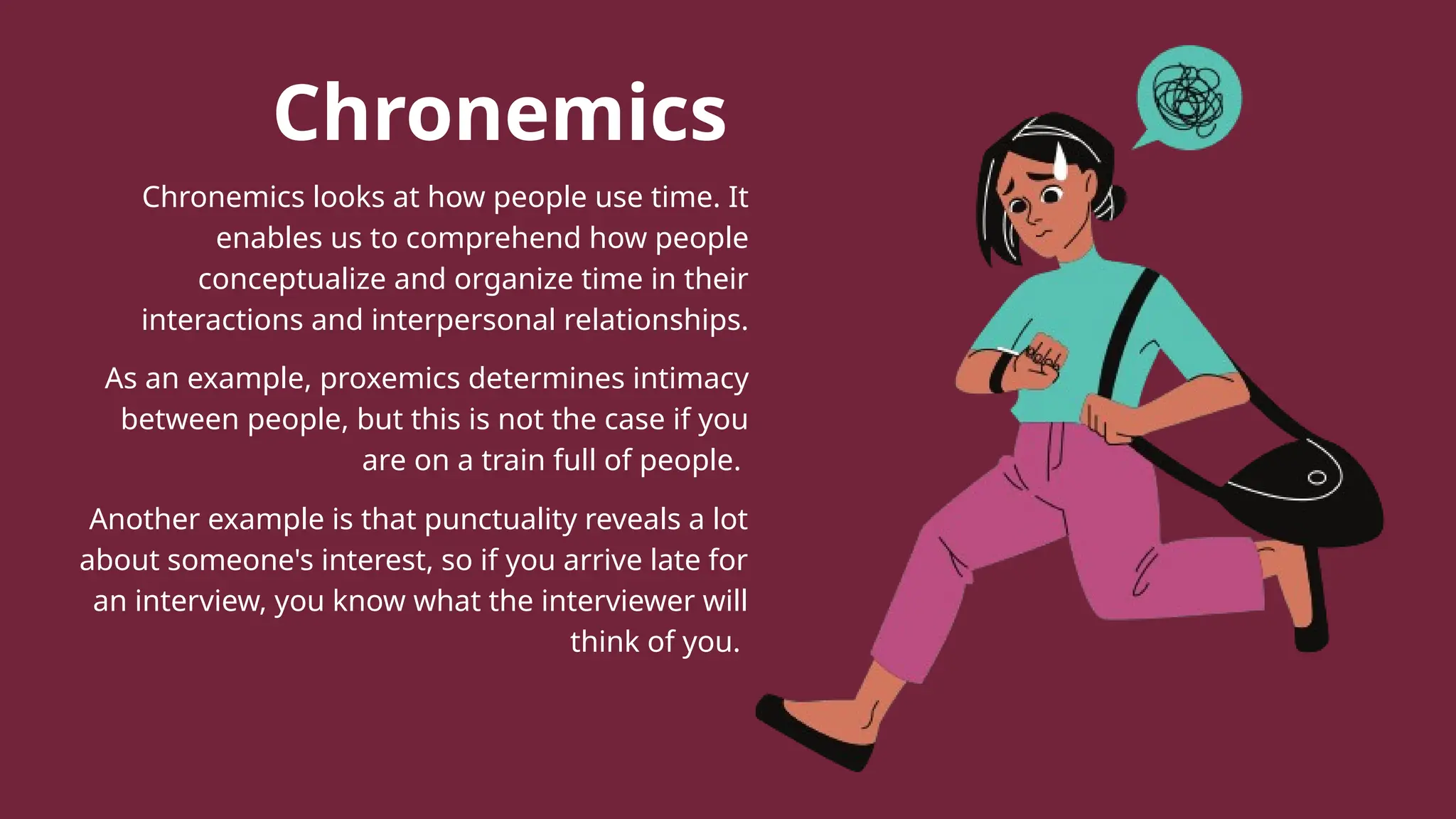
Chronemics looks at how people use time. It
enables us to comprehend how people
conceptualize and organize time in their
interactions and interpersonal relationships.
As an example, proxemics determines intimacy
between people, but this is not the case if you
are on a train full of people.
Another example is that punctuality reveals a lot
about someone's interest, so if you arrive late for
an interview, you know what the interviewer will
think of you.
Examples of Chronemics
1. Arriving Early for a Job Interview
Situation:
A job applicant arrives 15 minutes early for an interview.
Explanation:
This shows respect, professionalism, and eagerness. In chronemics, arriving early signals that the
person values the interviewer’s time and takes the opportunity seriously.
2. Taking a Long Time to Reply to a Message
Situation:
A friend takes three days to respond to an important message you sent.
Explanation:
The delay in response may be interpreted as disinterest, neglect, or even disrespect, depending on
the relationship. Chronemics looks at how the timing of replies impacts meaning and perception.
3. Spending Quality Time with Family
Situation:
A parent sets aside every Sunday afternoon to bond with their children.
Explanation:
This reflects the importance of relational time. In chronemics, the way we allocate time to others
communicates our priorities and emotional investment.
Haptics
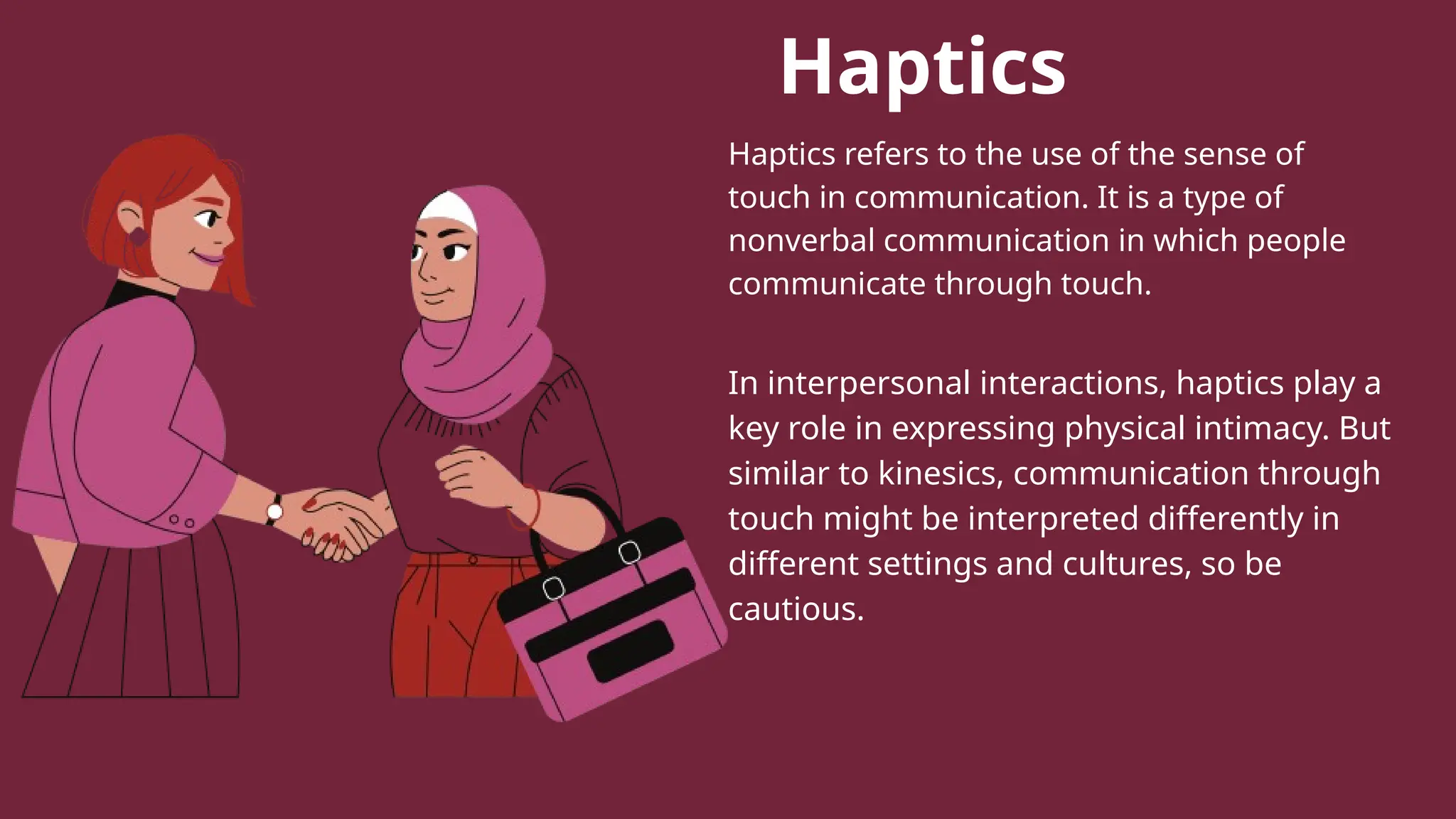
Haptics refers to the use of the sense of
touch in communication. It is a type of
nonverbal communication in which people
communicate through touch.
In interpersonal interactions, haptics play a
key role in expressing physical intimacy. But
similar to kinesics, communication through
touch might be interpreted differently in
different settings and cultures, so be
cautious.
Examples of Haptics
1. A Handshake in a Business Meeting
Situation:
Two professionals greet each other with a firm handshake at the start of a meeting.
Explanation:
The handshake is a form of formal touch that communicates respect, professionalism, and agreement.
2. A Hug Between Friends
Situation:
After not seeing each other for months, two close friends greet each other with a warm hug.
Explanation:
This affectionate touch expresses warmth, emotional closeness, and happiness—common in personal
relationships.
3. A Tap on the Shoulder to Get Attention
Situation:
In a noisy classroom, a student taps the teacher gently on the shoulder to ask a question.
Explanation:
This attention-seeking touch is used to nonverbally signal the need for interaction, especially when verbal
communication isn’t effective.
Wrap Up • Verbal communication refers to communication that makes use
of language in expressing ideas or emotions.
• Other than words, nonverbal communication involves body
language, gestures, appearance, and silence.
• The signs and signals we convey to others using our personal
and social space are referred to as proxemics.
• Kinesics refers to the use of body parts, such as hands, arms,
body, and face movements, in communicating ideas or
emotions.
• Chronemics looks at how people use time. It enables us to
comprehend how people conceptualize and organize time in
their interactions and interpersonal relationships.
• Haptics refers to the use of the sense of touch in
communication. It is a type of nonverbal communication in
which people communicate through touch.
Resources
Page

VERBAL AND NON VERBAL COMMUNICATION; ITS TYPES AND FORMS

  • 1.
  • 2.
    Learning Targets 01 02 03 The students shouldbe able to compare and contrast verbal and nonverbal communication. The students should be able to identify the different types of nonverbal communication. The students should be able to use appropriate nonverbal cues for effective communication.
  • 3.
    Learning Agenda 01 A discussionon the previous lesson on the nature and process of communication Recall A discussion on the definition and characteristics of verbal communication Verbal 02 03 A discussion on the definition and characteristics of nonverbal communication Nonverbal A discussion on the types of nonverbal, namely proxemics, kinesics, chronemics, and haptics. Types 04
  • 4.
    Verbal Communicati on Verbal communication refersto communication that makes use of language in expressing ideas or emotions. Communicators utilize speech to express or communicate what they wish to say or communicate. Although spoken communication is frequently thought of when the phrase "verbal communication" is used, written communication is also a form of verbal communication.
  • 5.
    Qualities of Verbal Communication Thelanguage that you use should be appropriate to the environment or occasion (i.e., whether formal or informal). Example: In a job interview, saying: “Good morning, Sir/Ma'am. Thank you for the opportunity to speak with you today.” is more appropriate than: “Hey! What’s up?” Appropriatenes s
  • 6.
    Qualities of Verbal Communication Speakerswho often use simple yet precise and powerful words are found to be more credible. Try to achieve brevity by being more direct with your words. Avoid fillers and insubstantial expressions which do not add to the message, such as “uh,” “you know,” “I guess,” and others. Example: Instead of saying: “Well, you know, like, basically I was just kinda wondering if maybe you could possibly help me with this.” Say: “Can you please help me with this?” Brevity
  • 7.
    Qualities of Verbal Communication Themeanings of words, feelings, or ideas may be interpreted differently by a listener; hence, it is essential for you to clearly state your message and express your ideas and feelings Example: Instead of saying: “The agenda needs to be contextualized through a strategic procedural lens.” Say: “We need to review and simplify our plan.” Clarity
  • 8.
    Qualities of Verbal Communication Wordsshould be carefully chosen in consideration of the gender, roles, ethnicity, preferences, and status of the person or people you are talking to. Example: Instead of saying: “That idea is stupid.” Say: “I think there may be a better approach we can consider.” Ethics
  • 9.
    Qualities of Verbal Communication Wordsthat vividly or creatively describe things or feelings usually add color and spice to communication. Hence, you are encouraged to find ways to charm your audience through the use of vivid words. Example: Instead of saying: “It was a nice sunset.” Say: “The sky exploded in hues of gold and crimson as the sun dipped behind the hills.” Vividness
  • 10.
    Nonverbal Communicati on Nonverbal communication refersto communication that does not make use of language to communicate. Other than words, nonverbal communication involves body language, gestures, appearance, and silence. There are types of nonverbal communication, namely proxemics, kinesics, chronemics, and haptics.
  • 11.
    Nonverbal Communication Mastery of nonverbalcommunication is important for several reasons: 1. It enhances and emphasizes the message of your speech, thus making it more meaningful, truthful, and relevant. 2. It can communicate feelings, attitudes, and perceptions without you saying a word. 3. It can sustain the attention of listeners and keep them engaged in the speech. 4. It gives the audience a preview to the type of speaker you are. 5. It makes you appear more dynamic and animated in your delivery.
  • 12.
    Nonverbal Communication Mastery of nonverbalcommunication is important for several reasons: 6. It serves as a channel to release tension and nervousness. 7. It helps make your speech more dramatic. 8. It can build a connection with listeners. 9. It makes you a credible speaker. 10. It helps you vary your speaking style and avoid a monotonous delivery.
  • 13.
    Proxemics Kinesics ChronemicsHaptics Types of Nonverbal Communication
  • 14.
    Proxemics The signs andsignals we convey to others using our personal and social space are referred to as proxemics in nonverbal communication. We determine these signs and signals based on the situation, such as work or school, or how close the relationships are to us.
  • 15.
    Proxemics look at thesetwo friends riding a train. Notice their distance between them. We get the idea that they have misunderstanding, evident in the distance between them.
  • 16.
    Proxemics When they donot have misunderstanding, they stand beside each other.
  • 17.
    Examples of Proxemics 1. PersonalSpace in a Conversation Situation: Two friends are having a casual conversation at a coffee shop. They sit close to each other, about 1 to 1.5 feet apart. Their close distance shows comfort and familiarity, falling within personal distance in proxemics. 2. Public Speaking in a Large Hall Situation: A motivational speaker is addressing an audience of 200 people in a conference hall. The speaker stands on stage several feet away from the front row. This public distance is appropriate for formal settings where the speaker needs to maintain authority and reach a larger audience. 3. Invasion of Intimate Space Situation: A new coworker stands just a few inches away while talking to you in the office pantry. You feel uncomfortable and instinctively step back. This is an example of someone violating intimate space, which is typically reserved for close relationships like family or partners.
  • 18.
    Kinesics Kinesics refers tothe use of body parts, such as hands, arms, body, and face movements, in communicating ideas or emotions. We interpret a great deal of meaning through body movement. However, communication through body language might be interpreted differently in different settings and cultures, so be cautious. For instance, some cultures value eye contact in communication, while others view it as a sign of disrespect.
  • 19.
    Examples of Kinesics 1.Nodding to Show Understanding Situation: During a classroom discussion, a student nods their head while the teacher explains a concept. Explanation: The nodding indicates that the student understands and agrees—this nonverbal gesture is a clear example of kinesics used for feedback. 2. Crossed Arms During a Meeting Situation: An employee sits in a meeting with their arms crossed, leaning slightly back in their chair. Explanation: This body posture may suggest defensiveness, discomfort, or disagreement—showing how body positioning communicates attitude or emotion. 3. Rolling Eyes in Disapproval Situation: A teenager rolls their eyes when their parent reminds them to do chores. Explanation: This facial expression clearly conveys annoyance or resistance, even without any words spoken— another key function of kinesics.
  • 20.
    Chronemics Chronemics looks athow people use time. It enables us to comprehend how people conceptualize and organize time in their interactions and interpersonal relationships. As an example, proxemics determines intimacy between people, but this is not the case if you are on a train full of people. Another example is that punctuality reveals a lot about someone's interest, so if you arrive late for an interview, you know what the interviewer will think of you.
  • 21.
    Examples of Chronemics 1.Arriving Early for a Job Interview Situation: A job applicant arrives 15 minutes early for an interview. Explanation: This shows respect, professionalism, and eagerness. In chronemics, arriving early signals that the person values the interviewer’s time and takes the opportunity seriously. 2. Taking a Long Time to Reply to a Message Situation: A friend takes three days to respond to an important message you sent. Explanation: The delay in response may be interpreted as disinterest, neglect, or even disrespect, depending on the relationship. Chronemics looks at how the timing of replies impacts meaning and perception. 3. Spending Quality Time with Family Situation: A parent sets aside every Sunday afternoon to bond with their children. Explanation: This reflects the importance of relational time. In chronemics, the way we allocate time to others communicates our priorities and emotional investment.
  • 22.
    Haptics Haptics refers tothe use of the sense of touch in communication. It is a type of nonverbal communication in which people communicate through touch. In interpersonal interactions, haptics play a key role in expressing physical intimacy. But similar to kinesics, communication through touch might be interpreted differently in different settings and cultures, so be cautious.
  • 23.
    Examples of Haptics 1.A Handshake in a Business Meeting Situation: Two professionals greet each other with a firm handshake at the start of a meeting. Explanation: The handshake is a form of formal touch that communicates respect, professionalism, and agreement. 2. A Hug Between Friends Situation: After not seeing each other for months, two close friends greet each other with a warm hug. Explanation: This affectionate touch expresses warmth, emotional closeness, and happiness—common in personal relationships. 3. A Tap on the Shoulder to Get Attention Situation: In a noisy classroom, a student taps the teacher gently on the shoulder to ask a question. Explanation: This attention-seeking touch is used to nonverbally signal the need for interaction, especially when verbal communication isn’t effective.
  • 24.
    Wrap Up •Verbal communication refers to communication that makes use of language in expressing ideas or emotions. • Other than words, nonverbal communication involves body language, gestures, appearance, and silence. • The signs and signals we convey to others using our personal and social space are referred to as proxemics. • Kinesics refers to the use of body parts, such as hands, arms, body, and face movements, in communicating ideas or emotions. • Chronemics looks at how people use time. It enables us to comprehend how people conceptualize and organize time in their interactions and interpersonal relationships. • Haptics refers to the use of the sense of touch in communication. It is a type of nonverbal communication in which people communicate through touch.
  • 25.