Emerging Market MNEs and Cross-
border Non-equity Modes: A Policy
Agenda
INVESTMENT CLIMATE ADVISORY SERVICES
WORLD BANK GROUP
Lilac Nachum
Professor, Globalization and Multinational Companies
My Intellectual World
as of 2015
My NEMs-Related Activities
Developed and teaching the ‘Global Strategic Partnerships’ course, Indian School of Business (ISB) MBA program, 2013 -
Organization of foreign affiliates as a distinctive choice between markets, hierarchy and networks. In Ramamurti/Hashai
(Eds), The Future of Foreign Direct Investment and the Multinational Enterprise. Emerald, 2011.
Foreignness, multinationality and inter-organizational relationships. Strategic Organization, 2010.
The movement of service jobs overseas: A theoretical perspective. A report prepared for UNCTAD as input for World
Investment Report 2004.
Outsourcing by Multinational Corporations as a choice between internalization and the market: Implications for theory
and policy makers. A report prepared for UNCTAD, 2003.
Offshoring Survey, A report prepared for the Paaras Consulting Group, 2003.
Offshoring: Not just for first movers. Journal of Financial Transformation, 2003 (with S. Gupta)
Speaker, National Conference of State Legislators, Policy responses to outsourcing: Prescriptive and normative
approaches. Washington D.C., Capitol Hill 2003.
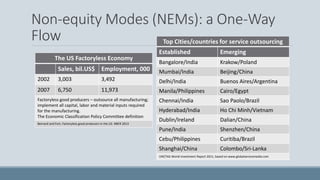
Non-equity Modes (NEMs): a One-Way
Flow Top Cities/countries for service outsourcing
Established Emerging
Bangalore/India Krakow/Poland
Mumbai/India Beijing/China
Delhi/India Buenos Aires/Argentina
Manila/Philippines Cairo/Egypt
Chennai/India Sao Paolo/Brazil
Hyderabad/India Ho Chi Minh/Vietnam
Dublin/Ireland Dalian/China
Pune/India Shenzhen/China
Cebu/Philippines Curitiba/Brazil
Shanghai/China Colombo/Sri-Lanka
UNCTAD World Investment Report 2011, based on www.globalservicemedia.com
The US Factoryless Economy
Sales, bil.US$ Employment, 000
2002 3,003 3,492
2007 6,750 11,973
Factoryless good producers – outsource all manufacturing;
implement all capital, labor and material inputs required
for the manufacturing.
The Economic Classification Policy Committee definition
Bernard and Fort, Factoryless good producers in the US. NBER 2013
Consequences for Emerging Market
TNCs (Firms)
Value appropriation from NEMs relationships
Capability development via NEMs agreements
NEMs as a vehicle for global expansion.
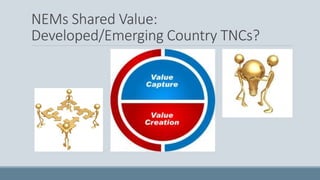
NEMs Shared Value:
Developed/Emerging Country TNCs?
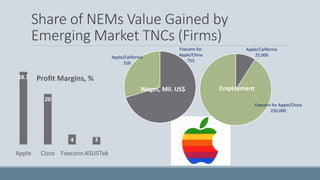
Share of NEMs Value Gained by
Emerging Market TNCs (Firms)
Apple/California
25,000
Foxconn for Apple/China
250,000
Employment
Foxconn for
Apple/China
753
Apple/California
318
Wages, Mil. US$
28.7
20
4 3
Apple Cisco FoxconnASUSTek
Profit Margins, %
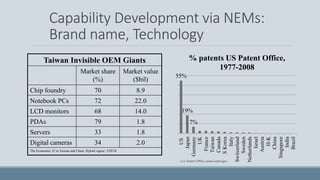
Capability Development via NEMs:
Brand name, Technology
Taiwan Invisible OEM Giants
Market share
(%)
Market value
($bil)
Chip foundry 70 8.9
Notebook PCs 72 22.0
LCD monitors 68 14.0
PDAs 79 1.8
Servers 33 1.8
Digital cameras 34 2.0
The Economist, IT in Taiwan and China: Hybrid vigour. 5/29/10
55%
19%
7%
US
Japan
Germany
UK
France
Taiwan
Canada
SKorea
Italy
Switzerland
Sweden
Netherlands
Israel
Austria
H-K
China
Singapore
India
Brazil
% patents US Patent Office,
1977-2008
U.S. Patent Office, www.uspto.gov
Nor do NEMs serve to as a Vehicle for
Global Expansion
Attraction as local partners – does not travel
Local partners goal at time of agreement – vehicle to global expansion:
Creating Competitive Advantage
via NEMs
• Airtel outsourcing model:
o IT operations, Customer care – IBM
o Running the network – Ericsson, Nokia, Siemens
• Cost saving:
o No fixed costs; no excess capacity cost; no maintenance costs
• Call rates, cents/minute, 2009:
o Airtel: 0.2; US operators: ~20 cents
• Revenues/user (per month):
o Airtel: $6; Verizon: $51
• Operating margins:
o Airtel: 40% = > US companies
o The 'minutes factory' model - low cost/high volumes
• Sunil Mittal: ‘Flying on the Wings of Others’.
‘Flying on the Wings of Others’ –
only in India?
Partners’ attraction to Airtel? Airtel attraction to partners?
Access to India market
Potential target
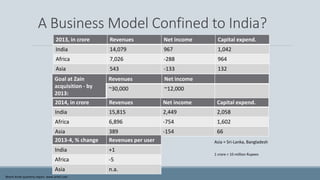
A Business Model Confined to India?
2013, in crore Revenues Net income Capital expend.
India 14,079 967 1,042
Africa 7,026 -288 964
Asia 543 -133 132
2014, in crore Revenues Net income Capital expend.
India 15,815 2,449 2,058
Africa 6,896 -754 1,602
Asia 389 -154 66
Asia = Sri-Lanka, Bangladesh
Goal at Zain
acquisition - by
2013:
Revenues Net income
~30,000 ~12,000
Bharti Airtel quarterly report. www.airtel.com
1 crore = 10 million Rupees
2013-4, % change Revenues per user
India +1
Africa -5
Asia n.a.
The ‘Africa Effect?’
‘Bharti Airtel [2014] Fourth-Quarter Net
Profit - Almost Halves, Missed Forecast.
…[this is] in part due to high interest costs
on the debt it took to buy ZAIN.’
NEMs as a Vehicle for Global Expansion:
Developed/Emerging Market TNCs
Fast food
◦ US companies - % franchised globally 85-100%
◦ Developing country companies – Jollibee overseas expansion – mostly via
acquisitions/shared ownership (j.v.)
Hotels
◦ US companies - ditto
◦ Developing country companies - hotels Indian Hotels (Taj Palaces), Obroi,
Shangri La
◦ Taj global expansion - mostly acquisitions.
Different Choices:
Developed/Emerging country Firms
Where Should we go From Here?
Some Suggestive Thoughts
Why NEMs by emerging market TNCs limited?
◦ Lesser specialization; excellence in generic skills [Apple/Samsung; Dell/Lenovo]
◦  history of institutional void
◦ Resistant to change, to economic development [Legend Holdings, est. 1984]
What will it take to encourage NEMs by emerging market TNCs?
◦ Acquisition of new skills and talent
◦ Change corporate culture!
◦ From efficiently implementing ideas designed elsewhere to innovation
◦ Internal/external resistance
◦ Convince shareholders
◦ [inevitable?] Loss of customers - do not want to do business with a competitor.
A Role for Governments?
The Policy Agenda
Home country branding
Capital – investment with long time span
IPR protection – encourage investment in innovation
More – when patterns better uderstood.
Nation [Place] Branding:
Marketing Theory Meets Nation States
Change country image – deliberate government efforts
◦ ‘Cool Brittania’
◦ Taiwan ‘reputation management’
◦ ‘Invest in remarkable Indonesia’
Challenge: brand already exists  re-branding! change perceptions
◦ Martin Spurling, CEO of HSBC in Turkey: ‘I had no idea how big Istanbul was until I
was appointed here. I was shocked. In terms of its location, history, culture, human
potential and hospitality, Istanbul's a great candidate to be an international finance
center. We have to explain it to the world a little better.’
Companies as ambassadors for nation – firms [+governments?]
◦ India IT companies.
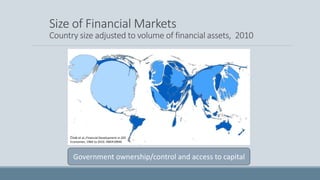
Size of Financial Markets
Country size adjusted to volume of financial assets, 2010
Čihák et al.,Financial Development in 205
Economies, 1960 to 2010. NBER18946
Government ownership/control and access to capital
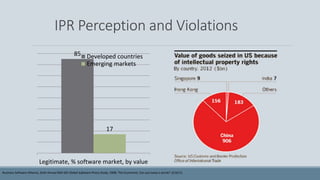
IPR Perception and Violations
85
17
Legitimate, % software market, by value
Developed countries
Emerging markets
Business Software Alliance, Sixth Annual BSA-IDC Global Software Piracy Study, 2008; The Economist, Can you keep a secret? 3/16/13
Run Out of Time after
Thoughts
Distinctive Policy Concerns of NEMs
Go under the radar of policy makers
◦ US Specific NEMs Laws: Franchise laws require registration and franchisors need to make certain
disclosures to prospective franchisees (balances the bargaining power)
◦ Partly addresses this concern
◦ US only country to have this legislation?
Leave no trail  poor record of actual activity  policymakers in the dark
Where this creates most pain:
Anti-trust authorities - can generate too much market power
Restrictions foreign ownership – may harm all the reasons that bring about these restrictions
Limited ability to affect mutual [equal?] gains of investment – investors/host countries.
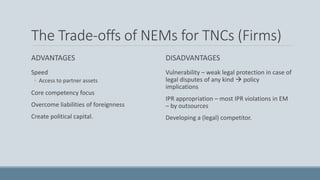
The Trade-offs of NEMs for TNCs (Firms)
ADVANTAGES
Speed
◦ Access to partner assets
Core competency focus
Overcome liabilities of foreignness
Create political capital.
DISADVANTAGES
Vulnerability – weak legal protection in case of
legal disputes of any kind  policy
implications
IPR appropriation – most IPR violations in EM
– by outsources
Developing a (legal) competitor.

non equity investment

  • 1.
    Emerging Market MNEsand Cross- border Non-equity Modes: A Policy Agenda INVESTMENT CLIMATE ADVISORY SERVICES WORLD BANK GROUP Lilac Nachum Professor, Globalization and Multinational Companies
  • 2.
  • 3.
    My NEMs-Related Activities Developedand teaching the ‘Global Strategic Partnerships’ course, Indian School of Business (ISB) MBA program, 2013 - Organization of foreign affiliates as a distinctive choice between markets, hierarchy and networks. In Ramamurti/Hashai (Eds), The Future of Foreign Direct Investment and the Multinational Enterprise. Emerald, 2011. Foreignness, multinationality and inter-organizational relationships. Strategic Organization, 2010. The movement of service jobs overseas: A theoretical perspective. A report prepared for UNCTAD as input for World Investment Report 2004. Outsourcing by Multinational Corporations as a choice between internalization and the market: Implications for theory and policy makers. A report prepared for UNCTAD, 2003. Offshoring Survey, A report prepared for the Paaras Consulting Group, 2003. Offshoring: Not just for first movers. Journal of Financial Transformation, 2003 (with S. Gupta) Speaker, National Conference of State Legislators, Policy responses to outsourcing: Prescriptive and normative approaches. Washington D.C., Capitol Hill 2003.
  • 4.
    Non-equity Modes (NEMs):a One-Way Flow Top Cities/countries for service outsourcing Established Emerging Bangalore/India Krakow/Poland Mumbai/India Beijing/China Delhi/India Buenos Aires/Argentina Manila/Philippines Cairo/Egypt Chennai/India Sao Paolo/Brazil Hyderabad/India Ho Chi Minh/Vietnam Dublin/Ireland Dalian/China Pune/India Shenzhen/China Cebu/Philippines Curitiba/Brazil Shanghai/China Colombo/Sri-Lanka UNCTAD World Investment Report 2011, based on www.globalservicemedia.com The US Factoryless Economy Sales, bil.US$ Employment, 000 2002 3,003 3,492 2007 6,750 11,973 Factoryless good producers – outsource all manufacturing; implement all capital, labor and material inputs required for the manufacturing. The Economic Classification Policy Committee definition Bernard and Fort, Factoryless good producers in the US. NBER 2013
  • 5.
    Consequences for EmergingMarket TNCs (Firms) Value appropriation from NEMs relationships Capability development via NEMs agreements NEMs as a vehicle for global expansion.
  • 6.
  • 7.
    Share of NEMsValue Gained by Emerging Market TNCs (Firms) Apple/California 25,000 Foxconn for Apple/China 250,000 Employment Foxconn for Apple/China 753 Apple/California 318 Wages, Mil. US$ 28.7 20 4 3 Apple Cisco FoxconnASUSTek Profit Margins, %
  • 8.
    Capability Development viaNEMs: Brand name, Technology Taiwan Invisible OEM Giants Market share (%) Market value ($bil) Chip foundry 70 8.9 Notebook PCs 72 22.0 LCD monitors 68 14.0 PDAs 79 1.8 Servers 33 1.8 Digital cameras 34 2.0 The Economist, IT in Taiwan and China: Hybrid vigour. 5/29/10 55% 19% 7% US Japan Germany UK France Taiwan Canada SKorea Italy Switzerland Sweden Netherlands Israel Austria H-K China Singapore India Brazil % patents US Patent Office, 1977-2008 U.S. Patent Office, www.uspto.gov
  • 9.
    Nor do NEMsserve to as a Vehicle for Global Expansion Attraction as local partners – does not travel Local partners goal at time of agreement – vehicle to global expansion:
  • 10.
    Creating Competitive Advantage viaNEMs • Airtel outsourcing model: o IT operations, Customer care – IBM o Running the network – Ericsson, Nokia, Siemens • Cost saving: o No fixed costs; no excess capacity cost; no maintenance costs • Call rates, cents/minute, 2009: o Airtel: 0.2; US operators: ~20 cents • Revenues/user (per month): o Airtel: $6; Verizon: $51 • Operating margins: o Airtel: 40% = > US companies o The 'minutes factory' model - low cost/high volumes • Sunil Mittal: ‘Flying on the Wings of Others’.
  • 11.
    ‘Flying on theWings of Others’ – only in India? Partners’ attraction to Airtel? Airtel attraction to partners? Access to India market Potential target
  • 12.
    A Business ModelConfined to India? 2013, in crore Revenues Net income Capital expend. India 14,079 967 1,042 Africa 7,026 -288 964 Asia 543 -133 132 2014, in crore Revenues Net income Capital expend. India 15,815 2,449 2,058 Africa 6,896 -754 1,602 Asia 389 -154 66 Asia = Sri-Lanka, Bangladesh Goal at Zain acquisition - by 2013: Revenues Net income ~30,000 ~12,000 Bharti Airtel quarterly report. www.airtel.com 1 crore = 10 million Rupees 2013-4, % change Revenues per user India +1 Africa -5 Asia n.a.
  • 13.
    The ‘Africa Effect?’ ‘BhartiAirtel [2014] Fourth-Quarter Net Profit - Almost Halves, Missed Forecast. …[this is] in part due to high interest costs on the debt it took to buy ZAIN.’
  • 14.
    NEMs as aVehicle for Global Expansion: Developed/Emerging Market TNCs Fast food ◦ US companies - % franchised globally 85-100% ◦ Developing country companies – Jollibee overseas expansion – mostly via acquisitions/shared ownership (j.v.) Hotels ◦ US companies - ditto ◦ Developing country companies - hotels Indian Hotels (Taj Palaces), Obroi, Shangri La ◦ Taj global expansion - mostly acquisitions.
  • 15.
  • 16.
    Where Should wego From Here? Some Suggestive Thoughts Why NEMs by emerging market TNCs limited? ◦ Lesser specialization; excellence in generic skills [Apple/Samsung; Dell/Lenovo] ◦  history of institutional void ◦ Resistant to change, to economic development [Legend Holdings, est. 1984] What will it take to encourage NEMs by emerging market TNCs? ◦ Acquisition of new skills and talent ◦ Change corporate culture! ◦ From efficiently implementing ideas designed elsewhere to innovation ◦ Internal/external resistance ◦ Convince shareholders ◦ [inevitable?] Loss of customers - do not want to do business with a competitor.
  • 17.
    A Role forGovernments? The Policy Agenda Home country branding Capital – investment with long time span IPR protection – encourage investment in innovation More – when patterns better uderstood.
  • 18.
    Nation [Place] Branding: MarketingTheory Meets Nation States Change country image – deliberate government efforts ◦ ‘Cool Brittania’ ◦ Taiwan ‘reputation management’ ◦ ‘Invest in remarkable Indonesia’ Challenge: brand already exists  re-branding! change perceptions ◦ Martin Spurling, CEO of HSBC in Turkey: ‘I had no idea how big Istanbul was until I was appointed here. I was shocked. In terms of its location, history, culture, human potential and hospitality, Istanbul's a great candidate to be an international finance center. We have to explain it to the world a little better.’ Companies as ambassadors for nation – firms [+governments?] ◦ India IT companies.
  • 19.
    Size of FinancialMarkets Country size adjusted to volume of financial assets, 2010 Čihák et al.,Financial Development in 205 Economies, 1960 to 2010. NBER18946 Government ownership/control and access to capital
  • 20.
    IPR Perception andViolations 85 17 Legitimate, % software market, by value Developed countries Emerging markets Business Software Alliance, Sixth Annual BSA-IDC Global Software Piracy Study, 2008; The Economist, Can you keep a secret? 3/16/13
  • 21.
    Run Out ofTime after Thoughts
  • 22.
    Distinctive Policy Concernsof NEMs Go under the radar of policy makers ◦ US Specific NEMs Laws: Franchise laws require registration and franchisors need to make certain disclosures to prospective franchisees (balances the bargaining power) ◦ Partly addresses this concern ◦ US only country to have this legislation? Leave no trail  poor record of actual activity  policymakers in the dark Where this creates most pain: Anti-trust authorities - can generate too much market power Restrictions foreign ownership – may harm all the reasons that bring about these restrictions Limited ability to affect mutual [equal?] gains of investment – investors/host countries.
  • 23.
    The Trade-offs ofNEMs for TNCs (Firms) ADVANTAGES Speed ◦ Access to partner assets Core competency focus Overcome liabilities of foreignness Create political capital. DISADVANTAGES Vulnerability – weak legal protection in case of legal disputes of any kind  policy implications IPR appropriation – most IPR violations in EM – by outsources Developing a (legal) competitor.

Editor's Notes

  • #2 NEMs almost exclusively North  South phenomenon. One-way transactions. Pattern that is not much discussed but hold important lessons for policymakers. The discussion of this topic is implicit (explicit) regarding the benefits for developing countries as hosts. Focus of the discussion – how to facilitate more NEMs to developing countries (improve regulatory environment, connect local partners with foreign companies etc.) and how to maximize their benefits (improve local partners negotiating power etc.). Some recognized costs (risk) are well acknowledged (i.e., local partners in weak negotiating power – what will it take to change this?). Other – less discussed but not less troubling – failure to improve local partner global activity; with few exceptions, does not draw them into GVC. Current situation do developing countries get their share of the value created via NEMs? But why is this pattern in the first place? Is it desired for developing countries?
  • #3 My work vis a vis the work of the BEA. Where I hope to add value: 1) General - Insights from IB on issues of study – complement economic thinking; create a bridge We asked similar questions, because our thinking is informed by the world that we observe around us. Different audiences  nuances of the answers we are looking for Different terminology 2) Specific - Heterogeneity among firms in the strategy/management lit. Foundations of IB theory – Hymer (Ray’s talk) One dimension of heterogeneity – foreign/domestic My credibility in this area. Share insights based on my own research and that of others IB scholars in this area
  • #5 Patterns persist also when NEMs broadly defined to include J.V./strategic alliances Resistant to economic development Location GAP contract manufacturers – 95% emerging markets
  • #7 Value capture = sharing
  • #8 Sources of differentiation; Negotiating power
  • #9 Compete on costs
  • #10 TNK clear goal at initiation of relationships - Going international - This is not what BP came to Russia for – a major reason for the dispute that led to the deal being resolved UTV CEO: ‘If we are not global, we are nothing! If we are in the US, that means we are in the world!’ HBR Case
  • #11  Bahrti – founded 1995. 1st international expansion 2009 – Sri-Lanka, Bangladesh 2010 – Zain’s acquisition
  • #13 Zain acquisition 2010; $12 bil.; Full ownership
  • #15 Anecdotal evidence – far less frequent
  • #16 Not ready yet? Are they on the right path?
  • #17 Better understanding of these questions as a guide for policy agenda
  • #21 Patenting requires publication of the patented idea, making it easier for firms in unlawful countries to steel it  reduction in patenting (particularly the most valuable ideas). Patent protection – time limited. Secrecy – infinite (Coca-Cola secret formula; KFC; Google search algorithm)