Emerging Giants:
Building World Class Companies From Emerging Markets
Group 8
Payal Agrawal (F003) | Ajith Konda (F028) | Aditi Goyal (F017) | Abhishek Tater (F062) | Vandita Singh (F058) |
Mrityunjay Dhamar (F016) | Anand Krishnan (F029)
Introduction
 Emerging markets – China , India, and Brazil
 Goal - To be globally competitive and to exploit new globalization opportunities
 Challenge – To compete with multinational companies
Multinationals –
 They are well established, and therefore have the benefits of incumbency: brand
name, organizational capabilities, and advanced technologies
 They can also leverage their access to vast resources – finances, talent, and supplier
and distribution networks in their home markets
What Emerging Giants do not have?
 They come from economies that suffer from severe market failures
 They often lack good infrastructure
 When their economies open up, emerging market companies are forced to compete with their
advanced market counterparts
 They cannot access risk capital with the same ease and cost
 They are hampered by unreliable quality of their supply network
There is a concern about being wiped out in their domestic market by multinationals when their domestic
markets open
However, there are a growing set of companies that appear to buck these odds, and have done well in
their battles against multinationals
Achieving Competitive Advantage against Multinationals
Emerging market companies can turn the disadvantages into an advantage
 Managers at local companies know how to work around the institutional voids which is difficult for the MNCs
 MNCs are reluctant to tailor their strategies, products, services, and communications for developing market
as its costly , cumbersome and risky
 Getting listed on NYSE or Nasdaq, it becomes easy for them to access to the capital the same way American
multinationals do
 Several emerging companies have been successful to cope up with local institutional voids by developing
their own internal organizational mechanism
Achieving Competitive Advantage Against Multinationals
Generic business opportunities where building
competitive advantage is likely
Three generic ways to do it :
 Capitalize on institutional voids in the product markets
 Capitalize on institutional voids in the factor markets
 Alleviate institutional voids
Generic Opportunity 1 : Exploiting unique knowledge of domestic product
markets
 The emerging companies capitalize on their knowledge of a unique local product market situation
 They also exploit the similarities in the geographically nearer countries
Ex - Jollibees in the Philippines, Nandos n S Africa
They used their mastery of unique taste of their domestic market to expand globally
Ex - Haier
Achieving Competitive Advantage Against Multinationals
Generic Opportunity 2 : Exploiting unique knowledge of domestic factor
markets
 They capitalize on their knowledge about the local factors of production like talent,
and capital markets.
 Some capitalize on the knowledge of their supply chain
Ex – Indian IT majors – TCS, Infosys
Achieving Competitive Advantage Against Multinationals
Generic Opportunity 3 : Exploiting Local Institutional voids as business opportunities
2 types of market institutions:
1. Facilitate credible information flow in the market
e.g.. ISO certification, GMAC, Stock Market, Publications rating universities and schools
2. Facilitate transaction through aggregation and distribution of goods and services or by creating forums where
seller and buyer can transact directly. e.g.. Banks, retailers, labour unions. EBay, online job portals
 Potential advantages to Emerging market business:
a. Human capital intensive.
b. Information intensive.
c. Government give national importance to these institutions.
 Limitations:
a. Opportunities are limited if market size is small.
b. Market is segmented into global and local piece. E.g. Citicorp
Journey From Presence In Local Market To Global Market
Identified countries of interest
 Jeffery Garten – Big 10 Emerging Markets
 Countries that attracted attention of Global investors- included in the investment portfolio of big mutual fund
companies e.g.. Fidelity, Vanguard
(Brazil, China, Mexico, India, South Africa, South Korea)
 Included countries that were frequently discussed.
(Argentina, Indonesia, Turkey, Poland)
 To include companies of these countries-
-Forbes Global 500 and Forbes International 500 lists
-Companies where investors have invested
 Included companies from International History of Company Directories
 So total now there were 134 firms.
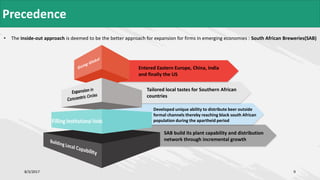
SAB build its plant capability and distribution
network through incremental growth
• The inside-out approach is deemed to be the better approach for expansion for firms in emerging economies : South African Breweries(SAB)
8/3/2017 9
Developed unique ability to distribute beer outside
formal channels thereby reaching black south African
population during the apartheid period
Tailored local tastes for Southern African
countries
Entered Eastern Europe, China, India
and finally the US
Precedence
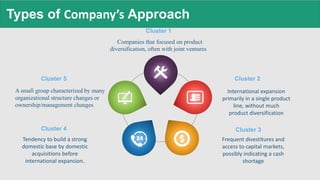
International expansion
primarily in a single product
line, without much
product diversification
Frequent divestitures and
access to capital markets,
possibly indicating a cash
shortage
Tendency to build a strong
domestic base by domestic
acquisitions before
international expansion.
Cluster 5
Cluster 4 Cluster 3
Cluster 2
Cluster 1
Companies that focused on product
diversification, often with joint ventures
A small group characterized by many
organizational structure changes or
ownership/management changes
Types of Company’s Approach
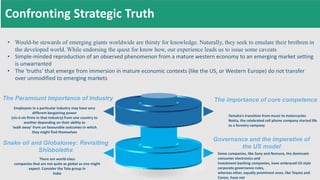
• Would-be stewards of emerging giants worldwide are thirsty for knowledge. Naturally, they seek to emulate their brethren in
the developed world. While endorsing the quest for know how, our experience leads us to issue some caveats
• Simple-minded reproduction of an observed phenomenon from a mature western economy to an emerging market setting
is unwarranted
• The ‘truths’ that emerge from immersion in mature economic contexts (like the US, or Western Europe) do not transfer
over unmodified to emerging markets
There are world-class
companies that are not quite as global as one might
expect. Consider the Tata group in
India
Snake oil and Globaloney: Revisiting
Shibboleths
Employees in a particular industry may have very
different bargaining power
(vis-à-vis firms in that industry) from one country to
another depending on their ability to
‘walk away’ from un favourable outcomes in which
they might find themselves
The Paramount Importance of Industry
Some companies, like Sony and Nomura, the dominant
consumer electronics and
investment banking companies, have embraced US style
corporate governance rules,
whereas other, equally prominent ones, like Toyota and
Canon, have not
Governance and the imperative of
the US model
Yamaha’s transition from music to motorcycles
Nokia, the celebrated cell phone company started life
as a forestry company
The importance of core competence
Confronting Strategic Truth
THANK YOU

Emerging Giants

  • 1.
    Emerging Giants: Building WorldClass Companies From Emerging Markets Group 8 Payal Agrawal (F003) | Ajith Konda (F028) | Aditi Goyal (F017) | Abhishek Tater (F062) | Vandita Singh (F058) | Mrityunjay Dhamar (F016) | Anand Krishnan (F029)
  • 2.
    Introduction  Emerging markets– China , India, and Brazil  Goal - To be globally competitive and to exploit new globalization opportunities  Challenge – To compete with multinational companies Multinationals –  They are well established, and therefore have the benefits of incumbency: brand name, organizational capabilities, and advanced technologies  They can also leverage their access to vast resources – finances, talent, and supplier and distribution networks in their home markets
  • 3.
    What Emerging Giantsdo not have?  They come from economies that suffer from severe market failures  They often lack good infrastructure  When their economies open up, emerging market companies are forced to compete with their advanced market counterparts  They cannot access risk capital with the same ease and cost  They are hampered by unreliable quality of their supply network There is a concern about being wiped out in their domestic market by multinationals when their domestic markets open However, there are a growing set of companies that appear to buck these odds, and have done well in their battles against multinationals
  • 4.
    Achieving Competitive Advantageagainst Multinationals Emerging market companies can turn the disadvantages into an advantage  Managers at local companies know how to work around the institutional voids which is difficult for the MNCs  MNCs are reluctant to tailor their strategies, products, services, and communications for developing market as its costly , cumbersome and risky  Getting listed on NYSE or Nasdaq, it becomes easy for them to access to the capital the same way American multinationals do  Several emerging companies have been successful to cope up with local institutional voids by developing their own internal organizational mechanism
  • 5.
    Achieving Competitive AdvantageAgainst Multinationals Generic business opportunities where building competitive advantage is likely Three generic ways to do it :  Capitalize on institutional voids in the product markets  Capitalize on institutional voids in the factor markets  Alleviate institutional voids Generic Opportunity 1 : Exploiting unique knowledge of domestic product markets  The emerging companies capitalize on their knowledge of a unique local product market situation  They also exploit the similarities in the geographically nearer countries Ex - Jollibees in the Philippines, Nandos n S Africa They used their mastery of unique taste of their domestic market to expand globally Ex - Haier
  • 6.
    Achieving Competitive AdvantageAgainst Multinationals Generic Opportunity 2 : Exploiting unique knowledge of domestic factor markets  They capitalize on their knowledge about the local factors of production like talent, and capital markets.  Some capitalize on the knowledge of their supply chain Ex – Indian IT majors – TCS, Infosys
  • 7.
    Achieving Competitive AdvantageAgainst Multinationals Generic Opportunity 3 : Exploiting Local Institutional voids as business opportunities 2 types of market institutions: 1. Facilitate credible information flow in the market e.g.. ISO certification, GMAC, Stock Market, Publications rating universities and schools 2. Facilitate transaction through aggregation and distribution of goods and services or by creating forums where seller and buyer can transact directly. e.g.. Banks, retailers, labour unions. EBay, online job portals  Potential advantages to Emerging market business: a. Human capital intensive. b. Information intensive. c. Government give national importance to these institutions.  Limitations: a. Opportunities are limited if market size is small. b. Market is segmented into global and local piece. E.g. Citicorp
  • 8.
    Journey From PresenceIn Local Market To Global Market Identified countries of interest  Jeffery Garten – Big 10 Emerging Markets  Countries that attracted attention of Global investors- included in the investment portfolio of big mutual fund companies e.g.. Fidelity, Vanguard (Brazil, China, Mexico, India, South Africa, South Korea)  Included countries that were frequently discussed. (Argentina, Indonesia, Turkey, Poland)  To include companies of these countries- -Forbes Global 500 and Forbes International 500 lists -Companies where investors have invested  Included companies from International History of Company Directories  So total now there were 134 firms.
  • 9.
    SAB build itsplant capability and distribution network through incremental growth • The inside-out approach is deemed to be the better approach for expansion for firms in emerging economies : South African Breweries(SAB) 8/3/2017 9 Developed unique ability to distribute beer outside formal channels thereby reaching black south African population during the apartheid period Tailored local tastes for Southern African countries Entered Eastern Europe, China, India and finally the US Precedence
  • 10.
    International expansion primarily ina single product line, without much product diversification Frequent divestitures and access to capital markets, possibly indicating a cash shortage Tendency to build a strong domestic base by domestic acquisitions before international expansion. Cluster 5 Cluster 4 Cluster 3 Cluster 2 Cluster 1 Companies that focused on product diversification, often with joint ventures A small group characterized by many organizational structure changes or ownership/management changes Types of Company’s Approach
  • 11.
    • Would-be stewardsof emerging giants worldwide are thirsty for knowledge. Naturally, they seek to emulate their brethren in the developed world. While endorsing the quest for know how, our experience leads us to issue some caveats • Simple-minded reproduction of an observed phenomenon from a mature western economy to an emerging market setting is unwarranted • The ‘truths’ that emerge from immersion in mature economic contexts (like the US, or Western Europe) do not transfer over unmodified to emerging markets There are world-class companies that are not quite as global as one might expect. Consider the Tata group in India Snake oil and Globaloney: Revisiting Shibboleths Employees in a particular industry may have very different bargaining power (vis-à-vis firms in that industry) from one country to another depending on their ability to ‘walk away’ from un favourable outcomes in which they might find themselves The Paramount Importance of Industry Some companies, like Sony and Nomura, the dominant consumer electronics and investment banking companies, have embraced US style corporate governance rules, whereas other, equally prominent ones, like Toyota and Canon, have not Governance and the imperative of the US model Yamaha’s transition from music to motorcycles Nokia, the celebrated cell phone company started life as a forestry company The importance of core competence Confronting Strategic Truth
  • 12.

Editor's Notes

  • #5  Ex- Samsung in Korea, Ayala Group in Philippines, Tata group in India