Nominal and VerbalSentences
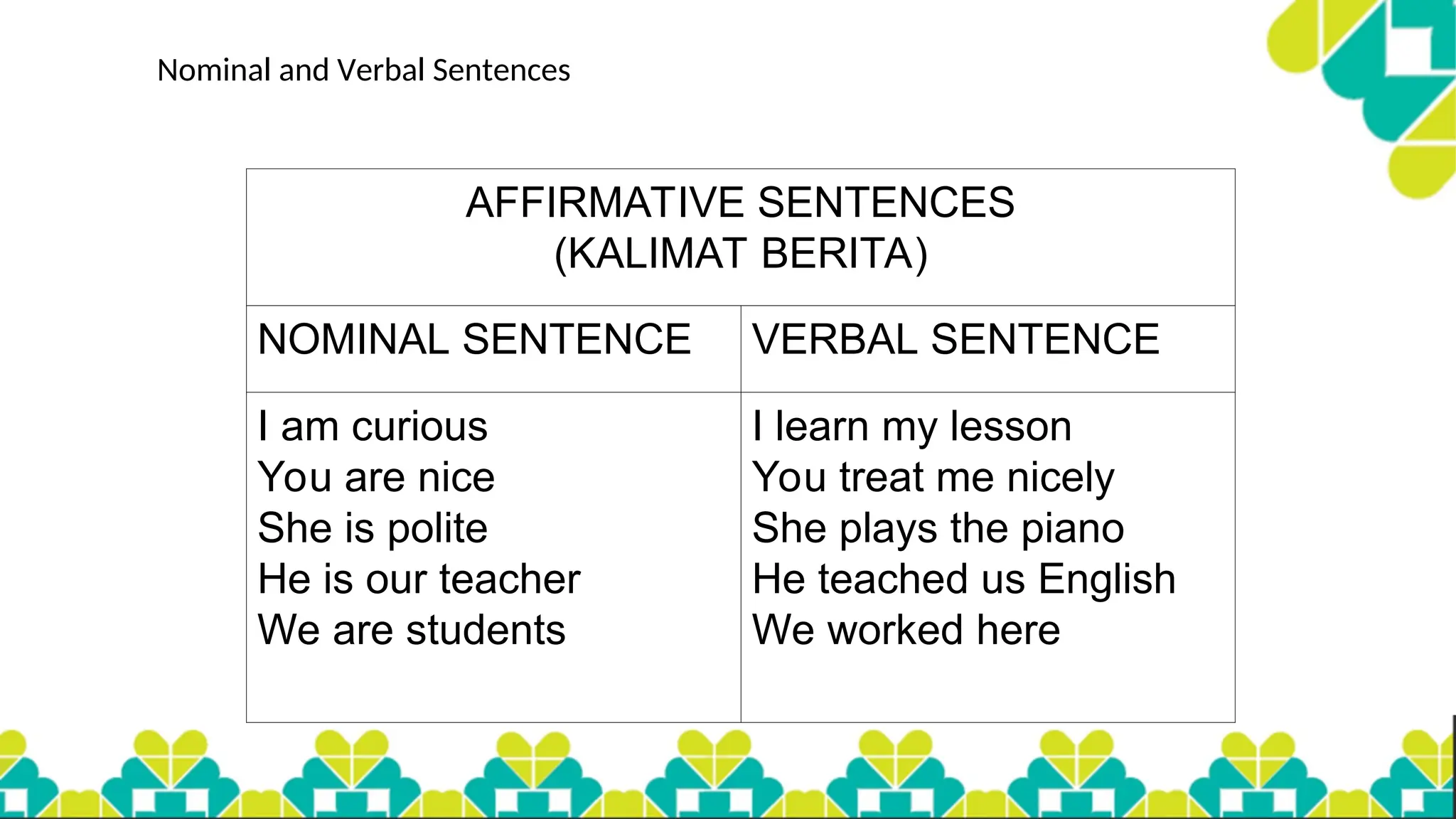
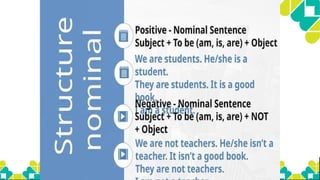
AFFIRMATIVE SENTENCES
(KALIMAT BERITA)
NOMINAL SENTENCE VERBAL SENTENCE
I am curious
You are nice
She is polite
He is our teacher
We are students
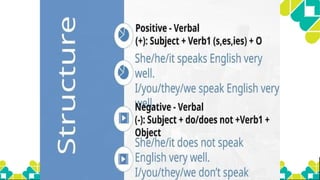
I learn my lesson
You treat me nicely
She plays the piano
He teached us English
We worked here
2.
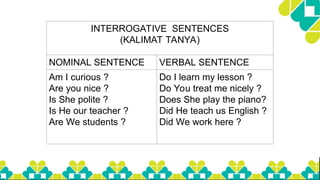
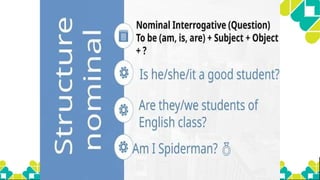
INTERROGATIVE SENTENCES
(KALIMAT TANYA)
NOMINALSENTENCE VERBAL SENTENCE
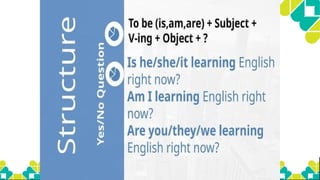
Am I curious ?
Are you nice ?
Is She polite ?
Is He our teacher ?
Are We students ?
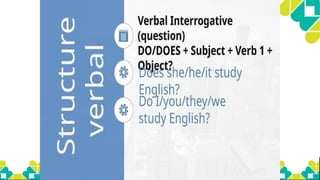
Do I learn my lesson ?
Do You treat me nicely ?
Does She play the piano?
Did He teach us English ?
Did We work here ?
3.
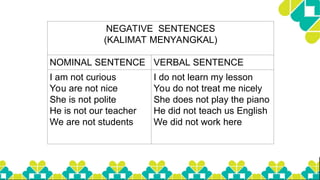
NEGATIVE SENTENCES
(KALIMAT MENYANGKAL)
NOMINALSENTENCE VERBAL SENTENCE
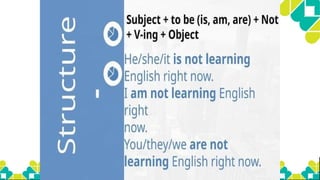
I am not curious
You are not nice
She is not polite
He is not our teacher
We are not students
I do not learn my lesson
You do not treat me nicely
She does not play the piano
He did not teach us English
We did not work here
38.
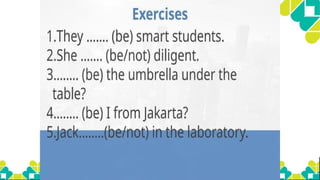
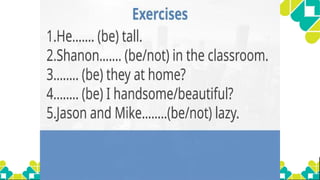
Exercise I
Arrange thefollowing words, so we will get the right sequence
words and meaningful sentences.
1. hydrogen / oxygen / and / water / each other / to
form / combine
2. three atoms / ozone / in / its molecule / contains
3. result / excellent / what a / this is
4. litmus paper / changes / in / solution / acid / the
color of
5. Rutherford / in 1817 / atomic theory / introduced
39.
Combined Sentence
•Combined sentenceis formed from the
combination of two or more simple sentences
•The word used to combine simple sentences is
called conjunctions. Besides and the other
words used as conjunction are: and then, but,
for, or, so, either ... or; Neither ... nor; not only
..,. but also.
40.
Example :
• Nitricacid is a strong acid.
• It can oxidise carbon compound.
•Nitric acid is a strong acid and can oxidise carbon
compound.
If the combined sentences have the same subject, the
subject is usually not written down repeatedly
Example :
• Acids react with metals.
• Acids have the ability to change the colour of indicators.
• Acids react with metals and have the ability to change
the colour of indicators
41.
Conversely, if thesubject is different, the two subjects
have to be written down in its own clause
Example :
• at the beginning of reaction, the concentration of product shows
the greatest rate of increase.
• at the beginning of reaction, the concentrations of reactants
show the highest rate of decrease.
•At the beginning of reaction, the concentration of
product shows the greatest rate of increase and the
concentrations of reactants show the highest rate of
decrease
42.
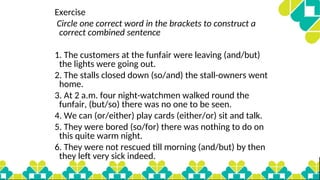
Exercise
Circle one correctword in the brackets to construct a
correct combined sentence
1. The customers at the funfair were leaving (and/but)
the lights were going out.
2. The stalls closed down (so/and) the stall-owners went
home.
3. At 2 a.m. four night-watchmen walked round the
funfair, (but/so) there was no one to be seen.
4. We can (or/either) play cards (either/or) sit and talk.
5. They were bored (so/for) there was nothing to do on
this quite warm night.
6. They were not rescued till morning (and/but) by then
they left very sick indeed.
43.
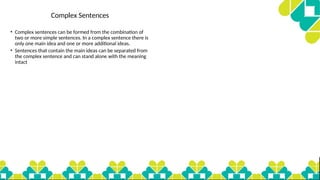
Complex Sentences
• Complexsentences can be formed from the combination of
two or more simple sentences. In a complex sentence there is
only one main idea and one or more additional ideas.
• Sentences that contain the main ideas can be separated from
the complex sentence and can stand alone with the meaning
intact
44.
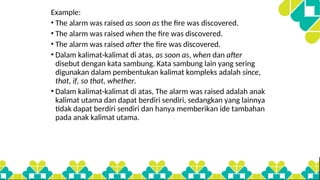
Example:
• The alarmwas raised as soon as the fire was discovered.
• The alarm was raised when the fire was discovered.
• The alarm was raised after the fire was discovered.
• Dalam kalimat-kalimat di atas, as soon as, when dan after
disebut dengan kata sambung. Kata sambung lain yang sering
digunakan dalam pembentukan kalimat kompleks adalah since,
that, if, so that, whether.
• Dalam kalimat-kalimat di atas, The alarm was raised adalah anak
kalimat utama dan dapat berdiri sendiri, sedangkan yang lainnya
tidak dapat berdiri sendiri dan hanya memberikan ide tambahan
pada anak kalimat utama.
45.
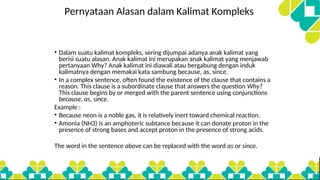
Pernyataan Alasan dalamKalimat Kompleks
• Dalam suatu kalimat kompleks, sering dijumpai adanya anak kalimat yang
berisi suatu alasan. Anak kalimat ini merupakan anak kalimat yang menjawab
pertanyaan Why? Anak kalimat ini diawali atau bergabung dengan induk
kalimatnya dengan memakai kata sambung because, as, since.
• In a complex sentence, often found the existence of the clause that contains a
reason. This clause is a subordinate clause that answers the question Why?
This clause begins by or merged with the parent sentence using conjunctions
because, as, since.
Example :
• Because neon is a noble gas, it is relatively inert toward chemical reaction.
• Amonia (NH3) is an amphoteric subtance because it can donate proton in the
presence of strong bases and accept proton in the presence of strong acids.
The word in the sentence above can be replaced with the word as or since.
46.
• As neonis a noble gas, it is relatively inert toward chemical reaction. Since neon is a noble gas,
it is relatively inert toward chemical reaction.
• Amonia (NH3) is an amphoteric subtance since it can donate proton in the presence of strong
bases and accept proton in the presence of strong acids.
47.
• Pernyataan Kontradiksidalam Kalimat Kompleks
• Adanya kontradiksi dalam kalimat kompleks dapat ditandai
dengan adanya kata sambung seperti although, considering
(that), though, eventhough, even if, much as, while dan
whereas.
48.
• Though Ihave had more than 100 experimental data, I am still
confuse to draw any conclusion.
• I am going to buy a computer even though I have not got
much money.
• I intend to do experiment till night to day even if I have
mathematics examination tomorrow
49.
• Combine thesentences below by using the
available words in the brackets.
1. I would like to help you. I am afraid I will not
be able to. (much as)
2. Your design is excellent. It is not suitable foe
our purposes. (while)
3. I try hard to play the piano. I do not seem to
improve. (although)
4. Chemistry is so difficult. It is surprising how
many students learn it. (considering that)
5. The play was wonderful. The film was a
commercial failure. (whereas)
50.
• Pernyataan Hasildalam Kalimat Kompleks
• Pernyataan hasil dapat terungkap dari kata sambung so + kata
sifat (that) atau such + kata benda (that)
51.
• The acidbase reaction is so fast that it is difficult to determine
the reaction rate.
• There were such a delay that I missed my English lesson
52.
• Pernyataan Perbandingandalam Kalimat Kompleks
• Adanya perbandingan dalam kalimat kompleks ditandai oleh
adanya kata sambung as .... as, not so ..... as, not ..... as much
as, kata perbandingan + than
53.
1. The courseGeneral Biology is not as difficult as the
course Biochemistry.
2. Woods are not so strong as metals.
3. This computer do not hold information as much as that
one.
4. Light travels faster than sound
54.
• Susunan PresentParticiple dalam Kalimat Kompleks
• Present Participle adalah kata kerja bentuk –ing, seperti
finding, recording, dan trying. Present Participle dapat
digunakan untuk menggantikan kata sambung so, and, dan
lainnya dalam menggabungkan dua kalimat sederhana
55.
• I foundmy beaker glass was broken. I looked for
new beaker glass
• Dapat digabung menjadi :I found my beaker glass
was broken and looked for the new one, atau
• Finding my beaker glass was broken, I looked for
the new one.
• Contoh lain :
• Not knowing the chemical formula, I was not
able to count its molecular weight (not knowing =
I did not know)
• Being lack of phenolphthalein, I used litmus
paper (being = I was)
56.
•Present Participle seringpula digunakan setelah kata
sambung, seperti:
•Present Particile is often used after conjunctions, such
as:
•Since I learnt Advanced Calculus, I have made
significant progress on mastering Chemical
Thermodynamics
•Dapat dinyatakan sebagai :
•Can be expressed as:
•Since learning Advanced Calculus, I have made
significant progress on mastering Chemical
Thermodynamics
57.
•Present Participle sebagaipengganti kata ganti orang
atau barang :
•Present Participle can also function as a pronoun
•Student who is reading at the classroom corner is very
clever
•Bottle which is lying on that table contains
concentrated hydrochloric acid
•Masing-masing dapat dinyatakan sebagai :
•Each can be expressed as:
•Student reading at the classroom corner is very clever
•Bottle lying on that table contains concentrated
hydrochloric acid
58.
• Susunan PresentParticiple dalam Kalimat Kompleks
• Present Participle adalah kata kerja bentuk III, seperti built,
played, reacted, dan sebagainya. Present Participle dapat
digunakan sebagai ganti bentuk pasif.
• Present Participle is a verb form III, as built, played, reacted,
and so forth. Present Participle can be used as a substitution of
the passive form.
• If stirred continuously, it will mix faster (If it is stirred ...)
• Although reacted hours ago, the product was not formed (It
was reacted...)
• Present Participle dapat menggantikan kata ganti who dan
which
• Present Participle can replace the pronoun Who and Which.
• The system used here is very successful (which is used...)