LESSON
OBJECTIVES
Understand the componentsof simple,
compound, complex, and compound-complex
sentences
Recognize and differentiate between simple,
compound, complex, and compound-complex
sentences
Review the basic building blocks of a sentence
3.
WHAT MAKES A
SENTENCE?
Endswith punctuation (period, question mark,
exclamation point)
Contains a subject—who or what the sentence is
about
Begins with a capital letter
Contains a predicate—what the subject does or is
4.
SIMPLE
SENTENCES
example
s:
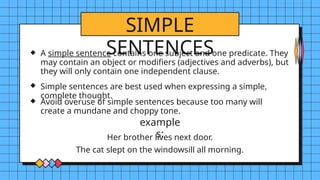
A simple sentencecontains one subject and one predicate. They
may contain an object or modifiers (adjectives and adverbs), but
they will only contain one independent clause.
Simple sentences are best used when expressing a simple,
complete thought.
Avoid overuse of simple sentences because too many will
create a mundane and choppy tone.
Her brother lives next door.
The cat slept on the windowsill all morning.
5.
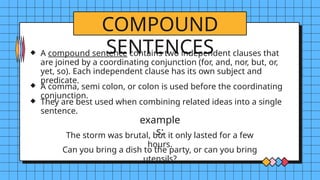
COMPOUND
SENTENCES
example
s:
A compound sentencecontains two independent clauses that
are joined by a coordinating conjunction (for, and, nor, but, or,
yet, so). Each independent clause has its own subject and
predicate.
A comma, semi colon, or colon is used before the coordinating
conjunction.
They are best used when combining related ideas into a single
sentence.
The storm was brutal, but it only lasted for a few
hours.
Can you bring a dish to the party, or can you bring
utensils?
6.
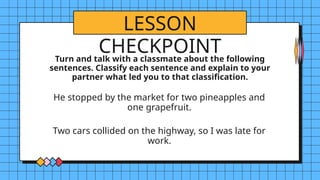
LESSON
CHECKPOINT
Turn and talkwith a classmate about the following
sentences. Classify each sentence and explain to your
partner what led you to that classification.
He stopped by the market for two pineapples and
one grapefruit.
Two cars collided on the highway, so I was late for
work.
7.
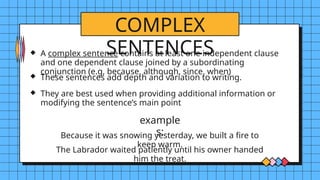
COMPLEX
SENTENCES
example
s:
A complex sentencecontains at least one independent clause
and one dependent clause joined by a subordinating
conjunction (e.g, because, although, since, when)
These sentences add depth and variation to writing.
They are best used when providing additional information or
modifying the sentence’s main point
Because it was snowing yesterday, we built a fire to
keep warm.
The Labrador waited patiently until his owner handed
him the treat.
8.
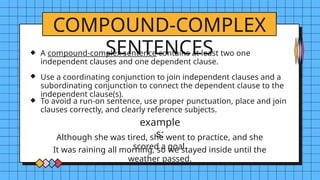
COMPOUND-COMPLEX
SENTENCES
example
s:
A compound-complex sentencecontains at least two one
independent clauses and one dependent clause.
Use a coordinating conjunction to join independent clauses and a
subordinating conjunction to connect the dependent clause to the
independent clause(s).
To avoid a run-on sentence, use proper punctuation, place and join
clauses correctly, and clearly reference subjects.
Although she was tired, she went to practice, and she
scored a goal.
It was raining all morning, so we stayed inside until the
weather passed.
9.
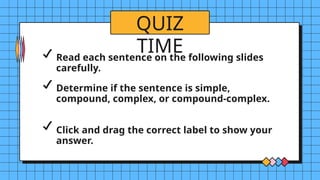
QUIZ
TIME
Read each sentenceon the following slides
carefully.
Determine if the sentence is simple,
compound, complex, or compound-complex.
Click and drag the correct label to show your
answer.
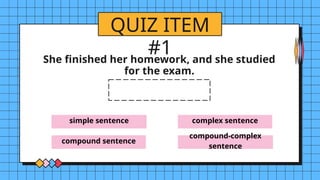
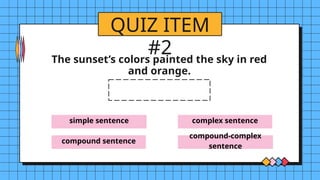
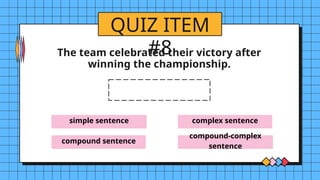
simple sentence
compound sentence
complexsentence
compound-complex
sentence
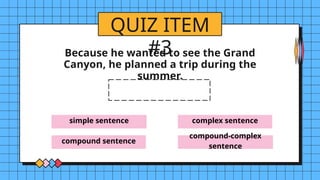
QUIZ ITEM
#3
Because he wanted to see the Grand
Canyon, he planned a trip during the
summer.
simple sentence
compound sentence
complexsentence
compound-complex
sentence
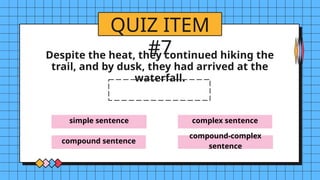
QUIZ ITEM
#7
Despite the heat, they continued hiking the
trail, and by dusk, they had arrived at the
waterfall.
PRESS THESE KEYSWHILE IN
PRESENT MODE
B for blur
D for drumroll
O for bubbles
U for unveil
C for confetti
M for mic
drop
Q for quiet
Any number
from 0-9 for
timer