PANNEERSELVAM,
TEACHER,
AVVAIYAR GOVT. GIRLS HIGHER
SECONDARY SCHOOL,
DHARMAPURI,
TAMILNADU, INDIA.
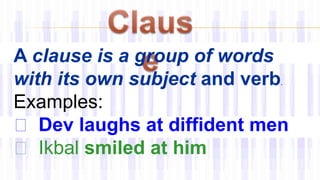
A clause is a group of words
with its own subject and verb.
Examples:
Dev laughs at diffident men
Ikbal smiled at him
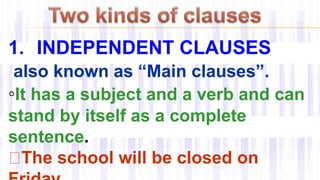
1. INDEPENDENT CLAUSES
also known as “Main clauses”.
◦It has a subject and a verb and can
stand by itself as a complete
sentence.
The school will be closed on
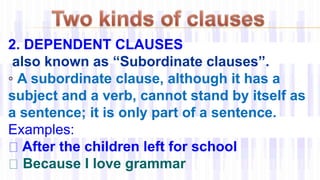
2. DEPENDENT CLAUSES
also known as “Subordinate clauses”.
◦ A subordinate clause, although it has a
subject and a verb, cannot stand by itself as
a sentence; it is only part of a sentence.
Examples:
After the children left for school
Because I love grammar
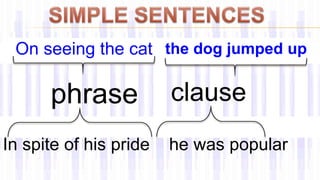
. On seeing the cat the dog jumped up
phrase clause
In spite of his pride he was popular
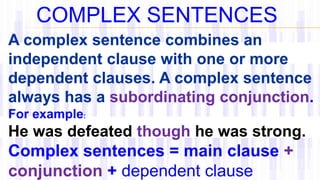
COMPLEX SENTENCES
A complex sentence combines an
independent clause with one or more
dependent clauses. A complex sentence
always has a subordinating conjunction.
For example:
He was defeated though he was strong.
Complex sentences = main clause +
conjunction + dependent clause
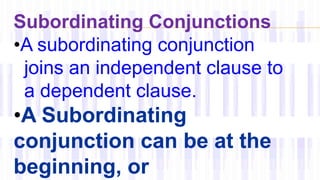
Subordinating Conjunctions
•A subordinating conjunction
joins an independent clause to
a dependent clause.
•A Subordinating
conjunction can be at the
beginning, or
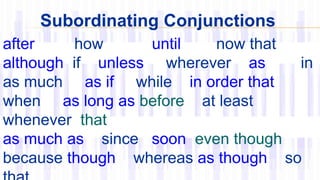
Subordinating Conjunctions
after how until now that
although if unless wherever as in
as much as if while in order that
when as long as before at least
whenever that
as much as since soon even though
because though whereas as though so
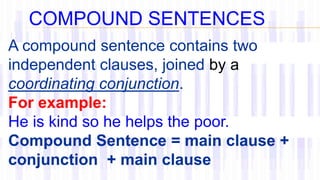
A compound sentence contains two
independent clauses, joined by a
coordinating conjunction.
For example:
He is kind so he helps the poor.
Compound Sentence = main clause +
conjunction + main clause
COMPOUND SENTENCES
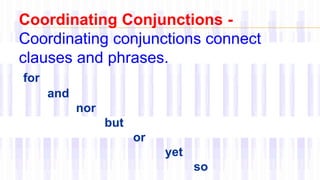
Coordinating Conjunctions -
Coordinating conjunctions connect
clauses and phrases.
for
and
nor
but
or
yet
so
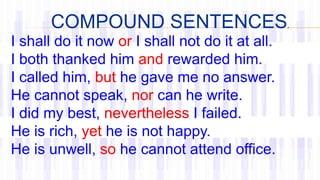
COMPOUND SENTENCES.
I shall do it now or I shall not do it at all.
I both thanked him and rewarded him.
I called him, but he gave me no answer.
He cannot speak, nor can he write.
I did my best, nevertheless I failed.
He is rich, yet he is not happy.
He is unwell, so he cannot attend office.
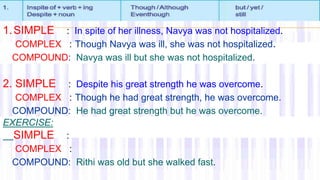
1.SIMPLE : In spite of her illness, Navya was not hospitalized.
COMPLEX : Though Navya was ill, she was not hospitalized.
COMPOUND: Navya was ill but she was not hospitalized.
2. SIMPLE : Despite his great strength he was overcome.
COMPLEX : Though he had great strength, he was overcome.
COMPOUND: He had great strength but he was overcome.
EXERCISE:
SIMPLE :
COMPLEX :
COMPOUND: Rithi was old but she walked fast.
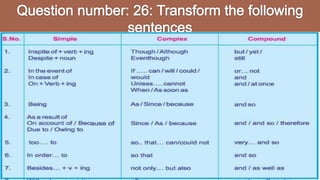
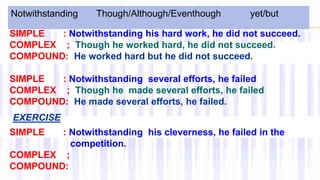
Notwithstanding Though/Although/Eventhough yet/but
SIMPLE : Notwithstanding his hard work, he did not succeed.
COMPLEX ; Though he worked hard, he did not succeed.
COMPOUND: He worked hard but he did not succeed.
SIMPLE : Notwithstanding several efforts, he failed
COMPLEX ; Though he made several efforts, he failed
COMPOUND: He made several efforts, he failed.
SIMPLE : Notwithstanding his cleverness, he failed in the
competition.
COMPLEX ;
COMPOUND:
EXERCISE
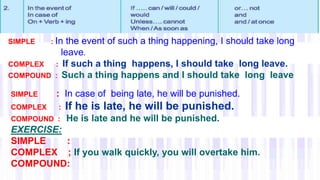
SIMPLE : In the event of such a thing happening, I should take long
leave.
COMPLEX : If such a thing happens, I should take long leave.
COMPOUND : Such a thing happens and I should take long leave
SIMPLE : In case of being late, he will be punished.
COMPLEX : If he is late, he will be punished.
COMPOUND : He is late and he will be punished.
EXERCISE:
SIMPLE :
COMPLEX ; If you walk quickly, you will overtake him.
COMPOUND:
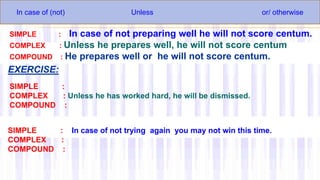
In case of (not) Unless or/ otherwise
SIMPLE : In case of not preparing well he will not score centum.
COMPLEX : Unless he prepares well, he will not score centum
COMPOUND : He prepares well or he will not score centum.
EXERCISE:
SIMPLE :
COMPLEX : Unless he has worked hard, he will be dismissed.
COMPOUND :
SIMPLE : In case of not trying again you may not win this time.
COMPLEX :
COMPOUND :
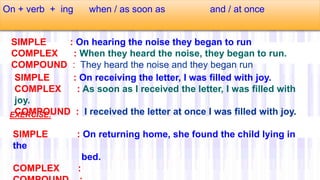
On + verb + ing when / as soon as and / at once
SIMPLE : On hearing the noise they began to run
COMPLEX : When they heard the noise, they began to run.
COMPOUND : They heard the noise and they began run
SIMPLE : On receiving the letter, I was filled with joy.
COMPLEX : As soon as I received the letter, I was filled with
joy.
COMPOUND : I received the letter at once I was filled with joy.
SIMPLE : On returning home, she found the child lying in
the
bed.
COMPLEX :
EXERCISE:
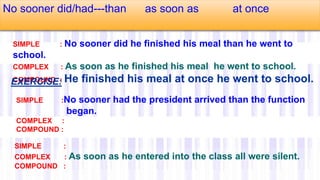
No sooner did/had---than as soon as at once
SIMPLE : No sooner did he finished his meal than he went to
school.
COMPLEX : As soon as he finished his meal he went to school.
COMPOUND : He finished his meal at once he went to school.
SIMPLE :No sooner had the president arrived than the function
began.
COMPLEX :
COMPOUND :
SIMPLE :
COMPLEX : As soon as he entered into the class all were silent.
COMPOUND :
EXERCISE:
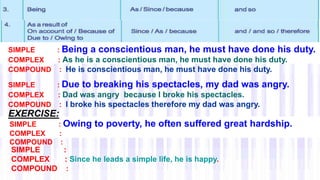
SIMPLE : Being a conscientious man, he must have done his duty.
COMPLEX : As he is a conscientious man, he must have done his duty.
COMPOUND : He is conscientious man, he must have done his duty.
SIMPLE : Due to breaking his spectacles, my dad was angry.
COMPLEX : Dad was angry because I broke his spectacles.
COMPOUND : I broke his spectacles therefore my dad was angry.
SIMPLE : Owing to poverty, he often suffered great hardship.
COMPLEX :
COMPOUND :
EXERCISE:
SIMPLE :
COMPLEX : Since he leads a simple life, he is happy.
COMPOUND :
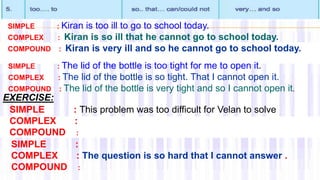
SIMPLE : Kiran is too ill to go to school today.
COMPLEX : Kiran is so ill that he cannot go to school today.
COMPOUND : Kiran is very ill and so he cannot go to school today.
SIMPLE : The lid of the bottle is too tight for me to open it.
COMPLEX : The lid of the bottle is so tight. That I cannot open it.
COMPOUND : The lid of the bottle is very tight and so I cannot open it.
SIMPLE : This problem was too difficult for Velan to solve
COMPLEX :
COMPOUND :
EXERCISE:
SIMPLE :
COMPLEX : The question is so hard that I cannot answer .
COMPOUND :
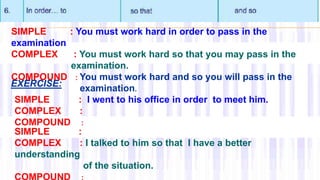
SIMPLE : You must work hard in order to pass in the
examination
COMPLEX : You must work hard so that you may pass in the
examination.
COMPOUND : You must work hard and so you will pass in the
examination.
SIMPLE : I went to his office in order to meet him.
COMPLEX :
COMPOUND :
EXERCISE:
SIMPLE :
COMPLEX : I talked to him so that I have a better
understanding
of the situation.
COMPOUND :
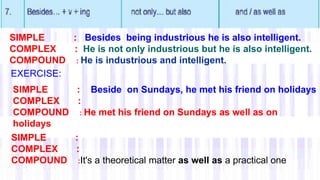
SIMPLE : Besides being industrious he is also intelligent.
COMPLEX : He is not only industrious but he is also intelligent.
COMPOUND : He is industrious and intelligent.
SIMPLE : Beside on Sundays, he met his friend on holidays
COMPLEX :
COMPOUND : He met his friend on Sundays as well as on
holidays
SIMPLE :
COMPLEX :
COMPOUND :It's a theoretical matter as well as a practical one
EXERCISE:
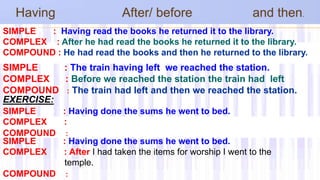
SIMPLE : Having read the books he returned it to the library.
COMPLEX : After he had read the books he returned it to the library.
COMPOUND : He had read the books and then he returned to the library.
SIMPLE : The train having left we reached the station.
COMPLEX : Before we reached the station the train had left
COMPOUND : The train had left and then we reached the station.
EXERCISE:
SIMPLE : Having done the sums he went to bed.
COMPLEX :
COMPOUND :
SIMPLE : Having done the sums he went to bed.
COMPLEX : After I had taken the items for worship I went to the
temple.
COMPOUND :
OTHER TYPES FOR TRANSFORMATION THE SENTENCES.
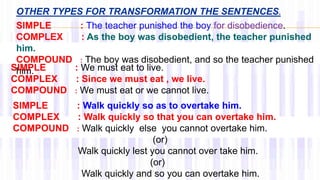
SIMPLE : The teacher punished the boy for disobedience.
COMPLEX : As the boy was disobedient, the teacher punished
him.
COMPOUND : The boy was disobedient, and so the teacher punished
him.SIMPLE : We must eat to live.
COMPLEX : Since we must eat , we live.
COMPOUND : We must eat or we cannot live.
SIMPLE : Walk quickly so as to overtake him.
COMPLEX : Walk quickly so that you can overtake him.
COMPOUND : Walk quickly else you cannot overtake him.
(or)
Walk quickly lest you cannot over take him.
(or)
Walk quickly and so you can overtake him.
OTHER TYPES FOR TRANSFORMATION THE SENTENCES
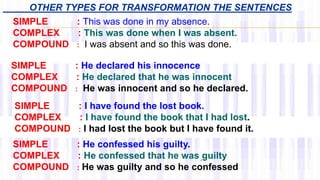
SIMPLE : He confessed his guilty.
COMPLEX : He confessed that he was guilty
COMPOUND : He was guilty and so he confessed
.
SIMPLE : He declared his innocence
COMPLEX : He declared that he was innocent
COMPOUND : He was innocent and so he declared.
SIMPLE : I have found the lost book.
COMPLEX : I have found the book that I had lost.
COMPOUND : I had lost the book but I have found it.
SIMPLE : This was done in my absence.
COMPLEX : This was done when I was absent.
COMPOUND : I was absent and so this was done.
OTHER TYPES FOR TRANSFORMATION THE SENTENCES.
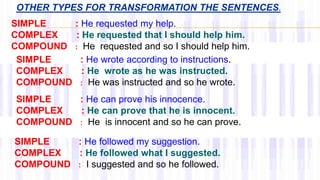
SIMPLE : He requested my help.
COMPLEX : He requested that I should help him.
COMPOUND : He requested and so I should help him.
SIMPLE : He wrote according to instructions.
COMPLEX : He wrote as he was instructed.
COMPOUND : He was instructed and so he wrote.
SIMPLE : He can prove his innocence.
COMPLEX : He can prove that he is innocent.
COMPOUND : He is innocent and so he can prove.
SIMPLE : He followed my suggestion.
COMPLEX : He followed what I suggested.
COMPOUND : I suggested and so he followed.
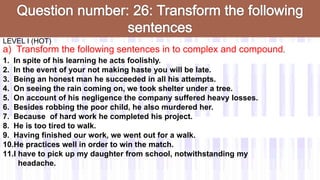
LEVEL I (HOT)
a) Transform the following sentences in to complex and compound.
1. In spite of his learning he acts foolishly.
2. In the event of your not making haste you will be late.
3. Being an honest man he succeeded in all his attempts.
4. On seeing the rain coming on, we took shelter under a tree.
5. On account of his negligence the company suffered heavy losses.
6. Besides robbing the poor child, he also murdered her.
7. Because of hard work he completed his project.
8. He is too tired to walk.
9. Having finished our work, we went out for a walk.
10.He practices well in order to win the match.
11.I have to pick up my daughter from school, notwithstanding my
headache.
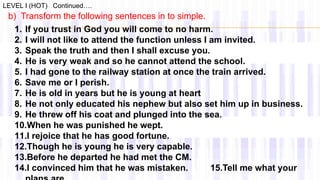
LEVEL I (HOT) Continued….
b) Transform the following sentences in to simple.
1. If you trust in God you will come to no harm.
2. I will not like to attend the function unless I am invited.
3. Speak the truth and then I shall excuse you.
4. He is very weak and so he cannot attend the school.
5. I had gone to the railway station at once the train arrived.
6. Save me or I perish.
7. He is old in years but he is young at heart
8. He not only educated his nephew but also set him up in business.
9. He threw off his coat and plunged into the sea.
10.When he was punished he wept.
11.I rejoice that he has good fortune.
12.Though he is young he is very capable.
13.Before he departed he had met the CM.
14.I convinced him that he was mistaken. 15.Tell me what your
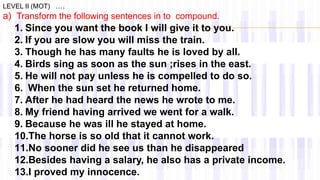
a) Transform the following sentences in to compound.
LEVEL II (MOT) ….
1. Since you want the book I will give it to you.
2. If you are slow you will miss the train.
3. Though he has many faults he is loved by all.
4. Birds sing as soon as the sun ;rises in the east.
5. He will not pay unless he is compelled to do so.
6. When the sun set he returned home.
7. After he had heard the news he wrote to me.
8. My friend having arrived we went for a walk.
9. Because he was ill he stayed at home.
10.The horse is so old that it cannot work.
11.No sooner did he see us than he disappeared
12.Besides having a salary, he also has a private income.
13.I proved my innocence.
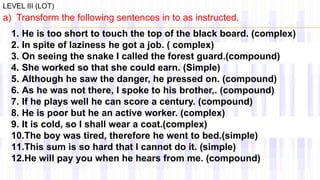
LEVEL III (LOT)
a) Transform the following sentences in to as instructed.
1. He is too short to touch the top of the black board. (complex)
2. In spite of laziness he got a job. ( complex)
3. On seeing the snake I called the forest guard.(compound)
4. She worked so that she could earn. (Simple)
5. Although he saw the danger, he pressed on. (compound)
6. As he was not there, I spoke to his brother,. (compound)
7. If he plays well he can score a century. (compound)
8. He is poor but he an active worker. (complex)
9. It is cold, so I shall wear a coat.(complex)
10.The boy was tired, therefore he went to bed.(simple)
11.This sum is so hard that I cannot do it. (simple)
12.He will pay you when he hears from me. (compound)
THANK
YOU

SIMPLE, COMPLEX AND COMPOUND SENTENCES.

  • 1.
    PANNEERSELVAM, TEACHER, AVVAIYAR GOVT. GIRLSHIGHER SECONDARY SCHOOL, DHARMAPURI, TAMILNADU, INDIA.
  • 5.
    A clause isa group of words with its own subject and verb. Examples: Dev laughs at diffident men Ikbal smiled at him
  • 6.
    1. INDEPENDENT CLAUSES alsoknown as “Main clauses”. ◦It has a subject and a verb and can stand by itself as a complete sentence. The school will be closed on
  • 7.
    2. DEPENDENT CLAUSES alsoknown as “Subordinate clauses”. ◦ A subordinate clause, although it has a subject and a verb, cannot stand by itself as a sentence; it is only part of a sentence. Examples: After the children left for school Because I love grammar
  • 8.
    . On seeingthe cat the dog jumped up phrase clause In spite of his pride he was popular
  • 9.
    COMPLEX SENTENCES A complexsentence combines an independent clause with one or more dependent clauses. A complex sentence always has a subordinating conjunction. For example: He was defeated though he was strong. Complex sentences = main clause + conjunction + dependent clause
  • 10.
    Subordinating Conjunctions •A subordinatingconjunction joins an independent clause to a dependent clause. •A Subordinating conjunction can be at the beginning, or
  • 11.
    Subordinating Conjunctions after howuntil now that although if unless wherever as in as much as if while in order that when as long as before at least whenever that as much as since soon even though because though whereas as though so
  • 12.
    A compound sentencecontains two independent clauses, joined by a coordinating conjunction. For example: He is kind so he helps the poor. Compound Sentence = main clause + conjunction + main clause COMPOUND SENTENCES
  • 13.
    Coordinating Conjunctions - Coordinatingconjunctions connect clauses and phrases. for and nor but or yet so
  • 14.
    COMPOUND SENTENCES. I shalldo it now or I shall not do it at all. I both thanked him and rewarded him. I called him, but he gave me no answer. He cannot speak, nor can he write. I did my best, nevertheless I failed. He is rich, yet he is not happy. He is unwell, so he cannot attend office.
  • 16.
    1.SIMPLE : Inspite of her illness, Navya was not hospitalized. COMPLEX : Though Navya was ill, she was not hospitalized. COMPOUND: Navya was ill but she was not hospitalized. 2. SIMPLE : Despite his great strength he was overcome. COMPLEX : Though he had great strength, he was overcome. COMPOUND: He had great strength but he was overcome. EXERCISE: SIMPLE : COMPLEX : COMPOUND: Rithi was old but she walked fast.
  • 17.
    Notwithstanding Though/Although/Eventhough yet/but SIMPLE: Notwithstanding his hard work, he did not succeed. COMPLEX ; Though he worked hard, he did not succeed. COMPOUND: He worked hard but he did not succeed. SIMPLE : Notwithstanding several efforts, he failed COMPLEX ; Though he made several efforts, he failed COMPOUND: He made several efforts, he failed. SIMPLE : Notwithstanding his cleverness, he failed in the competition. COMPLEX ; COMPOUND: EXERCISE
  • 18.
    SIMPLE : Inthe event of such a thing happening, I should take long leave. COMPLEX : If such a thing happens, I should take long leave. COMPOUND : Such a thing happens and I should take long leave SIMPLE : In case of being late, he will be punished. COMPLEX : If he is late, he will be punished. COMPOUND : He is late and he will be punished. EXERCISE: SIMPLE : COMPLEX ; If you walk quickly, you will overtake him. COMPOUND:
  • 19.
    In case of(not) Unless or/ otherwise SIMPLE : In case of not preparing well he will not score centum. COMPLEX : Unless he prepares well, he will not score centum COMPOUND : He prepares well or he will not score centum. EXERCISE: SIMPLE : COMPLEX : Unless he has worked hard, he will be dismissed. COMPOUND : SIMPLE : In case of not trying again you may not win this time. COMPLEX : COMPOUND :
  • 20.
    On + verb+ ing when / as soon as and / at once SIMPLE : On hearing the noise they began to run COMPLEX : When they heard the noise, they began to run. COMPOUND : They heard the noise and they began run SIMPLE : On receiving the letter, I was filled with joy. COMPLEX : As soon as I received the letter, I was filled with joy. COMPOUND : I received the letter at once I was filled with joy. SIMPLE : On returning home, she found the child lying in the bed. COMPLEX : EXERCISE:
  • 21.
    No sooner did/had---thanas soon as at once SIMPLE : No sooner did he finished his meal than he went to school. COMPLEX : As soon as he finished his meal he went to school. COMPOUND : He finished his meal at once he went to school. SIMPLE :No sooner had the president arrived than the function began. COMPLEX : COMPOUND : SIMPLE : COMPLEX : As soon as he entered into the class all were silent. COMPOUND : EXERCISE:
  • 22.
    SIMPLE : Beinga conscientious man, he must have done his duty. COMPLEX : As he is a conscientious man, he must have done his duty. COMPOUND : He is conscientious man, he must have done his duty. SIMPLE : Due to breaking his spectacles, my dad was angry. COMPLEX : Dad was angry because I broke his spectacles. COMPOUND : I broke his spectacles therefore my dad was angry. SIMPLE : Owing to poverty, he often suffered great hardship. COMPLEX : COMPOUND : EXERCISE: SIMPLE : COMPLEX : Since he leads a simple life, he is happy. COMPOUND :
  • 23.
    SIMPLE : Kiranis too ill to go to school today. COMPLEX : Kiran is so ill that he cannot go to school today. COMPOUND : Kiran is very ill and so he cannot go to school today. SIMPLE : The lid of the bottle is too tight for me to open it. COMPLEX : The lid of the bottle is so tight. That I cannot open it. COMPOUND : The lid of the bottle is very tight and so I cannot open it. SIMPLE : This problem was too difficult for Velan to solve COMPLEX : COMPOUND : EXERCISE: SIMPLE : COMPLEX : The question is so hard that I cannot answer . COMPOUND :
  • 24.
    SIMPLE : Youmust work hard in order to pass in the examination COMPLEX : You must work hard so that you may pass in the examination. COMPOUND : You must work hard and so you will pass in the examination. SIMPLE : I went to his office in order to meet him. COMPLEX : COMPOUND : EXERCISE: SIMPLE : COMPLEX : I talked to him so that I have a better understanding of the situation. COMPOUND :
  • 25.
    SIMPLE : Besidesbeing industrious he is also intelligent. COMPLEX : He is not only industrious but he is also intelligent. COMPOUND : He is industrious and intelligent. SIMPLE : Beside on Sundays, he met his friend on holidays COMPLEX : COMPOUND : He met his friend on Sundays as well as on holidays SIMPLE : COMPLEX : COMPOUND :It's a theoretical matter as well as a practical one EXERCISE:
  • 26.
    SIMPLE : Havingread the books he returned it to the library. COMPLEX : After he had read the books he returned it to the library. COMPOUND : He had read the books and then he returned to the library. SIMPLE : The train having left we reached the station. COMPLEX : Before we reached the station the train had left COMPOUND : The train had left and then we reached the station. EXERCISE: SIMPLE : Having done the sums he went to bed. COMPLEX : COMPOUND : SIMPLE : Having done the sums he went to bed. COMPLEX : After I had taken the items for worship I went to the temple. COMPOUND :
  • 27.
    OTHER TYPES FORTRANSFORMATION THE SENTENCES. SIMPLE : The teacher punished the boy for disobedience. COMPLEX : As the boy was disobedient, the teacher punished him. COMPOUND : The boy was disobedient, and so the teacher punished him.SIMPLE : We must eat to live. COMPLEX : Since we must eat , we live. COMPOUND : We must eat or we cannot live. SIMPLE : Walk quickly so as to overtake him. COMPLEX : Walk quickly so that you can overtake him. COMPOUND : Walk quickly else you cannot overtake him. (or) Walk quickly lest you cannot over take him. (or) Walk quickly and so you can overtake him.
  • 28.
    OTHER TYPES FORTRANSFORMATION THE SENTENCES SIMPLE : He confessed his guilty. COMPLEX : He confessed that he was guilty COMPOUND : He was guilty and so he confessed . SIMPLE : He declared his innocence COMPLEX : He declared that he was innocent COMPOUND : He was innocent and so he declared. SIMPLE : I have found the lost book. COMPLEX : I have found the book that I had lost. COMPOUND : I had lost the book but I have found it. SIMPLE : This was done in my absence. COMPLEX : This was done when I was absent. COMPOUND : I was absent and so this was done.
  • 29.
    OTHER TYPES FORTRANSFORMATION THE SENTENCES. SIMPLE : He requested my help. COMPLEX : He requested that I should help him. COMPOUND : He requested and so I should help him. SIMPLE : He wrote according to instructions. COMPLEX : He wrote as he was instructed. COMPOUND : He was instructed and so he wrote. SIMPLE : He can prove his innocence. COMPLEX : He can prove that he is innocent. COMPOUND : He is innocent and so he can prove. SIMPLE : He followed my suggestion. COMPLEX : He followed what I suggested. COMPOUND : I suggested and so he followed.
  • 30.
    LEVEL I (HOT) a)Transform the following sentences in to complex and compound. 1. In spite of his learning he acts foolishly. 2. In the event of your not making haste you will be late. 3. Being an honest man he succeeded in all his attempts. 4. On seeing the rain coming on, we took shelter under a tree. 5. On account of his negligence the company suffered heavy losses. 6. Besides robbing the poor child, he also murdered her. 7. Because of hard work he completed his project. 8. He is too tired to walk. 9. Having finished our work, we went out for a walk. 10.He practices well in order to win the match. 11.I have to pick up my daughter from school, notwithstanding my headache.
  • 31.
    LEVEL I (HOT)Continued…. b) Transform the following sentences in to simple. 1. If you trust in God you will come to no harm. 2. I will not like to attend the function unless I am invited. 3. Speak the truth and then I shall excuse you. 4. He is very weak and so he cannot attend the school. 5. I had gone to the railway station at once the train arrived. 6. Save me or I perish. 7. He is old in years but he is young at heart 8. He not only educated his nephew but also set him up in business. 9. He threw off his coat and plunged into the sea. 10.When he was punished he wept. 11.I rejoice that he has good fortune. 12.Though he is young he is very capable. 13.Before he departed he had met the CM. 14.I convinced him that he was mistaken. 15.Tell me what your
  • 32.
    a) Transform thefollowing sentences in to compound. LEVEL II (MOT) …. 1. Since you want the book I will give it to you. 2. If you are slow you will miss the train. 3. Though he has many faults he is loved by all. 4. Birds sing as soon as the sun ;rises in the east. 5. He will not pay unless he is compelled to do so. 6. When the sun set he returned home. 7. After he had heard the news he wrote to me. 8. My friend having arrived we went for a walk. 9. Because he was ill he stayed at home. 10.The horse is so old that it cannot work. 11.No sooner did he see us than he disappeared 12.Besides having a salary, he also has a private income. 13.I proved my innocence.
  • 33.
    LEVEL III (LOT) a)Transform the following sentences in to as instructed. 1. He is too short to touch the top of the black board. (complex) 2. In spite of laziness he got a job. ( complex) 3. On seeing the snake I called the forest guard.(compound) 4. She worked so that she could earn. (Simple) 5. Although he saw the danger, he pressed on. (compound) 6. As he was not there, I spoke to his brother,. (compound) 7. If he plays well he can score a century. (compound) 8. He is poor but he an active worker. (complex) 9. It is cold, so I shall wear a coat.(complex) 10.The boy was tired, therefore he went to bed.(simple) 11.This sum is so hard that I cannot do it. (simple) 12.He will pay you when he hears from me. (compound)
  • 34.