Compound Sentences
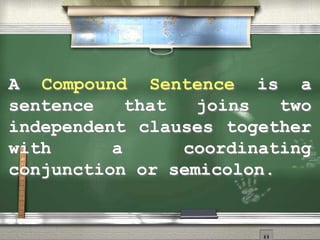
A Compound Sentence is a
sentence that joins two
independent clauses together
with a coordinating
conjunction or semicolon.
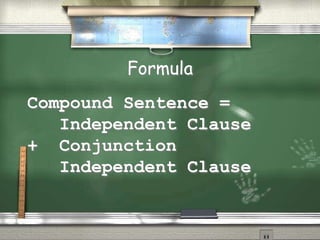
Formula
Compound Sentence =
Independent Clause
+ Conjunction
Independent Clause
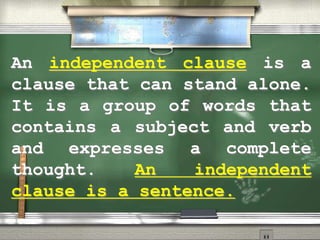
An independent clause is a
clause that can stand alone.
It is a group of words that
contains a subject and verb
and expresses a complete
thought. An independent
clause is a sentence.
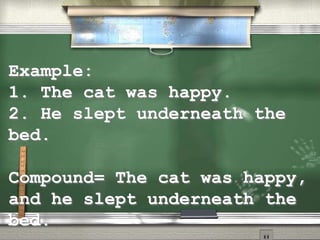
Example:
1. The cat was happy.
2. He slept underneath the
bed.
Compound= The cat was happy,
and he slept underneath the
bed.
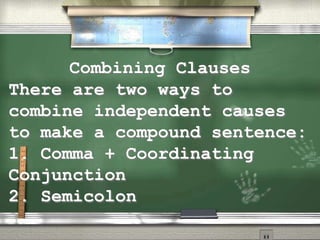
Combining Clauses
There are two ways to
combine independent causes
to make a compound sentence:
1. Comma + Coordinating
Conjunction
2. Semicolon
Comma + Coordinating
Conjunction
A coordinating conjunction
is also known as a
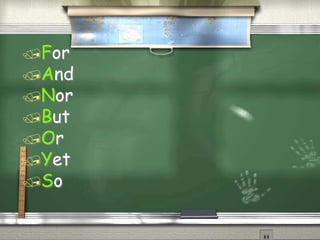
F.A.N.B.O.Y.S.
For, And, Nor, But, Or, Yet,
So.
For
And
Nor
But
Or
Yet
So
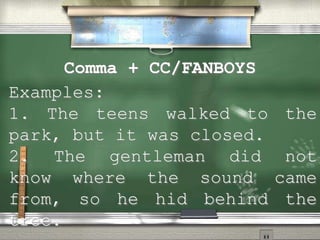
Comma + CC/FANBOYS
Examples:
1. The teens walked to the
park, but it was closed.
2. The gentleman did not
know where the sound came
from, so he hid behind the
tree.
Semicolon
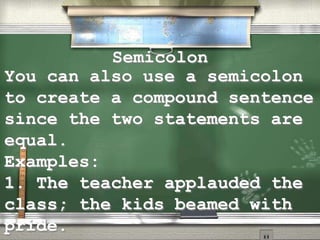
You can also use a semicolon
to create a compound sentence
since the two statements are
equal.
Examples:
1. The teacher applauded the
class; the kids beamed with
pride.
Encircle the two independent
clauses in each compound
sentence and box the
coordinating conjunction
used
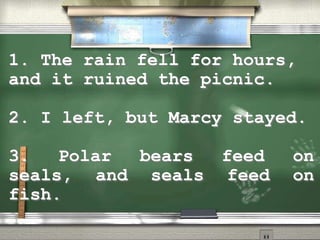
1. The rain fell for hours,
and it ruined the picnic.
2. I left, but Marcy stayed.
3. Polar bears feed on
seals, and seals feed on
fish.
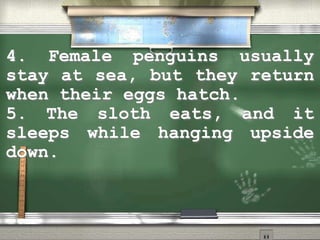
4. Female penguins usually
stay at sea, but they return
when their eggs hatch.
5. The sloth eats, and it
sleeps while hanging upside
down.
Complex Sentences
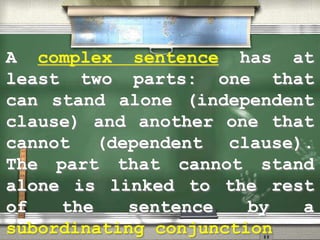
A complex sentence has at
least two parts: one that
can stand alone (independent
clause) and another one that
cannot (dependent clause).
The part that cannot stand
alone is linked to the rest
of the sentence by a
subordinating conjunction
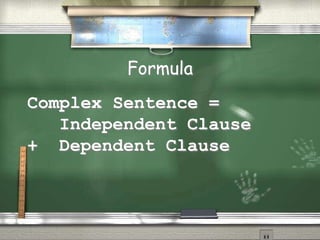
Formula
Complex Sentence =
Independent Clause
+ Dependent Clause
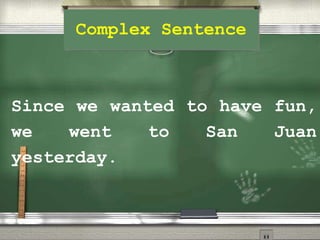
Complex Sentence
Since we wanted to have fun,
we went to San Juan
yesterday.
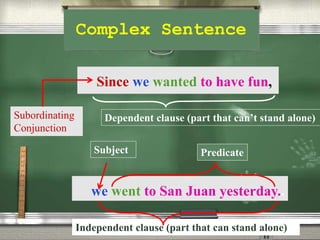
Complex Sentence
Since we wanted to have fun,
we went to San Juan yesterday..
Predicate
Subject
Subordinating
Conjunction
Dependent clause (part that can’t stand alone)
Independent clause (part that can stand alone)
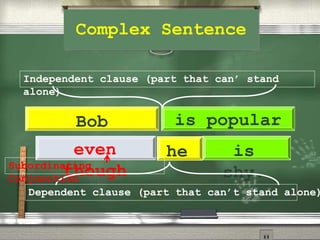
Complex Sentence
Bob is popular
he is
shy.
even
though
Independent clause (part that can’ stand
alone)
Dependent clause (part that can’t stand alone)
Subordinating
Conjunction
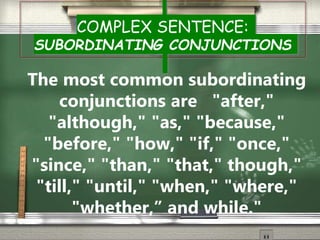
COMPLEX SENTENCE:
SUBORDINATING CONJUNCTIONS
The most common subordinating
conjunctions are "after,"
"although," "as," "because,"
"before," "how," "if," "once,"
"since," "than," "that," though,"
"till," "until," "when," "where,"
"whether,” and while."
COMPLEX SENTENCE:
SUBORDINATING CONJUNCTIONS
The most common subordinating
conjunctions are "after,"
"although," "as," "because,"
"before," "how," "if," "once,"
"since," "than," "that," though,"
"till," "until," "when," "where,"
"whether,” and while."
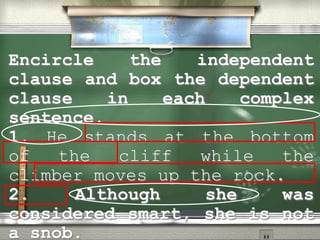
Encircle the independent
clause and box the dependent
clause in each complex
sentence.
1. He stands at the bottom
of the cliff while the
climber moves up the rock.
2. Although she was
considered smart, she is not
a snob.
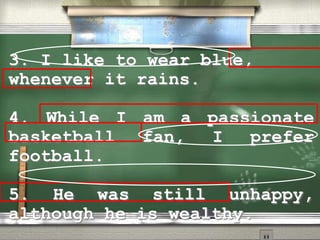
3. I like to wear blue,
whenever it rains.
4. While I am a passionate
basketball fan, I prefer
football.
5. He was still unhappy,
although he is wealthy.
Inverted Sentences
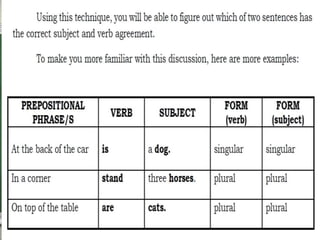
A verb must agree with its
subject, in number and in
person, i.e. a subject in
form must have a singular
verb, and the subject in the
plural form must have a
plural verb.
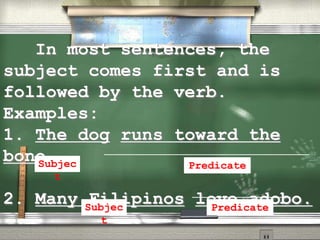
In most sentences, the
subject comes first and is
followed by the verb.
Examples:
1. The dog runs toward the
bone.
2. Many Filipinos love adobo.
Subjec
t
Predicate
Subjec
t
Predicate
Sometimes, however, the
subject and verb are reversed
or inverted, in which case
the verb comes before the
subject. The resulting
inverted sentences can cause
confusion in subject-verb
agreement.
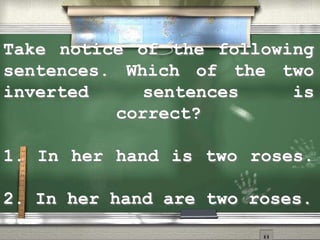
Take notice of the following
sentences. Which of the two
inverted sentences is
correct?
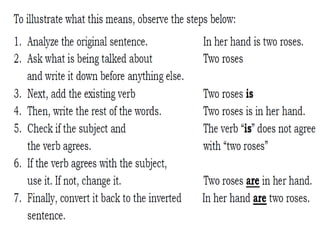
1. In her hand is two roses.
2. In her hand are two roses.
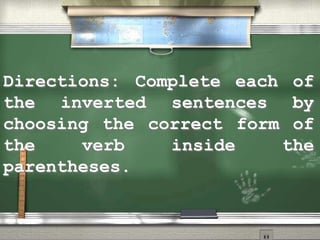
Directions: Complete each of
the inverted sentences by
choosing the correct form of
the verb inside the
parentheses.
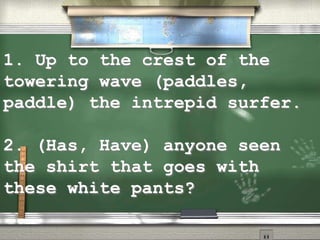
1. Up to the crest of the
towering wave (paddles,
paddle) the intrepid surfer.
2. (Has, Have) anyone seen
the shirt that goes with
these white pants?
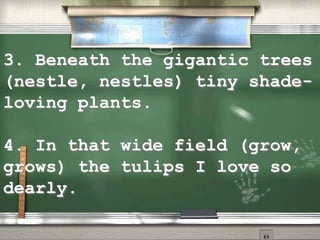
3. Beneath the gigantic trees
(nestle, nestles) tiny shade-
loving plants.
4. In that wide field (grow,
grows) the tulips I love so
dearly.
5. Here in Grade 5 Arts class
(develop, develops) the
creative minds of tomorrow.
1. Up to the crest of the
towering wave (paddles,
paddle) the intrepid surfer.
2. (Has, Have) anyone seen
the shirt that goes with
these white pants?
Adjectives
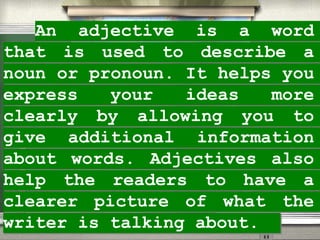
An adjective is a word
that is used to describe a
noun or pronoun. It helps you
express your ideas more
clearly by allowing you to
give additional information
about words. Adjectives also
help the readers to have a
clearer picture of what the
writer is talking about.
Like proper nouns, there
are also adjectives that need
to be capitalized; they are
called proper adjectives. A
proper adjective is a word
that modifies nouns and
pronouns and is formed from a
proper noun.
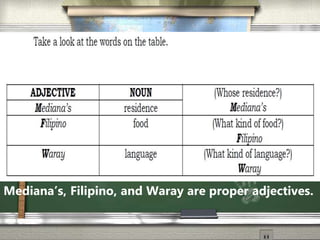
Mediana’s, Filipino, and Waray are proper adjectives.
On the other hand, some
adjectives are formed by
joining two different words
to give a new meaning. These
adjectives are called
compound adjectives. They are
usually hyphenated (-) to
avoid confusion.
Consider the following
examples:
1. Our family enjoyed the
two-day vacation we had in
Palawan.
2. Sarah Geronimo is a well-
known singer.
Also, there are other
adjectives that come after a
linking verb and modify the
subject of the linking verb.
They are called predicate
adjectives. A predicate
adjective is a subject
complement, a word or group of
words that follows a linking
verb or verb phrase such as is,
am, were, taste, look, sound,
have been and did seem.
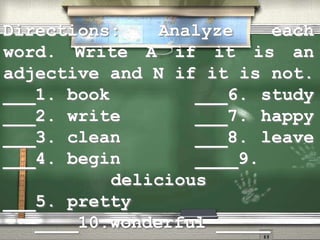
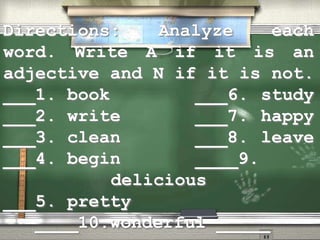
Directions: Analyze each
word. Write A if it is an
adjective and N if it is not.
___1. book ___6. study
___2. write ___7. happy
___3. clean ___8. leave
___4. begin ____9.
delicious
___5. pretty
____10.wonderful _____
Directions: Analyze each
word. Write A if it is an
adjective and N if it is not.
___1. book ___6. study
___2. write ___7. happy
___3. clean ___8. leave
___4. begin ____9.
delicious
___5. pretty
____10.wonderful _____

Compound Sentences.ppt

  • 1.
  • 2.
    A Compound Sentenceis a sentence that joins two independent clauses together with a coordinating conjunction or semicolon.
  • 3.
    Formula Compound Sentence = IndependentClause + Conjunction Independent Clause
  • 4.
    An independent clauseis a clause that can stand alone. It is a group of words that contains a subject and verb and expresses a complete thought. An independent clause is a sentence.
  • 5.
    Example: 1. The catwas happy. 2. He slept underneath the bed. Compound= The cat was happy, and he slept underneath the bed.
  • 6.
    Combining Clauses There aretwo ways to combine independent causes to make a compound sentence: 1. Comma + Coordinating Conjunction 2. Semicolon
  • 7.
    Comma + Coordinating Conjunction Acoordinating conjunction is also known as a F.A.N.B.O.Y.S. For, And, Nor, But, Or, Yet, So.
  • 8.
  • 9.
    Comma + CC/FANBOYS Examples: 1.The teens walked to the park, but it was closed. 2. The gentleman did not know where the sound came from, so he hid behind the tree.
  • 10.
    Semicolon You can alsouse a semicolon to create a compound sentence since the two statements are equal. Examples: 1. The teacher applauded the class; the kids beamed with pride.
  • 11.
    Encircle the twoindependent clauses in each compound sentence and box the coordinating conjunction used
  • 12.
    1. The rainfell for hours, and it ruined the picnic. 2. I left, but Marcy stayed. 3. Polar bears feed on seals, and seals feed on fish.
  • 13.
    4. Female penguinsusually stay at sea, but they return when their eggs hatch. 5. The sloth eats, and it sleeps while hanging upside down.
  • 14.
  • 15.
    A complex sentencehas at least two parts: one that can stand alone (independent clause) and another one that cannot (dependent clause). The part that cannot stand alone is linked to the rest of the sentence by a subordinating conjunction
  • 16.
    Formula Complex Sentence = IndependentClause + Dependent Clause
  • 17.
    Complex Sentence Since wewanted to have fun, we went to San Juan yesterday.
  • 18.
    Complex Sentence Since wewanted to have fun, we went to San Juan yesterday.. Predicate Subject Subordinating Conjunction Dependent clause (part that can’t stand alone) Independent clause (part that can stand alone)
  • 19.
    Complex Sentence Bob ispopular he is shy. even though Independent clause (part that can’ stand alone) Dependent clause (part that can’t stand alone) Subordinating Conjunction
  • 20.
    COMPLEX SENTENCE: SUBORDINATING CONJUNCTIONS Themost common subordinating conjunctions are "after," "although," "as," "because," "before," "how," "if," "once," "since," "than," "that," though," "till," "until," "when," "where," "whether,” and while."
  • 21.
    COMPLEX SENTENCE: SUBORDINATING CONJUNCTIONS Themost common subordinating conjunctions are "after," "although," "as," "because," "before," "how," "if," "once," "since," "than," "that," though," "till," "until," "when," "where," "whether,” and while."
  • 22.
    Encircle the independent clauseand box the dependent clause in each complex sentence. 1. He stands at the bottom of the cliff while the climber moves up the rock. 2. Although she was considered smart, she is not a snob.
  • 23.
    3. I liketo wear blue, whenever it rains. 4. While I am a passionate basketball fan, I prefer football. 5. He was still unhappy, although he is wealthy.
  • 24.
  • 25.
    A verb mustagree with its subject, in number and in person, i.e. a subject in form must have a singular verb, and the subject in the plural form must have a plural verb.
  • 26.
    In most sentences,the subject comes first and is followed by the verb. Examples: 1. The dog runs toward the bone. 2. Many Filipinos love adobo. Subjec t Predicate Subjec t Predicate
  • 27.
    Sometimes, however, the subjectand verb are reversed or inverted, in which case the verb comes before the subject. The resulting inverted sentences can cause confusion in subject-verb agreement.
  • 28.
    Take notice ofthe following sentences. Which of the two inverted sentences is correct? 1. In her hand is two roses. 2. In her hand are two roses.
  • 31.
    Directions: Complete eachof the inverted sentences by choosing the correct form of the verb inside the parentheses.
  • 32.
    1. Up tothe crest of the towering wave (paddles, paddle) the intrepid surfer. 2. (Has, Have) anyone seen the shirt that goes with these white pants?
  • 33.
    3. Beneath thegigantic trees (nestle, nestles) tiny shade- loving plants. 4. In that wide field (grow, grows) the tulips I love so dearly.
  • 34.
    5. Here inGrade 5 Arts class (develop, develops) the creative minds of tomorrow.
  • 35.
    1. Up tothe crest of the towering wave (paddles, paddle) the intrepid surfer. 2. (Has, Have) anyone seen the shirt that goes with these white pants?
  • 36.
  • 37.
    An adjective isa word that is used to describe a noun or pronoun. It helps you express your ideas more clearly by allowing you to give additional information about words. Adjectives also help the readers to have a clearer picture of what the writer is talking about.
  • 38.
    Like proper nouns,there are also adjectives that need to be capitalized; they are called proper adjectives. A proper adjective is a word that modifies nouns and pronouns and is formed from a proper noun.
  • 39.
    Mediana’s, Filipino, andWaray are proper adjectives.
  • 40.
    On the otherhand, some adjectives are formed by joining two different words to give a new meaning. These adjectives are called compound adjectives. They are usually hyphenated (-) to avoid confusion.
  • 41.
    Consider the following examples: 1.Our family enjoyed the two-day vacation we had in Palawan. 2. Sarah Geronimo is a well- known singer.
  • 42.
    Also, there areother adjectives that come after a linking verb and modify the subject of the linking verb. They are called predicate adjectives. A predicate adjective is a subject complement, a word or group of words that follows a linking verb or verb phrase such as is, am, were, taste, look, sound, have been and did seem.
  • 43.
    Directions: Analyze each word.Write A if it is an adjective and N if it is not. ___1. book ___6. study ___2. write ___7. happy ___3. clean ___8. leave ___4. begin ____9. delicious ___5. pretty ____10.wonderful _____
  • 44.
    Directions: Analyze each word.Write A if it is an adjective and N if it is not. ___1. book ___6. study ___2. write ___7. happy ___3. clean ___8. leave ___4. begin ____9. delicious ___5. pretty ____10.wonderful _____