Download to read offline

![2 w w w. n o i s e k e n . c o . j p
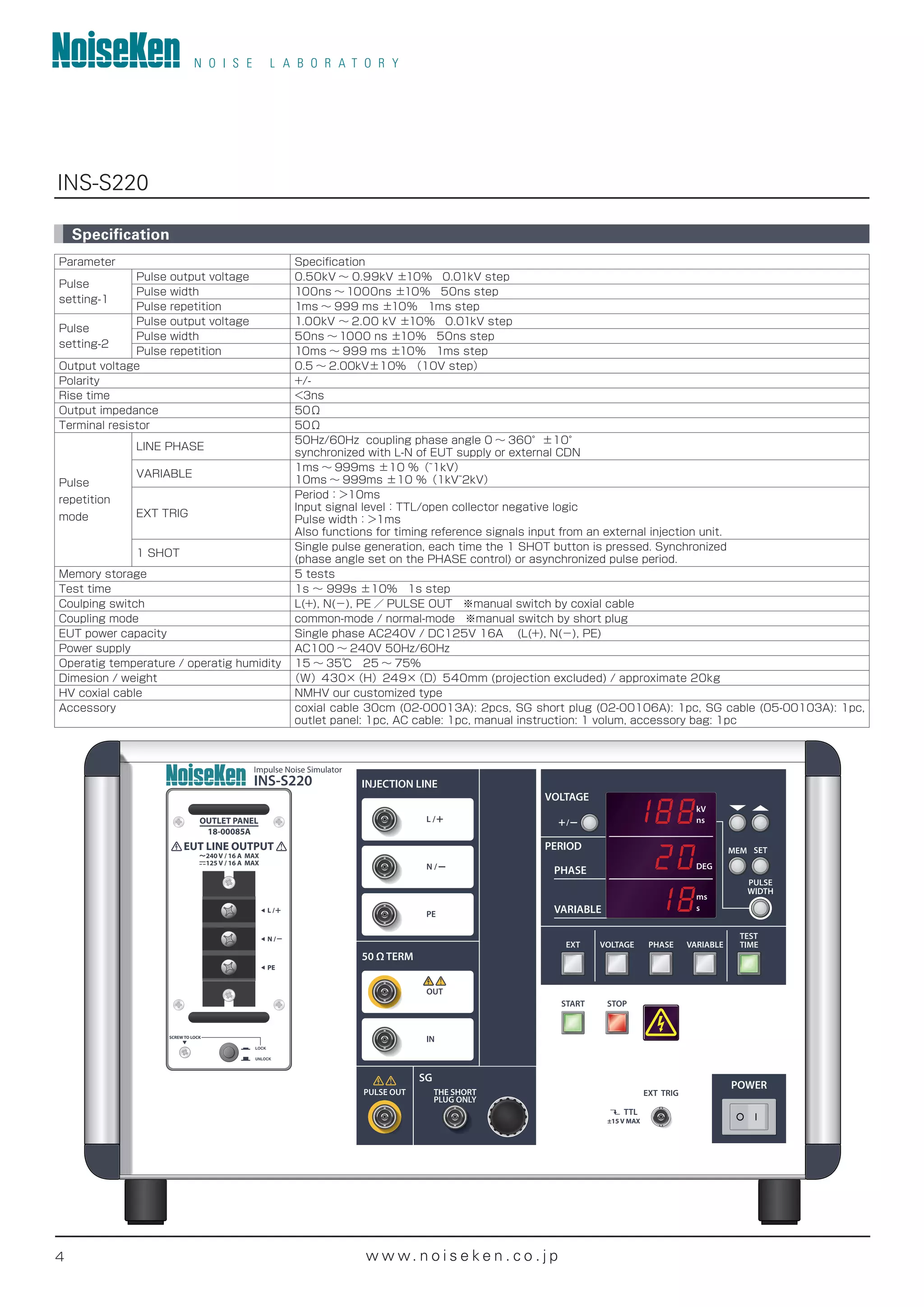
to solve the real trouble in the market
Feature
Impulse Noise Simulator (semi-conductor type)
INS-S220
Noise simulator can simulate high frequency noise generated ON/OFF at contact point
of switch or relay, arc caused by electric motor. It can evaluate the resistibility of
electric devices.
Pulse contains high frequency and by energy volume is changable by adjusting pulse
width. The high reproduction noise test of noise trouble in the market can be conducted.
● Repetition cycle becomes faster. Due to high repetition, mal-function
occurrence rate is up and test time is to be shortened.
● Pulse width setting becomes easier.
Just by pushing button, pulse width setting is available by 50ns step. Setting time and connection mistake can be reuced.
● Pulse waveform stability is improved, so high reproduction test is available.
● Cost is cut down because consuamable parts are reduced.
● Common mode/normal mode test is easily to switch by short plug.
● Wiring becomes easier because 50Ω resisitor is built in simulator.
● AC plug of EUT can be inserted directly by outlet panel.(option)
● Various tests are available by using different probes and coupling clamp.(option)
● EUT test with 3 phase 5 lines is available by external CDN.(option)
EFT frequency
range is up to
300MHz
Impulse noise
frequency range
is near 1GHz
50ns 100ns 400ns 1000ns
Y-axis : Spectrum density [dB]
X-axis : Frequency [MHz]
【 50ns pulse image 】
Effects electric
circuit greatly by
twice fast transient
in short term
Effects electric
circuit greatly by
twice fast transient
in short term
Strong energy effects
electric circuit
greatly
Strong energy effects
electric circuit
greatly
【 1000ns pulse image 】
[MHz]
[dB] [dB] [dB] [dB]
[MHz] [MHz] [MHz]
[dB]
50
50
E
c
c
tw
tw
tw
in
【
【
To solve the trouble in the markethigh frequency, energy volum of test
pulse can be ajustable
Even narrow pulse with 50ns-100ns width contains less energy, twice fast transient due to rise and fall and inducted coupling occurred by sharp
electromagnetic field effect electric circuit greatly.
Wide pulse with 800ns-1000ns contains more energy, so voltage fluctuation is easily to effect circuit.
The rise time of impulse simulator is faster than IEC61000-4-4 fast transient/burst test, so spectrum is high. When it injects noise to EUT, noise is
easier to invade electric circuit internally.
Spectrum and amplitude is different due to Impulse width, so it is recommended to test with different pulse width.](https://image.slidesharecdn.com/noisekenins220denkei-210513023032/75/Noiseken-ins220-Impulse-Noise-Simulator-denkei-2-2048.jpg)


![I M P U L S E N O I S E S I M U L A T O R
7
w w w. n o i s e k e n . c o . j p
■ Application Example of Probes
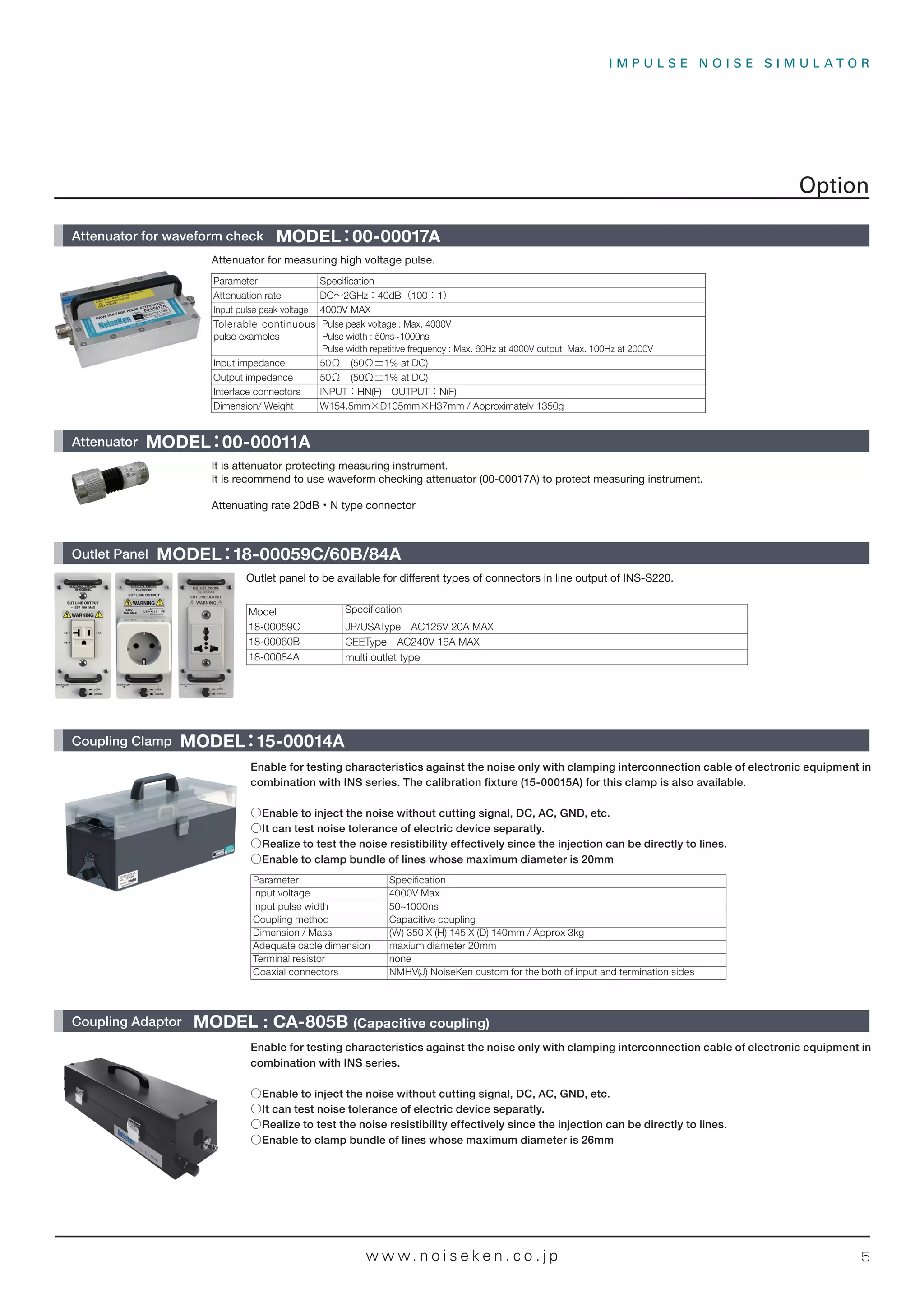
○Enable to test the noise resistibility in a board level since the direct injection to LSI pin by pin is possible
○Possible for the noise injection up to 500V utilizing the INS or FNS simulator on hand.
○Possible to exchange the coupling capacitor (Option)
○50 ohm termination resistor built-in
[Option]
Coupling capacitors: 06-00039A : 220pF 06-00040A : 330pF 06-00041A : 3pF 06-00042A : 500pF
* 01-00034A. does not contain the coupling capacitors
Noise simulator
Coaxial cable
Coupling capacitor
Discharge tip
Ground clip
Probes to irradiate the radiation noise to wiring on PCB of electronic equipment so that point where the radiation noise
resistibility is weak can be detected.
Radiation Probes MODEL : 01-00006A / 7A / 8A / 9A / 10A
Parameter Specification
Input voltage 4000V Max
Input pulse width 50ns~1μs
Loop diameter 01-00006A : φ50mm, 01-00007A : φ75mm, 01-00008A : φ100mm
01-00009A : φ150mm, 01-00010A : φ200mm, 01-00031A: 250mm, 01-00050A: 30mm
Cable length Approx. 2m
Mass Approx. 180g=220g
Applicable connector NMHV type
H2-B H2-B Radiation probe
Noise injection probe H2-B H2-B
Option
Noise Injection Probe MODEL : 01-00034A](https://image.slidesharecdn.com/noisekenins220denkei-210513023032/75/Noiseken-ins220-Impulse-Noise-Simulator-denkei-7-2048.jpg)



The document describes the Impulse Noise Simulator INS-S220. Key points: - It can simulate high frequency noise such as that generated by switches or electric motors. This allows evaluation of electronic devices' noise resistance. - The pulse width and repetition cycle can be adjusted, allowing tests with different pulse characteristics. Narrow pulses contain less energy but their fast transients still impact circuits. - Using semiconductor relays instead of mercury improves pulse stability and allows more quantitative testing compared to older models. - Settings are simplified through button operation rather than complex cable connections. This reduces setup time and errors. - Various optional accessories allow different types of noise injection tests on electronic equipment under test.


