ENVIRONMENTAL NOISE POLLUTION


                    M.Arivazhagan,
                    Dept of chemical Engg
                    NIT,Trichy .
Why worry about noise?
   Of all the pollution concerns:
       Air,water,land, and noise; noise pollution
        is the one that has the potential for the
        most damage to humans and wildlife.
       It is a hidden health hazard that impacts
        our physical, psychological and
        intellectual well being.
       Our ears never shut down, even while
        we are sleeping, so the input is constant.
Noise Pollution
   Noise pollution has a broad effect.
        It can excite us
        Warn us of danger
        Soothe us
        Inspire us
        Keep us in touch with our
        surroundings.
        And, harm our well being.
Noise is
Everywhere
Source of Noise

1.Noise in Industrial Area

2.Noise in Residential Area

             Mechanical devices
             Voices
             Music's
             Neighbors

3.Transportation Noise

             Road Traffic
             Rail Traffic
             Air Traffic
Continuation of sources

4.Constrution Noise /Public /Military

5.Domestic

6.Noise from Leisure Activities
Our Magical Ears
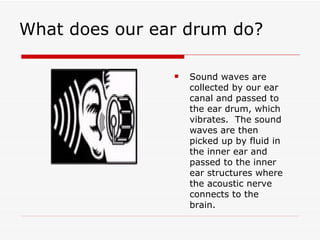
What does our ear drum do?

                   Sound waves are
                    collected by our ear
                    canal and passed to
                    the ear drum, which
                    vibrates. The sound
                    waves are then
                    picked up by fluid in
                    the inner ear and
                    passed to the inner
                    ear structures where
                    the acoustic nerve
                    connects to the
                    brain.
The Mighty Decibel
                        Hearing loss can occur
                         from a single exposure
                         to a loud noise or from
                         repeated exposures.
                        The Environmental
                         Protection Agency has
                         set a standard of 70 db
                         in a 24 hour period as
                         safe.
                        Decibels measure the
                         intensity of sound.
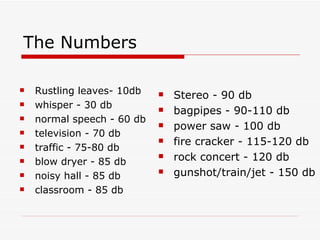
The Numbers

   Rustling leaves- 10db      Stereo - 90 db
   whisper - 30 db            bagpipes - 90-110 db
   normal speech - 60 db
                               power saw - 100 db
   television - 70 db
                               fire cracker - 115-120 db
   traffic - 75-80 db
   blow dryer - 85 db
                               rock concert - 120 db
   noisy hall - 85 db
                               gunshot/train/jet - 150 db
   classroom - 85 db
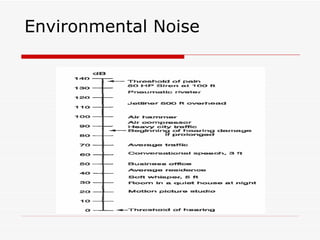
Environmental Noise
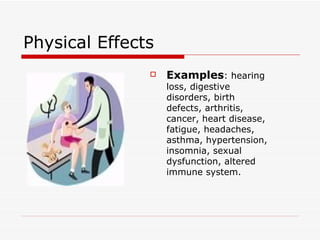
Physical Effects
                  Examples: hearing
                   loss, digestive
                   disorders, birth
                   defects, arthritis,
                   cancer, heart disease,
                   fatigue, headaches,
                   asthma, hypertension,
                   insomnia, sexual
                   dysfunction, altered
                   immune system.
Psychological Effects
   Examples:
    depression, anger,
    aggression,
    anxiety, increased
    violence, alcohol
    and drug use,
    fatigue, increase in
    suicide, decreased
    social skills,
    personality
    disorders
Communicative Effects
                  Examples:
                   decreased learning
                   capacity, memory
                   loss, poor language
                   skills, decreased
                   speech
                   development,
                   decreased
                   academic
                   performance,
                   decreased cognitive
                   ability
How much is too much?

   Damage to health begins at
    75 db.
   Hearing damage begins at 90
    db and can be permanent with
    one exposure of 120 db or
    more.
   The average decibel levels at
    Montpelier High School are
    70-86; where damage to
    physical, psychological and
    communicative health begins.
Sound Level Meter
   Type   1   Precision Sound Level Meter
   Type   2   General Purpose Sound Level Meter
   Type   3   Survey Sound Level Meter
   Type   4   Special Purpose Sound Level Meter
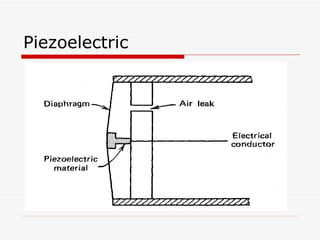
Microphones


              Condenser
Piezoelectric
Dynamic
Weighing Networks
Auxiliary Equipment of the Sound
    Level Meter
    Calibrator

    Octave Band Filter Set

    Wind Screen

    Impulse Network

    Graphic Level Recorder
Types and Measurement Procedure
Noise control

   Reducing the Sound Producer

   Interrupting the Path of the Source

   Protecting the Recipient
   Industrial Noise Control

   Community Noise

   Noise in the Home
Controlling the noise in your life is not hopeless, but does
require determination on your part to respect and alter the level
of noise.

          Wear ear plugs in
                                            Increase trees and
           very loud places.                 shrubs around
           Filtered ear plugs,               property.
           such as Sonic II can             Be aware of your
           be purchased in any               surroundings and do
           music or gun shop.                whatever you can to
           They reduce the                   reduce the noise level.
           damaging decibels,               Find quiet time daily.
           whereas foam plugs               Carpeting, pictures
           will muffle sound but             and plants will absorb
           still allow too high a            sound.
           decibel range to                 Limit your time in a
           enter your ears.
                                             noisy environment
Under Sea Noise Pollution

   Severe threat to the Marine organisms/
    Eco system

   Low Frequency Activities Sonar (LFAS)
        
            Covers 80% World Ocean
           Detect Submarine Noise (240db)
Ambient noise standards
Area code category                     Limits in dB
                                       Day      Night
A            Industrial area           75        70

B            Commercial area           65        55

C            Residential area          55        45

D            Silence zone              50        40

Figure in parenthesis are percentage
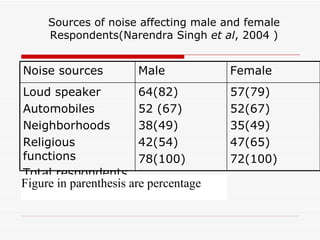
Sources of noise affecting male and female
     Respondents(Narendra Singh et al, 2004 )


Noise sources          Male            Female
Loud speaker           64(82)          57(79)
Automobiles            52 (67)         52(67)
Neighborhoods          38(49)          35(49)
Religious              42(54)          47(65)
functions              78(100)         72(100)
Total respondents
Figure in parenthesis are percentage
Effect of nosie on different age groups

Effect of
                   0-20      20-40     40-60     Above     Total
                                                  60
noise
Effect on hearing   23(68)    28(57)    34(79)    22(92)    107(71)
Interfere with
communication       33(97)    47(96)    41(95)    20(83)    141(94)
Cause annoyance     25(73)    38(78)    35(81)    18(75)    116(77)
Disturb sleep       33(68)    46(94)    41(95)    22(92)    132(88)
Result in           9(26)     15(31)    15(35)    13(54)    52(35)
Deafness            8(23)     17(35)    17(40)    8(32)     50(32)
Mental
Breakdown
Total               34(100)   49(100)   43(100)   24(100)   150(100)


          Figure in parenthesis are percentage
Suggestion by different (age group) respondents


       Suggestion                           Total
       Education                            50(33)
       Government Efforts                   33(22)
       Involving NGO’S
                                            26(17)
       Empowering police
                                            18(12)
       Empowering Civil Authorities
                                            23(15)
       Total                                150(100)


            Figure in parenthesis are percentage
Remedies
   Administrative remedies

   Judicial Remedies

   Legislative Remedies

   Public Co-operation

   International Co-operation
References
   Environmental Noise Pollution , Patrick F.Cunniff,John Wiley &
    Sons (1977)

   Narendra Singh et al ,Noise pollution Sources , Effects &
    Control , J.Hum.Ecol, 16(3):181-187(2004)

   Noise and You by JOAN FITCH RN/B.S.N

   Environmental Engineering Ruth F.Weiner, Fourth edition
    Butter worth& Heinemann (2003)
The End

Environmental noise pollution

  • 1.
    ENVIRONMENTAL NOISE POLLUTION M.Arivazhagan, Dept of chemical Engg NIT,Trichy .
  • 2.
    Why worry aboutnoise?  Of all the pollution concerns:  Air,water,land, and noise; noise pollution is the one that has the potential for the most damage to humans and wildlife.  It is a hidden health hazard that impacts our physical, psychological and intellectual well being.  Our ears never shut down, even while we are sleeping, so the input is constant.
  • 3.
    Noise Pollution  Noise pollution has a broad effect.  It can excite us  Warn us of danger  Soothe us  Inspire us  Keep us in touch with our surroundings.  And, harm our well being.
  • 4.
  • 5.
    Source of Noise 1.Noisein Industrial Area 2.Noise in Residential Area  Mechanical devices  Voices  Music's  Neighbors 3.Transportation Noise  Road Traffic  Rail Traffic  Air Traffic
  • 6.
    Continuation of sources 4.ConstrutionNoise /Public /Military 5.Domestic 6.Noise from Leisure Activities
  • 7.
  • 8.
    What does ourear drum do?  Sound waves are collected by our ear canal and passed to the ear drum, which vibrates. The sound waves are then picked up by fluid in the inner ear and passed to the inner ear structures where the acoustic nerve connects to the brain.
  • 9.
    The Mighty Decibel  Hearing loss can occur from a single exposure to a loud noise or from repeated exposures.  The Environmental Protection Agency has set a standard of 70 db in a 24 hour period as safe.  Decibels measure the intensity of sound.
  • 10.
    The Numbers  Rustling leaves- 10db  Stereo - 90 db  whisper - 30 db  bagpipes - 90-110 db  normal speech - 60 db  power saw - 100 db  television - 70 db  fire cracker - 115-120 db  traffic - 75-80 db  blow dryer - 85 db  rock concert - 120 db  noisy hall - 85 db  gunshot/train/jet - 150 db  classroom - 85 db
  • 11.
  • 12.
    Physical Effects  Examples: hearing loss, digestive disorders, birth defects, arthritis, cancer, heart disease, fatigue, headaches, asthma, hypertension, insomnia, sexual dysfunction, altered immune system.
  • 13.
    Psychological Effects  Examples: depression, anger, aggression, anxiety, increased violence, alcohol and drug use, fatigue, increase in suicide, decreased social skills, personality disorders
  • 14.
    Communicative Effects  Examples: decreased learning capacity, memory loss, poor language skills, decreased speech development, decreased academic performance, decreased cognitive ability
  • 15.
    How much istoo much?  Damage to health begins at 75 db.  Hearing damage begins at 90 db and can be permanent with one exposure of 120 db or more.  The average decibel levels at Montpelier High School are 70-86; where damage to physical, psychological and communicative health begins.
  • 16.
    Sound Level Meter  Type 1 Precision Sound Level Meter  Type 2 General Purpose Sound Level Meter  Type 3 Survey Sound Level Meter  Type 4 Special Purpose Sound Level Meter
  • 17.
    Microphones Condenser
  • 18.
  • 19.
  • 20.
  • 21.
    Auxiliary Equipment ofthe Sound Level Meter  Calibrator  Octave Band Filter Set  Wind Screen  Impulse Network  Graphic Level Recorder
  • 22.
  • 23.
    Noise control  Reducing the Sound Producer  Interrupting the Path of the Source  Protecting the Recipient
  • 24.
    Industrial Noise Control  Community Noise  Noise in the Home
  • 25.
    Controlling the noisein your life is not hopeless, but does require determination on your part to respect and alter the level of noise.  Wear ear plugs in  Increase trees and very loud places. shrubs around Filtered ear plugs, property. such as Sonic II can  Be aware of your be purchased in any surroundings and do music or gun shop. whatever you can to They reduce the reduce the noise level. damaging decibels,  Find quiet time daily. whereas foam plugs  Carpeting, pictures will muffle sound but and plants will absorb still allow too high a sound. decibel range to  Limit your time in a enter your ears. noisy environment
  • 26.
    Under Sea NoisePollution  Severe threat to the Marine organisms/ Eco system  Low Frequency Activities Sonar (LFAS)  Covers 80% World Ocean  Detect Submarine Noise (240db)
  • 27.
    Ambient noise standards Areacode category Limits in dB Day Night A Industrial area 75 70 B Commercial area 65 55 C Residential area 55 45 D Silence zone 50 40 Figure in parenthesis are percentage
  • 28.
    Sources of noiseaffecting male and female Respondents(Narendra Singh et al, 2004 ) Noise sources Male Female Loud speaker 64(82) 57(79) Automobiles 52 (67) 52(67) Neighborhoods 38(49) 35(49) Religious 42(54) 47(65) functions 78(100) 72(100) Total respondents Figure in parenthesis are percentage
  • 29.
    Effect of nosieon different age groups Effect of  0-20 20-40 40-60 Above Total 60 noise Effect on hearing 23(68) 28(57) 34(79) 22(92) 107(71) Interfere with communication 33(97) 47(96) 41(95) 20(83) 141(94) Cause annoyance 25(73) 38(78) 35(81) 18(75) 116(77) Disturb sleep 33(68) 46(94) 41(95) 22(92) 132(88) Result in 9(26) 15(31) 15(35) 13(54) 52(35) Deafness 8(23) 17(35) 17(40) 8(32) 50(32) Mental Breakdown Total 34(100) 49(100) 43(100) 24(100) 150(100) Figure in parenthesis are percentage
  • 30.
    Suggestion by different(age group) respondents Suggestion Total Education 50(33) Government Efforts 33(22) Involving NGO’S 26(17) Empowering police 18(12) Empowering Civil Authorities 23(15) Total 150(100) Figure in parenthesis are percentage
  • 31.
    Remedies  Administrative remedies  Judicial Remedies  Legislative Remedies  Public Co-operation  International Co-operation
  • 32.
    References  Environmental Noise Pollution , Patrick F.Cunniff,John Wiley & Sons (1977)  Narendra Singh et al ,Noise pollution Sources , Effects & Control , J.Hum.Ecol, 16(3):181-187(2004)  Noise and You by JOAN FITCH RN/B.S.N  Environmental Engineering Ruth F.Weiner, Fourth edition Butter worth& Heinemann (2003)
  • 33.