KINGS COLLEGE OF ENGINEERING
Department of Civil Engineering
CE6011-AIR POLLUTION
MANAGEMENT
NOISE POLLUTION
Submitted by:
I. Lydia
IV year
16CE13
Definition
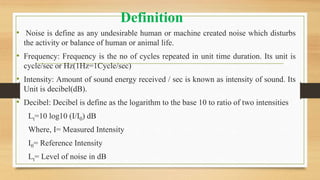
• Noise is define as any undesirable human or machine created noise which disturbs
the activity or balance of human or animal life.
• Frequency: Frequency is the no of cycles repeated in unit time duration. Its unit is
cycle/sec or Hz(1Hz=1Cycle/sec)
• Intensity: Amount of sound energy received / sec is known as intensity of sound. Its
Unit is decibel(dB).
• Decibel: Decibel is define as the logarithm to the base 10 to ratio of two intensities
Lt=10 log10 (I/I0) dB
Where, I= Measured Intensity
I0= Reference Intensity
Lt= Level of noise in dB
What is Noise?
In simple terms, noise is unwanted sound. Sound is a form of energy which is
emitted by a vibrating body and on reaching the ear causes the sensation of hearing
through nerves.
Sounds produced by all vibrating bodies are not audible. The frequency limits of
audibility are from 20 HZ to 20,000HZ.
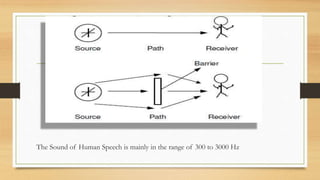
A noise problem generally consists of three inter-related elements- the source, the
receiver and the transmission path. This transmission path is usually the atmosphere
through which the sound is propagated, but can include the structural materials of
any building containing the receiver
The Sound of Human Speech is mainly in the range of 300 to 3000 Hz
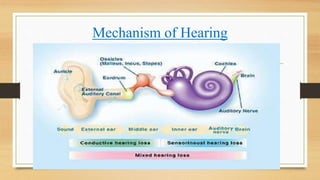
Mechanism of Hearing
The Science of Human hearing and sound is called human acoustics. Sound waves set
vibration in the ear drum which is made up of membrane In the upper ear. The
vibration in the Ear drum induces movement of three small soft bones in the middle
ear behind the ear drum.
The movement of the soft bones pass through viscous fluid in the inner ear creating
oscillation of Fluid. These oscillation then reaches the auditory nerves and finally
transmitted to the brain.
The oscillation or sound are identified and interpreted in the brain, which has capacity
to analyze sound into different frequency.
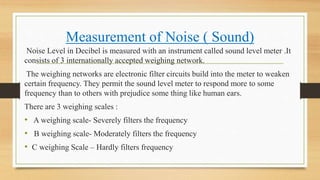
Measurement of Noise ( Sound)
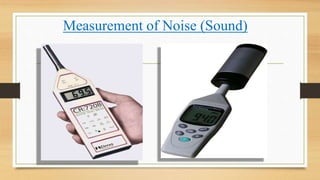
Noise Level in Decibel is measured with an instrument called sound level meter .It
consists of 3 internationally accepted weighing network.
The weighing networks are electronic filter circuits build into the meter to weaken
certain frequency. They permit the sound level meter to respond more to some
frequency than to others with prejudice some thing like human ears.
There are 3 weighing scales :
• A weighing scale- Severely filters the frequency
• B weighing scale- Moderately filters the frequency
• C weighing Scale – Hardly filters frequency
Measurement of Noise (Sound)
Sources Of Noise
Major Sources of Noise:
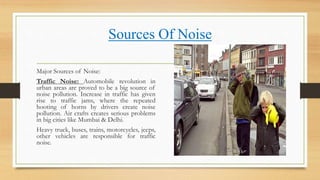
Traffic Noise: Automobile revolution in
urban areas are proved to be a big source of
noise pollution. Increase in traffic has given
rise to traffic jams, where the repeated
hooting of horns by drivers create noise
pollution. Air crafts creates serious problems
in big cities like Mumbai & Delhi.
Heavy truck, buses, trains, motorcycles, jeeps,
other vehicles are responsible for traffic
noise.
Industrial And Construction
Machinery Noise:
Factory equipment's, generators, drills, road
rollers, and similar machinery also make lot of
noise.
Public address System:- Public system contribute
in its own ways towards noise pollution by using
loud speakers for religious functions, birth,
marriage, election for commercial advertising.
Household:- The household activities will
contribute for indoor noise pollution domestic
gadgets like pressure cookers, A.C, Vacuum
cleaners, mixers, washing machines are major
source of noise at house hold level. Entertainment
equipment's like radio, music system, T.V . Will
contribute toward noise pollution
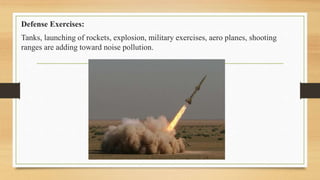
Defense Exercises:
Tanks, launching of rockets, explosion, military exercises, aero planes, shooting
ranges are adding toward noise pollution.
Effects of Noise pollution
Noise can do Physiological and or / Psychological damage if the volume is high or if
exposure is prolonged.
Common effects of Noise pollution are:
Hearing Loss: Loud noise damages fine hair cell in the ear. The vibration of these
hair cells is responsible for hearing of Sound by us. Since our body cannot replace
damaged hair cells. Permanent Hearing loss is caused by long term exposure to loud
noise.
Annoyance: It creates annoyance to the receptor due to sound level fluctuations
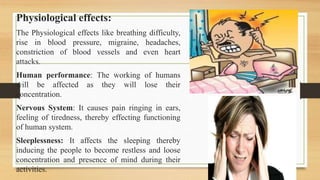
Physiological effects:
The Physiological effects like breathing difficulty,
rise in blood pressure, migraine, headaches,
constriction of blood vessels and even heart
attacks.
Human performance: The working of humans
will be affected as they will lose their
concentration.
Nervous System: It causes pain ringing in ears,
feeling of tiredness, thereby effecting functioning
of human system.
Sleeplessness: It affects the sleeping thereby
inducing the people to become restless and loose
concentration and presence of mind during their
activities.
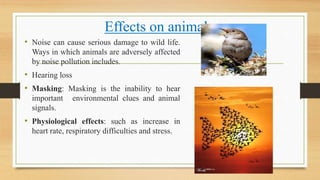
Effects on animals
• Noise can cause serious damage to wild life.
Ways in which animals are adversely affected
by noise pollution includes.
• Hearing loss
• Masking: Masking is the inability to hear
important environmental clues and animal
signals.
• Physiological effects: such as increase in
heart rate, respiratory difficulties and stress.
Control of Noise Pollution
Noise is not only a nuisance but a serious
environmental problem and a health hazard.
Like all other pollution, noise pollution is
needed to be controlled.
Noise pollution can be effectively controlled
by taking following measures.
For people working in noisy areas ear
protection aids like ear plugs, muffs, noise
helmets, head phones etc. should be
provided it reduces occupational exposure.
Sound Insulation
A) Sound insulations can be done by constructing windows with more than one
panes of glass and filling the gap with sound absorbing material.
B) Acoustical tiles, perforated plywood can be fixed on wall, ceilings, floors to
reduce noise.
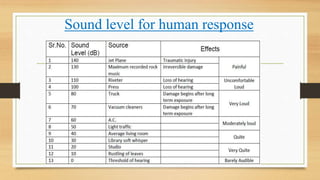
Sound level for human response
Thank you!!!

Noise Pollution

  • 1.
    KINGS COLLEGE OFENGINEERING Department of Civil Engineering CE6011-AIR POLLUTION MANAGEMENT NOISE POLLUTION Submitted by: I. Lydia IV year 16CE13
  • 2.
    Definition • Noise isdefine as any undesirable human or machine created noise which disturbs the activity or balance of human or animal life. • Frequency: Frequency is the no of cycles repeated in unit time duration. Its unit is cycle/sec or Hz(1Hz=1Cycle/sec) • Intensity: Amount of sound energy received / sec is known as intensity of sound. Its Unit is decibel(dB). • Decibel: Decibel is define as the logarithm to the base 10 to ratio of two intensities Lt=10 log10 (I/I0) dB Where, I= Measured Intensity I0= Reference Intensity Lt= Level of noise in dB
  • 3.
    What is Noise? Insimple terms, noise is unwanted sound. Sound is a form of energy which is emitted by a vibrating body and on reaching the ear causes the sensation of hearing through nerves. Sounds produced by all vibrating bodies are not audible. The frequency limits of audibility are from 20 HZ to 20,000HZ. A noise problem generally consists of three inter-related elements- the source, the receiver and the transmission path. This transmission path is usually the atmosphere through which the sound is propagated, but can include the structural materials of any building containing the receiver
  • 4.
    The Sound ofHuman Speech is mainly in the range of 300 to 3000 Hz
  • 5.
  • 6.
    Mechanism of Hearing TheScience of Human hearing and sound is called human acoustics. Sound waves set vibration in the ear drum which is made up of membrane In the upper ear. The vibration in the Ear drum induces movement of three small soft bones in the middle ear behind the ear drum. The movement of the soft bones pass through viscous fluid in the inner ear creating oscillation of Fluid. These oscillation then reaches the auditory nerves and finally transmitted to the brain. The oscillation or sound are identified and interpreted in the brain, which has capacity to analyze sound into different frequency.
  • 7.
    Measurement of Noise( Sound) Noise Level in Decibel is measured with an instrument called sound level meter .It consists of 3 internationally accepted weighing network. The weighing networks are electronic filter circuits build into the meter to weaken certain frequency. They permit the sound level meter to respond more to some frequency than to others with prejudice some thing like human ears. There are 3 weighing scales : • A weighing scale- Severely filters the frequency • B weighing scale- Moderately filters the frequency • C weighing Scale – Hardly filters frequency
  • 8.
  • 9.
    Sources Of Noise MajorSources of Noise: Traffic Noise: Automobile revolution in urban areas are proved to be a big source of noise pollution. Increase in traffic has given rise to traffic jams, where the repeated hooting of horns by drivers create noise pollution. Air crafts creates serious problems in big cities like Mumbai & Delhi. Heavy truck, buses, trains, motorcycles, jeeps, other vehicles are responsible for traffic noise.
  • 10.
    Industrial And Construction MachineryNoise: Factory equipment's, generators, drills, road rollers, and similar machinery also make lot of noise. Public address System:- Public system contribute in its own ways towards noise pollution by using loud speakers for religious functions, birth, marriage, election for commercial advertising. Household:- The household activities will contribute for indoor noise pollution domestic gadgets like pressure cookers, A.C, Vacuum cleaners, mixers, washing machines are major source of noise at house hold level. Entertainment equipment's like radio, music system, T.V . Will contribute toward noise pollution
  • 11.
    Defense Exercises: Tanks, launchingof rockets, explosion, military exercises, aero planes, shooting ranges are adding toward noise pollution.
  • 12.
    Effects of Noisepollution Noise can do Physiological and or / Psychological damage if the volume is high or if exposure is prolonged. Common effects of Noise pollution are: Hearing Loss: Loud noise damages fine hair cell in the ear. The vibration of these hair cells is responsible for hearing of Sound by us. Since our body cannot replace damaged hair cells. Permanent Hearing loss is caused by long term exposure to loud noise. Annoyance: It creates annoyance to the receptor due to sound level fluctuations
  • 13.
    Physiological effects: The Physiologicaleffects like breathing difficulty, rise in blood pressure, migraine, headaches, constriction of blood vessels and even heart attacks. Human performance: The working of humans will be affected as they will lose their concentration. Nervous System: It causes pain ringing in ears, feeling of tiredness, thereby effecting functioning of human system. Sleeplessness: It affects the sleeping thereby inducing the people to become restless and loose concentration and presence of mind during their activities.
  • 14.
    Effects on animals •Noise can cause serious damage to wild life. Ways in which animals are adversely affected by noise pollution includes. • Hearing loss • Masking: Masking is the inability to hear important environmental clues and animal signals. • Physiological effects: such as increase in heart rate, respiratory difficulties and stress.
  • 15.
    Control of NoisePollution Noise is not only a nuisance but a serious environmental problem and a health hazard. Like all other pollution, noise pollution is needed to be controlled. Noise pollution can be effectively controlled by taking following measures. For people working in noisy areas ear protection aids like ear plugs, muffs, noise helmets, head phones etc. should be provided it reduces occupational exposure.
  • 16.
    Sound Insulation A) Soundinsulations can be done by constructing windows with more than one panes of glass and filling the gap with sound absorbing material. B) Acoustical tiles, perforated plywood can be fixed on wall, ceilings, floors to reduce noise.
  • 17.
    Sound level forhuman response
  • 18.