International Journal of Mathematics and Statistics Invention (IJMSI)
E-ISSN: 2321 – 4767 P-ISSN: 2321 - 4759
www.ijmsi.org Volume 5 Issue 2 || February. 2017 || PP-58-64
www.ijmsi.org 58 | Page
Synthesis and Characterization of Thermal Analysis of La (Ii)
Macrocyclic Complexes of Their Biologycal Activity
M.R. Ullah, M. J. Hossain
Department of Chemistry, BUET, Dhaka.
ABSTRACT: The macrocyclic complex compounds of La(II) containing a ligand having tetraoxotetrahydrazin
moity are synthesized by template condensation of malonodihydrazide (C3H8N4O2) with different aldehydes. The
complexes are characterized on the basis of elemental analysis, UV-visible & IR spectroscopy, magnetic
moment and conductance measurement and other physical properties.Antibacterial activity of the derived
complex compounds, as well as already used standard compound kanamycin, was tested on fourteen pathogenic
bacteria. Given results were then compared to the efficacy of the Antibacterial activity of standard compound
kanamycin used for control of these pathogenic bacteria.
I. INTRODUCTION
The chemistry of synthetic macrocyclic ligands can be divided into two broad divisions. Firstly there are the
cyclic polyethers of the „crown‟ type of which is a typical example1
. Ligands of this general category have
received much recent attention because of their unusual behavior towards a range of non-transition metal ions2
.
Few studies involving transition metal ions have been reported3
and it is evident that the majority of such
polyether ligands show a limited tendency to form stable complexes with these ions4
.
The coordination chemistry of hydrazones is an intensive area of study and numerous transition metal
complexes of these ligands have been investigated 5
. The development of the field of bioinorganic chemistry has
increased the interest in Schiff base complexes, since it has been recognized that many of these complexes may
serve as models for biologically important species6
. Coordination compounds derived from aroylhydrazones
have been reported because of their anti-tuberculosis, antimicrobial and corrosion inhibitors7
. The chemistry and
complexation properties of macrocyclic dioxotetraamines were investigated8
. These macrocycles contain two
amino nitrogens and two amides. As with cylam and cyclen, the amino nitrogens with additional coordinating
groups form new hexadentate ligands. They are able to bind to metals like copper(II) and nickel(II) with
simultaneous dissociation of the two amide protons, such that metal binding is highly pH-sensitive and
reversible (-a very useful property for metal-sensing applications). The copper(II) complex of a functionalised
trans system at neutral and basic pH, and found very different structures according to whether just one or both of
the amides are deprotonated9
.
The recent article describing the use of [Cu-perchlorate contain complex] as a color indicator for solvent
parameters10
fails to identify the potential danger associated with the preparation and handling of this salt. Most
of us are aware that "organic perchlorates are self-contained explosives11
However, many overlook the fact that
a perchlorate salt of a cation, such as a complex ion that contains an organic group or other oxidizable atoms, is
also an explosive (although the conditions required to initiate an explosion vary from sample to sample). For
example, one sample of Co(H2O)3(ClO4)2 detonated under a slight impact while attempts to repeat the
detonation with other samples were not successful12
. Such compounds must be handled with great care13
, if at
all.
The complex [Ag(1NHSAL)2(ClO4)] and [Ag(lNHHAP)2ClO4] have been synthesis14
by adding ligand
dropwise and mixed with metal perchlorate solution in the 2:1 molar ratio, (where ligand INHSAL = 2-
hydroxybenzal dehyde) 1 NHHAP=2hydroxy acetophenone. On the basis of IR spectra showed a band at (1090-
620) cm-1
regions these are assignable that perchlorate coordinate to the metal.15
Biological Activity of Some Important Compounds
The last decade or so there has been a growing awareness of the importance of wide range of metallic and non
metallic elements in biological system16
. Some 25 elements which are currently throughout to be essential to
life, ten can be classified as trace metal ions; Fe, Cu, Zn, Mn, Co, Cr, Sn, V and Ni and four as bulk metal ions;
Na, K, Mg and Ca. In addition there is some tentative evidence that Cd and Pb may be required at very low
levels. There is also evidence that Sn, As and Br may possibly be essential trace elements. In the following
section the outline of the chemistry and biological effects of some of the essential and polluting elements is
given bellow.
Synthesis And Characterization Of Thermal Analysis Of La (Ii) Macrocyclic Complexes Of Their…
www.ijmsi.org 59 | Page
A number of metal complexes and ligand have been shown to be chemically useful in variety of areas, e.g. As
antitumor agent‟s antiviral agents and in the treatment of illness, for example, in haemocyanins, contain Cu and
bind one molecule of O2 for every pair of copper(I) ions. Haemocyanine is found only in molluscs and
arthropods. Inorganic chemistry has been interested in developing suitable copper complexes which would
minic some of properties of haemocyanin.17
II. AIM OF THE PRESENT WORK
In the recent years considerable attention have been given to the synthesis of macrocyclic complex18
. These
complex compounds have been used an model system of biologically important materials, such as porphyrin and
corins.
Some of the macrocyclic ligand cannot be easily prepared from the reactants19
. In that case the complex
compounds could be synthesised by template method. The desire macrocyclic ligand can be isolated by
stripping the complex compounds20
. Macrocyclic tetraaza complex of Ni2+
act as catalyst to reduce CO2 to CO
and Fe2+
, Mn3+
porphyrins have been most commonly studied catlyst.21
In view of the extensive use as drugs and significant pharmacological activities of macrocyclic complexes and
their derivatives, it is desired to synthesize macrocyclic complexes of Ni (II), Cu (II) and Fe (II). The
synthesized macrocyclic complexes and their derivatives are expected to have microbial activity.
Therefore, considering the rapid increasing importance of macrocyclic ligand and their complexes in biology
and in medicine the present work is divided in to two parts:
i. Firstly, synthesis of some new macrocyclic complexes by the reactions of malonodihydrazide with Ni(II),
Cu(II) and Fe(II) perchlorate in the presence of formaldehyde, acetaldehyde, butyraldehyde will be characterised
by elemental analysis, UV visible and IR spectral analysis, magnetic moment and conductance measurements
and some other physical properties.
ii. Secondly, study of antibacterial activity of the synthesised complexes (some test organisms such as,
Salmonella-17, Klebsilla, Shigella dysenteriae, Shigella shiga, Shigella boydii, Shigella sonnei, Shigella
flexneri, Escherichia coli, Pseudomonas aeruginosa, Salmonella, Bacillus megaterium, Sarcina lutea,
Staphylococcus aureus, Bacillus cereus) including the investigation of minimum inhibitory concentration of the
complexes.
Experimental
The ligand precursor, malonodihydrazide was prepared by the literature procedure22
. Micro analysis for carbon
hydrogen and nitrogen were obtained by using Kjeldahl Method for elemental analysis.
Infrared spectra (as KBr disc) were recorded using a shimadzu FTIR-8400 spectrometer from 4000-400 cm-1
and uv-visible spectra on shimadzu uv-160 Spectrophotometer in DMSO. Magnetic moment measurements
were done on Sherwood scientific magnetic susceptibility balance. Conductivities were measured by CG-857
Scott Gerate GmbH conductivity meter with a dip type cell having platinum electrodes in DMSO. Metals were
estimated complex complex metrically using EDTA and DMG after fuming the complexes with sulfuric acid22
.
Melting points were determined on an electro thermal melting point apparatus (model no. AZ 6512).
Preparation of macrocyclic complexes.
Preparation Of [La(C8H16N8O4)(ClO4)2] Complex 1.
To the aqueous malonodihydrazide, C3H8N4O2(0.792 g, 6 mmol in 10 mL water) formaldehyde solution (0.48 g,
6 mmol 37%) was added. To the above solution Lead(II) perchlorate hexahydrate (2.0829 g, 3 mmol in 10 mL
water) was added and the whole mixture was refluxed with constant stirring for two hours and cooled down. A
blue precipitate was formed immediately. The product was washed with ethanol for three times and dried in a
vacuum desiccator over anhydrous CaCl2. The melting point of the compound was 2250
C and yield was 1.894 g
(80%). The compound was soluble in DMSO and insoluble in acetone, ethanol, water and chloroform. Same
procedure was applied for the preparation of complexes 2, 3, 4.5 and 6 using acetaldehyde, crotonaldehyde,
cinnamaldehyde, benzaldehyde and butanal dehyde were the reaction mixture was refluxed for 4,5,3,7 and 10
hours respectively.,
III. RESULT AND DISCUSSION
Macrocyclic Complexes Of La (II)
Reactions of malonodihydrazide with La(II) perchlorate hexahydrate in presence of formaldehyde,
acetaldehyde, crotonaldehyde, cinnamaldehyde, benzaldehyde and butanal dehyde give some 16 member
macrocyclic complex as described above
Complexes (1-6) are characterized on the basis of elemental analysis, magnetic moment & conductance
measurements, UV-visible spectra & infrared studies and other physical properties, like melting point,
solubility, colour etc. Molar conductance data of the complexes (1-6) are shown in Table 4.1. The conductance
values of the complexes suggested that they are non-electrolytic in nature24
.
Synthesis And Characterization Of Thermal Analysis Of La (Ii) Macrocyclic Complexes Of Their…
www.ijmsi.org 60 | Page
The infrared spectra of the complexes (1-6) are shown as spectral data (Table 4.4) of the complexes showed a
strong and broad band at (3246-3265) cm-1
which is assigned for the (NH) stretching25
.
Due to coordination the (N-H) stretching of the amide group goes to the higher field at (3250, 3282) cm-1
region as compared to the starting material malonodihydrazide26
. In the complexes the terminal-NH2 group of
malonodihydrazide condensed with the aldehyde moiety form a new secondary1
-NH group which may appear at
the same region (or overlape) as to the amide-NH group as a result the (N-H) band appear as a strong and
broad band. [The starting material malonodihydrazide have three (N-H) bands at (3250, 3251, 33270) cm-1
.
The bands at (3250, 3382) cm-1
for the asymmetrie and symmetric (N-H) stretching of the terminal-NH2
moiety and 3250 cm-1
for amidic (N-H) group]. The complexes showed a broad band at (2920-2970) cm-1
is
suggested for the (C-H) stretching of aliphatic moiety32
. The complexes showed a strong band at (1640-1680)
cm-1
which represent the (C=O) of NH-NH-CO-CH2 moity27
. Three or four band at (621-1180) cm-1
region
also indicated the 1,2,3,4 bands of (ClO-
4) moiety. These stretching frequency is suggested the coordination
of perchlorate to the metal through the O atom28
. A medium band at (406-420) cm-1
region is tentatively
attributed to the (M-N) mode29,30.
indicating the coordination of the lignad to the metal through the nitrogen
atom.
The magnetic moment measurement data (Table 4.3) of the La(II) complexes (1-6) showed (1.56-1.78) B.M.
These values correspond to no unpaired electrons of La(II) d10
system suggest the octahedral environment of the
complexes which are consistent with the literature value1
. The elemental analyses (C, H and N) (Table 4.2) and
metal estimation data (Table 4.3) of the complexes are consistent with the proposed formula.
The UV-visible spectra of the complexes (1-6) are shown (Table 4.5) band at 330, 350 nm, (1-6) at represent the
d-d transition of 4
A2g (F)  4
T1g(F), 4
A2g(F)  4
T1g(P), which suggested the octahedral geometry of the La(II)
complexes31,32
.
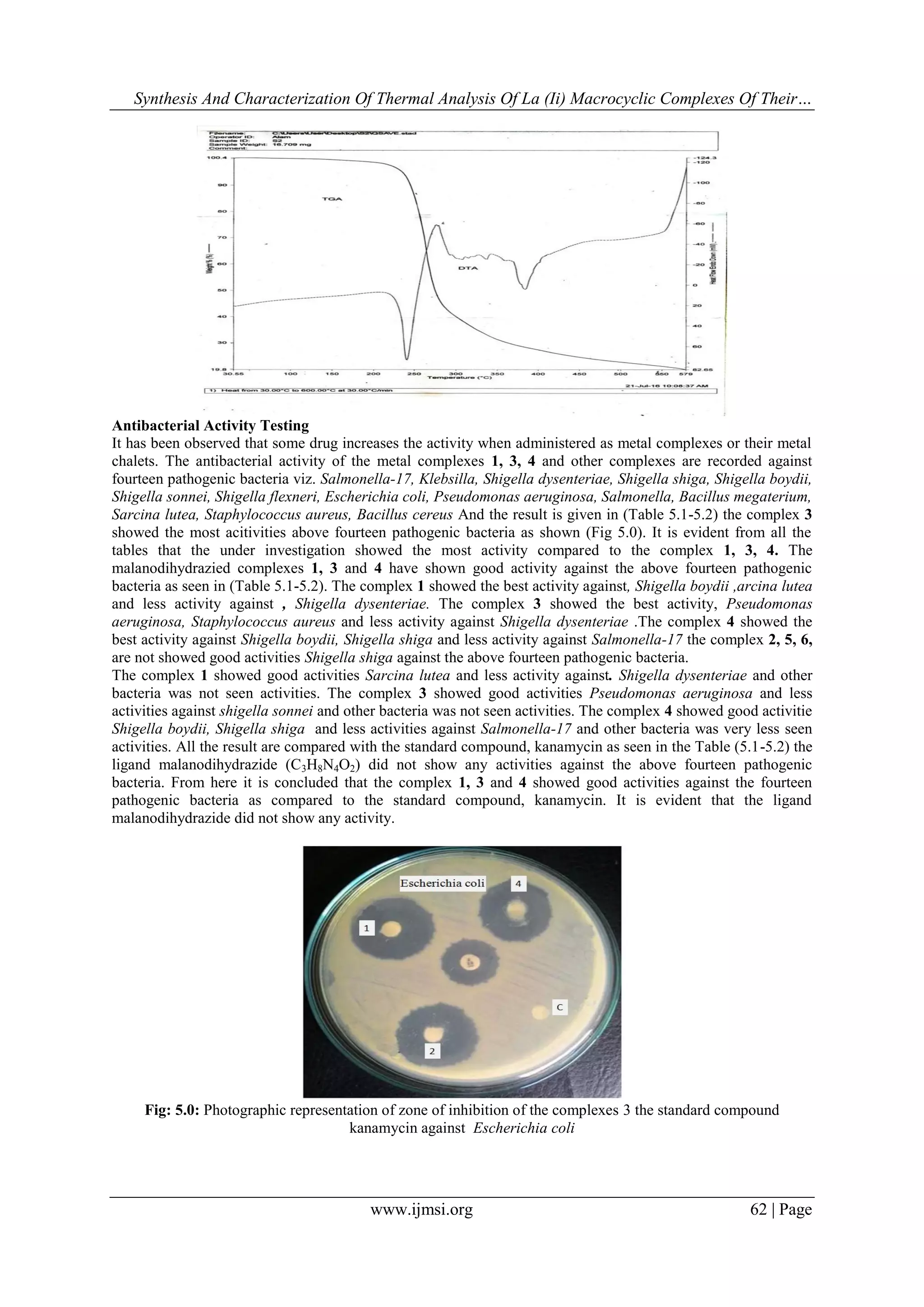
Thermal studies: The thermal properties of metal (II) complexes were investigated by thermo grams
(TGA,DTA) and are shown in (Fig..) and the corresponding thermal analysis is presented in (Tabl.4.6).
In the case of complex (I) (F.g 01) the decomposition occurs in the (230-325)0
C range. There is no mass loss up
to 2300
C. The first stage of decomposition starts at 2300
C and end at 2300
C with a corresponding weight loss
25%.Which is accompanied by endothermic effect in the DTA curve in the range 2250
C which is accompanied
by weight loss confirming the second stage of decomposition is observed at 225-3500
C (60% wt.
loss).meanwhile the DTA curve exhibits endothermic effect in the range 3250
C which is accompanied by
weight loss confirming.
On the basis of elemental analysis magnetic moment and conductance measurements, thermal studies UV
Visible spectra, infrared spectra and other physical properties the suggested structure of the complexes are
octahedral in nature as in Fig.4.1.
M =La (II), where R=H(1), CH3(2),CH3CH=CH,-(3) C6H5CH=CH2-(4),CH3-CH2-CH2-(5), C6H6CH-(6)
Table- 4.1: Analytical Data and Other Physical Properties of Compounds (1-6)
No. Compounds %Yield Colour Milting
point 0
C
% M Molar conductance
ohm-1
cm2
mol-1
Calculated Found
1 [La(C8H16N8O4)(ClO4)2] 60 White 193 22.24 22.20 26.50
2 [La(C10H20N8O4)(ClO4)2] 70 Yellow 190 21.28 21.20 26.10
3 [La (C14H28N8O4)(ClO4)2] 80 White 180 19.60 19.50 26.20
4 [La( C14H24N8O4)(ClO4)2] 70 Yellow 195 19.70 19.65 27.10
5 [La (C24H28N8O4)(ClO4)2] 60 whit 197 16.76 16.70 26.90
6 [La (C20H 24N8O4)(ClO4)2] 70 Yellow 195 19.06 19.00 25.90
Synthesis And Characterization Of Thermal Analysis Of La (Ii) Macrocyclic Complexes Of Their…
www.ijmsi.org 61 | Page
Table- 4.2: Elemental analysis data of compounds (1-6)
Table- 4.3: Magnetic moment data of compounds (1-6)
Table- 4.4: Important infrared spectral bands of compounds (1-6)
Table- 4.5: U.V- Visible Adsorption Maxima Of Compounds (1-6)
No. Compounds λ max (n,m)
1 [La(C8H16N8O4)(ClO4)2] 330, 550
2 [La(C10H20N8O4)(ClO4)2] 350,430
3 [La (C14H28N8O4)(ClO4)2] 330,520
4 [La( C14H24N8O4)(ClO4)2] 350,530
5 [La (C24H28N8O4)(ClO4)2] 360.550
6 [La (C20H 24N8O4)(ClO4)2] 340,540
Table- 4.6: Thermal Analysis Data of Compounds (1-6)
No. Compounds %C %H %N
Calculated Found Calculated Found Calculated Found
1 [La(C8H16N8O4)(ClO4)2] 16.18 16.20 2.86 2.86 20.07 20.00
2 [La(C10H20N8O4)(ClO4)2] 36.13 36.15 3.51 3.51 14.04 14.03
3 [La (C14H28N8O4)(ClO4)2] 19.65 19.60 2.89 2.89 20.27 20.2
4 [La( C14H24N8O4)(ClO4)2] 20.72 20.74 3.44 3.44 19.29 19.27
5 [La (C24H28N8O4)(ClO4)2] 19.38 19.35 3.23 3.23 22.62 22.60
6 [La (C20H 24N8O4)(ClO4)2] 41.19 41.20 4.00 4.00 16.01 16.00
No. Compounds %M (Ligand) %M Metal oxide(MO)
Tem0
C Calculated Found Tem0
C Calculated Found
1 [La(C8H16N8O4)(ClO4)2] 135.02 83.22 83.20 599.00 37.66 37.60
2 [La(C10H20N8O4)(ClO4)2] 135.00 86.21 86.20 599.00 36.14 36.10
3 [La (C14H28N8O4)(ClO4)2] 130.90 87.14 87.10 550.60 33.72 33.60
4 [La( C14H24N8O4)(ClO4)2] 130.45 88.91 88.50 450.00 29.06 29.00
5 [La (C24H28N8O4)(ClO4)2] 140.50 88.23 88.20 530.00 30.86 30.40
6 [La (C20H 24N8O4)(ClO4)2] 137.45 87.07 87.00 540.00 33.89 33.30
Synthesis And Characterization Of Thermal Analysis Of La (Ii) Macrocyclic Complexes Of Their…
www.ijmsi.org 62 | Page
Antibacterial Activity Testing
It has been observed that some drug increases the activity when administered as metal complexes or their metal
chalets. The antibacterial activity of the metal complexes 1, 3, 4 and other complexes are recorded against
fourteen pathogenic bacteria viz. Salmonella-17, Klebsilla, Shigella dysenteriae, Shigella shiga, Shigella boydii,
Shigella sonnei, Shigella flexneri, Escherichia coli, Pseudomonas aeruginosa, Salmonella, Bacillus megaterium,
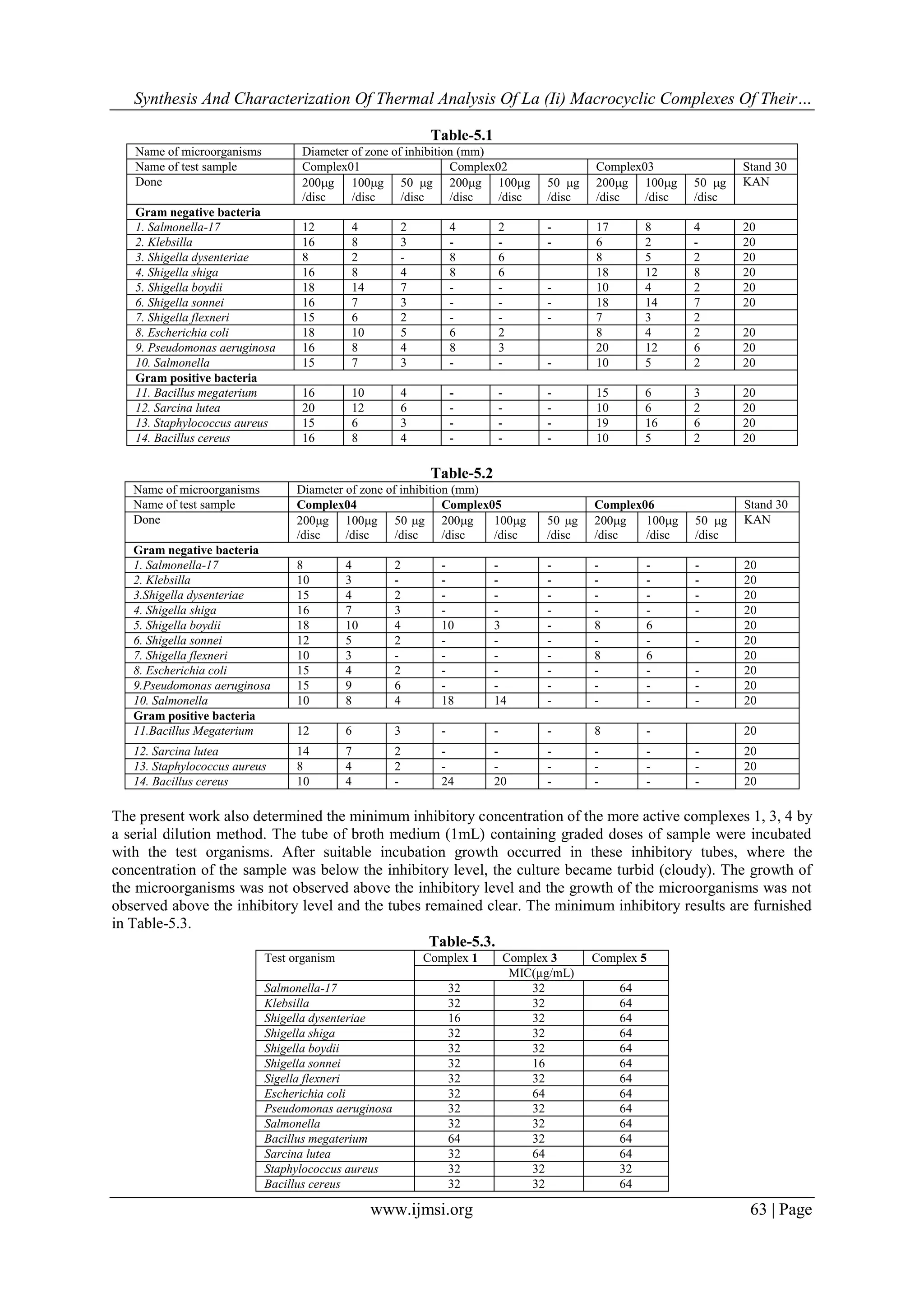
Sarcina lutea, Staphylococcus aureus, Bacillus cereus And the result is given in (Table 5.1-5.2) the complex 3
showed the most acitivities above fourteen pathogenic bacteria as shown (Fig 5.0). It is evident from all the
tables that the under investigation showed the most activity compared to the complex 1, 3, 4. The
malanodihydrazied complexes 1, 3 and 4 have shown good activity against the above fourteen pathogenic
bacteria as seen in (Table 5.1-5.2). The complex 1 showed the best activity against, Shigella boydii ,arcina lutea
and less activity against , Shigella dysenteriae. The complex 3 showed the best activity, Pseudomonas
aeruginosa, Staphylococcus aureus and less activity against Shigella dysenteriae .The complex 4 showed the
best activity against Shigella boydii, Shigella shiga and less activity against Salmonella-17 the complex 2, 5, 6,
are not showed good activities Shigella shiga against the above fourteen pathogenic bacteria.
The complex 1 showed good activities Sarcina lutea and less activity against. Shigella dysenteriae and other
bacteria was not seen activities. The complex 3 showed good activities Pseudomonas aeruginosa and less
activities against shigella sonnei and other bacteria was not seen activities. The complex 4 showed good activitie
Shigella boydii, Shigella shiga and less activities against Salmonella-17 and other bacteria was very less seen
activities. All the result are compared with the standard compound, kanamycin as seen in the Table (5.1-5.2) the
ligand malanodihydrazide (C3H8N4O2) did not show any activities against the above fourteen pathogenic
bacteria. From here it is concluded that the complex 1, 3 and 4 showed good activities against the fourteen
pathogenic bacteria as compared to the standard compound, kanamycin. It is evident that the ligand
malanodihydrazide did not show any activity.
Fig: 5.0: Photographic representation of zone of inhibition of the complexes 3 the standard compound
kanamycin against Escherichia coli
Synthesis And Characterization Of Thermal Analysis Of La (Ii) Macrocyclic Complexes Of Their…
www.ijmsi.org 63 | Page
Table-5.1
Name of microorganisms Diameter of zone of inhibition (mm)
Name of test sample Complex01 Complex02 Complex03 Stand 30
Done 200g
/disc
100g
/disc
50 g
/disc
200g
/disc
100g
/disc
50 g
/disc
200g
/disc
100g
/disc
50 g
/disc
KAN
Gram negative bacteria
1. Salmonella-17 12 4 2 4 2 - 17 8 4 20
2. Klebsilla 16 8 3 - - - 6 2 - 20
3. Shigella dysenteriae 8 2 - 8 6 8 5 2 20
4. Shigella shiga 16 8 4 8 6 18 12 8 20
5. Shigella boydii 18 14 7 - - - 10 4 2 20
6. Shigella sonnei 16 7 3 - - - 18 14 7 20
7. Shigella flexneri 15 6 2 - - - 7 3 2
8. Escherichia coli 18 10 5 6 2 8 4 2 20
9. Pseudomonas aeruginosa 16 8 4 8 3 20 12 6 20
10. Salmonella 15 7 3 - - - 10 5 2 20
Gram positive bacteria
11. Bacillus megaterium 16 10 4 - - - 15 6 3 20
12. Sarcina lutea 20 12 6 - - - 10 6 2 20
13. Staphylococcus aureus 15 6 3 - - - 19 16 6 20
14. Bacillus cereus 16 8 4 - - - 10 5 2 20
Table-5.2
Name of microorganisms Diameter of zone of inhibition (mm)
Name of test sample Complex04 Complex05 Complex06 Stand 30
Done 200g
/disc
100g
/disc
50 g
/disc
200g
/disc
100g
/disc
50 g
/disc
200g
/disc
100g
/disc
50 g
/disc
KAN
Gram negative bacteria
1. Salmonella-17 8 4 2 - - - - - - 20
2. Klebsilla 10 3 - - - - - - - 20
3.Shigella dysenteriae 15 4 2 - - - - - - 20
4. Shigella shiga 16 7 3 - - - - - - 20
5. Shigella boydii 18 10 4 10 3 - 8 6 20
6. Shigella sonnei 12 5 2 - - - - - - 20
7. Shigella flexneri 10 3 - - - - 8 6 20
8. Escherichia coli 15 4 2 - - - - - - 20
9.Pseudomonas aeruginosa 15 9 6 - - - - - - 20
10. Salmonella 10 8 4 18 14 - - - - 20
Gram positive bacteria
11.Bacillus Megaterium 12 6 3 - - - 8 - 20
12. Sarcina lutea 14 7 2 - - - - - - 20
13. Staphylococcus aureus 8 4 2 - - - - - - 20
14. Bacillus cereus 10 4 - 24 20 - - - - 20
The present work also determined the minimum inhibitory concentration of the more active complexes 1, 3, 4 by
a serial dilution method. The tube of broth medium (1mL) containing graded doses of sample were incubated
with the test organisms. After suitable incubation growth occurred in these inhibitory tubes, where the
concentration of the sample was below the inhibitory level, the culture became turbid (cloudy). The growth of
the microorganisms was not observed above the inhibitory level and the growth of the microorganisms was not
observed above the inhibitory level and the tubes remained clear. The minimum inhibitory results are furnished
in Table-5.3.
Table-5.3.
Test organism Complex 1 Complex 3 Complex 5
MIC(µg/mL)
Salmonella-17 32 32 64
Klebsilla 32 32 64
Shigella dysenteriae 16 32 64
Shigella shiga 32 32 64
Shigella boydii 32 32 64
Shigella sonnei 32 16 64
Sigella flexneri 32 32 64
Escherichia coli 32 64 64
Pseudomonas aeruginosa 32 32 64
Salmonella 32 32 64
Bacillus megaterium 64 32 64
Sarcina lutea 32 64 64
Staphylococcus aureus 32 32 32
Bacillus cereus 32 32 64
Synthesis And Characterization Of Thermal Analysis Of La (Ii) Macrocyclic Complexes Of Their…
www.ijmsi.org 64 | Page
REFERENCES
[1]. C. J. Pedersen, J. Amer. Chem. Soc., 89, 7017, (1967).
[2]. D. Dunitz, P. Hemmerich, J. A. Ibers, C. K. Jorgensen, J. B. Neilands, D. Reinen and R. J. P. Williams, Structure and Bonding, ed.
Vol. 16, (1973).
[3]. J. J. Christensen, D.J. Eatough, and R. M. Izatt, Chem. Rev., 74, 351, (1974).
[4]. L. Su and J. F. Weiher, Inorg. Chem., 7, 176, (1968),.
[5]. S.M., M. Dinodia and A. Kumar, Synthesis, anti-inflammatory and analgesic activity evaluation of some amidine and hydrazone
derivatives; Sondhi, Bioorg. Med. Chem., 14: 4657, (2006).
[6]. and K. Natarajan, Synthesis, characterization, and biological activities of ruthenium(II) carbonyl complexes containing bifunctional
tridentate Schiff bases; Jayabalakrishnan, React. Inorg. Met-Org. Chem., 31:983, (2001).
[7]. A.S., Aswar, V.V Dhande and V.B. Badwaik, Hydrazone as complexing agent: synthesis, structural characterization and biological
studies of some Complexes; Russ. J. Inorg. Chem., 52: 1206, (2007).
[8]. A.S. Aswar,A.R. Yaul, V.V. Dhande and N.J. Suryawanshi, Synthesis structural investigation and biological studies of some
transition metal chelates of acid hydrazone; Polish J. Chem., 29: 556, (2009).
[9]. M.K. Taylor, J. Reglinski, D. Wallace. Polyhedron. 23, 3201, (2004).
[10]. J. Hunter; B. Murphy; J. Nelson, J. Chem. Educ. 68, 59-63, (1991).
[11]. R. W. Soukup, and R. Schmidt, J. CHEM. EDUc., 62, 459 (1985).
[12]. L. Bretherick., (Editor). “Hazards in the Chemical Laboratory,” Royal Society of London, London, p. 431, (1981).
[13]. R. E Cook, and P. J. Robinson, J. Chem. Res., 9S) 267, (M) 2772 (1982).
[14]. Schilt, “Perchloric Acid and Perchlorates”, The G. Frederick Smith Chemical Co., Columbus, Ohio, (1979).
[15]. BB mahapatra* & A. K. Behera. Ind. J. of Chem. Vol. 35A 154, (1996).
[16]. BJ Hathaway & Under Hill A. E. J. Chem Soc. 3091, (1901).
[17]. K Nakamoto, Infrared Spectra of indraganoc and coordination compounds, 3rd
Edn. (John, Wiley NY) (1977).
[18]. Rao and L. A. Saryan, J. Med. Chem. 23, 1310 (1980).
[19]. M. Sezgin, A. D. Beduck, S. Ertul and A. Kocak; Synth React, Inorg. Met-org. Chem. 23, 269.
[20]. R. D. Hancoock and M. P. Ngwenya J. C. S., Dalton, Trans, 2911 (1987).
[21]. P. Kyba, G. W. Gokel, E. de Jong K. Koga, L. R. Sousa, M. G. Siegel, L. Kaplan, G. D. Y. Sogah and D. J. Cram. J. Org. Che, 42,
4173 (1977).
[22]. A. A. Adeniyi and K. S. Patel, Synth. React. Inorg. Met.-Org. Chem., 1993, 23, 185.
[23]. Vogel‟s “Text Book of Quantitative Inorganic Analysis,” (4th
Edn.) Longmann Group, England, 1985.
[24]. V. L. Goedken, J. Molin-case and Y. Whang; J. C. S. Chem. Comm. 337 (1973).
[25]. J. Cairns R. A. heckman, A. C. Melnyk, W. M. Davis and D. H. Bush; J. C. S. Dalton, Trnas. 2505 (1987).
[26]. ABP Lever, inorganic electronic spectroscopy, 2nd
end. (Elesevier Amsterdam), (1984).
[27]. M. Adams, “Metal-Liganrs and Relative Vibrations” P, 319, Arnold, London, (1967).
[28]. J. Ojima, T. Inamato, T. Onishi, N. Indamatio and K. Tamaru, Chem Commun. Chem. Soc. 1510, (1979).
[29]. L. Pavia, G. M Lampman & G. S. Kriz, Jr. “Introduction to Spectroscopy” Saunders College Edi., Philadelphia.
[30]. K. S. Patel and A. A. Adeniyi, “Syn, Reat Inorg. Met-orgn. Chem. 21, 1331, (1991).
[31]. A. A. Schilt, “Perchloric Acid and Perchlorates”, The G. Frederick Smith Chemical Co., Columbus, Ohio, (1979).
[32]. FA. Abdlseed and MM.El-ajaily” Complex formation of TiO(IV),Cr((III) and Pb(II) ions Using 1,3-bis (2-hydroxybenzylidene)
Thiourea as Ligand.
[33]. Farzin. Marandi, Zahra Nikpey,Jia.Hao.Goh, and Hoong-Kun.Fun. Synthesis and crystal structure of Lead (II) thenoyl
trifluoracetonate complexes with substituted 2,2`-Bipyridines.Interply of Intermolecular Interactions in crystals.

Synthesis and Characterization of Thermal Analysis of La (Ii) Macrocyclic Complexes of Their Biologycal Activity

  • 1.
    International Journal ofMathematics and Statistics Invention (IJMSI) E-ISSN: 2321 – 4767 P-ISSN: 2321 - 4759 www.ijmsi.org Volume 5 Issue 2 || February. 2017 || PP-58-64 www.ijmsi.org 58 | Page Synthesis and Characterization of Thermal Analysis of La (Ii) Macrocyclic Complexes of Their Biologycal Activity M.R. Ullah, M. J. Hossain Department of Chemistry, BUET, Dhaka. ABSTRACT: The macrocyclic complex compounds of La(II) containing a ligand having tetraoxotetrahydrazin moity are synthesized by template condensation of malonodihydrazide (C3H8N4O2) with different aldehydes. The complexes are characterized on the basis of elemental analysis, UV-visible & IR spectroscopy, magnetic moment and conductance measurement and other physical properties.Antibacterial activity of the derived complex compounds, as well as already used standard compound kanamycin, was tested on fourteen pathogenic bacteria. Given results were then compared to the efficacy of the Antibacterial activity of standard compound kanamycin used for control of these pathogenic bacteria. I. INTRODUCTION The chemistry of synthetic macrocyclic ligands can be divided into two broad divisions. Firstly there are the cyclic polyethers of the „crown‟ type of which is a typical example1 . Ligands of this general category have received much recent attention because of their unusual behavior towards a range of non-transition metal ions2 . Few studies involving transition metal ions have been reported3 and it is evident that the majority of such polyether ligands show a limited tendency to form stable complexes with these ions4 . The coordination chemistry of hydrazones is an intensive area of study and numerous transition metal complexes of these ligands have been investigated 5 . The development of the field of bioinorganic chemistry has increased the interest in Schiff base complexes, since it has been recognized that many of these complexes may serve as models for biologically important species6 . Coordination compounds derived from aroylhydrazones have been reported because of their anti-tuberculosis, antimicrobial and corrosion inhibitors7 . The chemistry and complexation properties of macrocyclic dioxotetraamines were investigated8 . These macrocycles contain two amino nitrogens and two amides. As with cylam and cyclen, the amino nitrogens with additional coordinating groups form new hexadentate ligands. They are able to bind to metals like copper(II) and nickel(II) with simultaneous dissociation of the two amide protons, such that metal binding is highly pH-sensitive and reversible (-a very useful property for metal-sensing applications). The copper(II) complex of a functionalised trans system at neutral and basic pH, and found very different structures according to whether just one or both of the amides are deprotonated9 . The recent article describing the use of [Cu-perchlorate contain complex] as a color indicator for solvent parameters10 fails to identify the potential danger associated with the preparation and handling of this salt. Most of us are aware that "organic perchlorates are self-contained explosives11 However, many overlook the fact that a perchlorate salt of a cation, such as a complex ion that contains an organic group or other oxidizable atoms, is also an explosive (although the conditions required to initiate an explosion vary from sample to sample). For example, one sample of Co(H2O)3(ClO4)2 detonated under a slight impact while attempts to repeat the detonation with other samples were not successful12 . Such compounds must be handled with great care13 , if at all. The complex [Ag(1NHSAL)2(ClO4)] and [Ag(lNHHAP)2ClO4] have been synthesis14 by adding ligand dropwise and mixed with metal perchlorate solution in the 2:1 molar ratio, (where ligand INHSAL = 2- hydroxybenzal dehyde) 1 NHHAP=2hydroxy acetophenone. On the basis of IR spectra showed a band at (1090- 620) cm-1 regions these are assignable that perchlorate coordinate to the metal.15 Biological Activity of Some Important Compounds The last decade or so there has been a growing awareness of the importance of wide range of metallic and non metallic elements in biological system16 . Some 25 elements which are currently throughout to be essential to life, ten can be classified as trace metal ions; Fe, Cu, Zn, Mn, Co, Cr, Sn, V and Ni and four as bulk metal ions; Na, K, Mg and Ca. In addition there is some tentative evidence that Cd and Pb may be required at very low levels. There is also evidence that Sn, As and Br may possibly be essential trace elements. In the following section the outline of the chemistry and biological effects of some of the essential and polluting elements is given bellow.
  • 2.
    Synthesis And CharacterizationOf Thermal Analysis Of La (Ii) Macrocyclic Complexes Of Their… www.ijmsi.org 59 | Page A number of metal complexes and ligand have been shown to be chemically useful in variety of areas, e.g. As antitumor agent‟s antiviral agents and in the treatment of illness, for example, in haemocyanins, contain Cu and bind one molecule of O2 for every pair of copper(I) ions. Haemocyanine is found only in molluscs and arthropods. Inorganic chemistry has been interested in developing suitable copper complexes which would minic some of properties of haemocyanin.17 II. AIM OF THE PRESENT WORK In the recent years considerable attention have been given to the synthesis of macrocyclic complex18 . These complex compounds have been used an model system of biologically important materials, such as porphyrin and corins. Some of the macrocyclic ligand cannot be easily prepared from the reactants19 . In that case the complex compounds could be synthesised by template method. The desire macrocyclic ligand can be isolated by stripping the complex compounds20 . Macrocyclic tetraaza complex of Ni2+ act as catalyst to reduce CO2 to CO and Fe2+ , Mn3+ porphyrins have been most commonly studied catlyst.21 In view of the extensive use as drugs and significant pharmacological activities of macrocyclic complexes and their derivatives, it is desired to synthesize macrocyclic complexes of Ni (II), Cu (II) and Fe (II). The synthesized macrocyclic complexes and their derivatives are expected to have microbial activity. Therefore, considering the rapid increasing importance of macrocyclic ligand and their complexes in biology and in medicine the present work is divided in to two parts: i. Firstly, synthesis of some new macrocyclic complexes by the reactions of malonodihydrazide with Ni(II), Cu(II) and Fe(II) perchlorate in the presence of formaldehyde, acetaldehyde, butyraldehyde will be characterised by elemental analysis, UV visible and IR spectral analysis, magnetic moment and conductance measurements and some other physical properties. ii. Secondly, study of antibacterial activity of the synthesised complexes (some test organisms such as, Salmonella-17, Klebsilla, Shigella dysenteriae, Shigella shiga, Shigella boydii, Shigella sonnei, Shigella flexneri, Escherichia coli, Pseudomonas aeruginosa, Salmonella, Bacillus megaterium, Sarcina lutea, Staphylococcus aureus, Bacillus cereus) including the investigation of minimum inhibitory concentration of the complexes. Experimental The ligand precursor, malonodihydrazide was prepared by the literature procedure22 . Micro analysis for carbon hydrogen and nitrogen were obtained by using Kjeldahl Method for elemental analysis. Infrared spectra (as KBr disc) were recorded using a shimadzu FTIR-8400 spectrometer from 4000-400 cm-1 and uv-visible spectra on shimadzu uv-160 Spectrophotometer in DMSO. Magnetic moment measurements were done on Sherwood scientific magnetic susceptibility balance. Conductivities were measured by CG-857 Scott Gerate GmbH conductivity meter with a dip type cell having platinum electrodes in DMSO. Metals were estimated complex complex metrically using EDTA and DMG after fuming the complexes with sulfuric acid22 . Melting points were determined on an electro thermal melting point apparatus (model no. AZ 6512). Preparation of macrocyclic complexes. Preparation Of [La(C8H16N8O4)(ClO4)2] Complex 1. To the aqueous malonodihydrazide, C3H8N4O2(0.792 g, 6 mmol in 10 mL water) formaldehyde solution (0.48 g, 6 mmol 37%) was added. To the above solution Lead(II) perchlorate hexahydrate (2.0829 g, 3 mmol in 10 mL water) was added and the whole mixture was refluxed with constant stirring for two hours and cooled down. A blue precipitate was formed immediately. The product was washed with ethanol for three times and dried in a vacuum desiccator over anhydrous CaCl2. The melting point of the compound was 2250 C and yield was 1.894 g (80%). The compound was soluble in DMSO and insoluble in acetone, ethanol, water and chloroform. Same procedure was applied for the preparation of complexes 2, 3, 4.5 and 6 using acetaldehyde, crotonaldehyde, cinnamaldehyde, benzaldehyde and butanal dehyde were the reaction mixture was refluxed for 4,5,3,7 and 10 hours respectively., III. RESULT AND DISCUSSION Macrocyclic Complexes Of La (II) Reactions of malonodihydrazide with La(II) perchlorate hexahydrate in presence of formaldehyde, acetaldehyde, crotonaldehyde, cinnamaldehyde, benzaldehyde and butanal dehyde give some 16 member macrocyclic complex as described above Complexes (1-6) are characterized on the basis of elemental analysis, magnetic moment & conductance measurements, UV-visible spectra & infrared studies and other physical properties, like melting point, solubility, colour etc. Molar conductance data of the complexes (1-6) are shown in Table 4.1. The conductance values of the complexes suggested that they are non-electrolytic in nature24 .
  • 3.
    Synthesis And CharacterizationOf Thermal Analysis Of La (Ii) Macrocyclic Complexes Of Their… www.ijmsi.org 60 | Page The infrared spectra of the complexes (1-6) are shown as spectral data (Table 4.4) of the complexes showed a strong and broad band at (3246-3265) cm-1 which is assigned for the (NH) stretching25 . Due to coordination the (N-H) stretching of the amide group goes to the higher field at (3250, 3282) cm-1 region as compared to the starting material malonodihydrazide26 . In the complexes the terminal-NH2 group of malonodihydrazide condensed with the aldehyde moiety form a new secondary1 -NH group which may appear at the same region (or overlape) as to the amide-NH group as a result the (N-H) band appear as a strong and broad band. [The starting material malonodihydrazide have three (N-H) bands at (3250, 3251, 33270) cm-1 . The bands at (3250, 3382) cm-1 for the asymmetrie and symmetric (N-H) stretching of the terminal-NH2 moiety and 3250 cm-1 for amidic (N-H) group]. The complexes showed a broad band at (2920-2970) cm-1 is suggested for the (C-H) stretching of aliphatic moiety32 . The complexes showed a strong band at (1640-1680) cm-1 which represent the (C=O) of NH-NH-CO-CH2 moity27 . Three or four band at (621-1180) cm-1 region also indicated the 1,2,3,4 bands of (ClO- 4) moiety. These stretching frequency is suggested the coordination of perchlorate to the metal through the O atom28 . A medium band at (406-420) cm-1 region is tentatively attributed to the (M-N) mode29,30. indicating the coordination of the lignad to the metal through the nitrogen atom. The magnetic moment measurement data (Table 4.3) of the La(II) complexes (1-6) showed (1.56-1.78) B.M. These values correspond to no unpaired electrons of La(II) d10 system suggest the octahedral environment of the complexes which are consistent with the literature value1 . The elemental analyses (C, H and N) (Table 4.2) and metal estimation data (Table 4.3) of the complexes are consistent with the proposed formula. The UV-visible spectra of the complexes (1-6) are shown (Table 4.5) band at 330, 350 nm, (1-6) at represent the d-d transition of 4 A2g (F)  4 T1g(F), 4 A2g(F)  4 T1g(P), which suggested the octahedral geometry of the La(II) complexes31,32 . Thermal studies: The thermal properties of metal (II) complexes were investigated by thermo grams (TGA,DTA) and are shown in (Fig..) and the corresponding thermal analysis is presented in (Tabl.4.6). In the case of complex (I) (F.g 01) the decomposition occurs in the (230-325)0 C range. There is no mass loss up to 2300 C. The first stage of decomposition starts at 2300 C and end at 2300 C with a corresponding weight loss 25%.Which is accompanied by endothermic effect in the DTA curve in the range 2250 C which is accompanied by weight loss confirming the second stage of decomposition is observed at 225-3500 C (60% wt. loss).meanwhile the DTA curve exhibits endothermic effect in the range 3250 C which is accompanied by weight loss confirming. On the basis of elemental analysis magnetic moment and conductance measurements, thermal studies UV Visible spectra, infrared spectra and other physical properties the suggested structure of the complexes are octahedral in nature as in Fig.4.1. M =La (II), where R=H(1), CH3(2),CH3CH=CH,-(3) C6H5CH=CH2-(4),CH3-CH2-CH2-(5), C6H6CH-(6) Table- 4.1: Analytical Data and Other Physical Properties of Compounds (1-6) No. Compounds %Yield Colour Milting point 0 C % M Molar conductance ohm-1 cm2 mol-1 Calculated Found 1 [La(C8H16N8O4)(ClO4)2] 60 White 193 22.24 22.20 26.50 2 [La(C10H20N8O4)(ClO4)2] 70 Yellow 190 21.28 21.20 26.10 3 [La (C14H28N8O4)(ClO4)2] 80 White 180 19.60 19.50 26.20 4 [La( C14H24N8O4)(ClO4)2] 70 Yellow 195 19.70 19.65 27.10 5 [La (C24H28N8O4)(ClO4)2] 60 whit 197 16.76 16.70 26.90 6 [La (C20H 24N8O4)(ClO4)2] 70 Yellow 195 19.06 19.00 25.90
  • 4.
    Synthesis And CharacterizationOf Thermal Analysis Of La (Ii) Macrocyclic Complexes Of Their… www.ijmsi.org 61 | Page Table- 4.2: Elemental analysis data of compounds (1-6) Table- 4.3: Magnetic moment data of compounds (1-6) Table- 4.4: Important infrared spectral bands of compounds (1-6) Table- 4.5: U.V- Visible Adsorption Maxima Of Compounds (1-6) No. Compounds λ max (n,m) 1 [La(C8H16N8O4)(ClO4)2] 330, 550 2 [La(C10H20N8O4)(ClO4)2] 350,430 3 [La (C14H28N8O4)(ClO4)2] 330,520 4 [La( C14H24N8O4)(ClO4)2] 350,530 5 [La (C24H28N8O4)(ClO4)2] 360.550 6 [La (C20H 24N8O4)(ClO4)2] 340,540 Table- 4.6: Thermal Analysis Data of Compounds (1-6) No. Compounds %C %H %N Calculated Found Calculated Found Calculated Found 1 [La(C8H16N8O4)(ClO4)2] 16.18 16.20 2.86 2.86 20.07 20.00 2 [La(C10H20N8O4)(ClO4)2] 36.13 36.15 3.51 3.51 14.04 14.03 3 [La (C14H28N8O4)(ClO4)2] 19.65 19.60 2.89 2.89 20.27 20.2 4 [La( C14H24N8O4)(ClO4)2] 20.72 20.74 3.44 3.44 19.29 19.27 5 [La (C24H28N8O4)(ClO4)2] 19.38 19.35 3.23 3.23 22.62 22.60 6 [La (C20H 24N8O4)(ClO4)2] 41.19 41.20 4.00 4.00 16.01 16.00 No. Compounds %M (Ligand) %M Metal oxide(MO) Tem0 C Calculated Found Tem0 C Calculated Found 1 [La(C8H16N8O4)(ClO4)2] 135.02 83.22 83.20 599.00 37.66 37.60 2 [La(C10H20N8O4)(ClO4)2] 135.00 86.21 86.20 599.00 36.14 36.10 3 [La (C14H28N8O4)(ClO4)2] 130.90 87.14 87.10 550.60 33.72 33.60 4 [La( C14H24N8O4)(ClO4)2] 130.45 88.91 88.50 450.00 29.06 29.00 5 [La (C24H28N8O4)(ClO4)2] 140.50 88.23 88.20 530.00 30.86 30.40 6 [La (C20H 24N8O4)(ClO4)2] 137.45 87.07 87.00 540.00 33.89 33.30
  • 5.
    Synthesis And CharacterizationOf Thermal Analysis Of La (Ii) Macrocyclic Complexes Of Their… www.ijmsi.org 62 | Page Antibacterial Activity Testing It has been observed that some drug increases the activity when administered as metal complexes or their metal chalets. The antibacterial activity of the metal complexes 1, 3, 4 and other complexes are recorded against fourteen pathogenic bacteria viz. Salmonella-17, Klebsilla, Shigella dysenteriae, Shigella shiga, Shigella boydii, Shigella sonnei, Shigella flexneri, Escherichia coli, Pseudomonas aeruginosa, Salmonella, Bacillus megaterium, Sarcina lutea, Staphylococcus aureus, Bacillus cereus And the result is given in (Table 5.1-5.2) the complex 3 showed the most acitivities above fourteen pathogenic bacteria as shown (Fig 5.0). It is evident from all the tables that the under investigation showed the most activity compared to the complex 1, 3, 4. The malanodihydrazied complexes 1, 3 and 4 have shown good activity against the above fourteen pathogenic bacteria as seen in (Table 5.1-5.2). The complex 1 showed the best activity against, Shigella boydii ,arcina lutea and less activity against , Shigella dysenteriae. The complex 3 showed the best activity, Pseudomonas aeruginosa, Staphylococcus aureus and less activity against Shigella dysenteriae .The complex 4 showed the best activity against Shigella boydii, Shigella shiga and less activity against Salmonella-17 the complex 2, 5, 6, are not showed good activities Shigella shiga against the above fourteen pathogenic bacteria. The complex 1 showed good activities Sarcina lutea and less activity against. Shigella dysenteriae and other bacteria was not seen activities. The complex 3 showed good activities Pseudomonas aeruginosa and less activities against shigella sonnei and other bacteria was not seen activities. The complex 4 showed good activitie Shigella boydii, Shigella shiga and less activities against Salmonella-17 and other bacteria was very less seen activities. All the result are compared with the standard compound, kanamycin as seen in the Table (5.1-5.2) the ligand malanodihydrazide (C3H8N4O2) did not show any activities against the above fourteen pathogenic bacteria. From here it is concluded that the complex 1, 3 and 4 showed good activities against the fourteen pathogenic bacteria as compared to the standard compound, kanamycin. It is evident that the ligand malanodihydrazide did not show any activity. Fig: 5.0: Photographic representation of zone of inhibition of the complexes 3 the standard compound kanamycin against Escherichia coli
  • 6.
    Synthesis And CharacterizationOf Thermal Analysis Of La (Ii) Macrocyclic Complexes Of Their… www.ijmsi.org 63 | Page Table-5.1 Name of microorganisms Diameter of zone of inhibition (mm) Name of test sample Complex01 Complex02 Complex03 Stand 30 Done 200g /disc 100g /disc 50 g /disc 200g /disc 100g /disc 50 g /disc 200g /disc 100g /disc 50 g /disc KAN Gram negative bacteria 1. Salmonella-17 12 4 2 4 2 - 17 8 4 20 2. Klebsilla 16 8 3 - - - 6 2 - 20 3. Shigella dysenteriae 8 2 - 8 6 8 5 2 20 4. Shigella shiga 16 8 4 8 6 18 12 8 20 5. Shigella boydii 18 14 7 - - - 10 4 2 20 6. Shigella sonnei 16 7 3 - - - 18 14 7 20 7. Shigella flexneri 15 6 2 - - - 7 3 2 8. Escherichia coli 18 10 5 6 2 8 4 2 20 9. Pseudomonas aeruginosa 16 8 4 8 3 20 12 6 20 10. Salmonella 15 7 3 - - - 10 5 2 20 Gram positive bacteria 11. Bacillus megaterium 16 10 4 - - - 15 6 3 20 12. Sarcina lutea 20 12 6 - - - 10 6 2 20 13. Staphylococcus aureus 15 6 3 - - - 19 16 6 20 14. Bacillus cereus 16 8 4 - - - 10 5 2 20 Table-5.2 Name of microorganisms Diameter of zone of inhibition (mm) Name of test sample Complex04 Complex05 Complex06 Stand 30 Done 200g /disc 100g /disc 50 g /disc 200g /disc 100g /disc 50 g /disc 200g /disc 100g /disc 50 g /disc KAN Gram negative bacteria 1. Salmonella-17 8 4 2 - - - - - - 20 2. Klebsilla 10 3 - - - - - - - 20 3.Shigella dysenteriae 15 4 2 - - - - - - 20 4. Shigella shiga 16 7 3 - - - - - - 20 5. Shigella boydii 18 10 4 10 3 - 8 6 20 6. Shigella sonnei 12 5 2 - - - - - - 20 7. Shigella flexneri 10 3 - - - - 8 6 20 8. Escherichia coli 15 4 2 - - - - - - 20 9.Pseudomonas aeruginosa 15 9 6 - - - - - - 20 10. Salmonella 10 8 4 18 14 - - - - 20 Gram positive bacteria 11.Bacillus Megaterium 12 6 3 - - - 8 - 20 12. Sarcina lutea 14 7 2 - - - - - - 20 13. Staphylococcus aureus 8 4 2 - - - - - - 20 14. Bacillus cereus 10 4 - 24 20 - - - - 20 The present work also determined the minimum inhibitory concentration of the more active complexes 1, 3, 4 by a serial dilution method. The tube of broth medium (1mL) containing graded doses of sample were incubated with the test organisms. After suitable incubation growth occurred in these inhibitory tubes, where the concentration of the sample was below the inhibitory level, the culture became turbid (cloudy). The growth of the microorganisms was not observed above the inhibitory level and the growth of the microorganisms was not observed above the inhibitory level and the tubes remained clear. The minimum inhibitory results are furnished in Table-5.3. Table-5.3. Test organism Complex 1 Complex 3 Complex 5 MIC(µg/mL) Salmonella-17 32 32 64 Klebsilla 32 32 64 Shigella dysenteriae 16 32 64 Shigella shiga 32 32 64 Shigella boydii 32 32 64 Shigella sonnei 32 16 64 Sigella flexneri 32 32 64 Escherichia coli 32 64 64 Pseudomonas aeruginosa 32 32 64 Salmonella 32 32 64 Bacillus megaterium 64 32 64 Sarcina lutea 32 64 64 Staphylococcus aureus 32 32 32 Bacillus cereus 32 32 64
  • 7.
    Synthesis And CharacterizationOf Thermal Analysis Of La (Ii) Macrocyclic Complexes Of Their… www.ijmsi.org 64 | Page REFERENCES [1]. C. J. Pedersen, J. Amer. Chem. Soc., 89, 7017, (1967). [2]. D. Dunitz, P. Hemmerich, J. A. Ibers, C. K. Jorgensen, J. B. Neilands, D. Reinen and R. J. P. Williams, Structure and Bonding, ed. Vol. 16, (1973). [3]. J. J. Christensen, D.J. Eatough, and R. M. Izatt, Chem. Rev., 74, 351, (1974). [4]. L. Su and J. F. Weiher, Inorg. Chem., 7, 176, (1968),. [5]. S.M., M. Dinodia and A. Kumar, Synthesis, anti-inflammatory and analgesic activity evaluation of some amidine and hydrazone derivatives; Sondhi, Bioorg. Med. Chem., 14: 4657, (2006). [6]. and K. Natarajan, Synthesis, characterization, and biological activities of ruthenium(II) carbonyl complexes containing bifunctional tridentate Schiff bases; Jayabalakrishnan, React. Inorg. Met-Org. Chem., 31:983, (2001). [7]. A.S., Aswar, V.V Dhande and V.B. Badwaik, Hydrazone as complexing agent: synthesis, structural characterization and biological studies of some Complexes; Russ. J. Inorg. Chem., 52: 1206, (2007). [8]. A.S. Aswar,A.R. Yaul, V.V. Dhande and N.J. Suryawanshi, Synthesis structural investigation and biological studies of some transition metal chelates of acid hydrazone; Polish J. Chem., 29: 556, (2009). [9]. M.K. Taylor, J. Reglinski, D. Wallace. Polyhedron. 23, 3201, (2004). [10]. J. Hunter; B. Murphy; J. Nelson, J. Chem. Educ. 68, 59-63, (1991). [11]. R. W. Soukup, and R. Schmidt, J. CHEM. EDUc., 62, 459 (1985). [12]. L. Bretherick., (Editor). “Hazards in the Chemical Laboratory,” Royal Society of London, London, p. 431, (1981). [13]. R. E Cook, and P. J. Robinson, J. Chem. Res., 9S) 267, (M) 2772 (1982). [14]. Schilt, “Perchloric Acid and Perchlorates”, The G. Frederick Smith Chemical Co., Columbus, Ohio, (1979). [15]. BB mahapatra* & A. K. Behera. Ind. J. of Chem. Vol. 35A 154, (1996). [16]. BJ Hathaway & Under Hill A. E. J. Chem Soc. 3091, (1901). [17]. K Nakamoto, Infrared Spectra of indraganoc and coordination compounds, 3rd Edn. (John, Wiley NY) (1977). [18]. Rao and L. A. Saryan, J. Med. Chem. 23, 1310 (1980). [19]. M. Sezgin, A. D. Beduck, S. Ertul and A. Kocak; Synth React, Inorg. Met-org. Chem. 23, 269. [20]. R. D. Hancoock and M. P. Ngwenya J. C. S., Dalton, Trans, 2911 (1987). [21]. P. Kyba, G. W. Gokel, E. de Jong K. Koga, L. R. Sousa, M. G. Siegel, L. Kaplan, G. D. Y. Sogah and D. J. Cram. J. Org. Che, 42, 4173 (1977). [22]. A. A. Adeniyi and K. S. Patel, Synth. React. Inorg. Met.-Org. Chem., 1993, 23, 185. [23]. Vogel‟s “Text Book of Quantitative Inorganic Analysis,” (4th Edn.) Longmann Group, England, 1985. [24]. V. L. Goedken, J. Molin-case and Y. Whang; J. C. S. Chem. Comm. 337 (1973). [25]. J. Cairns R. A. heckman, A. C. Melnyk, W. M. Davis and D. H. Bush; J. C. S. Dalton, Trnas. 2505 (1987). [26]. ABP Lever, inorganic electronic spectroscopy, 2nd end. (Elesevier Amsterdam), (1984). [27]. M. Adams, “Metal-Liganrs and Relative Vibrations” P, 319, Arnold, London, (1967). [28]. J. Ojima, T. Inamato, T. Onishi, N. Indamatio and K. Tamaru, Chem Commun. Chem. Soc. 1510, (1979). [29]. L. Pavia, G. M Lampman & G. S. Kriz, Jr. “Introduction to Spectroscopy” Saunders College Edi., Philadelphia. [30]. K. S. Patel and A. A. Adeniyi, “Syn, Reat Inorg. Met-orgn. Chem. 21, 1331, (1991). [31]. A. A. Schilt, “Perchloric Acid and Perchlorates”, The G. Frederick Smith Chemical Co., Columbus, Ohio, (1979). [32]. FA. Abdlseed and MM.El-ajaily” Complex formation of TiO(IV),Cr((III) and Pb(II) ions Using 1,3-bis (2-hydroxybenzylidene) Thiourea as Ligand. [33]. Farzin. Marandi, Zahra Nikpey,Jia.Hao.Goh, and Hoong-Kun.Fun. Synthesis and crystal structure of Lead (II) thenoyl trifluoracetonate complexes with substituted 2,2`-Bipyridines.Interply of Intermolecular Interactions in crystals.