
Pune Metro- Why DELAYED!! 
NIKHIL YADAV 
MBA – MARKETING 
PUMBA , PUNE
CONTENTS 
 Introduction – Metro in India 
 Brief history 
 Concerns for Pune metro 
 Learnings & conclusion
Metro 
 Metro conjures up a very big picture and we may have a 
feeling that it is high time we have Metro in Pune 
 Nothing wrong, but first we need to be clear about what 
metro is and what metro is not ! 
 What Metro is not – 
 Metro is not a magic wand which will make the traffic 
problems of the city disappear 
 Metro is not a system which Pune should have, simply 
because it is the most advanced mass transport system 
 Metro is not a system which Pune should have, simply 
because Pune is now a big, growing metropolitan city – 
IT, industrial, education hub…. 
 Metro is not a system which Pune must have whatever 
be the impact and price to be paid
Metro 
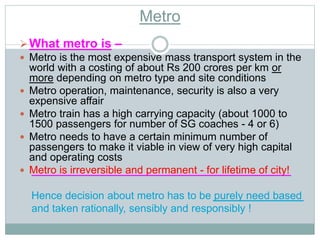
What metro is – 
 Metro is the most expensive mass transport system in the 
world with a costing of about Rs 200 crores per km or 
more depending on metro type and site conditions 
 Metro operation, maintenance, security is also a very 
expensive affair 
 Metro train has a high carrying capacity (about 1000 to 
1500 passengers for number of SG coaches - 4 or 6) 
 Metro needs to have a certain minimum number of 
passengers to make it viable in view of very high capital 
and operating costs 
 Metro is irreversible and permanent - for lifetime of city! 
Hence decision about metro has to be purely need based 
and taken rationally, sensibly and responsibly !
Benefits of a metro 
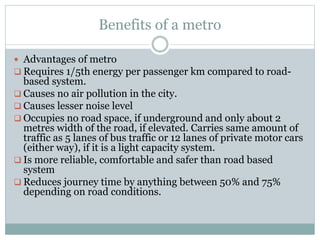
 Advantages of metro 
 Requires 1/5th energy per passenger km compared to road-based 
system. 
 Causes no air pollution in the city. 
 Causes lesser noise level 
 Occupies no road space, if underground and only about 2 
metres width of the road, if elevated. Carries same amount of 
traffic as 5 lanes of bus traffic or 12 lanes of private motor cars 
(either way), if it is a light capacity system. 
 Is more reliable, comfortable and safer than road based 
system 
 Reduces journey time by anything between 50% and 75% 
depending on road conditions.
 Need of metro in Pune 
Increasing traffic congestion due to rising per capita 
income 
 7th largest city 
Pollution control
Pune Metro proposal 
 DMRC (Delhi Metro Rail Corporation) appointed by PMC submitted a 
report for Metro in Pune. This report was originally approved by PMC in 
great haste in January 2010 without any independent study, 
transparency and public consultations. Now after two and half years 
State Government has also approved the DMRC report in June 2012. 
 Report available on PMC website – www.punecorporation.org 
• No one need be against Metro as a mode of mass transport. But we 
citizens have a right to know what DMRC’s metro proposal is, whether it 
will be really useful for us, what impact it will have on us and our city, 
what financial burden will be put on us and then decide whether we 
want it ! 
 As PMC has not provided information to citizens about Pune Metro plan, 
this citizen-friendly presentation has been prepared for public 
information and awareness and is based on a study of DMRC’s report 
from a citizens’ perspective.
Pune Metro presentation 
Basic key considerations 
Suitability of DMRC plan for Vanaz–Ramwadi Elevated Metro assessed on 
following considerations - 
1) Metro route feasibility, viability and whether convenient, 
really useful for majority of citizens 
2) Elevated metro 
– Impact on city, people, road traffic 
– Compliance with rules
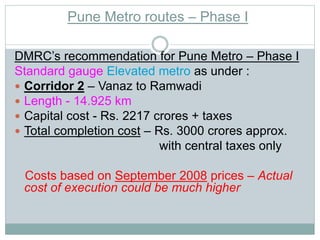
Pune Metro routes – Phase I 
DMRC’s recommendation for Pune Metro – Phase I 
Standard gauge Elevated metro as under : 
 Corridor 2 – Vanaz to Ramwadi 
 Length - 14.925 km 
 Capital cost - Rs. 2217 crores + taxes 
 Total completion cost – Rs. 3000 crores approx. 
with central taxes only 
Costs based on September 2008 prices – Actual 
cost of execution could be much higher
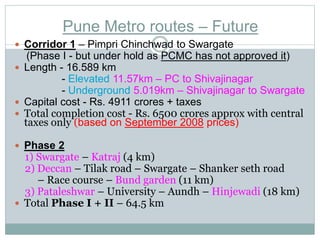
Pune Metro routes – Future 
 Corridor 1 – Pimpri Chinchwad to Swargate 
(Phase I - but under hold as PCMC has not approved it) 
 Length - 16.589 km 
- Elevated 11.57km – PC to Shivajinagar 
- Underground 5.019km – Shivajinagar to Swargate 
 Capital cost - Rs. 4911 crores + taxes 
 Total completion cost - Rs. 6500 crores approx with central 
taxes only (based on September 2008 prices) 
 Phase 2 
1) Swargate – Katraj (4 km) 
2) Deccan – Tilak road – Swargate – Shanker seth road 
– Race course – Bund garden (11 km) 
3) Pataleshwar – University – Aundh – Hinjewadi (18 km) 
 Total Phase I + II – 64.5 km
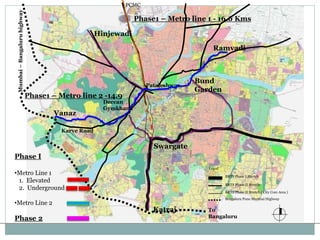
Karve Road 
Mumbai – Bangaluru highway 
Phase1 – Metro line 1 - 16.6 Kms 
BRTS Phase I Stretch 
BRTS Phase II Stretch 
BRTS Phase II Stretch ( City Core Area ) 
Bengaluru Pune Mumbai Highway 
Leged 
To 
Bangaluru 
Katraj 
PCMC 
Pataleshwar 
Swargate 
Hinjewadi 
Phase1 – Metro line 2 -14.9 
Bund 
Garden 
Vanaz 
Deccan 
Gymkhana 
Ramvadi 
Phase I 
•Metro Line 1 
1. Elevated 
2. Underground 
•Metro Line 2 
Phase 2
Metro Issues 
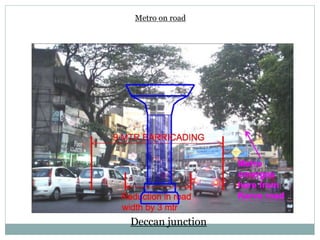
1) Metro on road 
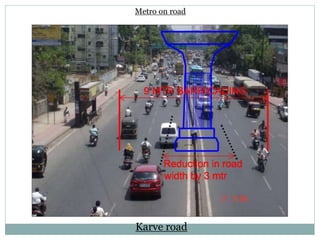
 Elevated metro has to run on road at a height of about 10 mtr. 
There will be a flyover like structure called via duct with pillars 
on road. Reduction in total road carriageway width by about 3 
mtr. 
– likely increase in traffic congestion as road widening not possible and 
no guaranty of substantial reduction in number of vehicles due to metro 
– Central lane BRT will not be possible 
– Normal bus service also affected due to less road width 
 9 mtr of central road portion will be barricaded during 
construction– traffic chaos as no suitable alternative diversion roads 
available (example Karve road, J M road, Maldhakka road, Sasoon 
road, Railway station area)
WITH UNDERGROUND METRO 
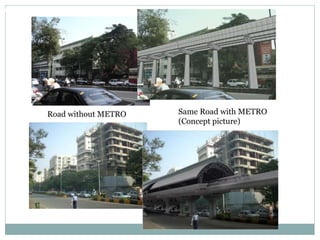
Before 
METRO 
Road without METRO Same Road with METRO 
(Concept picture)
Metro on road 
Karve road
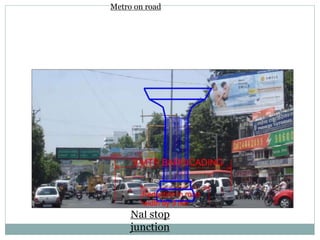
Metro on road 
Nal stop 
junction
Metro on road 
Deccan junction
Metro Issues 
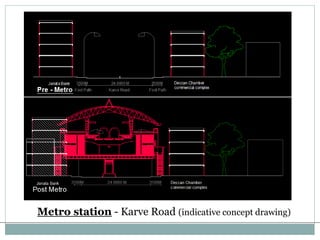
2) Metro station on road 
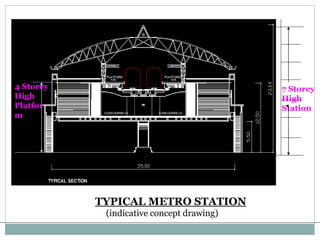
 35-40 mtr wide,140 mtr long and 23 mtr (7-8 storey) high metro station 
– insufficient clear space for station (example Nalstop station) 
– demolition of road side buildings, land acquisition required 
– increase in pollution as vehicle exhaust gases cannot escape upwards 
 Station platform at 12 to 17 mtr height (4-5 storey) above road level – 
access could be a problem – large number of steps to be climbed (As 
per DMRC report - Executive summary, pg 12 – Provision for escalators 
only in paid area. No lifts for disabled persons at present – future 
provision being kept in civil work) 
 Station entry/exit will block footpath, unsafe for pedestrians who will 
have to walk on congested road 
 Bus stops will be shifted inconveniencing bus passengers 
 No parking space possible at metro stations due to location in 
congested areas (DMRC report - Executive summary, pg 12) – 
people using own vehicles will not be able to use metro
7 Storey 
High 
Station 
TYPICAL METRO STATION 
(indicative concept drawing) 
4 Storey 
High 
Platfor 
m
Metro station - Karve Road (indicative concept drawing)
Vanaz-Ramwadi Elevated Metro Issues 
3) Metro alignment on road 
 Metro cannot be at road centre in case of obstructions or sharp 
turn on road which metro cannot take 
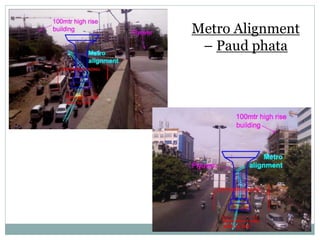
 Existing Paud phata flyover will shift metro to Paud phata - 
SNDT road further reducing road width on the congested road 
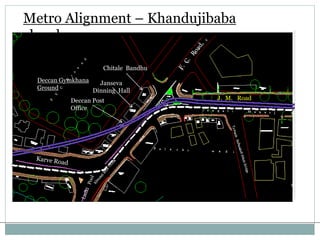
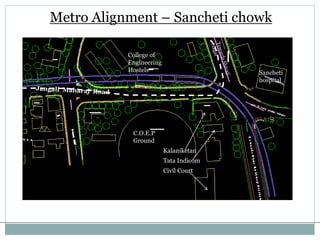
 Metro alignment not possible at existing road turnings, for 
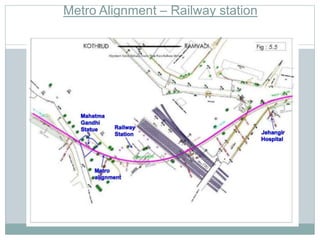
example Khandujibaba chowk,Sancheti chowk,Railway station 
– metro will deviate from road centre 
– demolition of road side buildings, land acquisition required 
 Railway crossing at Pune Railway Station – big problem as 
very busy rail route 
 River crossings may also pose problem, land acquisition 
required
Metro Alignment 
– Paud phata
Metro Alignment – Khandujibaba 
chowk 
Deccan Gymkhana 
Ground 
Chitale Bandhu 
Janseva 
Dinning Hall 
Deccan Post 
Office 
J. M. Road 
(Reference: DMRC Report)
Metro Alignment – Sancheti chowk 
Courtesy : V I T ‘S PVP College of Architecture, Pune. Project by : IV th year B.Arch. 
Civil Court 
Sancheti 
hospital 
College of 
Engineering 
Hostels 
C.O.E.P 
Ground 
Kalaniketan 
Tata Indicom
Metro Alignment – Railway station
Vanaz-Ramwadi Elevated Metro Issues 
4) Violation of fire safety norms and DC rules in 
metro construction 
 Insufficient space for metro stations and alignment 
 Part or full demolition of buildings required 
 Metro construction will encroach on footpaths and side 
margins of road side buildings 
 Metro construction could be very close to existing buildings 
without sufficient circulation space in between 
 Natural light, ventilation for buildings will be affected 
 Clear access to building from road may get blocked 
 All portions and floors of building will not be accessible for 
fire engines 
 Rescue in case of emergencies will be severely hampered
Vanaz-Ramwadi Elevated Metro Issues 
5) Shifting of surface and under ground utilities required 
(water, sewage, storm water drain, electricity, telephone, traffic signals) 
– serious problems in physical shifting 
– poor co-ordination between different agencies 
– availability of suitable space for relocation will be a problem 
– citizens will suffer due to disruption/disconnection of services during 
shifting, relocation, replacement 
6) Traffic management during construction - big problem 
(regulation, re-routing, diversion etc.) 
– suitable roads for traffic diversion not available 
– severe traffic congestion & unsafe road conditions 
– insufficient traffic police strength for traffic regulation 
– people will suffer as mobility seriously affected 
– pedestrians will face serious problems 
– fate of disabled will be worst
Vanaz-Ramwadi Elevated Metro Issues 
7) All future options on road will be closed permanently – flyovers, 
subways, BRT, monorail, walkways, trees, beautification etc. 
8) Risks & trauma 
 Risk to existing buildings due to operation of heavy machinery, crane 
movement etc. 
 Safety risk for people, accident hazard 
 Health risk and severe inconvenience for people residing or working 
in construction site area due to noise, vibrations, air pollution etc. 
 Patients, senior citizens, students will be seriously affected 
 Mental trauma to citizens due to continuous disturbance, disruption of 
utility services, mobility problems, changes in daily life pattern, 
rehabilitation due to demolitions, land acquisitions etc.
Vanaz-Ramwadi Elevated Metro Issues 
9) Loss for citizens 
 Loss of business due to construction activity and difficulty 
for customers, goods carriers to access the business 
premises 
 Loss of livelihood 
 Loss of value of premises due to various reasons 
 Loss of time for travel on road 
 Loss due to increased fuel consumption 
 Loss of life and property in case of emergencies where 
premises are inaccessible for fire engines, ambulances due 
to metro alignment, metro stations
Vanaz-Ramwadi Elevated Metro Issues 
10) Visual impact & quality of life 
– Hundreds of trees on road will be cut (eg JM road) 
– Building side margins and road side open spaces, 
beautification will vanish 
– Metro track will be like a continuous flyover on road cutting 
off view of sky 
– Huge metro stations across entire road width and very close 
to road side buildings will be eye sores 
– Elevated track and stations together will give basement effect 
on road 
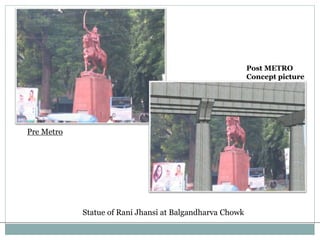
– View of historical monuments, statues affected 
– This extreme visual pollution on prime roads will reduce 
quality of life for citizens
Statue of Rani Jhansi at Balgandharva Chowk 
Pre Metro 
Post METRO 
Concept picture
Pune Metro plan 
Some important questions - 
 Why no transparency and people not taken into confidence 
 Why their views, suggestions, objections not invited before taking decision 
• Why Integrated Master plan for Traffic & Transportation considering 
various mobility options and transport modes not prepared before taking 
any decision in the matter of very expensive mass transport like Metro 
• Why independent study of DMRC report not done by PMC 
 Why DMRC not asked to do detailed feasibility study for proposed routes 
for both elevated & under ground metro, standard gauge & broad gauge 
• Whether all other concerned agencies consulted before finalizing 
metro plan, for example Town planning, Traffic police… . 
 Whether realistic estimates prepared for metro related works 
 How will funds be generated .. 
 Who would have ownership of Metro – public accountability ?
Metro Issues 
Impacts where ? 
 All these impacts on roads which are vital arterial links for the city 
– Paud phata, Karve road, JM road, Maldhakka road, Bund garden road.. 
 Roads already congested with traffic volume exceeding road capacity 
 Central lane BRT also planned on the roads 
 Areas fully developed and further road widening not possible 
 Massive metro columns and stations would reduce carriageway width 
which may cause serious traffic congestion problems 
 Situation worse during construction phase as half the road carriageway 
width would be blocked 
 Suitable alternative roads of adequate capacity not available for traffic 
diversion 
 Traffic and mobility will become a nightmare for citizens seriously affecting 
their daily life 
 Situation for pedestrians will become terrible and highly unsafe
Vanaz-Ramwadi Elevated Metro Issues 
 Station location 
– For metro to be useful, most important is convenient access 
to metro station for people using different transport modes, 
example walk, cycles, buses, rickshaws, own vehicles 
– Proper footpaths, road crossings, cycle stands, feeder bus 
routes and bus stops, rickshaw stands, vehicle parking space 
are a must for maximum people to use metro. This is also 
necessary for sufficient rider-ship and financial viability of 
metro 
– However all this is not possible for metro stations located on 
congested routes – stations are proposed even at such 
congested locations as Nal stop, Garware college
Concerns about Pune Metro DPR 
 Whether it will fit in with other transport systems like BRTS etc. 
Having an integrated multimodal transport system is necessary. 
 FSI problem. 
 Narrowing of road width in case metro isn’t underground. 
 Inconvenience to pedestrians, problems regarding parking etc. 
 Land acquisition problems. Disruption in existing infrastructural 
fabric of the city. 
 DPR was made by DMRC which only forecasted the traffic demand 
of the metro system and identified potential locations and was 
passed hastily. 
 Presupposed the need for a high capacity network rather than to 
evaluate whether one was needed. 
 Concerns regarding overground metros in densely populated areas.
 Investors would necessarily depend on some form of 
Government support in the form of viability gap 
funding, higher taxes,free or subsidized land 
concessions etc. – all of which would be paid by 
citizens. 
 Safety and health risk 
 Traffic management while construction 
 Future options after metro construction become very 
limited.
Pune Metro costing 
DMRC cost estimate based on September 2008 prices – how realistic it is? 
Cost escalation possible in case of following - 
 All direct and indirect items/works not considered adequately 
 Detailed surveys and studies not done to assess work quantum 
 Delays due to hurdles in obtaining required statutory permissions 
 Delays due to problems in land acquisition 
 Delays due to non-availability of site clearances 
 Delays due to improper assessment of work and difficulties in execution 
 Delays due to shifting of utilities 
 Delays due to non-availability of funds 
 Delays due to commercial / legal issues……. 
Escalation in project costs as work progresses is a usual experience 
– how will the additional funds be raised ?
Metro funding 
Proposed funding of metro capital cost 
1) SPV model – Special Purpose Vehicle under State control eg.DMRC 
 20% each - by Central Government and State Government as equity 
 60% - by PMC, loans from banks/financial institutions, other sources 
2) PPP model – Not very successful elsewhere as Metro is social sector 
 BOT – Private firm responsible for financing, designing, building, 
operating and maintaining entire project. 
– State Government’s contribution limited to cost of land only. 
– Private operator will demand certain assured high rate of return 
– Can become burden on city and citizens 
 Other PPP models – Both public and private sector assume 
separate responsibilities
Metro funding 
Other sources of revenue 
 Sale of 4 FSI proposed for 500 mtr stretch on both sides of metro 
corridor 
 Property development of Govt. land with 4 FSI & with involvement of 
Developers 
 Lease rentals 
 Advertisements 
 Parking rights leasing 
 Co-branding rights to corporates 
 50% cess on tax for registration of vehicles 
 Surcharge on fuel (petrol, diesel, CNG) 
 Metro tax @ 2% on pay rolls of all establishments with more than 100 
employees 
 Surcharge @ 10% on luxury tax on earnings of Star hotels 
 Professional tax @ 1% 
 Surcharge on property tax 
 Entry tax on all commercial vehicles…….
Do we want all this to happen in Pune?
Vanaz-Ramwadi Elevated Metro 
IMPACTS 
 Project to be implemented through fully developed areas and along 
highly congested routes 
 Great hardships, inconvenience and unsafe conditions for citizens during 
construction phase as well as losses due to various reasons 
 Safety risk, health risk, mental trauma for citizens 
 Shifting of utilities - a major problem 
 Demolition of buildings, land acquisition, rehabilitation 
 Cutting of trees 
 Violation of fire safety norms and DC rules 
 Traffic congestion will increase – during construction and even after 
 Bus service and BRT will be affected – further shift to private vehicles? 
 Visual pollution 
 City skyline permanently damaged 
 Future options on road permanently closed
Learnings & Conclusion 
 Decision making in most urban local bodies (ULBs) 
needs to be transparent and participative, as not being 
done in case of Pune. 
 Decision making needs to be scientific rather than on an 
ad-hoc approach. 
 Despite guidelines to the contrary from MoUD, transport 
planning in most Indian cities is done in separate project 
silos with different modes being treated independently 
rather than as parts of a single integrated solution. 
 Least‐cost planning considering supply and demand side 
options has to be done in order to reduce burden on aam 
junta. This should be done accounting for the socio-economic 
impact this project will account for.
Conclusion 
Metro 
There is a big question mark both on Vanaz-Ramwadi metro route 
and elevated metro on this route. Hence implementation of metro as 
per present DMRC report is not in city’s interests. 
 Alternatives - How should Metro plan be ? 
 Bus for shorter distances where road width insufficient for metro 
 Other routes outside core city areas can be considered for metro eg. 
HCMTR (High capacity mass transit route), ring road etc. 
 In case necessary to run metro in developed areas with congested 
roads, it should be underground only. 
 It can be elevated on city outskirts where road width more than 40 mtr. 
 Surface metro should be considered if sufficient road width is available
Vanaz-Ramwadi Elevated Metro 
What needs to be done – 
• Independent study and appraisal of DMRC report by third 
party experts 
• Citizens should be given adequate opportunity to present 
and explain their suggestions and objections to the expert 
committee 
• Study for techno-economic evaluation of alternatives with 
cost-benefit analysis 
• PMC should take people into confidence and give 
information about the metro project and impacts in a 
language and format they will understand 
• Final decision about Metro should only be taken based on 
above independent studies and in consultation with the 
public
Wake up call for Pune 
 Metro very costly irreversible project and decision will impact city 
tremendously 
 No response from Government to suggestions, objections submitted 
 Decision if proved wrong later would be disastrous for the city. Ultimately it 
is we citizens who will suffer 
 Metro if later found unviable and not useful for majority of citizens, would 
be a permanent back-breaking financial burden for the city - And basic 
traffic problem will remain unsolved and get worse 
 Once Tenders are floated and contract awarded, it becomes very difficult to 
stop the project 
 Normally citizens wake up only when work reaches their door step and it is 
too late by then 
 Everyone should understand what is being planned, what is most likely to 
happen, how it will affect us as citizens and the city as a whole... 
 Please think and decide whether you want all this to happen… 
And speak out, react before it is too late !
Thank you

NIKHIL YADAV-PUNE METRO & WHY DELAYED!!!

  • 1.
    Pune Metro- WhyDELAYED!! NIKHIL YADAV MBA – MARKETING PUMBA , PUNE
  • 2.
    CONTENTS  Introduction– Metro in India  Brief history  Concerns for Pune metro  Learnings & conclusion
  • 3.
    Metro  Metroconjures up a very big picture and we may have a feeling that it is high time we have Metro in Pune  Nothing wrong, but first we need to be clear about what metro is and what metro is not !  What Metro is not –  Metro is not a magic wand which will make the traffic problems of the city disappear  Metro is not a system which Pune should have, simply because it is the most advanced mass transport system  Metro is not a system which Pune should have, simply because Pune is now a big, growing metropolitan city – IT, industrial, education hub….  Metro is not a system which Pune must have whatever be the impact and price to be paid
  • 4.
    Metro What metrois –  Metro is the most expensive mass transport system in the world with a costing of about Rs 200 crores per km or more depending on metro type and site conditions  Metro operation, maintenance, security is also a very expensive affair  Metro train has a high carrying capacity (about 1000 to 1500 passengers for number of SG coaches - 4 or 6)  Metro needs to have a certain minimum number of passengers to make it viable in view of very high capital and operating costs  Metro is irreversible and permanent - for lifetime of city! Hence decision about metro has to be purely need based and taken rationally, sensibly and responsibly !
  • 5.
    Benefits of ametro  Advantages of metro  Requires 1/5th energy per passenger km compared to road-based system.  Causes no air pollution in the city.  Causes lesser noise level  Occupies no road space, if underground and only about 2 metres width of the road, if elevated. Carries same amount of traffic as 5 lanes of bus traffic or 12 lanes of private motor cars (either way), if it is a light capacity system.  Is more reliable, comfortable and safer than road based system  Reduces journey time by anything between 50% and 75% depending on road conditions.
  • 6.
     Need ofmetro in Pune Increasing traffic congestion due to rising per capita income  7th largest city Pollution control
  • 7.
    Pune Metro proposal  DMRC (Delhi Metro Rail Corporation) appointed by PMC submitted a report for Metro in Pune. This report was originally approved by PMC in great haste in January 2010 without any independent study, transparency and public consultations. Now after two and half years State Government has also approved the DMRC report in June 2012.  Report available on PMC website – www.punecorporation.org • No one need be against Metro as a mode of mass transport. But we citizens have a right to know what DMRC’s metro proposal is, whether it will be really useful for us, what impact it will have on us and our city, what financial burden will be put on us and then decide whether we want it !  As PMC has not provided information to citizens about Pune Metro plan, this citizen-friendly presentation has been prepared for public information and awareness and is based on a study of DMRC’s report from a citizens’ perspective.
  • 8.
    Pune Metro presentation Basic key considerations Suitability of DMRC plan for Vanaz–Ramwadi Elevated Metro assessed on following considerations - 1) Metro route feasibility, viability and whether convenient, really useful for majority of citizens 2) Elevated metro – Impact on city, people, road traffic – Compliance with rules
  • 9.
    Pune Metro routes– Phase I DMRC’s recommendation for Pune Metro – Phase I Standard gauge Elevated metro as under :  Corridor 2 – Vanaz to Ramwadi  Length - 14.925 km  Capital cost - Rs. 2217 crores + taxes  Total completion cost – Rs. 3000 crores approx. with central taxes only Costs based on September 2008 prices – Actual cost of execution could be much higher
  • 10.
    Pune Metro routes– Future  Corridor 1 – Pimpri Chinchwad to Swargate (Phase I - but under hold as PCMC has not approved it)  Length - 16.589 km - Elevated 11.57km – PC to Shivajinagar - Underground 5.019km – Shivajinagar to Swargate  Capital cost - Rs. 4911 crores + taxes  Total completion cost - Rs. 6500 crores approx with central taxes only (based on September 2008 prices)  Phase 2 1) Swargate – Katraj (4 km) 2) Deccan – Tilak road – Swargate – Shanker seth road – Race course – Bund garden (11 km) 3) Pataleshwar – University – Aundh – Hinjewadi (18 km)  Total Phase I + II – 64.5 km
  • 11.
    Karve Road Mumbai– Bangaluru highway Phase1 – Metro line 1 - 16.6 Kms BRTS Phase I Stretch BRTS Phase II Stretch BRTS Phase II Stretch ( City Core Area ) Bengaluru Pune Mumbai Highway Leged To Bangaluru Katraj PCMC Pataleshwar Swargate Hinjewadi Phase1 – Metro line 2 -14.9 Bund Garden Vanaz Deccan Gymkhana Ramvadi Phase I •Metro Line 1 1. Elevated 2. Underground •Metro Line 2 Phase 2
  • 12.
    Metro Issues 1)Metro on road  Elevated metro has to run on road at a height of about 10 mtr. There will be a flyover like structure called via duct with pillars on road. Reduction in total road carriageway width by about 3 mtr. – likely increase in traffic congestion as road widening not possible and no guaranty of substantial reduction in number of vehicles due to metro – Central lane BRT will not be possible – Normal bus service also affected due to less road width  9 mtr of central road portion will be barricaded during construction– traffic chaos as no suitable alternative diversion roads available (example Karve road, J M road, Maldhakka road, Sasoon road, Railway station area)
  • 13.
    WITH UNDERGROUND METRO Before METRO Road without METRO Same Road with METRO (Concept picture)
  • 14.
    Metro on road Karve road
  • 15.
    Metro on road Nal stop junction
  • 16.
    Metro on road Deccan junction
  • 17.
    Metro Issues 2)Metro station on road  35-40 mtr wide,140 mtr long and 23 mtr (7-8 storey) high metro station – insufficient clear space for station (example Nalstop station) – demolition of road side buildings, land acquisition required – increase in pollution as vehicle exhaust gases cannot escape upwards  Station platform at 12 to 17 mtr height (4-5 storey) above road level – access could be a problem – large number of steps to be climbed (As per DMRC report - Executive summary, pg 12 – Provision for escalators only in paid area. No lifts for disabled persons at present – future provision being kept in civil work)  Station entry/exit will block footpath, unsafe for pedestrians who will have to walk on congested road  Bus stops will be shifted inconveniencing bus passengers  No parking space possible at metro stations due to location in congested areas (DMRC report - Executive summary, pg 12) – people using own vehicles will not be able to use metro
  • 18.
    7 Storey High Station TYPICAL METRO STATION (indicative concept drawing) 4 Storey High Platfor m
  • 19.
    Metro station -Karve Road (indicative concept drawing)
  • 20.
    Vanaz-Ramwadi Elevated MetroIssues 3) Metro alignment on road  Metro cannot be at road centre in case of obstructions or sharp turn on road which metro cannot take  Existing Paud phata flyover will shift metro to Paud phata - SNDT road further reducing road width on the congested road  Metro alignment not possible at existing road turnings, for example Khandujibaba chowk,Sancheti chowk,Railway station – metro will deviate from road centre – demolition of road side buildings, land acquisition required  Railway crossing at Pune Railway Station – big problem as very busy rail route  River crossings may also pose problem, land acquisition required
  • 21.
  • 22.
    Metro Alignment –Khandujibaba chowk Deccan Gymkhana Ground Chitale Bandhu Janseva Dinning Hall Deccan Post Office J. M. Road (Reference: DMRC Report)
  • 23.
    Metro Alignment –Sancheti chowk Courtesy : V I T ‘S PVP College of Architecture, Pune. Project by : IV th year B.Arch. Civil Court Sancheti hospital College of Engineering Hostels C.O.E.P Ground Kalaniketan Tata Indicom
  • 24.
    Metro Alignment –Railway station
  • 25.
    Vanaz-Ramwadi Elevated MetroIssues 4) Violation of fire safety norms and DC rules in metro construction  Insufficient space for metro stations and alignment  Part or full demolition of buildings required  Metro construction will encroach on footpaths and side margins of road side buildings  Metro construction could be very close to existing buildings without sufficient circulation space in between  Natural light, ventilation for buildings will be affected  Clear access to building from road may get blocked  All portions and floors of building will not be accessible for fire engines  Rescue in case of emergencies will be severely hampered
  • 26.
    Vanaz-Ramwadi Elevated MetroIssues 5) Shifting of surface and under ground utilities required (water, sewage, storm water drain, electricity, telephone, traffic signals) – serious problems in physical shifting – poor co-ordination between different agencies – availability of suitable space for relocation will be a problem – citizens will suffer due to disruption/disconnection of services during shifting, relocation, replacement 6) Traffic management during construction - big problem (regulation, re-routing, diversion etc.) – suitable roads for traffic diversion not available – severe traffic congestion & unsafe road conditions – insufficient traffic police strength for traffic regulation – people will suffer as mobility seriously affected – pedestrians will face serious problems – fate of disabled will be worst
  • 27.
    Vanaz-Ramwadi Elevated MetroIssues 7) All future options on road will be closed permanently – flyovers, subways, BRT, monorail, walkways, trees, beautification etc. 8) Risks & trauma  Risk to existing buildings due to operation of heavy machinery, crane movement etc.  Safety risk for people, accident hazard  Health risk and severe inconvenience for people residing or working in construction site area due to noise, vibrations, air pollution etc.  Patients, senior citizens, students will be seriously affected  Mental trauma to citizens due to continuous disturbance, disruption of utility services, mobility problems, changes in daily life pattern, rehabilitation due to demolitions, land acquisitions etc.
  • 28.
    Vanaz-Ramwadi Elevated MetroIssues 9) Loss for citizens  Loss of business due to construction activity and difficulty for customers, goods carriers to access the business premises  Loss of livelihood  Loss of value of premises due to various reasons  Loss of time for travel on road  Loss due to increased fuel consumption  Loss of life and property in case of emergencies where premises are inaccessible for fire engines, ambulances due to metro alignment, metro stations
  • 29.
    Vanaz-Ramwadi Elevated MetroIssues 10) Visual impact & quality of life – Hundreds of trees on road will be cut (eg JM road) – Building side margins and road side open spaces, beautification will vanish – Metro track will be like a continuous flyover on road cutting off view of sky – Huge metro stations across entire road width and very close to road side buildings will be eye sores – Elevated track and stations together will give basement effect on road – View of historical monuments, statues affected – This extreme visual pollution on prime roads will reduce quality of life for citizens
  • 30.
    Statue of RaniJhansi at Balgandharva Chowk Pre Metro Post METRO Concept picture
  • 31.
    Pune Metro plan Some important questions -  Why no transparency and people not taken into confidence  Why their views, suggestions, objections not invited before taking decision • Why Integrated Master plan for Traffic & Transportation considering various mobility options and transport modes not prepared before taking any decision in the matter of very expensive mass transport like Metro • Why independent study of DMRC report not done by PMC  Why DMRC not asked to do detailed feasibility study for proposed routes for both elevated & under ground metro, standard gauge & broad gauge • Whether all other concerned agencies consulted before finalizing metro plan, for example Town planning, Traffic police… .  Whether realistic estimates prepared for metro related works  How will funds be generated ..  Who would have ownership of Metro – public accountability ?
  • 32.
    Metro Issues Impactswhere ?  All these impacts on roads which are vital arterial links for the city – Paud phata, Karve road, JM road, Maldhakka road, Bund garden road..  Roads already congested with traffic volume exceeding road capacity  Central lane BRT also planned on the roads  Areas fully developed and further road widening not possible  Massive metro columns and stations would reduce carriageway width which may cause serious traffic congestion problems  Situation worse during construction phase as half the road carriageway width would be blocked  Suitable alternative roads of adequate capacity not available for traffic diversion  Traffic and mobility will become a nightmare for citizens seriously affecting their daily life  Situation for pedestrians will become terrible and highly unsafe
  • 33.
    Vanaz-Ramwadi Elevated MetroIssues  Station location – For metro to be useful, most important is convenient access to metro station for people using different transport modes, example walk, cycles, buses, rickshaws, own vehicles – Proper footpaths, road crossings, cycle stands, feeder bus routes and bus stops, rickshaw stands, vehicle parking space are a must for maximum people to use metro. This is also necessary for sufficient rider-ship and financial viability of metro – However all this is not possible for metro stations located on congested routes – stations are proposed even at such congested locations as Nal stop, Garware college
  • 34.
    Concerns about PuneMetro DPR  Whether it will fit in with other transport systems like BRTS etc. Having an integrated multimodal transport system is necessary.  FSI problem.  Narrowing of road width in case metro isn’t underground.  Inconvenience to pedestrians, problems regarding parking etc.  Land acquisition problems. Disruption in existing infrastructural fabric of the city.  DPR was made by DMRC which only forecasted the traffic demand of the metro system and identified potential locations and was passed hastily.  Presupposed the need for a high capacity network rather than to evaluate whether one was needed.  Concerns regarding overground metros in densely populated areas.
  • 35.
     Investors wouldnecessarily depend on some form of Government support in the form of viability gap funding, higher taxes,free or subsidized land concessions etc. – all of which would be paid by citizens.  Safety and health risk  Traffic management while construction  Future options after metro construction become very limited.
  • 36.
    Pune Metro costing DMRC cost estimate based on September 2008 prices – how realistic it is? Cost escalation possible in case of following -  All direct and indirect items/works not considered adequately  Detailed surveys and studies not done to assess work quantum  Delays due to hurdles in obtaining required statutory permissions  Delays due to problems in land acquisition  Delays due to non-availability of site clearances  Delays due to improper assessment of work and difficulties in execution  Delays due to shifting of utilities  Delays due to non-availability of funds  Delays due to commercial / legal issues……. Escalation in project costs as work progresses is a usual experience – how will the additional funds be raised ?
  • 37.
    Metro funding Proposedfunding of metro capital cost 1) SPV model – Special Purpose Vehicle under State control eg.DMRC  20% each - by Central Government and State Government as equity  60% - by PMC, loans from banks/financial institutions, other sources 2) PPP model – Not very successful elsewhere as Metro is social sector  BOT – Private firm responsible for financing, designing, building, operating and maintaining entire project. – State Government’s contribution limited to cost of land only. – Private operator will demand certain assured high rate of return – Can become burden on city and citizens  Other PPP models – Both public and private sector assume separate responsibilities
  • 38.
    Metro funding Othersources of revenue  Sale of 4 FSI proposed for 500 mtr stretch on both sides of metro corridor  Property development of Govt. land with 4 FSI & with involvement of Developers  Lease rentals  Advertisements  Parking rights leasing  Co-branding rights to corporates  50% cess on tax for registration of vehicles  Surcharge on fuel (petrol, diesel, CNG)  Metro tax @ 2% on pay rolls of all establishments with more than 100 employees  Surcharge @ 10% on luxury tax on earnings of Star hotels  Professional tax @ 1%  Surcharge on property tax  Entry tax on all commercial vehicles…….
  • 39.
    Do we wantall this to happen in Pune?
  • 40.
    Vanaz-Ramwadi Elevated Metro IMPACTS  Project to be implemented through fully developed areas and along highly congested routes  Great hardships, inconvenience and unsafe conditions for citizens during construction phase as well as losses due to various reasons  Safety risk, health risk, mental trauma for citizens  Shifting of utilities - a major problem  Demolition of buildings, land acquisition, rehabilitation  Cutting of trees  Violation of fire safety norms and DC rules  Traffic congestion will increase – during construction and even after  Bus service and BRT will be affected – further shift to private vehicles?  Visual pollution  City skyline permanently damaged  Future options on road permanently closed
  • 41.
    Learnings & Conclusion  Decision making in most urban local bodies (ULBs) needs to be transparent and participative, as not being done in case of Pune.  Decision making needs to be scientific rather than on an ad-hoc approach.  Despite guidelines to the contrary from MoUD, transport planning in most Indian cities is done in separate project silos with different modes being treated independently rather than as parts of a single integrated solution.  Least‐cost planning considering supply and demand side options has to be done in order to reduce burden on aam junta. This should be done accounting for the socio-economic impact this project will account for.
  • 42.
    Conclusion Metro Thereis a big question mark both on Vanaz-Ramwadi metro route and elevated metro on this route. Hence implementation of metro as per present DMRC report is not in city’s interests.  Alternatives - How should Metro plan be ?  Bus for shorter distances where road width insufficient for metro  Other routes outside core city areas can be considered for metro eg. HCMTR (High capacity mass transit route), ring road etc.  In case necessary to run metro in developed areas with congested roads, it should be underground only.  It can be elevated on city outskirts where road width more than 40 mtr.  Surface metro should be considered if sufficient road width is available
  • 43.
    Vanaz-Ramwadi Elevated Metro What needs to be done – • Independent study and appraisal of DMRC report by third party experts • Citizens should be given adequate opportunity to present and explain their suggestions and objections to the expert committee • Study for techno-economic evaluation of alternatives with cost-benefit analysis • PMC should take people into confidence and give information about the metro project and impacts in a language and format they will understand • Final decision about Metro should only be taken based on above independent studies and in consultation with the public
  • 44.
    Wake up callfor Pune  Metro very costly irreversible project and decision will impact city tremendously  No response from Government to suggestions, objections submitted  Decision if proved wrong later would be disastrous for the city. Ultimately it is we citizens who will suffer  Metro if later found unviable and not useful for majority of citizens, would be a permanent back-breaking financial burden for the city - And basic traffic problem will remain unsolved and get worse  Once Tenders are floated and contract awarded, it becomes very difficult to stop the project  Normally citizens wake up only when work reaches their door step and it is too late by then  Everyone should understand what is being planned, what is most likely to happen, how it will affect us as citizens and the city as a whole...  Please think and decide whether you want all this to happen… And speak out, react before it is too late !
  • 45.