Health Innovation
Exchange
NHS and LCR structures, priorities
and commissioning workshop
11th September 2018
@innovationnwc
@andydcairns
Some introductions . . .
• Andy, Jenny, Mike
• Angela
Agenda
• NHS overview – Andy 15 mins
• Social care overview - Angela 15 mins
• Cheshire and Merseyside STP/ICS structure & priorities – Jenny
15 mins
• Arms lengths bodies – Mike 15 mins
• Panel Q & A 10mins
The NHS
Andy Cairns
Commercial Programme Manager
Innovation Agency
The headlines
• Created in 1948 - 70th Bday on July 5
• Free at point of care to all (Optical, Dental, Prescriptions)
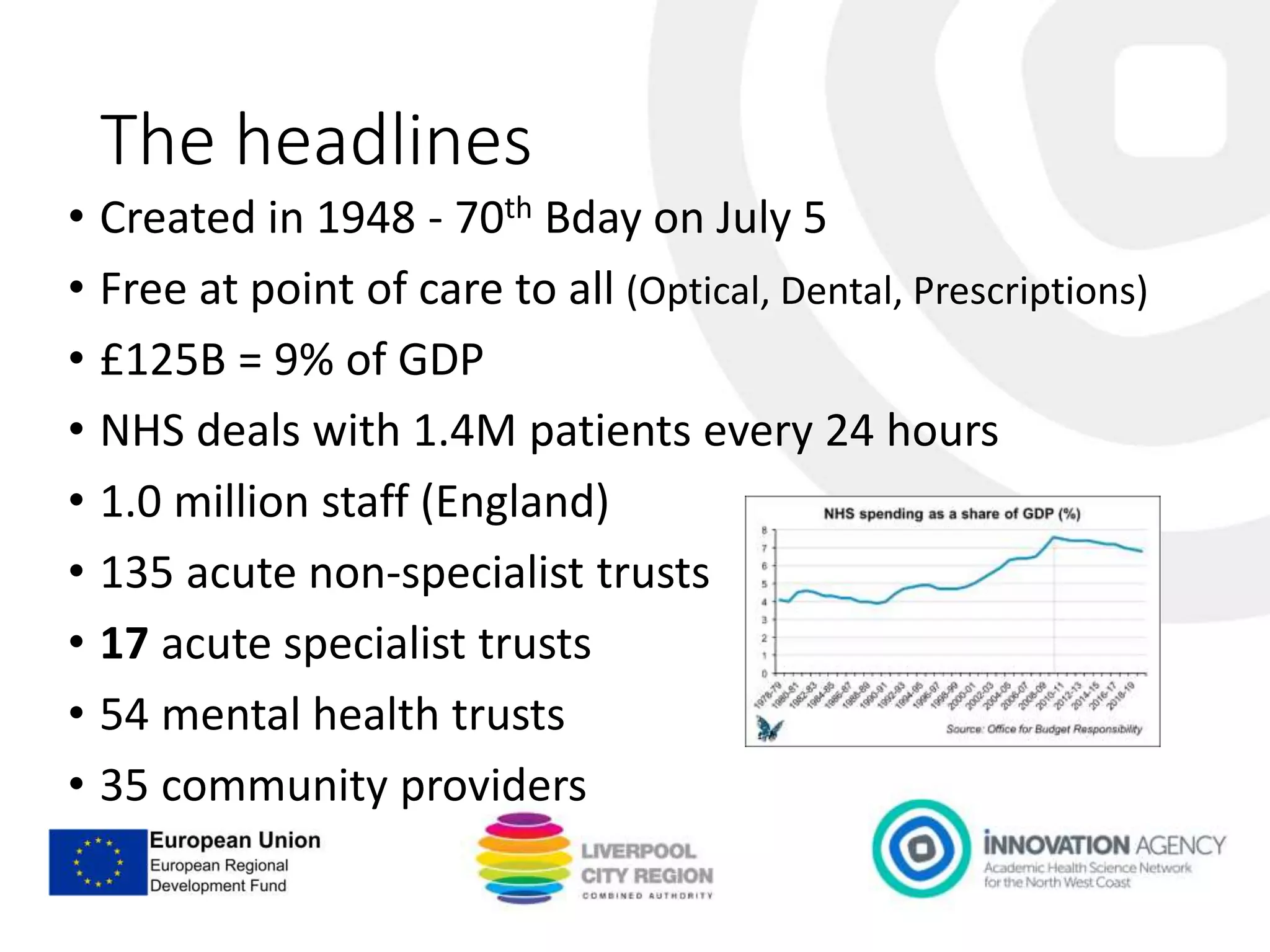
• £125B = 9% of GDP
• NHS deals with 1.4M patients every 24 hours
• 1.0 million staff (England)
• 135 acute non-specialist trusts
• 17 acute specialist trusts
• 54 mental health trusts
• 35 community providers
NHS principals
3 core principles since 1948;
1. that it meet the needs of everyone
2. that it be free at the point of delivery
3. that it be based on clinical need, not ability to pay
The NHS structures and how it works
• How does the NHS in England work_ An alternative
guide.mp4
• https://youtu.be/DEARD4I3xtE
• https://www.kingsfund.org.uk/audio-video/how-does-
nhs-in-england-work
The NHS structures
• NHS England sets the priorities and direction of the NHS to
improve health and care outcomes.
• Is the commissioner for primary care at CCG level, services
such as GPs, pharmacists and dentists, including military
health services and some specialised services and professional
training programmes via HEE
• £100 B allocated to CCGs
• Five Year Forward View, ( refresh at march 2018)
The NHS structures
• Clinical commissioning groups (CCGs) replaced primary care
trusts (PCTs) 2013. Clinically led NHS bodies responsible for
the planning and commissioning of many healthcare services
for their local area.
• CCGs can commission any service provider - NHS trust, social
enterprises, charities or private sector providers.
•220 CCGs grouped into 44 STPs
• STP in Lancashire and South Cumbria is now in a shadow ICS
form – Linda will go into more detail
The money
• NHS England/NHS Improvement – single entity regional teams
• 1948 - £437M (£15 billion at today’s value)
• 2017/18 - £125B
• Budget increase by 1.2% between 09/10 and 20/21
• Cost increase of 4%, cash reduction, activity rising at 4% annum
• L/T average of 4% £ increase not keeping pace with demand
The challenges
• Health inequalities
• PLACE based care ( out of hospital) and the aging pop
• Workforce
• Finances
National priorities
• Shift in focus from competition to collaboration
• Integrated health and social care
• Devolution(STPs)
• Additional funding
• 7 day GP services
• Urgent Care
• Cancer
• Mental Health
The opportunities
• Shift the emphasis from disease and distress to prevention
and promotion (prevent the fires)
• Passive patient becomes more discerning and responsible
for their health and wellbeing – choices and consequences
• Technology
• Resource optimisation
• Reducing duplication
• Greater standardisation and reliability
Social Care
Angela Johnson
Assistant Director for Integration
Liverpool City Region Adult Social Care Integrated Commissioning
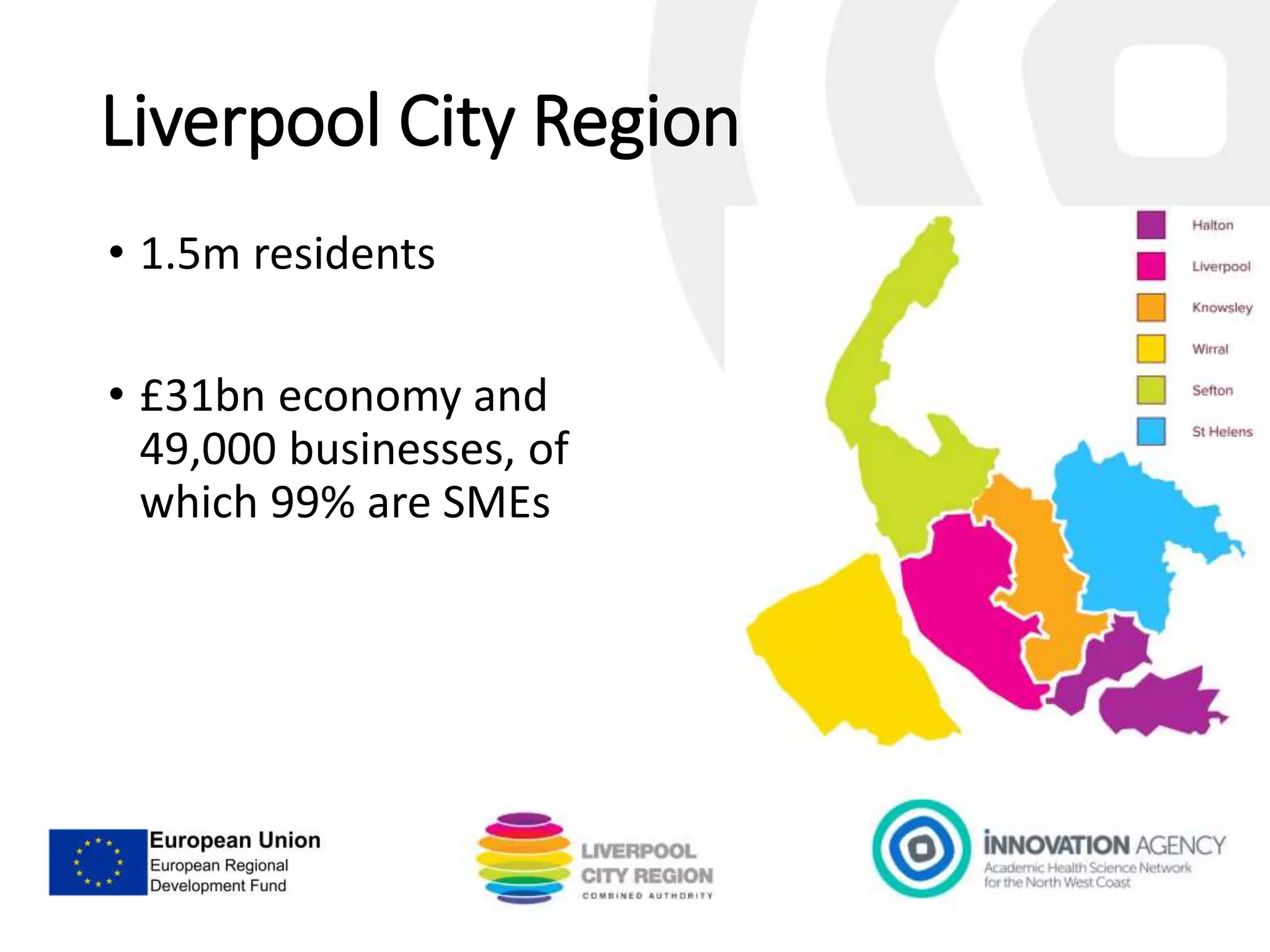
Liverpool City Region
• 1.5m residents
• £31bn economy and
49,000 businesses, of
which 99% are SMEs
Liverpool City Region (LCR)
Combined Authority
• LCR Combined Authority established on 1st April 2014
• LCR Powers enhanced and increased through Devolution
deals 2015 and 2016: Economic Development , Business
Growth and Support, Strategic Transport, Strategic
Housing and Planning, Asset Management, Energy and
Environment, Employment and Skills, Culture and
Tourism
• No specific requests in respect to health and social
care……..work across the region is therefore progressed
through collaboration
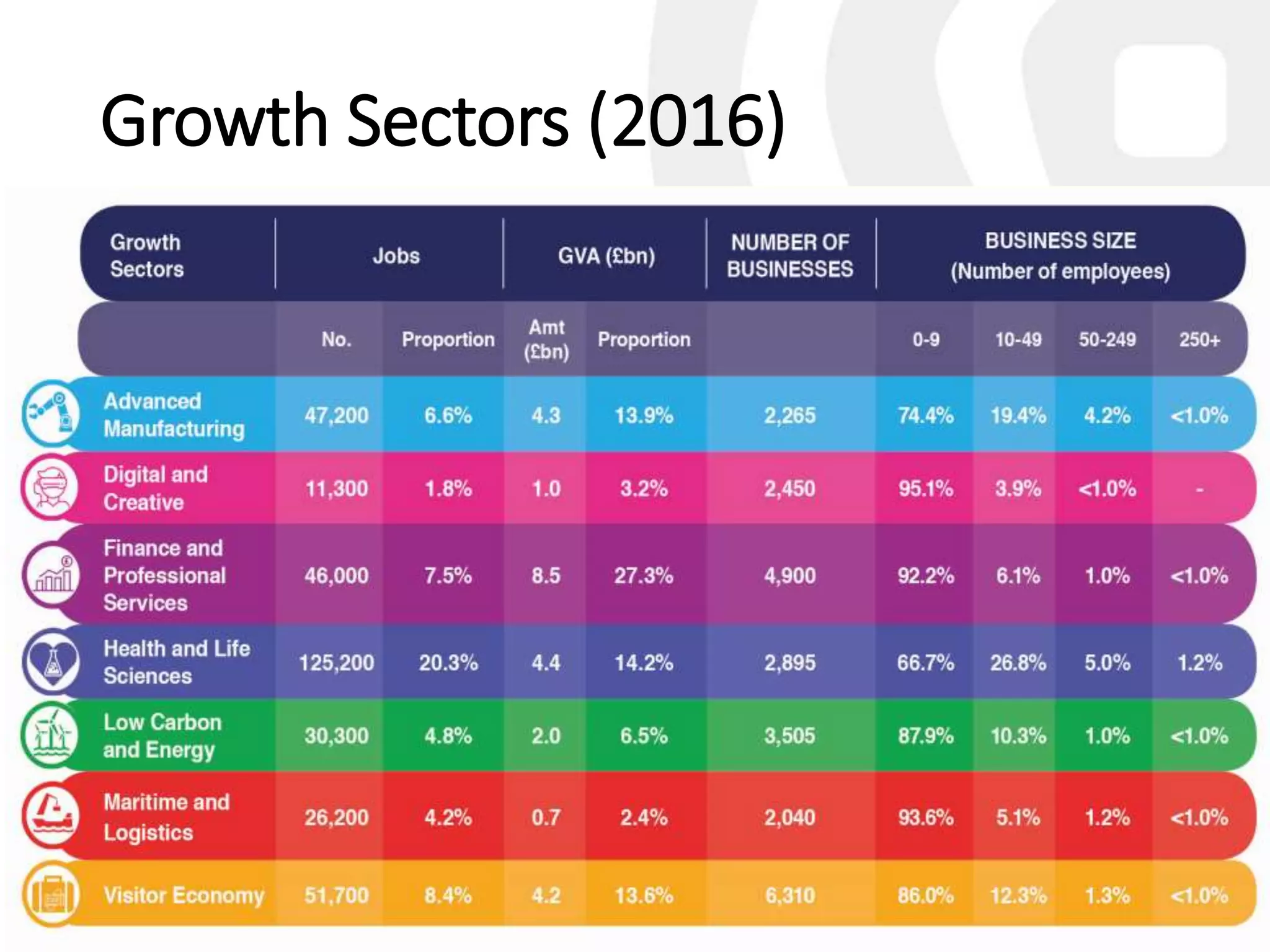
Growth Sectors (2016)
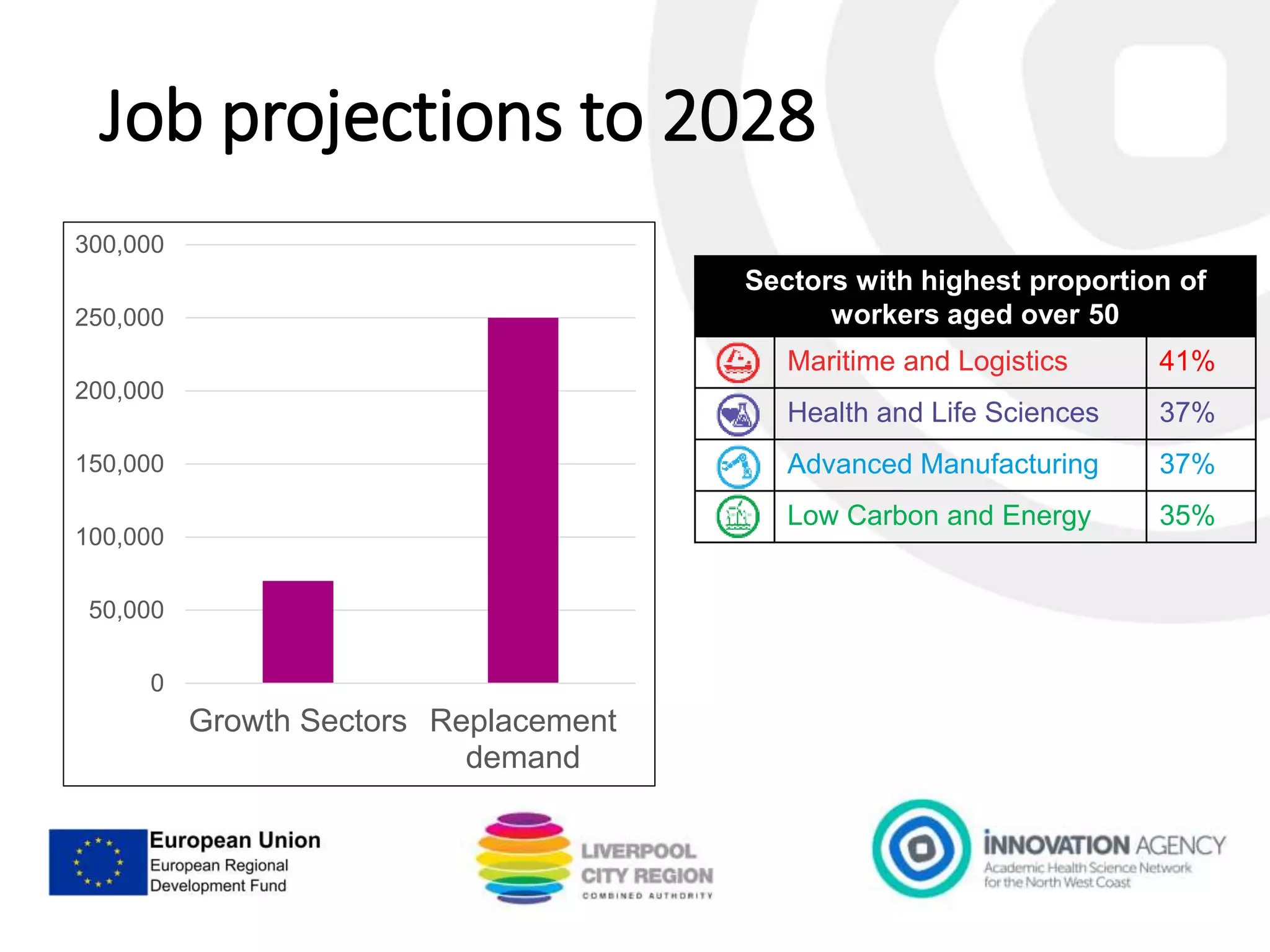
Job projections to 2028
0
50,000
100,000
150,000
200,000
250,000
300,000
Growth Sectors Replacement
demand
Sectors with highest proportion of
workers aged over 50
Maritime and Logistics 41%
Health and Life Sciences 37%
Advanced Manufacturing 37%
Low Carbon and Energy 35%
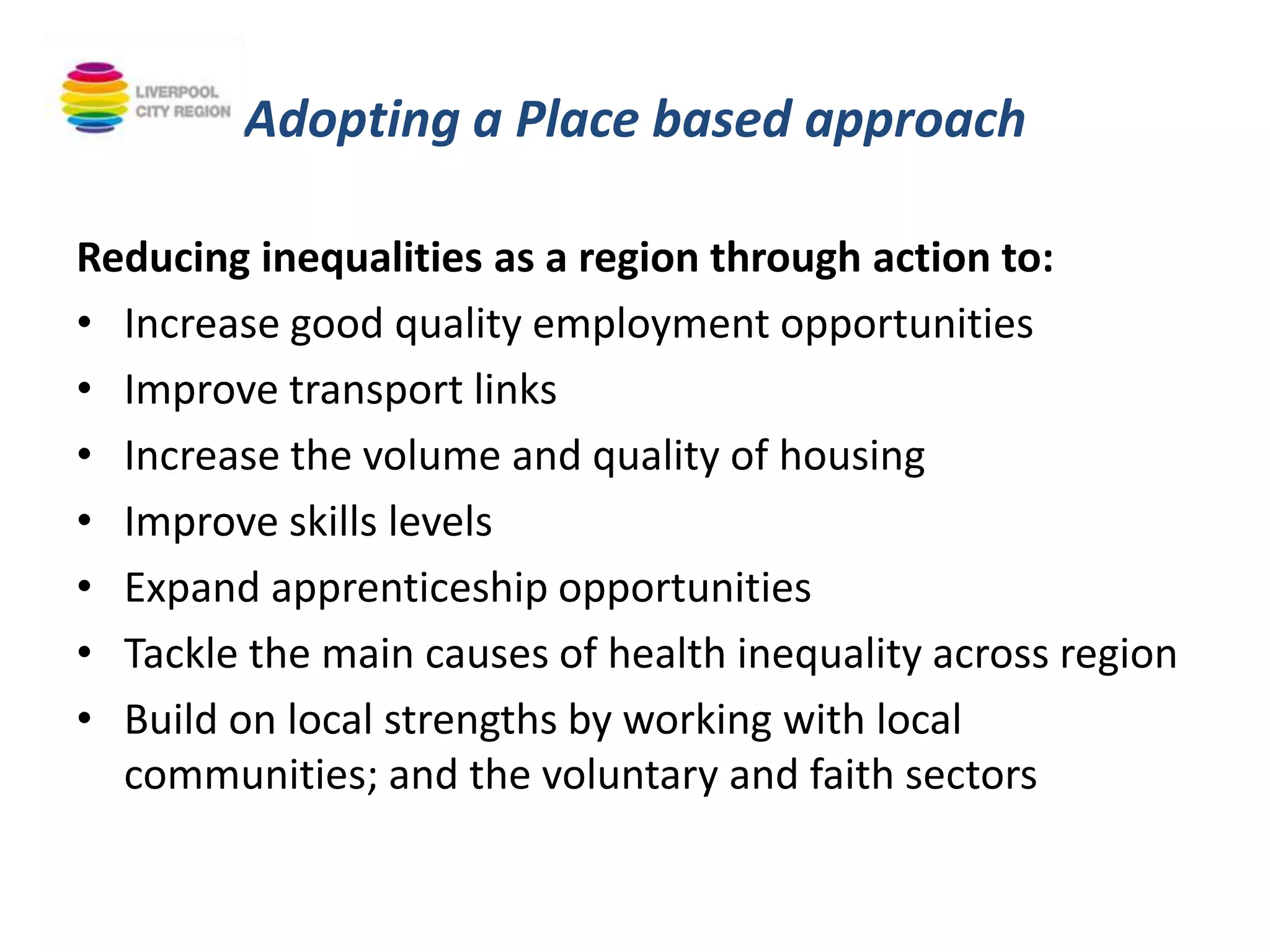
Adopting a Place based approach
Reducing inequalities as a region through action to:
• Increase good quality employment opportunities
• Improve transport links
• Increase the volume and quality of housing
• Improve skills levels
• Expand apprenticeship opportunities
• Tackle the main causes of health inequality across region
• Build on local strengths by working with local
communities; and the voluntary and faith sectors
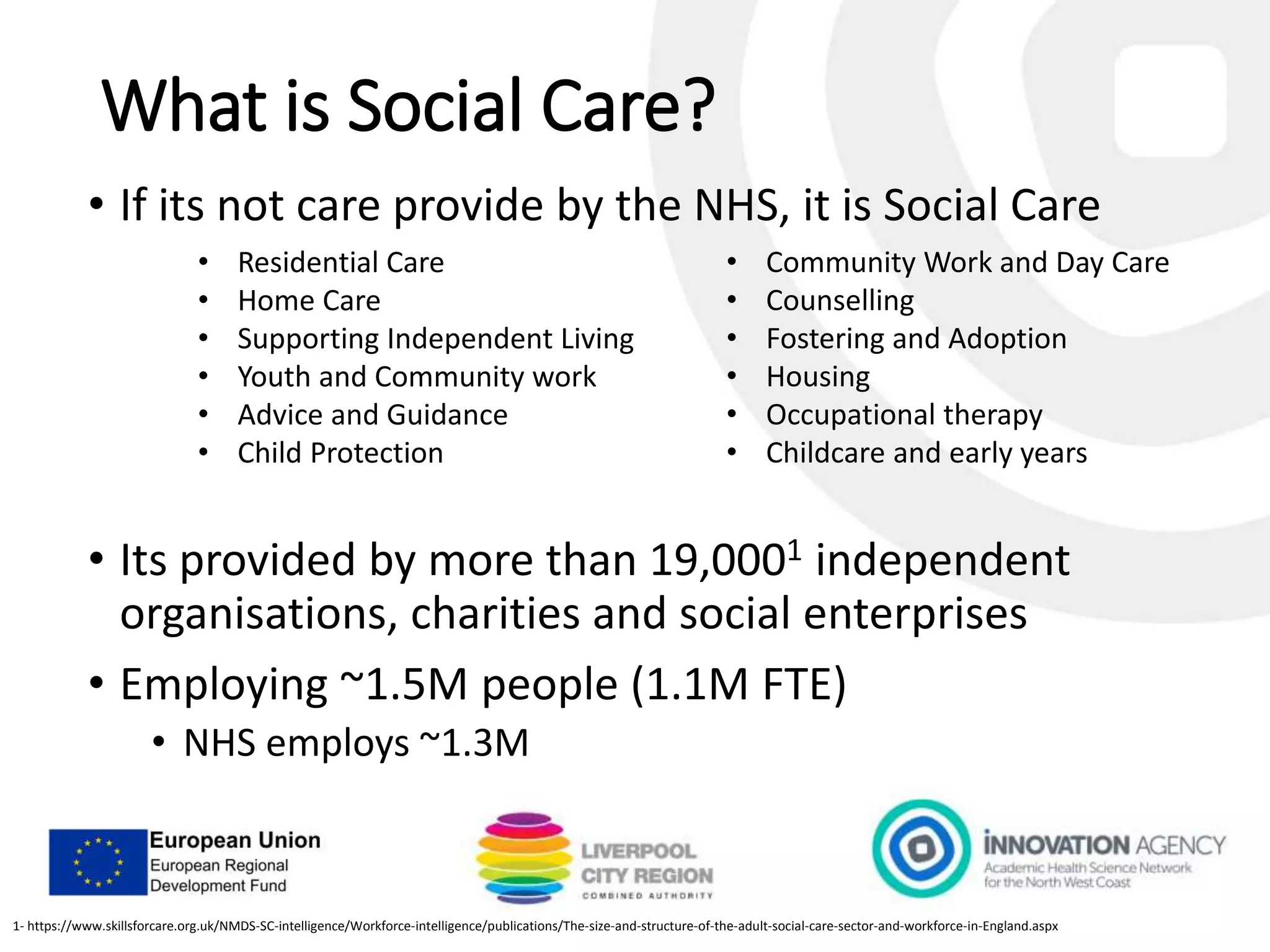
What is Social Care?
• If its not care provide by the NHS, it is Social Care
• Its provided by more than 19,0001 independent
organisations, charities and social enterprises
• Employing ~1.5M people (1.1M FTE)
• NHS employs ~1.3M
• Residential Care
• Home Care
• Supporting Independent Living
• Youth and Community work
• Advice and Guidance
• Child Protection
• Community Work and Day Care
• Counselling
• Fostering and Adoption
• Housing
• Occupational therapy
• Childcare and early years
1- https://www.skillsforcare.org.uk/NMDS-SC-intelligence/Workforce-intelligence/publications/The-size-and-structure-of-the-adult-social-care-sector-and-workforce-in-England.aspx
Workforce
• 80% of all jobs in adult social care are done by
women
• Most adult social care jobs (74%) involve providing
care.
• More than 20,000 social workers are employed,
mainly by local authorities, and their role is changing
in response to different models of service delivery
• The rest of the social care workforce is relatively
unskilled.
• England’s adult social care sector has some 90,000
vacancies on any one day and an average turnover
rate of 28%
https://www.kingsfund.org.uk/projects/time-think-differently/trends-workforce-overview
https://www.skillsforcare.org.uk/NMDS-SC-intelligence/Workforce-intelligence/documents/First-issue-March-2018-Press-briefing-FINAL.pdf
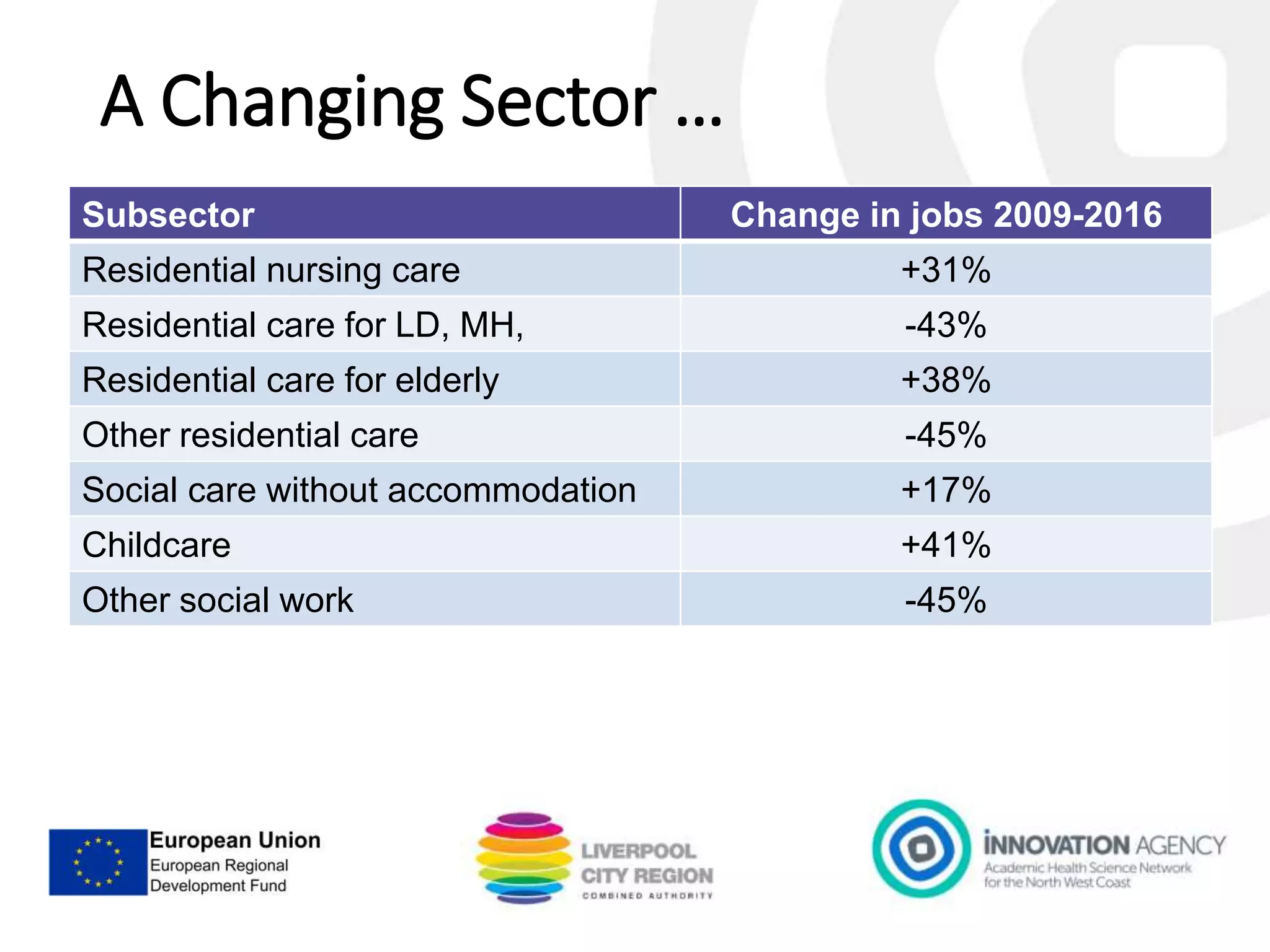
A Changing Sector …
Subsector Change in jobs 2009-2016
Residential nursing care +31%
Residential care for LD, MH, -43%
Residential care for elderly +38%
Other residential care -45%
Social care without accommodation +17%
Childcare +41%
Other social work -45%
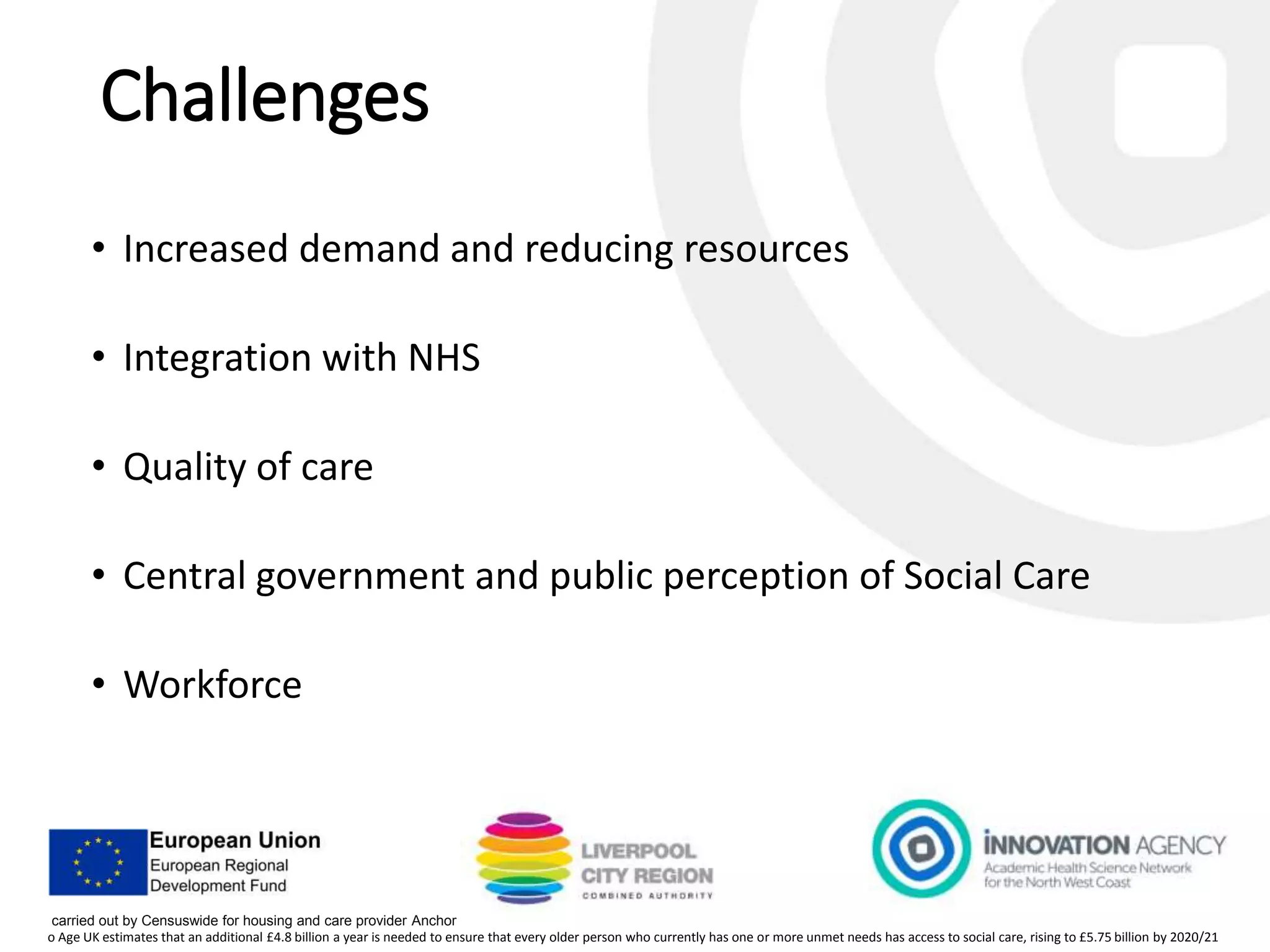
Challenges
• Increased demand and reducing resources
• Integration with NHS
• Quality of care
• Central government and public perception of Social Care
• Workforce
carried out by Censuswide for housing and care provider Anchor
o Age UK estimates that an additional £4.8 billion a year is needed to ensure that every older person who currently has one or more unmet needs has access to social care, rising to £5.75 billion by 2020/21
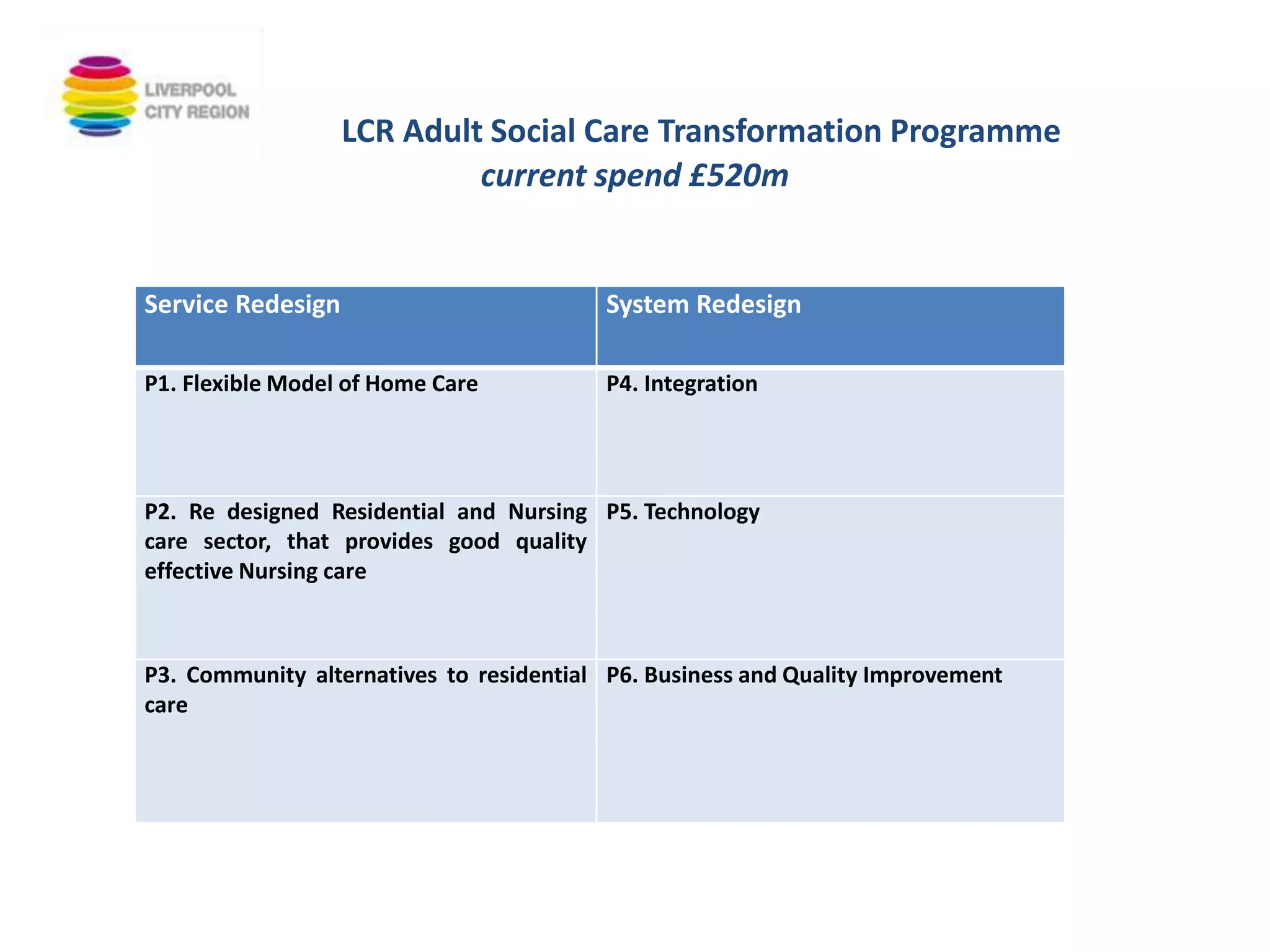
LCR Adult Social Care Transformation Programme
current spend £520m
Service Redesign System Redesign
P1. Flexible Model of Home Care P4. Integration
P2. Re designed Residential and Nursing
care sector, that provides good quality
effective Nursing care
P5. Technology
P3. Community alternatives to residential
care
P6. Business and Quality Improvement
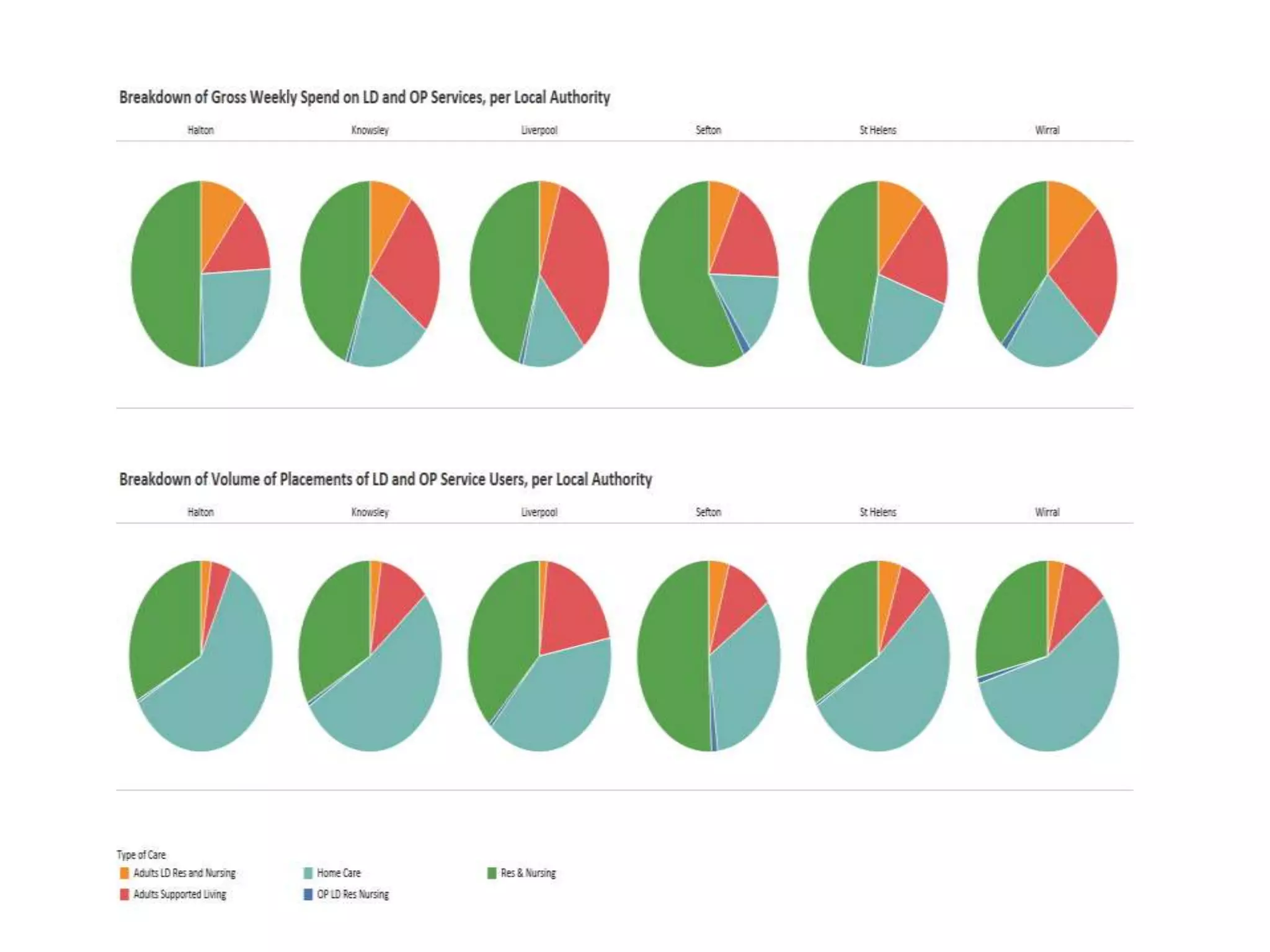
• Demand and spend is currently focussed on three core
services areas:
• Domiciliary Care
• Residential Care
• Supported Living
25
Service and System Re design
• Our aim is to replace these more traditional
services with new outcome based models of
care that reduce both demand and cost across
the health and social care system
• In addition to redesigning care delivery, LCR is
looking to work with our community and
statutory partners to redesign systems to
support new ways of working
Opportunities
• Integration- Care centred around the needs of the individual
• Valuing the sector
• Personalisation and Community Assets
• Complete pathways
Cheshire and Merseyside
STP/ICS structure and
priorities
Jenny Dodd
Innovation Agency
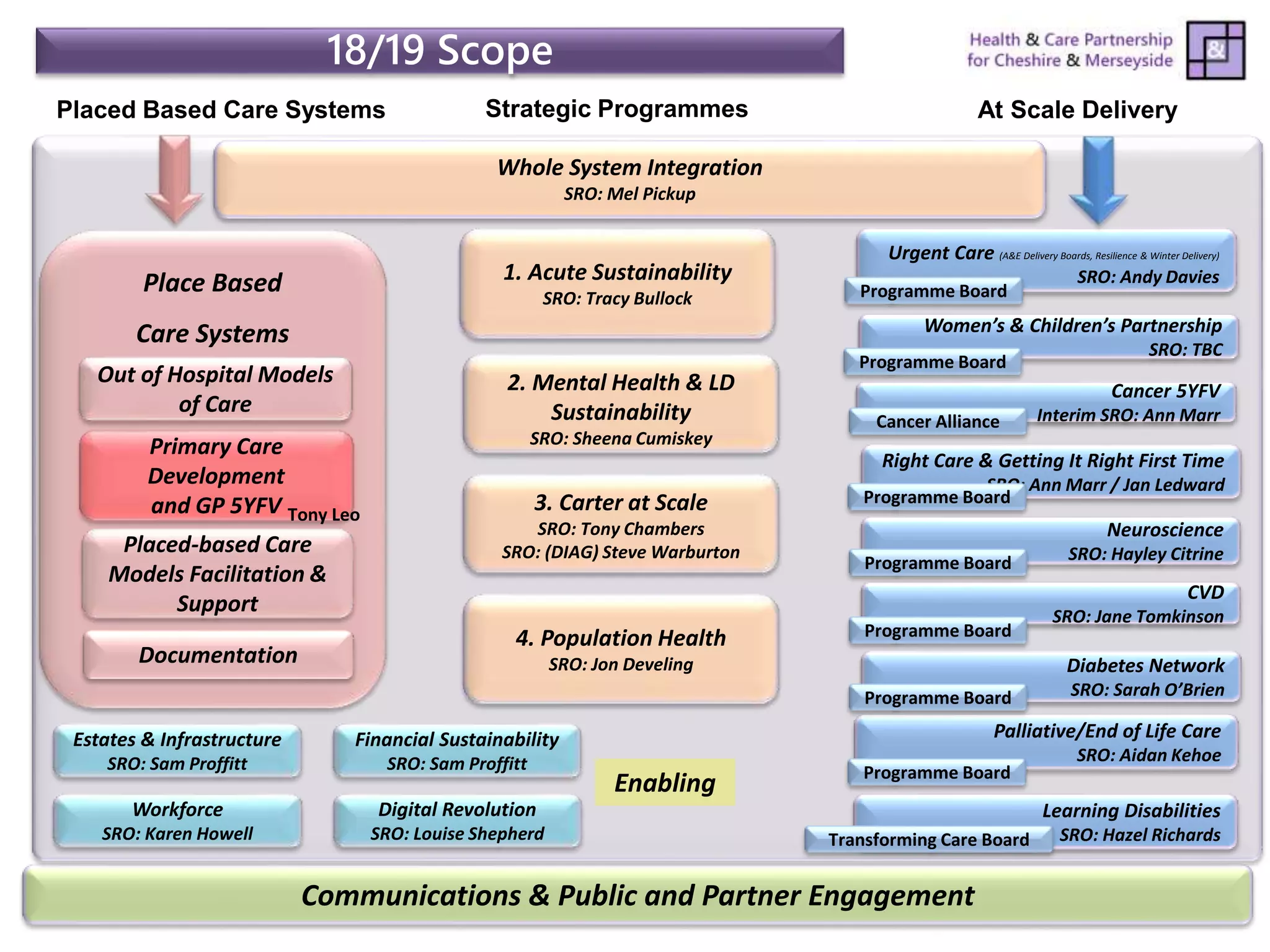
Communications & Public and Partner Engagement
Place Based
Care Systems
Urgent Care (A&E Delivery Boards, Resilience & Winter Delivery)
SRO: Andy Davies
CVD
SRO: Jane Tomkinson
Neuroscience
SRO: Hayley Citrine
Palliative/End of Life Care
SRO: Aidan Kehoe
Right Care & Getting It Right First Time
SRO: Ann Marr / Jan Ledward
Cancer 5YFV
Interim SRO: Ann Marr
Whole System Integration
SRO: Mel Pickup
1. Acute Sustainability
SRO: Tracy Bullock
2. Mental Health & LD
Sustainability
SRO: Sheena Cumiskey
Placed Based Care Systems Strategic Programmes
Diabetes Network
SRO: Sarah O’Brien
3. Carter at Scale
SRO: Tony Chambers
SRO: (DIAG) Steve WarburtonPlaced-based Care
Models Facilitation &
Support
Enabling
4. Population Health
SRO: Jon Develing
At Scale Delivery
Out of Hospital Models
of Care
Documentation
Primary Care
Development
and GP 5YFV
Financial Sustainability
SRO: Sam Proffitt
Workforce
SRO: Karen Howell
Digital Revolution
SRO: Louise Shepherd
Programme Board
Programme Board
Programme Board
Programme Board
Programme Board
Programme Board
Cancer Alliance
Estates & Infrastructure
SRO: Sam Proffitt
Women’s & Children’s Partnership
SRO: TBC
Programme Board
Learning Disabilities
SRO: Hazel RichardsTransforming Care Board
Tony Leo
18/19 Scope
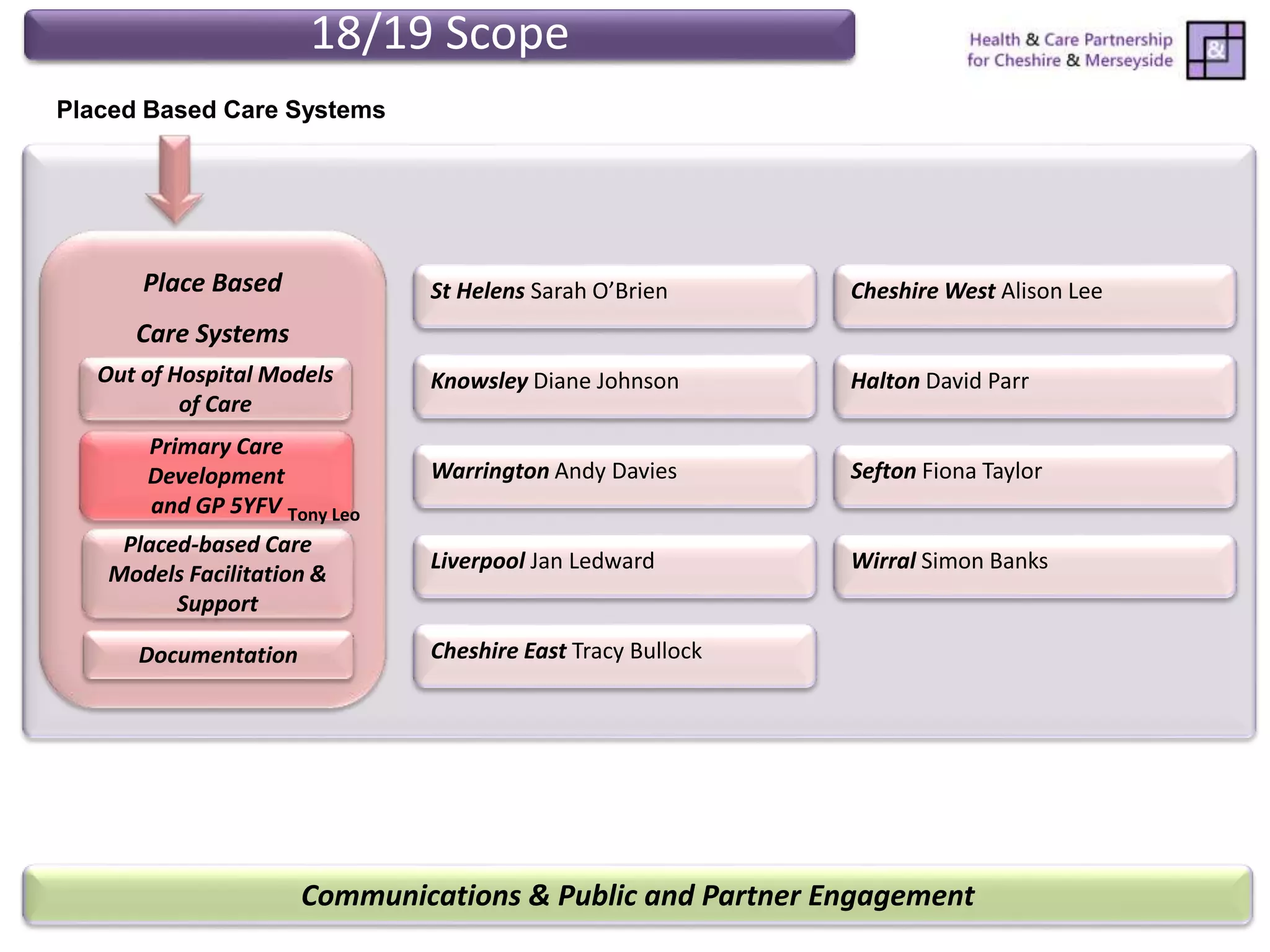
Communications & Public and Partner Engagement
Place Based
Care Systems
18/19 Scope
St Helens Sarah O’Brien
Placed-based Care
Models Facilitation &
Support
Out of Hospital Models
of Care
Documentation
Primary Care
Development
and GP 5YFV Tony Leo
Cheshire West Alison Lee
Knowsley Diane Johnson Halton David Parr
Warrington Andy Davies
Liverpool Jan Ledward
Sefton Fiona Taylor
Wirral Simon Banks
Cheshire East Tracy Bullock
Placed Based Care Systems
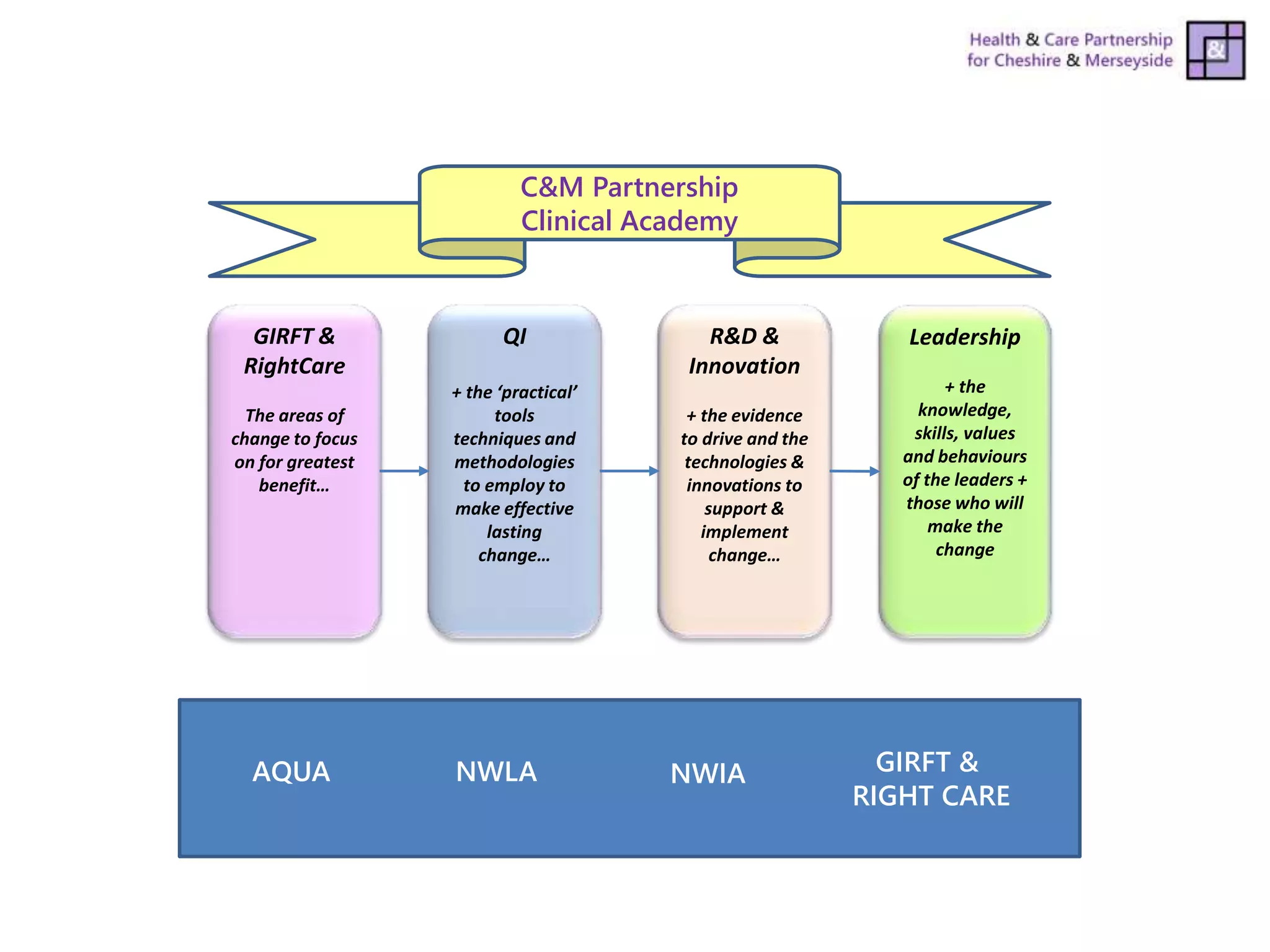
Leadership
+ the
knowledge,
skills, values
and behaviours
of the leaders +
those who will
make the
change
QI
+ the ‘practical’
tools
techniques and
methodologies
to employ to
make effective
lasting
change…
R&D &
Innovation
+ the evidence
to drive and the
technologies &
innovations to
support &
implement
change…
GIRFT &
RightCare
The areas of
change to focus
on for greatest
benefit…
C&M Partnership
Clinical Academy
AQUA
AQUA NWLA NWIA GIRFT &
RIGHT CARE
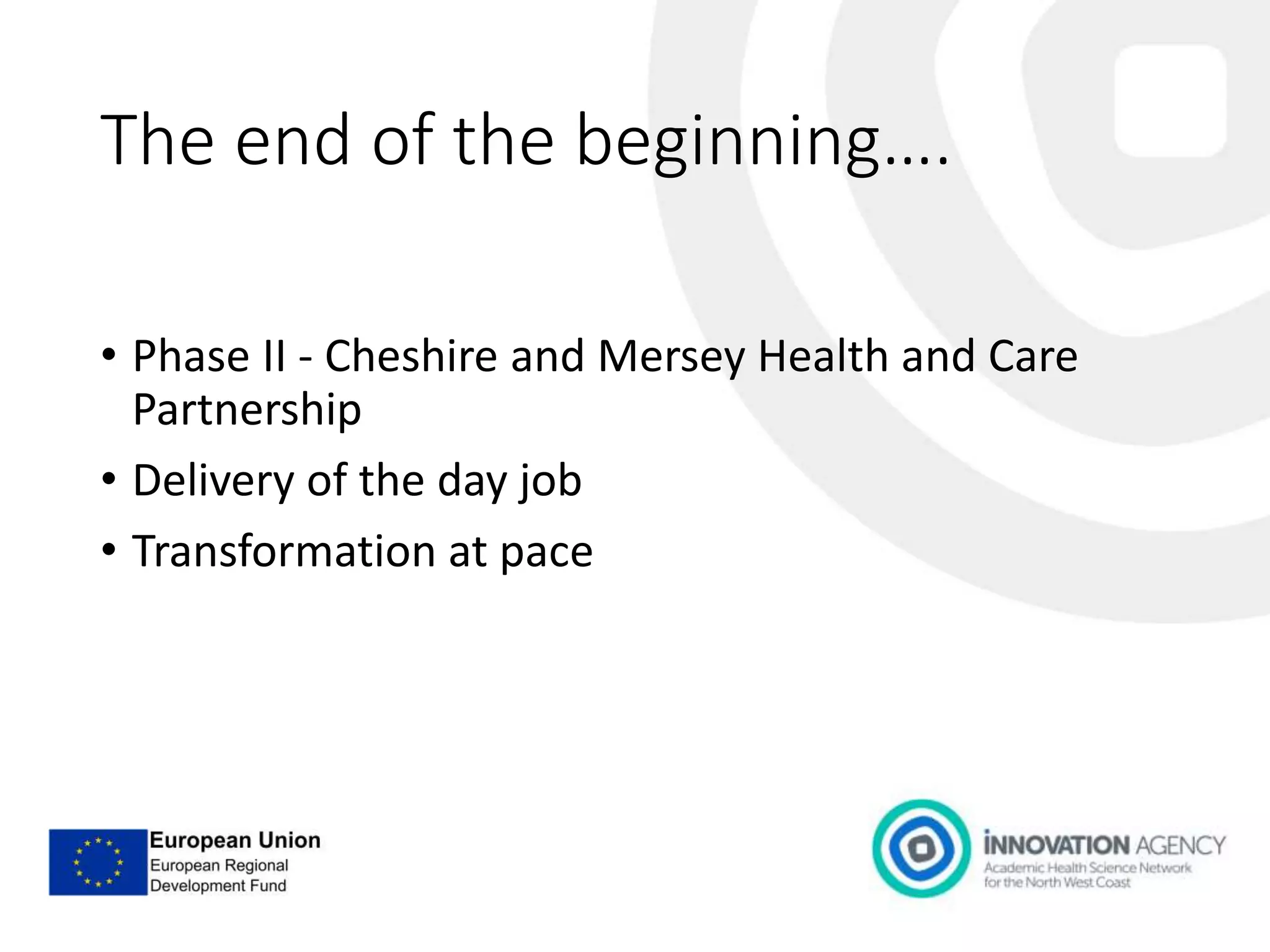
The end of the beginning….
• Phase II - Cheshire and Mersey Health and Care
Partnership
• Delivery of the day job
• Transformation at pace
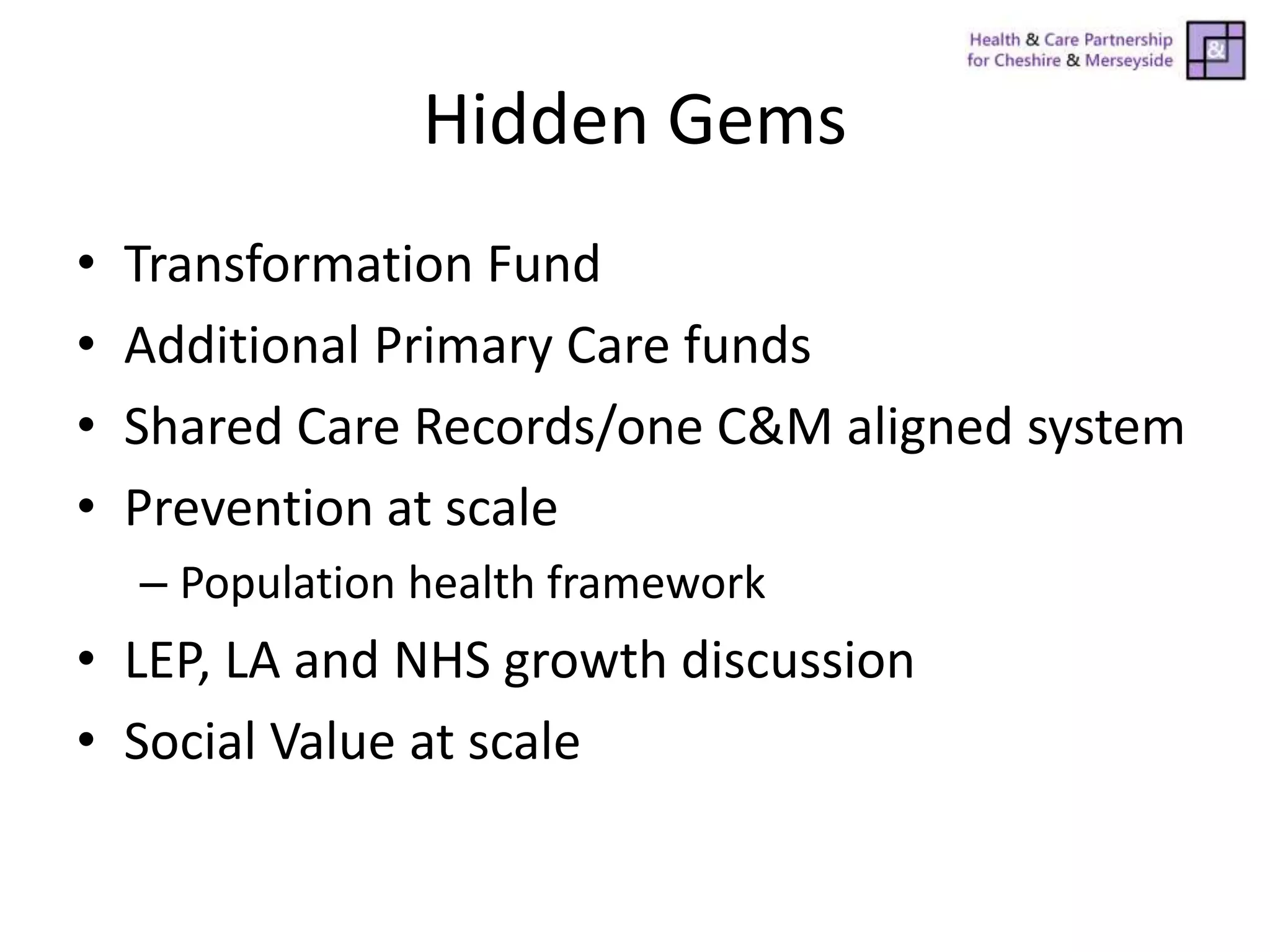
Hidden Gems
• Transformation Fund
• Additional Primary Care funds
• Shared Care Records/one C&M aligned system
• Prevention at scale
– Population health framework
• LEP, LA and NHS growth discussion
• Social Value at scale
Arms length bodies
Mike Kenny
Associate Commercial Director
Innovation Agency
Arms lengths bodies
• AHSN – 15 nationally
• NICE
• CQC
• PHE
• NHS Digital
• HEE
• NHS improvement
• AQUA
• Health and Well Being Boards
• NIHR
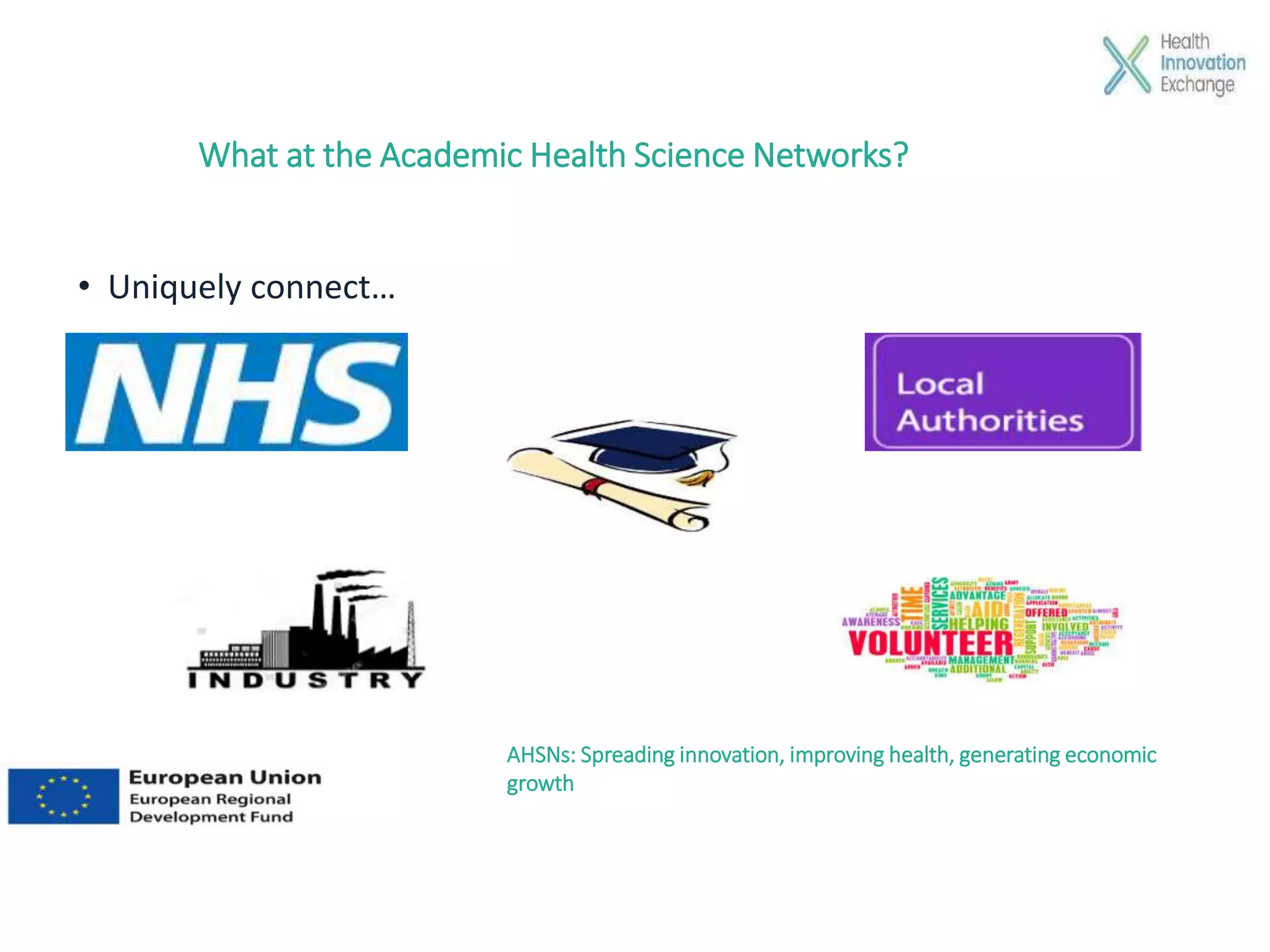
What at the Academic Health Science Networks?
• Uniquely connect…
AHSNs: Spreading innovation, improving health, generating economic
growth
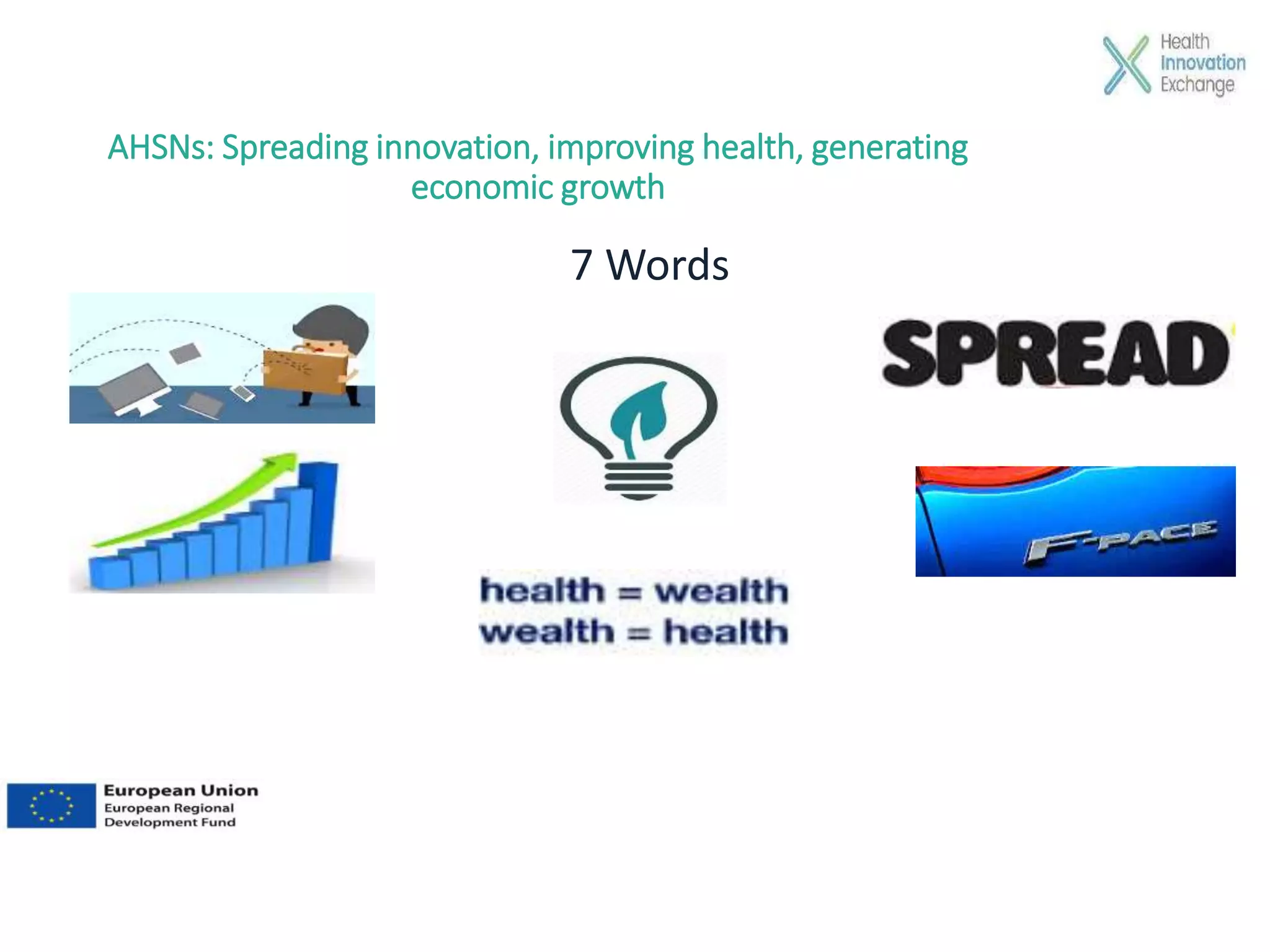
AHSNs: Spreading innovation, improving health, generating
economic growth
7 Words
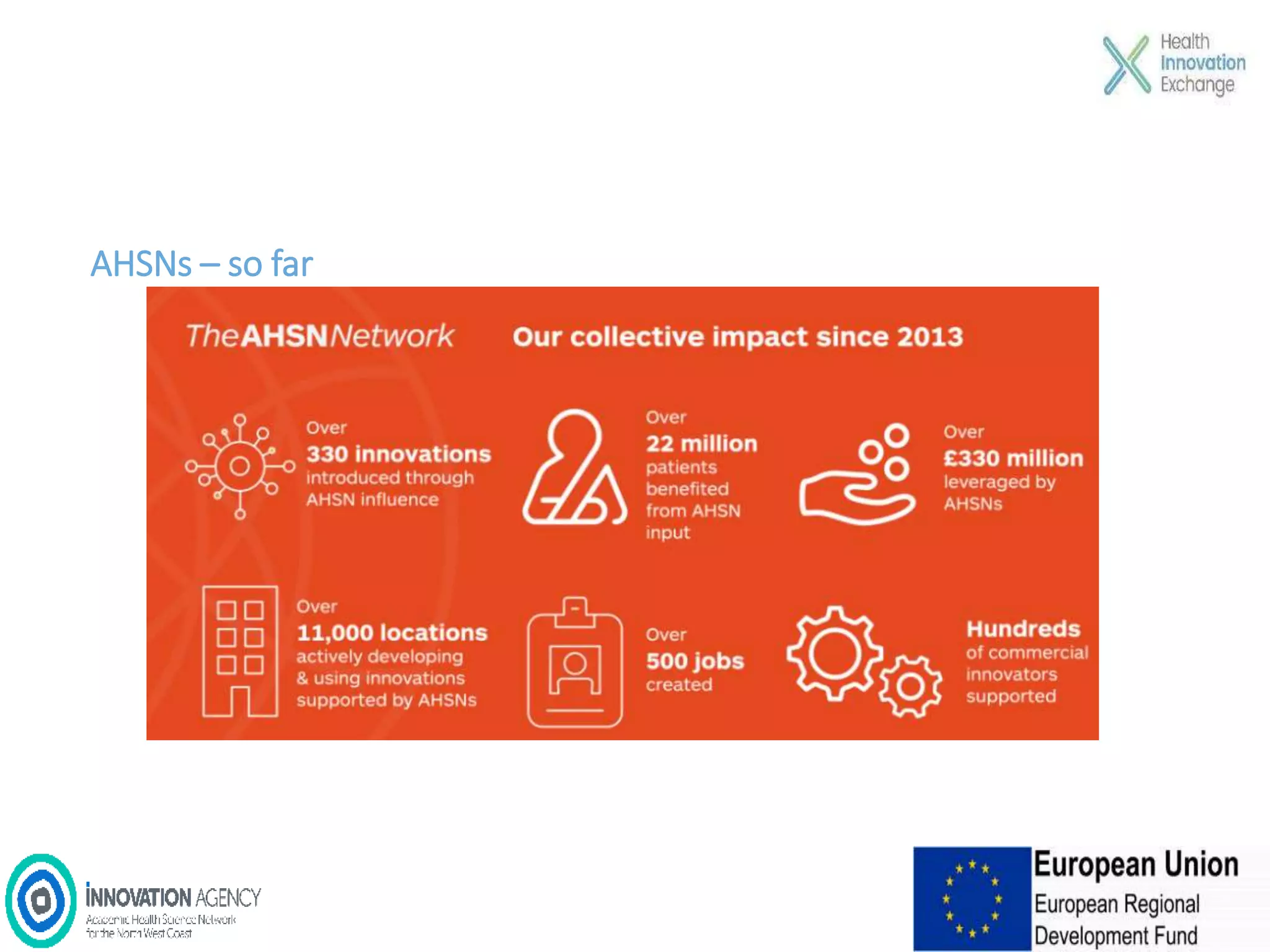
AHSNs – so far
AHSNs – TN5yrs
• Curating& spreading innovation
• Helping to destroy NHS ‘not invented here’ syndrome
• Drive £ - helping industry to better meet NHS needs
• Collaborate with STPs/ICSs to deliver National Programmes – AF & Stroke, Digital Self Care, Cerebral
Palsy prevention
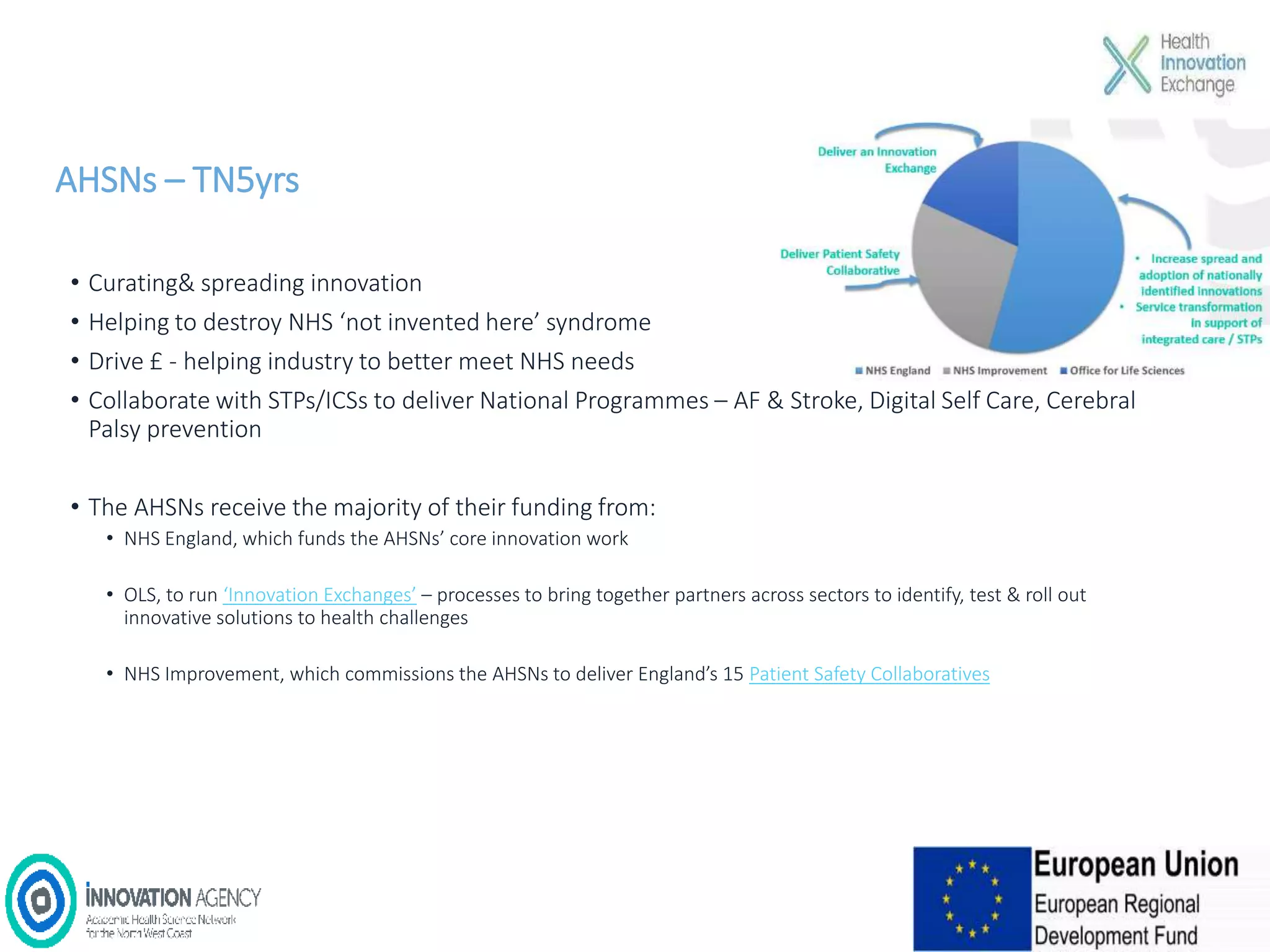
• The AHSNs receive the majority of their funding from:
• NHS England, which funds the AHSNs’ core innovation work
• OLS, to run ‘Innovation Exchanges’ – processes to bring together partners across sectors to identify, test & roll out
innovative solutions to health challenges
• NHS Improvement, which commissions the AHSNs to deliver England’s 15 Patient Safety Collaboratives
NICE – National Institute for Health & Care Excellence:-
Provides national guidance & advice to improve health & social care
Health & Social Care Directorate
Produces a range of products to improve quality
• Quality standards
• Medicines & Prescribing Programme (inc. BNF)
• NICE Pathways
• Implementation of guidance
• Health Technologies Adoption Programme
(HTAP)
Ctr for Health Technology Evaluation (CHTE)
Develops guidance on the use of new & existing
medicines, MedTech & surgical procedures.
• Technology appraisals
• Interventional procedures guidance
• Cancer Drugs Fund
Centre for Guidelines (CfG)
Develops guidance on
• promotion of good health
• prevention of ill health,
• appropriate treatment & care for people with
specific diseases & conditions
Evidence Resources Directorate
Maintains and builds NICE’s digital services.
• Provides access to quality information to support
guidance development and other NICE
programmes, identifying, selecting and appraising
new evidence
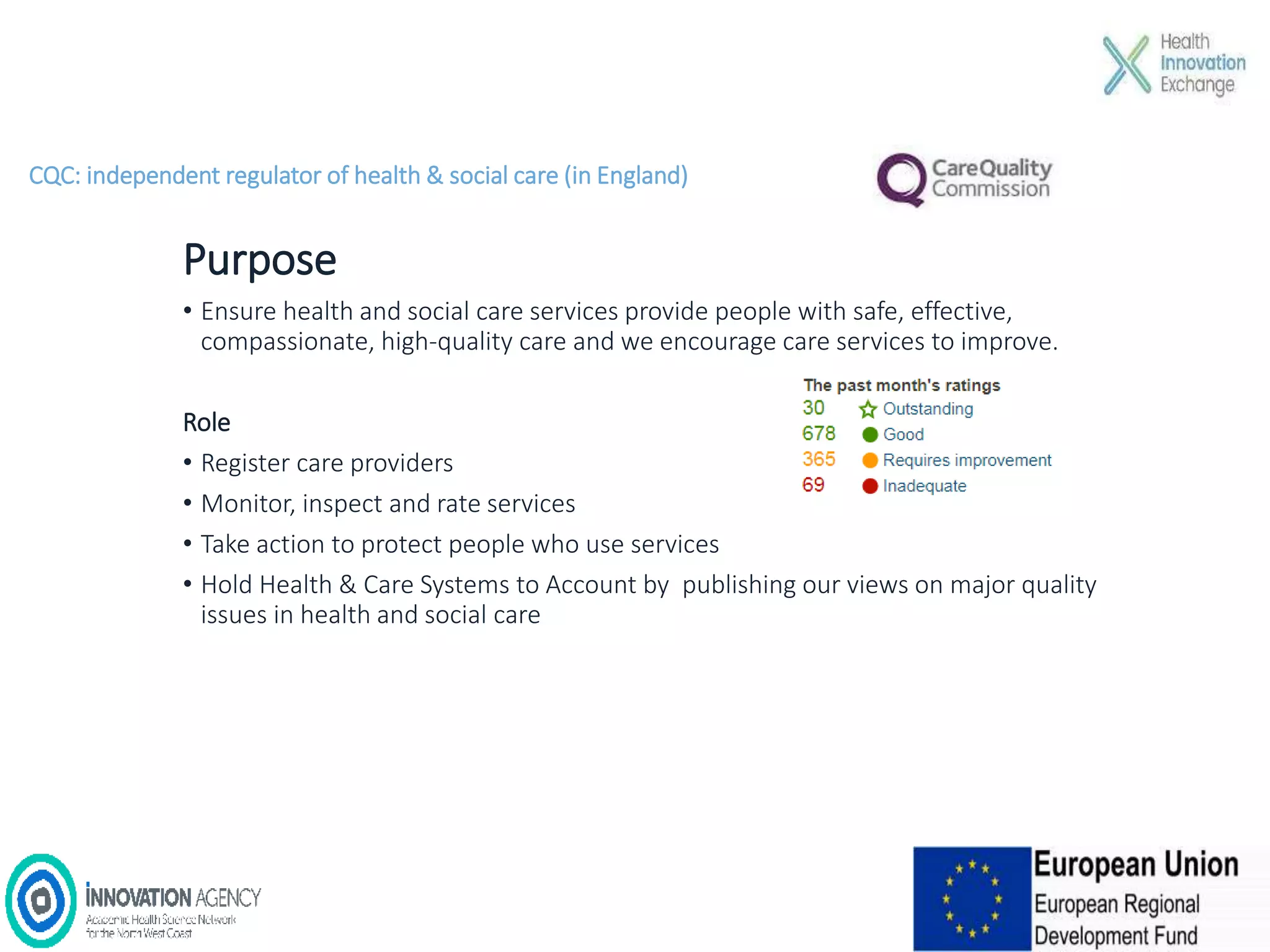
CQC: independent regulator of health & social care (in England)
Purpose
• Ensure health and social care services provide people with safe, effective,
compassionate, high-quality care and we encourage care services to improve.
Role
• Register care providers
• Monitor, inspect and rate services
• Take action to protect people who use services
• Hold Health & Care Systems to Account by publishing our views on major quality
issues in health and social care
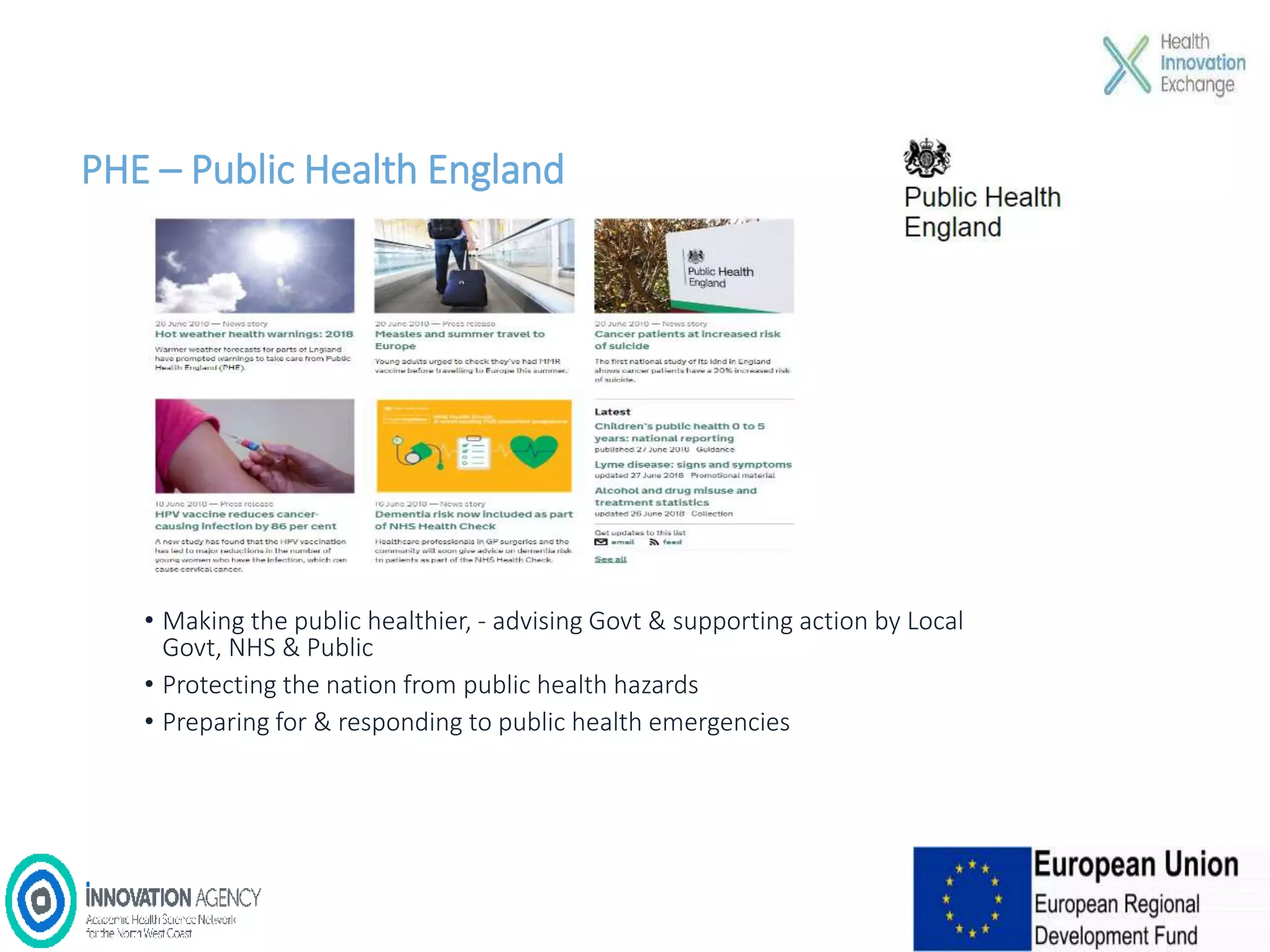
PHE – Public Health England
• Making the public healthier, - advising Govt & supporting action by Local
Govt, NHS & Public
• Protecting the nation from public health hazards
• Preparing for & responding to public health emergencies
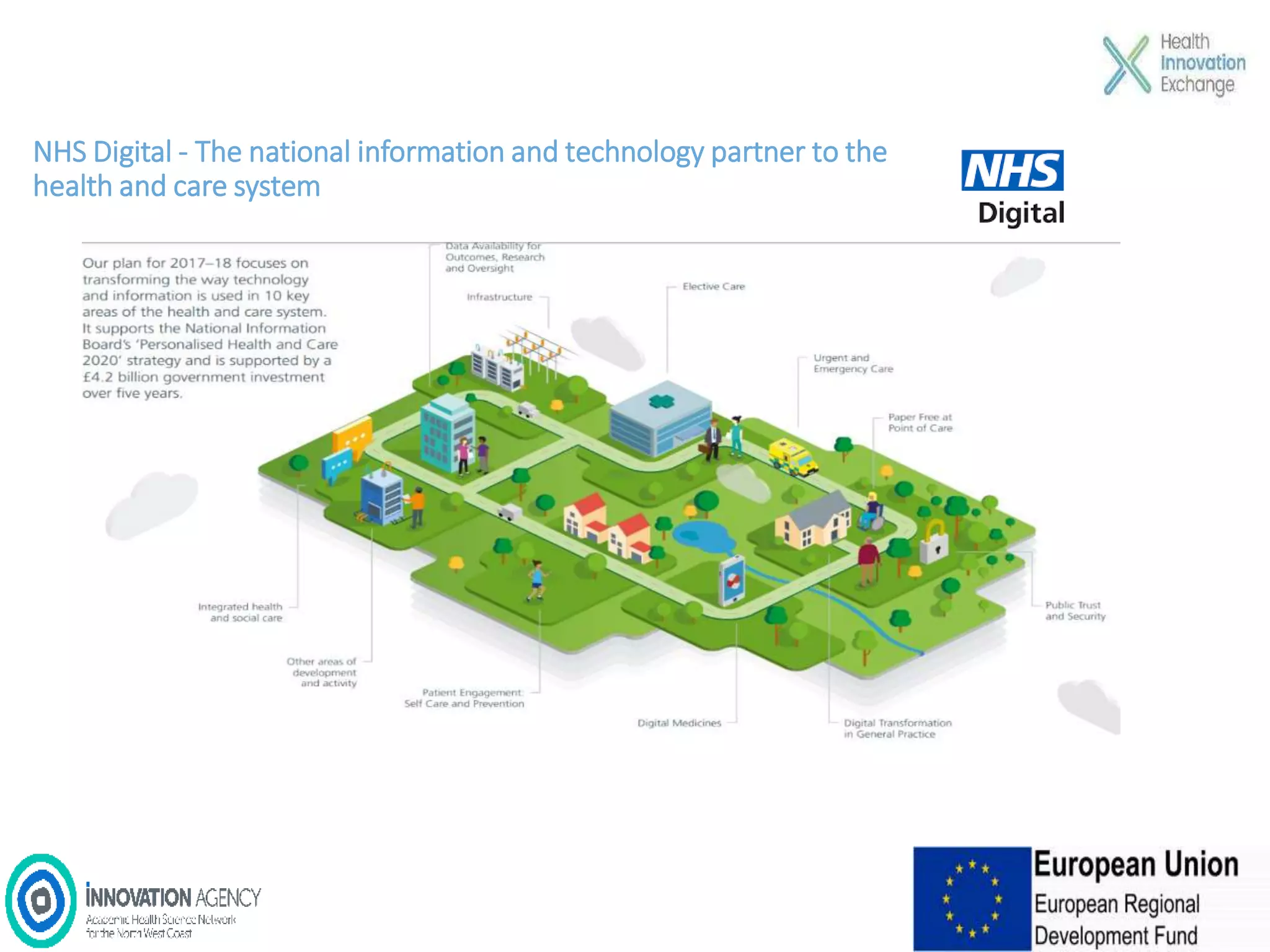
NHS Digital - The national information and technology partner to the
health and care system
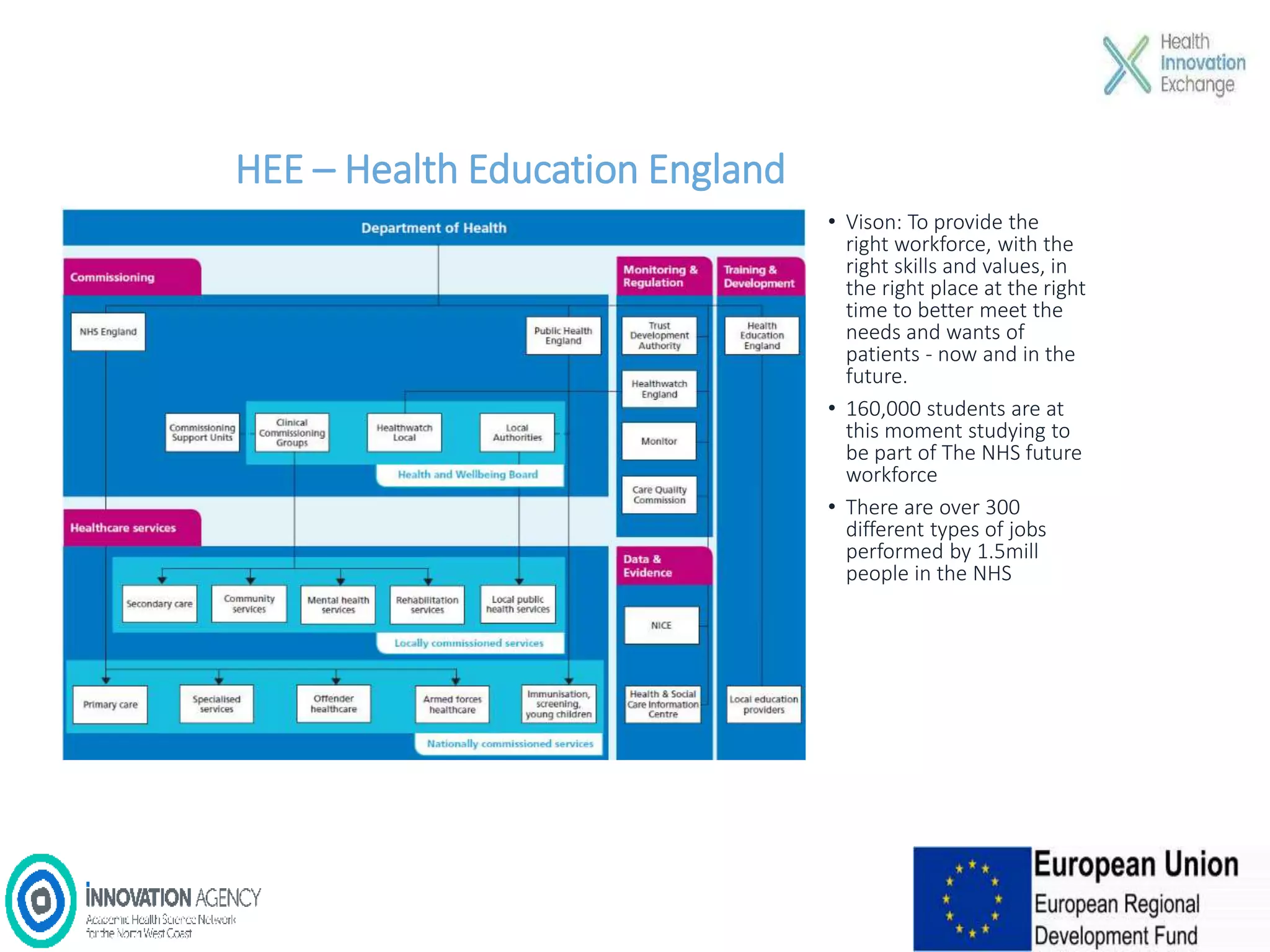
HEE – Health Education England
• Vison: To provide the
right workforce, with the
right skills and values, in
the right place at the right
time to better meet the
needs and wants of
patients - now and in the
future.
• 160,000 students are at
this moment studying to
be part of The NHS future
workforce
• There are over 300
different types of jobs
performed by 1.5mill
people in the NHS
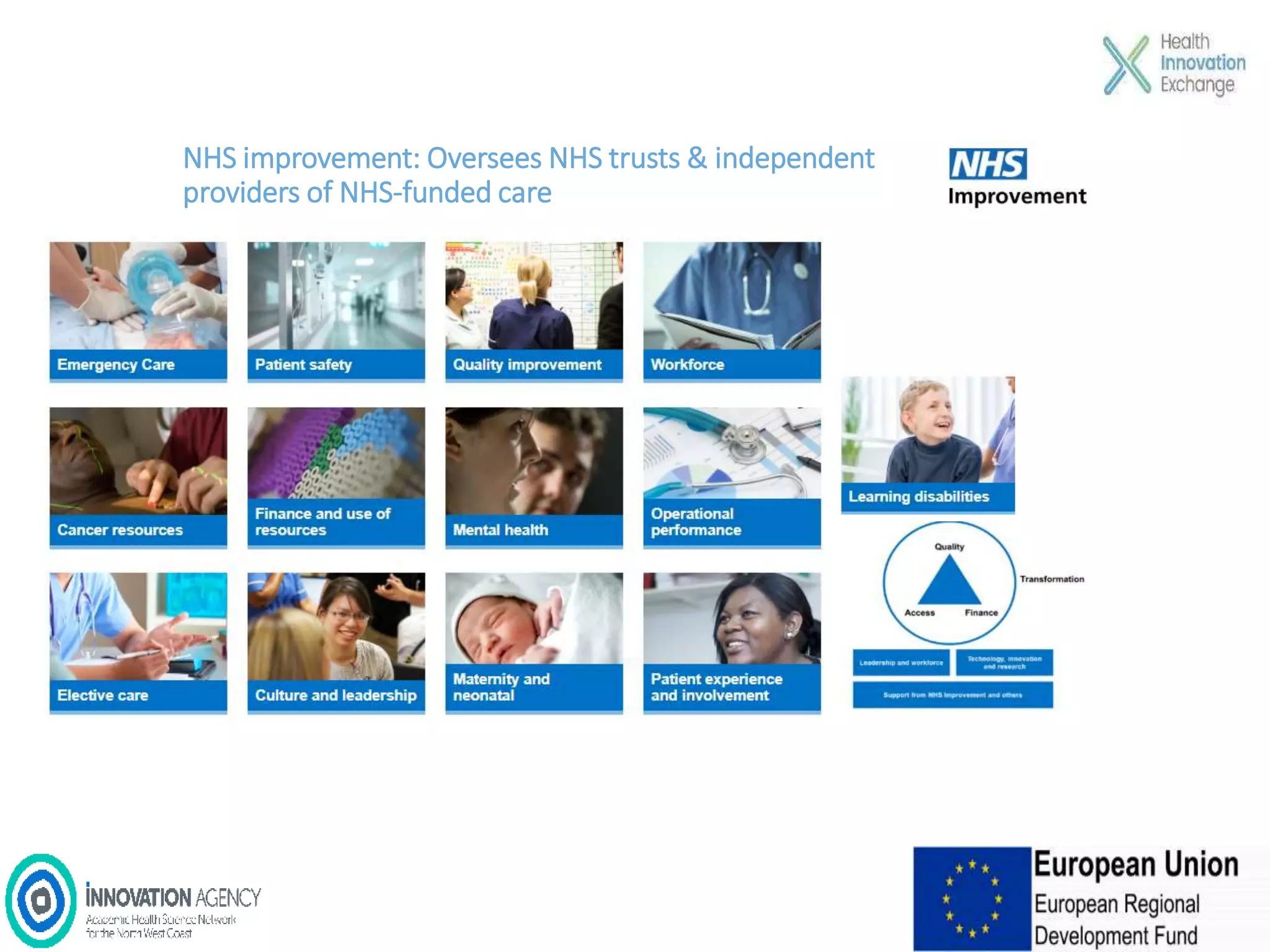
NHS improvement: Oversees NHS trusts & independent
providers of NHS-funded care
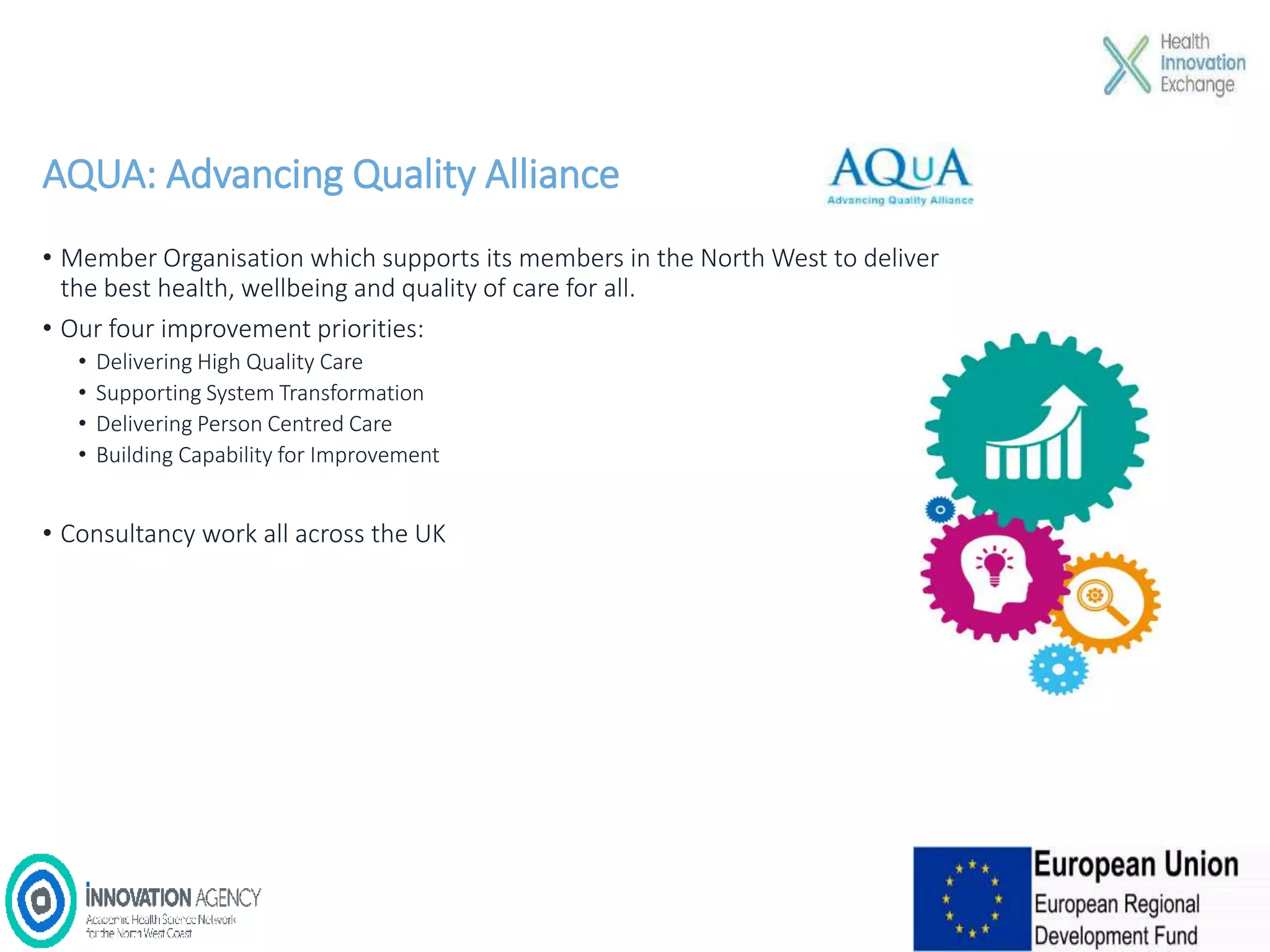
AQUA: Advancing Quality Alliance
• Member Organisation which supports its members in the North West to deliver
the best health, wellbeing and quality of care for all.
• Our four improvement priorities:
• Delivering High Quality Care
• Supporting System Transformation
• Delivering Person Centred Care
• Building Capability for Improvement
• Consultancy work all across the UK
Health & Well Being Boards
• Forum in which key leaders from the local health & care system could work
together to improve the health and wellbeing of their local population
• They have a statutory duty, with clinical commissioning groups (CCGs), to
produce a joint strategic needs assessment and a joint health and wellbeing
strategy for their local population.
• The boards have very limited formal powers. They are constituted as a
partnership forum rather than an executive decision-making body.
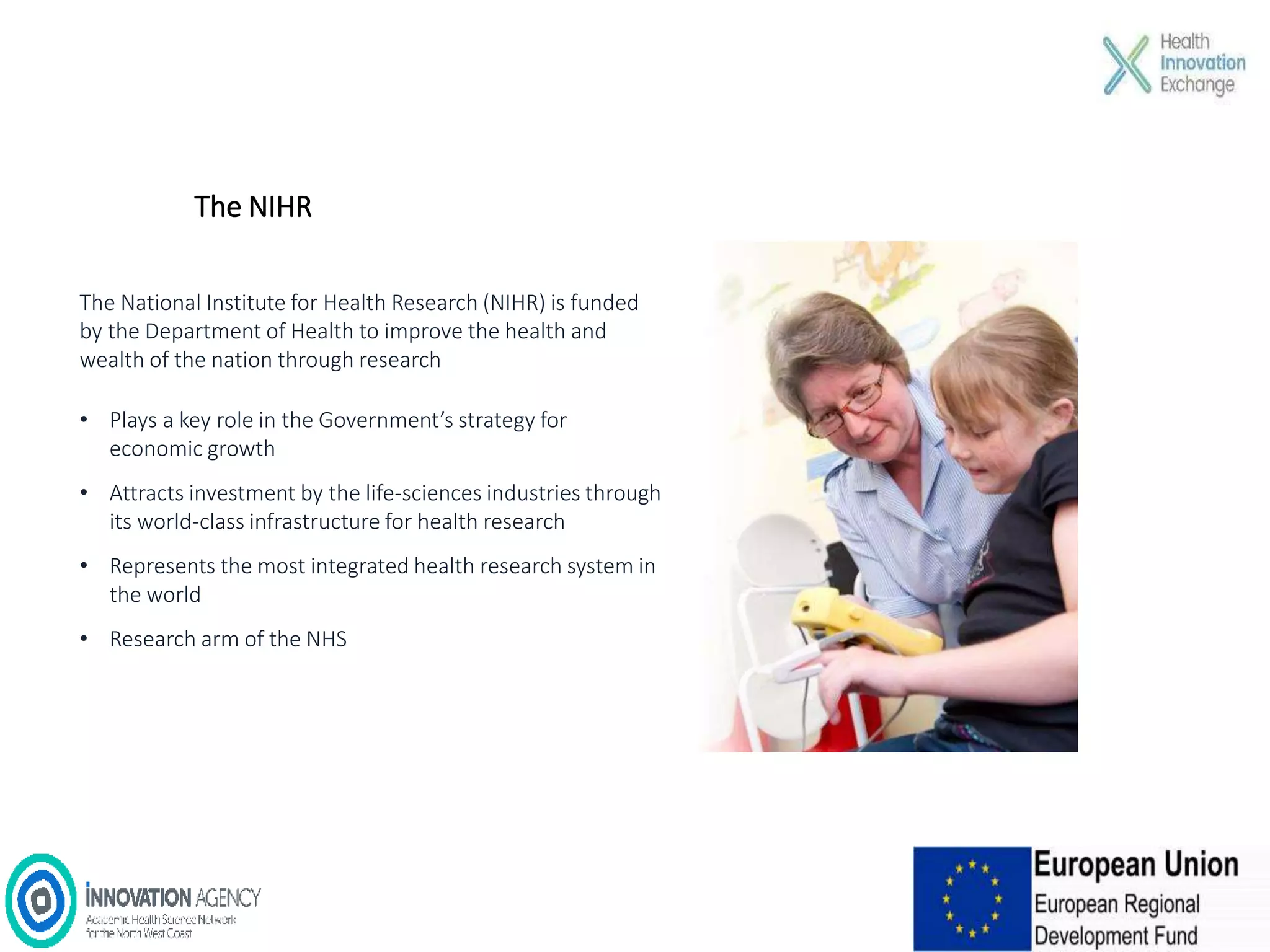
The NIHR
The National Institute for Health Research (NIHR) is funded
by the Department of Health to improve the health and
wealth of the nation through research
• Plays a key role in the Government’s strategy for
economic growth
• Attracts investment by the life-sciences industries through
its world-class infrastructure for health research
• Represents the most integrated health research system in
the world
• Research arm of the NHS
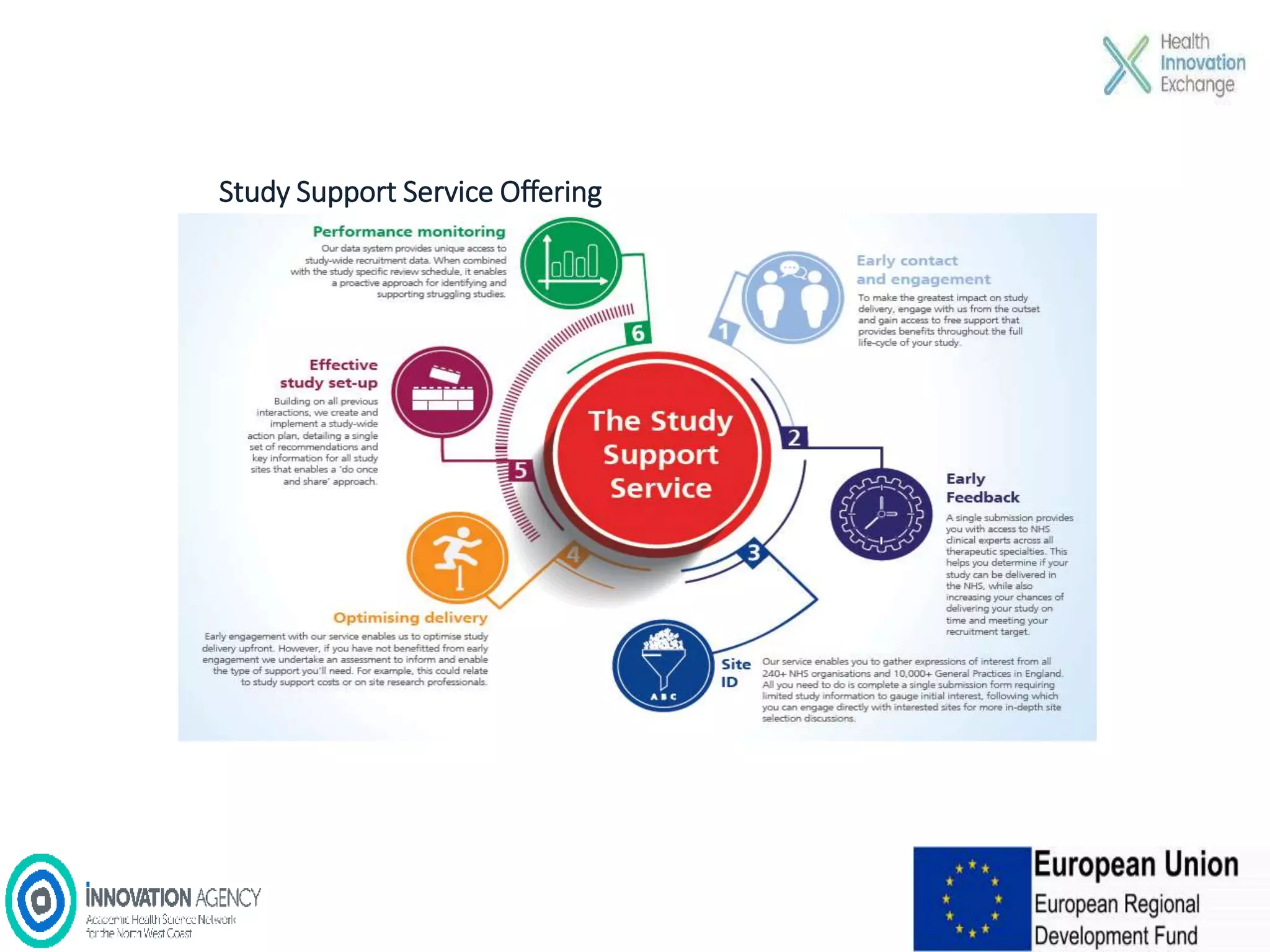
Study Support Service Offering
Mike Kenny
Associate Commercial Director
Innovation Agency
NHS Academic Health Science Network for the NW Coast
: @innovation_mike : @innovationnwc Likeuson Facebook:InnovationNWC
Q&A with the panel

NHS and Liverpool structures, priorities and commissioning workshop

  • 1.
    Health Innovation Exchange NHS andLCR structures, priorities and commissioning workshop 11th September 2018 @innovationnwc @andydcairns
  • 2.
    Some introductions .. . • Andy, Jenny, Mike • Angela
  • 3.
    Agenda • NHS overview– Andy 15 mins • Social care overview - Angela 15 mins • Cheshire and Merseyside STP/ICS structure & priorities – Jenny 15 mins • Arms lengths bodies – Mike 15 mins • Panel Q & A 10mins
  • 4.
    The NHS Andy Cairns CommercialProgramme Manager Innovation Agency
  • 5.
    The headlines • Createdin 1948 - 70th Bday on July 5 • Free at point of care to all (Optical, Dental, Prescriptions) • £125B = 9% of GDP • NHS deals with 1.4M patients every 24 hours • 1.0 million staff (England) • 135 acute non-specialist trusts • 17 acute specialist trusts • 54 mental health trusts • 35 community providers
  • 6.
    NHS principals 3 coreprinciples since 1948; 1. that it meet the needs of everyone 2. that it be free at the point of delivery 3. that it be based on clinical need, not ability to pay
  • 7.
    The NHS structuresand how it works • How does the NHS in England work_ An alternative guide.mp4 • https://youtu.be/DEARD4I3xtE • https://www.kingsfund.org.uk/audio-video/how-does- nhs-in-england-work
  • 8.
    The NHS structures •NHS England sets the priorities and direction of the NHS to improve health and care outcomes. • Is the commissioner for primary care at CCG level, services such as GPs, pharmacists and dentists, including military health services and some specialised services and professional training programmes via HEE • £100 B allocated to CCGs • Five Year Forward View, ( refresh at march 2018)
  • 9.
    The NHS structures •Clinical commissioning groups (CCGs) replaced primary care trusts (PCTs) 2013. Clinically led NHS bodies responsible for the planning and commissioning of many healthcare services for their local area. • CCGs can commission any service provider - NHS trust, social enterprises, charities or private sector providers. •220 CCGs grouped into 44 STPs • STP in Lancashire and South Cumbria is now in a shadow ICS form – Linda will go into more detail
  • 10.
    The money • NHSEngland/NHS Improvement – single entity regional teams • 1948 - £437M (£15 billion at today’s value) • 2017/18 - £125B • Budget increase by 1.2% between 09/10 and 20/21 • Cost increase of 4%, cash reduction, activity rising at 4% annum • L/T average of 4% £ increase not keeping pace with demand
  • 11.
    The challenges • Healthinequalities • PLACE based care ( out of hospital) and the aging pop • Workforce • Finances
  • 12.
    National priorities • Shiftin focus from competition to collaboration • Integrated health and social care • Devolution(STPs) • Additional funding • 7 day GP services • Urgent Care • Cancer • Mental Health
  • 13.
    The opportunities • Shiftthe emphasis from disease and distress to prevention and promotion (prevent the fires) • Passive patient becomes more discerning and responsible for their health and wellbeing – choices and consequences • Technology • Resource optimisation • Reducing duplication • Greater standardisation and reliability
  • 14.
    Social Care Angela Johnson AssistantDirector for Integration Liverpool City Region Adult Social Care Integrated Commissioning
  • 15.
    Liverpool City Region •1.5m residents • £31bn economy and 49,000 businesses, of which 99% are SMEs
  • 16.
    Liverpool City Region(LCR) Combined Authority • LCR Combined Authority established on 1st April 2014 • LCR Powers enhanced and increased through Devolution deals 2015 and 2016: Economic Development , Business Growth and Support, Strategic Transport, Strategic Housing and Planning, Asset Management, Energy and Environment, Employment and Skills, Culture and Tourism • No specific requests in respect to health and social care……..work across the region is therefore progressed through collaboration
  • 17.
  • 18.
    Job projections to2028 0 50,000 100,000 150,000 200,000 250,000 300,000 Growth Sectors Replacement demand Sectors with highest proportion of workers aged over 50 Maritime and Logistics 41% Health and Life Sciences 37% Advanced Manufacturing 37% Low Carbon and Energy 35%
  • 19.
    Adopting a Placebased approach Reducing inequalities as a region through action to: • Increase good quality employment opportunities • Improve transport links • Increase the volume and quality of housing • Improve skills levels • Expand apprenticeship opportunities • Tackle the main causes of health inequality across region • Build on local strengths by working with local communities; and the voluntary and faith sectors
  • 20.
    What is SocialCare? • If its not care provide by the NHS, it is Social Care • Its provided by more than 19,0001 independent organisations, charities and social enterprises • Employing ~1.5M people (1.1M FTE) • NHS employs ~1.3M • Residential Care • Home Care • Supporting Independent Living • Youth and Community work • Advice and Guidance • Child Protection • Community Work and Day Care • Counselling • Fostering and Adoption • Housing • Occupational therapy • Childcare and early years 1- https://www.skillsforcare.org.uk/NMDS-SC-intelligence/Workforce-intelligence/publications/The-size-and-structure-of-the-adult-social-care-sector-and-workforce-in-England.aspx
  • 21.
    Workforce • 80% ofall jobs in adult social care are done by women • Most adult social care jobs (74%) involve providing care. • More than 20,000 social workers are employed, mainly by local authorities, and their role is changing in response to different models of service delivery • The rest of the social care workforce is relatively unskilled. • England’s adult social care sector has some 90,000 vacancies on any one day and an average turnover rate of 28% https://www.kingsfund.org.uk/projects/time-think-differently/trends-workforce-overview https://www.skillsforcare.org.uk/NMDS-SC-intelligence/Workforce-intelligence/documents/First-issue-March-2018-Press-briefing-FINAL.pdf
  • 22.
    A Changing Sector… Subsector Change in jobs 2009-2016 Residential nursing care +31% Residential care for LD, MH, -43% Residential care for elderly +38% Other residential care -45% Social care without accommodation +17% Childcare +41% Other social work -45%
  • 23.
    Challenges • Increased demandand reducing resources • Integration with NHS • Quality of care • Central government and public perception of Social Care • Workforce carried out by Censuswide for housing and care provider Anchor o Age UK estimates that an additional £4.8 billion a year is needed to ensure that every older person who currently has one or more unmet needs has access to social care, rising to £5.75 billion by 2020/21
  • 24.
    LCR Adult SocialCare Transformation Programme current spend £520m Service Redesign System Redesign P1. Flexible Model of Home Care P4. Integration P2. Re designed Residential and Nursing care sector, that provides good quality effective Nursing care P5. Technology P3. Community alternatives to residential care P6. Business and Quality Improvement
  • 25.
    • Demand andspend is currently focussed on three core services areas: • Domiciliary Care • Residential Care • Supported Living 25 Service and System Re design
  • 27.
    • Our aimis to replace these more traditional services with new outcome based models of care that reduce both demand and cost across the health and social care system • In addition to redesigning care delivery, LCR is looking to work with our community and statutory partners to redesign systems to support new ways of working
  • 28.
    Opportunities • Integration- Carecentred around the needs of the individual • Valuing the sector • Personalisation and Community Assets • Complete pathways
  • 29.
    Cheshire and Merseyside STP/ICSstructure and priorities Jenny Dodd Innovation Agency
  • 31.
    Communications & Publicand Partner Engagement Place Based Care Systems Urgent Care (A&E Delivery Boards, Resilience & Winter Delivery) SRO: Andy Davies CVD SRO: Jane Tomkinson Neuroscience SRO: Hayley Citrine Palliative/End of Life Care SRO: Aidan Kehoe Right Care & Getting It Right First Time SRO: Ann Marr / Jan Ledward Cancer 5YFV Interim SRO: Ann Marr Whole System Integration SRO: Mel Pickup 1. Acute Sustainability SRO: Tracy Bullock 2. Mental Health & LD Sustainability SRO: Sheena Cumiskey Placed Based Care Systems Strategic Programmes Diabetes Network SRO: Sarah O’Brien 3. Carter at Scale SRO: Tony Chambers SRO: (DIAG) Steve WarburtonPlaced-based Care Models Facilitation & Support Enabling 4. Population Health SRO: Jon Develing At Scale Delivery Out of Hospital Models of Care Documentation Primary Care Development and GP 5YFV Financial Sustainability SRO: Sam Proffitt Workforce SRO: Karen Howell Digital Revolution SRO: Louise Shepherd Programme Board Programme Board Programme Board Programme Board Programme Board Programme Board Cancer Alliance Estates & Infrastructure SRO: Sam Proffitt Women’s & Children’s Partnership SRO: TBC Programme Board Learning Disabilities SRO: Hazel RichardsTransforming Care Board Tony Leo 18/19 Scope
  • 32.
    Communications & Publicand Partner Engagement Place Based Care Systems 18/19 Scope St Helens Sarah O’Brien Placed-based Care Models Facilitation & Support Out of Hospital Models of Care Documentation Primary Care Development and GP 5YFV Tony Leo Cheshire West Alison Lee Knowsley Diane Johnson Halton David Parr Warrington Andy Davies Liverpool Jan Ledward Sefton Fiona Taylor Wirral Simon Banks Cheshire East Tracy Bullock Placed Based Care Systems
  • 33.
    Leadership + the knowledge, skills, values andbehaviours of the leaders + those who will make the change QI + the ‘practical’ tools techniques and methodologies to employ to make effective lasting change… R&D & Innovation + the evidence to drive and the technologies & innovations to support & implement change… GIRFT & RightCare The areas of change to focus on for greatest benefit… C&M Partnership Clinical Academy AQUA AQUA NWLA NWIA GIRFT & RIGHT CARE
  • 34.
    The end ofthe beginning…. • Phase II - Cheshire and Mersey Health and Care Partnership • Delivery of the day job • Transformation at pace
  • 35.
    Hidden Gems • TransformationFund • Additional Primary Care funds • Shared Care Records/one C&M aligned system • Prevention at scale – Population health framework • LEP, LA and NHS growth discussion • Social Value at scale
  • 37.
    Arms length bodies MikeKenny Associate Commercial Director Innovation Agency
  • 38.
    Arms lengths bodies •AHSN – 15 nationally • NICE • CQC • PHE • NHS Digital • HEE • NHS improvement • AQUA • Health and Well Being Boards • NIHR
  • 39.
    What at theAcademic Health Science Networks? • Uniquely connect… AHSNs: Spreading innovation, improving health, generating economic growth
  • 40.
    AHSNs: Spreading innovation,improving health, generating economic growth 7 Words
  • 41.
  • 42.
    AHSNs – TN5yrs •Curating& spreading innovation • Helping to destroy NHS ‘not invented here’ syndrome • Drive £ - helping industry to better meet NHS needs • Collaborate with STPs/ICSs to deliver National Programmes – AF & Stroke, Digital Self Care, Cerebral Palsy prevention • The AHSNs receive the majority of their funding from: • NHS England, which funds the AHSNs’ core innovation work • OLS, to run ‘Innovation Exchanges’ – processes to bring together partners across sectors to identify, test & roll out innovative solutions to health challenges • NHS Improvement, which commissions the AHSNs to deliver England’s 15 Patient Safety Collaboratives
  • 43.
    NICE – NationalInstitute for Health & Care Excellence:- Provides national guidance & advice to improve health & social care Health & Social Care Directorate Produces a range of products to improve quality • Quality standards • Medicines & Prescribing Programme (inc. BNF) • NICE Pathways • Implementation of guidance • Health Technologies Adoption Programme (HTAP) Ctr for Health Technology Evaluation (CHTE) Develops guidance on the use of new & existing medicines, MedTech & surgical procedures. • Technology appraisals • Interventional procedures guidance • Cancer Drugs Fund Centre for Guidelines (CfG) Develops guidance on • promotion of good health • prevention of ill health, • appropriate treatment & care for people with specific diseases & conditions Evidence Resources Directorate Maintains and builds NICE’s digital services. • Provides access to quality information to support guidance development and other NICE programmes, identifying, selecting and appraising new evidence
  • 44.
    CQC: independent regulatorof health & social care (in England) Purpose • Ensure health and social care services provide people with safe, effective, compassionate, high-quality care and we encourage care services to improve. Role • Register care providers • Monitor, inspect and rate services • Take action to protect people who use services • Hold Health & Care Systems to Account by publishing our views on major quality issues in health and social care
  • 45.
    PHE – PublicHealth England • Making the public healthier, - advising Govt & supporting action by Local Govt, NHS & Public • Protecting the nation from public health hazards • Preparing for & responding to public health emergencies
  • 46.
    NHS Digital -The national information and technology partner to the health and care system
  • 47.
    HEE – HealthEducation England • Vison: To provide the right workforce, with the right skills and values, in the right place at the right time to better meet the needs and wants of patients - now and in the future. • 160,000 students are at this moment studying to be part of The NHS future workforce • There are over 300 different types of jobs performed by 1.5mill people in the NHS
  • 48.
    NHS improvement: OverseesNHS trusts & independent providers of NHS-funded care
  • 49.
    AQUA: Advancing QualityAlliance • Member Organisation which supports its members in the North West to deliver the best health, wellbeing and quality of care for all. • Our four improvement priorities: • Delivering High Quality Care • Supporting System Transformation • Delivering Person Centred Care • Building Capability for Improvement • Consultancy work all across the UK
  • 50.
    Health & WellBeing Boards • Forum in which key leaders from the local health & care system could work together to improve the health and wellbeing of their local population • They have a statutory duty, with clinical commissioning groups (CCGs), to produce a joint strategic needs assessment and a joint health and wellbeing strategy for their local population. • The boards have very limited formal powers. They are constituted as a partnership forum rather than an executive decision-making body.
  • 51.
    The NIHR The NationalInstitute for Health Research (NIHR) is funded by the Department of Health to improve the health and wealth of the nation through research • Plays a key role in the Government’s strategy for economic growth • Attracts investment by the life-sciences industries through its world-class infrastructure for health research • Represents the most integrated health research system in the world • Research arm of the NHS
  • 52.
  • 53.
    Mike Kenny Associate CommercialDirector Innovation Agency NHS Academic Health Science Network for the NW Coast : @innovation_mike : @innovationnwc Likeuson Facebook:InnovationNWC
  • 54.

Editor's Notes

  • #6 NHS Facts: Aneurin Bevan created the NHS Aneurin Bevan worked on the principal that the NHS should meet the needs of everybody, be free at the point of delivery, and based on clinical needs and not the ability to pay; he was the Minister of Health from 1945 to 1951 and a long-standing Member of Parliament up until his death in 1960. Aneurin once said: “The collective principle asserts that…no society can legitimately call itself civilised if a sick person is denied medical aid because of lack of means.” [1] NHS Facts: The NHS is the largest employer in the UK and 5th largest in the world NHS England is the UK’s biggest employer, closely followed by NHS Scotland. The NHS employs a total of approximately 1.5 million people across England, Wales, Scotland and Northern Ireland. It’s also the world’s fifth largest employer behind the US Department of Defence, China’s People Liberation Army, Wal-Mart and McDonalds. Half of people employed by the NHS are professionally qualified clinical staff. [2] NHS Facts: Prescriptions on the NHS used to be free The current charge for a single prescription in England is £8.60; under 16s, over 60s and inpatients are exempt from paying, but when the NHS was first created prescriptions were completely free[3] to everybody. A growing drugs bill in 1952 meant that a charge of 1 shilling per prescription form was put in place. This increased to 2 shillings per item in 1959 and in 1965 the charge was abolished for three years until 1968, when a charge was brought in once again. Since then, prices have continued to rise and fall to bring us where we are today. NHS Facts: The NHS budget started at £437 million When the NHS launched 70 years ago it had a much smaller budget than today. It started off with a budget of £437 million [4], the equivalent of approximately £15 billion in today’s value. Today’s budget for the Department of Health lies at over £124.7 billion. NHS Facts: The World Stage The London 2012 Olympic opening ceremony, a £27 million four-hour spectacular, featured a tribute to the NHS and all performers in the act came from the NHS and local schools. Creator Danny Boyle said “it’s something that we are really proud of. It celebrates something unique about this country.” [5]
  • #21 Ranging from big corporate chains to small family-run businesses
  • #22 In 2008 two-thirds (67 per cent) of people working as ‘care assistants and home carers’ claimed to be qualified to NVQ Level 2 or above, and 7 percent had no qualifications at all
  • #24 o Age UK estimates that an additional £4.8 billion a year is needed to ensure that every older person who currently has one or more unmet needs has access to social care, rising to £5.75 billion by 2020/21 number aged over 80 projected to double in England by 2037. The Social Care sector has a low profile with the general public and is undervalued by government Health Inequalities shift to Place Based out of Hospital Care
  • #29 Enhanced Health in Care Homes
  • #40 15 Academic Health Science Networks (AHSNs) across England Uniquely connect NHS, academic organisations, LA’s, 3rd sector & industry We do this by bringing people, resources and organisations together quickly, delivering benefits that could not be achieved alone. Bringing people, resources & organisations together quickly, delivering benefits that couldn’t be achieved alone Support the development of healthcare innovations & technologies by SME’s Drive commercial return for SME’s through supporting adoption, procurement & supply into to the NHS market The impact we are making is already clear: for example a survey of AHSNs commissioned by NHS England found that 73% of respondents would recommend working with us
  • #41 15 Academic Health Science Networks (AHSNs) across England Uniquely connect NHS, academic organisations, LA’s, 3rd sector & industry We do this by bringing people, resources and organisations together quickly, delivering benefits that could not be achieved alone. Bringing people, resources & organisations together quickly, delivering benefits that couldn’t be achieved alone Support the development of healthcare innovations & technologies by SME’s Drive commercial return for SME’s through supporting adoption, procurement & supply into to the NHS market The impact we are making is already clear: for example a survey of AHSNs commissioned by NHS England found that 73% of respondents would recommend working with us
  • #42 Ian Dodge, NHS England’s National Director for Strategy and Innovation, said: “I don’t think there’s a more important question the NHS faces than how can we get better at curating and spreading innovation? And who will serve as the NHS distribution network for innovation? The answer is the AHSNs as they enter their next phase and increasingly work together as a single national network of networks, helping to destroy NHS ‘not invented here’ syndrome.” AHSNs have a unique place in England’s health system, building collaboration across all sectors including the NHS, social care, public health, universities, NIHR research bodies, charities and industry (from small medical technology enterprises to pharmaceutical companies). AHSNs also support economic growth by helping industry to better meet identified NHS needs. Professor Mike Hannay, Chair of the AHSN Network said: “The impacts from our first licence highlight the fantastic potential of the AHSNs and today’s announcement represents a step change in the country’s approach to health innovation and transformation. “Each AHSN works in its area to support local innovation and transformation, and comes together as a connected national network – this creates a unique formula to improve clinical outcomes, deliver better patient experiences, drive down the cost of care and stimulate economic growth.” In their new NHS England licences, AHSNs will work in their regions with Sustainability and Transformation Partnerships to address local needs, and will coordinate nationally to deliver big programmes focusing on major NHS challenges including: Preventing strokes and saving lives through better detection of atrial fibrillation Improving patient safety and making better use of medicines to save NHS money and reduce the risk of patient harm Using digital technology to save NHS resources and help patients manage their care Preventing cerebral palsy in pre-term babies through administration of magnesium sulphate Helping frontline NHS staff to take their great ideas and spread them.   The commitment to the long term future of a national network of AHSNs is underpinned by a range of recent reports by the NHS, Government and independent ‘think tanks’ highlighting their critical role (see Notes to Editors). The AHSNs receive the majority of their funding from: NHS England, which funds the AHSNs’ core innovation work The Government’s Office for Life Sciences to run ‘Innovation Exchanges’ – processes to bring together partners across sectors to identify, test and roll out innovative solutions to health challenges NHS Improvement, which commissions the AHSNs to deliver England’s 15 Patient Safety Collaboratives.

  • #43 Ian Dodge, NHS England’s National Director for Strategy and Innovation, said: “I don’t think there’s a more important question the NHS faces than how can we get better at curating and spreading innovation? And who will serve as the NHS distribution network for innovation? The answer is the AHSNs as they enter their next phase and increasingly work together as a single national network of networks, helping to destroy NHS ‘not invented here’ syndrome.” AHSNs have a unique place in England’s health system, building collaboration across all sectors including the NHS, social care, public health, universities, NIHR research bodies, charities and industry (from small medical technology enterprises to pharmaceutical companies). AHSNs also support economic growth by helping industry to better meet identified NHS needs. Professor Mike Hannay, Chair of the AHSN Network said: “The impacts from our first licence highlight the fantastic potential of the AHSNs and today’s announcement represents a step change in the country’s approach to health innovation and transformation. “Each AHSN works in its area to support local innovation and transformation, and comes together as a connected national network – this creates a unique formula to improve clinical outcomes, deliver better patient experiences, drive down the cost of care and stimulate economic growth.” In their new NHS England licences, AHSNs will work in their regions with Sustainability and Transformation Partnerships to address local needs, and will coordinate nationally to deliver big programmes focusing on major NHS challenges including: Preventing strokes and saving lives through better detection of atrial fibrillation Improving patient safety and making better use of medicines to save NHS money and reduce the risk of patient harm Using digital technology to save NHS resources and help patients manage their care Preventing cerebral palsy in pre-term babies through administration of magnesium sulphate Helping frontline NHS staff to take their great ideas and spread them.   The commitment to the long term future of a national network of AHSNs is underpinned by a range of recent reports by the NHS, Government and independent ‘think tanks’ highlighting their critical role (see Notes to Editors). The AHSNs receive the majority of their funding from: NHS England, which funds the AHSNs’ core innovation work The Government’s Office for Life Sciences to run ‘Innovation Exchanges’ – processes to bring together partners across sectors to identify, test and roll out innovative solutions to health challenges NHS Improvement, which commissions the AHSNs to deliver England’s 15 Patient Safety Collaboratives.