





www.england.nhs.uk
The Future of Primary Care Networks.
Sharing learning from the National ICS Primary Care
Development Programme
17th September 2018
Professor Nick Harding OBE
Senior Medical Advisor to Primary Care /Right care
Aston Medical School
Sandwell and West Birmingham CCG
www.england.nhs.uk
www.england.nhs.uk
www.england.nhs.uk
www.england.nhs.uk
www.england.nhs.uk
www.england.nhs.uk
www.england.nhs.uk
www.england.nhs.uk
www.england.nhs.uk
The health needs of the population are changing…
12
The changing health needs of the population are putting pressure on the health and social care system in
England.
Ageing
population
Between 2017 and 2027, there will be 2 million more
people aged over 75.
Chronic
conditions
The NHS’ predominant task has changed from treating
individual episodes of illness, to helping people manage
long-term conditions.
The steady expansion of new treatments gives rise to
demand for an increasing range of services.
New Treatments
… and the system has not changed enough to meet these needs
13
• Service provision is fragmented in multiple different types of organisations
• Too often, these services don’t communicate effectively with each other
• The totality of patients’ needs are not always understood by those serving
them
• Care is not always delivered in a person-centred way
Voluntary
Sector
Hospital
Care
Homes
Domiciliar
y Care
Mental
Health
services
Primary
care
Nursing
Homes
NHS 111
Patient
My first week
80
%
Ian,
sick child
Christine,
diabetic
18 2
%
Stephen,
dementia
Hand-me-down healthcare
• We were using an outdated model
• 10 years later, we had twice as many
patients
• The hand-me-down model was no longer
sustainable – something had to change
Healthcare fitted to personal need
Access point training focused packaged
of care
complex conditions become our challenge to deal with
Traditional Practice Model Federations ‘Super Partnerships’
(Sole trader, multi-partners)
Full MergerCollaborationScatter
2k – 15k patients 50k – 500k patients 50k + patients
Business Forms: Just a Means to an End
17
Federation Plus SP Super Federation
New Generation Mix / Collaboration Models
100k – 500k patients 500k – 1m+ patients
Business Form: Size Matters
18
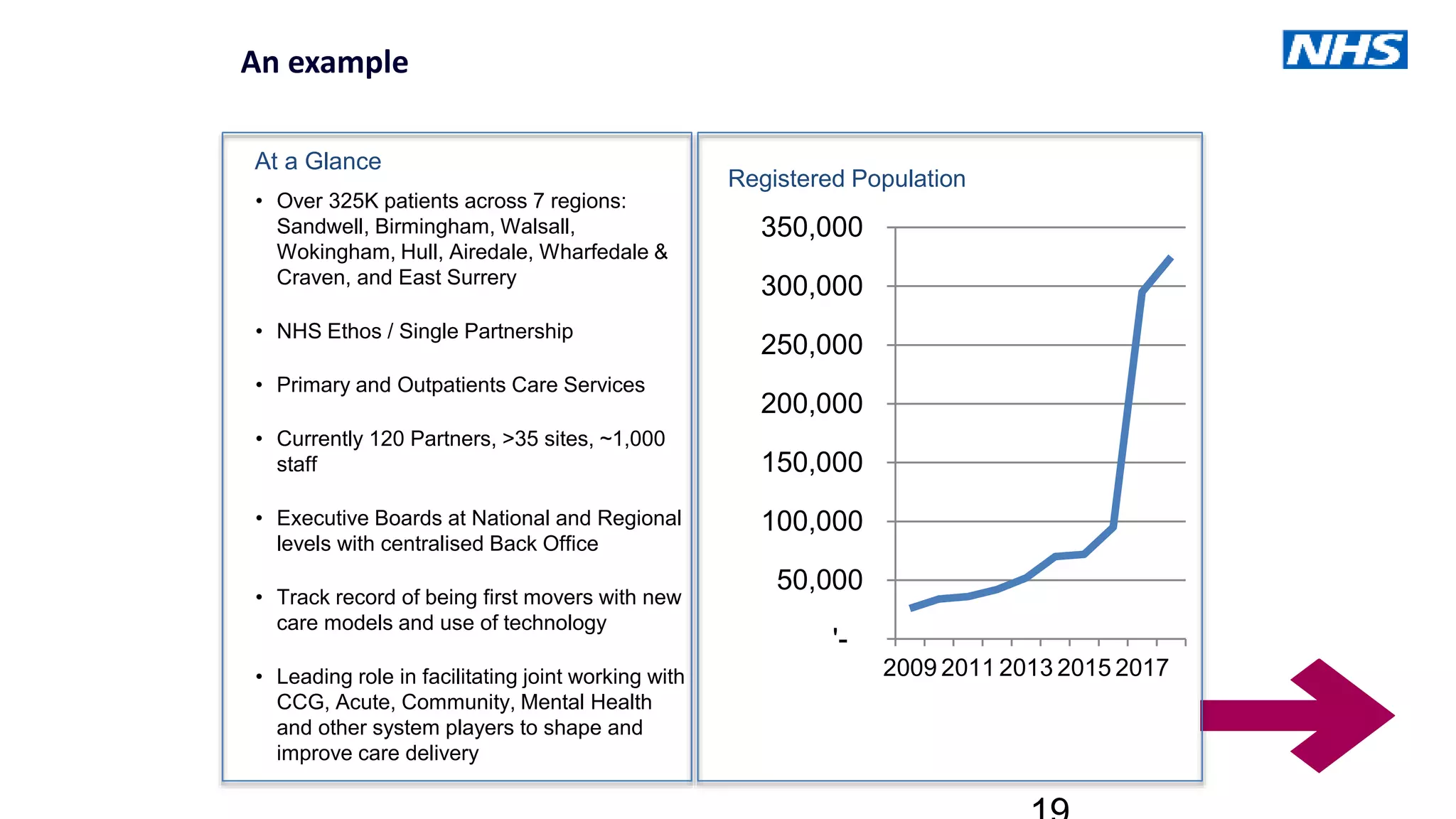
• Over 325K patients across 7 regions:
Sandwell, Birmingham, Walsall,
Wokingham, Hull, Airedale, Wharfedale &
Craven, and East Surrery
• NHS Ethos / Single Partnership
• Primary and Outpatients Care Services
• Currently 120 Partners, >35 sites, ~1,000
staff
• Executive Boards at National and Regional
levels with centralised Back Office
• Track record of being first movers with new
care models and use of technology
• Leading role in facilitating joint working with
CCG, Acute, Community, Mental Health
and other system players to shape and
improve care delivery
Registered Population
At a Glance
'-
50,000
100,000
150,000
200,000
250,000
300,000
350,000
2009 2011 2013 2015 2017
An example
First Contact Practice Level
Back Office
Support
• Website Optimisation
• Patient Apps
• NHS symptom checker
• Re-routed NHS 111
• Video consultations
• Twitter/Facebook
• Digital NHS F&F Test
• E consulting
• Care Navigation
• Call/Recall
• Standardised clinical
templates
• Patient Interaction Initiatives
• Extended Access
• Enhanced Services
• Specialist Services Delivery
• Enhanced Primary care teams
• Physio/pharmacy/ANP/PA/EP
• MDTs with community
Change Management
Lean Processes
The Platform
Primary Care Working Together
Continual Improvement
• HR
• Governance
• Finance /Payroll
• IT Support
• Group Purchasing
• Training
The vanguards have started to demonstrate how integrating services
improves services for patients…
21
East London
Utilising the power of
voluntary and
community services
• In Tower Hamlets, care co-ordinators in primary care can refer
patients to 1500 local voluntary sector organisations that
support residents to manage their health and wellbeing
• Patients have been supported to engage in arts activities, group
learning, gardening, befriending, cookery, healthy eating advice
and a range of sports.
Yorkshire
Integrating care teams
across organisational
boundaries
• In Wakefield, multi-disciplinary teams have been formed
between care homes and primary care to manage the needs of
residents in 27 care homes and 6 supported living facilities
• Local analysis showed that ambulance call outs have been
reduced by 9% and bed days have reduced by 26% from the
2015/16 baseline.
Lancashire
Providing flexible
access to specialist
support
• University Hospitals of Morecambe Bay NHS Foundation Trust
has been working with local out-of-hospital providers, to
implement electronic advice and guidance across 16 specialities
• The service has enabled patients to seek specialist support
without being referred to secondary care, saving around 1700
referrals.
…as well as making the system more effective and efficient
22
PACS and MCP Vanguards have seen slower
growth in emergency admissions…
…and Care Home Vanguards
reduced admissions
Emergency admissions
growth from care home
residents2:
• Rest of England: +6.7%
• EHCH Vanguards: -1.4%
1. For the 12 months to Q2 2017/18, compared to the base-line year 2014/15.
2. For the 12 months to Q2 2017-18, compared to a baseline period of Q3 2014-15 to Q2 2015-16.
Emergency admissions growth1:
• Rest of England: +4.9%
• MCP average: +2.6%
• PACS average: +1.2%
www.england.nhs.uk
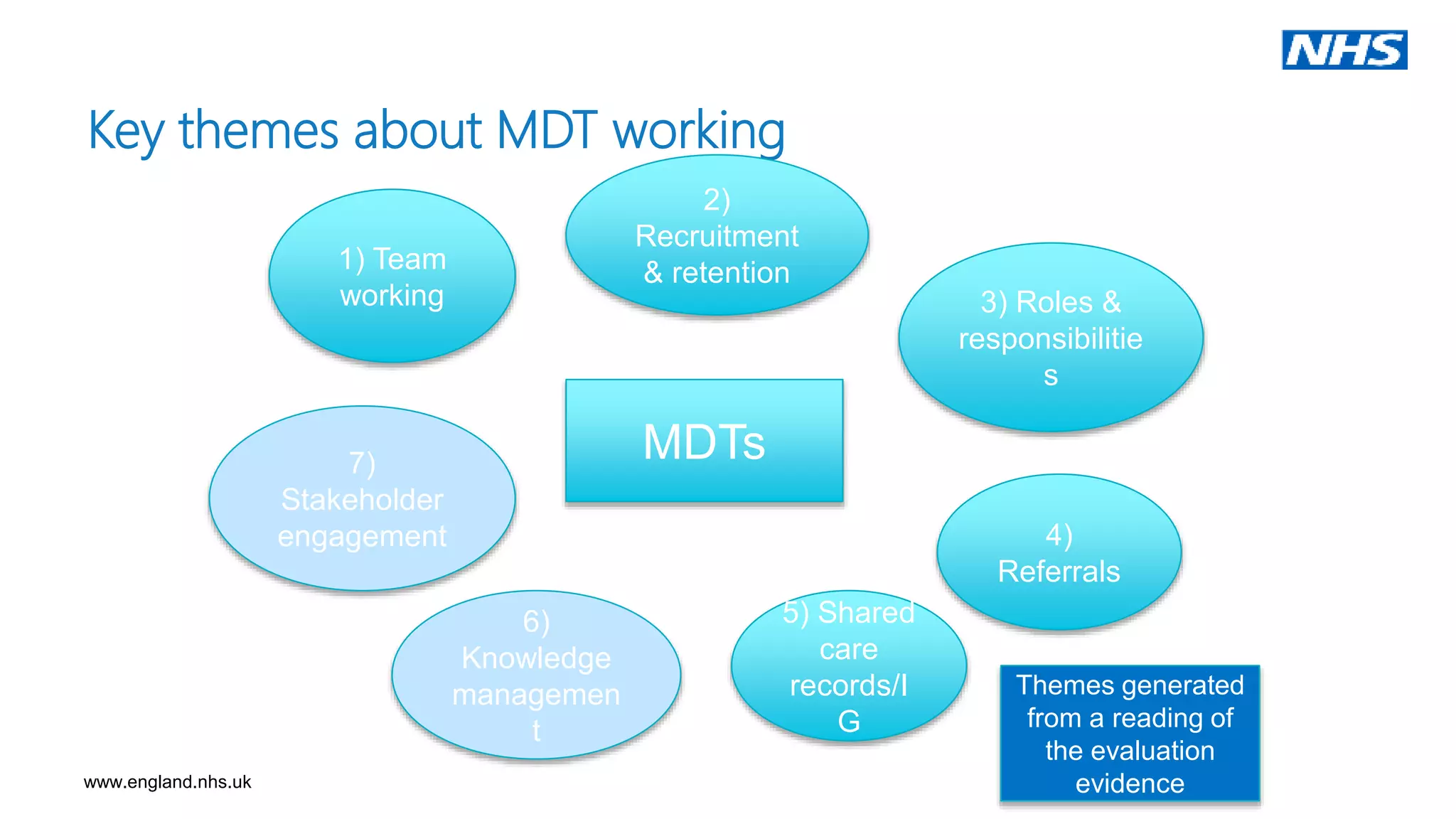
Key themes about MDT working
1) Team
working
2)
Recruitment
& retention
3) Roles &
responsibilitie
s
7)
Stakeholder
engagement
6)
Knowledge
managemen
t
4)
Referrals
5) Shared
care
records/I
G
MDTs
Themes generated
from a reading of
the evaluation
evidence
www.england.nhs.uk
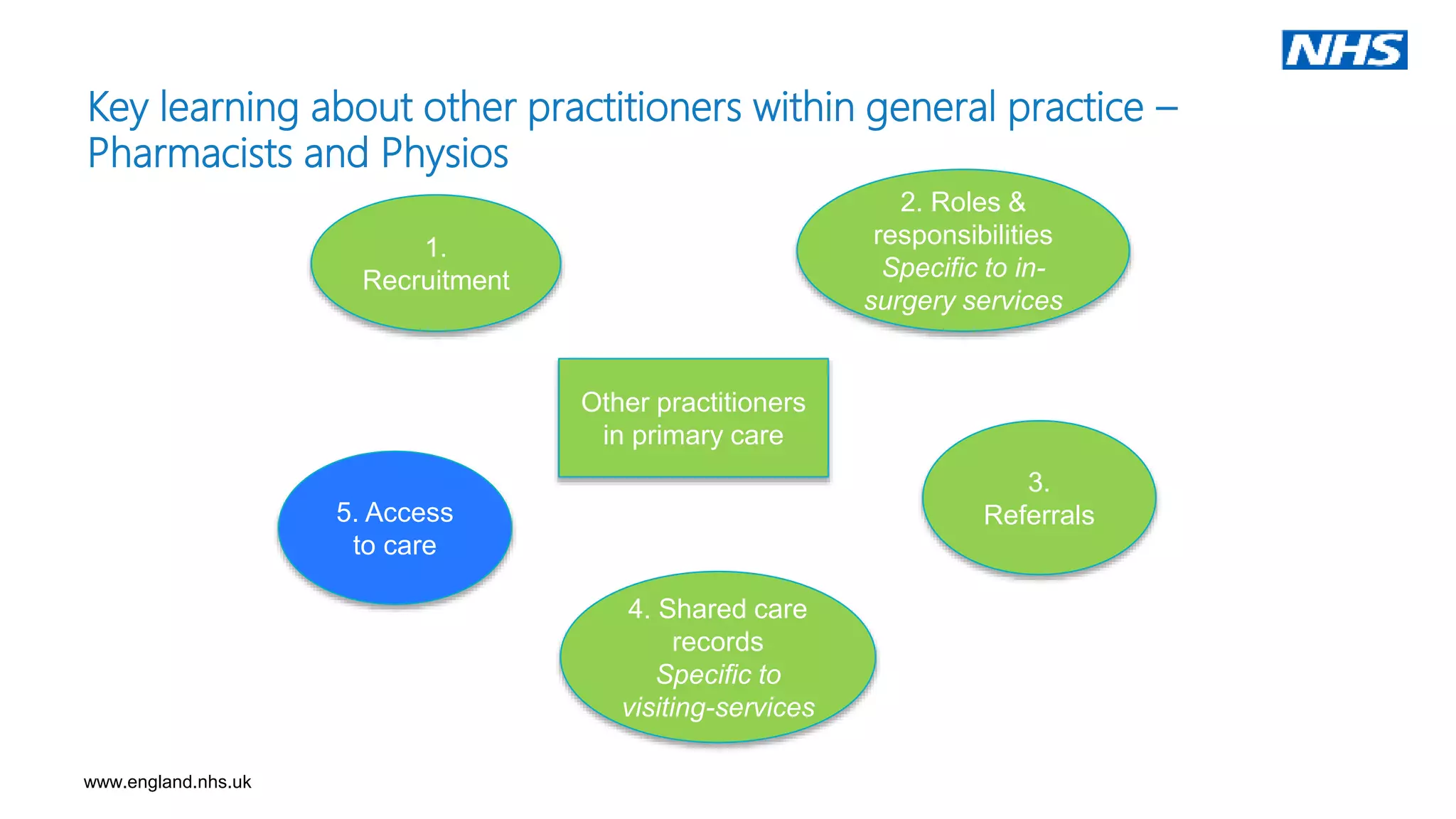
Key learning about other practitioners within general practice –
Pharmacists and Physios
Other practitioners
in primary care
1.
Recruitment
2. Roles &
responsibilities
Specific to in-
surgery services
5. Access
to care
4. Shared care
records
Specific to
visiting-services
3.
Referrals
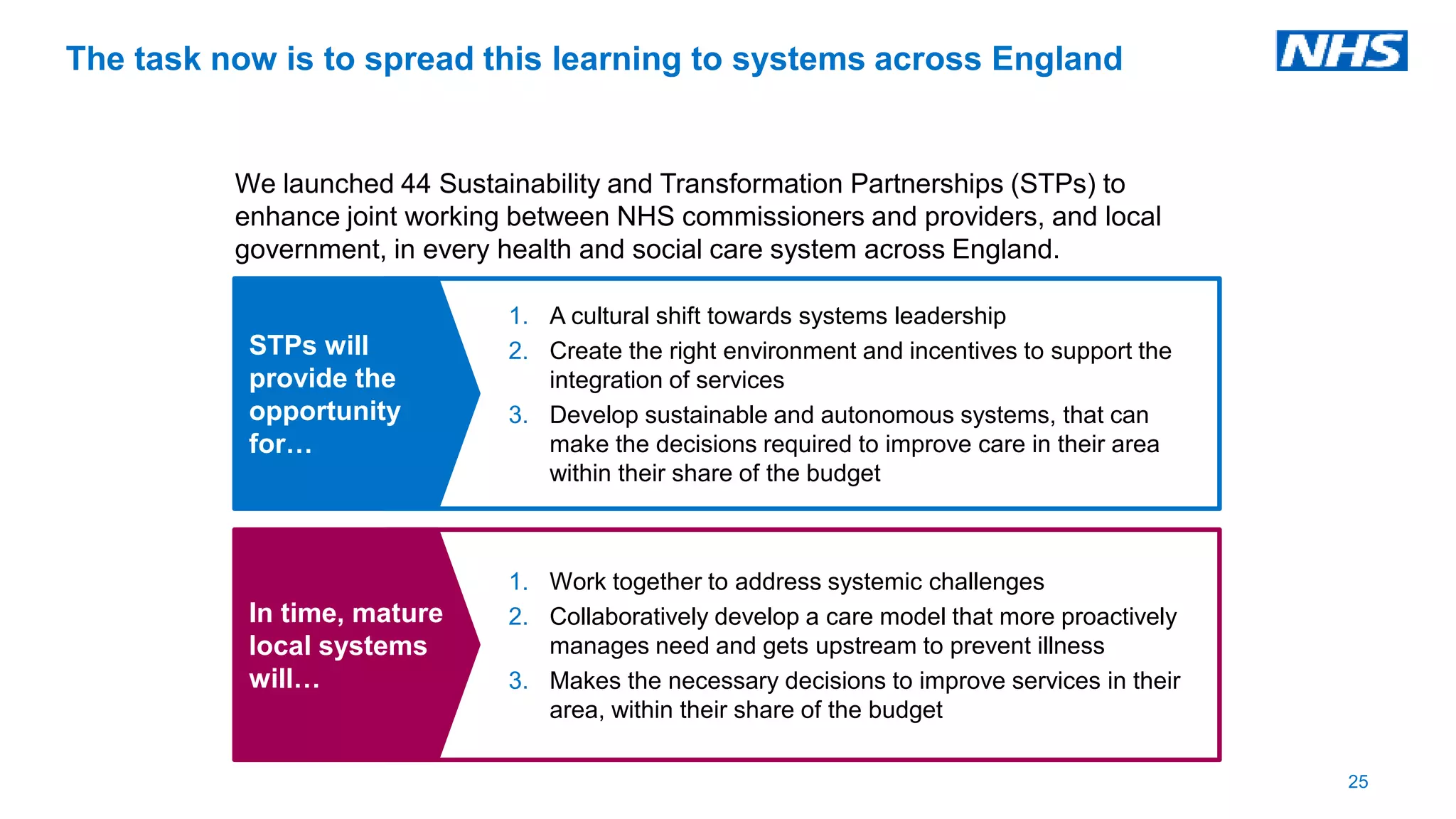
The task now is to spread this learning to systems across England
25
We launched 44 Sustainability and Transformation Partnerships (STPs) to
enhance joint working between NHS commissioners and providers, and local
government, in every health and social care system across England.
1. A cultural shift towards systems leadership
2. Create the right environment and incentives to support the
integration of services
3. Develop sustainable and autonomous systems, that can
make the decisions required to improve care in their area
within their share of the budget
1. Work together to address systemic challenges
2. Collaboratively develop a care model that more proactively
manages need and gets upstream to prevent illness
3. Makes the necessary decisions to improve services in their
area, within their share of the budget
In time, mature
local systems
will…
STPs will
provide the
opportunity
for…
Integrated Care Systems
26
ICS Wave 1
Berkshire West
Bedford, Luton and Milton Keynes
Buckinghamshire
Dorset
Frimley
Lancashire and South Cumbria
Greater Manchester (Devo)
Nottingham
South Yorkshire and Bassetlaw
Surrey Heartlands (Devo)
ICS Wave 2
West, North and East Cumbria
Gloucestershire
Suffolk, North and East Essex
West Yorkshire and Harrogate
We are supporting all STPs to develop into ICSs over
several stages…
27
STP Shadow
ICS
Full
ICS
Matur
e ICS
STP development
programme
Criteria to become
a shadow ICS is
met
Criteria to become
a full ICS is met
Shadow ICS development
programme
ICS development
programme
Leaders from
across different
organisations are
working together
to improve the
way care is
delivered. There
is a single STP
leader.
A full ICS has
taken on greater
responsibilities
and has greater
freedoms.
Operationalising
integrated ways
of working.
Partnership
working is
embedded at all
levels of the
system. Public
engage with
health and care
services is done
in a demonstrably
different way.
System forms
structures around
its ICS. Care is
being designed in
a different way
and there is a
dedicated team to
support the ICS
development.
The diagram below illustrates the roadmap to become an ICS, including the two
“gateways” to become a “shadow” and “full” ICS.
www.england.nhs.uk 28
Integrated care system
The primary care network
The practice
The person
•Supported by families and local
communities
•Enabled and empowered to access care
in a way which works for them
•Provision of resilient and sustainable
core general practice
•Coordination and planning of holistic,
personalised accessible care
•Geographically contiguous teams of
practices caring for 30-50,000 people
•Delivery of data driven integrated
multidisciplinary team based services
The at-scale primary
care provider
•Delivering efficiencies of scale and
leadership support
•Providing a voice for integration across
boundaries of care
•Alliance of commissioners and
providers across health and social care
•Population based and outcomes
focused within a shared budget
THE MODEL OF CARE
ICS footprint: 300k-2m
• Workforce &
infrastructure
planning
• Large scale
service
reconfiguration
• Major partnerships
& shifts in priority
Scale provider 100-
350k
Organisational infrastructure & governance
Specialist staff & services
Employment & career development
Model design (population management, care models)
Strategic partnerships
Primary Care
Network 30-50k
Urgent care
Locality-tailored services
Shared MDT
Place of ‘belonging’
Core team: 3-4k
Coordinated,
complex
multidisciplinary care
Continuity
29
Scales of operation
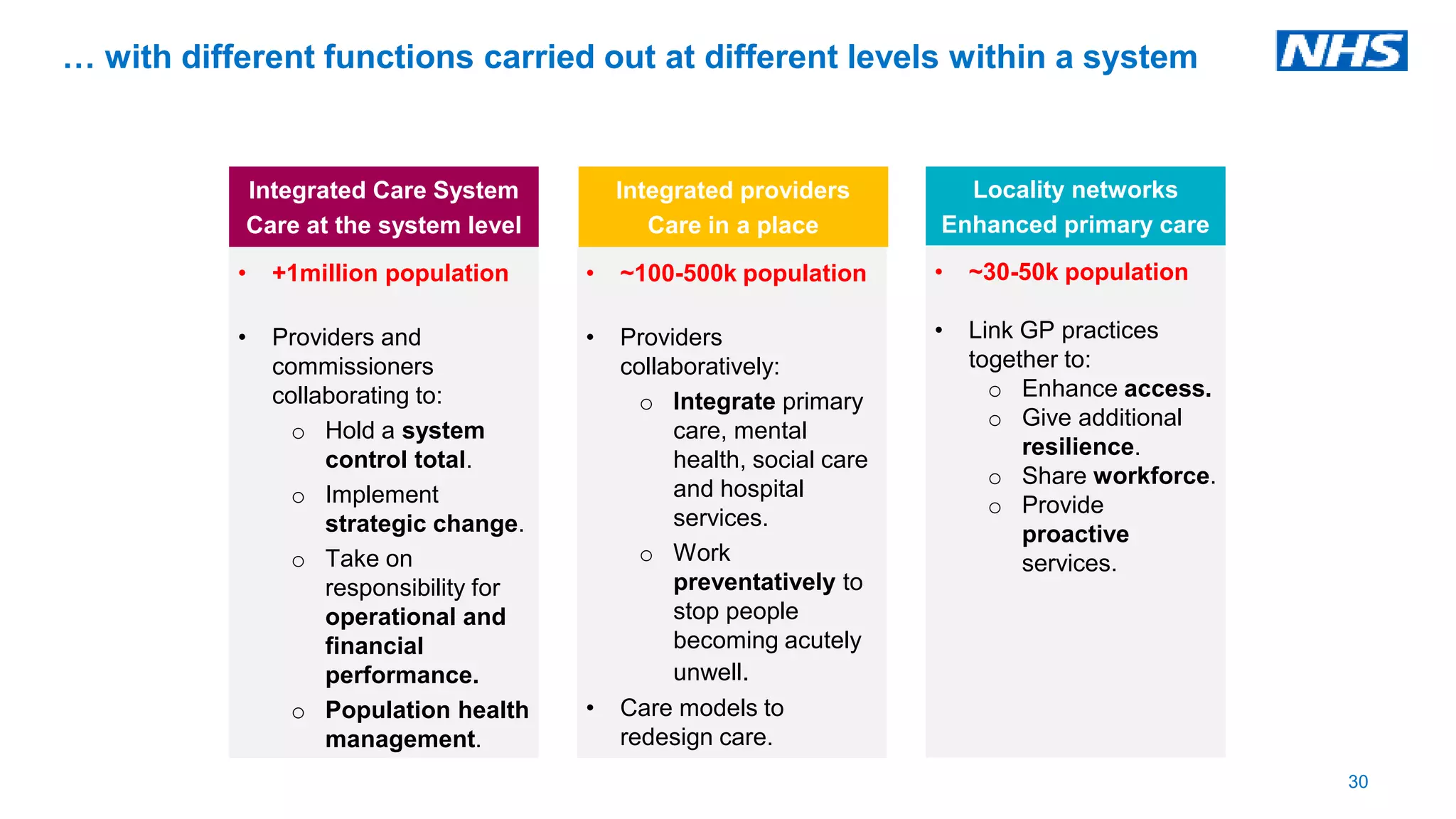
… with different functions carried out at different levels within a system
30
Integrated Care System
Care at the system level
• +1million population
• Providers and
commissioners
collaborating to:
o Hold a system
control total.
o Implement
strategic change.
o Take on
responsibility for
operational and
financial
performance.
o Population health
management.
Locality networks
Enhanced primary care
• ~30-50k population
• Link GP practices
together to:
o Enhance access.
o Give additional
resilience.
o Share workforce.
o Provide
proactive
services.
Integrated providers
Care in a place
• ~100-500k population
• Providers
collaboratively:
o Integrate primary
care, mental
health, social care
and hospital
services.
o Work
preventatively to
stop people
becoming acutely
unwell.
• Care models to
redesign care.
www.england.nhs.uk
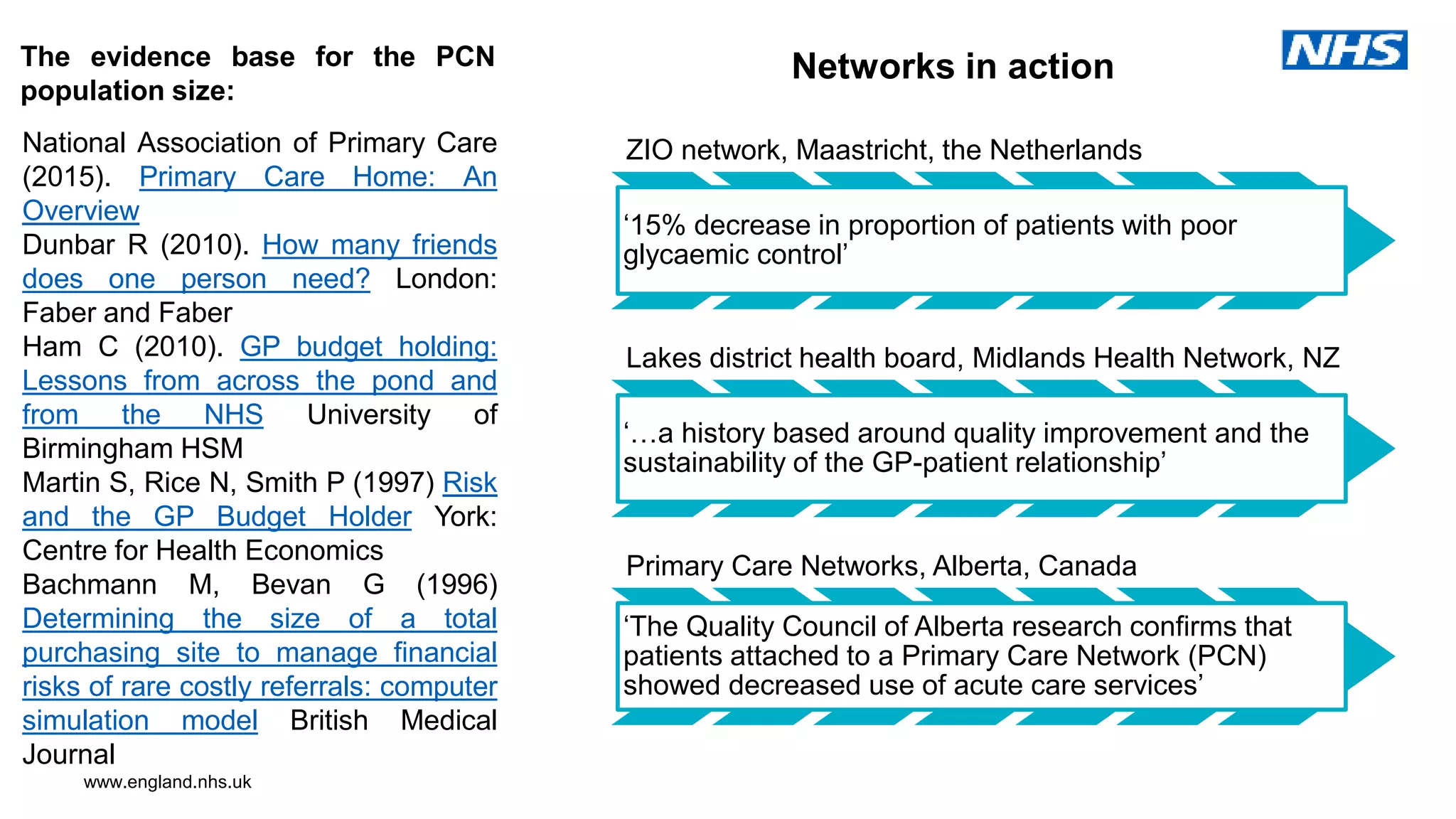
National Association of Primary Care
(2015). Primary Care Home: An
Overview
Dunbar R (2010). How many friends
does one person need? London:
Faber and Faber
Ham C (2010). GP budget holding:
Lessons from across the pond and
from the NHS University of
Birmingham HSM
Martin S, Rice N, Smith P (1997) Risk
and the GP Budget Holder York:
Centre for Health Economics
Bachmann M, Bevan G (1996)
Determining the size of a total
purchasing site to manage financial
risks of rare costly referrals: computer
simulation model British Medical
Journal
The evidence base for the PCN
population size:
Networks in action
ZIO network, Maastricht, the Netherlands
‘15% decrease in proportion of patients with poor
glycaemic control’
Lakes district health board, Midlands Health Network, NZ
‘…a history based around quality improvement and the
sustainability of the GP-patient relationship’
Primary Care Networks, Alberta, Canada
‘The Quality Council of Alberta research confirms that
patients attached to a Primary Care Network (PCN)
showed decreased use of acute care services’
A working definition.
32
• Primary care networks enable the provision of proactive,
accessible, coordinated and more integrated primary and
community care improving outcomes for patients. They are likely to
be formed around natural communities based on GP registered lists,
often serving populations of around 30,000 to 50,000. Networks
will be small enough to still provide the personal care valued by both
patients and GPs, but large enough to have impact through deeper
collaboration between practices and others in the local health
(community and primary care) and social care system. They will
provide a platform for providers of care being sustainable into the
longer term.
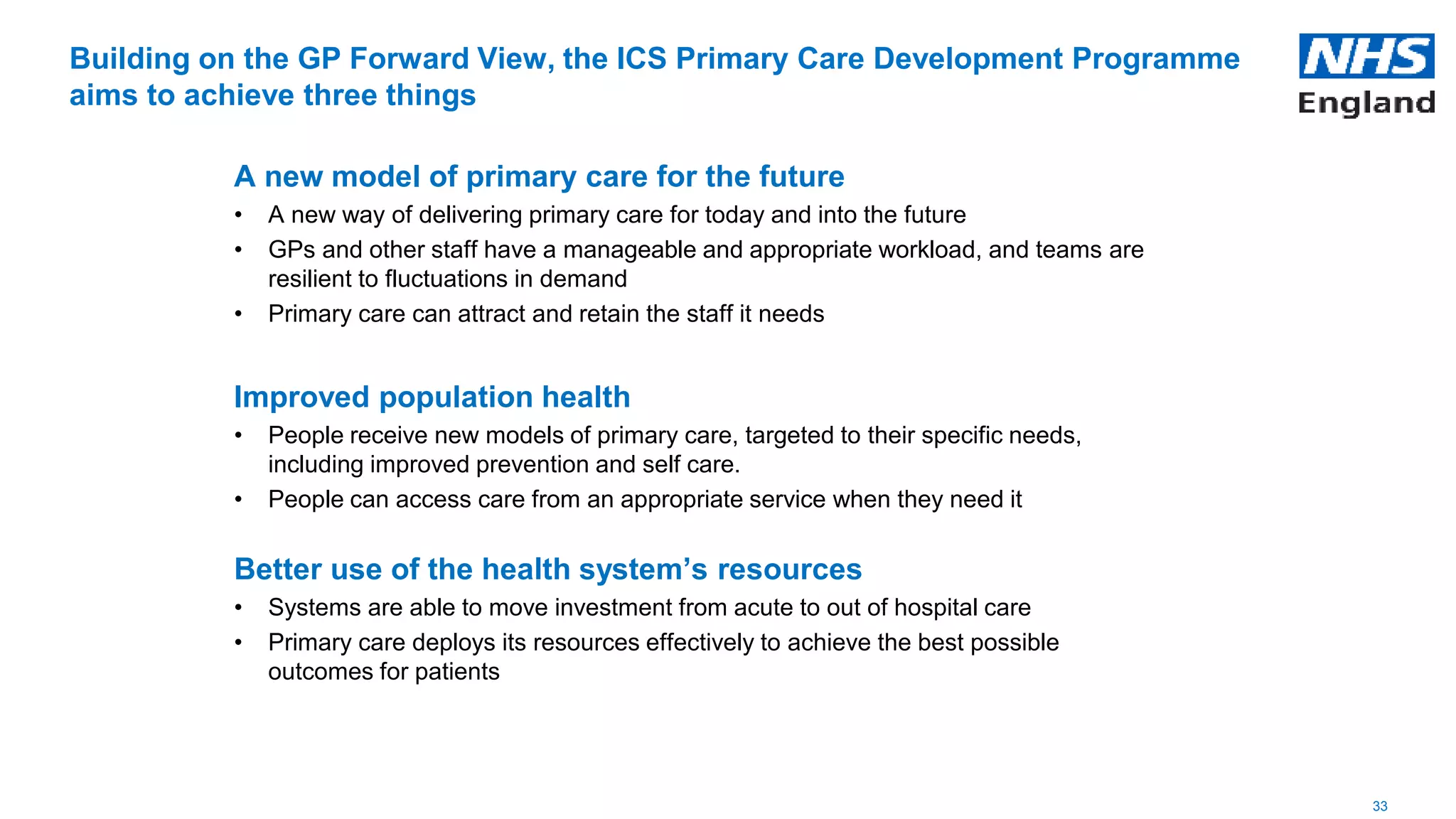
33
Building on the GP Forward View, the ICS Primary Care Development Programme
aims to achieve three things
A new model of primary care for the future
• A new way of delivering primary care for today and into the future
• GPs and other staff have a manageable and appropriate workload, and teams are
resilient to fluctuations in demand
• Primary care can attract and retain the staff it needs
Improved population health
• People receive new models of primary care, targeted to their specific needs,
including improved prevention and self care.
• People can access care from an appropriate service when they need it
Better use of the health system’s resources
• Systems are able to move investment from acute to out of hospital care
• Primary care deploys its resources effectively to achieve the best possible
outcomes for patients
www.england.nhs.uk
Five themes are emerging from the work to date with
the Wave One Integrated Care Systems:
Right scale. Primary care working as networks with other system partners;
and with sharing of information and expanded capabilities.
Managing resources and reducing variation.
Integrated working, across all of primary care. including general practice,
community services, social care and the third sector.
Understanding population needs, targeting care. Data driven population
segmentation to understand people’s health and care needs. Increased focus
on high quality preventative and proactive care.
Empowered primary care. Including equal partnerships across health and
social care in system-level decision making.
1
2
3
4
5
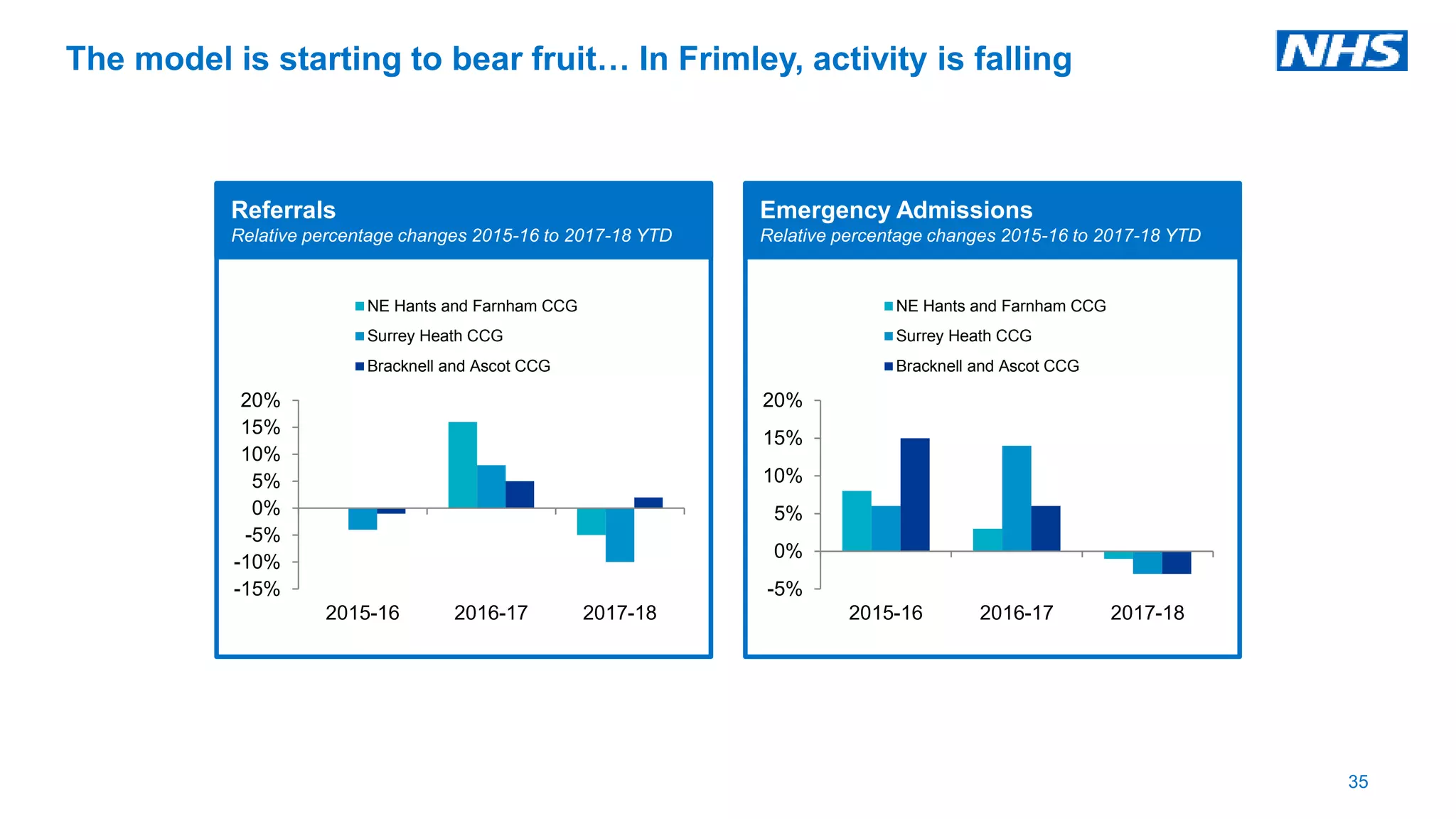
The model is starting to bear fruit… In Frimley, activity is falling
35
-15%
-10%
-5%
0%
5%
10%
15%
20%
2015-16 2016-17 2017-18
NE Hants and Farnham CCG
Surrey Heath CCG
Bracknell and Ascot CCG
Referrals
Relative percentage changes 2015-16 to 2017-18 YTD
-5%
0%
5%
10%
15%
20%
2015-16 2016-17 2017-18
NE Hants and Farnham CCG
Surrey Heath CCG
Bracknell and Ascot CCG
Emergency Admissions
Relative percentage changes 2015-16 to 2017-18 YTD
www.england.nhs.uk
#GPforwardview
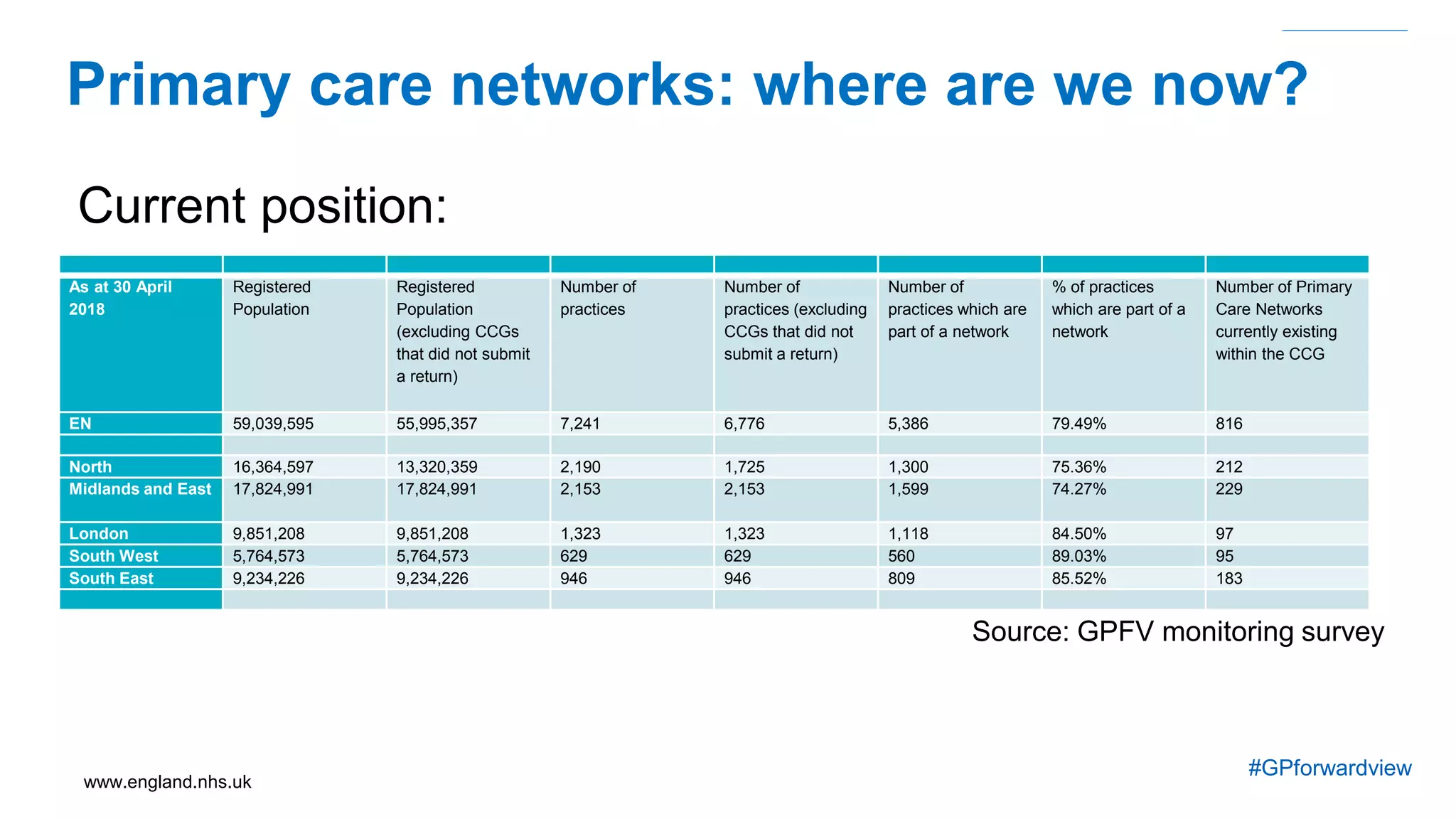
Primary care networks: where are we now?
Current position:
As at 30 April
2018
Registered
Population
Registered
Population
(excluding CCGs
that did not submit
a return)
Number of
practices
Number of
practices (excluding
CCGs that did not
submit a return)
Number of
practices which are
part of a network
% of practices
which are part of a
network
Number of Primary
Care Networks
currently existing
within the CCG
EN 59,039,595 55,995,357 7,241 6,776 5,386 79.49% 816
North 16,364,597 13,320,359 2,190 1,725 1,300 75.36% 212
Midlands and East 17,824,991 17,824,991 2,153 2,153 1,599 74.27% 229
London 9,851,208 9,851,208 1,323 1,323 1,118 84.50% 97
South West 5,764,573 5,764,573 629 629 560 89.03% 95
South East 9,234,226 9,234,226 946 946 809 85.52% 183
Source: GPFV monitoring survey
www.england.nhs.uk
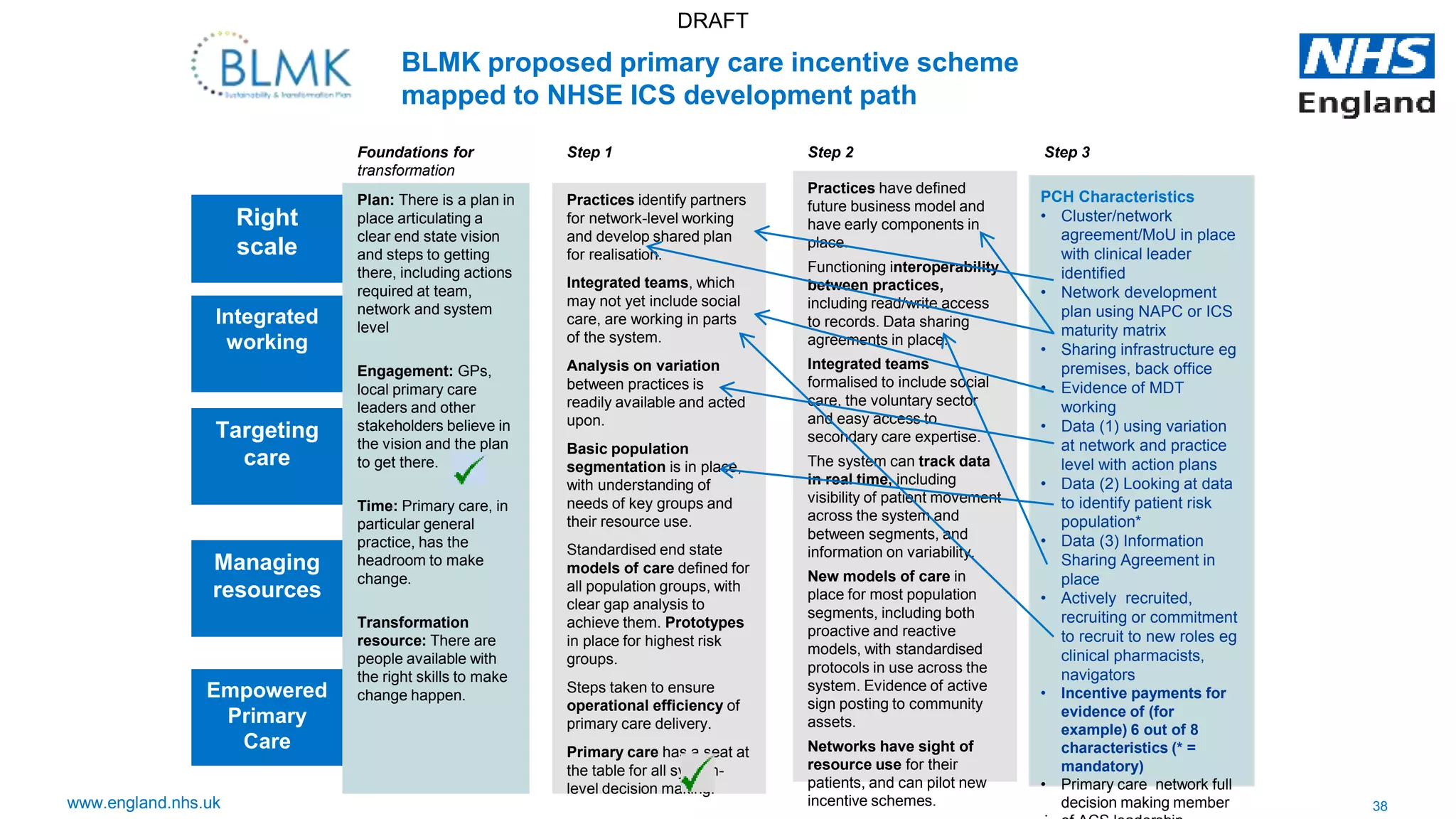
The following maturity matrix sets out the journey we are
developing with ICSs for primary care at scale
38www.england.nhs.uk
DRAFT
Right
scale
Integrated
working
Targeting
care
Managing
resources
Empowered
Primary
Care
Plan: There is a plan in
place articulating a
clear end state vision
and steps to getting
there, including actions
required at team,
network and system
level
Engagement: GPs,
local primary care
leaders and other
stakeholders believe in
the vision and the plan
to get there.
Time: Primary care, in
particular general
practice, has the
headroom to make
change.
Transformation
resource: There are
people available with
the right skills to make
change happen.
Practices identify partners
for network-level working
and develop shared plan
for realisation.
Integrated teams, which
may not yet include social
care, are working in parts
of the system.
Analysis on variation
between practices is
readily available and acted
upon.
Basic population
segmentation is in place,
with understanding of
needs of key groups and
their resource use.
Standardised end state
models of care defined for
all population groups, with
clear gap analysis to
achieve them. Prototypes
in place for highest risk
groups.
Steps taken to ensure
operational efficiency of
primary care delivery.
Primary care has a seat at
the table for all system-
level decision making.
Practices have defined
future business model and
have early components in
place.
Functioning interoperability
between practices,
including read/write access
to records. Data sharing
agreements in place.
Integrated teams
formalised to include social
care, the voluntary sector
and easy access to
secondary care expertise.
The system can track data
in real time, including
visibility of patient movement
across the system and
between segments, and
information on variability.
New models of care in
place for most population
segments, including both
proactive and reactive
models, with standardised
protocols in use across the
system. Evidence of active
sign posting to community
assets.
Networks have sight of
resource use for their
patients, and can pilot new
incentive schemes.
BLMK proposed primary care incentive scheme
mapped to NHSE ICS development path
Network business model
fully operational.
Interoperable systems
Integrated clinical records.
Workforce shared across
network. Rationalisation of
primary care with optimum
estate usage.
Fully functioning
integrated team. Systematic
population segmentation
including risk stratification.
Care plans for all high risk
patients. Internal referral
processes in place. Routine
peer review of metrics per
hub.
Stratification of appointments
with 7 day working. Upper
decile public health targets
and patient and staff survey
metrics.
Primary care networks take
collective responsibility
for available funding.
Clinical pathway change
leading to care closer to
home. Data being used at
individual clinical level to
make best use of resources.
.
Foundations for
transformation
Step 1 Step 2 Step 3
PCH Characteristics
• Cluster/network
agreement/MoU in place
with clinical leader
identified
• Network development
plan using NAPC or ICS
maturity matrix
• Sharing infrastructure eg
premises, back office
• Evidence of MDT
working
• Data (1) using variation
at network and practice
level with action plans
• Data (2) Looking at data
to identify patient risk
population*
• Data (3) Information
Sharing Agreement in
place
• Actively recruited,
recruiting or commitment
to recruit to new roles eg
clinical pharmacists,
navigators
• Incentive payments for
evidence of (for
example) 6 out of 8
characteristics (* =
mandatory)
• Primary care network full
decision making member
39www.england.nhs.uk
DRAFT
Clinical Performance Dashboard
40www.england.nhs.uk
DRAFT
Examples of services provided at network level that are not embedded in
practices
Examples of services provided through network and
embedded in practices
GP
Practice
GP
Practice
GP
Practice
GP
Practice
Network Leadership
Hospital and specialist
services
Business intelligence
via CSU, public health
and CCG
Pharmacist
Care
Navigator
Mental
health
Diabetes
MSK
Community
nurses
Wound
care
Social Care
Dermatology
Frailty
Children’s hub
Dementia
Cardiovascular
Urgent care
41www.england.nhs.uk
DRAFT
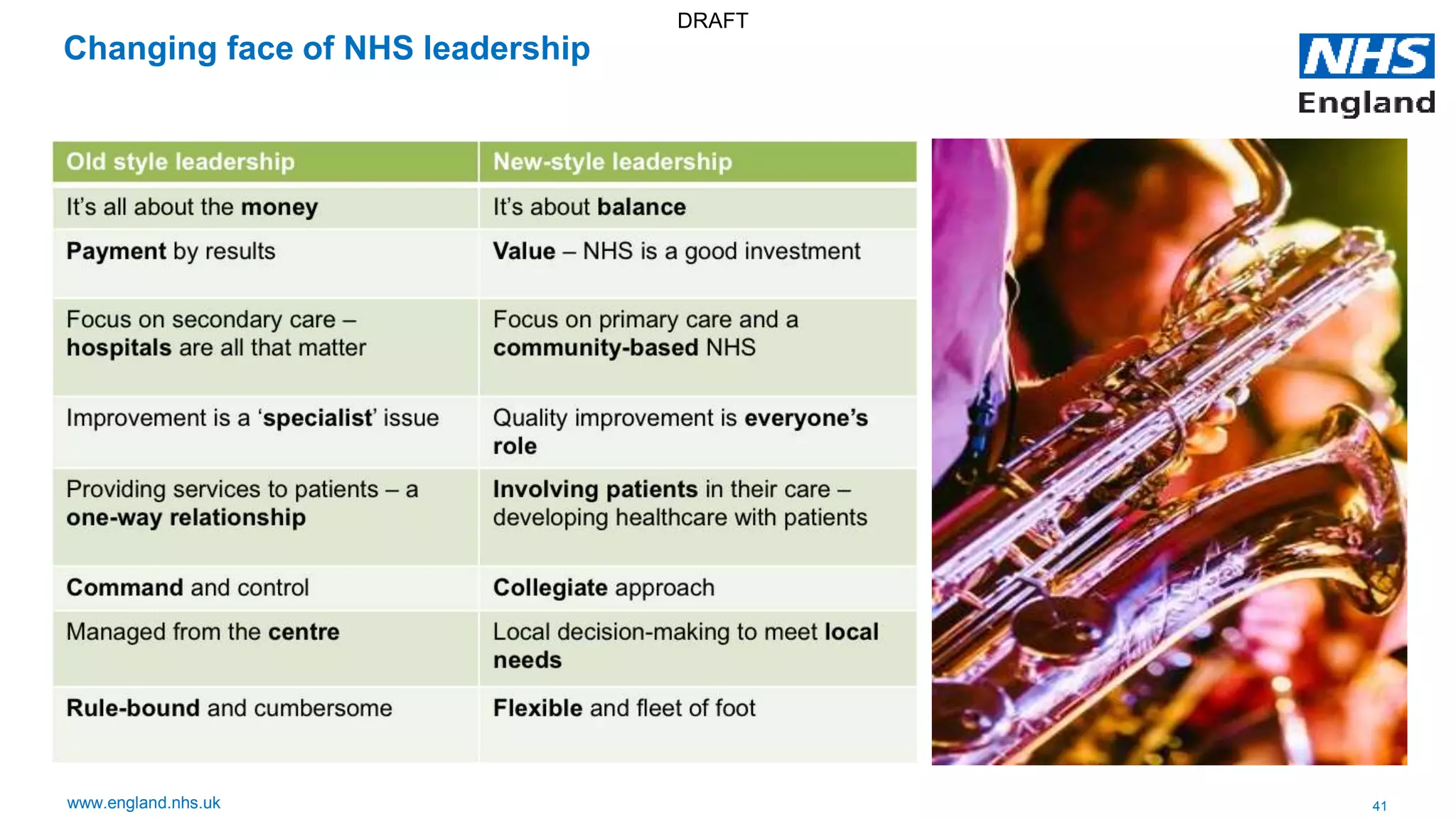
Changing face of NHS leadership
42www.england.nhs.uk
DRAFT
Primary care networks reference guide
• Provides support for local communities,
building on learning from the existing models.
• Provides advice and guidance on the key
areas commissioners and practices should
consider in establishing primary care networks
locally.
• Sets out the vision for networks, core
characteristics, care models at the heart of
primary care at scale.
• Key enablers that underpin the effective
development of networks.
• Feedback has been provided by many different
stakeholders and a final version will published
shortly.
43www.england.nhs.uk
DRAFT
44www.england.nhs.uk
DRAFT
17
www.england.nhs.uk
Thank you

Keynote - Future of primary care networks

  • 1.
    www.england.nhs.uk The Future ofPrimary Care Networks. Sharing learning from the National ICS Primary Care Development Programme 17th September 2018 Professor Nick Harding OBE Senior Medical Advisor to Primary Care /Right care Aston Medical School Sandwell and West Birmingham CCG
  • 2.
  • 3.
  • 4.
  • 5.
  • 6.
  • 7.
  • 8.
  • 9.
  • 11.
  • 12.
    The health needsof the population are changing… 12 The changing health needs of the population are putting pressure on the health and social care system in England. Ageing population Between 2017 and 2027, there will be 2 million more people aged over 75. Chronic conditions The NHS’ predominant task has changed from treating individual episodes of illness, to helping people manage long-term conditions. The steady expansion of new treatments gives rise to demand for an increasing range of services. New Treatments
  • 13.
    … and thesystem has not changed enough to meet these needs 13 • Service provision is fragmented in multiple different types of organisations • Too often, these services don’t communicate effectively with each other • The totality of patients’ needs are not always understood by those serving them • Care is not always delivered in a person-centred way Voluntary Sector Hospital Care Homes Domiciliar y Care Mental Health services Primary care Nursing Homes NHS 111 Patient
  • 14.
    My first week 80 % Ian, sickchild Christine, diabetic 18 2 % Stephen, dementia
  • 15.
    Hand-me-down healthcare • Wewere using an outdated model • 10 years later, we had twice as many patients • The hand-me-down model was no longer sustainable – something had to change
  • 16.
    Healthcare fitted topersonal need Access point training focused packaged of care complex conditions become our challenge to deal with
  • 17.
    Traditional Practice ModelFederations ‘Super Partnerships’ (Sole trader, multi-partners) Full MergerCollaborationScatter 2k – 15k patients 50k – 500k patients 50k + patients Business Forms: Just a Means to an End 17
  • 18.
    Federation Plus SPSuper Federation New Generation Mix / Collaboration Models 100k – 500k patients 500k – 1m+ patients Business Form: Size Matters 18
  • 19.
    • Over 325Kpatients across 7 regions: Sandwell, Birmingham, Walsall, Wokingham, Hull, Airedale, Wharfedale & Craven, and East Surrery • NHS Ethos / Single Partnership • Primary and Outpatients Care Services • Currently 120 Partners, >35 sites, ~1,000 staff • Executive Boards at National and Regional levels with centralised Back Office • Track record of being first movers with new care models and use of technology • Leading role in facilitating joint working with CCG, Acute, Community, Mental Health and other system players to shape and improve care delivery Registered Population At a Glance '- 50,000 100,000 150,000 200,000 250,000 300,000 350,000 2009 2011 2013 2015 2017 An example
  • 20.
    First Contact PracticeLevel Back Office Support • Website Optimisation • Patient Apps • NHS symptom checker • Re-routed NHS 111 • Video consultations • Twitter/Facebook • Digital NHS F&F Test • E consulting • Care Navigation • Call/Recall • Standardised clinical templates • Patient Interaction Initiatives • Extended Access • Enhanced Services • Specialist Services Delivery • Enhanced Primary care teams • Physio/pharmacy/ANP/PA/EP • MDTs with community Change Management Lean Processes The Platform Primary Care Working Together Continual Improvement • HR • Governance • Finance /Payroll • IT Support • Group Purchasing • Training
  • 21.
    The vanguards havestarted to demonstrate how integrating services improves services for patients… 21 East London Utilising the power of voluntary and community services • In Tower Hamlets, care co-ordinators in primary care can refer patients to 1500 local voluntary sector organisations that support residents to manage their health and wellbeing • Patients have been supported to engage in arts activities, group learning, gardening, befriending, cookery, healthy eating advice and a range of sports. Yorkshire Integrating care teams across organisational boundaries • In Wakefield, multi-disciplinary teams have been formed between care homes and primary care to manage the needs of residents in 27 care homes and 6 supported living facilities • Local analysis showed that ambulance call outs have been reduced by 9% and bed days have reduced by 26% from the 2015/16 baseline. Lancashire Providing flexible access to specialist support • University Hospitals of Morecambe Bay NHS Foundation Trust has been working with local out-of-hospital providers, to implement electronic advice and guidance across 16 specialities • The service has enabled patients to seek specialist support without being referred to secondary care, saving around 1700 referrals.
  • 22.
    …as well asmaking the system more effective and efficient 22 PACS and MCP Vanguards have seen slower growth in emergency admissions… …and Care Home Vanguards reduced admissions Emergency admissions growth from care home residents2: • Rest of England: +6.7% • EHCH Vanguards: -1.4% 1. For the 12 months to Q2 2017/18, compared to the base-line year 2014/15. 2. For the 12 months to Q2 2017-18, compared to a baseline period of Q3 2014-15 to Q2 2015-16. Emergency admissions growth1: • Rest of England: +4.9% • MCP average: +2.6% • PACS average: +1.2%
  • 23.
    www.england.nhs.uk Key themes aboutMDT working 1) Team working 2) Recruitment & retention 3) Roles & responsibilitie s 7) Stakeholder engagement 6) Knowledge managemen t 4) Referrals 5) Shared care records/I G MDTs Themes generated from a reading of the evaluation evidence
  • 24.
    www.england.nhs.uk Key learning aboutother practitioners within general practice – Pharmacists and Physios Other practitioners in primary care 1. Recruitment 2. Roles & responsibilities Specific to in- surgery services 5. Access to care 4. Shared care records Specific to visiting-services 3. Referrals
  • 25.
    The task nowis to spread this learning to systems across England 25 We launched 44 Sustainability and Transformation Partnerships (STPs) to enhance joint working between NHS commissioners and providers, and local government, in every health and social care system across England. 1. A cultural shift towards systems leadership 2. Create the right environment and incentives to support the integration of services 3. Develop sustainable and autonomous systems, that can make the decisions required to improve care in their area within their share of the budget 1. Work together to address systemic challenges 2. Collaboratively develop a care model that more proactively manages need and gets upstream to prevent illness 3. Makes the necessary decisions to improve services in their area, within their share of the budget In time, mature local systems will… STPs will provide the opportunity for…
  • 26.
    Integrated Care Systems 26 ICSWave 1 Berkshire West Bedford, Luton and Milton Keynes Buckinghamshire Dorset Frimley Lancashire and South Cumbria Greater Manchester (Devo) Nottingham South Yorkshire and Bassetlaw Surrey Heartlands (Devo) ICS Wave 2 West, North and East Cumbria Gloucestershire Suffolk, North and East Essex West Yorkshire and Harrogate
  • 27.
    We are supportingall STPs to develop into ICSs over several stages… 27 STP Shadow ICS Full ICS Matur e ICS STP development programme Criteria to become a shadow ICS is met Criteria to become a full ICS is met Shadow ICS development programme ICS development programme Leaders from across different organisations are working together to improve the way care is delivered. There is a single STP leader. A full ICS has taken on greater responsibilities and has greater freedoms. Operationalising integrated ways of working. Partnership working is embedded at all levels of the system. Public engage with health and care services is done in a demonstrably different way. System forms structures around its ICS. Care is being designed in a different way and there is a dedicated team to support the ICS development. The diagram below illustrates the roadmap to become an ICS, including the two “gateways” to become a “shadow” and “full” ICS.
  • 28.
    www.england.nhs.uk 28 Integrated caresystem The primary care network The practice The person •Supported by families and local communities •Enabled and empowered to access care in a way which works for them •Provision of resilient and sustainable core general practice •Coordination and planning of holistic, personalised accessible care •Geographically contiguous teams of practices caring for 30-50,000 people •Delivery of data driven integrated multidisciplinary team based services The at-scale primary care provider •Delivering efficiencies of scale and leadership support •Providing a voice for integration across boundaries of care •Alliance of commissioners and providers across health and social care •Population based and outcomes focused within a shared budget THE MODEL OF CARE
  • 29.
    ICS footprint: 300k-2m •Workforce & infrastructure planning • Large scale service reconfiguration • Major partnerships & shifts in priority Scale provider 100- 350k Organisational infrastructure & governance Specialist staff & services Employment & career development Model design (population management, care models) Strategic partnerships Primary Care Network 30-50k Urgent care Locality-tailored services Shared MDT Place of ‘belonging’ Core team: 3-4k Coordinated, complex multidisciplinary care Continuity 29 Scales of operation
  • 30.
    … with differentfunctions carried out at different levels within a system 30 Integrated Care System Care at the system level • +1million population • Providers and commissioners collaborating to: o Hold a system control total. o Implement strategic change. o Take on responsibility for operational and financial performance. o Population health management. Locality networks Enhanced primary care • ~30-50k population • Link GP practices together to: o Enhance access. o Give additional resilience. o Share workforce. o Provide proactive services. Integrated providers Care in a place • ~100-500k population • Providers collaboratively: o Integrate primary care, mental health, social care and hospital services. o Work preventatively to stop people becoming acutely unwell. • Care models to redesign care.
  • 31.
    www.england.nhs.uk National Association ofPrimary Care (2015). Primary Care Home: An Overview Dunbar R (2010). How many friends does one person need? London: Faber and Faber Ham C (2010). GP budget holding: Lessons from across the pond and from the NHS University of Birmingham HSM Martin S, Rice N, Smith P (1997) Risk and the GP Budget Holder York: Centre for Health Economics Bachmann M, Bevan G (1996) Determining the size of a total purchasing site to manage financial risks of rare costly referrals: computer simulation model British Medical Journal The evidence base for the PCN population size: Networks in action ZIO network, Maastricht, the Netherlands ‘15% decrease in proportion of patients with poor glycaemic control’ Lakes district health board, Midlands Health Network, NZ ‘…a history based around quality improvement and the sustainability of the GP-patient relationship’ Primary Care Networks, Alberta, Canada ‘The Quality Council of Alberta research confirms that patients attached to a Primary Care Network (PCN) showed decreased use of acute care services’
  • 32.
    A working definition. 32 •Primary care networks enable the provision of proactive, accessible, coordinated and more integrated primary and community care improving outcomes for patients. They are likely to be formed around natural communities based on GP registered lists, often serving populations of around 30,000 to 50,000. Networks will be small enough to still provide the personal care valued by both patients and GPs, but large enough to have impact through deeper collaboration between practices and others in the local health (community and primary care) and social care system. They will provide a platform for providers of care being sustainable into the longer term.
  • 33.
    33 Building on theGP Forward View, the ICS Primary Care Development Programme aims to achieve three things A new model of primary care for the future • A new way of delivering primary care for today and into the future • GPs and other staff have a manageable and appropriate workload, and teams are resilient to fluctuations in demand • Primary care can attract and retain the staff it needs Improved population health • People receive new models of primary care, targeted to their specific needs, including improved prevention and self care. • People can access care from an appropriate service when they need it Better use of the health system’s resources • Systems are able to move investment from acute to out of hospital care • Primary care deploys its resources effectively to achieve the best possible outcomes for patients
  • 34.
    www.england.nhs.uk Five themes areemerging from the work to date with the Wave One Integrated Care Systems: Right scale. Primary care working as networks with other system partners; and with sharing of information and expanded capabilities. Managing resources and reducing variation. Integrated working, across all of primary care. including general practice, community services, social care and the third sector. Understanding population needs, targeting care. Data driven population segmentation to understand people’s health and care needs. Increased focus on high quality preventative and proactive care. Empowered primary care. Including equal partnerships across health and social care in system-level decision making. 1 2 3 4 5
  • 35.
    The model isstarting to bear fruit… In Frimley, activity is falling 35 -15% -10% -5% 0% 5% 10% 15% 20% 2015-16 2016-17 2017-18 NE Hants and Farnham CCG Surrey Heath CCG Bracknell and Ascot CCG Referrals Relative percentage changes 2015-16 to 2017-18 YTD -5% 0% 5% 10% 15% 20% 2015-16 2016-17 2017-18 NE Hants and Farnham CCG Surrey Heath CCG Bracknell and Ascot CCG Emergency Admissions Relative percentage changes 2015-16 to 2017-18 YTD
  • 36.
    www.england.nhs.uk #GPforwardview Primary care networks:where are we now? Current position: As at 30 April 2018 Registered Population Registered Population (excluding CCGs that did not submit a return) Number of practices Number of practices (excluding CCGs that did not submit a return) Number of practices which are part of a network % of practices which are part of a network Number of Primary Care Networks currently existing within the CCG EN 59,039,595 55,995,357 7,241 6,776 5,386 79.49% 816 North 16,364,597 13,320,359 2,190 1,725 1,300 75.36% 212 Midlands and East 17,824,991 17,824,991 2,153 2,153 1,599 74.27% 229 London 9,851,208 9,851,208 1,323 1,323 1,118 84.50% 97 South West 5,764,573 5,764,573 629 629 560 89.03% 95 South East 9,234,226 9,234,226 946 946 809 85.52% 183 Source: GPFV monitoring survey
  • 37.
    www.england.nhs.uk The following maturitymatrix sets out the journey we are developing with ICSs for primary care at scale
  • 38.
    38www.england.nhs.uk DRAFT Right scale Integrated working Targeting care Managing resources Empowered Primary Care Plan: There isa plan in place articulating a clear end state vision and steps to getting there, including actions required at team, network and system level Engagement: GPs, local primary care leaders and other stakeholders believe in the vision and the plan to get there. Time: Primary care, in particular general practice, has the headroom to make change. Transformation resource: There are people available with the right skills to make change happen. Practices identify partners for network-level working and develop shared plan for realisation. Integrated teams, which may not yet include social care, are working in parts of the system. Analysis on variation between practices is readily available and acted upon. Basic population segmentation is in place, with understanding of needs of key groups and their resource use. Standardised end state models of care defined for all population groups, with clear gap analysis to achieve them. Prototypes in place for highest risk groups. Steps taken to ensure operational efficiency of primary care delivery. Primary care has a seat at the table for all system- level decision making. Practices have defined future business model and have early components in place. Functioning interoperability between practices, including read/write access to records. Data sharing agreements in place. Integrated teams formalised to include social care, the voluntary sector and easy access to secondary care expertise. The system can track data in real time, including visibility of patient movement across the system and between segments, and information on variability. New models of care in place for most population segments, including both proactive and reactive models, with standardised protocols in use across the system. Evidence of active sign posting to community assets. Networks have sight of resource use for their patients, and can pilot new incentive schemes. BLMK proposed primary care incentive scheme mapped to NHSE ICS development path Network business model fully operational. Interoperable systems Integrated clinical records. Workforce shared across network. Rationalisation of primary care with optimum estate usage. Fully functioning integrated team. Systematic population segmentation including risk stratification. Care plans for all high risk patients. Internal referral processes in place. Routine peer review of metrics per hub. Stratification of appointments with 7 day working. Upper decile public health targets and patient and staff survey metrics. Primary care networks take collective responsibility for available funding. Clinical pathway change leading to care closer to home. Data being used at individual clinical level to make best use of resources. . Foundations for transformation Step 1 Step 2 Step 3 PCH Characteristics • Cluster/network agreement/MoU in place with clinical leader identified • Network development plan using NAPC or ICS maturity matrix • Sharing infrastructure eg premises, back office • Evidence of MDT working • Data (1) using variation at network and practice level with action plans • Data (2) Looking at data to identify patient risk population* • Data (3) Information Sharing Agreement in place • Actively recruited, recruiting or commitment to recruit to new roles eg clinical pharmacists, navigators • Incentive payments for evidence of (for example) 6 out of 8 characteristics (* = mandatory) • Primary care network full decision making member
  • 39.
  • 40.
    40www.england.nhs.uk DRAFT Examples of servicesprovided at network level that are not embedded in practices Examples of services provided through network and embedded in practices GP Practice GP Practice GP Practice GP Practice Network Leadership Hospital and specialist services Business intelligence via CSU, public health and CCG Pharmacist Care Navigator Mental health Diabetes MSK Community nurses Wound care Social Care Dermatology Frailty Children’s hub Dementia Cardiovascular Urgent care
  • 41.
  • 42.
    42www.england.nhs.uk DRAFT Primary care networksreference guide • Provides support for local communities, building on learning from the existing models. • Provides advice and guidance on the key areas commissioners and practices should consider in establishing primary care networks locally. • Sets out the vision for networks, core characteristics, care models at the heart of primary care at scale. • Key enablers that underpin the effective development of networks. • Feedback has been provided by many different stakeholders and a final version will published shortly.
  • 43.
  • 44.
  • 45.

Editor's Notes

  • #2 ‘Sharing learning from the National ICS Primary Care Development Programme’
  • #23 Verbal prompts: We now have the early evidence that the new care models have made an impact on people and populations This early evidence suggests that people living in areas where care is more closely integrated have their needs more proactively managed in community settings outside of hospital, meaning they attend A&E less often than they otherwise would From this we could make inferences/assumptions about the quality of care people receive in vanguard areas, the cost of these services, and the health outcomes of people living there – However more robust evaluation is essential to understand the impact of the more vanguards more clearly.
  • #24 Date produced – w/c 11th June 1) Workforce - Team working: + Useful platform for developing and embedding ideas. + Collective experience to share problems. + removed barriers to communication across partners. + Greater knowledge of others’ roles/skills (some reported this led to ‘upskilling’). + Greater awareness of available services. - But some staff couldn’t ‘let go’ whilst others saw the MDT as an opportunity to ‘shift’ patients to other professionals. * Reliant on personal relationships which take time to establish . 2) Workforce - Recruitment & retention: - Unfilled vacancies leading to professional gaps on the MDT, delays to care planning and one example of service being withdrawn. - Particular gaps around social care and concerns about staff not being as embedded as other professionals. - Staff leaving towards end of vanguard due to uncertainties over the future of the service. 3) Workforce - Roles and responsibilities: -Lack of clarity over roles and responsibilities e.g: Tensions with changing roles; Not clear of the role of the MDT meeting; Difficulties with the teams being exploratory in nature; Lack of job descriptions ; Concerns about working ‘too flexibly’. 4) Delivery of care & people and communities - Referrals: 1) Appropriateness of referrals Concerns those with complex needs would benefit (link with findings from risk stratification study). Lack of clear referral criteria. Is there a need if identified as frail or complex but managing well on their own? If/how to work with those who are unmotivated. 2) Engagement with referrers - Particularly getting GPs buy-in to ‘hand over’ patients (so model adapted in places). 5) Technology - Shared care records: Mentioned across many vanguards. The vision of shared care records had generally not been realised and was a key barrier to MDT working e.g. district nurses couldn’t access EMIS. 6) Knowledge - Knowledge management: A couple of vanguards mentioned they needed to a) know what had been tried before and/or b) have more feedback on the service.. 7) People and Communities - Stakeholder engagement: Where stakeholders came together with a shared vision, and an understanding of the challenges, this was seen as an enabler. A few vanguards reported needing greater links with external organisations. Links to existing infrastructure important e.g. ICT and estates departments were seen as important.
  • #25 Date produced – w/c 18th June Workforce - Recruitment: Difficulties getting the right pharmacists with the right skills. - Challenges filling physio roles - Hard to recruit paramedics, which are in short supply nationally. In fact one service stopped due to recruitment issues. 2. Workforce - Roles and responsibilities: Specific to in-surgery services - Pharmacists initially unclear on role; - Patients unclear what appointment would involve; Scheme placing newly qualified pharmacists in GP practices seen as aiding professional development. 3) People and Communities – engagement - Referrals awareness/buy-in for referrers e.g.: care co-ordinators/GPs; Control centre was also not consistently allocating jobs to the technicians. 2) Referral constraints e.g. geographical region- technicians were ring fenced to one area, which limited impact they could have. 4) Technology - Shared care records Specific to visiting services Barrier - patient record access required travel to/from practices and thus reduced the amount of time available to undertake visits; Facilitator - Toughbooks enabled mobile working. Nurses had full access to the primary care patient records including any notes from specialist teams entered into the patients’ record. 5) Delivery of care - Access to care - Speed of access valued; - Enabled more time to be spent with patients than GPs; - Access to service at GP practice (over e.g. hospital) appreciated.
  • #29 Patients will experience: Joined up digital, telephone based and physical services so patients can choose how they approach services but can also shift channels for each individual issue Shorter waiting times to see the right professional for their issue first time More services being delivered within their community for them and their families, for prevention, episodic illness and long-term conditions Improved access to a wider range of professionals and diagnostics at practice and hub levels Practices will experience: Greater resilience from sharing data, staff, resources and capacity Workload reduction as more patients are routed directly to alternate more appropriate services e.g. care navigation, social prescribing, pharmacy, IAPT, MSK, antenatal A wider range of services to support their treatment plan for patients Diagnostics to support their management of more complex patients Greater help from community based specialists and their teams
  • #32 Last week the NAPC published its first impact assessment of three of its 92 primary care home sites which suggested reductions in emergency attendance and reduced GP appointment waiting times, as well as improved staff job satisfaction. NAPC chair Dr Nav Chana told GPonline the size of its model came from what works best. ‘There is some rationale and evidence to the number,' he said, because it allows for a workforce size which does not put at risk the important relationships of support which can be lost in bigger units Lakes district health board, Midlands Health Network, NZ (30K+) Primary Care Networks, Alberta, Canada