www.england.nhs.uk
Five Year Forward
View
Dr Neil Goulbourne
Deputy Director, Strategy Group, NHSE
NHS Five Year Forward View – time to deliver
• The NHS Five Year Forward View
(5YFV) was published on 23
October 2014
• Integral was the launch of the new
care models programme
• The challenge now is implementing
the models and maintaining
momentum
2
www.england.nhs.uk
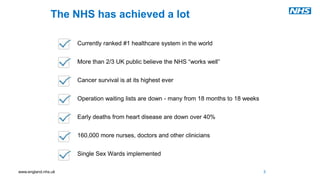
The NHS has achieved a lot
Currently ranked #1 healthcare system in the world
More than 2/3 UK public believe the NHS “works well”
Cancer survival is at its highest ever
Operation waiting lists are down - many from 18 months to 18 weeks
Early deaths from heart disease are down over 40%
160,000 more nurses, doctors and other clinicians
Single Sex Wards implemented
3
www.england.nhs.uk
We are delivering more care
4
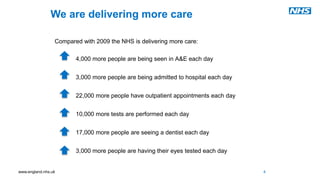
Compared with 2009 the NHS is delivering more care:
• 4,000 more people are being seen in A&E each day
• 3,000 more people are being admitted to hospital each day
• 22,000 more people have outpatient appointments each day
• 10,000 more tests are performed each day
• 17,000 more people are seeing a dentist each day
• 3,000 more people are having their eyes tested each day
www.england.nhs.uk
But demand for care is rapidly growing
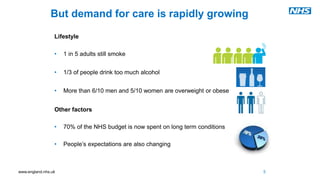
Lifestyle
• 1 in 5 adults still smoke
• 1/3 of people drink too much alcohol
• More than 6/10 men and 5/10 women are overweight or obese
Other factors
• 70% of the NHS budget is now spent on long term conditions
• People’s expectations are also changing
5
www.england.nhs.uk
There are also new opportunities
6
New technologies and treatments
• Improving our ability to predict, diagnose and treat disease
• Keeping people alive longer
• But resulting in more people living with long term conditions
New ways to deliver care
• Dissolving traditional boundaries in how care is delivered
• Improving the coordination of care around patients
• Improving outcomes and quality
…but the financial challenge remains, with the gap in 2020/21 previously
projected at £30bn
www.england.nhs.uk
The future NHS
7
The Forward View identifies three ‘gaps’ that must be addressed:
Radical
upgrade in
prevention
• Back national action on major health risks
• Targeted prevention initiatives e.g. diabetes
• Much greater patient control
• Harnessing the ‘renewable energy’ of communities
Health &
wellbeing
gap
1
New
models of
care
• Neither ‘one size fits all’, nor ‘thousand flowers’
• A menu of care models for local areas to consider
• Investment and flexibilities to support implementation
of new care models
Care &
quality gap
2
Efficiency &
investment
• Implementation of these care models and other
actions could deliver significant efficiency gains
• However, there remains an additional funding
requirement for the next government
• And the need for upfront, pump-priming investment
Funding
gap
3
www.england.nhs.uk
Getting serious about prevention
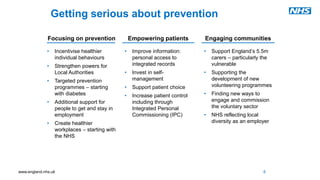
Focusing on prevention Empowering patients Engaging communities
• Incentivise healthier
individual behaviours
• Strengthen powers for
Local Authorities
• Targeted prevention
programmes – starting
with diabetes
• Additional support for
people to get and stay in
employment
• Create healthier
workplaces – starting with
the NHS
• Improve information:
personal access to
integrated records
• Invest in self-
management
• Support patient choice
• Increase patient control
including through
Integrated Personal
Commissioning (IPC)
• Support England’s 5.5m
carers – particularly the
vulnerable
• Supporting the
development of new
volunteering programmes
• Finding new ways to
engage and commission
the voluntary sector
• NHS reflecting local
diversity as an employer
8
www.england.nhs.uk
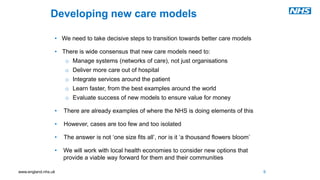
Developing new care models
• We need to take decisive steps to transition towards better care models
• There is wide consensus that new care models need to:
o Manage systems (networks of care), not just organisations
o Deliver more care out of hospital
o Integrate services around the patient
o Learn faster, from the best examples around the world
o Evaluate success of new models to ensure value for money
• There are already examples of where the NHS is doing elements of this
• However, cases are too few and too isolated
• The answer is not ‘one size fits all’, nor is it ‘a thousand flowers bloom’
• We will work with local health economies to consider new options that
provide a viable way forward for them and their communities
9
www.england.nhs.uk
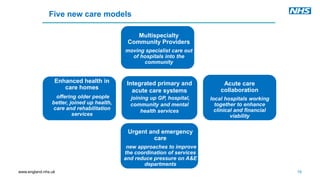
Multispecialty
Community Providers
moving specialist care out
of hospitals into the
community
Integrated primary and
acute care systems
joining up GP, hospital,
community and mental
health services
Acute care
collaboration
local hospitals working
together to enhance
clinical and financial
viability
Enhanced health in
care homes
offering older people
better, joined up health,
care and rehabilitation
services
Urgent and emergency
care
new approaches to improve
the coordination of services
and reduce pressure on A&E
departments
Five new care models
10
www.england.nhs.uk
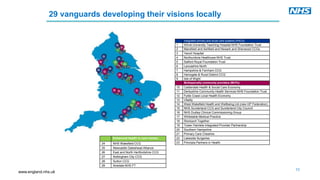
Integrated primary and acute care systems (PACS)
1 Wirral University Teaching Hospital NHS Foundation Trust
2 Mansfield and Ashfield and Newark and Sherwood CCGs
3 Yeovil Hospital
4 Northumbria Healthcare NHS Trust
5 Salford Royal Foundation Trust
6 Lancashire North
7 Hampshire & Farnham CCG
8 Harrogate & Rural District CCG
9 Isle of Wight
Multispecialty community providers (MCPs)
10 Calderdale Health & Social Care Economy
11 Derbyshire Community Health Services NHS Foundation Trust
12 Fylde Coast Local Health Economy
13 Vitality
14 West Wakefield Health and Wellbeing Ltd (new GP Federation)
15 NHS Sunderland CCG and Sunderland City Council
16 NHS Dudley Clinical Commissioning Group
17 Whitstable Medical Practice
18 Stockport Together
19 Tower Hamlets Integrated Provider Partnership
20 Southern Hampshire
21 Primary Care Cheshire
22 Lakeside Surgeries
23 Principia Partners in Health
Enhanced health in care homes
24 NHS Wakefield CCG
25 Newcastle Gateshead Alliance
26 East and North Hertfordshire CCG
27 Nottingham City CCG
28 Sutton CCG
29 Airedale NHS FT
29 vanguards developing their visions locally
11
www.england.nhs.uk
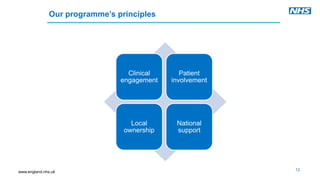
Clinical
engagement
Patient
involvement
Local
ownership
National
support
Our programme’s principles
12
www.england.nhs.uk
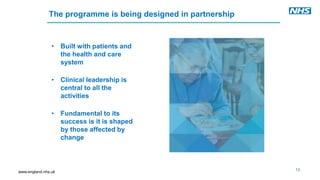
• Built with patients and
the health and care
system
• Clinical leadership is
central to all the
activities
• Fundamental to its
success is it is shaped
by those affected by
change
The programme is being designed in partnership
13
www.england.nhs.uk
New Care Models for the NHS
14
A range of new care models that are locally delivered across the country and
can be replicated across the system
• Greater focus on care out-of-hospital care and
prevention
• NHS trusts, GPs, Local Authorities, the
voluntary sector and other providers will all
work together for the benefit of their population
• A long term focus
• A focus on supporting vanguard sites to
embody nationally replicable models of care
How this is
different
1
• The programme will bring investment, both
locally and in national support
• Dedicated national expertise to work with local
systems to unblock barriers
• The programme will aim to play “matchmaker”
in bringing together parts of the system
How will it
address gaps
2
www.england.nhs.uk
What does success look like?
15
A range of new care models that are locally delivered across the country and
can be replicated across the system
• A need to manage systems of care not just
organisations
• Integrated services around the patient giving
the patient greater control in their care
New care models1
• A focus on meeting local population health
needs
• Support from a diverse range of active delivery
partners, local commissioners and communities
• Active patient involvement
Locally delivered2
• Fast learning from best practice examples that
can be applied to other areas across the
country
• Applying innovations and learnings across the
system
National
replicability
3
• Now inviting expressions of
interest from hospitals to
develop new ways of delivering
and improving their local acute
services
• Builds on the proposals in
Sir David Dalton’s recent report
• Aim is to enhance the viability of
hospitals through new working
arrangements
• Open to all acute hospitals
• Closing date: 31 July 2015
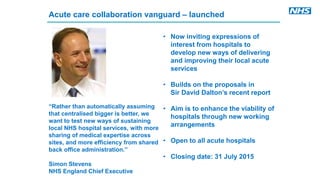
Acute care collaboration vanguard – launched
“Rather than automatically assuming
that centralised bigger is better, we
want to test new ways of sustaining
local NHS hospital services, with more
sharing of medical expertise across
sites, and more efficiency from shared
back office administration.”
Simon Stevens
NHS England Chief Executive
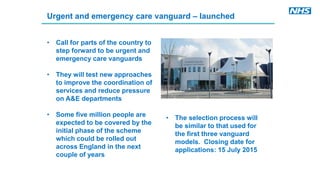
Urgent and emergency care vanguard – launched
• Call for parts of the country to
step forward to be urgent and
emergency care vanguards
• They will test new approaches
to improve the coordination of
services and reduce pressure
on A&E departments
• Some five million people are
expected to be covered by the
initial phase of the scheme
which could be rolled out
across England in the next
couple of years
• The selection process will
be similar to that used for
the first three vanguard
models. Closing date for
applications: 15 July 2015
www.england.nhs.uk
18
Further information…
More information can be
found on the NHS England
website:
www.england.nhs.uk/ourwor
k/futurenhs/5yfv-ch3/new-
care-models/
You can also follow and
join in the conversation
using #futureNHS

The NHS 5 Year Plan -Neil Goulbourne presentation

  • 1.
    www.england.nhs.uk Five Year Forward View DrNeil Goulbourne Deputy Director, Strategy Group, NHSE
  • 2.
    NHS Five YearForward View – time to deliver • The NHS Five Year Forward View (5YFV) was published on 23 October 2014 • Integral was the launch of the new care models programme • The challenge now is implementing the models and maintaining momentum 2
  • 3.
    www.england.nhs.uk The NHS hasachieved a lot Currently ranked #1 healthcare system in the world More than 2/3 UK public believe the NHS “works well” Cancer survival is at its highest ever Operation waiting lists are down - many from 18 months to 18 weeks Early deaths from heart disease are down over 40% 160,000 more nurses, doctors and other clinicians Single Sex Wards implemented 3
  • 4.
    www.england.nhs.uk We are deliveringmore care 4 Compared with 2009 the NHS is delivering more care: • 4,000 more people are being seen in A&E each day • 3,000 more people are being admitted to hospital each day • 22,000 more people have outpatient appointments each day • 10,000 more tests are performed each day • 17,000 more people are seeing a dentist each day • 3,000 more people are having their eyes tested each day
  • 5.
    www.england.nhs.uk But demand forcare is rapidly growing Lifestyle • 1 in 5 adults still smoke • 1/3 of people drink too much alcohol • More than 6/10 men and 5/10 women are overweight or obese Other factors • 70% of the NHS budget is now spent on long term conditions • People’s expectations are also changing 5
  • 6.
    www.england.nhs.uk There are alsonew opportunities 6 New technologies and treatments • Improving our ability to predict, diagnose and treat disease • Keeping people alive longer • But resulting in more people living with long term conditions New ways to deliver care • Dissolving traditional boundaries in how care is delivered • Improving the coordination of care around patients • Improving outcomes and quality …but the financial challenge remains, with the gap in 2020/21 previously projected at £30bn
  • 7.
    www.england.nhs.uk The future NHS 7 TheForward View identifies three ‘gaps’ that must be addressed: Radical upgrade in prevention • Back national action on major health risks • Targeted prevention initiatives e.g. diabetes • Much greater patient control • Harnessing the ‘renewable energy’ of communities Health & wellbeing gap 1 New models of care • Neither ‘one size fits all’, nor ‘thousand flowers’ • A menu of care models for local areas to consider • Investment and flexibilities to support implementation of new care models Care & quality gap 2 Efficiency & investment • Implementation of these care models and other actions could deliver significant efficiency gains • However, there remains an additional funding requirement for the next government • And the need for upfront, pump-priming investment Funding gap 3
  • 8.
    www.england.nhs.uk Getting serious aboutprevention Focusing on prevention Empowering patients Engaging communities • Incentivise healthier individual behaviours • Strengthen powers for Local Authorities • Targeted prevention programmes – starting with diabetes • Additional support for people to get and stay in employment • Create healthier workplaces – starting with the NHS • Improve information: personal access to integrated records • Invest in self- management • Support patient choice • Increase patient control including through Integrated Personal Commissioning (IPC) • Support England’s 5.5m carers – particularly the vulnerable • Supporting the development of new volunteering programmes • Finding new ways to engage and commission the voluntary sector • NHS reflecting local diversity as an employer 8
  • 9.
    www.england.nhs.uk Developing new caremodels • We need to take decisive steps to transition towards better care models • There is wide consensus that new care models need to: o Manage systems (networks of care), not just organisations o Deliver more care out of hospital o Integrate services around the patient o Learn faster, from the best examples around the world o Evaluate success of new models to ensure value for money • There are already examples of where the NHS is doing elements of this • However, cases are too few and too isolated • The answer is not ‘one size fits all’, nor is it ‘a thousand flowers bloom’ • We will work with local health economies to consider new options that provide a viable way forward for them and their communities 9
  • 10.
    www.england.nhs.uk Multispecialty Community Providers moving specialistcare out of hospitals into the community Integrated primary and acute care systems joining up GP, hospital, community and mental health services Acute care collaboration local hospitals working together to enhance clinical and financial viability Enhanced health in care homes offering older people better, joined up health, care and rehabilitation services Urgent and emergency care new approaches to improve the coordination of services and reduce pressure on A&E departments Five new care models 10
  • 11.
    www.england.nhs.uk Integrated primary andacute care systems (PACS) 1 Wirral University Teaching Hospital NHS Foundation Trust 2 Mansfield and Ashfield and Newark and Sherwood CCGs 3 Yeovil Hospital 4 Northumbria Healthcare NHS Trust 5 Salford Royal Foundation Trust 6 Lancashire North 7 Hampshire & Farnham CCG 8 Harrogate & Rural District CCG 9 Isle of Wight Multispecialty community providers (MCPs) 10 Calderdale Health & Social Care Economy 11 Derbyshire Community Health Services NHS Foundation Trust 12 Fylde Coast Local Health Economy 13 Vitality 14 West Wakefield Health and Wellbeing Ltd (new GP Federation) 15 NHS Sunderland CCG and Sunderland City Council 16 NHS Dudley Clinical Commissioning Group 17 Whitstable Medical Practice 18 Stockport Together 19 Tower Hamlets Integrated Provider Partnership 20 Southern Hampshire 21 Primary Care Cheshire 22 Lakeside Surgeries 23 Principia Partners in Health Enhanced health in care homes 24 NHS Wakefield CCG 25 Newcastle Gateshead Alliance 26 East and North Hertfordshire CCG 27 Nottingham City CCG 28 Sutton CCG 29 Airedale NHS FT 29 vanguards developing their visions locally 11
  • 12.
  • 13.
    www.england.nhs.uk • Built withpatients and the health and care system • Clinical leadership is central to all the activities • Fundamental to its success is it is shaped by those affected by change The programme is being designed in partnership 13
  • 14.
    www.england.nhs.uk New Care Modelsfor the NHS 14 A range of new care models that are locally delivered across the country and can be replicated across the system • Greater focus on care out-of-hospital care and prevention • NHS trusts, GPs, Local Authorities, the voluntary sector and other providers will all work together for the benefit of their population • A long term focus • A focus on supporting vanguard sites to embody nationally replicable models of care How this is different 1 • The programme will bring investment, both locally and in national support • Dedicated national expertise to work with local systems to unblock barriers • The programme will aim to play “matchmaker” in bringing together parts of the system How will it address gaps 2
  • 15.
    www.england.nhs.uk What does successlook like? 15 A range of new care models that are locally delivered across the country and can be replicated across the system • A need to manage systems of care not just organisations • Integrated services around the patient giving the patient greater control in their care New care models1 • A focus on meeting local population health needs • Support from a diverse range of active delivery partners, local commissioners and communities • Active patient involvement Locally delivered2 • Fast learning from best practice examples that can be applied to other areas across the country • Applying innovations and learnings across the system National replicability 3
  • 16.
    • Now invitingexpressions of interest from hospitals to develop new ways of delivering and improving their local acute services • Builds on the proposals in Sir David Dalton’s recent report • Aim is to enhance the viability of hospitals through new working arrangements • Open to all acute hospitals • Closing date: 31 July 2015 Acute care collaboration vanguard – launched “Rather than automatically assuming that centralised bigger is better, we want to test new ways of sustaining local NHS hospital services, with more sharing of medical expertise across sites, and more efficiency from shared back office administration.” Simon Stevens NHS England Chief Executive
  • 17.
    Urgent and emergencycare vanguard – launched • Call for parts of the country to step forward to be urgent and emergency care vanguards • They will test new approaches to improve the coordination of services and reduce pressure on A&E departments • Some five million people are expected to be covered by the initial phase of the scheme which could be rolled out across England in the next couple of years • The selection process will be similar to that used for the first three vanguard models. Closing date for applications: 15 July 2015
  • 18.
    www.england.nhs.uk 18 Further information… More informationcan be found on the NHS England website: www.england.nhs.uk/ourwor k/futurenhs/5yfv-ch3/new- care-models/ You can also follow and join in the conversation using #futureNHS