Jim Spohrer (IBM)
NHH Center for Service Innovation, Bergen, Norway
Monday June 27, 2016
http://www.slideshare.net/spohrer/nhh-csi-20160627-v2
6/27/2016 1
NHH CSI Advisory Board Meeting
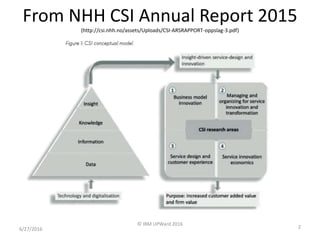
From NHH CSI Annual Report 2015
(http://csi.nhh.no/assets/Uploads/CSI-ARSRAPPORT-oppslag-3.pdf)
6/27/2016
© IBM UPWard 2016
2
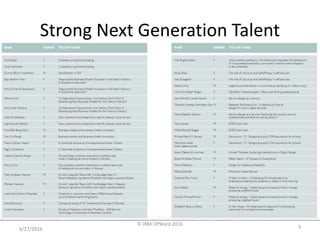
Strong Next Generation Talent
6/27/2016
© IBM UPWard 2016
3
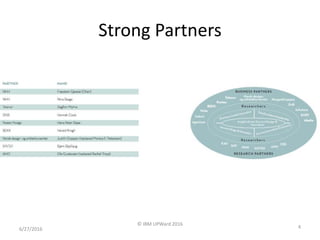
Strong Partners
6/27/2016
© IBM UPWard 2016
4
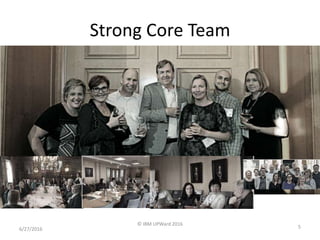
Strong Core Team
6/27/2016
© IBM UPWard 2016
5
6/27/2016
© IBM UPWard 2016
6
6/27/2016
© IBM UPWard 2016
7
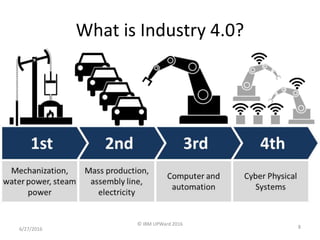
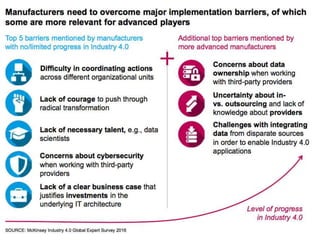
What is Industry 4.0?
6/27/2016
© IBM UPWard 2016
8
6/27/2016
© IBM UPWard 2016
9
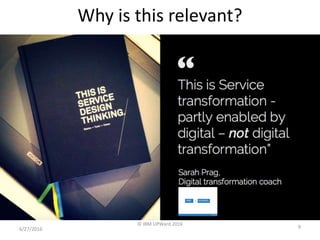
Why is this relevant?
6/27/2016
© IBM UPWard 2016
10
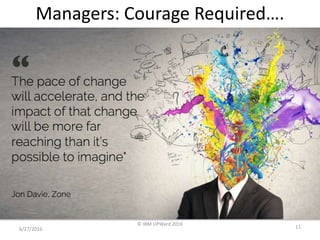
Managers: Courage Required….
6/27/2016
© IBM UPWard 2016
11
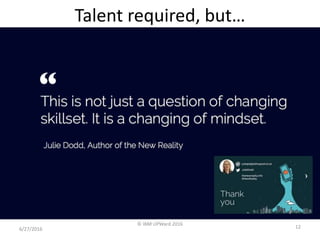
Talent required, but…
6/27/2016
© IBM UPWard 2016
12
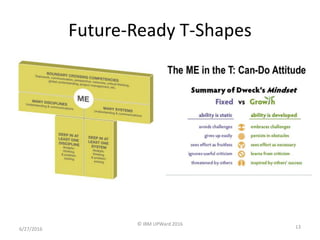
Future-Ready T-Shapes
6/27/2016
© IBM UPWard 2016
13
6/27/2016
© IBM UPWard 2016
14
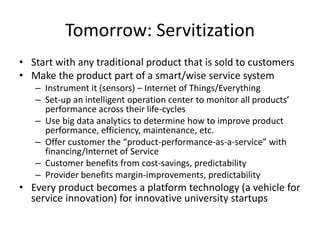
Tomorrow: Servitization
• Start with any traditional product that is sold to customers
• Make the product part of a smart/wise service system
– Instrument it (sensors) – Internet of Things/Everything
– Set-up an intelligent operation center to monitor all products’
performance across their life-cycles
– Use big data analytics to determine how to improve product
performance, efficiency, maintenance, etc.
– Offer customer the “product-performance-as-a-service” with
financing/Internet of Service
– Customer benefits from cost-savings, predictability
– Provider benefits margin-improvements, predictability
• Every product becomes a platform technology (a vehicle for
service innovation) for innovative university startups
6/27/2016 16
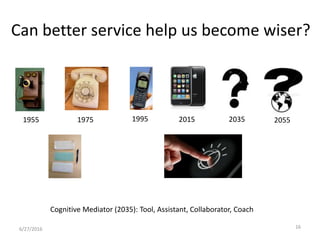
1955 1975 1995 2015 2035 2055
Can better service help us become wiser?
Cognitive Mediator (2035): Tool, Assistant, Collaborator, Coach
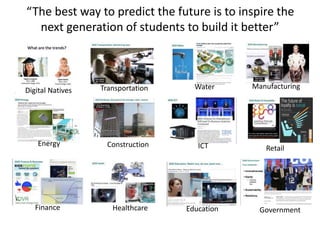
“The best way to predict the future is to inspire the
next generation of students to build it better”
Digital Natives Transportation Water Manufacturing
Energy Construction ICT Retail
Finance Healthcare Education Government
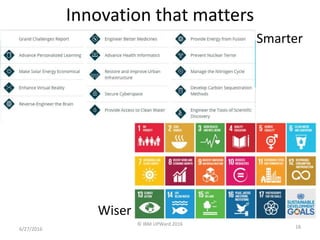
Innovation that matters
6/27/2016
© IBM UPWard 2016
18
Smarter
Wiser
6/27/2016
© IBM 2015, IBM Upward University
Programs Worldwide accelerating regional
development
19
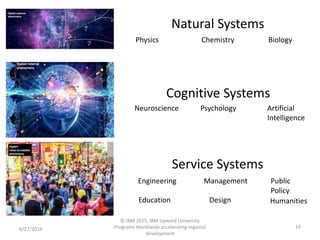
Physics Chemistry Biology
Neuroscience Psychology Artificial
Intelligence
Engineering Management Public
Policy
Education Design Humanities
Natural Systems
Cognitive Systems
Service Systems
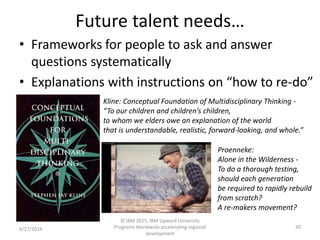
Future talent needs…
• Frameworks for people to ask and answer
questions systematically
• Explanations with instructions on “how to re-do”
6/27/2016
© IBM 2015, IBM Upward University
Programs Worldwide accelerating regional
development
20
Kline: Conceptual Foundation of Multidisciplinary Thinking -
“To our children and children’s children,
to whom we elders owe an explanation of the world
that is understandable, realistic, forward-looking, and whole.”
Proenneke:
Alone in the Wilderness -
To do a thorough testing,
should each generation
be required to rapidly rebuild
from scratch?
A re-makers movement?
Assisting individuals and organizations
to close their service innovation skills gap
and co-create wiser service systems
empowering employees, customers, citizens
with cognitive mediators
in the collaborative service economy
6/27/2016
© IBM 2015, IBM Upward University
Programs Worldwide accelerating regional
development
22
6/27/2016
© IBM 2015, IBM Upward University
Programs Worldwide accelerating regional
development
23
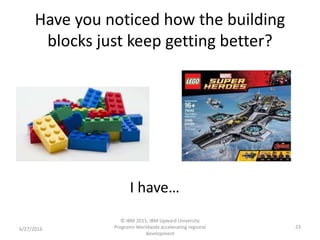
I have…
Have you noticed how the building
blocks just keep getting better?
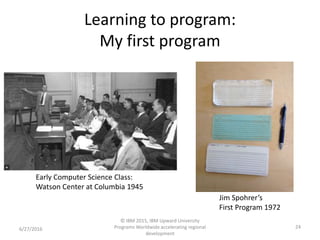
Learning to program:
My first program
6/27/2016
© IBM 2015, IBM Upward University
Programs Worldwide accelerating regional
development
24
Early Computer Science Class:
Watson Center at Columbia 1945
Jim Spohrer’s
First Program 1972
6/27/2016
© IBM UPWard 2016
25
Fast Forward 2016:
Consider this…
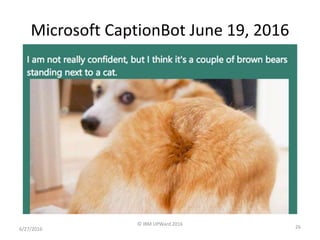
Microsoft CaptionBot June 19, 2016
6/27/2016
© IBM UPWard 2016
26
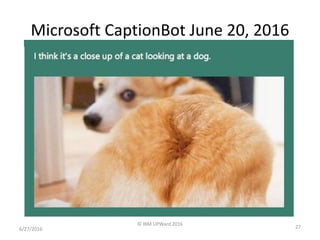
Microsoft CaptionBot June 20, 2016
6/27/2016
© IBM UPWard 2016
27
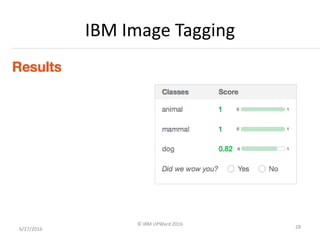
IBM Image Tagging
6/27/2016
© IBM UPWard 2016
28
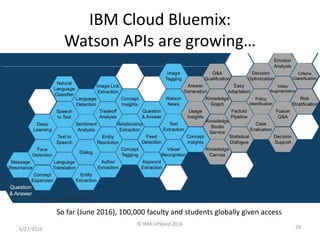
IBM Cloud Bluemix:
Watson APIs are growing…
6/27/2016
© IBM UPWard 2016
29
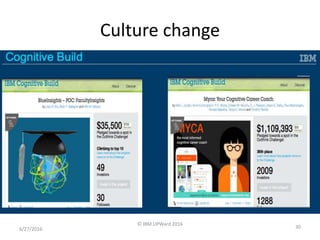
So far (June 2016), 100,000 faculty and students globally given access
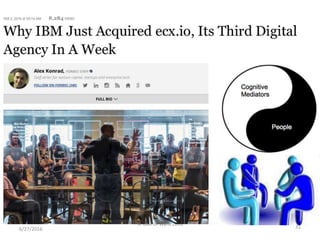
Culture change
6/27/2016
© IBM UPWard 2016
30
6/27/2016
© IBM UPWard 2016
31
6/27/2016
© IBM UPWard 2016
32
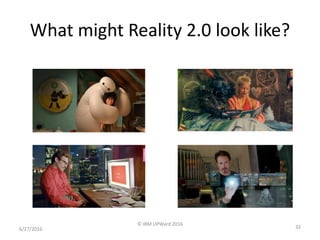
What might Reality 2.0 look like?
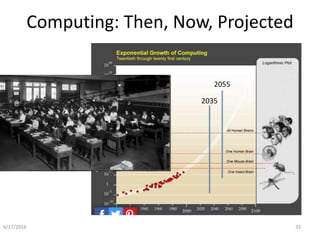
Computing: Then, Now, Projected
6/27/2016 33
2035
2055
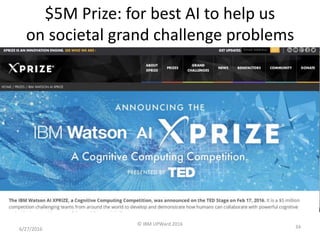
$5M Prize: for best AI to help us
on societal grand challenge problems
6/27/2016
© IBM UPWard 2016
34
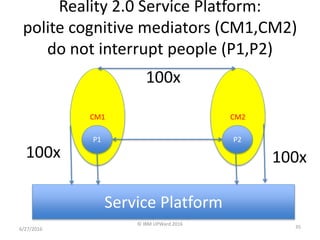
Reality 2.0 Service Platform:
polite cognitive mediators (CM1,CM2)
do not interrupt people (P1,P2)
6/27/2016
© IBM UPWard 2016
35
Service Platform
CM2
P2
CM1
P1
100x
100x 100x
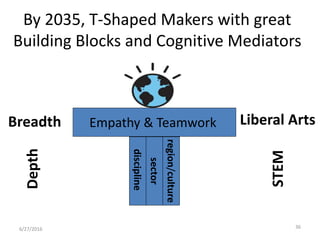
By 2035, T-Shaped Makers with great
Building Blocks and Cognitive Mediators
6/27/2016 36
Empathy & Teamwork
sector
region/culture
discipline
Depth
Breadth
STEM
Liberal Arts
6/27/2016
© IBM 2015, IBM Upward University
Programs Worldwide accelerating regional
development
37
Future of Skills
In Summary
6/27/2016
© IBM 2015, IBM Upward University
Programs Worldwide accelerating regional
development
38
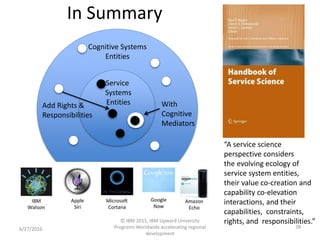
“A service science
perspective considers
the evolving ecology of
service system entities,
their value co-creation and
capability co-elevation
interactions, and their
capabilities, constraints,
rights, and responsibilities.”
Cognitive Systems
Entities
Service
Systems
Entities With
Cognitive
Mediators
Add Rights &
Responsibilities
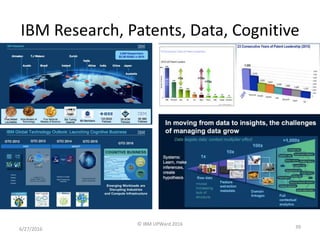
IBM Research, Patents, Data, Cognitive
6/27/2016
© IBM UPWard 2016
39

Nhh csi 20160627 v2

  • 1.
    Jim Spohrer (IBM) NHHCenter for Service Innovation, Bergen, Norway Monday June 27, 2016 http://www.slideshare.net/spohrer/nhh-csi-20160627-v2 6/27/2016 1 NHH CSI Advisory Board Meeting
  • 2.
    From NHH CSIAnnual Report 2015 (http://csi.nhh.no/assets/Uploads/CSI-ARSRAPPORT-oppslag-3.pdf) 6/27/2016 © IBM UPWard 2016 2
  • 3.
    Strong Next GenerationTalent 6/27/2016 © IBM UPWard 2016 3
  • 4.
  • 5.
  • 6.
  • 7.
  • 8.
    What is Industry4.0? 6/27/2016 © IBM UPWard 2016 8
  • 9.
    6/27/2016 © IBM UPWard2016 9 Why is this relevant?
  • 10.
  • 11.
  • 12.
  • 13.
  • 14.
  • 15.
    Tomorrow: Servitization • Startwith any traditional product that is sold to customers • Make the product part of a smart/wise service system – Instrument it (sensors) – Internet of Things/Everything – Set-up an intelligent operation center to monitor all products’ performance across their life-cycles – Use big data analytics to determine how to improve product performance, efficiency, maintenance, etc. – Offer customer the “product-performance-as-a-service” with financing/Internet of Service – Customer benefits from cost-savings, predictability – Provider benefits margin-improvements, predictability • Every product becomes a platform technology (a vehicle for service innovation) for innovative university startups
  • 16.
    6/27/2016 16 1955 19751995 2015 2035 2055 Can better service help us become wiser? Cognitive Mediator (2035): Tool, Assistant, Collaborator, Coach
  • 17.
    “The best wayto predict the future is to inspire the next generation of students to build it better” Digital Natives Transportation Water Manufacturing Energy Construction ICT Retail Finance Healthcare Education Government
  • 18.
    Innovation that matters 6/27/2016 ©IBM UPWard 2016 18 Smarter Wiser
  • 19.
    6/27/2016 © IBM 2015,IBM Upward University Programs Worldwide accelerating regional development 19 Physics Chemistry Biology Neuroscience Psychology Artificial Intelligence Engineering Management Public Policy Education Design Humanities Natural Systems Cognitive Systems Service Systems
  • 20.
    Future talent needs… •Frameworks for people to ask and answer questions systematically • Explanations with instructions on “how to re-do” 6/27/2016 © IBM 2015, IBM Upward University Programs Worldwide accelerating regional development 20 Kline: Conceptual Foundation of Multidisciplinary Thinking - “To our children and children’s children, to whom we elders owe an explanation of the world that is understandable, realistic, forward-looking, and whole.” Proenneke: Alone in the Wilderness - To do a thorough testing, should each generation be required to rapidly rebuild from scratch? A re-makers movement?
  • 21.
    Assisting individuals andorganizations to close their service innovation skills gap and co-create wiser service systems empowering employees, customers, citizens with cognitive mediators in the collaborative service economy
  • 22.
    6/27/2016 © IBM 2015,IBM Upward University Programs Worldwide accelerating regional development 22
  • 23.
    6/27/2016 © IBM 2015,IBM Upward University Programs Worldwide accelerating regional development 23 I have… Have you noticed how the building blocks just keep getting better?
  • 24.
    Learning to program: Myfirst program 6/27/2016 © IBM 2015, IBM Upward University Programs Worldwide accelerating regional development 24 Early Computer Science Class: Watson Center at Columbia 1945 Jim Spohrer’s First Program 1972
  • 25.
    6/27/2016 © IBM UPWard2016 25 Fast Forward 2016: Consider this…
  • 26.
    Microsoft CaptionBot June19, 2016 6/27/2016 © IBM UPWard 2016 26
  • 27.
    Microsoft CaptionBot June20, 2016 6/27/2016 © IBM UPWard 2016 27
  • 28.
  • 29.
    IBM Cloud Bluemix: WatsonAPIs are growing… 6/27/2016 © IBM UPWard 2016 29 So far (June 2016), 100,000 faculty and students globally given access
  • 30.
  • 31.
  • 32.
    6/27/2016 © IBM UPWard2016 32 What might Reality 2.0 look like?
  • 33.
    Computing: Then, Now,Projected 6/27/2016 33 2035 2055
  • 34.
    $5M Prize: forbest AI to help us on societal grand challenge problems 6/27/2016 © IBM UPWard 2016 34
  • 35.
    Reality 2.0 ServicePlatform: polite cognitive mediators (CM1,CM2) do not interrupt people (P1,P2) 6/27/2016 © IBM UPWard 2016 35 Service Platform CM2 P2 CM1 P1 100x 100x 100x
  • 36.
    By 2035, T-ShapedMakers with great Building Blocks and Cognitive Mediators 6/27/2016 36 Empathy & Teamwork sector region/culture discipline Depth Breadth STEM Liberal Arts
  • 37.
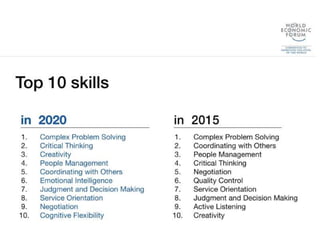
    6/27/2016 © IBM 2015,IBM Upward University Programs Worldwide accelerating regional development 37 Future of Skills
  • 38.
    In Summary 6/27/2016 © IBM2015, IBM Upward University Programs Worldwide accelerating regional development 38 “A service science perspective considers the evolving ecology of service system entities, their value co-creation and capability co-elevation interactions, and their capabilities, constraints, rights, and responsibilities.” Cognitive Systems Entities Service Systems Entities With Cognitive Mediators Add Rights & Responsibilities
  • 39.
    IBM Research, Patents,Data, Cognitive 6/27/2016 © IBM UPWard 2016 39

Editor's Notes

  • #2  For permission to reuse – contact spohrer@us.ibm.com Reference: Spohrer, J (2016) NHH CSI Advisory Board Meeting. Center for Service Innovation. Bergen, Norway. June 27-28, 2016. URL http://www.slideshare.net/spohrer/nhh-csi-20160627-v2
  • #9 4th is a cyber-physcial systems.
  • #12 We are talking about the Frontiers of Service here – and Roland has long predicted information and service converge in some hard to imagine way…
  • #13 The 50% of taxi cab drivers that are scared of driverless cars can only think about skillset. The 50% of tax cab drivers that are not scared of driveless cars are all over mindset…
  • #17 The weakest link is what needs to be improved – according to system scientists. Accessing help, service, experts is the weakest link in most systems. By 2035 the phone may have the power of one human brain – by 2055 the phone may have the power of all human brains. Before trying to answer the question about which types of sciences are more important – the ones that try to explain the external world or the ones that try to explain the internal world – consider this, slide that shows the different telephones that I have used in my life. I grew up in rural Maine, where we had a party line telephone because we were somewhat remote on our farm in Newburgh, Maine. However, over the years phones got much better…. So in 2035 or 2055, who are you going to call when you need help?
  • #18 By 2036, there will be an accumulation of knowledge as well as a distribution of knowledge in service systems globally. We need to ensure as there is knowledge accumulation that service systems at all scale become more resilient. Leading to the capability of rapid rebuilding of service systems across scales, by T-shaped people who understand how to rapidly rebuild – knowledge has been chunked, modularized, and put into networks that support rapid rebuilding.
  • #20 However, at the end of the day, even with more creative and productive people…. With the 2035 symbiosis of people and their cognitive assistants, we are left trying to explain external phenomena and internal phenomena, as well as to create possible future worlds… The natural sciences of course include physics, chemistry, and biology. The cogntive science are not as well understood, but people are increasing aware of neuroscience (brain science), psychology, and artificial intelligence – which inform cognitive science. Finally, the least understood and newest is service science. Service science is the study of the evolving ecology of service sytem entities with capabilities, contraints, rights, and responsibilities – but also importantly with imagination! The humanities and fiction are a great source of possible future worlds. We just have to design and edcuate the next generation to engineer, manage, and set in place public policy that allows us to realize possible future worlds that we would like to live in. Source: Regis Lemmes http://www.slideshare.net/SalesCubes/sales-cocreation-35336385
  • #21 These concerns about what could possibly go wrong with cognitive mediators are real, so how can science help provide answers to help us make good choices in creating our future? Image sources: http://ecx.images-amazon.com/images/I/51oBLyAHXzL._SX327_BO1,204,203,200_.jpg Alone in the Wilderness (1968) – Dick Proenneke - https://www.youtube.com/watch?v=iYJKd0rkKss
  • #24 Today’s talk will explore two questions What should we know how to make? What might programming education become? If we look at history we see a time when people could make only simple things, and often a single person could make them. Would it ever be possible for a single person to know and make complex things? And what role might programming education play? Will the cognitive era – the coming era of smart machines – make people more capable or less capable to know and make complex things?
  • #25 In the 1940’s IBM started teaching computer science at Columbia. My first program – punch cards 1972.
  • #34 If Moore’s Law continues, by 2035 and by 2055, we are projected to have unimaginably large amounts of cheap computing…. 2035 one human brain level, and by 2055 all human brains level(10 billion people). Based on Kurweil’s graph of how much compute power $1000 will buy, it seems that by 2030, for $1000 you should be able to buy the compute power of one person’s brain, and that by 2060 for $1000 you should be able to buy the computer power of 10***10, or 10B people, the compute power of the world’s population for $1000. Source: http://waitbutwhy.com/2015/01/artificial-intelligence-revolution-1.html Was Moore’s Law inevitable? http://kk.org/thetechnium/was-moores-law/
  • #36 CM1 to CM2 “Once they stop talking about the weather, do you think we should let them know together they could potentially cure cancer?”
  • #37 Source: http://tsummit.org