Cognitive Systems Institute Group (CSIG)
Join Weekly Calls: http://cognitive-science.info/community/weekly-update/
Join Weekly Discussion: https://www.linkedin.com/grp/home?gid=6729452
Jim Spohrer, IBM
Director, Global University Programs (GUP) and Cognitive Systems Institute Group (CSIG)
CSIG Overview, Thursday July 23, 2015
http://www.slideshare.net/spohrer/csig-20150723-v2
7/23/2015
© IBM 2015, IBM UPward - University
Programs Worldwide accelerating regional
development
1
7/23/2015
© IBM 2015, IBM Upward University
Programs Worldwide accelerating regional
development
2
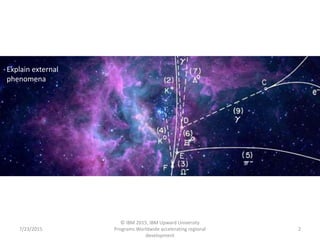
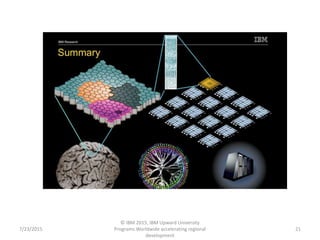
Explain external
phenomena
7/23/2015
© IBM 2015, IBM Upward University
Programs Worldwide accelerating regional
development
3
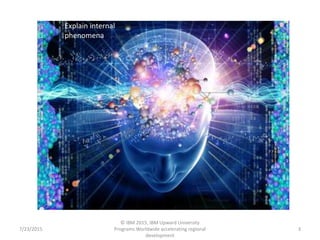
Explain internal
phenomena
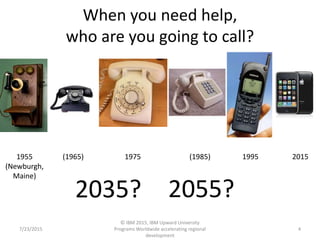
When you need help,
who are you going to call?
7/23/2015
© IBM 2015, IBM Upward University
Programs Worldwide accelerating regional
development
4
1955
(Newburgh,
Maine)
(1965) 1975 (1985) 1995 2015
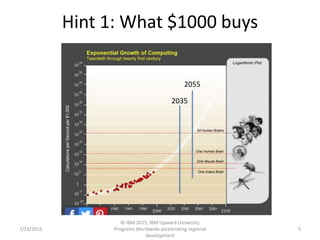
2035? 2055?
Hint 1: What $1000 buys
7/23/2015
© IBM 2015, IBM Upward University
Programs Worldwide accelerating regional
development
5
2035
2055
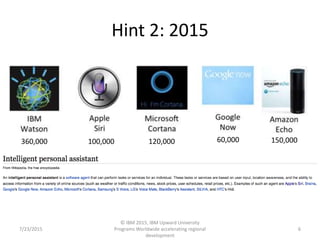
Hint 2: 2015
7/23/2015
© IBM 2015, IBM Upward University
Programs Worldwide accelerating regional
development
6
360,000 100,000 120,000 60,000 150,000
7/23/2015
© IBM 2015, IBM Upward University
Programs Worldwide accelerating regional
development
7
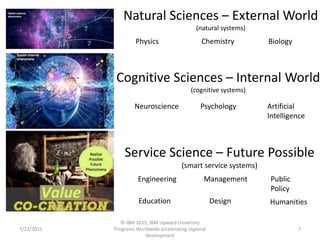
Physics Chemistry Biology
Neuroscience Psychology Artificial
Intelligence
Engineering Management Public
Policy
Education Design Humanities
Natural Sciences – External World
(natural systems)
Cognitive Sciences – Internal World
(cognitive systems)
Service Science – Future Possible
(smart service systems)
Helping individuals and organizations
close their service innovation skills gap
to create smarter service systems
that empower customers and citizens
in the collaborative service economy
7/23/2015
© IBM 2015, IBM Upward University
Programs Worldwide accelerating regional
development
9
Goals for Talk
• Learn about IBM, IBM Research
– “On a mission to build a smarter planet.”
– “Platforms for making and scaling
innovations.”
• Learn about Universities
– “Best way to predict the future is to
inspire the next generation of students to
build it better.”
– “The future is already here at
universities, it is just not yet well
distributed.”
7/23/2015
© IBM 2015, IBM Upward University
Programs Worldwide accelerating regional
development
10
7/23/2015
© IBM 2015, IBM Upward University
Programs Worldwide accelerating regional
development
11
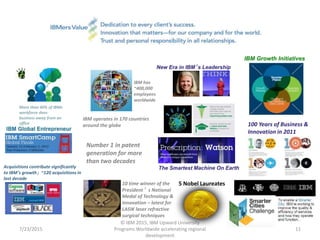
IBM operates in 170 countries
around the globe
Acquisitions contribute significantly
to IBM’s growth ; ~120 acquisitions in
last decade
Number 1 in patent
generation for more
than two decades
More than 40% of IBMs
workforce does
business away from an
office
5 Nobel Laureates10 time winner of the
President’s National
Medal of Technology &
Innovation – latest for
LASIK laser refractive
surgical techniques
The Smartest Machine On Earth
100 Years of Business &
Innovation in 2011
New Era in IBM’s Leadership
IBM Growth Initiatives
IBM has
~400,000
employees
worldwide
7/23/2015
© IBM 2015, IBM Upward University
Programs Worldwide accelerating regional
development
12
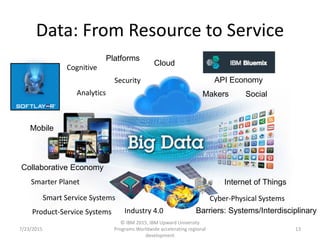
Data: From Resource to Service
7/23/2015
© IBM 2015, IBM Upward University
Programs Worldwide accelerating regional
development
13
Cloud
Social
Internet of Things
Makers
Cognitive
Security
Analytics
Cyber-Physical Systems
Smarter Planet
Smart Service Systems
Industry 4.0
Mobile
Collaborative Economy
Product-Service Systems
API Economy
Platforms
Barriers: Systems/Interdisciplinary
IBM
• 1. Big
• 2. Historic
• 3. Inventive
• 4. Acquisitive
• 5. Brand
7/23/2015
© IBM 2015, IBM Upward University
Programs Worldwide accelerating regional
development
14
• 6. IBMers
• 7. Ups & Downs
• 8. Open
• 9. Mysterious
• 10. Future
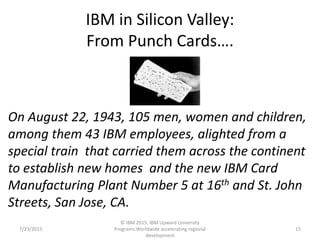
IBM in Silicon Valley:
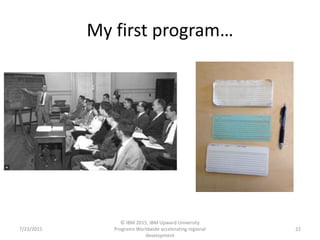
From Punch Cards….
7/23/2015
© IBM 2015, IBM Upward University
Programs Worldwide accelerating regional
development
15
On August 22, 1943, 105 men, women and children,
among them 43 IBM employees, alighted from a
special train that carried them across the continent
to establish new homes and the new IBM Card
Manufacturing Plant Number 5 at 16th and St. John
Streets, San Jose, CA.
7/23/2015
© IBM 2015, IBM Upward University
Programs Worldwide accelerating regional
development
16
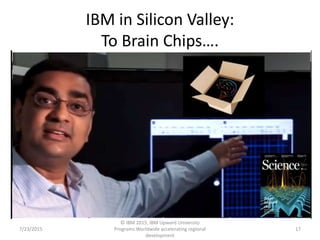
IBM in Silicon Valley:
To Brain Chips….
7/23/2015
© IBM 2015, IBM Upward University
Programs Worldwide accelerating regional
development
17
7/23/2015
© IBM 2015, IBM Upward University
Programs Worldwide accelerating regional
development
18
7/23/2015
© IBM 2015, IBM Upward University
Programs Worldwide accelerating regional
development
19
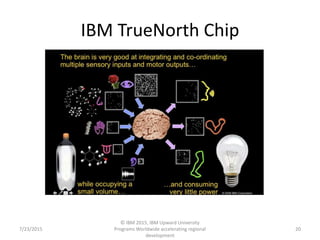
IBM TrueNorth Chip
7/23/2015
© IBM 2015, IBM Upward University
Programs Worldwide accelerating regional
development
20
7/23/2015
© IBM 2015, IBM Upward University
Programs Worldwide accelerating regional
development
21
My first program…
7/23/2015
© IBM 2015, IBM Upward University
Programs Worldwide accelerating regional
development
22
7/23/2015
© IBM 2015, IBM Upward University
Programs Worldwide accelerating regional
development
23
7/23/2015
© IBM 2015, IBM Upward University
Programs Worldwide accelerating regional
development
24
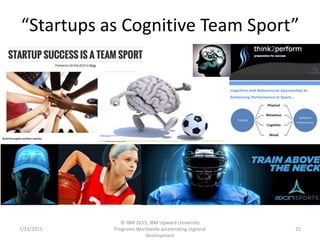
“Startups as Cognitive Team Sport”
7/23/2015
© IBM 2015, IBM Upward University
Programs Worldwide accelerating regional
development
25
7/23/2015
© IBM 2013 IBM University Programs
worldwide accelerating regional
development (IBM UPward)
26
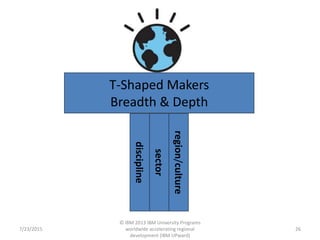
T-Shaped Makers
Breadth & Depth
sector
region/culture
discipline
7/23/2015
© IBM 2015, IBM Upward University
Programs Worldwide accelerating regional
development
27
7/23/2015
© IBM 2015, IBM Upward University
Programs Worldwide accelerating regional
development
28
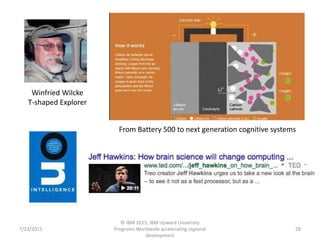
Winfried Wilcke
T-shaped Explorer
From Battery 500 to next generation cognitive systems
7/23/2015
© IBM 2015, IBM Upward University
Programs Worldwide accelerating regional
development
29
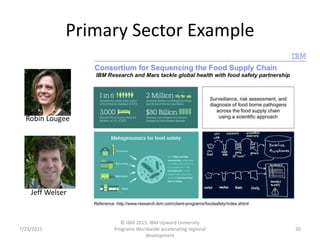
Primary Sector Example
7/23/2015
© IBM 2015, IBM Upward University
Programs Worldwide accelerating regional
development
30
Robin Lougee
Jeff Welser
7/23/2015
© IBM 2015, IBM Upward University
Programs Worldwide accelerating regional
development
31
7/23/2015
© IBM 2015, IBM Upward University
Programs Worldwide accelerating regional
development
32
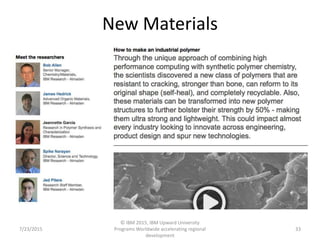
New Materials
7/23/2015
© IBM 2015, IBM Upward University
Programs Worldwide accelerating regional
development
33
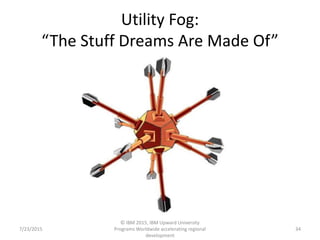
Utility Fog:
“The Stuff Dreams Are Made Of”
7/23/2015
© IBM 2015, IBM Upward University
Programs Worldwide accelerating regional
development
34
35
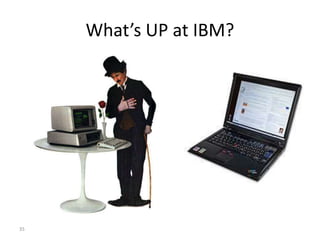
What’s UP at IBM?
36
Those in-the-know say, “IBM is helping to build a Smarter Planet…”
37
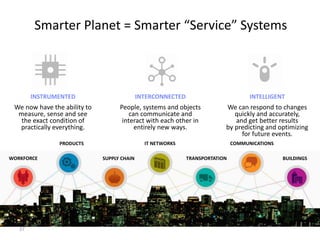
Smarter Planet = Smarter “Service” Systems
INSTRUMENTED
We now have the ability to
measure, sense and see
the exact condition of
practically everything.
INTERCONNECTED
People, systems and objects
can communicate and
interact with each other in
entirely new ways.
INTELLIGENT
We can respond to changes
quickly and accurately,
and get better results
by predicting and optimizing
for future events.
WORKFORCE
PRODUCTS
SUPPLY CHAIN
COMMUNICATIONS
TRANSPORTATION BUILDINGS
IT NETWORKS
38
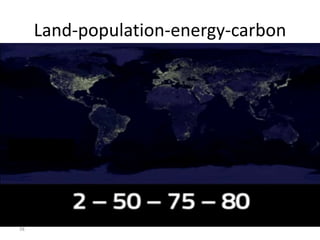
Land-population-energy-carbon
Carlo Ratti:
Senseable Cities
39
40
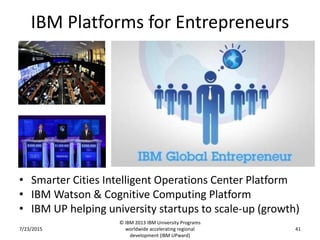
IBM Platforms for Entrepreneurs
• Smarter Cities Intelligent Operations Center Platform
• IBM Watson & Cognitive Computing Platform
• IBM UP helping university startups to scale-up (growth)
7/23/2015
© IBM 2013 IBM University Programs
worldwide accelerating regional
development (IBM UPward)
41
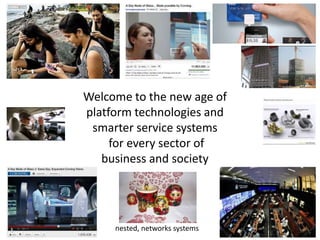
Welcome to the new age of
platform technologies and
smarter service systems
for every sector of
business and society
nested, networks systems
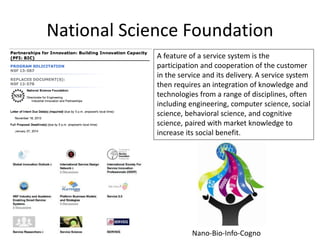
National Science Foundation
A feature of a service system is the
participation and cooperation of the customer
in the service and its delivery. A service system
then requires an integration of knowledge and
technologies from a range of disciplines, often
including engineering, computer science, social
science, behavioral science, and cognitive
science, paired with market knowledge to
increase its social benefit.
Nano-Bio-Info-Cogno
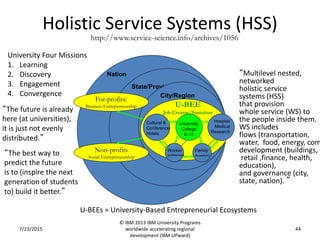
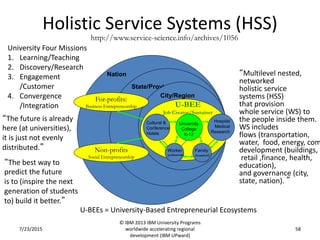
Holistic Service Systems (HSS)
7/23/2015
© IBM 2013 IBM University Programs
worldwide accelerating regional
development (IBM UPward)
44
http://www.service-science.info/archives/1056
Nation
State/Province
City/Region
University
College
K-12
Cultural &
Conference
Hotels
Hospital
Medical
Research
Worker
(professional)
Family
(household)
For-profits:
Business Entrepreneurship
Non-profits
Social Entrepreneurship
U-BEE
Job Creator/Sustainer
U-BEEs = University-Based Entrepreneurial Ecosystems
“The future is already
here (at universities),
it is just not evenly
distributed.”
“The best way to
predict the future
is to (inspire the next
generation of students
to) build it better.”
“Multilevel nested,
networked
holistic service
systems (HSS)
that provision
whole service (WS) to
the people inside them.
WS includes
flows (transportation,
water, food, energy, com
development (buildings,
retail ,finance, health,
education),
and governance (city,
state, nation). ”
University Four Missions
1. Learning
2. Discovery
3. Engagement
4. Convergence
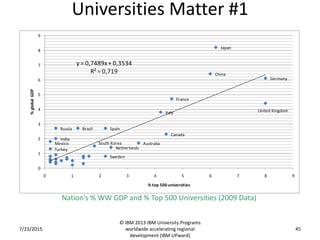
Universities Matter #1
7/23/2015
© IBM 2013 IBM University Programs
worldwide accelerating regional
development (IBM UPward)
45
Japan
China
Germany
France
United KingdomItaly
Russia SpainBrazil
Canada
India
Mexico AustraliaSouth Korea
NetherlandsTurkey
Sweden
y = 0,7489x+ 0,3534
R² = 0,719
0
1
2
3
4
5
6
7
8
9
0 1 2 3 4 5 6 7 8 9
%globalGDP
% top 500 universities
Nation’s % WW GDP and % Top 500 Universities (2009 Data)
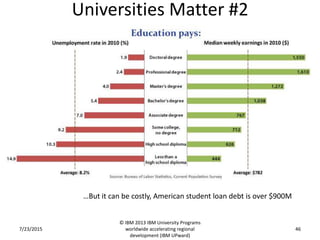
Universities Matter #2
7/23/2015
© IBM 2013 IBM University Programs
worldwide accelerating regional
development (IBM UPward)
46
…But it can be costly, American student loan debt is over $900M
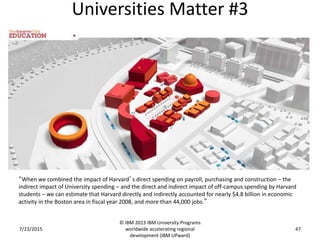
Universities Matter #3
7/23/2015
© IBM 2013 IBM University Programs
worldwide accelerating regional
development (IBM UPward)
47
“When we combined the impact of Harvard’s direct spending on payroll, purchasing and construction – the
indirect impact of University spending – and the direct and indirect impact of off-campus spending by Harvard
students – we can estimate that Harvard directly and indirectly accounted for nearly $4.8 billion in economic
activity in the Boston area in fiscal year 2008, and more than 44,000 jobs.”
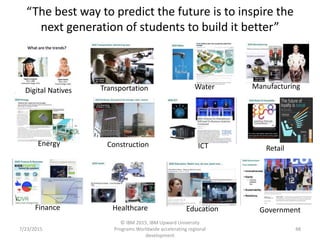
“The best way to predict the future is to inspire the
next generation of students to build it better”
7/23/2015
© IBM 2015, IBM Upward University
Programs Worldwide accelerating regional
development
48
Digital Natives Transportation Water Manufacturing
Energy Construction ICT Retail
Finance Healthcare Education Government
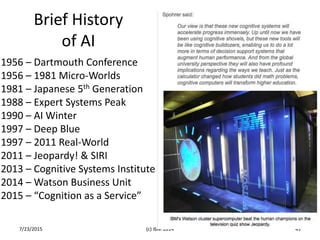
Brief History
of AI
1956 – Dartmouth Conference
1956 – 1981 Micro-Worlds
1981 – Japanese 5th Generation
1988 – Expert Systems Peak
1990 – AI Winter
1997 – Deep Blue
1997 – 2011 Real-World
2011 – Jeopardy! & SIRI
2013 – Cognitive Systems Institute
2014 – Watson Business Unit
2015 – “Cognition as a Service”
7/23/2015 (c) IBM 2014 49
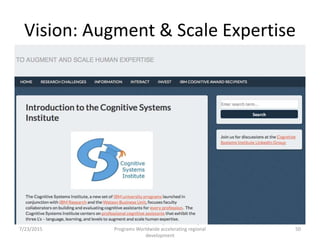
Vision: Augment & Scale Expertise
7/23/2015
© IBM 2015, IBM Upward University
Programs Worldwide accelerating regional
development
50
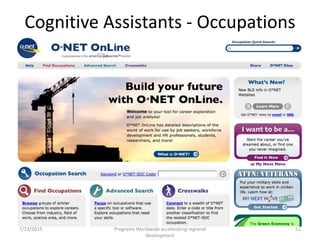
Cognitive Assistants - Occupations
7/23/2015
© IBM 2015, IBM Upward University
Programs Worldwide accelerating regional
development
51
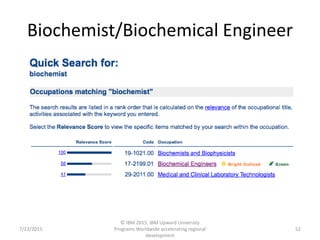
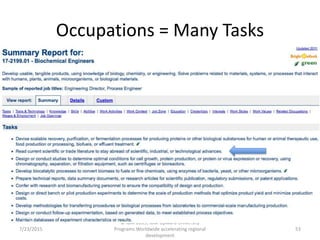
Biochemist/Biochemical Engineer
7/23/2015
© IBM 2015, IBM Upward University
Programs Worldwide accelerating regional
development
52
Occupations = Many Tasks
7/23/2015
© IBM 2015, IBM Upward University
Programs Worldwide accelerating regional
development
53
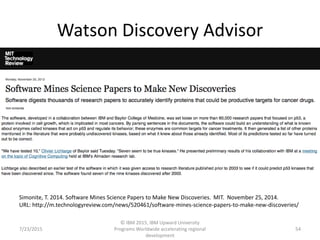
Watson Discovery Advisor
7/23/2015
© IBM 2015, IBM Upward University
Programs Worldwide accelerating regional
development
54
Simonite, T. 2014. Software Mines Science Papers to Make New Discoveries. MIT. November 25, 2014.
URL: http://m.technologyreview.com/news/520461/software-mines-science-papers-to-make-new-discoveries/
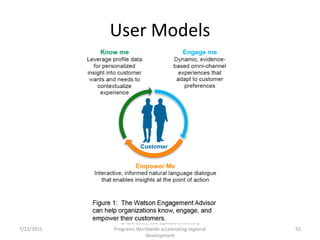
User Models
7/23/2015
© IBM 2015, IBM Upward University
Programs Worldwide accelerating regional
development
55
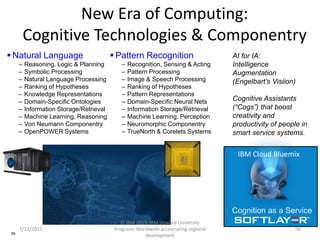
New Era of Computing:
Cognitive Technologies & Componentry
56
 Natural Language
– Reasoning, Logic & Planning
– Symbolic Processing
– Natural Language Processing
– Ranking of Hypotheses
– Knowledge Representations
– Domain-Specific Ontologies
– Information Storage/Retrieval
– Machine Learning, Reasoning
– Von Neumann Componentry
– OpenPOWER Systems
 Pattern Recognition
– Recognition, Sensing & Acting
– Pattern Processing
– Image & Speech Processing
– Ranking of Hypotheses
– Pattern Representations
– Domain-Specific Neural Nets
– Information Storage/Retrieval
– Machine Learning, Perception
– Neuromorphic Componentry
– TrueNorth & Corelets Systems
AI for IA:
Intelligence
Augmentation
(Engelbart’s Visiion)
Cognitive Assistants
(“Cogs”) that boost
creativity and
productivity of people in
smart service systems.
Cognition as a Service
7/23/2015
© IBM 2015, IBM Upward University
Programs Worldwide accelerating regional
development
56
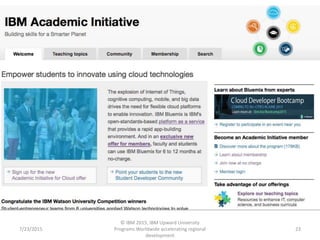
IBM Cloud Bluemix
7/23/2015
© IBM 2015, IBM Upward University
Programs Worldwide accelerating regional
development
57
Holistic Service Systems (HSS)
7/23/2015
© IBM 2013 IBM University Programs
worldwide accelerating regional
development (IBM UPward)
58
http://www.service-science.info/archives/1056
Nation
State/Province
City/Region
University
College
K-12
Cultural &
Conference
Hotels
Hospital
Medical
Research
Worker
(professional)
Family
(household)
For-profits:
Business Entrepreneurship
Non-profits
Social Entrepreneurship
U-BEE
Job Creator/Sustainer
U-BEEs = University-Based Entrepreneurial Ecosystems
“The future is already
here (at universities),
it is just not evenly
distributed.”
“The best way to
predict the future
is to (inspire the next
generation of students
to) build it better.”
“Multilevel nested,
networked
holistic service
systems (HSS)
that provision
whole service (WS) to
the people inside them.
WS includes
flows (transportation,
water, food, energy, com
development (buildings,
retail ,finance, health,
education),
and governance (city,
state, nation). ”
University Four Missions
1. Learning/Teaching
2. Discovery/Research
3. Engagement
/Customer
4. Convergence
/Integration
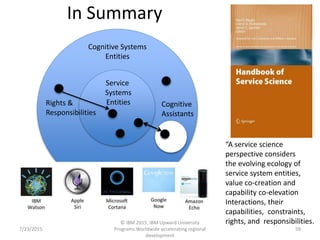
In Summary
7/23/2015
© IBM 2015, IBM Upward University
Programs Worldwide accelerating regional
development
59
“A service science
perspective considers
the evolving ecology of
service system entities,
value co-creation and
capability co-elevation
Interactions, their
capabilities, constraints,
rights, and responsibilities.
Cognitive Systems
Entities
Service
Systems
Entities Cognitive
Assistants
Rights &
Responsibilities
7/23/2015
© IBM 2015, IBM Upward University
Programs Worldwide accelerating regional
development
60
7/23/2015
© IBM 2015, IBM Upward University
Programs Worldwide accelerating regional
development
61
62
Moore’s-Like Law for
Smart Service Systems
Computational System
Smarter Technology
Requires investment roadmap
Service Systems: Stakeholders & Resources
1. People
2. Technology
3. Shared Information
4. Organizations
connected by win-win value propositions
Smarter Buildings, Universities, Cities
Requires investment roadmap
People:
From I to T-shape and Beyond!
7/23/2015
© IBM 2013 IBM University Programs
worldwide accelerating regional
development (IBM UPward)
63
Many disciplines
Many sectors
Many regions/cultures
(understanding & communications)
Deepinonesector
Deepinoneregion/culture
Deepinonediscipline
7/23/2015
© IBM 2015, IBM Upward University
Programs Worldwide accelerating regional
development
64
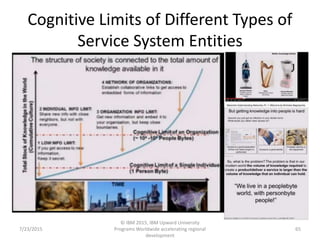
Cognitive Limits of Different Types of
Service System Entities
7/23/2015
© IBM 2015, IBM Upward University
Programs Worldwide accelerating regional
development
65
7/23/2015
© IBM 2015, IBM Upward University
Programs Worldwide accelerating regional
development
66
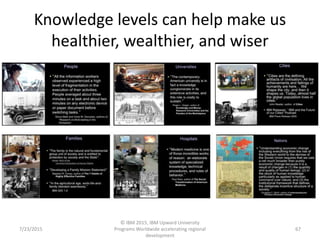
Knowledge levels can help make us
healthier, wealthier, and wiser
7/23/2015
© IBM 2015, IBM Upward University
Programs Worldwide accelerating regional
development
67
Alone in the Wilderness
7/23/2015
© IBM 2015, IBM Upward University
Programs Worldwide accelerating regional
development
68
7/23/2015
© IBM 2015, IBM Upward University
Programs Worldwide accelerating regional
development
69
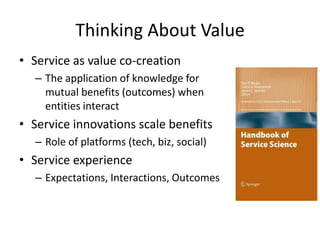
Thinking About Value
• Service as value co-creation
– The application of knowledge for
mutual benefits (outcomes) when
entities interact
• Service innovations scale benefits
– Role of platforms (tech, biz, social)
• Service experience
– Expectations, Interactions, Outcomes
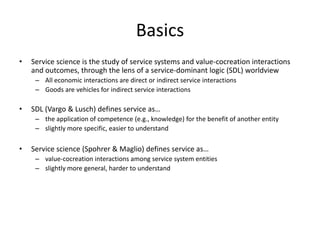
Basics
• Service science is the study of service systems and value-cocreation interactions
and outcomes, through the lens of a service-dominant logic (SDL) worldview
– All economic interactions are direct or indirect service interactions
– Goods are vehicles for indirect service interactions
• SDL (Vargo & Lusch) defines service as…
– the application of competence (e.g., knowledge) for the benefit of another entity
– slightly more specific, easier to understand
• Service science (Spohrer & Maglio) defines service as…
– value-cocreation interactions among service system entities
– slightly more general, harder to understand
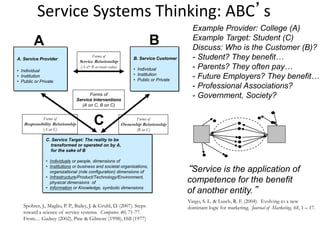
Service Systems Thinking: ABC’s
A. Service Provider
• Individual
• Institution
• Public or Private
C. Service Target: The reality to be
transformed or operated on by A,
for the sake of B
• Individuals or people, dimensions of
• Institutions or business and societal organizations,
organizational (role configuration) dimensions of
• Infrastructure/Product/Technology/Environment,
physical dimensions of
• Information or Knowledge, symbolic dimensions
B. Service Customer
• Individual
• Institution
• Public or Private
Forms of
Ownership Relationship
(B on C)
Forms of
Service Relationship
(A & B co-create value)
Forms of
Responsibility Relationship
(A on C)
Forms of
Service Interventions
(A on C, B on C)
Spohrer, J., Maglio, P. P., Bailey, J. & Gruhl, D. (2007). Steps
toward a science of service systems. Computer, 40, 71-77.
From… Gadrey (2002), Pine & Gilmore (1998), Hill (1977)
Vargo, S. L. & Lusch, R. F. (2004). Evolving to a new
dominant logic for marketing. Journal of Marketing, 68, 1 – 17.
“Service is the application of
competence for the benefit
of another entity.”
Example Provider: College (A)
Example Target: Student (C)
Discuss: Who is the Customer (B)?
- Student? They benefit…
- Parents? They often pay…
- Future Employers? They benefit…
- Professional Associations?
- Government, Society?
A B
C
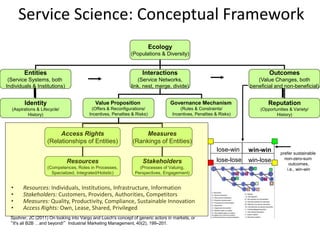
Service Science: Conceptual Framework
• Resources: Individuals, Institutions, Infrastructure, Information
• Stakeholders: Customers, Providers, Authorities, Competitors
• Measures: Quality, Productivity, Compliance, Sustainable Innovation
• Access Rights: Own, Lease, Shared, Privileged
Ecology
(Populations & Diversity)
Entities
(Service Systems, both
Individuals & Institutions)
Interactions
(Service Networks,
link, nest, merge, divide)
Outcomes
(Value Changes, both
beneficial and non-beneficial)
Value Proposition
(Offers & Reconfigurations/
Incentives, Penalties & Risks)
Governance Mechanism
(Rules & Constraints/
Incentives, Penalties & Risks)
Access Rights
(Relationships of Entities)
Measures
(Rankings of Entities)
Resources
(Competences, Roles in Processes,
Specialized, Integrated/Holistic)
Stakeholders
(Processes of Valuing,
Perspectives, Engagement)
Identity
(Aspirations & Lifecycle/
History)
Reputation
(Opportunities & Variety/
History)
prefer sustainable
non-zero-sum
outcomes,
i.e., win-win
win-win
lose-lose win-lose
lose-win
Spohrer, JC (2011) On looking into Vargo and Lusch's concept of generic actors in markets, or
“It's all B2B …and beyond!” Industrial Marketing Management, 40(2), 199–201.
74
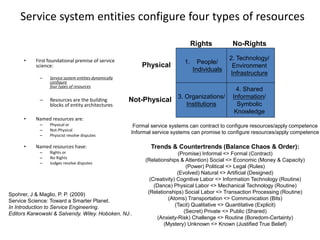
Service system entities configure four types of resources
• First foundational premise of service
science:
– Service system entities dynamically
configure
four types of resources
– Resources are the building
blocks of entity architectures
• Named resources are:
– Physical or
– Not-Physical
– Physicist resolve disputes
• Named resources have:
– Rights or
– No Rights
– Judges resolve disputes
Spohrer, J & Maglio, P. P. (2009)
Service Science: Toward a Smarter Planet.
In Introduction to Service Engineering.
Editors Karwowski & Salvendy. Wiley. Hoboken, NJ..
Physical
Not-Physical
Rights No-Rights
2. Technology/
Environment
Infrastructure
4. Shared
Information/
Symbolic
Knowledge
1. People/
Individuals
3. Organizations/
Institutions
Formal service systems can contract to configure resources/apply competence
Informal service systems can promise to configure resources/apply competence
Trends & Countertrends (Balance Chaos & Order):
(Promise) Informal <> Formal (Contract)
(Relationships & Attention) Social <> Economic (Money & Capacity)
(Power) Political <> Legal (Rules)
(Evolved) Natural <> Artificial (Designed)
(Creativity) Cognitive Labor <> Information Technology (Routine)
(Dance) Physical Labor <> Mechanical Technology (Routine)
(Relationships) Social Labor <> Transaction Processing (Routine)
(Atoms) Transportation <> Communication (Bits)
(Tacit) Qualitative <> Quantitative (Explicit)
(Secret) Private <> Public (Shared)
(Anxiety-Risk) Challenge <> Routine (Boredom-Certainty)
(Mystery) Unknown <> Known (Justified True Belief)
75
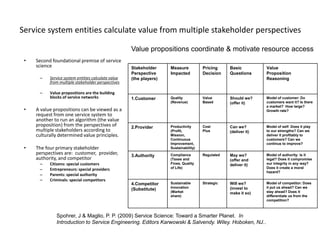
Service system entities calculate value from multiple stakeholder perspectives
• Second foundational premise of service
science
– Service system entities calculate value
from multiple stakeholder perspectives
– Value propositions are the building
blocks of service networks
• A value propositions can be viewed as a
request from one service system to
another to run an algorithm (the value
proposition) from the perspectives of
multiple stakeholders according to
culturally determined value principles.
• The four primary stakeholder
perspectives are: customer, provider,
authority, and competitor
– Citizens: special customers
– Entrepreneurs: special providers
– Parents: special authority
– Criminals: special competitors
Spohrer, J & Maglio, P. P. (2009) Service Science: Toward a Smarter Planet. In
Introduction to Service Engineering. Editors Karwowski & Salvendy. Wiley. Hoboken, NJ..
Model of competitor: Does
it put us ahead? Can we
stay ahead? Does it
differentiate us from the
competition?
Will we?
(invest to
make it so)
StrategicSustainable
Innovation
(Market
share)
4.Competitor
(Substitute)
Model of authority: Is it
legal? Does it compromise
our integrity in any way?
Does it create a moral
hazard?
May we?
(offer and
deliver it)
RegulatedCompliance
(Taxes and
Fines, Quality
of Life)
3.Authority
Model of self: Does it play
to our strengths? Can we
deliver it profitably to
customers? Can we
continue to improve?
Can we?
(deliver it)
Cost
Plus
Productivity
(Profit,
Mission,
Continuous
Improvement,
Sustainability)
2.Provider
Model of customer: Do
customers want it? Is there
a market? How large?
Growth rate?
Should we?
(offer it)
Value
Based
Quality
(Revenue)
1.Customer
Value
Proposition
Reasoning
Basic
Questions
Pricing
Decision
Measure
Impacted
Stakeholder
Perspective
(the players)
Value propositions coordinate & motivate resource access
76
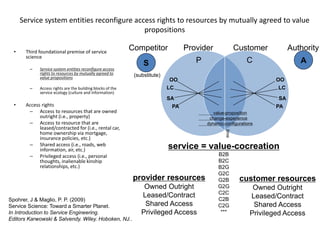
Service system entities reconfigure access rights to resources by mutually agreed to value
propositions
• Third foundational premise of service
science
– Service system entities reconfigure access
rights to resources by mutually agreed to
value propositions
– Access rights are the building blocks of the
service ecology (culture and information)
• Access rights
– Access to resources that are owned
outright (i.e., property)
– Access to resource that are
leased/contracted for (i.e., rental car,
home ownership via mortgage,
insurance policies, etc.)
– Shared access (i.e., roads, web
information, air, etc.)
– Privileged access (i.e., personal
thoughts, inalienable kinship
relationships, etc.)
service = value-cocreation
B2B
B2C
B2G
G2C
G2B
G2G
C2C
C2B
C2G
***
provider resources
Owned Outright
Leased/Contract
Shared Access
Privileged Access
customer resources
Owned Outright
Leased/Contract
Shared Access
Privileged Access
OO
SA
PA
LC
OO
LC
SA
PA
S AP C
Competitor Provider Customer Authority
value-proposition
change-experience
dynamic-configurations
(substitute)
time
Spohrer, J & Maglio, P. P. (2009)
Service Science: Toward a Smarter Planet.
In Introduction to Service Engineering.
Editors Karwowski & Salvendy. Wiley. Hoboken, NJ..
77
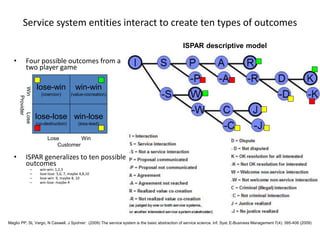
Service system entities interact to create ten types of outcomes
• Four possible outcomes from a
two player game
• ISPAR generalizes to ten possible
outcomes
– win-win: 1,2,3
– lose-lose: 5,6, 7, maybe 4,8,10
– lose-win: 9, maybe 8, 10
– win-lose: maybe 4
lose-win
(coercion)
win-win
(value-cocreation)
lose-lose
(co-destruction)
win-lose
(loss-lead)
WinLose
Provider
Lose Win
Customer
ISPAR descriptive model
Maglio PP, SL Vargo, N Caswell, J Spohrer: (2009) The service system is the basic abstraction of service science. Inf. Syst. E-Business Management 7(4): 395-406 (2009)
78
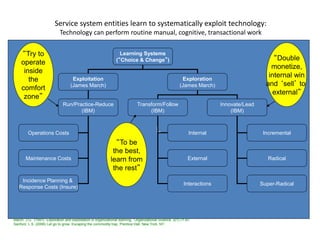
Service system entities learn to systematically exploit technology:
Technology can perform routine manual, cognitive, transactional work
L
Learning Systems
(“Choice & Change”)
Exploitation
(James March)
Exploration
(James March)
Run/Practice-Reduce
(IBM)
Transform/Follow
(IBM)
Innovate/Lead
(IBM)
Operations Costs
Maintenance Costs
Incidence Planning &
Response Costs (Insure)
Incremental
Radical
Super-Radical
Internal
External
Interactions
“To be
the best,
learn from
the rest”
“Double
monetize,
internal win
and ‘sell’ to
external”
“Try to
operate
inside
the
comfort
zone”
March, J.G. (1991) Exploration and exploitation in organizational learning. Organizational Science. 2(1).71-87.
Sanford, L.S. (2006) Let go to grow: Escaping the commodity trap. Prentice Hall. New York, NY.
79
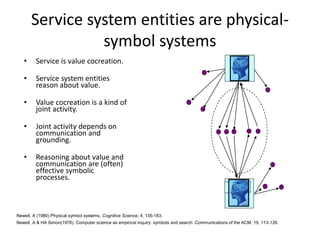
Service system entities are physical-
symbol systems
• Service is value cocreation.
• Service system entities
reason about value.
• Value cocreation is a kind of
joint activity.
• Joint activity depends on
communication and
grounding.
• Reasoning about value and
communication are (often)
effective symbolic
processes.
Newell, A (1980) Physical symbol systems, Cognitive Science, 4, 135-183.
Newell, A & HA Simon(1976). Computer science as empirical inquiry: symbols and search. Communications of the ACM, 19, 113-126.
80
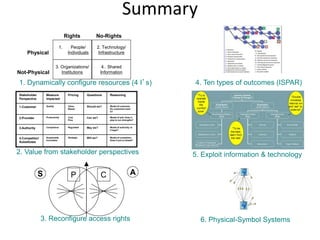
Summary
Spohrer, J & Maglio, P. P. (2009) Service Science: Toward a Smarter Planet. In Introduction to Service Engineering. Editors Karwowski & Salvendy. Wiley. Hoboken, NJ..
Physical
Not-Physical
Rights No-Rights
2. Technology/
Infrastructure
4.. Shared
Information
1. People/
Individuals
3. Organizations/
Institutions
1. Dynamically configure resources (4 I’s)
Model of competitor:
Does it put us ahead?
Will we?StrategicSustainable
Innovation
4.Competitor/
Substitutes
Model of authority: Is
it legal?
May we?RegulatedCompliance3.Authority
Model of self: Does it
play to our strengths?
Can we?Cost
Plus
Productivity2.Provider
Model of customer:
Do customers want
it?
Should we?Value
Based
Quality1.Customer
ReasoningQuestionsPricingMeasure
Impacted
Stakeholder
Perspective
2. Value from stakeholder perspectives
S AP C
3. Reconfigure access rights
4. Ten types of outcomes (ISPAR)
5. Exploit information & technology
6. Physical-Symbol Systems
81
Learning More
About Service Systems…
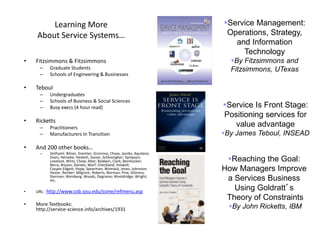
• Fitzsimmons & Fitzsimmons
– Graduate Students
– Schools of Engineering & Businesses
• Teboul
– Undergraduates
– Schools of Business & Social Sciences
– Busy execs (4 hour read)
• Ricketts
– Practitioners
– Manufacturers In Transition
• And 200 other books…
– Zeithaml, Bitner, Gremler; Gronross, Chase, Jacobs, Aquilano;
Davis, Heineke; Heskett, Sasser, Schlesingher; Sampson;
Lovelock, Wirtz, Chew; Alter; Baldwin, Clark; Beinhocker;
Berry; Bryson, Daniels, Warf; Checkland, Holwell;
Cooper,Edgett; Hopp, Spearman; Womack, Jones; Johnston;
Heizer, Render; Milgrom, Roberts; Norman; Pine, Gilmore;
Sterman; Weinberg; Woods, Degramo; Wooldridge; Wright;
etc.
• URL: http://www.cob.sjsu.edu/ssme/refmenu.asp
• More Textbooks:
http://service-science.info/archives/1931
Reaching the Goal:
How Managers Improve
a Services Business
Using Goldratt’s
Theory of Constraints
By John Ricketts, IBM
Service Management:
Operations, Strategy,
and Information
Technology
By Fitzsimmons and
Fitzsimmons, UTexas
Service Is Front Stage:
Positioning services for
value advantage
By James Teboul, INSEAD
82
Service Innovators
• ISSIP = International
Society of
Service Innovation
Professionals
• T-shaped Professionals
– Depth
– Breadth
• Register at:
– ISSIP.org
7/23/2015
© IBM 2015, IBM Upward University
Programs Worldwide accelerating regional
development
83
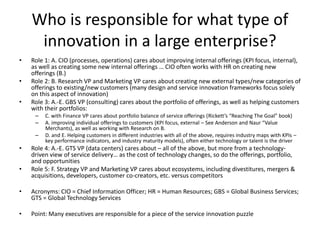
Who is responsible for what type of
innovation in a large enterprise?
• Role 1: A. CIO (processes, operations) cares about improving internal offerings (KPI focus, internal),
as well as creating some new internal offerings … CIO often works with HR on creating new
offerings (B.)
• Role 2: B. Research VP and Marketing VP cares about creating new external types/new categories of
offerings to existing/new customers (many design and service innovation frameworks focus solely
on this aspect of innovation)
• Role 3: A.-E. GBS VP (consulting) cares about the portfolio of offerings, as well as helping customers
with their portfolios:
– C. with Finance VP cares about portfolio balance of service offerings (Rickett’s “Reaching The Goal” book)
– A. improving individual offerings to customers (KPI focus, external – See Anderson and Naur “Value
Merchants), as well as working with Research on B.
– D. and E. Helping customers in different industries with all of the above, requires industry maps with KPIs –
key performance indicators, and industry maturity models), often either technology or talent is the driver
• Role 4: A.-E. GTS VP (data centers) cares about – all of the above, but more from a technology-
driven view of service delivery… as the cost of technology changes, so do the offerings, portfolio,
and opportunities
• Role 5: F. Strategy VP and Marketing VP cares about ecosystems, including divestitures, mergers &
acquisitions, developers, customer co-creators, etc. versus competitors
• Acronyms: CIO = Chief Information Officer; HR = Human Resources; GBS = Global Business Services;
GTS = Global Technology Services
• Point: Many executives are responsible for a piece of the service innovation puzzle
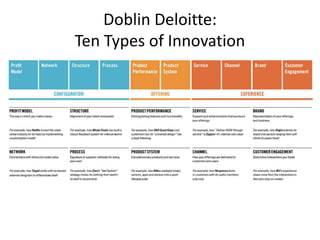
Doblin Deloitte:
Ten Types of Innovation
86
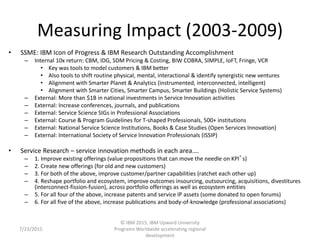
Measuring Impact (2003-2009)
• SSME: IBM Icon of Progress & IBM Research Outstanding Accomplishment
– Internal 10x return: CBM, IDG, SDM Pricing & Costing, BIW COBRA, SIMPLE, IoFT, Fringe, VCR
• Key was tools to model customers & IBM better
• Also tools to shift routine physical, mental, interactional & identify synergistic new ventures
• Alignment with Smarter Planet & Analytics (instrumented, interconnected, intelligent)
• Alignment with Smarter Cities, Smarter Campus, Smarter Buildings (Holistic Service Systems)
– External: More than $1B in national investments in Service Innovation activities
– External: Increase conferences, journals, and publications
– External: Service Science SIGs in Professional Associations
– External: Course & Program Guidelines for T-shaped Professionals, 500+ institutions
– External: National Service Science Institutions, Books & Case Studies (Open Services Innovation)
– External: International Society of Service Innovation Professionals (ISSIP)
• Service Research – service innovation methods in each area….
– 1. Improve existing offerings (value propositions that can move the needle on KPI’s)
– 2. Create new offerings (for old and new customers)
– 3. For both of the above, improve customer/partner capabilities (ratchet each other up)
– 4. Reshape portfolio and ecosystem, improve outcomes insourcing, outsourcing, acquisitions, divestitures
(interconnect-fission-fusion), across portfolio offerings as well as ecosystem entities
– 5. For all four of the above, increase patents and service IP assets (some donated to open forums)
– 6. For all five of the above, increase publications and body-of-knowledge (professional associations)
7/23/2015
© IBM 2015, IBM Upward University
Programs Worldwide accelerating regional
development
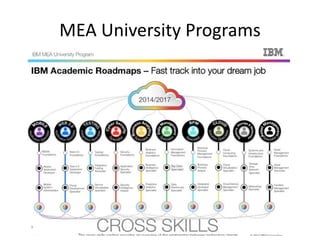
MEA University Programs
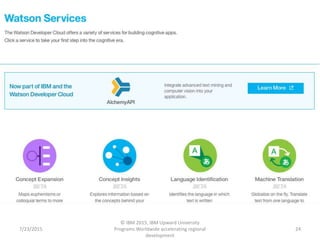
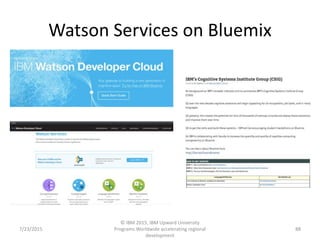
Watson Services on Bluemix
7/23/2015
© IBM 2015, IBM Upward University
Programs Worldwide accelerating regional
development
88
7/23/2015
© IBM 2015, IBM Upward University
Programs Worldwide accelerating regional
development
89
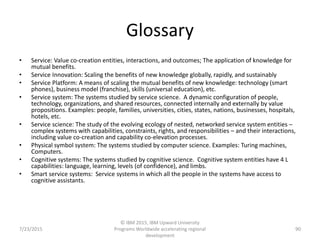
Glossary
• Service: Value co-creation entities, interactions, and outcomes; The application of knowledge for
mutual benefits.
• Service Innovation: Scaling the benefits of new knowledge globally, rapidly, and sustainably
• Service Platform: A means of scaling the mutual benefits of new knowledge: technology (smart
phones), business model (franchise), skills (universal education), etc.
• Service system: The systems studied by service science. A dynamic configuration of people,
technology, organizations, and shared resources, connected internally and externally by value
propositions. Examples: people, families, universities, cities, states, nations, businesses, hospitals,
hotels, etc.
• Service science: The study of the evolving ecology of nested, networked service system entities –
complex systems with capabilities, constraints, rights, and responsibilities – and their interactions,
including value co-creation and capability co-elevation processes.
• Physical symbol system: The systems studied by computer science. Examples: Turing machines,
Computers.
• Cognitive systems: The systems studied by cognitive science. Cognitive system entities have 4 L
capabilities: language, learning, levels (of confidence), and limbs.
• Smart service systems: Service systems in which all the people in the systems have access to
cognitive assistants.
7/23/2015
© IBM 2015, IBM Upward University
Programs Worldwide accelerating regional
development
90
More to Read & Watch
• Rapidly Rebuilding Societal Infrastructure from
Scratch
– Posted by Jim Spohrer on 14 July 2012, 11:55 am
– http://service-science.info/archives/2189
7/23/2015
© IBM 2015, IBM Upward University
Programs Worldwide accelerating regional
development
91
7/23/2015
© IBM 2015, IBM Upward University
Programs Worldwide accelerating regional
development
92
7/23/2015
© IBM 2015, IBM Upward University
Programs Worldwide accelerating regional
development
93
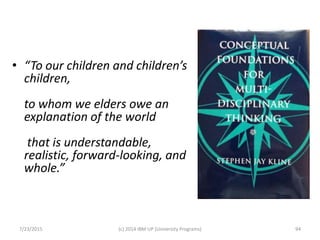
• “To our children and children’s
children,
to whom we elders owe an
explanation of the world
that is understandable,
realistic, forward-looking, and
whole.”
7/23/2015 (c) 2014 IBM UP (University Programs) 94
IBM Almaden Service Research (ASR):
Entities, Interactions, Outcomes
Entities
(People Inside
Experiences)
Interactions
(Offerings, and KPIs)
Outcomes
(Configurations)
Improve Self
(IBM)
A. Improve existing offering (internal/external) C. (Re)shape Portfolio
B. Create new offering (internal/external)
Help Others
(Customers,
Partners, etc.)
D. Improve existing offering (internal/external) F. (Re)shape
EcosystemE. Create new offering (internal/external)
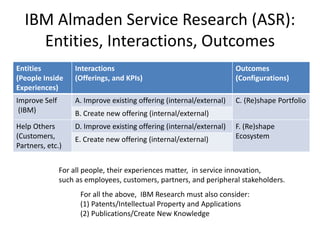
For all people, their experiences matter, in service innovation,
such as employees, customers, partners, and peripheral stakeholders.
For all the above, IBM Research must also consider:
(1) Patents/Intellectual Property and Applications
(2) Publications/Create New Knowledge
Conferences
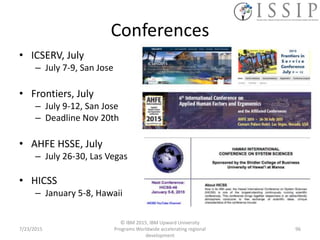
• ICSERV, July
– July 7-9, San Jose
• Frontiers, July
– July 9-12, San Jose
– Deadline Nov 20th
• AHFE HSSE, July
– July 26-30, Las Vegas
• HICSS
– January 5-8, Hawaii
7/23/2015
© IBM 2015, IBM Upward University
Programs Worldwide accelerating regional
development
96
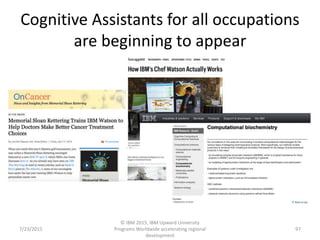
Cognitive Assistants for all occupations
are beginning to appear
7/23/2015
© IBM 2015, IBM Upward University
Programs Worldwide accelerating regional
development
97
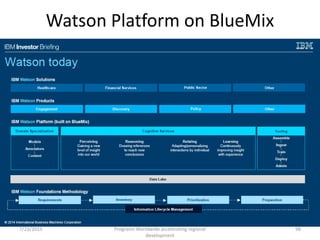
Watson Platform on BlueMix
7/23/2015
© IBM 2015, IBM Upward University
Programs Worldwide accelerating regional
development
98
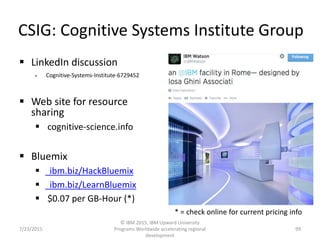
CSIG: Cognitive Systems Institute Group
 LinkedIn discussion
 Cognitive-Systems-Institute-6729452
 Web site for resource
sharing
 cognitive-science.info
 Bluemix
 ibm.biz/HackBluemix
 ibm.biz/LearnBluemix
 $0.07 per GB-Hour (*)
7/23/2015
© IBM 2015, IBM Upward University
Programs Worldwide accelerating regional
development
99
* = check online for current pricing info
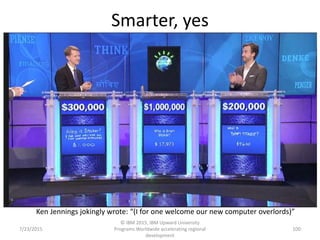
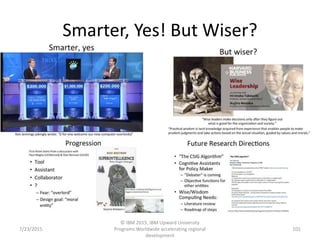
Smarter, yes
7/23/2015
© IBM 2015, IBM Upward University
Programs Worldwide accelerating regional
development
100
Ken Jennings jokingly wrote: “(I for one welcome our new computer overlords)”
Smarter, Yes! But Wiser?
7/23/2015
© IBM 2015, IBM Upward University
Programs Worldwide accelerating regional
development
101
Smarter Service Systems Workshop
7/23/2015
© IBM 2015, IBM Upward University
Programs Worldwide accelerating regional
development
102
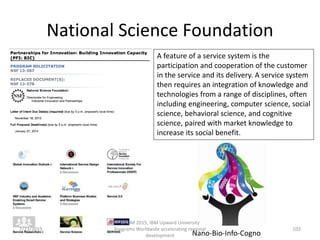
National Science Foundation
A feature of a service system is the
participation and cooperation of the customer
in the service and its delivery. A service system
then requires an integration of knowledge and
technologies from a range of disciplines, often
including engineering, computer science, social
science, behavioral science, and cognitive
science, paired with market knowledge to
increase its social benefit.
Nano-Bio-Info-Cogno
7/23/2015
© IBM 2015, IBM Upward University
Programs Worldwide accelerating regional
development
103
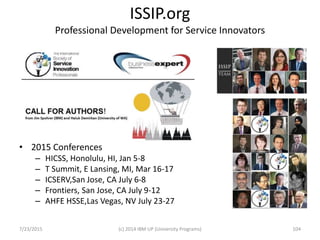
ISSIP.org
Professional Development for Service Innovators
• 2015 Conferences
– HICSS, Honolulu, HI, Jan 5-8
– T Summit, E Lansing, MI, Mar 16-17
– ICSERV,San Jose, CA July 6-8
– Frontiers, San Jose, CA July 9-12
– AHFE HSSE,Las Vegas, NV July 23-27
7/23/2015 (c) 2014 IBM UP (University Programs) 104
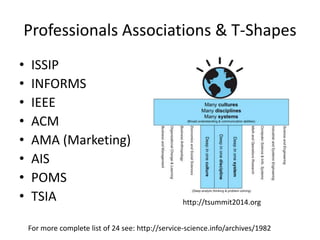
Professionals Associations & T-Shapes
• ISSIP
• INFORMS
• IEEE
• ACM
• AMA (Marketing)
• AIS
• POMS
• TSIA
For more complete list of 24 see: http://service-science.info/archives/1982
http://tsummit2014.org
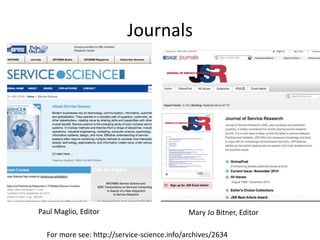
Journals
For more see: http://service-science.info/archives/2634
Paul Maglio, Editor Mary Jo Bitner, Editor
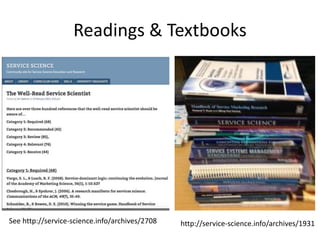
Readings & Textbooks
See http://service-science.info/archives/2708 http://service-science.info/archives/1931
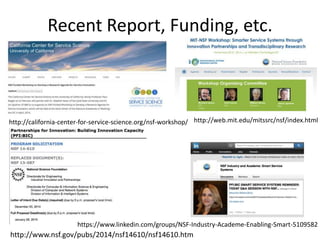
Recent Report, Funding, etc.
http://california-center-for-service-science.org/nsf-workshop/
http://www.nsf.gov/pubs/2014/nsf14610/nsf14610.htm
https://www.linkedin.com/groups/NSF-Industry-Academe-Enabling-Smart-5109582
http://web.mit.edu/mitssrc/nsf/index.html
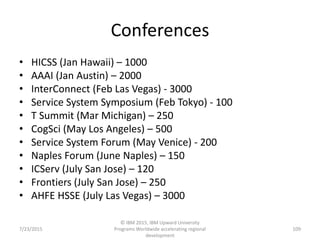
Conferences
• HICSS (Jan Hawaii) – 1000
• AAAI (Jan Austin) – 2000
• InterConnect (Feb Las Vegas) - 3000
• Service System Symposium (Feb Tokyo) - 100
• T Summit (Mar Michigan) – 250
• CogSci (May Los Angeles) – 500
• Service System Forum (May Venice) - 200
• Naples Forum (June Naples) – 150
• ICServ (July San Jose) – 120
• Frontiers (July San Jose) – 250
• AHFE HSSE (July Las Vegas) – 3000
7/23/2015
© IBM 2015, IBM Upward University
Programs Worldwide accelerating regional
development
109
7/23/2015
© IBM 2015, IBM Upward University
Programs Worldwide accelerating regional
development
110
7/23/2015
© IBM 2015, IBM Upward University
Programs Worldwide accelerating regional
development
111
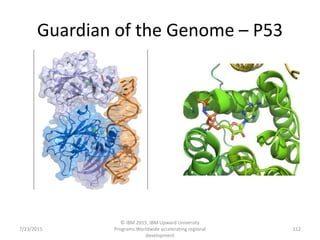
Guardian of the Genome – P53
7/23/2015
© IBM 2015, IBM Upward University
Programs Worldwide accelerating regional
development
112
7/23/2015
© IBM 2015, IBM Upward University
Programs Worldwide accelerating regional
development
113
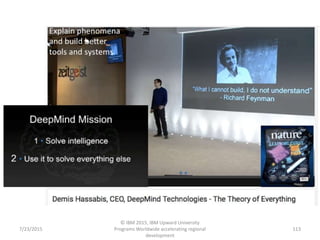
Explain phenomena
and build better
tools and systems
7/23/2015
© IBM 2015, IBM Upward University
Programs Worldwide accelerating regional
development
114
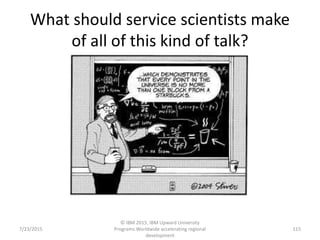
What should service scientists make
of all of this kind of talk?
7/23/2015
© IBM 2015, IBM Upward University
Programs Worldwide accelerating regional
development
115
7/23/2015
© IBM 2015, IBM Upward University
Programs Worldwide accelerating regional
development
116
7/23/2015
© IBM 2015, IBM Upward University
Programs Worldwide accelerating regional
development
117
7/23/2015
© IBM 2015, IBM Upward University
Programs Worldwide accelerating regional
development
118
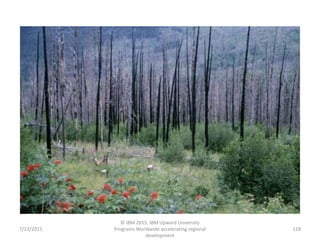
Resilence?
7/23/2015
© IBM 2015, IBM Upward University
Programs Worldwide accelerating regional
development
119
Jim Spohrer, IBM
• Dr. James (“Jim”) C. Spohrer is Director IBM Global University
Programs and leads IBM’s Cognitive Systems Institute. The
Cognitive Systems Institute works to align cognitive systems
researchers in academics, government, and industry globally to
improve productivity and creativity of problem-solving
professionals, transforming learning, discovery, and sustainable
development. IBM University Programs works to align IBM and
universities globally for innovation amplification and T-shaped
skills. Jim co-founded IBM’s first Service Research group, ISSIP
Service Science community, and was founding CTO of IBM’s
Venture Capital Relations Group in Silicon Valley. He was awarded
Apple Computers’ Distinguished Engineer Scientist and
Technology title for his work on next generation learning
platforms. Jim has a Yale PhD in Computer Science/Artificial
Intelligence and MIT BS in Physics. His research priorities include
service science, cognitive systems for smart holistic service
systems, especially universities and cities. With over ninety
publications and nine patents, he is also a PICMET Fellow and a
winner of the S-D Logic award.
7/23/2015
© IBM 2015, IBM Upward University
Programs Worldwide accelerating regional
development
120
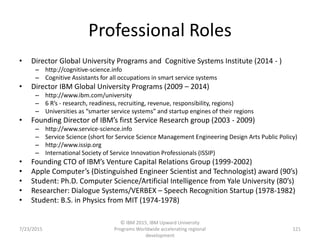
Professional Roles
• Director Global University Programs and Cognitive Systems Institute (2014 - )
– http://cognitive-science.info
– Cognitive Assistants for all occupations in smart service systems
• Director IBM Global University Programs (2009 – 2014)
– http://www.ibm.com/university
– 6 R’s - research, readiness, recruiting, revenue, responsibility, regions)
– Universities as “smarter service systems” and startup engines of their regions
• Founding Director of IBM’s first Service Research group (2003 - 2009)
– http://www.service-science.info
– Service Science (short for Service Science Management Engineering Design Arts Public Policy)
– http://www.issip.org
– International Society of Service Innovation Professionals (ISSIP)
• Founding CTO of IBM’s Venture Capital Relations Group (1999-2002)
• Apple Computer’s (Distinguished Engineer Scientist and Technologist) award (90’s)
• Student: Ph.D. Computer Science/Artificial Intelligence from Yale University (80’s)
• Researcher: Dialogue Systems/VERBEX – Speech Recognition Startup (1978-1982)
• Student: B.S. in Physics from MIT (1974-1978)
7/23/2015
© IBM 2015, IBM Upward University
Programs Worldwide accelerating regional
development
121
122
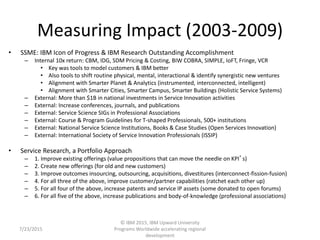
Measuring Impact (2003-2009)
• SSME: IBM Icon of Progress & IBM Research Outstanding Accomplishment
– Internal 10x return: CBM, IDG, SDM Pricing & Costing, BIW COBRA, SIMPLE, IoFT, Fringe, VCR
• Key was tools to model customers & IBM better
• Also tools to shift routine physical, mental, interactional & identify synergistic new ventures
• Alignment with Smarter Planet & Analytics (instrumented, interconnected, intelligent)
• Alignment with Smarter Cities, Smarter Campus, Smarter Buildings (Holistic Service Systems)
– External: More than $1B in national investments in Service Innovation activities
– External: Increase conferences, journals, and publications
– External: Service Science SIGs in Professional Associations
– External: Course & Program Guidelines for T-shaped Professionals, 500+ institutions
– External: National Service Science Institutions, Books & Case Studies (Open Services Innovation)
– External: International Society of Service Innovation Professionals (ISSIP)
• Service Research, a Portfolio Approach
– 1. Improve existing offerings (value propositions that can move the needle on KPI’s)
– 2. Create new offerings (for old and new customers)
– 3. Improve outcomes insourcing, outsourcing, acquisitions, divestitures (interconnect-fission-fusion)
– 4. For all three of the above, improve customer/partner capabilities (ratchet each other up)
– 5. For all four of the above, increase patents and service IP assets (some donated to open forums)
– 6. For all five of the above, increase publications and body-of-knowledge (professional associations)
7/23/2015
© IBM 2015, IBM Upward University
Programs Worldwide accelerating regional
development
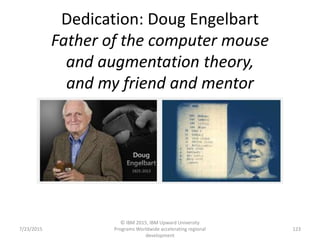
Dedication: Doug Engelbart
Father of the computer mouse
and augmentation theory,
and my friend and mentor
7/23/2015
© IBM 2015, IBM Upward University
Programs Worldwide accelerating regional
development
123
7/23/2015
© IBM 2015, IBM Upward University
Programs Worldwide accelerating regional
development
124

Csig 20150723 v2

  • 1.
    Cognitive Systems InstituteGroup (CSIG) Join Weekly Calls: http://cognitive-science.info/community/weekly-update/ Join Weekly Discussion: https://www.linkedin.com/grp/home?gid=6729452 Jim Spohrer, IBM Director, Global University Programs (GUP) and Cognitive Systems Institute Group (CSIG) CSIG Overview, Thursday July 23, 2015 http://www.slideshare.net/spohrer/csig-20150723-v2 7/23/2015 © IBM 2015, IBM UPward - University Programs Worldwide accelerating regional development 1
  • 2.
    7/23/2015 © IBM 2015,IBM Upward University Programs Worldwide accelerating regional development 2 Explain external phenomena
  • 3.
    7/23/2015 © IBM 2015,IBM Upward University Programs Worldwide accelerating regional development 3 Explain internal phenomena
  • 4.
    When you needhelp, who are you going to call? 7/23/2015 © IBM 2015, IBM Upward University Programs Worldwide accelerating regional development 4 1955 (Newburgh, Maine) (1965) 1975 (1985) 1995 2015 2035? 2055?
  • 5.
    Hint 1: What$1000 buys 7/23/2015 © IBM 2015, IBM Upward University Programs Worldwide accelerating regional development 5 2035 2055
  • 6.
    Hint 2: 2015 7/23/2015 ©IBM 2015, IBM Upward University Programs Worldwide accelerating regional development 6 360,000 100,000 120,000 60,000 150,000
  • 7.
    7/23/2015 © IBM 2015,IBM Upward University Programs Worldwide accelerating regional development 7 Physics Chemistry Biology Neuroscience Psychology Artificial Intelligence Engineering Management Public Policy Education Design Humanities Natural Sciences – External World (natural systems) Cognitive Sciences – Internal World (cognitive systems) Service Science – Future Possible (smart service systems)
  • 8.
    Helping individuals andorganizations close their service innovation skills gap to create smarter service systems that empower customers and citizens in the collaborative service economy
  • 9.
    7/23/2015 © IBM 2015,IBM Upward University Programs Worldwide accelerating regional development 9
  • 10.
    Goals for Talk •Learn about IBM, IBM Research – “On a mission to build a smarter planet.” – “Platforms for making and scaling innovations.” • Learn about Universities – “Best way to predict the future is to inspire the next generation of students to build it better.” – “The future is already here at universities, it is just not yet well distributed.” 7/23/2015 © IBM 2015, IBM Upward University Programs Worldwide accelerating regional development 10
  • 11.
    7/23/2015 © IBM 2015,IBM Upward University Programs Worldwide accelerating regional development 11 IBM operates in 170 countries around the globe Acquisitions contribute significantly to IBM’s growth ; ~120 acquisitions in last decade Number 1 in patent generation for more than two decades More than 40% of IBMs workforce does business away from an office 5 Nobel Laureates10 time winner of the President’s National Medal of Technology & Innovation – latest for LASIK laser refractive surgical techniques The Smartest Machine On Earth 100 Years of Business & Innovation in 2011 New Era in IBM’s Leadership IBM Growth Initiatives IBM has ~400,000 employees worldwide
  • 12.
    7/23/2015 © IBM 2015,IBM Upward University Programs Worldwide accelerating regional development 12
  • 13.
    Data: From Resourceto Service 7/23/2015 © IBM 2015, IBM Upward University Programs Worldwide accelerating regional development 13 Cloud Social Internet of Things Makers Cognitive Security Analytics Cyber-Physical Systems Smarter Planet Smart Service Systems Industry 4.0 Mobile Collaborative Economy Product-Service Systems API Economy Platforms Barriers: Systems/Interdisciplinary
  • 14.
    IBM • 1. Big •2. Historic • 3. Inventive • 4. Acquisitive • 5. Brand 7/23/2015 © IBM 2015, IBM Upward University Programs Worldwide accelerating regional development 14 • 6. IBMers • 7. Ups & Downs • 8. Open • 9. Mysterious • 10. Future
  • 15.
    IBM in SiliconValley: From Punch Cards…. 7/23/2015 © IBM 2015, IBM Upward University Programs Worldwide accelerating regional development 15 On August 22, 1943, 105 men, women and children, among them 43 IBM employees, alighted from a special train that carried them across the continent to establish new homes and the new IBM Card Manufacturing Plant Number 5 at 16th and St. John Streets, San Jose, CA.
  • 16.
    7/23/2015 © IBM 2015,IBM Upward University Programs Worldwide accelerating regional development 16
  • 17.
    IBM in SiliconValley: To Brain Chips…. 7/23/2015 © IBM 2015, IBM Upward University Programs Worldwide accelerating regional development 17
  • 18.
    7/23/2015 © IBM 2015,IBM Upward University Programs Worldwide accelerating regional development 18
  • 19.
    7/23/2015 © IBM 2015,IBM Upward University Programs Worldwide accelerating regional development 19
  • 20.
    IBM TrueNorth Chip 7/23/2015 ©IBM 2015, IBM Upward University Programs Worldwide accelerating regional development 20
  • 21.
    7/23/2015 © IBM 2015,IBM Upward University Programs Worldwide accelerating regional development 21
  • 22.
    My first program… 7/23/2015 ©IBM 2015, IBM Upward University Programs Worldwide accelerating regional development 22
  • 23.
    7/23/2015 © IBM 2015,IBM Upward University Programs Worldwide accelerating regional development 23
  • 24.
    7/23/2015 © IBM 2015,IBM Upward University Programs Worldwide accelerating regional development 24
  • 25.
    “Startups as CognitiveTeam Sport” 7/23/2015 © IBM 2015, IBM Upward University Programs Worldwide accelerating regional development 25
  • 26.
    7/23/2015 © IBM 2013IBM University Programs worldwide accelerating regional development (IBM UPward) 26 T-Shaped Makers Breadth & Depth sector region/culture discipline
  • 27.
    7/23/2015 © IBM 2015,IBM Upward University Programs Worldwide accelerating regional development 27
  • 28.
    7/23/2015 © IBM 2015,IBM Upward University Programs Worldwide accelerating regional development 28 Winfried Wilcke T-shaped Explorer From Battery 500 to next generation cognitive systems
  • 29.
    7/23/2015 © IBM 2015,IBM Upward University Programs Worldwide accelerating regional development 29
  • 30.
    Primary Sector Example 7/23/2015 ©IBM 2015, IBM Upward University Programs Worldwide accelerating regional development 30 Robin Lougee Jeff Welser
  • 31.
    7/23/2015 © IBM 2015,IBM Upward University Programs Worldwide accelerating regional development 31
  • 32.
    7/23/2015 © IBM 2015,IBM Upward University Programs Worldwide accelerating regional development 32
  • 33.
    New Materials 7/23/2015 © IBM2015, IBM Upward University Programs Worldwide accelerating regional development 33
  • 34.
    Utility Fog: “The StuffDreams Are Made Of” 7/23/2015 © IBM 2015, IBM Upward University Programs Worldwide accelerating regional development 34
  • 35.
  • 36.
    36 Those in-the-know say,“IBM is helping to build a Smarter Planet…”
  • 37.
    37 Smarter Planet =Smarter “Service” Systems INSTRUMENTED We now have the ability to measure, sense and see the exact condition of practically everything. INTERCONNECTED People, systems and objects can communicate and interact with each other in entirely new ways. INTELLIGENT We can respond to changes quickly and accurately, and get better results by predicting and optimizing for future events. WORKFORCE PRODUCTS SUPPLY CHAIN COMMUNICATIONS TRANSPORTATION BUILDINGS IT NETWORKS
  • 38.
  • 39.
  • 40.
  • 41.
    IBM Platforms forEntrepreneurs • Smarter Cities Intelligent Operations Center Platform • IBM Watson & Cognitive Computing Platform • IBM UP helping university startups to scale-up (growth) 7/23/2015 © IBM 2013 IBM University Programs worldwide accelerating regional development (IBM UPward) 41
  • 42.
    Welcome to thenew age of platform technologies and smarter service systems for every sector of business and society nested, networks systems
  • 43.
    National Science Foundation Afeature of a service system is the participation and cooperation of the customer in the service and its delivery. A service system then requires an integration of knowledge and technologies from a range of disciplines, often including engineering, computer science, social science, behavioral science, and cognitive science, paired with market knowledge to increase its social benefit. Nano-Bio-Info-Cogno
  • 44.
    Holistic Service Systems(HSS) 7/23/2015 © IBM 2013 IBM University Programs worldwide accelerating regional development (IBM UPward) 44 http://www.service-science.info/archives/1056 Nation State/Province City/Region University College K-12 Cultural & Conference Hotels Hospital Medical Research Worker (professional) Family (household) For-profits: Business Entrepreneurship Non-profits Social Entrepreneurship U-BEE Job Creator/Sustainer U-BEEs = University-Based Entrepreneurial Ecosystems “The future is already here (at universities), it is just not evenly distributed.” “The best way to predict the future is to (inspire the next generation of students to) build it better.” “Multilevel nested, networked holistic service systems (HSS) that provision whole service (WS) to the people inside them. WS includes flows (transportation, water, food, energy, com development (buildings, retail ,finance, health, education), and governance (city, state, nation). ” University Four Missions 1. Learning 2. Discovery 3. Engagement 4. Convergence
  • 45.
    Universities Matter #1 7/23/2015 ©IBM 2013 IBM University Programs worldwide accelerating regional development (IBM UPward) 45 Japan China Germany France United KingdomItaly Russia SpainBrazil Canada India Mexico AustraliaSouth Korea NetherlandsTurkey Sweden y = 0,7489x+ 0,3534 R² = 0,719 0 1 2 3 4 5 6 7 8 9 0 1 2 3 4 5 6 7 8 9 %globalGDP % top 500 universities Nation’s % WW GDP and % Top 500 Universities (2009 Data)
  • 46.
    Universities Matter #2 7/23/2015 ©IBM 2013 IBM University Programs worldwide accelerating regional development (IBM UPward) 46 …But it can be costly, American student loan debt is over $900M
  • 47.
    Universities Matter #3 7/23/2015 ©IBM 2013 IBM University Programs worldwide accelerating regional development (IBM UPward) 47 “When we combined the impact of Harvard’s direct spending on payroll, purchasing and construction – the indirect impact of University spending – and the direct and indirect impact of off-campus spending by Harvard students – we can estimate that Harvard directly and indirectly accounted for nearly $4.8 billion in economic activity in the Boston area in fiscal year 2008, and more than 44,000 jobs.”
  • 48.
    “The best wayto predict the future is to inspire the next generation of students to build it better” 7/23/2015 © IBM 2015, IBM Upward University Programs Worldwide accelerating regional development 48 Digital Natives Transportation Water Manufacturing Energy Construction ICT Retail Finance Healthcare Education Government
  • 49.
    Brief History of AI 1956– Dartmouth Conference 1956 – 1981 Micro-Worlds 1981 – Japanese 5th Generation 1988 – Expert Systems Peak 1990 – AI Winter 1997 – Deep Blue 1997 – 2011 Real-World 2011 – Jeopardy! & SIRI 2013 – Cognitive Systems Institute 2014 – Watson Business Unit 2015 – “Cognition as a Service” 7/23/2015 (c) IBM 2014 49
  • 50.
    Vision: Augment &Scale Expertise 7/23/2015 © IBM 2015, IBM Upward University Programs Worldwide accelerating regional development 50
  • 51.
    Cognitive Assistants -Occupations 7/23/2015 © IBM 2015, IBM Upward University Programs Worldwide accelerating regional development 51
  • 52.
    Biochemist/Biochemical Engineer 7/23/2015 © IBM2015, IBM Upward University Programs Worldwide accelerating regional development 52
  • 53.
    Occupations = ManyTasks 7/23/2015 © IBM 2015, IBM Upward University Programs Worldwide accelerating regional development 53
  • 54.
    Watson Discovery Advisor 7/23/2015 ©IBM 2015, IBM Upward University Programs Worldwide accelerating regional development 54 Simonite, T. 2014. Software Mines Science Papers to Make New Discoveries. MIT. November 25, 2014. URL: http://m.technologyreview.com/news/520461/software-mines-science-papers-to-make-new-discoveries/
  • 55.
    User Models 7/23/2015 © IBM2015, IBM Upward University Programs Worldwide accelerating regional development 55
  • 56.
    New Era ofComputing: Cognitive Technologies & Componentry 56  Natural Language – Reasoning, Logic & Planning – Symbolic Processing – Natural Language Processing – Ranking of Hypotheses – Knowledge Representations – Domain-Specific Ontologies – Information Storage/Retrieval – Machine Learning, Reasoning – Von Neumann Componentry – OpenPOWER Systems  Pattern Recognition – Recognition, Sensing & Acting – Pattern Processing – Image & Speech Processing – Ranking of Hypotheses – Pattern Representations – Domain-Specific Neural Nets – Information Storage/Retrieval – Machine Learning, Perception – Neuromorphic Componentry – TrueNorth & Corelets Systems AI for IA: Intelligence Augmentation (Engelbart’s Visiion) Cognitive Assistants (“Cogs”) that boost creativity and productivity of people in smart service systems. Cognition as a Service 7/23/2015 © IBM 2015, IBM Upward University Programs Worldwide accelerating regional development 56 IBM Cloud Bluemix
  • 57.
    7/23/2015 © IBM 2015,IBM Upward University Programs Worldwide accelerating regional development 57
  • 58.
    Holistic Service Systems(HSS) 7/23/2015 © IBM 2013 IBM University Programs worldwide accelerating regional development (IBM UPward) 58 http://www.service-science.info/archives/1056 Nation State/Province City/Region University College K-12 Cultural & Conference Hotels Hospital Medical Research Worker (professional) Family (household) For-profits: Business Entrepreneurship Non-profits Social Entrepreneurship U-BEE Job Creator/Sustainer U-BEEs = University-Based Entrepreneurial Ecosystems “The future is already here (at universities), it is just not evenly distributed.” “The best way to predict the future is to (inspire the next generation of students to) build it better.” “Multilevel nested, networked holistic service systems (HSS) that provision whole service (WS) to the people inside them. WS includes flows (transportation, water, food, energy, com development (buildings, retail ,finance, health, education), and governance (city, state, nation). ” University Four Missions 1. Learning/Teaching 2. Discovery/Research 3. Engagement /Customer 4. Convergence /Integration
  • 59.
    In Summary 7/23/2015 © IBM2015, IBM Upward University Programs Worldwide accelerating regional development 59 “A service science perspective considers the evolving ecology of service system entities, value co-creation and capability co-elevation Interactions, their capabilities, constraints, rights, and responsibilities. Cognitive Systems Entities Service Systems Entities Cognitive Assistants Rights & Responsibilities
  • 60.
    7/23/2015 © IBM 2015,IBM Upward University Programs Worldwide accelerating regional development 60
  • 61.
    7/23/2015 © IBM 2015,IBM Upward University Programs Worldwide accelerating regional development 61
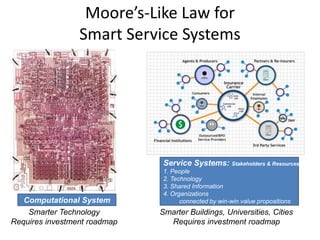
  • 62.
    62 Moore’s-Like Law for SmartService Systems Computational System Smarter Technology Requires investment roadmap Service Systems: Stakeholders & Resources 1. People 2. Technology 3. Shared Information 4. Organizations connected by win-win value propositions Smarter Buildings, Universities, Cities Requires investment roadmap
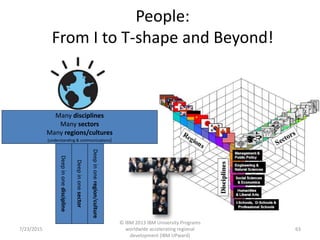
  • 63.
    People: From I toT-shape and Beyond! 7/23/2015 © IBM 2013 IBM University Programs worldwide accelerating regional development (IBM UPward) 63 Many disciplines Many sectors Many regions/cultures (understanding & communications) Deepinonesector Deepinoneregion/culture Deepinonediscipline
  • 64.
    7/23/2015 © IBM 2015,IBM Upward University Programs Worldwide accelerating regional development 64
  • 65.
    Cognitive Limits ofDifferent Types of Service System Entities 7/23/2015 © IBM 2015, IBM Upward University Programs Worldwide accelerating regional development 65
  • 66.
    7/23/2015 © IBM 2015,IBM Upward University Programs Worldwide accelerating regional development 66
  • 67.
    Knowledge levels canhelp make us healthier, wealthier, and wiser 7/23/2015 © IBM 2015, IBM Upward University Programs Worldwide accelerating regional development 67
  • 68.
    Alone in theWilderness 7/23/2015 © IBM 2015, IBM Upward University Programs Worldwide accelerating regional development 68
  • 69.
    7/23/2015 © IBM 2015,IBM Upward University Programs Worldwide accelerating regional development 69
  • 70.
    Thinking About Value •Service as value co-creation – The application of knowledge for mutual benefits (outcomes) when entities interact • Service innovations scale benefits – Role of platforms (tech, biz, social) • Service experience – Expectations, Interactions, Outcomes
  • 71.
    Basics • Service scienceis the study of service systems and value-cocreation interactions and outcomes, through the lens of a service-dominant logic (SDL) worldview – All economic interactions are direct or indirect service interactions – Goods are vehicles for indirect service interactions • SDL (Vargo & Lusch) defines service as… – the application of competence (e.g., knowledge) for the benefit of another entity – slightly more specific, easier to understand • Service science (Spohrer & Maglio) defines service as… – value-cocreation interactions among service system entities – slightly more general, harder to understand
  • 72.
    Service Systems Thinking:ABC’s A. Service Provider • Individual • Institution • Public or Private C. Service Target: The reality to be transformed or operated on by A, for the sake of B • Individuals or people, dimensions of • Institutions or business and societal organizations, organizational (role configuration) dimensions of • Infrastructure/Product/Technology/Environment, physical dimensions of • Information or Knowledge, symbolic dimensions B. Service Customer • Individual • Institution • Public or Private Forms of Ownership Relationship (B on C) Forms of Service Relationship (A & B co-create value) Forms of Responsibility Relationship (A on C) Forms of Service Interventions (A on C, B on C) Spohrer, J., Maglio, P. P., Bailey, J. & Gruhl, D. (2007). Steps toward a science of service systems. Computer, 40, 71-77. From… Gadrey (2002), Pine & Gilmore (1998), Hill (1977) Vargo, S. L. & Lusch, R. F. (2004). Evolving to a new dominant logic for marketing. Journal of Marketing, 68, 1 – 17. “Service is the application of competence for the benefit of another entity.” Example Provider: College (A) Example Target: Student (C) Discuss: Who is the Customer (B)? - Student? They benefit… - Parents? They often pay… - Future Employers? They benefit… - Professional Associations? - Government, Society? A B C
  • 73.
    Service Science: ConceptualFramework • Resources: Individuals, Institutions, Infrastructure, Information • Stakeholders: Customers, Providers, Authorities, Competitors • Measures: Quality, Productivity, Compliance, Sustainable Innovation • Access Rights: Own, Lease, Shared, Privileged Ecology (Populations & Diversity) Entities (Service Systems, both Individuals & Institutions) Interactions (Service Networks, link, nest, merge, divide) Outcomes (Value Changes, both beneficial and non-beneficial) Value Proposition (Offers & Reconfigurations/ Incentives, Penalties & Risks) Governance Mechanism (Rules & Constraints/ Incentives, Penalties & Risks) Access Rights (Relationships of Entities) Measures (Rankings of Entities) Resources (Competences, Roles in Processes, Specialized, Integrated/Holistic) Stakeholders (Processes of Valuing, Perspectives, Engagement) Identity (Aspirations & Lifecycle/ History) Reputation (Opportunities & Variety/ History) prefer sustainable non-zero-sum outcomes, i.e., win-win win-win lose-lose win-lose lose-win Spohrer, JC (2011) On looking into Vargo and Lusch's concept of generic actors in markets, or “It's all B2B …and beyond!” Industrial Marketing Management, 40(2), 199–201.
  • 74.
    74 Service system entitiesconfigure four types of resources • First foundational premise of service science: – Service system entities dynamically configure four types of resources – Resources are the building blocks of entity architectures • Named resources are: – Physical or – Not-Physical – Physicist resolve disputes • Named resources have: – Rights or – No Rights – Judges resolve disputes Spohrer, J & Maglio, P. P. (2009) Service Science: Toward a Smarter Planet. In Introduction to Service Engineering. Editors Karwowski & Salvendy. Wiley. Hoboken, NJ.. Physical Not-Physical Rights No-Rights 2. Technology/ Environment Infrastructure 4. Shared Information/ Symbolic Knowledge 1. People/ Individuals 3. Organizations/ Institutions Formal service systems can contract to configure resources/apply competence Informal service systems can promise to configure resources/apply competence Trends & Countertrends (Balance Chaos & Order): (Promise) Informal <> Formal (Contract) (Relationships & Attention) Social <> Economic (Money & Capacity) (Power) Political <> Legal (Rules) (Evolved) Natural <> Artificial (Designed) (Creativity) Cognitive Labor <> Information Technology (Routine) (Dance) Physical Labor <> Mechanical Technology (Routine) (Relationships) Social Labor <> Transaction Processing (Routine) (Atoms) Transportation <> Communication (Bits) (Tacit) Qualitative <> Quantitative (Explicit) (Secret) Private <> Public (Shared) (Anxiety-Risk) Challenge <> Routine (Boredom-Certainty) (Mystery) Unknown <> Known (Justified True Belief)
  • 75.
    75 Service system entitiescalculate value from multiple stakeholder perspectives • Second foundational premise of service science – Service system entities calculate value from multiple stakeholder perspectives – Value propositions are the building blocks of service networks • A value propositions can be viewed as a request from one service system to another to run an algorithm (the value proposition) from the perspectives of multiple stakeholders according to culturally determined value principles. • The four primary stakeholder perspectives are: customer, provider, authority, and competitor – Citizens: special customers – Entrepreneurs: special providers – Parents: special authority – Criminals: special competitors Spohrer, J & Maglio, P. P. (2009) Service Science: Toward a Smarter Planet. In Introduction to Service Engineering. Editors Karwowski & Salvendy. Wiley. Hoboken, NJ.. Model of competitor: Does it put us ahead? Can we stay ahead? Does it differentiate us from the competition? Will we? (invest to make it so) StrategicSustainable Innovation (Market share) 4.Competitor (Substitute) Model of authority: Is it legal? Does it compromise our integrity in any way? Does it create a moral hazard? May we? (offer and deliver it) RegulatedCompliance (Taxes and Fines, Quality of Life) 3.Authority Model of self: Does it play to our strengths? Can we deliver it profitably to customers? Can we continue to improve? Can we? (deliver it) Cost Plus Productivity (Profit, Mission, Continuous Improvement, Sustainability) 2.Provider Model of customer: Do customers want it? Is there a market? How large? Growth rate? Should we? (offer it) Value Based Quality (Revenue) 1.Customer Value Proposition Reasoning Basic Questions Pricing Decision Measure Impacted Stakeholder Perspective (the players) Value propositions coordinate & motivate resource access
  • 76.
    76 Service system entitiesreconfigure access rights to resources by mutually agreed to value propositions • Third foundational premise of service science – Service system entities reconfigure access rights to resources by mutually agreed to value propositions – Access rights are the building blocks of the service ecology (culture and information) • Access rights – Access to resources that are owned outright (i.e., property) – Access to resource that are leased/contracted for (i.e., rental car, home ownership via mortgage, insurance policies, etc.) – Shared access (i.e., roads, web information, air, etc.) – Privileged access (i.e., personal thoughts, inalienable kinship relationships, etc.) service = value-cocreation B2B B2C B2G G2C G2B G2G C2C C2B C2G *** provider resources Owned Outright Leased/Contract Shared Access Privileged Access customer resources Owned Outright Leased/Contract Shared Access Privileged Access OO SA PA LC OO LC SA PA S AP C Competitor Provider Customer Authority value-proposition change-experience dynamic-configurations (substitute) time Spohrer, J & Maglio, P. P. (2009) Service Science: Toward a Smarter Planet. In Introduction to Service Engineering. Editors Karwowski & Salvendy. Wiley. Hoboken, NJ..
  • 77.
    77 Service system entitiesinteract to create ten types of outcomes • Four possible outcomes from a two player game • ISPAR generalizes to ten possible outcomes – win-win: 1,2,3 – lose-lose: 5,6, 7, maybe 4,8,10 – lose-win: 9, maybe 8, 10 – win-lose: maybe 4 lose-win (coercion) win-win (value-cocreation) lose-lose (co-destruction) win-lose (loss-lead) WinLose Provider Lose Win Customer ISPAR descriptive model Maglio PP, SL Vargo, N Caswell, J Spohrer: (2009) The service system is the basic abstraction of service science. Inf. Syst. E-Business Management 7(4): 395-406 (2009)
  • 78.
    78 Service system entitieslearn to systematically exploit technology: Technology can perform routine manual, cognitive, transactional work L Learning Systems (“Choice & Change”) Exploitation (James March) Exploration (James March) Run/Practice-Reduce (IBM) Transform/Follow (IBM) Innovate/Lead (IBM) Operations Costs Maintenance Costs Incidence Planning & Response Costs (Insure) Incremental Radical Super-Radical Internal External Interactions “To be the best, learn from the rest” “Double monetize, internal win and ‘sell’ to external” “Try to operate inside the comfort zone” March, J.G. (1991) Exploration and exploitation in organizational learning. Organizational Science. 2(1).71-87. Sanford, L.S. (2006) Let go to grow: Escaping the commodity trap. Prentice Hall. New York, NY.
  • 79.
    79 Service system entitiesare physical- symbol systems • Service is value cocreation. • Service system entities reason about value. • Value cocreation is a kind of joint activity. • Joint activity depends on communication and grounding. • Reasoning about value and communication are (often) effective symbolic processes. Newell, A (1980) Physical symbol systems, Cognitive Science, 4, 135-183. Newell, A & HA Simon(1976). Computer science as empirical inquiry: symbols and search. Communications of the ACM, 19, 113-126.
  • 80.
    80 Summary Spohrer, J &Maglio, P. P. (2009) Service Science: Toward a Smarter Planet. In Introduction to Service Engineering. Editors Karwowski & Salvendy. Wiley. Hoboken, NJ.. Physical Not-Physical Rights No-Rights 2. Technology/ Infrastructure 4.. Shared Information 1. People/ Individuals 3. Organizations/ Institutions 1. Dynamically configure resources (4 I’s) Model of competitor: Does it put us ahead? Will we?StrategicSustainable Innovation 4.Competitor/ Substitutes Model of authority: Is it legal? May we?RegulatedCompliance3.Authority Model of self: Does it play to our strengths? Can we?Cost Plus Productivity2.Provider Model of customer: Do customers want it? Should we?Value Based Quality1.Customer ReasoningQuestionsPricingMeasure Impacted Stakeholder Perspective 2. Value from stakeholder perspectives S AP C 3. Reconfigure access rights 4. Ten types of outcomes (ISPAR) 5. Exploit information & technology 6. Physical-Symbol Systems
  • 81.
    81 Learning More About ServiceSystems… • Fitzsimmons & Fitzsimmons – Graduate Students – Schools of Engineering & Businesses • Teboul – Undergraduates – Schools of Business & Social Sciences – Busy execs (4 hour read) • Ricketts – Practitioners – Manufacturers In Transition • And 200 other books… – Zeithaml, Bitner, Gremler; Gronross, Chase, Jacobs, Aquilano; Davis, Heineke; Heskett, Sasser, Schlesingher; Sampson; Lovelock, Wirtz, Chew; Alter; Baldwin, Clark; Beinhocker; Berry; Bryson, Daniels, Warf; Checkland, Holwell; Cooper,Edgett; Hopp, Spearman; Womack, Jones; Johnston; Heizer, Render; Milgrom, Roberts; Norman; Pine, Gilmore; Sterman; Weinberg; Woods, Degramo; Wooldridge; Wright; etc. • URL: http://www.cob.sjsu.edu/ssme/refmenu.asp • More Textbooks: http://service-science.info/archives/1931 Reaching the Goal: How Managers Improve a Services Business Using Goldratt’s Theory of Constraints By John Ricketts, IBM Service Management: Operations, Strategy, and Information Technology By Fitzsimmons and Fitzsimmons, UTexas Service Is Front Stage: Positioning services for value advantage By James Teboul, INSEAD
  • 82.
    82 Service Innovators • ISSIP= International Society of Service Innovation Professionals • T-shaped Professionals – Depth – Breadth • Register at: – ISSIP.org
  • 83.
    7/23/2015 © IBM 2015,IBM Upward University Programs Worldwide accelerating regional development 83
  • 84.
    Who is responsiblefor what type of innovation in a large enterprise? • Role 1: A. CIO (processes, operations) cares about improving internal offerings (KPI focus, internal), as well as creating some new internal offerings … CIO often works with HR on creating new offerings (B.) • Role 2: B. Research VP and Marketing VP cares about creating new external types/new categories of offerings to existing/new customers (many design and service innovation frameworks focus solely on this aspect of innovation) • Role 3: A.-E. GBS VP (consulting) cares about the portfolio of offerings, as well as helping customers with their portfolios: – C. with Finance VP cares about portfolio balance of service offerings (Rickett’s “Reaching The Goal” book) – A. improving individual offerings to customers (KPI focus, external – See Anderson and Naur “Value Merchants), as well as working with Research on B. – D. and E. Helping customers in different industries with all of the above, requires industry maps with KPIs – key performance indicators, and industry maturity models), often either technology or talent is the driver • Role 4: A.-E. GTS VP (data centers) cares about – all of the above, but more from a technology- driven view of service delivery… as the cost of technology changes, so do the offerings, portfolio, and opportunities • Role 5: F. Strategy VP and Marketing VP cares about ecosystems, including divestitures, mergers & acquisitions, developers, customer co-creators, etc. versus competitors • Acronyms: CIO = Chief Information Officer; HR = Human Resources; GBS = Global Business Services; GTS = Global Technology Services • Point: Many executives are responsible for a piece of the service innovation puzzle
  • 85.
  • 86.
    86 Measuring Impact (2003-2009) •SSME: IBM Icon of Progress & IBM Research Outstanding Accomplishment – Internal 10x return: CBM, IDG, SDM Pricing & Costing, BIW COBRA, SIMPLE, IoFT, Fringe, VCR • Key was tools to model customers & IBM better • Also tools to shift routine physical, mental, interactional & identify synergistic new ventures • Alignment with Smarter Planet & Analytics (instrumented, interconnected, intelligent) • Alignment with Smarter Cities, Smarter Campus, Smarter Buildings (Holistic Service Systems) – External: More than $1B in national investments in Service Innovation activities – External: Increase conferences, journals, and publications – External: Service Science SIGs in Professional Associations – External: Course & Program Guidelines for T-shaped Professionals, 500+ institutions – External: National Service Science Institutions, Books & Case Studies (Open Services Innovation) – External: International Society of Service Innovation Professionals (ISSIP) • Service Research – service innovation methods in each area…. – 1. Improve existing offerings (value propositions that can move the needle on KPI’s) – 2. Create new offerings (for old and new customers) – 3. For both of the above, improve customer/partner capabilities (ratchet each other up) – 4. Reshape portfolio and ecosystem, improve outcomes insourcing, outsourcing, acquisitions, divestitures (interconnect-fission-fusion), across portfolio offerings as well as ecosystem entities – 5. For all four of the above, increase patents and service IP assets (some donated to open forums) – 6. For all five of the above, increase publications and body-of-knowledge (professional associations) 7/23/2015 © IBM 2015, IBM Upward University Programs Worldwide accelerating regional development
  • 87.
  • 88.
    Watson Services onBluemix 7/23/2015 © IBM 2015, IBM Upward University Programs Worldwide accelerating regional development 88
  • 89.
    7/23/2015 © IBM 2015,IBM Upward University Programs Worldwide accelerating regional development 89
  • 90.
    Glossary • Service: Valueco-creation entities, interactions, and outcomes; The application of knowledge for mutual benefits. • Service Innovation: Scaling the benefits of new knowledge globally, rapidly, and sustainably • Service Platform: A means of scaling the mutual benefits of new knowledge: technology (smart phones), business model (franchise), skills (universal education), etc. • Service system: The systems studied by service science. A dynamic configuration of people, technology, organizations, and shared resources, connected internally and externally by value propositions. Examples: people, families, universities, cities, states, nations, businesses, hospitals, hotels, etc. • Service science: The study of the evolving ecology of nested, networked service system entities – complex systems with capabilities, constraints, rights, and responsibilities – and their interactions, including value co-creation and capability co-elevation processes. • Physical symbol system: The systems studied by computer science. Examples: Turing machines, Computers. • Cognitive systems: The systems studied by cognitive science. Cognitive system entities have 4 L capabilities: language, learning, levels (of confidence), and limbs. • Smart service systems: Service systems in which all the people in the systems have access to cognitive assistants. 7/23/2015 © IBM 2015, IBM Upward University Programs Worldwide accelerating regional development 90
  • 91.
    More to Read& Watch • Rapidly Rebuilding Societal Infrastructure from Scratch – Posted by Jim Spohrer on 14 July 2012, 11:55 am – http://service-science.info/archives/2189 7/23/2015 © IBM 2015, IBM Upward University Programs Worldwide accelerating regional development 91
  • 92.
    7/23/2015 © IBM 2015,IBM Upward University Programs Worldwide accelerating regional development 92
  • 93.
    7/23/2015 © IBM 2015,IBM Upward University Programs Worldwide accelerating regional development 93
  • 94.
    • “To ourchildren and children’s children, to whom we elders owe an explanation of the world that is understandable, realistic, forward-looking, and whole.” 7/23/2015 (c) 2014 IBM UP (University Programs) 94
  • 95.
    IBM Almaden ServiceResearch (ASR): Entities, Interactions, Outcomes Entities (People Inside Experiences) Interactions (Offerings, and KPIs) Outcomes (Configurations) Improve Self (IBM) A. Improve existing offering (internal/external) C. (Re)shape Portfolio B. Create new offering (internal/external) Help Others (Customers, Partners, etc.) D. Improve existing offering (internal/external) F. (Re)shape EcosystemE. Create new offering (internal/external) For all people, their experiences matter, in service innovation, such as employees, customers, partners, and peripheral stakeholders. For all the above, IBM Research must also consider: (1) Patents/Intellectual Property and Applications (2) Publications/Create New Knowledge
  • 96.
    Conferences • ICSERV, July –July 7-9, San Jose • Frontiers, July – July 9-12, San Jose – Deadline Nov 20th • AHFE HSSE, July – July 26-30, Las Vegas • HICSS – January 5-8, Hawaii 7/23/2015 © IBM 2015, IBM Upward University Programs Worldwide accelerating regional development 96
  • 97.
    Cognitive Assistants forall occupations are beginning to appear 7/23/2015 © IBM 2015, IBM Upward University Programs Worldwide accelerating regional development 97
  • 98.
    Watson Platform onBlueMix 7/23/2015 © IBM 2015, IBM Upward University Programs Worldwide accelerating regional development 98
  • 99.
    CSIG: Cognitive SystemsInstitute Group  LinkedIn discussion  Cognitive-Systems-Institute-6729452  Web site for resource sharing  cognitive-science.info  Bluemix  ibm.biz/HackBluemix  ibm.biz/LearnBluemix  $0.07 per GB-Hour (*) 7/23/2015 © IBM 2015, IBM Upward University Programs Worldwide accelerating regional development 99 * = check online for current pricing info
  • 100.
    Smarter, yes 7/23/2015 © IBM2015, IBM Upward University Programs Worldwide accelerating regional development 100 Ken Jennings jokingly wrote: “(I for one welcome our new computer overlords)”
  • 101.
    Smarter, Yes! ButWiser? 7/23/2015 © IBM 2015, IBM Upward University Programs Worldwide accelerating regional development 101
  • 102.
    Smarter Service SystemsWorkshop 7/23/2015 © IBM 2015, IBM Upward University Programs Worldwide accelerating regional development 102
  • 103.
    National Science Foundation Afeature of a service system is the participation and cooperation of the customer in the service and its delivery. A service system then requires an integration of knowledge and technologies from a range of disciplines, often including engineering, computer science, social science, behavioral science, and cognitive science, paired with market knowledge to increase its social benefit. Nano-Bio-Info-Cogno 7/23/2015 © IBM 2015, IBM Upward University Programs Worldwide accelerating regional development 103
  • 104.
    ISSIP.org Professional Development forService Innovators • 2015 Conferences – HICSS, Honolulu, HI, Jan 5-8 – T Summit, E Lansing, MI, Mar 16-17 – ICSERV,San Jose, CA July 6-8 – Frontiers, San Jose, CA July 9-12 – AHFE HSSE,Las Vegas, NV July 23-27 7/23/2015 (c) 2014 IBM UP (University Programs) 104
  • 105.
    Professionals Associations &T-Shapes • ISSIP • INFORMS • IEEE • ACM • AMA (Marketing) • AIS • POMS • TSIA For more complete list of 24 see: http://service-science.info/archives/1982 http://tsummit2014.org
  • 106.
    Journals For more see:http://service-science.info/archives/2634 Paul Maglio, Editor Mary Jo Bitner, Editor
  • 107.
    Readings & Textbooks Seehttp://service-science.info/archives/2708 http://service-science.info/archives/1931
  • 108.
    Recent Report, Funding,etc. http://california-center-for-service-science.org/nsf-workshop/ http://www.nsf.gov/pubs/2014/nsf14610/nsf14610.htm https://www.linkedin.com/groups/NSF-Industry-Academe-Enabling-Smart-5109582 http://web.mit.edu/mitssrc/nsf/index.html
  • 109.
    Conferences • HICSS (JanHawaii) – 1000 • AAAI (Jan Austin) – 2000 • InterConnect (Feb Las Vegas) - 3000 • Service System Symposium (Feb Tokyo) - 100 • T Summit (Mar Michigan) – 250 • CogSci (May Los Angeles) – 500 • Service System Forum (May Venice) - 200 • Naples Forum (June Naples) – 150 • ICServ (July San Jose) – 120 • Frontiers (July San Jose) – 250 • AHFE HSSE (July Las Vegas) – 3000 7/23/2015 © IBM 2015, IBM Upward University Programs Worldwide accelerating regional development 109
  • 110.
    7/23/2015 © IBM 2015,IBM Upward University Programs Worldwide accelerating regional development 110
  • 111.
    7/23/2015 © IBM 2015,IBM Upward University Programs Worldwide accelerating regional development 111
  • 112.
    Guardian of theGenome – P53 7/23/2015 © IBM 2015, IBM Upward University Programs Worldwide accelerating regional development 112
  • 113.
    7/23/2015 © IBM 2015,IBM Upward University Programs Worldwide accelerating regional development 113 Explain phenomena and build better tools and systems
  • 114.
    7/23/2015 © IBM 2015,IBM Upward University Programs Worldwide accelerating regional development 114
  • 115.
    What should servicescientists make of all of this kind of talk? 7/23/2015 © IBM 2015, IBM Upward University Programs Worldwide accelerating regional development 115
  • 116.
    7/23/2015 © IBM 2015,IBM Upward University Programs Worldwide accelerating regional development 116
  • 117.
    7/23/2015 © IBM 2015,IBM Upward University Programs Worldwide accelerating regional development 117
  • 118.
    7/23/2015 © IBM 2015,IBM Upward University Programs Worldwide accelerating regional development 118
  • 119.
    Resilence? 7/23/2015 © IBM 2015,IBM Upward University Programs Worldwide accelerating regional development 119
  • 120.
    Jim Spohrer, IBM •Dr. James (“Jim”) C. Spohrer is Director IBM Global University Programs and leads IBM’s Cognitive Systems Institute. The Cognitive Systems Institute works to align cognitive systems researchers in academics, government, and industry globally to improve productivity and creativity of problem-solving professionals, transforming learning, discovery, and sustainable development. IBM University Programs works to align IBM and universities globally for innovation amplification and T-shaped skills. Jim co-founded IBM’s first Service Research group, ISSIP Service Science community, and was founding CTO of IBM’s Venture Capital Relations Group in Silicon Valley. He was awarded Apple Computers’ Distinguished Engineer Scientist and Technology title for his work on next generation learning platforms. Jim has a Yale PhD in Computer Science/Artificial Intelligence and MIT BS in Physics. His research priorities include service science, cognitive systems for smart holistic service systems, especially universities and cities. With over ninety publications and nine patents, he is also a PICMET Fellow and a winner of the S-D Logic award. 7/23/2015 © IBM 2015, IBM Upward University Programs Worldwide accelerating regional development 120
  • 121.
    Professional Roles • DirectorGlobal University Programs and Cognitive Systems Institute (2014 - ) – http://cognitive-science.info – Cognitive Assistants for all occupations in smart service systems • Director IBM Global University Programs (2009 – 2014) – http://www.ibm.com/university – 6 R’s - research, readiness, recruiting, revenue, responsibility, regions) – Universities as “smarter service systems” and startup engines of their regions • Founding Director of IBM’s first Service Research group (2003 - 2009) – http://www.service-science.info – Service Science (short for Service Science Management Engineering Design Arts Public Policy) – http://www.issip.org – International Society of Service Innovation Professionals (ISSIP) • Founding CTO of IBM’s Venture Capital Relations Group (1999-2002) • Apple Computer’s (Distinguished Engineer Scientist and Technologist) award (90’s) • Student: Ph.D. Computer Science/Artificial Intelligence from Yale University (80’s) • Researcher: Dialogue Systems/VERBEX – Speech Recognition Startup (1978-1982) • Student: B.S. in Physics from MIT (1974-1978) 7/23/2015 © IBM 2015, IBM Upward University Programs Worldwide accelerating regional development 121
  • 122.
    122 Measuring Impact (2003-2009) •SSME: IBM Icon of Progress & IBM Research Outstanding Accomplishment – Internal 10x return: CBM, IDG, SDM Pricing & Costing, BIW COBRA, SIMPLE, IoFT, Fringe, VCR • Key was tools to model customers & IBM better • Also tools to shift routine physical, mental, interactional & identify synergistic new ventures • Alignment with Smarter Planet & Analytics (instrumented, interconnected, intelligent) • Alignment with Smarter Cities, Smarter Campus, Smarter Buildings (Holistic Service Systems) – External: More than $1B in national investments in Service Innovation activities – External: Increase conferences, journals, and publications – External: Service Science SIGs in Professional Associations – External: Course & Program Guidelines for T-shaped Professionals, 500+ institutions – External: National Service Science Institutions, Books & Case Studies (Open Services Innovation) – External: International Society of Service Innovation Professionals (ISSIP) • Service Research, a Portfolio Approach – 1. Improve existing offerings (value propositions that can move the needle on KPI’s) – 2. Create new offerings (for old and new customers) – 3. Improve outcomes insourcing, outsourcing, acquisitions, divestitures (interconnect-fission-fusion) – 4. For all three of the above, improve customer/partner capabilities (ratchet each other up) – 5. For all four of the above, increase patents and service IP assets (some donated to open forums) – 6. For all five of the above, increase publications and body-of-knowledge (professional associations) 7/23/2015 © IBM 2015, IBM Upward University Programs Worldwide accelerating regional development
  • 123.
    Dedication: Doug Engelbart Fatherof the computer mouse and augmentation theory, and my friend and mentor 7/23/2015 © IBM 2015, IBM Upward University Programs Worldwide accelerating regional development 123
  • 124.
    7/23/2015 © IBM 2015,IBM Upward University Programs Worldwide accelerating regional development 124