Future of AI
Jim Spohrer
Board of Directors, ISSIP.org
Questions: spohrer@gmail.com
Twitter: @JimSpohrer
LinkedIn: https://www.linkedin.com/in/spohrer/
Slack: https://slack.lfai.foundation
Presentations on line at: https://slideshare.net/spohrer
Thanks to Liya Yuan for inviting me to be a speaker at the
AI for Good conference – online (Oct 18, 2021)
Highly recommend:
Humankind: A Hopeful History
By Dutch Historian, Rutger Bregman
<- Thanks
To Ray Fisk
For suggesting
this book
Today’s Talk
• Trusted AI will usher in a “Golden Age of Service”
• However, when will AI be real?
• Computing roadmap
• Open source leaderboad roadmap
• The best way to predict the future
2
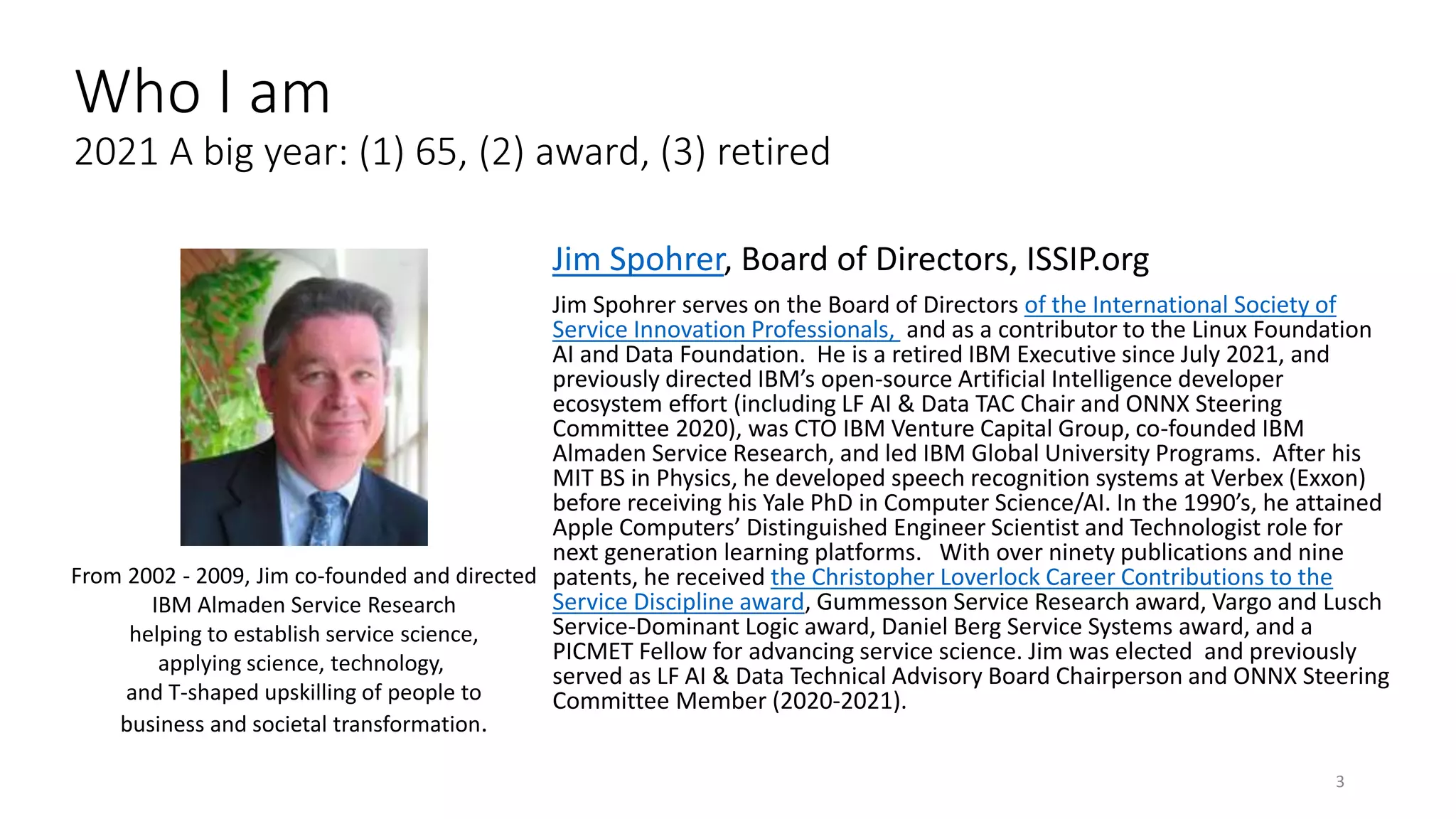
Jim Spohrer, Board of Directors, ISSIP.org
Jim Spohrer serves on the Board of Directors of the International Society of
Service Innovation Professionals, and as a contributor to the Linux Foundation
AI and Data Foundation. He is a retired IBM Executive since July 2021, and
previously directed IBM’s open-source Artificial Intelligence developer
ecosystem effort (including LF AI & Data TAC Chair and ONNX Steering
Committee 2020), was CTO IBM Venture Capital Group, co-founded IBM
Almaden Service Research, and led IBM Global University Programs. After his
MIT BS in Physics, he developed speech recognition systems at Verbex (Exxon)
before receiving his Yale PhD in Computer Science/AI. In the 1990’s, he attained
Apple Computers’ Distinguished Engineer Scientist and Technologist role for
next generation learning platforms. With over ninety publications and nine
patents, he received the Christopher Loverlock Career Contributions to the
Service Discipline award, Gummesson Service Research award, Vargo and Lusch
Service-Dominant Logic award, Daniel Berg Service Systems award, and a
PICMET Fellow for advancing service science. Jim was elected and previously
served as LF AI & Data Technical Advisory Board Chairperson and ONNX Steering
Committee Member (2020-2021).
3
From 2002 - 2009, Jim co-founded and directed
IBM Almaden Service Research
helping to establish service science,
applying science, technology,
and T-shaped upskilling of people to
business and societal transformation.
Who I am
2021 A big year: (1) 65, (2) award, (3) retired
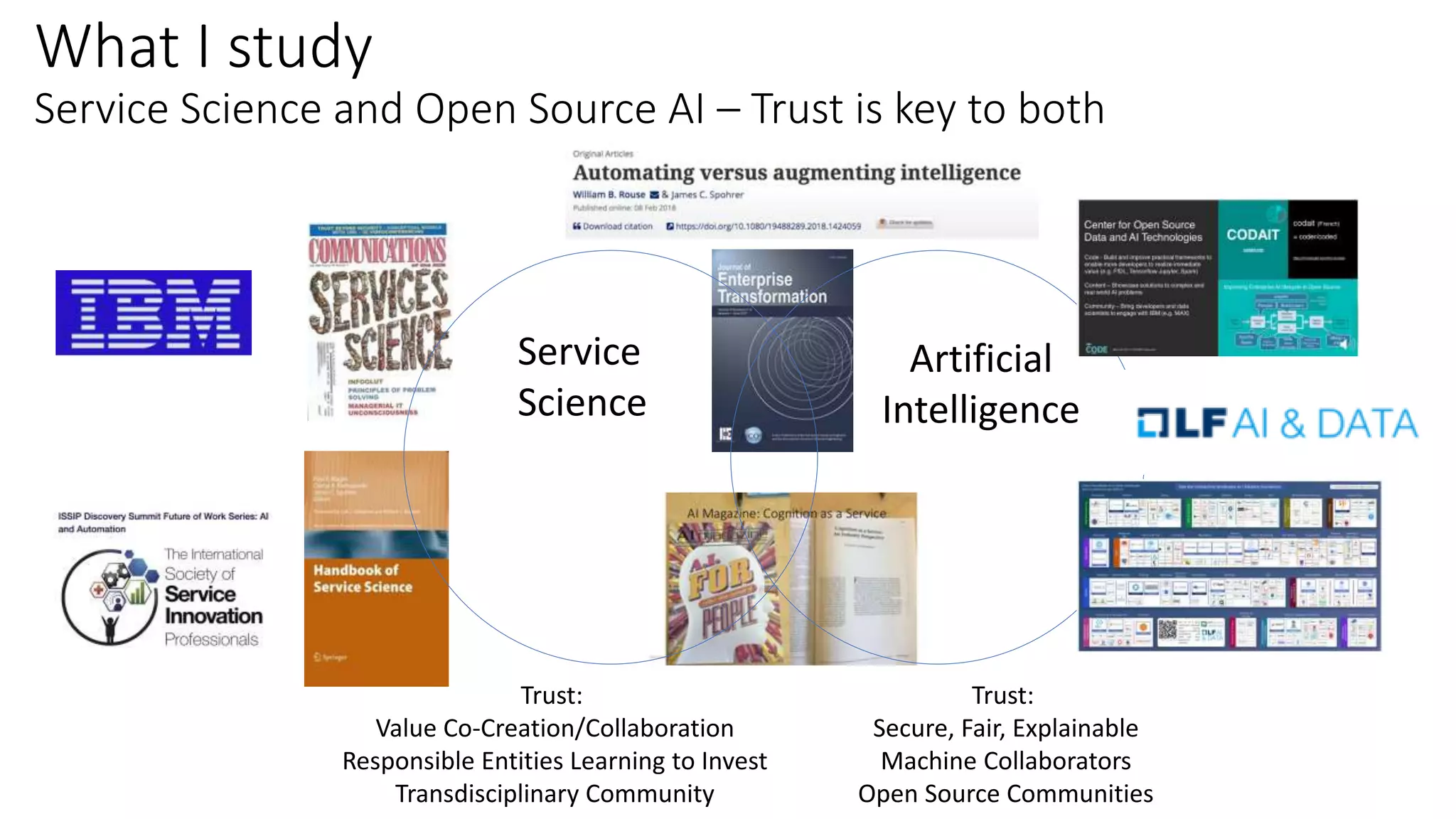
What I study
Service Science and Open Source AI – Trust is key to both
Service
Science
Artificial
Intelligence
Trust:
Value Co-Creation/Collaboration
Responsible Entities Learning to Invest
Transdisciplinary Community
Trust:
Secure, Fair, Explainable
Machine Collaborators
Open Source Communities
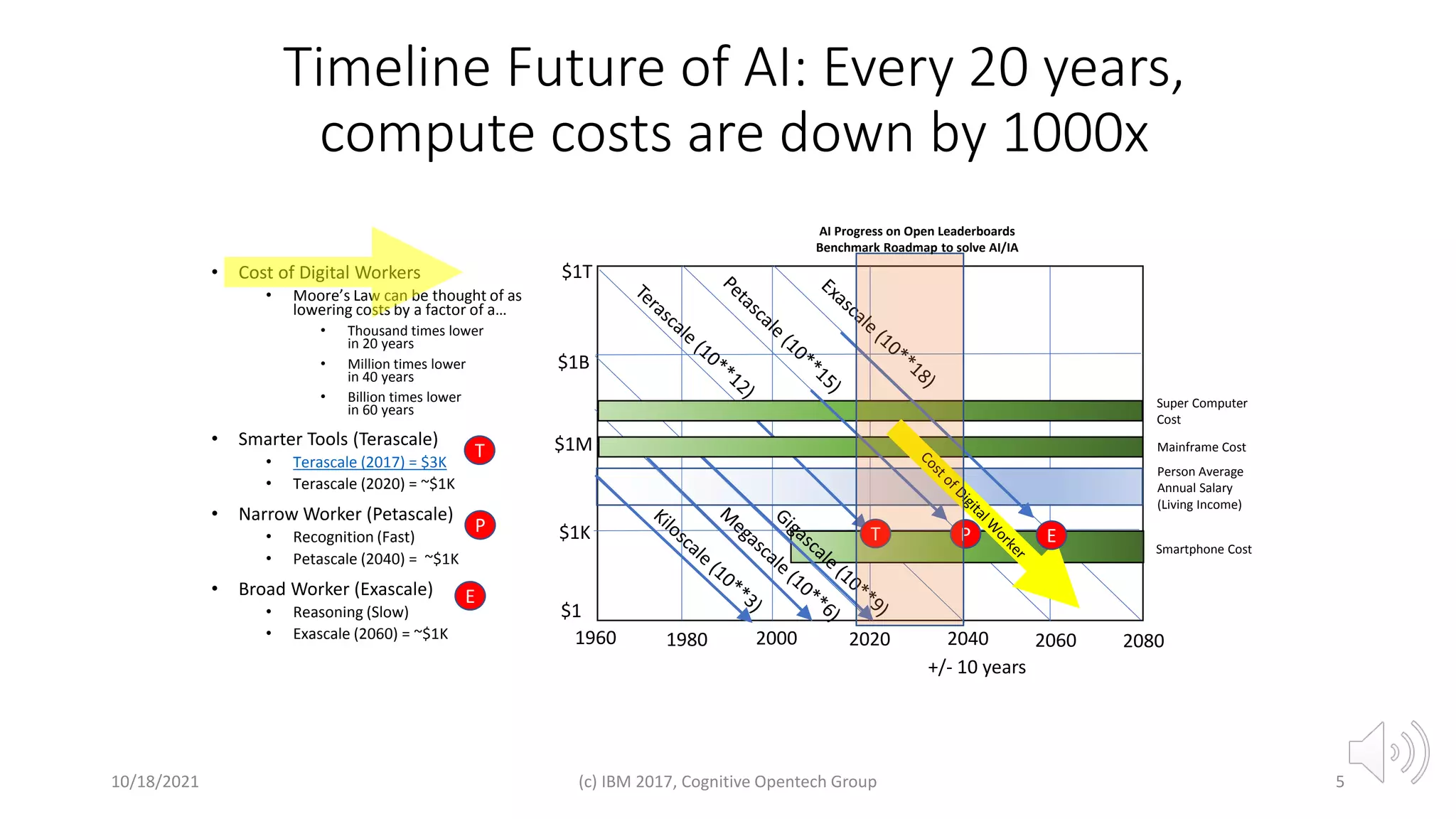
Timeline Future of AI: Every 20 years,
compute costs are down by 1000x
• Cost of Digital Workers
• Moore’s Law can be thought of as
lowering costs by a factor of a…
• Thousand times lower
in 20 years
• Million times lower
in 40 years
• Billion times lower
in 60 years
• Smarter Tools (Terascale)
• Terascale (2017) = $3K
• Terascale (2020) = ~$1K
• Narrow Worker (Petascale)
• Recognition (Fast)
• Petascale (2040) = ~$1K
• Broad Worker (Exascale)
• Reasoning (Slow)
• Exascale (2060) = ~$1K
5
10/18/2021 (c) IBM 2017, Cognitive Opentech Group
2080
2040
2000
1960
$1K
$1M
$1B
$1T
2060
2020
1980
+/- 10 years
$1
Person Average
Annual Salary
(Living Income)
Super Computer
Cost
Mainframe Cost
Smartphone Cost
T
P
E
T P E
AI Progress on Open Leaderboards
Benchmark Roadmap to solve AI/IA
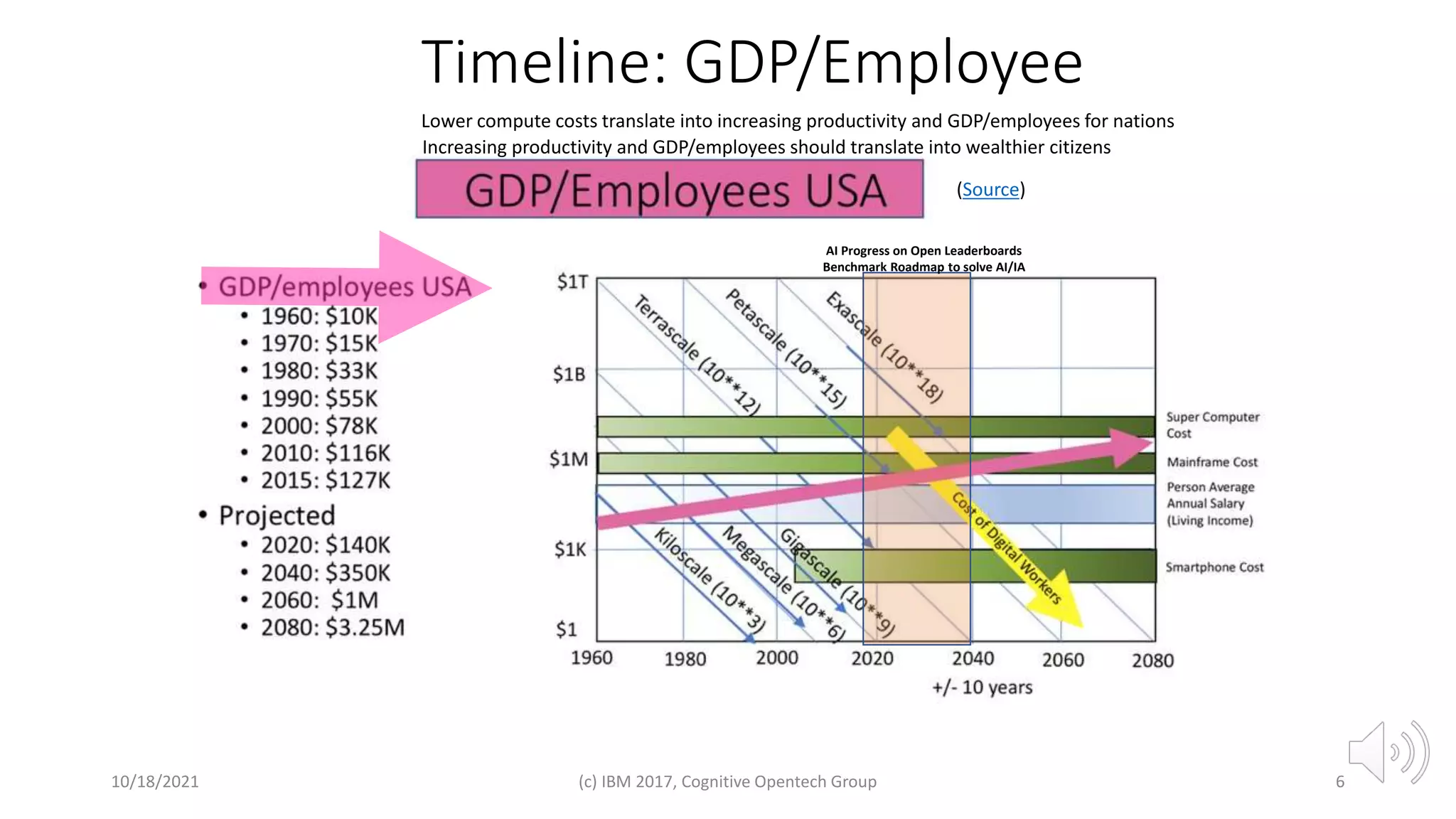
Timeline: GDP/Employee
10/18/2021 (c) IBM 2017, Cognitive Opentech Group 6
(Source)
Lower compute costs translate into increasing productivity and GDP/employees for nations
Increasing productivity and GDP/employees should translate into wealthier citizens
AI Progress on Open Leaderboards
Benchmark Roadmap to solve AI/IA
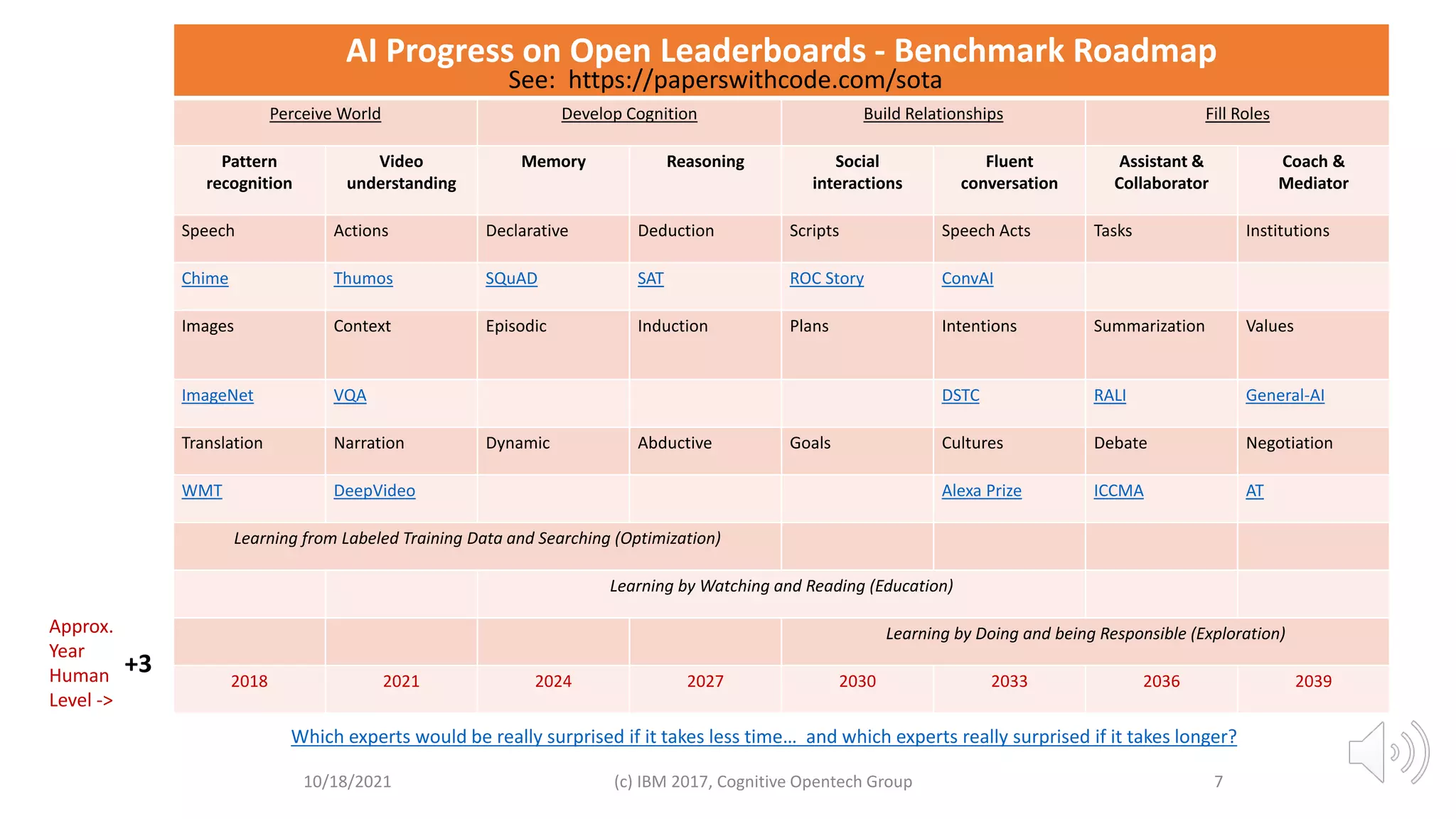
Timeline: Leaderboards Framework
AI Progress on Open Leaderboards - Benchmark Roadmap
Perceive World Develop Cognition Build Relationships Fill Roles
Pattern
recognition
Video
understanding
Memory Reasoning Social
interactions
Fluent
conversation
Assistant &
Collaborator
Coach &
Mediator
Speech Actions Declarative Deduction Scripts Speech Acts Tasks Institutions
Chime Thumos SQuAD SAT ROC Story ConvAI
Images Context Episodic Induction Plans Intentions Summarization Values
ImageNet VQA DSTC RALI General-AI
Translation Narration Dynamic Abductive Goals Cultures Debate Negotiation
WMT DeepVideo Alexa Prize ICCMA AT
Learning from Labeled Training Data and Searching (Optimization)
Learning by Watching and Reading (Education)
Learning by Doing and being Responsible (Exploration)
2018 2021 2024 2027 2030 2033 2036 2039
10/18/2021 (c) IBM 2017, Cognitive Opentech Group 7
Which experts would be really surprised if it takes less time… and which experts really surprised if it takes longer?
Approx.
Year
Human
Level ->
+3
See: https://paperswithcode.com/sota
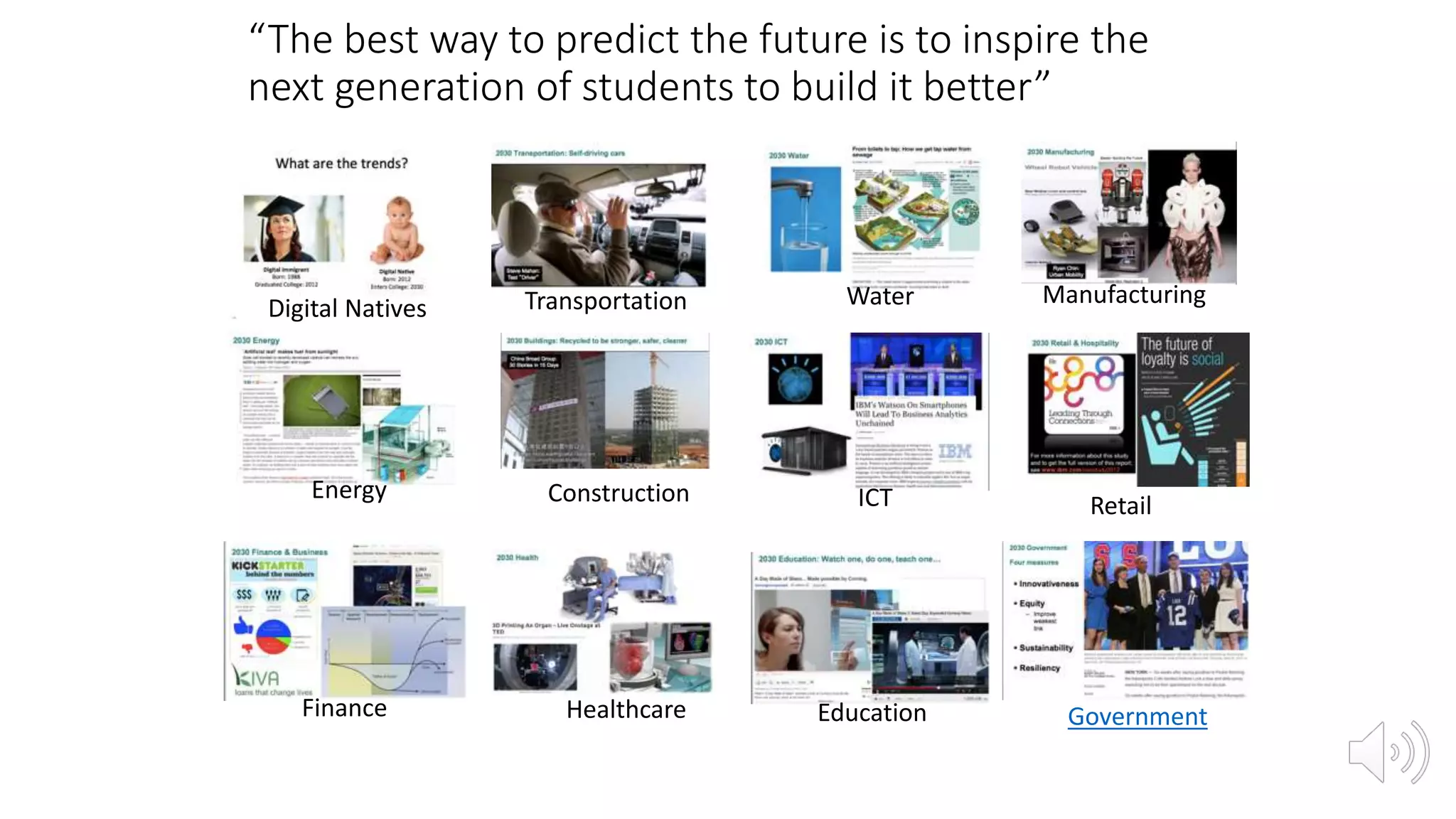
“The best way to predict the future is to inspire the
next generation of students to build it better”
Digital Natives Transportation Water Manufacturing
Energy Construction ICT Retail
Finance Healthcare Education Government
Backup Slides
• Additional information about service science and artificial intelligence
10/18/2021 (c) IBM MAP COG .| 9
Two disciplines: Two approaches to the future
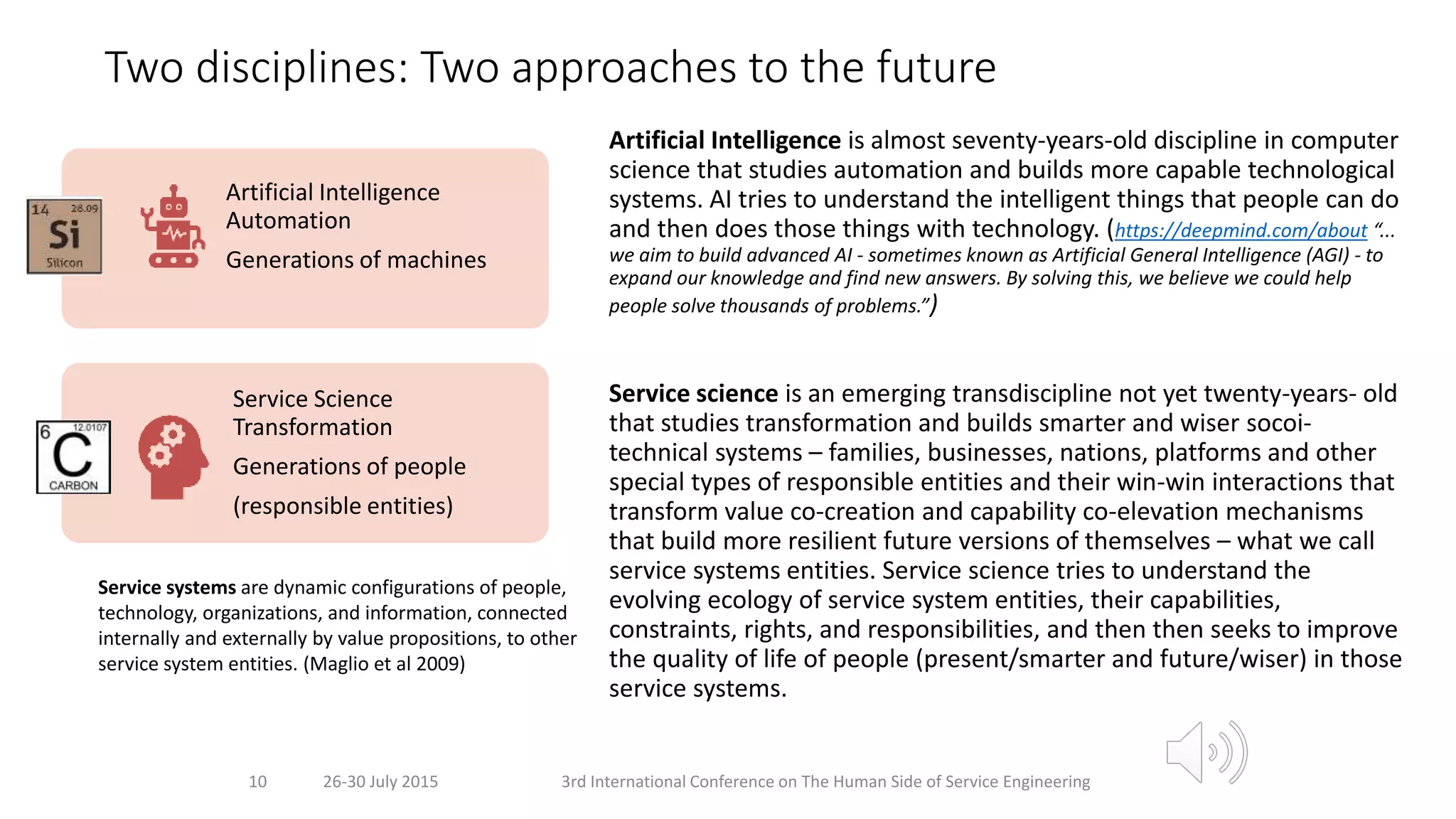
Artificial Intelligence is almost seventy-years-old discipline in computer
science that studies automation and builds more capable technological
systems. AI tries to understand the intelligent things that people can do
and then does those things with technology. (https://deepmind.com/about “...
we aim to build advanced AI - sometimes known as Artificial General Intelligence (AGI) - to
expand our knowledge and find new answers. By solving this, we believe we could help
people solve thousands of problems.”)
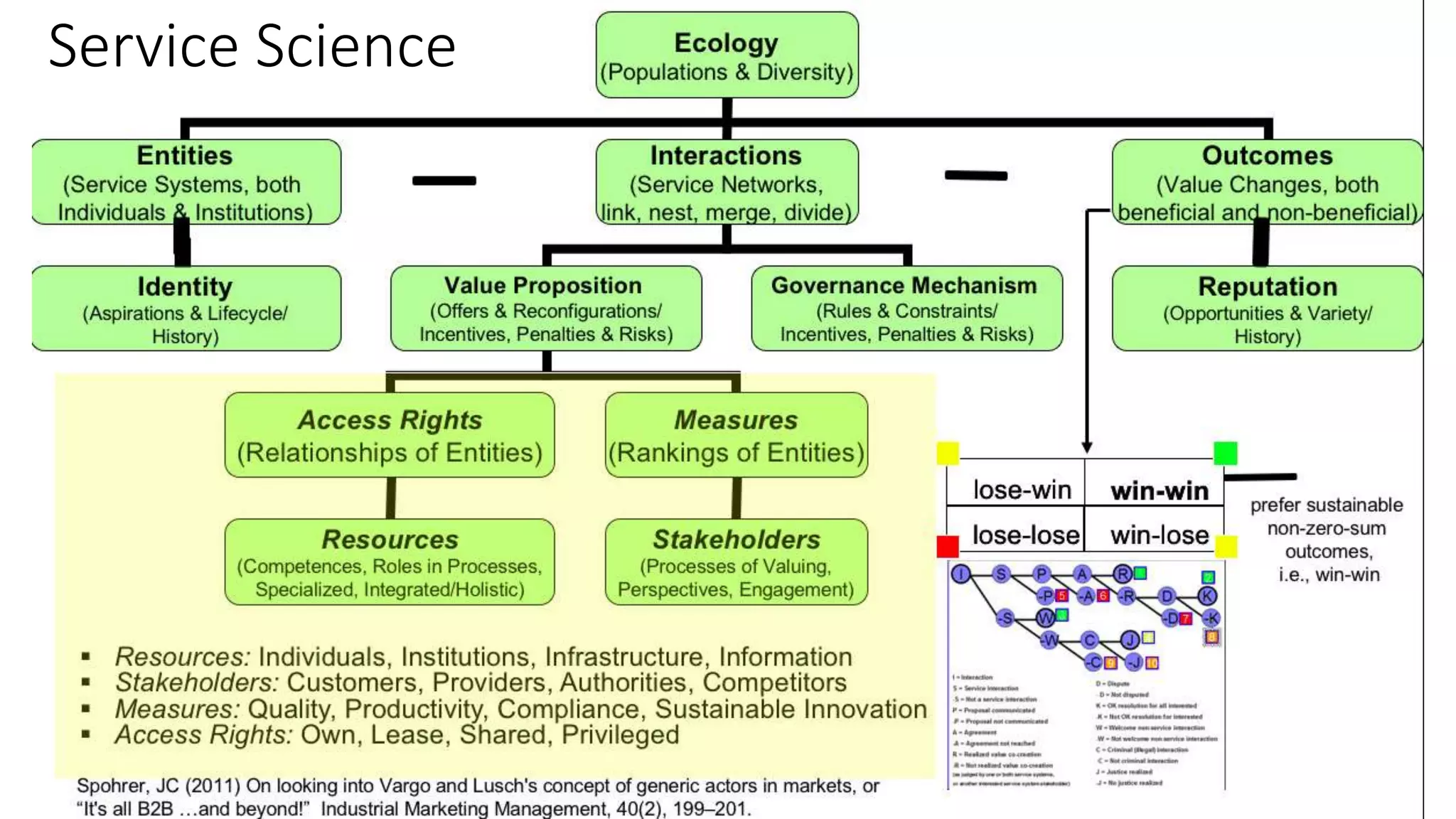
Service science is an emerging transdiscipline not yet twenty-years- old
that studies transformation and builds smarter and wiser socoi-
technical systems – families, businesses, nations, platforms and other
special types of responsible entities and their win-win interactions that
transform value co-creation and capability co-elevation mechanisms
that build more resilient future versions of themselves – what we call
service systems entities. Service science tries to understand the
evolving ecology of service system entities, their capabilities,
constraints, rights, and responsibilities, and then then seeks to improve
the quality of life of people (present/smarter and future/wiser) in those
service systems.
26-30 July 2015 3rd International Conference on The Human Side of Service Engineering
10
Artificial Intelligence
Automation
Generations of machines
Service Science
Transformation
Generations of people
(responsible entities)
Service systems are dynamic configurations of people,
technology, organizations, and information, connected
internally and externally by value propositions, to other
service system entities. (Maglio et al 2009)
Service Science: Conceptual Framework
10/18/2021 (c) IBM MAP COG .| 13
Service Science
(c) IBM MAP COG .| 14
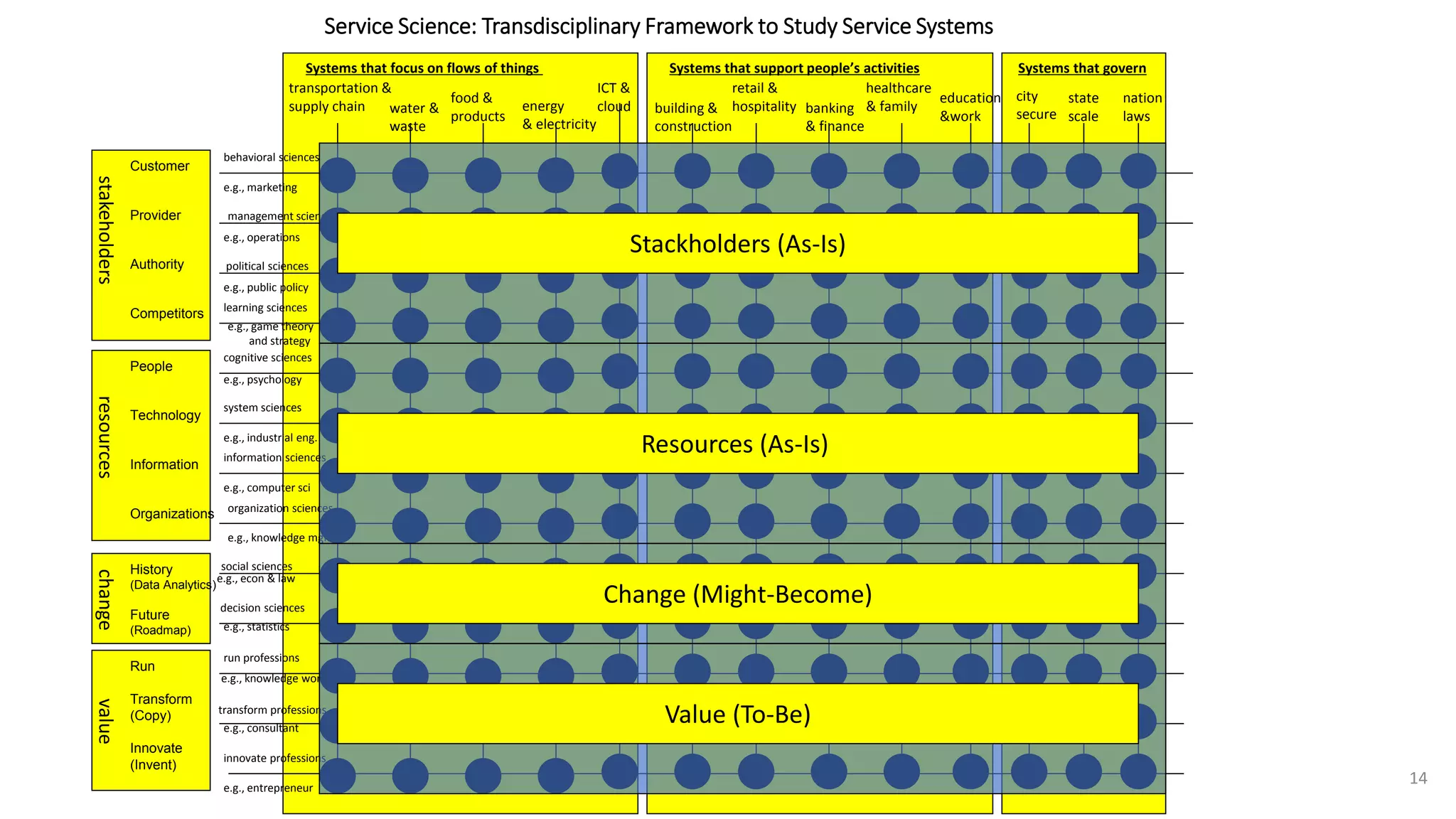
Service Science: Transdisciplinary Framework to Study Service Systems
Systems that focus on flows of things Systems that govern
Systems that support people’s activities
transportation &
supply chain water &
waste
food &
products
energy
& electricity
building &
construction
healthcare
& family
retail &
hospitality banking
& finance
ICT &
cloud
education
&work
city
secure
state
scale
nation
laws
social sciences
behavioral sciences
management sciences
political sciences
learning sciences
cognitive sciences
system sciences
information sciences
organization sciences
decision sciences
run professions
transform professions
innovate professions
e.g., econ & law
e.g., marketing
e.g., operations
e.g., public policy
e.g., game theory
and strategy
e.g., psychology
e.g., industrial eng.
e.g., computer sci
e.g., knowledge mgmt
e.g., statistics
e.g., knowledge worker
e.g., consultant
e.g., entrepreneur
stakeholders
Customer
Provider
Authority
Competitors
resources
People
Technology
Information
Organizations
change
History
(Data Analytics)
Future
(Roadmap)
value
Run
Transform
(Copy)
Innovate
(Invent)
Stackholders (As-Is)
Resources (As-Is)
Change (Might-Become)
Value (To-Be)
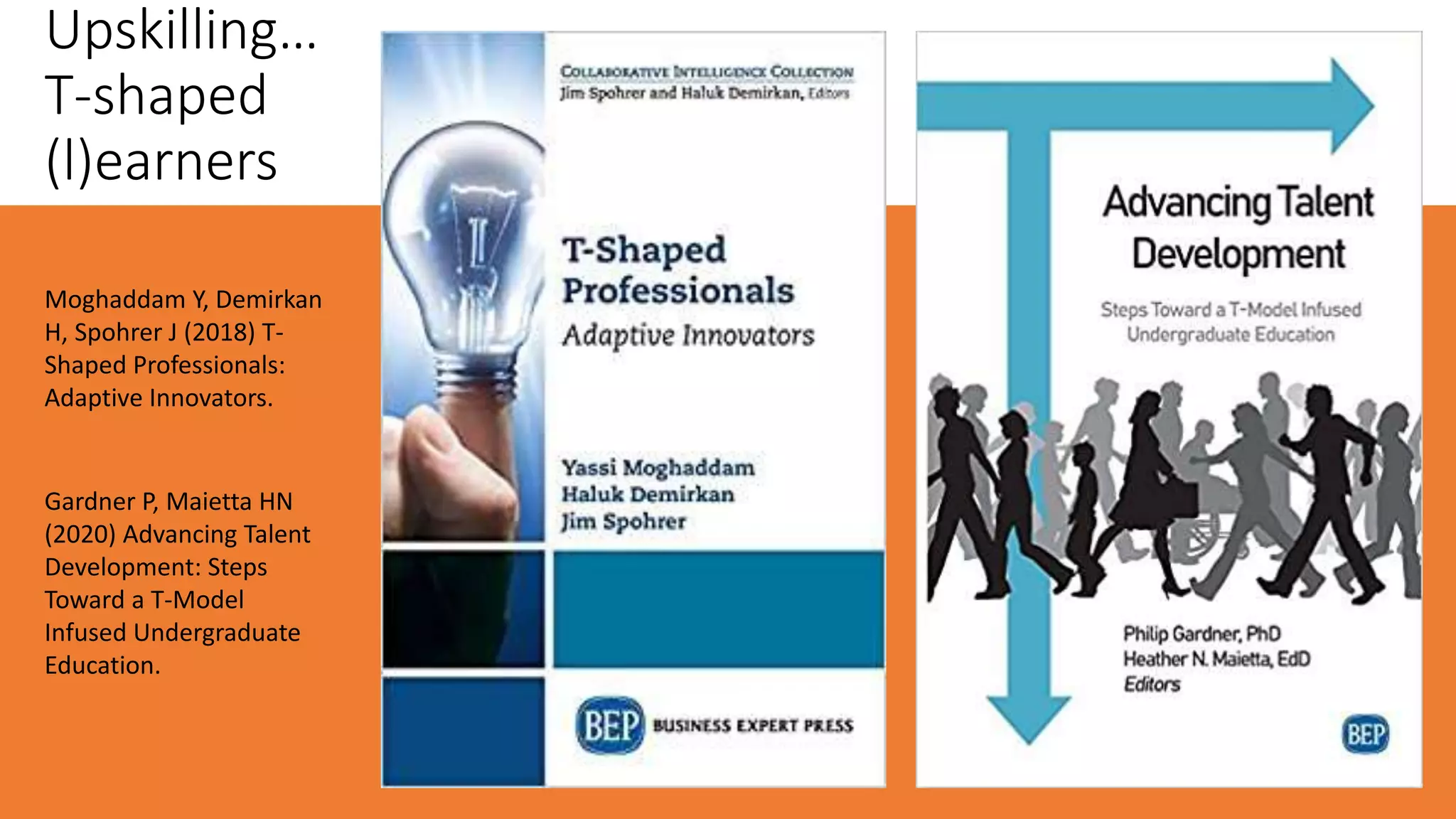
Upskilling…
T-shaped
(l)earners
Gardner P, Maietta HN
(2020) Advancing Talent
Development: Steps
Toward a T-Model
Infused Undergraduate
Education.
Moghaddam Y, Demirkan
H, Spohrer J (2018) T-
Shaped Professionals:
Adaptive Innovators.
10/18/2021 (c) IBM MAP COG .| 16
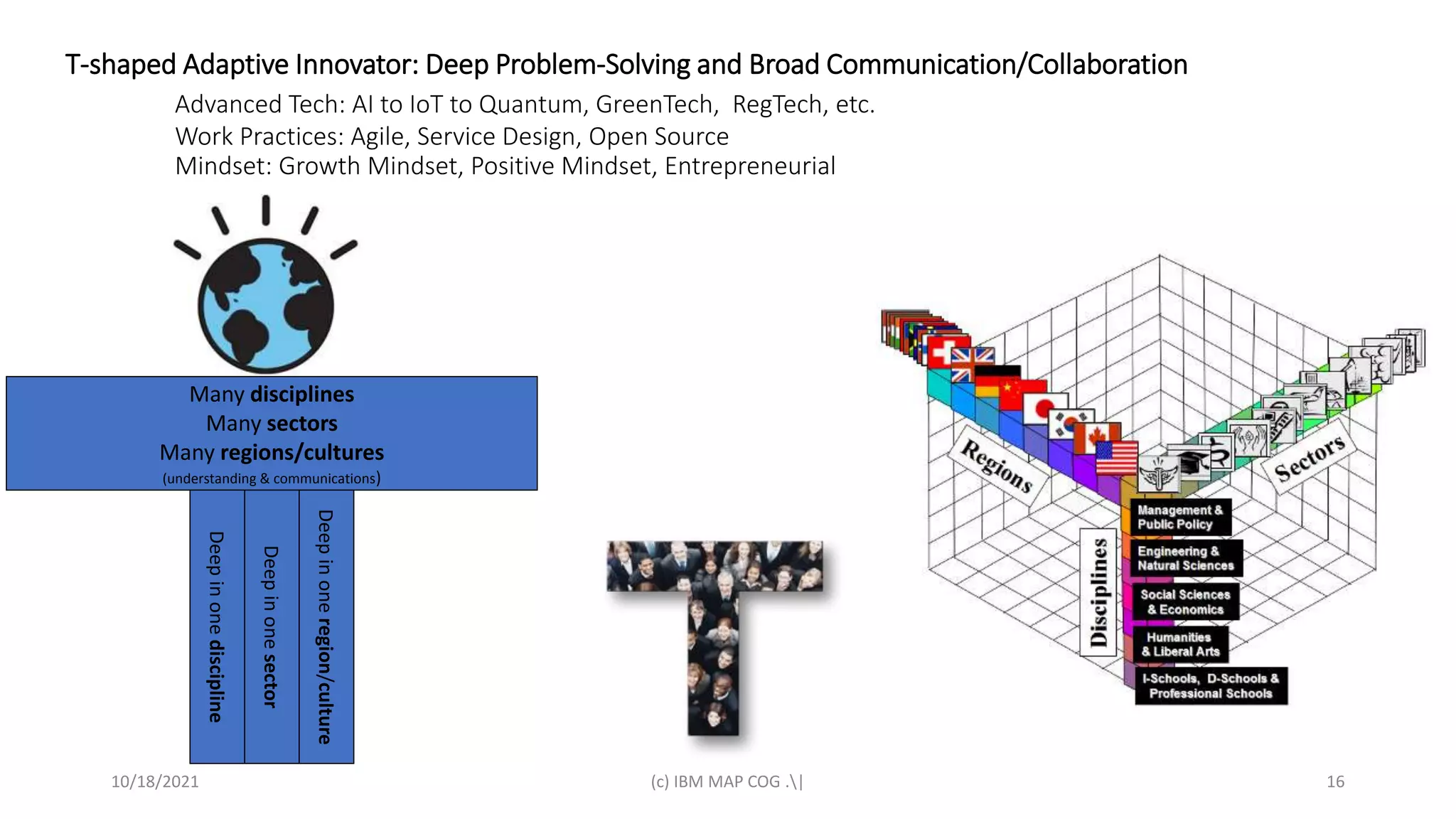
T-shaped Adaptive Innovator: Deep Problem-Solving and Broad Communication/Collaboration
Advanced Tech: AI to IoT to Quantum, GreenTech, RegTech, etc.
Work Practices: Agile, Service Design, Open Source
Mindset: Growth Mindset, Positive Mindset, Entrepreneurial
Many disciplines
Many sectors
Many regions/cultures
(understanding & communications)
Deep
in
one
sector
Deep
in
one
region/culture
Deep
in
one
discipline
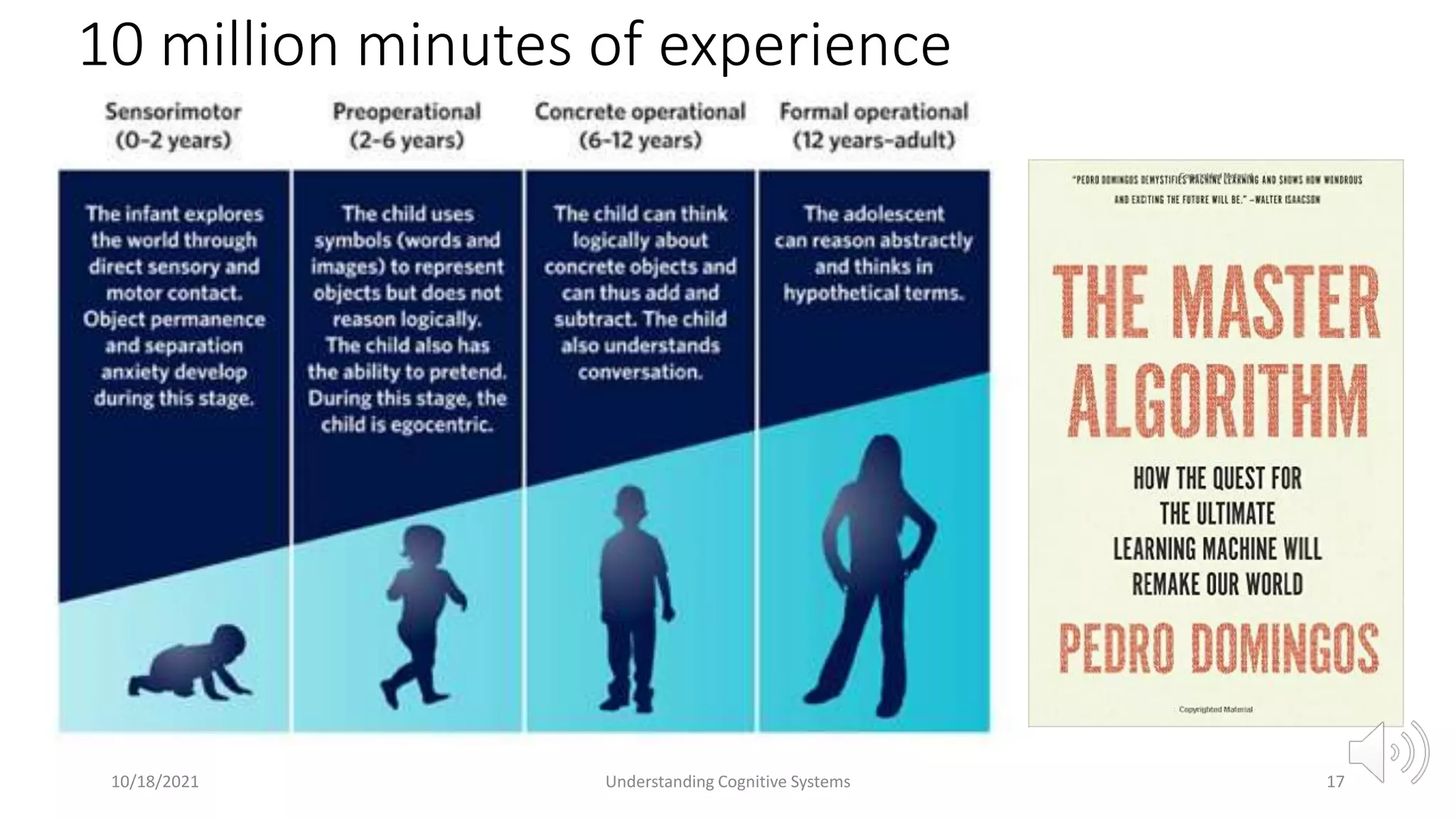
10 million minutes of experience
10/18/2021 Understanding Cognitive Systems 17
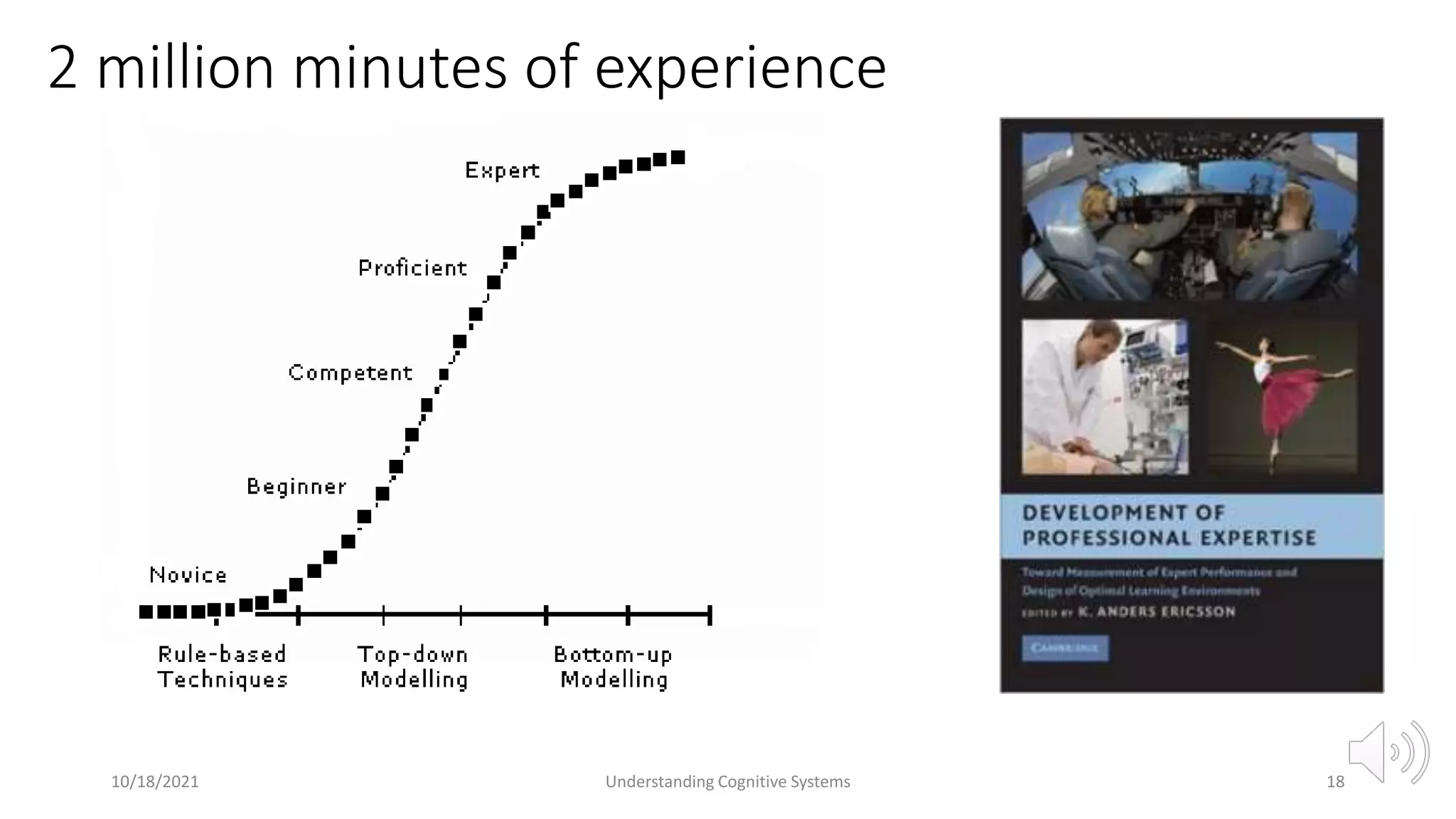
2 million minutes of experience
10/18/2021 Understanding Cognitive Systems 18
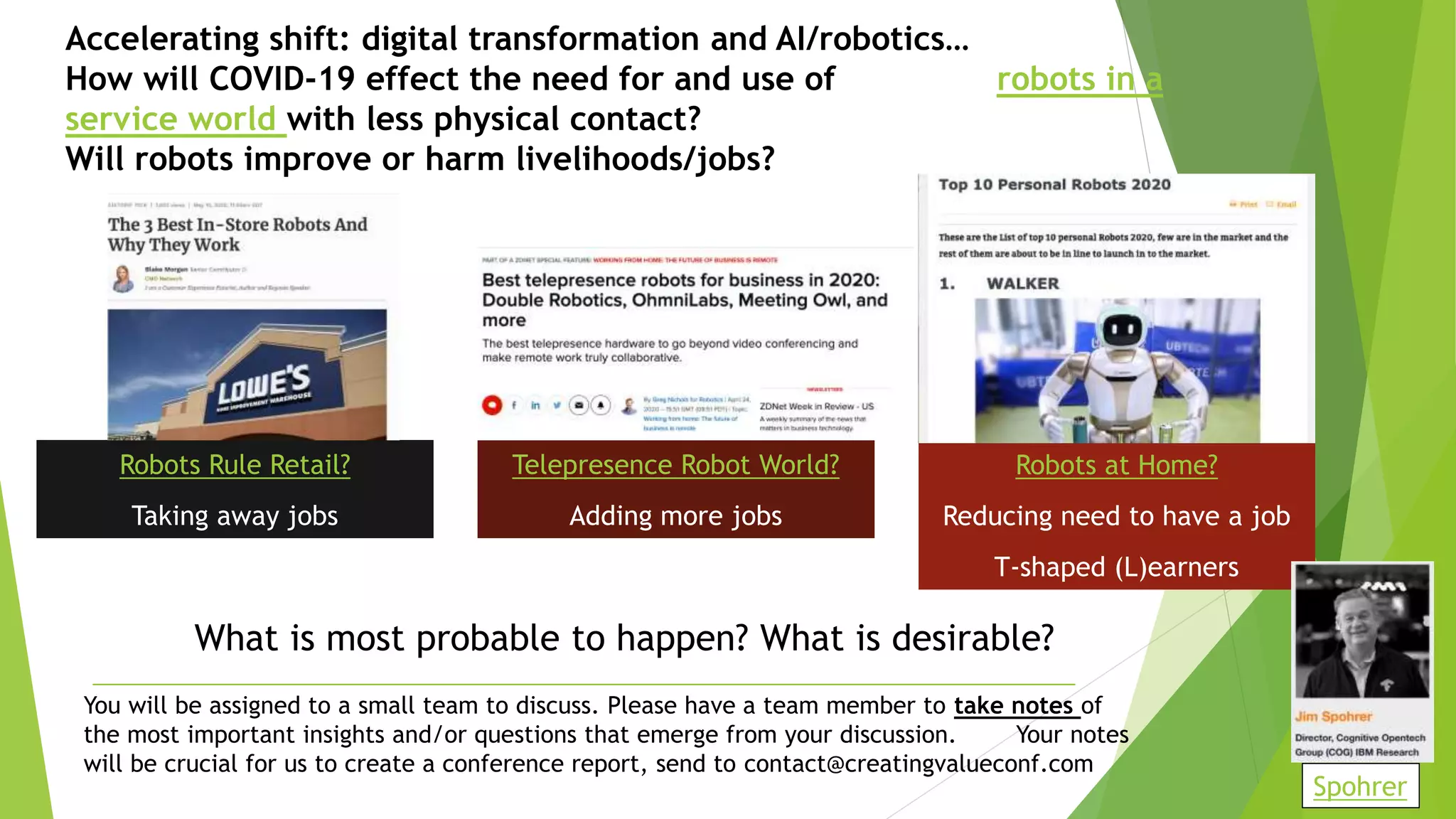
Accelerating shift: digital transformation and AI/robotics…
How will COVID-19 effect the need for and use of robots in a
service world with less physical contact?
Will robots improve or harm livelihoods/jobs?
Robots Rule Retail?
Taking away jobs
Telepresence Robot World?
Adding more jobs
Robots at Home?
Reducing need to have a job
T-shaped (L)earners
You will be assigned to a small team to discuss. Please have a team member to take notes of
the most important insights and/or questions that emerge from your discussion. Your notes
will be crucial for us to create a conference report, send to contact@creatingvalueconf.com
What is most probable to happen? What is desirable?
Spohrer
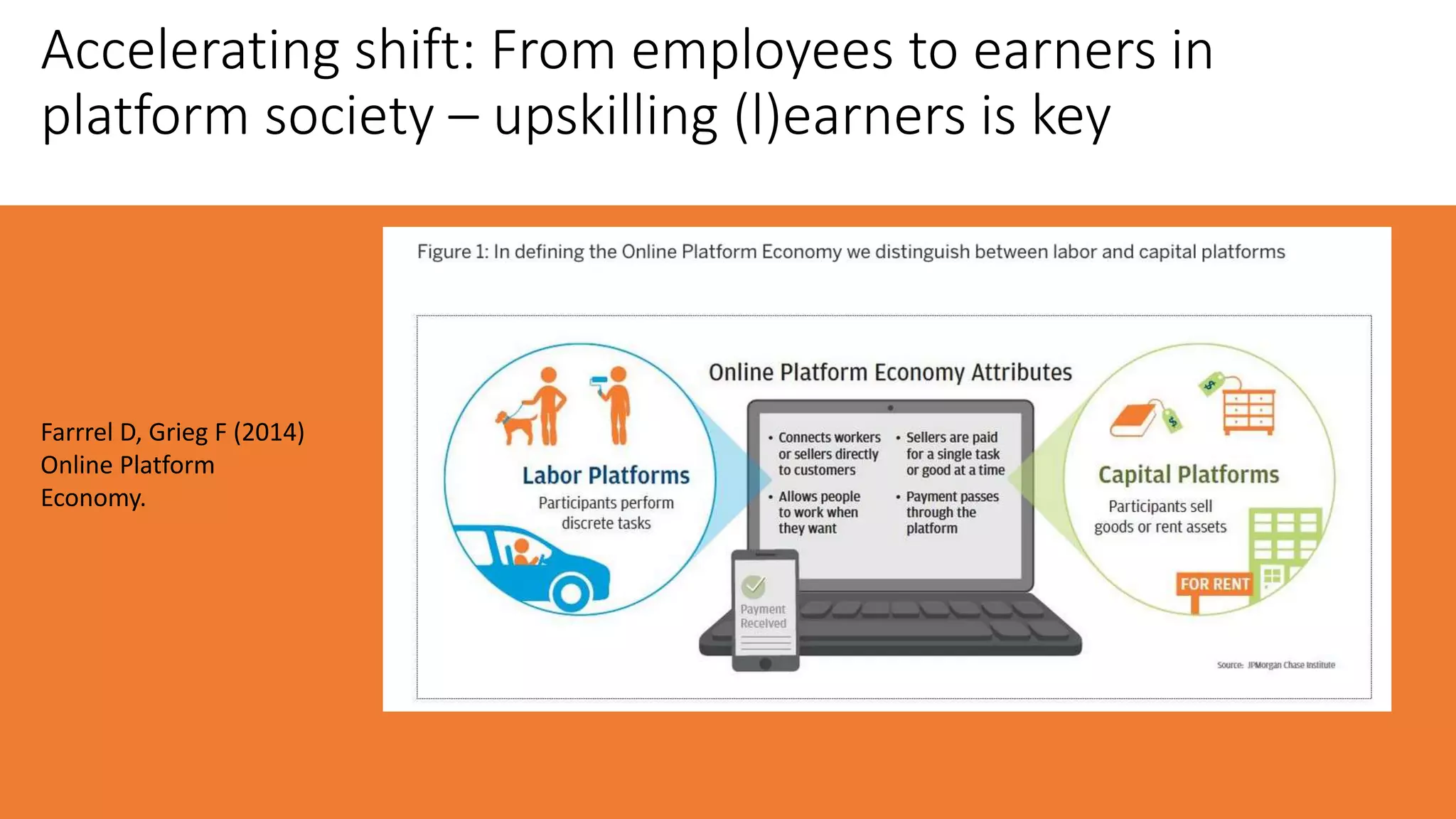
Accelerating shift: From employees to earners in
platform society – upskilling (l)earners is key
Farrrel D, Grieg F (2014)
Online Platform
Economy.
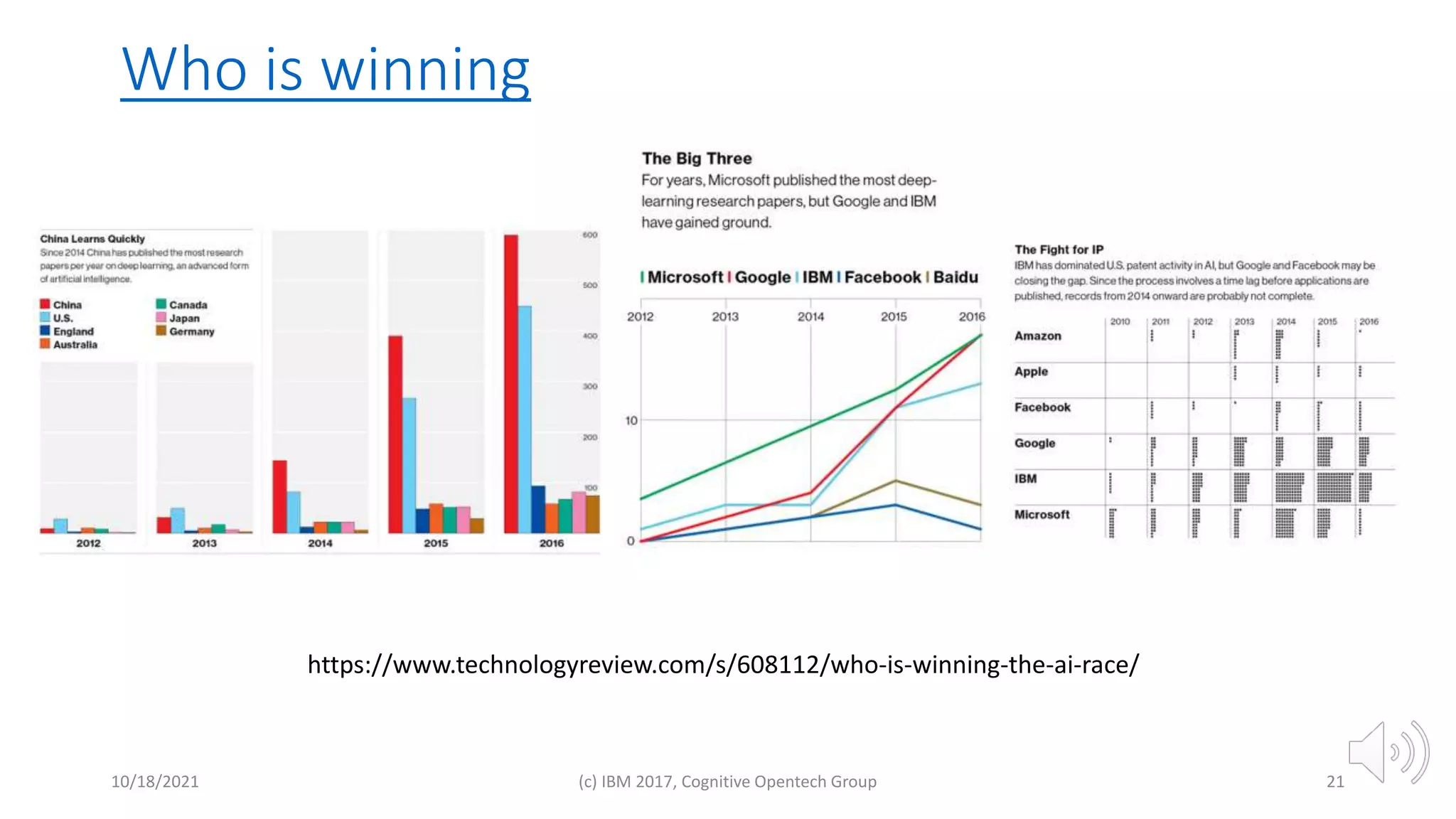
Who is winning
10/18/2021 (c) IBM 2017, Cognitive Opentech Group 21
https://www.technologyreview.com/s/608112/who-is-winning-the-ai-race/
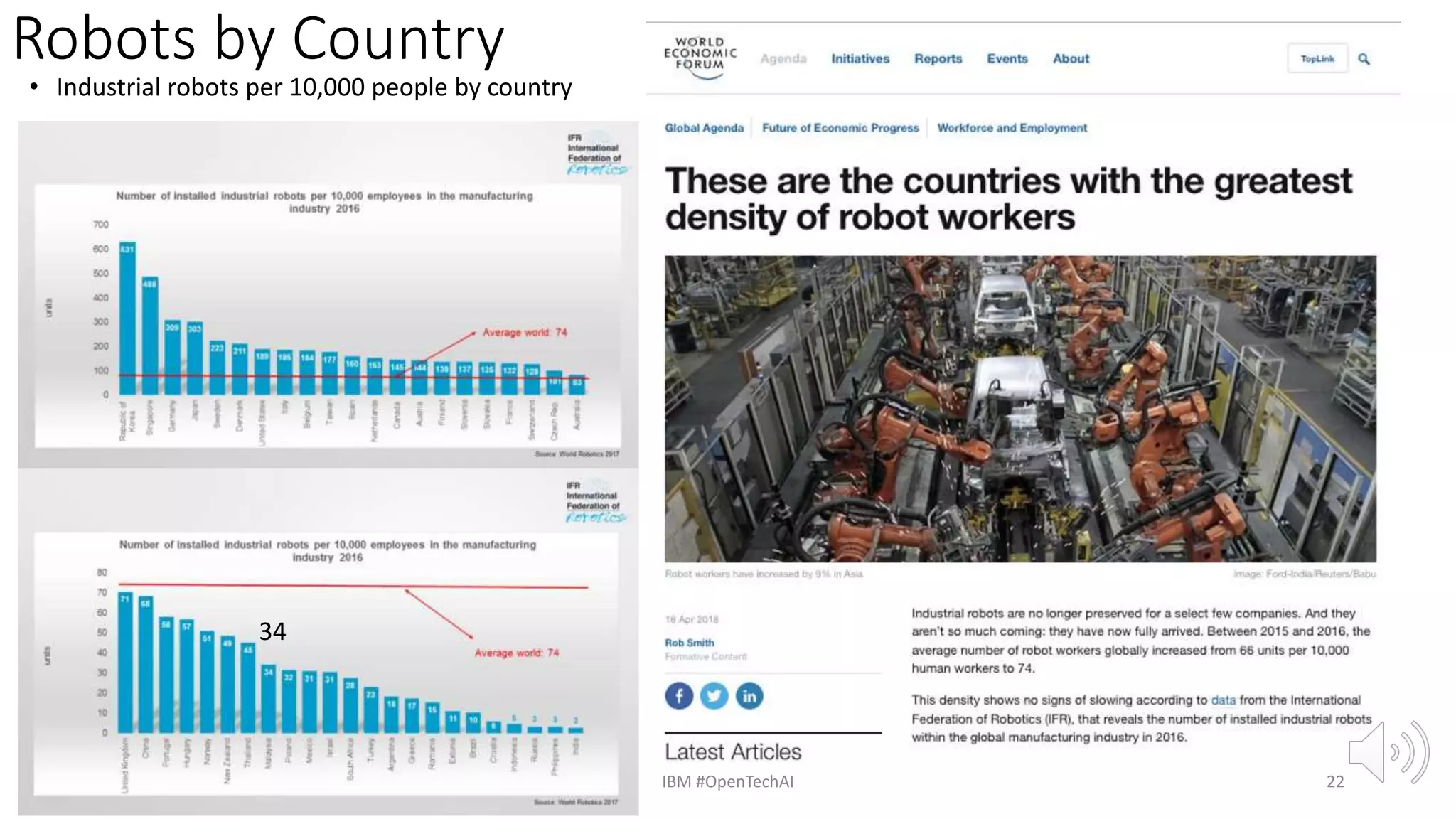
Robots by Country
• Industrial robots per 10,000 people by country
10/18/2021 IBM #OpenTechAI 22
34
AI Benefits
• Access to expertise
• “Insanely great” labor productivity for trusted service providers
• Digital workers for healthcare, education, finance, etc.
• Better choices
• ”Insanely great” collaborations with others on what matters most
• AI for IA = Augmented Intelligence and higher value co-creation interactions
10/18/2021 (c) IBM 2017, Cognitive Opentech Group 23
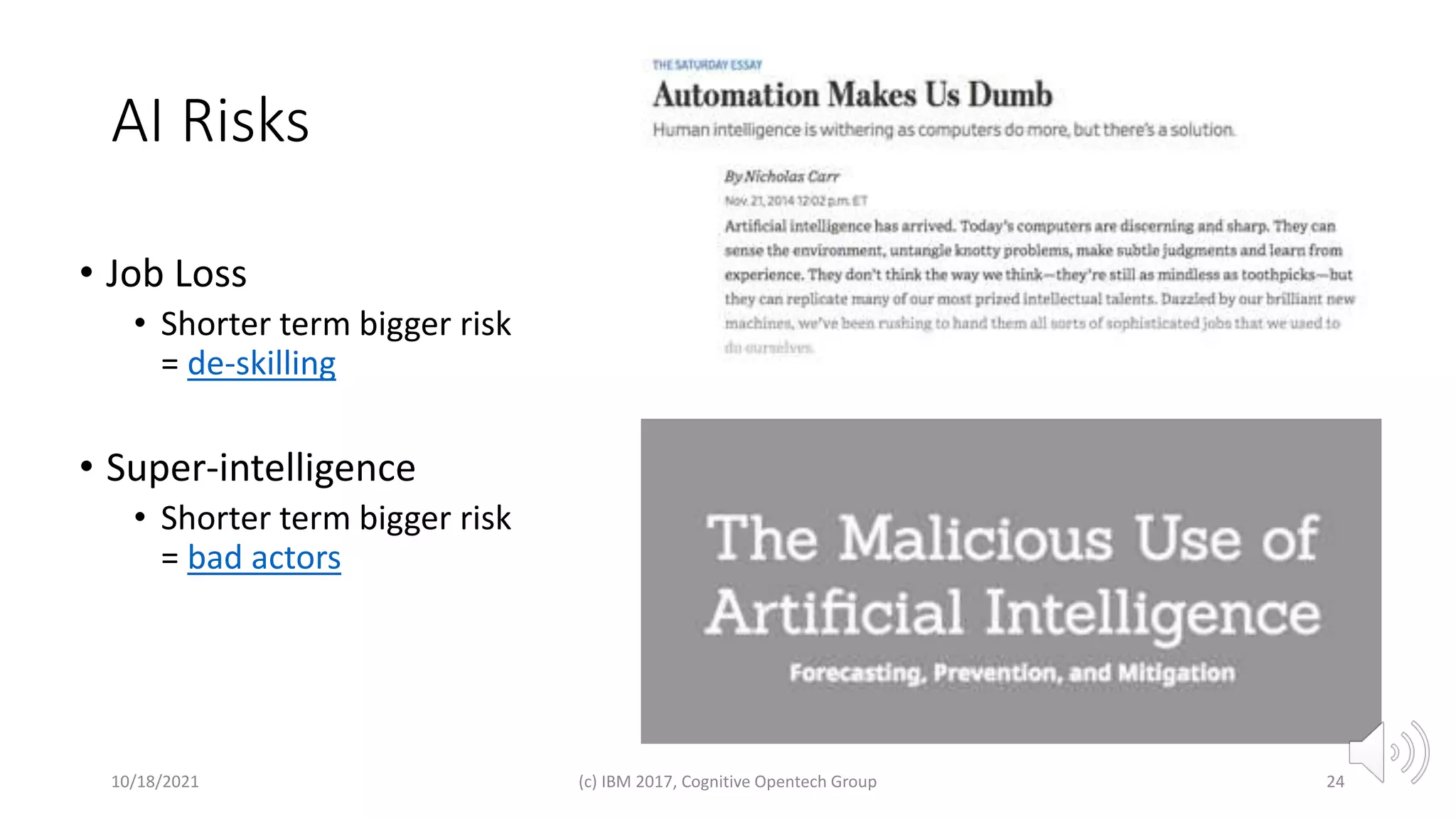
AI Risks
• Job Loss
• Shorter term bigger risk
= de-skilling
• Super-intelligence
• Shorter term bigger risk
= bad actors
10/18/2021 (c) IBM 2017, Cognitive Opentech Group 24
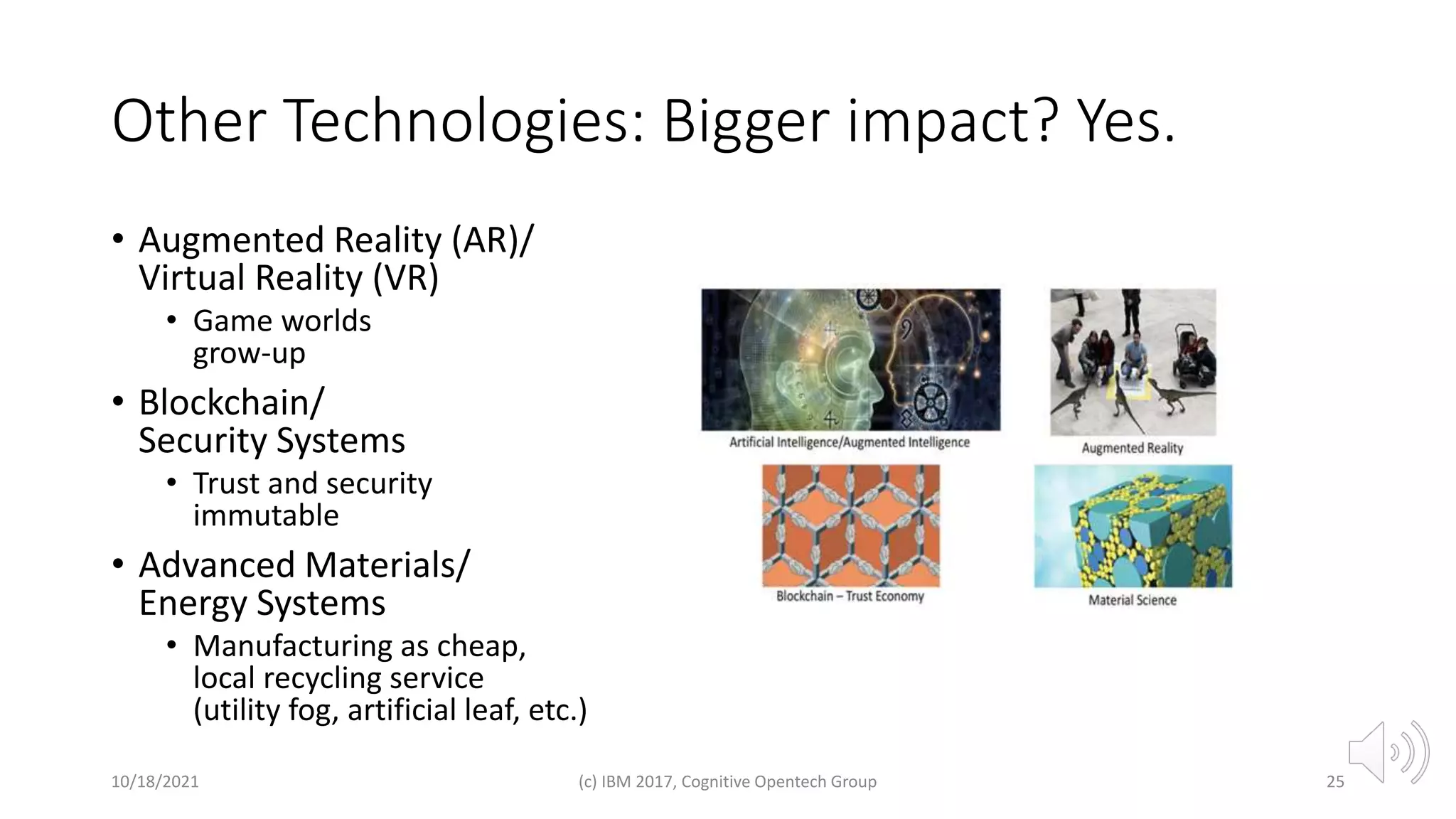
Other Technologies: Bigger impact? Yes.
• Augmented Reality (AR)/
Virtual Reality (VR)
• Game worlds
grow-up
• Blockchain/
Security Systems
• Trust and security
immutable
• Advanced Materials/
Energy Systems
• Manufacturing as cheap,
local recycling service
(utility fog, artificial leaf, etc.)
10/18/2021 (c) IBM 2017, Cognitive Opentech Group 25
26
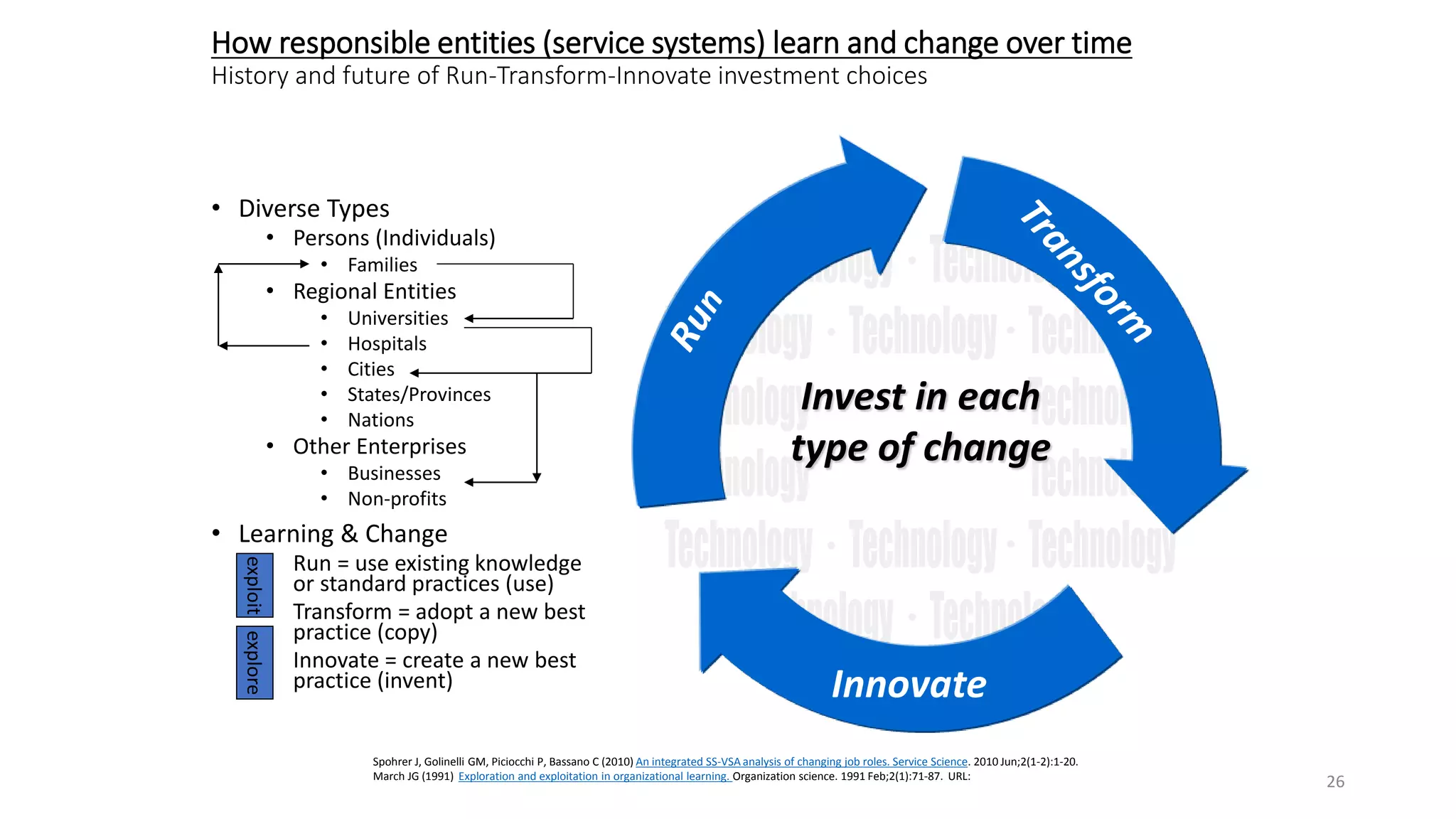
How responsible entities (service systems) learn and change over time
History and future of Run-Transform-Innovate investment choices
• Diverse Types
• Persons (Individuals)
• Families
• Regional Entities
• Universities
• Hospitals
• Cities
• States/Provinces
• Nations
• Other Enterprises
• Businesses
• Non-profits
• Learning & Change
• Run = use existing knowledge
or standard practices (use)
• Transform = adopt a new best
practice (copy)
• Innovate = create a new best
practice (invent) Innovate
Invest in each
type of change
Spohrer J, Golinelli GM, Piciocchi P, Bassano C (2010) An integrated SS-VSA analysis of changing job roles. Service Science. 2010 Jun;2(1-2):1-20.
March JG (1991) Exploration and exploitation in organizational learning. Organization science. 1991 Feb;2(1):71-87. URL:
exploit
explore
10/18/2021 27
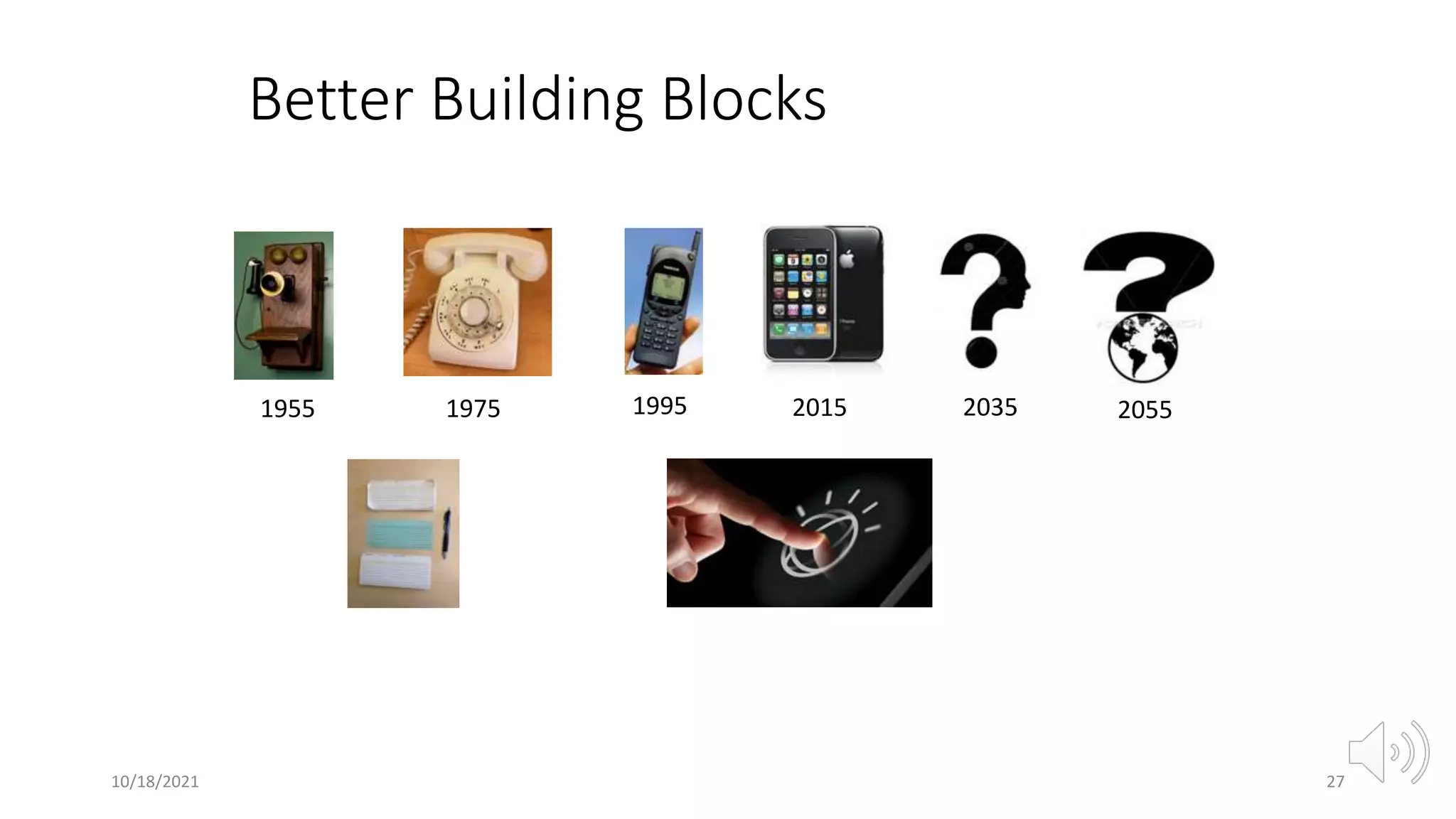
1955 1975 1995 2015 2035 2055
Better Building Blocks

2021020 jim spohrer ai for_good_conference future_of_ai v4

  • 1.
    Future of AI JimSpohrer Board of Directors, ISSIP.org Questions: spohrer@gmail.com Twitter: @JimSpohrer LinkedIn: https://www.linkedin.com/in/spohrer/ Slack: https://slack.lfai.foundation Presentations on line at: https://slideshare.net/spohrer Thanks to Liya Yuan for inviting me to be a speaker at the AI for Good conference – online (Oct 18, 2021) Highly recommend: Humankind: A Hopeful History By Dutch Historian, Rutger Bregman <- Thanks To Ray Fisk For suggesting this book
  • 2.
    Today’s Talk • TrustedAI will usher in a “Golden Age of Service” • However, when will AI be real? • Computing roadmap • Open source leaderboad roadmap • The best way to predict the future 2
  • 3.
    Jim Spohrer, Boardof Directors, ISSIP.org Jim Spohrer serves on the Board of Directors of the International Society of Service Innovation Professionals, and as a contributor to the Linux Foundation AI and Data Foundation. He is a retired IBM Executive since July 2021, and previously directed IBM’s open-source Artificial Intelligence developer ecosystem effort (including LF AI & Data TAC Chair and ONNX Steering Committee 2020), was CTO IBM Venture Capital Group, co-founded IBM Almaden Service Research, and led IBM Global University Programs. After his MIT BS in Physics, he developed speech recognition systems at Verbex (Exxon) before receiving his Yale PhD in Computer Science/AI. In the 1990’s, he attained Apple Computers’ Distinguished Engineer Scientist and Technologist role for next generation learning platforms. With over ninety publications and nine patents, he received the Christopher Loverlock Career Contributions to the Service Discipline award, Gummesson Service Research award, Vargo and Lusch Service-Dominant Logic award, Daniel Berg Service Systems award, and a PICMET Fellow for advancing service science. Jim was elected and previously served as LF AI & Data Technical Advisory Board Chairperson and ONNX Steering Committee Member (2020-2021). 3 From 2002 - 2009, Jim co-founded and directed IBM Almaden Service Research helping to establish service science, applying science, technology, and T-shaped upskilling of people to business and societal transformation. Who I am 2021 A big year: (1) 65, (2) award, (3) retired
  • 4.
    What I study ServiceScience and Open Source AI – Trust is key to both Service Science Artificial Intelligence Trust: Value Co-Creation/Collaboration Responsible Entities Learning to Invest Transdisciplinary Community Trust: Secure, Fair, Explainable Machine Collaborators Open Source Communities
  • 5.
    Timeline Future ofAI: Every 20 years, compute costs are down by 1000x • Cost of Digital Workers • Moore’s Law can be thought of as lowering costs by a factor of a… • Thousand times lower in 20 years • Million times lower in 40 years • Billion times lower in 60 years • Smarter Tools (Terascale) • Terascale (2017) = $3K • Terascale (2020) = ~$1K • Narrow Worker (Petascale) • Recognition (Fast) • Petascale (2040) = ~$1K • Broad Worker (Exascale) • Reasoning (Slow) • Exascale (2060) = ~$1K 5 10/18/2021 (c) IBM 2017, Cognitive Opentech Group 2080 2040 2000 1960 $1K $1M $1B $1T 2060 2020 1980 +/- 10 years $1 Person Average Annual Salary (Living Income) Super Computer Cost Mainframe Cost Smartphone Cost T P E T P E AI Progress on Open Leaderboards Benchmark Roadmap to solve AI/IA
  • 6.
    Timeline: GDP/Employee 10/18/2021 (c)IBM 2017, Cognitive Opentech Group 6 (Source) Lower compute costs translate into increasing productivity and GDP/employees for nations Increasing productivity and GDP/employees should translate into wealthier citizens AI Progress on Open Leaderboards Benchmark Roadmap to solve AI/IA
  • 7.
    Timeline: Leaderboards Framework AIProgress on Open Leaderboards - Benchmark Roadmap Perceive World Develop Cognition Build Relationships Fill Roles Pattern recognition Video understanding Memory Reasoning Social interactions Fluent conversation Assistant & Collaborator Coach & Mediator Speech Actions Declarative Deduction Scripts Speech Acts Tasks Institutions Chime Thumos SQuAD SAT ROC Story ConvAI Images Context Episodic Induction Plans Intentions Summarization Values ImageNet VQA DSTC RALI General-AI Translation Narration Dynamic Abductive Goals Cultures Debate Negotiation WMT DeepVideo Alexa Prize ICCMA AT Learning from Labeled Training Data and Searching (Optimization) Learning by Watching and Reading (Education) Learning by Doing and being Responsible (Exploration) 2018 2021 2024 2027 2030 2033 2036 2039 10/18/2021 (c) IBM 2017, Cognitive Opentech Group 7 Which experts would be really surprised if it takes less time… and which experts really surprised if it takes longer? Approx. Year Human Level -> +3 See: https://paperswithcode.com/sota
  • 8.
    “The best wayto predict the future is to inspire the next generation of students to build it better” Digital Natives Transportation Water Manufacturing Energy Construction ICT Retail Finance Healthcare Education Government
  • 9.
    Backup Slides • Additionalinformation about service science and artificial intelligence 10/18/2021 (c) IBM MAP COG .| 9
  • 10.
    Two disciplines: Twoapproaches to the future Artificial Intelligence is almost seventy-years-old discipline in computer science that studies automation and builds more capable technological systems. AI tries to understand the intelligent things that people can do and then does those things with technology. (https://deepmind.com/about “... we aim to build advanced AI - sometimes known as Artificial General Intelligence (AGI) - to expand our knowledge and find new answers. By solving this, we believe we could help people solve thousands of problems.”) Service science is an emerging transdiscipline not yet twenty-years- old that studies transformation and builds smarter and wiser socoi- technical systems – families, businesses, nations, platforms and other special types of responsible entities and their win-win interactions that transform value co-creation and capability co-elevation mechanisms that build more resilient future versions of themselves – what we call service systems entities. Service science tries to understand the evolving ecology of service system entities, their capabilities, constraints, rights, and responsibilities, and then then seeks to improve the quality of life of people (present/smarter and future/wiser) in those service systems. 26-30 July 2015 3rd International Conference on The Human Side of Service Engineering 10 Artificial Intelligence Automation Generations of machines Service Science Transformation Generations of people (responsible entities) Service systems are dynamic configurations of people, technology, organizations, and information, connected internally and externally by value propositions, to other service system entities. (Maglio et al 2009)
  • 13.
    Service Science: ConceptualFramework 10/18/2021 (c) IBM MAP COG .| 13 Service Science
  • 14.
    (c) IBM MAPCOG .| 14 Service Science: Transdisciplinary Framework to Study Service Systems Systems that focus on flows of things Systems that govern Systems that support people’s activities transportation & supply chain water & waste food & products energy & electricity building & construction healthcare & family retail & hospitality banking & finance ICT & cloud education &work city secure state scale nation laws social sciences behavioral sciences management sciences political sciences learning sciences cognitive sciences system sciences information sciences organization sciences decision sciences run professions transform professions innovate professions e.g., econ & law e.g., marketing e.g., operations e.g., public policy e.g., game theory and strategy e.g., psychology e.g., industrial eng. e.g., computer sci e.g., knowledge mgmt e.g., statistics e.g., knowledge worker e.g., consultant e.g., entrepreneur stakeholders Customer Provider Authority Competitors resources People Technology Information Organizations change History (Data Analytics) Future (Roadmap) value Run Transform (Copy) Innovate (Invent) Stackholders (As-Is) Resources (As-Is) Change (Might-Become) Value (To-Be)
  • 15.
    Upskilling… T-shaped (l)earners Gardner P, MaiettaHN (2020) Advancing Talent Development: Steps Toward a T-Model Infused Undergraduate Education. Moghaddam Y, Demirkan H, Spohrer J (2018) T- Shaped Professionals: Adaptive Innovators.
  • 16.
    10/18/2021 (c) IBMMAP COG .| 16 T-shaped Adaptive Innovator: Deep Problem-Solving and Broad Communication/Collaboration Advanced Tech: AI to IoT to Quantum, GreenTech, RegTech, etc. Work Practices: Agile, Service Design, Open Source Mindset: Growth Mindset, Positive Mindset, Entrepreneurial Many disciplines Many sectors Many regions/cultures (understanding & communications) Deep in one sector Deep in one region/culture Deep in one discipline
  • 17.
    10 million minutesof experience 10/18/2021 Understanding Cognitive Systems 17
  • 18.
    2 million minutesof experience 10/18/2021 Understanding Cognitive Systems 18
  • 19.
    Accelerating shift: digitaltransformation and AI/robotics… How will COVID-19 effect the need for and use of robots in a service world with less physical contact? Will robots improve or harm livelihoods/jobs? Robots Rule Retail? Taking away jobs Telepresence Robot World? Adding more jobs Robots at Home? Reducing need to have a job T-shaped (L)earners You will be assigned to a small team to discuss. Please have a team member to take notes of the most important insights and/or questions that emerge from your discussion. Your notes will be crucial for us to create a conference report, send to contact@creatingvalueconf.com What is most probable to happen? What is desirable? Spohrer
  • 20.
    Accelerating shift: Fromemployees to earners in platform society – upskilling (l)earners is key Farrrel D, Grieg F (2014) Online Platform Economy.
  • 21.
    Who is winning 10/18/2021(c) IBM 2017, Cognitive Opentech Group 21 https://www.technologyreview.com/s/608112/who-is-winning-the-ai-race/
  • 22.
    Robots by Country •Industrial robots per 10,000 people by country 10/18/2021 IBM #OpenTechAI 22 34
  • 23.
    AI Benefits • Accessto expertise • “Insanely great” labor productivity for trusted service providers • Digital workers for healthcare, education, finance, etc. • Better choices • ”Insanely great” collaborations with others on what matters most • AI for IA = Augmented Intelligence and higher value co-creation interactions 10/18/2021 (c) IBM 2017, Cognitive Opentech Group 23
  • 24.
    AI Risks • JobLoss • Shorter term bigger risk = de-skilling • Super-intelligence • Shorter term bigger risk = bad actors 10/18/2021 (c) IBM 2017, Cognitive Opentech Group 24
  • 25.
    Other Technologies: Biggerimpact? Yes. • Augmented Reality (AR)/ Virtual Reality (VR) • Game worlds grow-up • Blockchain/ Security Systems • Trust and security immutable • Advanced Materials/ Energy Systems • Manufacturing as cheap, local recycling service (utility fog, artificial leaf, etc.) 10/18/2021 (c) IBM 2017, Cognitive Opentech Group 25
  • 26.
    26 How responsible entities(service systems) learn and change over time History and future of Run-Transform-Innovate investment choices • Diverse Types • Persons (Individuals) • Families • Regional Entities • Universities • Hospitals • Cities • States/Provinces • Nations • Other Enterprises • Businesses • Non-profits • Learning & Change • Run = use existing knowledge or standard practices (use) • Transform = adopt a new best practice (copy) • Innovate = create a new best practice (invent) Innovate Invest in each type of change Spohrer J, Golinelli GM, Piciocchi P, Bassano C (2010) An integrated SS-VSA analysis of changing job roles. Service Science. 2010 Jun;2(1-2):1-20. March JG (1991) Exploration and exploitation in organizational learning. Organization science. 1991 Feb;2(1):71-87. URL: exploit explore
  • 27.
    10/18/2021 27 1955 19751995 2015 2035 2055 Better Building Blocks