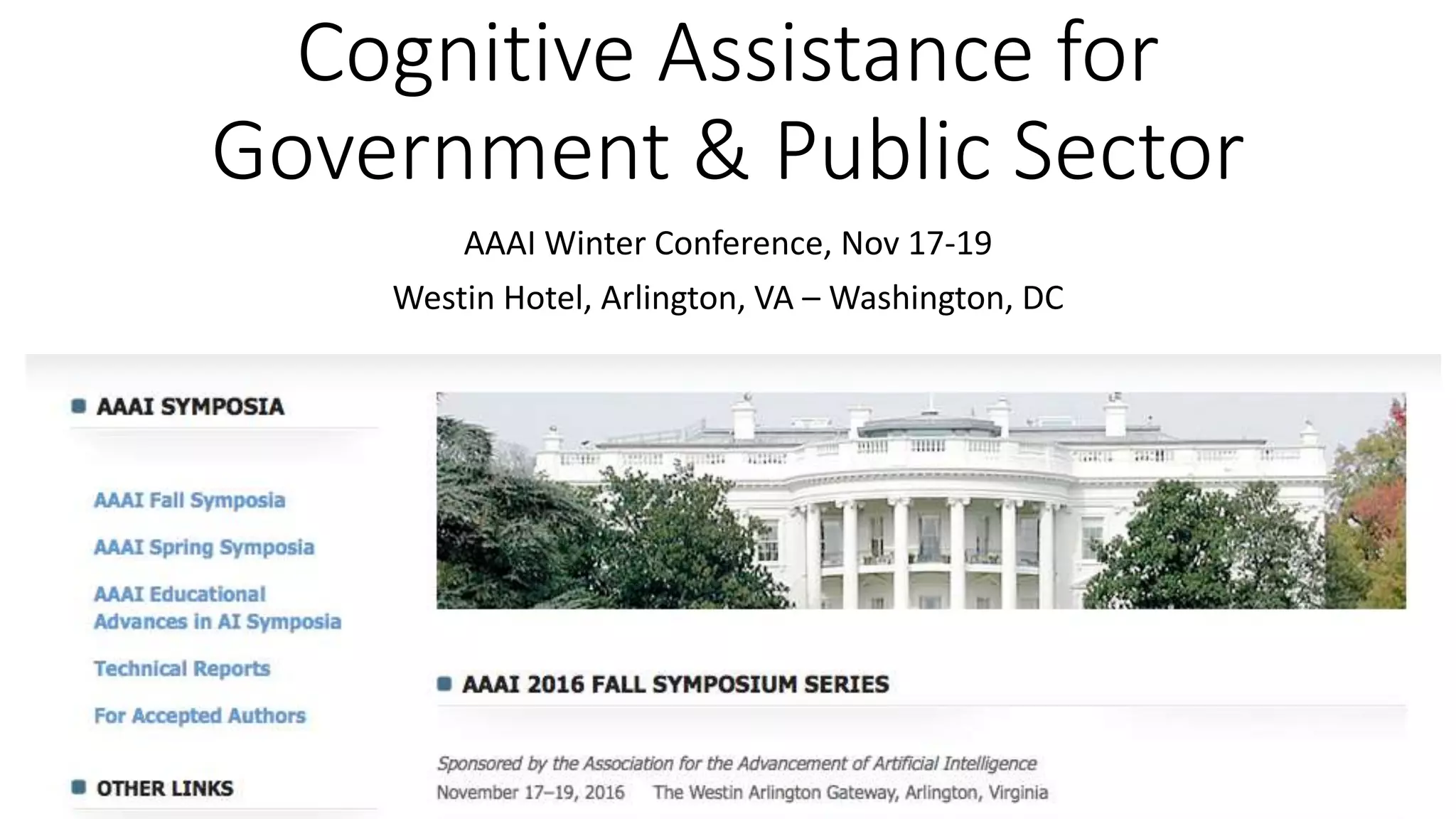
Cognitive Assistance for
Government & Public Sector
AAAI Winter Conference, Nov 17-19
Westin Hotel, Arlington, VA – Washington, DC
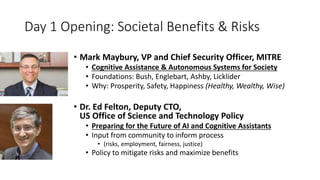
Day 1 Opening: Societal Benefits & Risks
• Mark Maybury, VP and Chief Security Officer, MITRE
• Cognitive Assistance & Autonomous Systems for Society
• Foundations: Bush, Englebart, Ashby, Licklider
• Why: Prosperity, Safety, Happiness (Healthy, Wealthy, Wise)
• Dr. Ed Felton, Deputy CTO,
US Office of Science and Technology Policy
• Preparing for the Future of AI and Cognitive Assistants
• Input from community to inform process
• (risks, employment, fairness, justice)
• Policy to mitigate risks and maximize benefits
Day 1 Morning: Legal & Justice Assistance
• Dan Guttfreund, IBM Haifa Research and MIT Cambridge, MA
• Automatic Arguments Constructions, From search engines to research
• Computational tech developed to support decision through argumentation
• A connected series of statements (claims, evidence) from a topic to a decision
• Sudhir Agarwal, Stanford University, Computer Science
• Smart Forms
• US Federal agencies use ~23,000 forms
• Dynamic Logic Program = Logic program – Constraints + Update Policies
• Arthi Kristna, Brian Feldman, et al - US Patent and Trademark Office
• AI Algorithms for Prior-Art Identification
• Similar to process of reviewing papers submitted to a conference or journal
• Criteria: Novelty, Utility and Inventive
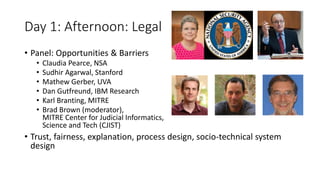
Day 1: Afternoon: Legal
• Panel: Opportunities & Barriers
• Claudia Pearce, NSA
• Sudhir Agarwal, Stanford
• Mathew Gerber, UVA
• Dan Gutfreund, IBM Research
• Karl Branting, MITRE
• Brad Brown (moderator),
MITRE Center for Judicial Informatics,
Science and Tech (CJIST)
• Trust, fairness, explanation, process design, socio-technical system
design
Day 1 Afternoon: Education
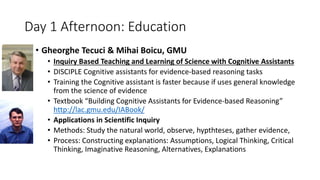
• Gheorghe Tecuci & Mihai Boicu, GMU
• Inquiry Based Teaching and Learning of Science with Cognitive Assistants
• DISCIPLE Cognitive assistants for evidence-based reasoning tasks
• Training the Cognitive assistant is faster because if uses general knowledge
from the science of evidence
• Textbook “Building Cognitive Assistants for Evidence-based Reasoning”
http://lac.gmu.edu/IABook/
• Applications in Scientific Inquiry
• Methods: Study the natural world, observe, hypthteses, gather evidence,
• Process: Constructing explanations: Assumptions, Logical Thinking, Critical
Thinking, Imaginative Reasoning, Alternatives, Explanations
Day 1 Afternoon: Education
• Panel: Progress, Opportunities, Challenges
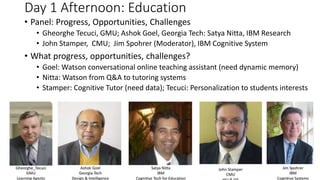
• Gheorghe Tecuci, GMU; Ashok Goel, Georgia Tech: Satya Nitta, IBM Research
• John Stamper, CMU; Jim Spohrer (Moderator), IBM Cognitive System
• What progress, opportunities, challenges?
• Goel: Watson conversational online teaching assistant (need dynamic memory)
• Nitta: Watson from Q&A to tutoring systems
• Stamper: Cognitive Tutor (need data); Tecuci: Personalization to students interests
Day 1 Closing: Healthcare
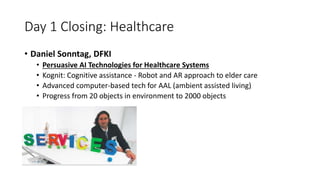
• Daniel Sonntag, DFKI
• Persuasive AI Technologies for Healthcare Systems
• Kognit: Cognitive assistance - Robot and AR approach to elder care
• Advanced computer-based tech for AAL (ambient assisted living)
• Progress from 20 objects in environment to 2000 objects
Day 2 Opening Keynote:
Future Science & Public Sector Services
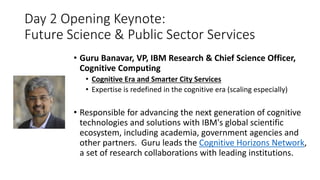
• Guru Banavar, VP, IBM Research & Chief Science Officer,
Cognitive Computing
• Cognitive Era and Smarter City Services
• Expertise is redefined in the cognitive era (scaling especially)
• Responsible for advancing the next generation of cognitive
technologies and solutions with IBM's global scientific
ecosystem, including academia, government agencies and
other partners. Guru leads the Cognitive Horizons Network,
a set of research collaborations with leading institutions.
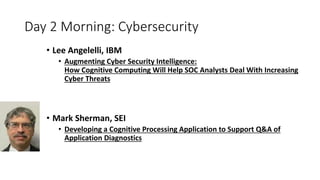
Day 2 Morning: Cybersecurity
• Lee Angelelli, IBM
• Augmenting Cyber Security Intelligence:
How Cognitive Computing Will Help SOC Analysts Deal With Increasing
Cyber Threats
• Mark Sherman, SEI
• Developing a Cognitive Processing Application to Support Q&A of
Application Diagnostics
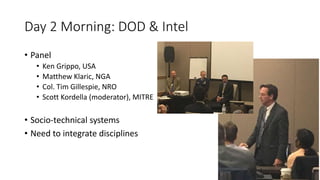
Day 2 Morning: DOD & Intel
• Panel
• Ken Grippo, USA
• Matthew Klaric, NGA
• Col. Tim Gillespie, NRO
• Scott Kordella (moderator), MITRE
• Socio-technical systems
• Need to integrate disciplines
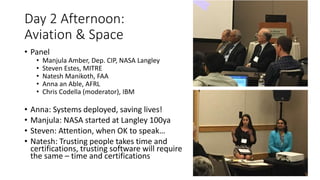
Day 2 Afternoon:
Aviation & Space
• Panel
• Manjula Amber, Dep. CIP, NASA Langley
• Steven Estes, MITRE
• Natesh Manikoth, FAA
• Anna an Able, AFRL
• Chris Codella (moderator), IBM
• Anna: Systems deployed, saving lives!
• Manjula: NASA started at Langley 100ya
• Steven: Attention, when OK to speak…
• Natesh: Trusting people takes time and
certifications, trusting software will require
the same – time and certifications
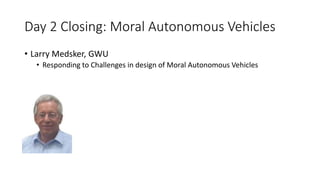
Day 2 Closing: Moral Autonomous Vehicles
• Larry Medsker, GWU
• Responding to Challenges in design of Moral Autonomous Vehicles
Organizing Committee
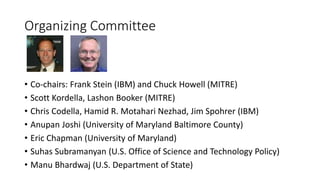
• Co-chairs: Frank Stein (IBM) and Chuck Howell (MITRE)
• Scott Kordella, Lashon Booker (MITRE)
• Chris Codella, Hamid R. Motahari Nezhad, Jim Spohrer (IBM)
• Anupan Joshi (University of Maryland Baltimore County)
• Eric Chapman (University of Maryland)
• Suhas Subramanyan (U.S. Office of Science and Technology Policy)
• Manu Bhardwaj (U.S. Department of State)
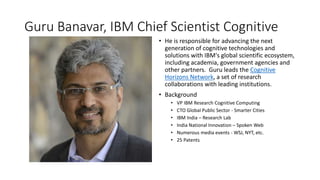
Guru Banavar, IBM Chief Scientist Cognitive
• He is responsible for advancing the next
generation of cognitive technologies and
solutions with IBM's global scientific ecosystem,
including academia, government agencies and
other partners. Guru leads the Cognitive
Horizons Network, a set of research
collaborations with leading institutions.
• Background
• VP IBM Research Cognitive Computing
• CTO Global Public Sector - Smarter Cities
• IBM India – Research Lab
• India National Innovation – Spoken Web
• Numerous media events - WSJ, NYT, etc.
• 25 Patents
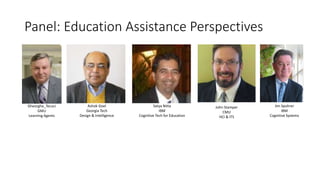
Panel: Education Assistance Perspectives
Gheorghe_Tecuci
GMU
Learning Agents
Ashok Goel
Georgia Tech
Design & Intelligence
Satya Nitta
IBM
Cognitive Tech for Education
John Stamper
CMU
HCI & ITS
Jim Spohrer
IBM
Cognitive Systems
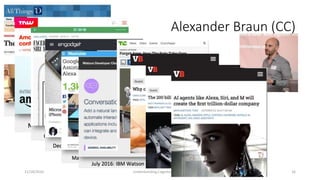
Alexander Braun (CC)
11/18/2016 Understanding Cognitive Systems 16
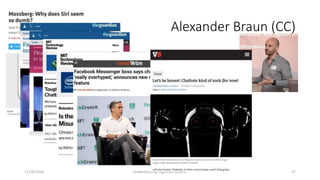
Alexander Braun (CC)
11/18/2016 Understanding Cognitive Systems 17

Aaai 201601118 v6

  • 1.
    Cognitive Assistance for Government& Public Sector AAAI Winter Conference, Nov 17-19 Westin Hotel, Arlington, VA – Washington, DC
  • 2.
    Day 1 Opening:Societal Benefits & Risks • Mark Maybury, VP and Chief Security Officer, MITRE • Cognitive Assistance & Autonomous Systems for Society • Foundations: Bush, Englebart, Ashby, Licklider • Why: Prosperity, Safety, Happiness (Healthy, Wealthy, Wise) • Dr. Ed Felton, Deputy CTO, US Office of Science and Technology Policy • Preparing for the Future of AI and Cognitive Assistants • Input from community to inform process • (risks, employment, fairness, justice) • Policy to mitigate risks and maximize benefits
  • 3.
    Day 1 Morning:Legal & Justice Assistance • Dan Guttfreund, IBM Haifa Research and MIT Cambridge, MA • Automatic Arguments Constructions, From search engines to research • Computational tech developed to support decision through argumentation • A connected series of statements (claims, evidence) from a topic to a decision • Sudhir Agarwal, Stanford University, Computer Science • Smart Forms • US Federal agencies use ~23,000 forms • Dynamic Logic Program = Logic program – Constraints + Update Policies • Arthi Kristna, Brian Feldman, et al - US Patent and Trademark Office • AI Algorithms for Prior-Art Identification • Similar to process of reviewing papers submitted to a conference or journal • Criteria: Novelty, Utility and Inventive
  • 4.
    Day 1: Afternoon:Legal • Panel: Opportunities & Barriers • Claudia Pearce, NSA • Sudhir Agarwal, Stanford • Mathew Gerber, UVA • Dan Gutfreund, IBM Research • Karl Branting, MITRE • Brad Brown (moderator), MITRE Center for Judicial Informatics, Science and Tech (CJIST) • Trust, fairness, explanation, process design, socio-technical system design
  • 5.
    Day 1 Afternoon:Education • Gheorghe Tecuci & Mihai Boicu, GMU • Inquiry Based Teaching and Learning of Science with Cognitive Assistants • DISCIPLE Cognitive assistants for evidence-based reasoning tasks • Training the Cognitive assistant is faster because if uses general knowledge from the science of evidence • Textbook “Building Cognitive Assistants for Evidence-based Reasoning” http://lac.gmu.edu/IABook/ • Applications in Scientific Inquiry • Methods: Study the natural world, observe, hypthteses, gather evidence, • Process: Constructing explanations: Assumptions, Logical Thinking, Critical Thinking, Imaginative Reasoning, Alternatives, Explanations
  • 6.
    Day 1 Afternoon:Education • Panel: Progress, Opportunities, Challenges • Gheorghe Tecuci, GMU; Ashok Goel, Georgia Tech: Satya Nitta, IBM Research • John Stamper, CMU; Jim Spohrer (Moderator), IBM Cognitive System • What progress, opportunities, challenges? • Goel: Watson conversational online teaching assistant (need dynamic memory) • Nitta: Watson from Q&A to tutoring systems • Stamper: Cognitive Tutor (need data); Tecuci: Personalization to students interests
  • 7.
    Day 1 Closing:Healthcare • Daniel Sonntag, DFKI • Persuasive AI Technologies for Healthcare Systems • Kognit: Cognitive assistance - Robot and AR approach to elder care • Advanced computer-based tech for AAL (ambient assisted living) • Progress from 20 objects in environment to 2000 objects
  • 8.
    Day 2 OpeningKeynote: Future Science & Public Sector Services • Guru Banavar, VP, IBM Research & Chief Science Officer, Cognitive Computing • Cognitive Era and Smarter City Services • Expertise is redefined in the cognitive era (scaling especially) • Responsible for advancing the next generation of cognitive technologies and solutions with IBM's global scientific ecosystem, including academia, government agencies and other partners. Guru leads the Cognitive Horizons Network, a set of research collaborations with leading institutions.
  • 9.
    Day 2 Morning:Cybersecurity • Lee Angelelli, IBM • Augmenting Cyber Security Intelligence: How Cognitive Computing Will Help SOC Analysts Deal With Increasing Cyber Threats • Mark Sherman, SEI • Developing a Cognitive Processing Application to Support Q&A of Application Diagnostics
  • 10.
    Day 2 Morning:DOD & Intel • Panel • Ken Grippo, USA • Matthew Klaric, NGA • Col. Tim Gillespie, NRO • Scott Kordella (moderator), MITRE • Socio-technical systems • Need to integrate disciplines
  • 11.
    Day 2 Afternoon: Aviation& Space • Panel • Manjula Amber, Dep. CIP, NASA Langley • Steven Estes, MITRE • Natesh Manikoth, FAA • Anna an Able, AFRL • Chris Codella (moderator), IBM • Anna: Systems deployed, saving lives! • Manjula: NASA started at Langley 100ya • Steven: Attention, when OK to speak… • Natesh: Trusting people takes time and certifications, trusting software will require the same – time and certifications
  • 12.
    Day 2 Closing:Moral Autonomous Vehicles • Larry Medsker, GWU • Responding to Challenges in design of Moral Autonomous Vehicles
  • 13.
    Organizing Committee • Co-chairs:Frank Stein (IBM) and Chuck Howell (MITRE) • Scott Kordella, Lashon Booker (MITRE) • Chris Codella, Hamid R. Motahari Nezhad, Jim Spohrer (IBM) • Anupan Joshi (University of Maryland Baltimore County) • Eric Chapman (University of Maryland) • Suhas Subramanyan (U.S. Office of Science and Technology Policy) • Manu Bhardwaj (U.S. Department of State)
  • 14.
    Guru Banavar, IBMChief Scientist Cognitive • He is responsible for advancing the next generation of cognitive technologies and solutions with IBM's global scientific ecosystem, including academia, government agencies and other partners. Guru leads the Cognitive Horizons Network, a set of research collaborations with leading institutions. • Background • VP IBM Research Cognitive Computing • CTO Global Public Sector - Smarter Cities • IBM India – Research Lab • India National Innovation – Spoken Web • Numerous media events - WSJ, NYT, etc. • 25 Patents
  • 15.
    Panel: Education AssistancePerspectives Gheorghe_Tecuci GMU Learning Agents Ashok Goel Georgia Tech Design & Intelligence Satya Nitta IBM Cognitive Tech for Education John Stamper CMU HCI & ITS Jim Spohrer IBM Cognitive Systems
  • 16.
    Alexander Braun (CC) 11/18/2016Understanding Cognitive Systems 16
  • 17.
    Alexander Braun (CC) 11/18/2016Understanding Cognitive Systems 17

Editor's Notes

  • #3 9:00 am – 9:10 am Welcome and Themes for Conference   Chuck Howell 9:10 am – 9:50 am Keynote Mark Maybury, AAAI Fellow & Chief Security Officer, Mitre Introduced by Chuck Howell 9:50 am – 10:30 am Preparing for the Future of AI and Cognitive Assistants Edward W. Felten, Deputy U.S. CTO Suhas Subramanyam, EOP/OSTP, will introduce 10:30 am – 11:00 am Coffee Break     11:00 am – 11:40 am ALDA: Cognitive Assistant for Legal Document Analytics Karuna P. Joshi, University of Maryland Baltimore County Aditi Gupta, UMBC Sudip Mittal, UMBC Claudia Pearce, UMBC Anupam Joshi, UMBC Tim Finin, UMBC Chuck Howell Facilitates – introduces speakers, tracks time (until he introduces Brad Brown) 11:40 am – 12:20 pm Automatic Arguments Construction - from search engine to research engine Dan Gutfreund, IBM Research Rauit Aharonov, IBM Research Yoav Katz, IBM Research Noam Slonim, IBM Research   12:20 pm – 1:45 pm Lunch (start/end early)     1:45 pm – 2:25 pm Smart Forms Sudhir Agarwal, Stanford University   2:25 pm – 3:05 pm AI Algorithms for Prior-Art Identification Arthi Kristna, USPTO Brian Feldman, USPTO Joseph Wolf, USPTO Greg Gabel, USPTO Scott Believeau, USPTO Thomas Beach, USPTO   3:05 pm – 3:35pm Panel Discussion: Opportunities and Barriers for adoption of Cognitive Assistance for Legal and Judiciary Panel Members: Claudia Pearce, NSA Sudhir Agarwal, Stanford Matthew Gerber, UVA Dan Gutfreund, IBM Karl Branting, Mitre Moderator: Brad Brown, Mitre , Center for Judicial Informatics, Science and Technology (CJIST) 3:35 – 4:00 pm Break   4:00 – 5:20 pm Inquiry-based Teaching and Learning of Science with Cognitive Assistants Gheorghe Tecuci, George Mason University Mihai Boicu GMU Dorin Marcu, GMU James Trefil, GMU Nancy Holincheck, GMU Introduced by Jim Spohrer, IBM 4:40 pm – 5:20 pm Panel Discussion Panel Members: Gheorghe Tecuci, GMU Satya Nitta, IBM Ashok Goel, GT John Stamper,CMU Moderator: Jim Spohrer, IBM 5:20 pm – 6:00 pm Persuasive AI Technologies for Healthcare Systems Daniel Sonntag, DFKI, German Research Center for Artificial Intelligence Frank Stein, IBM, iIntroduces (and reminds everyone of tomorrow’s schedule at the end) 6:00 pm – 7:00 pm Reception    
  • #9 Welcome Back   Frank Stein, IBM Keynote Guru Banavar, VP, IBM Research & Chief Science Officer, Cognitive Computing Introduced by Jim Spohrer, IBM Augmenting Cyber Security Intelligence: How Cognitive Computing Will Help SOC Analysts Deal With Increasing Cyber Threats Lee Angelelli, IBM Introduced by Don Tobin, NcCOE, NIST Break     Developing a Cognitive Processing Application to Support Q&A of Application Diagnostics Mark Sherman, SEI Introduced by Don Tobin, NcCoE, NIST   Joint Q&A Moderator: Don Tobin, NCCoE Cognitive Assistance in DoD & Intel Invited Talk: Ken Grippo, USA - Commanders Virtual Staff Discussion & Q&A Ken Grippo, USA; Matthew Klaric, NGA Col. Tim Gillespie, NRO Scott Kordella, Mitre introduces and moderates the discussion. Lunch     Cognitive Assistance in Aviation and Space Panel Discussion Manjula Ambur, Dep. CIO, NASA Langley Research Center Steven Estes, Mitre Natesh Manikoth, FAA Anna an Able, AFRL Moderator: Chris Codella , IBM       Break     Responding to Challenges in the Design of Moral Autonomous Vehicles Larry Medsker, George Washington University Helen Zhao, GWU Kirsten Dimovitz, GWU Brooke Staveland, GWU Introduced by Frank Stein, IBM Workshop Discussion & Readout Prep What is needed to enable and accelerate the use of Cognitive Assistance in Govt and Public Sector? Create Slides on above discussion Chuck Howell Facilitates the discussion; John Tyler, scribe. Jim Spohrer and interested others Plenary Session 5 min - The talks should present to an audience of AI researchers something that is interesting and also present some of the issues behind the symposium. Jim Spohrer presents our summary
  • #17  Braun A (2016) From Eliza to SIRI and Beyond: Promise and Challenges of Intelligent, Language-controlled Assistants (Chatbots). 20161103 URL: http://www.slideshare.net/diannepatricia/from-eliza-to-siri-and-beyond-promise-and-challenges-of-intelligent-languagecontrolled-assistantschatbots
  • #18  Braun A (2016) From Eliza to SIRI and Beyond: Promise and Challenges of Intelligent, Language-controlled Assistants (Chatbots). 20161103 URL: http://www.slideshare.net/diannepatricia/from-eliza-to-siri-and-beyond-promise-and-challenges-of-intelligent-languagecontrolled-assistantschatbots