Panel Discussion Open Innovation & Singularity:
The Future of Industries & Business Models
Jim Spohrer (IBM)
HICSS, Kaua’I Hawaii, Jnuary 5th, 2016
http://www.slideshare.net/spohrer/spohrer-darwin-woi-2015119-v2
1/5/2016 1© IBM 2015, © Solomon N. Darwin –
2015: All Rights Reserved
Co-evolution of
business models and technology
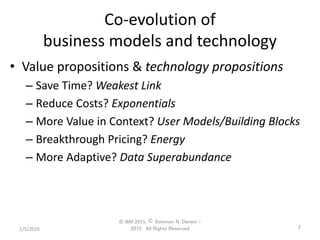
• Value propositions & technology propositions
– Save Time? Weakest Link
– Reduce Costs? Exponentials
– More Value in Context? User Models/Building Blocks
– Breakthrough Pricing? Energy
– More Adaptive? Data Superabundance
1/5/2016
© IBM 2015, © Solomon N. Darwin –
2015: All Rights Reserved 2
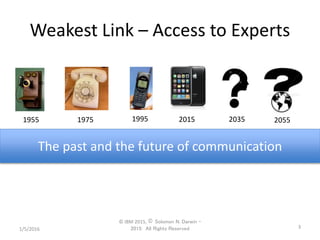
Weakest Link – Access to Experts
1/5/2016
© IBM 2015, © Solomon N. Darwin –
2015: All Rights Reserved 3
1955 1975 1995 2015 2035 2055
The past and the future of communication
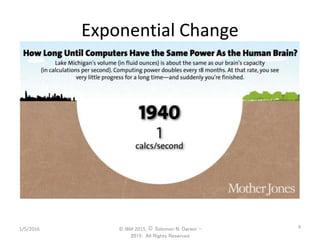
Exponential Change
1/5/2016 4© IBM 2015, © Solomon N. Darwin –
2015: All Rights Reserved
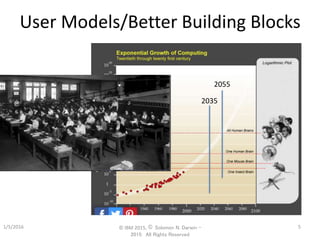
User Models/Better Building Blocks
1/5/2016 5
2035
2055
© IBM 2015, © Solomon N. Darwin –
2015: All Rights Reserved
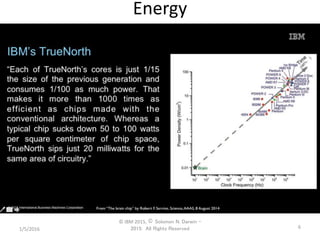
Energy
1/5/2016
© IBM 2015, © Solomon N. Darwin –
2015: All Rights Reserved 6
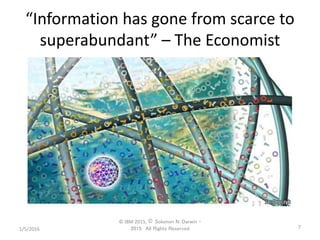
“Information has gone from scarce to
superabundant” – The Economist
1/5/2016
© IBM 2015, © Solomon N. Darwin –
2015: All Rights Reserved 7
Predictions: Courses & Cognitive
• 2015
– Course: “How to build a cognitive system for Q&A task.”
– 9 months for 40% question answering (Q&A) accuracy for corpus/textbook
– 1-2 years for 90% accuracy, mostly which user questions to reject
• 2025
– Course: “How to use a cognitive system to be a better professional X.”
– Tools to build a student level Q&A from textbook in 1 week
• 2035
– Course: “How to use your cognitive assistant to build a unicorn startup.”
– Tools to build faculty level Q&A for textbook in one day
– Most people have at least one cognitive assistant working for them
– A cognitive mediator knows a person better than they know themselves
• 2055
– Course: “How to manage your workforce of cognitive assistants.”
– Most people have 100 cognitive assistants working for them.
1/5/2016
© IBM 2015, © Solomon N. Darwin –
2015: All Rights Reserved 8
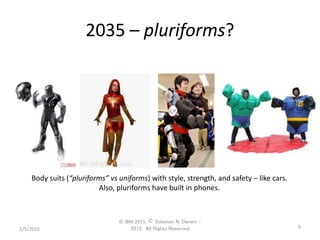
2035 – pluriforms?
1/5/2016
© IBM 2015, © Solomon N. Darwin –
2015: All Rights Reserved 9
Body suits (“pluriforms” vs uniforms) with style, strength, and safety – like cars.
Also, pluriforms have built in phones.
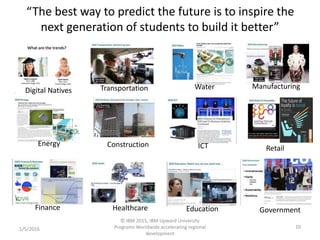
“The best way to predict the future is to inspire the
next generation of students to build it better”
1/5/2016
© IBM 2015, IBM Upward University
Programs Worldwide accelerating regional
development
10
Digital Natives Transportation Water Manufacturing
Energy Construction ICT Retail
Finance Healthcare Education Government
CSIG Model:
Cognitive Systems Institute Group
• CSIG Model for IBM-University interactions:
• (1) Faculty and students describe their work on weekly ISSIP COI CSIG calls - http://cognitive-
science.info/community/weekly-update/
• (2) IBMers and faculty/students identify and work on submitting grant proposals to federal and
foundation sources - for example, in USA: http://www.nsf.gov/pubs/2015/nsf15610/nsf15610.htm
• (3) Review of any possible IBM awards to support aligned submissions - http://cognitive-
science.info/award-recipients/
• (4) Research outcomes/publications and IBM hires students
• (5) possible exchange - IBMers on Campus at university, Faculty/Students at IBM
• (6) CSIG: building cognitive systems is still very hard, and CSIG is exploring how to improve methods
to develop cognitive assistants for all occupations
1/5/2016
© IBM 2015, © Solomon N. Darwin –
2015: All Rights Reserved 11
CSIG Algorithm:
Cognitive Systems Institute Group
• 1000 occupations are described at the O*NET website:
http://www.onetonline.org/
For all occupations in O*NET
For list of tasks in an occupation:
Measure:
(1) expert/novice performance on related task
(2) cognitive system performance on that related task
• Plot the data and update it see the progress.
– An example of (1) above is this article (thanks Franz Dill!):
the game Airport Scanner - turning tasks into games to measure expert novice performance levels
http://eponymouspickle.blogspot.com/2015/01/turning-boring-task-into-game.html
– An example of (2) above is this article (thanks Jean Paul Jacob!)
Computer-based personality judgments are more accurate than those made by humans
http://www.pnas.org/content/early/2015/01/07/1418680112
1/5/2016
© IBM 2015, © Solomon N. Darwin –
2015: All Rights Reserved 12
1/5/2016
© IBM 2015, IBM Upward University
Programs Worldwide accelerating regional
development
13
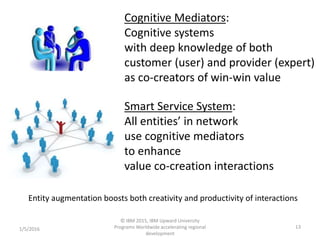
Smart Service System:
All entities’ in network
use cognitive mediators
to enhance
value co-creation interactions
Cognitive Mediators:
Cognitive systems
with deep knowledge of both
customer (user) and provider (expert)
as co-creators of win-win value
Entity augmentation boosts both creativity and productivity of interactions
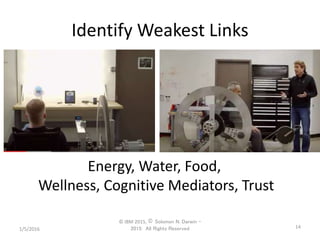
Identify Weakest Links
1/5/2016
© IBM 2015, © Solomon N. Darwin –
2015: All Rights Reserved 14
Energy, Water, Food,
Wellness, Cognitive Mediators, Trust
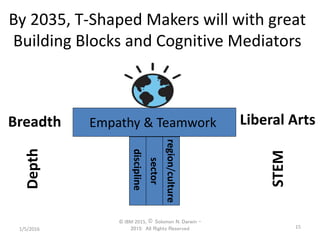
By 2035, T-Shaped Makers will with great
Building Blocks and Cognitive Mediators
1/5/2016
© IBM 2015, © Solomon N. Darwin –
2015: All Rights Reserved 15
Empathy & Teamwork
sector
region/culture
discipline
Depth
Breadth
STEM
Liberal Arts
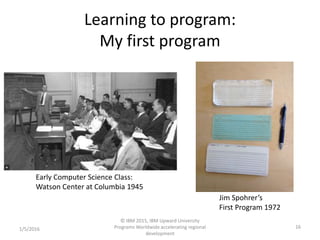
Learning to program:
My first program
1/5/2016
© IBM 2015, IBM Upward University
Programs Worldwide accelerating regional
development
16
Early Computer Science Class:
Watson Center at Columbia 1945
Jim Spohrer’s
First Program 1972
1/5/2016
© IBM 2015, IBM Upward University
Programs Worldwide accelerating regional
development
17
1/5/2016
© IBM 2015, IBM Upward University
Programs Worldwide accelerating regional
development
18
In Summary
1/5/2016
© IBM 2015, IBM Upward University
Programs Worldwide accelerating regional
development
19
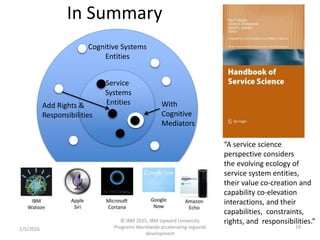
“A service science
perspective considers
the evolving ecology of
service system entities,
their value co-creation and
capability co-elevation
interactions, and their
capabilities, constraints,
rights, and responsibilities.”
Cognitive Systems
Entities
Service
Systems
Entities With
Cognitive
Mediators
Add Rights &
Responsibilities
Assisting individuals and organizations
to close their service innovation skills gap
and co-create smarter service systems
empowering employees, customers, citizens
with cognitive mediators
in the collaborative service economy
1/5/2016
© IBM 2015, IBM Upward University
Programs Worldwide accelerating regional
development
21

Spohrer hicss 20160105 v2

  • 1.
    Panel Discussion OpenInnovation & Singularity: The Future of Industries & Business Models Jim Spohrer (IBM) HICSS, Kaua’I Hawaii, Jnuary 5th, 2016 http://www.slideshare.net/spohrer/spohrer-darwin-woi-2015119-v2 1/5/2016 1© IBM 2015, © Solomon N. Darwin – 2015: All Rights Reserved
  • 2.
    Co-evolution of business modelsand technology • Value propositions & technology propositions – Save Time? Weakest Link – Reduce Costs? Exponentials – More Value in Context? User Models/Building Blocks – Breakthrough Pricing? Energy – More Adaptive? Data Superabundance 1/5/2016 © IBM 2015, © Solomon N. Darwin – 2015: All Rights Reserved 2
  • 3.
    Weakest Link –Access to Experts 1/5/2016 © IBM 2015, © Solomon N. Darwin – 2015: All Rights Reserved 3 1955 1975 1995 2015 2035 2055 The past and the future of communication
  • 4.
    Exponential Change 1/5/2016 4©IBM 2015, © Solomon N. Darwin – 2015: All Rights Reserved
  • 5.
    User Models/Better BuildingBlocks 1/5/2016 5 2035 2055 © IBM 2015, © Solomon N. Darwin – 2015: All Rights Reserved
  • 6.
    Energy 1/5/2016 © IBM 2015,© Solomon N. Darwin – 2015: All Rights Reserved 6
  • 7.
    “Information has gonefrom scarce to superabundant” – The Economist 1/5/2016 © IBM 2015, © Solomon N. Darwin – 2015: All Rights Reserved 7
  • 8.
    Predictions: Courses &Cognitive • 2015 – Course: “How to build a cognitive system for Q&A task.” – 9 months for 40% question answering (Q&A) accuracy for corpus/textbook – 1-2 years for 90% accuracy, mostly which user questions to reject • 2025 – Course: “How to use a cognitive system to be a better professional X.” – Tools to build a student level Q&A from textbook in 1 week • 2035 – Course: “How to use your cognitive assistant to build a unicorn startup.” – Tools to build faculty level Q&A for textbook in one day – Most people have at least one cognitive assistant working for them – A cognitive mediator knows a person better than they know themselves • 2055 – Course: “How to manage your workforce of cognitive assistants.” – Most people have 100 cognitive assistants working for them. 1/5/2016 © IBM 2015, © Solomon N. Darwin – 2015: All Rights Reserved 8
  • 9.
    2035 – pluriforms? 1/5/2016 ©IBM 2015, © Solomon N. Darwin – 2015: All Rights Reserved 9 Body suits (“pluriforms” vs uniforms) with style, strength, and safety – like cars. Also, pluriforms have built in phones.
  • 10.
    “The best wayto predict the future is to inspire the next generation of students to build it better” 1/5/2016 © IBM 2015, IBM Upward University Programs Worldwide accelerating regional development 10 Digital Natives Transportation Water Manufacturing Energy Construction ICT Retail Finance Healthcare Education Government
  • 11.
    CSIG Model: Cognitive SystemsInstitute Group • CSIG Model for IBM-University interactions: • (1) Faculty and students describe their work on weekly ISSIP COI CSIG calls - http://cognitive- science.info/community/weekly-update/ • (2) IBMers and faculty/students identify and work on submitting grant proposals to federal and foundation sources - for example, in USA: http://www.nsf.gov/pubs/2015/nsf15610/nsf15610.htm • (3) Review of any possible IBM awards to support aligned submissions - http://cognitive- science.info/award-recipients/ • (4) Research outcomes/publications and IBM hires students • (5) possible exchange - IBMers on Campus at university, Faculty/Students at IBM • (6) CSIG: building cognitive systems is still very hard, and CSIG is exploring how to improve methods to develop cognitive assistants for all occupations 1/5/2016 © IBM 2015, © Solomon N. Darwin – 2015: All Rights Reserved 11
  • 12.
    CSIG Algorithm: Cognitive SystemsInstitute Group • 1000 occupations are described at the O*NET website: http://www.onetonline.org/ For all occupations in O*NET For list of tasks in an occupation: Measure: (1) expert/novice performance on related task (2) cognitive system performance on that related task • Plot the data and update it see the progress. – An example of (1) above is this article (thanks Franz Dill!): the game Airport Scanner - turning tasks into games to measure expert novice performance levels http://eponymouspickle.blogspot.com/2015/01/turning-boring-task-into-game.html – An example of (2) above is this article (thanks Jean Paul Jacob!) Computer-based personality judgments are more accurate than those made by humans http://www.pnas.org/content/early/2015/01/07/1418680112 1/5/2016 © IBM 2015, © Solomon N. Darwin – 2015: All Rights Reserved 12
  • 13.
    1/5/2016 © IBM 2015,IBM Upward University Programs Worldwide accelerating regional development 13 Smart Service System: All entities’ in network use cognitive mediators to enhance value co-creation interactions Cognitive Mediators: Cognitive systems with deep knowledge of both customer (user) and provider (expert) as co-creators of win-win value Entity augmentation boosts both creativity and productivity of interactions
  • 14.
    Identify Weakest Links 1/5/2016 ©IBM 2015, © Solomon N. Darwin – 2015: All Rights Reserved 14 Energy, Water, Food, Wellness, Cognitive Mediators, Trust
  • 15.
    By 2035, T-ShapedMakers will with great Building Blocks and Cognitive Mediators 1/5/2016 © IBM 2015, © Solomon N. Darwin – 2015: All Rights Reserved 15 Empathy & Teamwork sector region/culture discipline Depth Breadth STEM Liberal Arts
  • 16.
    Learning to program: Myfirst program 1/5/2016 © IBM 2015, IBM Upward University Programs Worldwide accelerating regional development 16 Early Computer Science Class: Watson Center at Columbia 1945 Jim Spohrer’s First Program 1972
  • 17.
    1/5/2016 © IBM 2015,IBM Upward University Programs Worldwide accelerating regional development 17
  • 18.
    1/5/2016 © IBM 2015,IBM Upward University Programs Worldwide accelerating regional development 18
  • 19.
    In Summary 1/5/2016 © IBM2015, IBM Upward University Programs Worldwide accelerating regional development 19 “A service science perspective considers the evolving ecology of service system entities, their value co-creation and capability co-elevation interactions, and their capabilities, constraints, rights, and responsibilities.” Cognitive Systems Entities Service Systems Entities With Cognitive Mediators Add Rights & Responsibilities
  • 20.
    Assisting individuals andorganizations to close their service innovation skills gap and co-create smarter service systems empowering employees, customers, citizens with cognitive mediators in the collaborative service economy
  • 21.
    1/5/2016 © IBM 2015,IBM Upward University Programs Worldwide accelerating regional development 21

Editor's Notes

  • #2 “Open Innovation & Technological Singularity”   Solomon: Welcome to “Open Innovation & Technological Singularity” Panel. This is a discussion as to where the business models are headed. This is going to be more like a fireside chat than a panel.   Joining me is Dr. Jim Spohrer; he is the Director of IBM Global University Programs and Cognitive Systems Institute at IBM. He is a graduate of MIT in Physics; earned his PhD in computer science from Yale University and has many patents to his name. Prior to IBM his served as a distinguished Computer Engineer at Apple.   A good part of Jim’s Job’s is to capture the external knowledge flows that is being generate at universities around the world. IBM works with over 5000 universities worldwide where knowledge is being exponentially created. I heard Jim say many a time “The future is here and it is at the universities”   Jim, welcome! as you know, business models are increasing coming under stress – In my opinion, the Business Models having to do five things: 1. Save Time, 2. Eliminate Costs, 3. Deliver Value in Context, 4. Offer Value at Price points that people can afford and 5. Adapt to the changes while managing innovation.   Let us discuss this one at a time:   1. Solomon: Save Time: (for the individual customer as well as the entire ecosystem – wasting one person’s time has a domino effect on the entire ecosystem)   Jim: It has long been known in systems theory that the biggest gains come from improving the weakest links. What we are seeing with cognitive is a new kind of resource for people - a resource with the potential to help improve weakest link. (Any slides?)   Solomon: Can you provide some examples about improving the weakest link?   2. Solomon: Eliminate Costs to create a Minimum Viable Ecosystem (for the individual customer but also from the entire ecosystem all together) As you know, my students are developing Business Models for Future Cities or Smart Cities. A city unlike a firm has more complex ecosystem surrounding them.   Jim: Cognitive is on an exponential - anytime cost reductions are on exponential - big things can happen. (See imagine of Lake Michigan filling up)   3. Solomon: Deliver value in context of the customer’s specific need in real time – when - where - how - format and context matters!   Jim: cognitive will know us better than we know ourselves (in some ways) by 2035. This knowledge of us is necessary for good "executive assistants" and "personal coaches" (any slide here?)   4. Solomon: Offer value at price points that the customers can afford – this is critical as 6 billion poor people in the world are left out of the equation – models that create value only for the 1.5 billion rich people will soon fall apart.   Jim: again exponential cost reduction is a pretty good driver of value. (Any slide here?)   Solomon: Adaptable to changes as they happen in real time while managing innovation.   Jim: Big data growth is reshaping the environment people, businesses, and governments operate in -- smarter planet Big data is beyond what people can handle without powerful cognitive tools. (Any slides here?) – I have a suggestion.   Open up to Q&A For permission to reuse – contact spohrer@us.ibm.com and darwin@haas.berkeley.edu Reference: Spohrer, J and Darwin, S (2015) Panel Discussion Open Innovation & Singularity: The Future of Industries & Business Models. 2nd Annual World Open Innovation Conference, Santa Clara Convention Center, CA USA. Thursday November 19, 2015. URL http://www.slideshare.net/spohrer/spohrer-darwin-woi-20151119-v2
  • #4 The weakest link is what needs to be improved – according to system scientists. Accessing help, service, experts is the weakest link in most systems. By 2035 the phone may have the power of one human brain – by 2055 the phone may have the power of all human brains. Before trying to answer the question about which types of sciences are more important – the ones that try to explain the external world or the ones that try to explain the internal world – consider this, slide that shows the different telephones that I have used in my life. I grew up in rural Maine, where we had a party line telephone because we were somewhat remote on our farm in Newburgh, Maine. However, over the years phones got much better…. So in 2035 or 2055, who are you going to call when you need help?
  • #5 Source URL: Mother Jones - http://www.motherjones.com/media/2013/05/robots-artificial-intelligence-jobs-automation
  • #6 If Moore’s Law continues, by 2035 and by 2055, we are projected to have unimaginably large amounts of cheap computing…. 2035 one human brain level, and by 2055 all human brains level(10 billion people). Based on Kurweil’s graph of how much compute power $1000 will buy, it seems that by 2030, for $1000 you should be able to buy the compute power of one person’s brain, and that by 2060 for $1000 you should be able to buy the computer power of 10***10, or 10B people, the compute power of the world’s population for $1000. Source: http://waitbutwhy.com/2015/01/artificial-intelligence-revolution-1.html Was Moore’s Law inevitable? http://kk.org/thetechnium/was-moores-law/
  • #8 Source: http://www.economist.com/node/15557443
  • #9 Here is what I tell students.... ... to try to provoke their thinking about the cognitive era:     (0) 2015 - about 9 months to build a formative Q&A system - 40% accuracy;         - another 1-2 years and a team of 10-20, can get it to 90% accuracy, by reducing the scope ("sorry that question is out of scope")         - today's systems can only answer questions, if the answers are already existing in the text explicitly         - debater is an example of where we would like to get to though in 5 years: https://www.youtube.com/watch?v=7g59PJxbGhY         - more about the ambitions at  http://cognitive-science.info     (1) 2025: Watson will be able to rapidly ingest just about any textbooks and produce a Q&A system         - the Q&A system will rival C-grade (average) student performance on questions     (2) 2035 - above, but rivals C-level (average) faculty performance on questions     (3) 2035 - an exascale of compute power costs about $1000         - an exascale is the equivalent compute of one person's brain power (at 20W power)     (4) 2035 - nearly everyone has a cognitive mediator that knows them in many ways better than they know themselves          - memory of all health information, memory of everyone you have ever interacted with, executive assistant, personal coach, process and memory aid, etc.     (5) 2055 - nearly everyone has 100 cognitive assistants that "work for them"         - better management of your cognitive assistant workforce is a course taught at university In 2015, we are at the beginning of the beginning or the cognitive era... In 2025, we will be middle of beginning... easy to generate average student level performance on questions in textbook.... In 2035, we will be end of beginning (one brain power equivalent)... easy to generate average faculty level performance on questions in textbook....     http://www.slideshare.net/spohrer/spohrer-ubi-learn-20151103-v2 By 2055, roughly 2x 20 year generations out, the cognitive era will be in full force. Cellphones will likely become body suits - with burst-mode super-strength and super-safety features: Suits - body suit cell phones Cognitive Mediators will read everything for us, and relate the information to  us - and what we know and our goals. Think combined personal coach, executive assistant, personal research team.... The key is knowing which problem to work on next - see this long video for the answer - energy, water, food, wellness -  and note especially the wellness suit at the end:     https://www.youtube.com/watch?v=YY7f1t9y9a0&index=10&list=WL Do not be put off by the beginning of the video - it is a bit over hyped and trivial, to say the leasat... but the projects are really good if you have the patience to watch.
  • #10 Sources: 1. http://static.comicvine.com/uploads/scale_super/1/18863/2598875-stealthsuit.jpg 2. http://www.polyvore.com/cgi/img-thing?.out=jpg&size=l&tid=63774335 3. http://www.smashingrobotics.com/wp-content/uploads/2012/06/iudf-su7fy-sdhfuihsduifh-sd003_opt.jpg 4. https://images.bouncycastlenetwork.com/c_limit,w_900/q_80/f1d8ecf5282644da68f8ce8f4437b344
  • #11 By 2036, there will be an accumulation of knowledge as well as a distribution of knowledge in service systems globally. We need to ensure as there is knowledge accumulation that service systems at all scale become more resilient. Leading to the capability of rapid rebuilding of service systems across scales, by T-shaped people who understand how to rapidly rebuild – knowledge has been chunked, modularized, and put into networks that support rapid rebuilding.
  • #12 Source: https://www.linkedin.com/grp/post/6729452-6033243372641140739
  • #13 Source: https://www.linkedin.com/grp/post/6729452-6033243372641140739 Questions and possible Answers: Q1. How to prioritize occupations? Which to work on first? (thanks Frank Stein!) A1a. prioritized by their data volume, velocity, value Q2. How to classify tasks in occupations? Which to outsource to cognitive systems first? (thanks Michael Gorman!) A2a. Does the task involve h-h (human-human) or h-t (human-technology/tool/info) interactions? Q3. How to measure human expert and novice performance on tasks? (thanks Franz Dill!) A3a. turning tasks into games, get crowds to play them, and gather performance variations Q4. How to measure cognitive systems performance? (thanks Jean Paul Jacob!) A4a. monitor press released and publications on cognitive systems performance
  • #14  Images Sources: http://www.preventionjustice.org/potent-partnerships-networks-of-people-living-with-hiv/
  • #15 Source: Billions for Change, Manoj Bhargava story https://www.youtube.com/watch?v=YY7f1t9y9a0
  • #16 Source: http://tsummit.org
  • #17 In the 1940’s IBM started teaching computer science at Columbia. My first program – punch cards 1972.
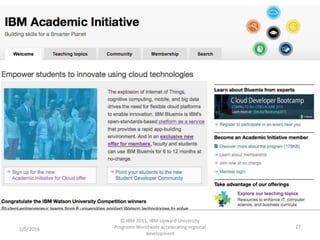
  • #18 Bluemix free access – http://www.ibm.com/university – see academic intiatives
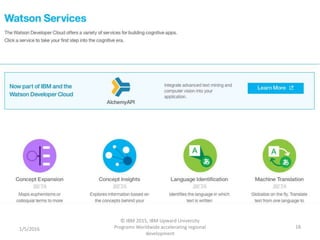
  • #19 Interested faculty, students, really anyone with a credit card can get 750 GB-Hours a month free http://www.ibm.com/smarterplanet/us/en/ibmwatson/developercloud/services-catalog.html