Outline
■ What areethics?
■ Professional ethics
■ Engineering ethics
■ Computer ethics
■ Categories of computer ethics issues
■ Moral and ethical problems
•Hacking, cracking and virus creation
•Software piracy
■ Computer ethics awareness and educational issues
■ Computer ethics - Case studies
■ Conclusions
3.
What are Ethics?
■Derived from the Greek word “ethos”, which means “custom”,
“habit”, and “way of living”
■ Ethics is concerned with human conduct, i.e., behavior of
individuals in society
■ Ethics is a system of morals of a particular person, religion or a
group
■ Moral: means dealing with, or capable of, distinguishing between right
and wrong, and between just and unjust
■ Ethical Theory: a system of ethics guides towards actions good for
all
■ Applied Ethics:
• The practice of ethics
• Rules for ethical behavior for everyday life
• Impossible for all people to share same applied ethics in all details share
same applied ethics in all details
4.
What are Ethics?
■Professional Ethics: concerns one's conduct of behavior
and practice when carrying out professional work, e.g.,
consulting, researching, teaching and writing
■ Professional Ethics must take into accounts:
•Relations between professionals and clients
•Relation between profession and society
•Relations among professionals
•Relations between employee and employer
•Specialized technical details of the profession
■ A computing professional must understand
•Cultural, social, legal, and ethical issues in computing
•Responsibility and possible consequences of failure
5.
Professional Ethics
■ Professionalorganizations dealing with computing have
code of ethics (e.g. IEEE, ACM, and NSPE)
■ Professional code of ethics:
•Symbolize professionalism
•Protect group interests
•Specify membership etiquette
•Inspire good conduct
•Educate and discipline members
•Foster external relations
•Enumerate principles, express ideals
•Put forth rules, offer guidelines
•Codify rights
6.
Engineering Ethics
■ Engineeringis an important and learned profession
■ Engineers are expected to exhibit the highest
standards of honesty and integrity
■ Engineering has a direct and vital impact on the
quality of life for all people
■ Services provided by engineers require:
•Honesty
•Impartiality
•Fairness
•Equity
•Must be dedicated to the protection of the public health,
safety, and welfare
7.
Ethics
● Each societyestablishes rules and limits on acceptable
behaviour
● These rules form a moral code
● Sometimes the rules conflict
● In general they are beliefs or conventions on good and evil,
good or bad conduct, justice and injustice
● The rules sometimes do not cover new situations
8.
Examples:
● Employee monitoring.
●Downloading music using Napster
software at no charge.
● Robert Hansen, FBI agent, convicted for
providing information to Russia.
● DoubleClick sued for planning to reveal
Web users identities.
● Plagiarism.
● Hackers defaced Web sites.
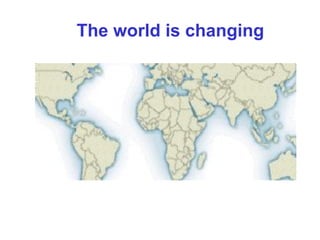
The world ischanging
● In the industrialized world computers are
changing everything: from education to health,
from voting to making friends or making war.
● Developing countries can also fully participate in
cyberspace and make use of opportunities offered by
global networks.
● We are living a technological and informational
revolution.
● It is therefore important for policy makers, leaders,
teachers, computer professionals and all social
thinkers to get involved in the social and ethical
impacts of this communication technology.
11.
Cyberethics and cybertechnology
Definitions
● Cyberethics is the field of applied ethics that
examines moral, legal, and social issues in the
development and use of cybertechnology.
●
● Cybertechnology refers to a broad range of
technologies from stand-alone computers to the
cluster of networked computing, information and
communication technologies.
●
Internet ethics and information ethics.
12.
Computer ethics: definition
●The study of ethical issues that are
associated primarily with computing
machines and the computing profession.
● The field of applied professional ethics
dealing with ethical problems aggravated,
transformed, or created by computer
technology (1970, Maner)
13.
Computer Ethics
Some historicalmilestones
● 1940-1950: Founded by MIT prof Norbert Wiener:
cybernetics-science of information feedback systems.
● 1960s: Donn Parker from California examined unethical
and illegal uses of computers by professionals.1st
code
of professional conduct for the ACM.
● 1970: Joseph Weizenbaum, prof at MIT, created Eliza.
● Mid 1970: Walter Maner taught 1st
course and starter
kit in computer ethics.
● 1980: Issues like computer-enabled crime, disasters,
invasion of privacy via databases, lawsuits about
software ownership became public.
14.
Computer Ethics
Some historicalmilestones
● Mid 80s: James Moore of Dartmouth, Deborah
Johnson of Rensselaer, Sherry Turkle of MIT, and
Judith Perrolle published article and books.
● 1990: Interest in computer ethics as a field of research
had spread to Europe and Australia.
● Simon Rogerson of De Montfort University (UK) Terrell
Bynum, editor of Metaphilosophy (USA), initiated
international conferences.
● Mid 90s: Beginning of a 2nd
generation of computer
ethics with more practical action.
● 2004: Interest spreads to Cotonou, Benin
15.
Any unique moralissues?
Deborah Johnson: Ethics online
● The scope of the Internet is global and
interactive.
● The Internet enables users to interact with
anonymity.
● Internet technology makes the
reproducibility of information possible in
ways not possible before.
● The above features make behavior on-line
morally different than off-line.
16.
The debate continues
“”
● James Moore: Computer technology is
logically malleable unlike previous
technologies. It can create “new possibilities
for human action”.
● Brey: disclosing non-obvious features
embedded in computer systems that can
have moral implications.
● Alison Adams: Take into account
gender-related biases. Combine feminist
ethics with empirical studies.
17.
Computer Ethics
■ Computerethics defined as the application of classical
ethical principles to the use of computer technology
■ Ethical problems related to computers are not unique but
they tend to occur on a much larger scale and scope
•Scope: communications networks bring the world together
•Anonymity: beneficial but creates problems of integrity
•Reproducibility
■ Aspects of computer ethics:
•Analysis of the nature of problems related to the social
impact of computers
•Formulation and justification of policies needed to manage
computer technology
18.
Categories of ComputerEthics Issues
■ Privacy
•Computers create a false sense of security
•People do not realize how vulnerable information stored on
computers are
■ Property
•Physical property
•Intellectual property (in both copyright and patent)
•Data as property
■ Access
•Access to computing technology
•Access to data
■ Accuracy
•Accuracy of information stored
19.
Sample topics incomputer ethics
● Computers in the workplace: a threat to jobs?
Deskilling? Health and safety?
● Computer security: Viruses. Spying by hackers.
● Logical security: Privacy, integrity,
unimpaired service, consistency, controlling
access to resources.
● Software ownership: Intellectual property vs. open
source.
● Software development: quality, safety
20.
Computers in theworkplace
● Monitoring of employees: employer vs.
employee point of view.
● Loyalty- Whistle blowing. Health issues.
● Use of contingent workers. A threat to
jobs.
● Deskilling
21.
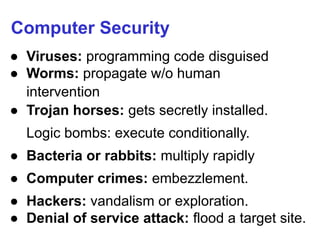
Computer Security
● Viruses:programming code disguised
● Worms: propagate w/o human
intervention
● Trojan horses: gets secretly installed.
Logic bombs: execute conditionally.
● Bacteria or rabbits: multiply rapidly
● Computer crimes: embezzlement.
● Hackers: vandalism or exploration.
● Denial of service attack: flood a target site.
22.
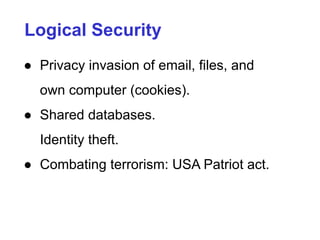
Logical Security
● Privacyinvasion of email, files, and
own computer (cookies).
● Shared databases.
Identity theft.
● Combating terrorism: USA Patriot act.
23.
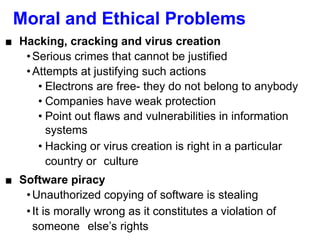
Moral and EthicalProblems
■ Hacking, cracking and virus creation
•Serious crimes that cannot be justified
•Attempts at justifying such actions
• Electrons are free- they do not belong to anybody
• Companies have weak protection
• Point out flaws and vulnerabilities in information
systems
• Hacking or virus creation is right in a particular
country or culture
■ Software piracy
•Unauthorized copying of software is stealing
•It is morally wrong as it constitutes a violation of
someone else’s rights
24.
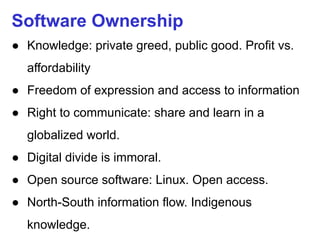
Software Ownership
● Knowledge:private greed, public good. Profit vs.
affordability
● Freedom of expression and access to information
● Right to communicate: share and learn in a
globalized world.
● Digital divide is immoral.
● Open source software: Linux. Open access.
● North-South information flow. Indigenous
knowledge.
25.
Professional Responsibility
● Codesof ethics.
● Professional organizations: ACM. IEEE,
CPSR
● Licensing
● Industry certifications
● Common ethical issues: Piracy, inappropriate
sharing of information, inappropriate usage of
computing resources.
26.
Codes of Ethics
●Avoid harm to others
● Be honest and trustworthy
● Acquire and maintain professional
competence
● Know and respect existing laws pertaining
to professional work
● Avoid real or perceived conflicts of interest
● Be honest and realistic in stating claims or
estimates based on available data
27.
Problems with Codesof Ethics
■ A legal system is not a complete and correct
guide to moral behavior
■ Codes of ethics are mostly voluntary
■ May encounter situations for which the code
makes no explicit recommendations
■ Goodness cannot be defined through a list of
Dos and Don'ts
■ You must use your internal sense of ethics
28.
Computer Ethics Awarenessand
Educational Issues
■ How to raise the moral consciousness and ethical
level
■ Possibilities of developing global computer ethics
codes
■ Computer ethics education should include:
•Explanation of disruptive potential of even a single user
•Understanding of importance of ethics and lack of laws in
computer/information technology
•Explanation of information security & related problems
•Making people aware of ethical impact of their actions
•Training and education by professionals
29.
Computing Ethics andGuidelines -
Example
■ Respect privacy of other users and do not share your
account with others
■ Respect appropriate laws and copyrights
■ Obey established guidelines for any network or
system used
■ Do not use computer resources for unauthorized
purposes
■ Do not use computer resources for commercial
endeavors
■ Do not use computer resources in ways detrimental to
normal operation
30.
Global Information Ethics
●Freedom of speech in the USA Control of
pornography Protection of intellectual
property Invasion of privacy
● Global cyber business Global
education: free press
● Information rich and poor
31.
The future
● Gorniakhypothesis: Computer Ethics, a
branch now of applied ethics, will evolve into
a system of global ethics applicable in every
culture on earth. The computer revolution
will lead to a new ethical system, global and
cross-cultural. It will supplant parochial
theories like Bentham and Kant based on
isolated cultures.
● The Johnson hypothesis: Opposite.
32.
Computer Ethics -Case Studies
Administrator Dilemma
■ The problem here is that every file on the system is
accessible by the administrator and they have no tracks
when they change a file
■ If administrator is always believed, he is given the ability
to take advantage of anybody at any time
■ If user is always believed, he is given the ability to get
away with anything he does
■ Anything on the system can be faked without evidence
33.
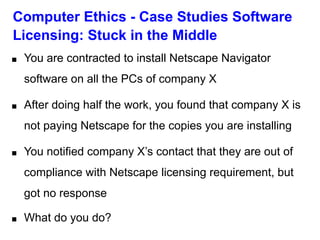
Computer Ethics -Case Studies Software
Licensing: Stuck in the Middle
■ You are contracted to install Netscape Navigator
software on all the PCs of company X
■ After doing half the work, you found that company X is
not paying Netscape for the copies you are installing
■ You notified company X’s contact that they are out of
compliance with Netscape licensing requirement, but
got no response
■ What do you do?
34.
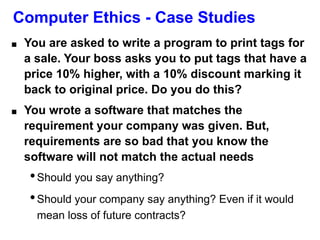
Computer Ethics -Case Studies
■ You are asked to write a program to print tags for
a sale. Your boss asks you to put tags that have a
price 10% higher, with a 10% discount marking it
back to original price. Do you do this?
■ You wrote a software that matches the
requirement your company was given. But,
requirements are so bad that you know the
software will not match the actual needs
•Should you say anything?
•Should your company say anything? Even if it would
mean loss of future contracts?
35.
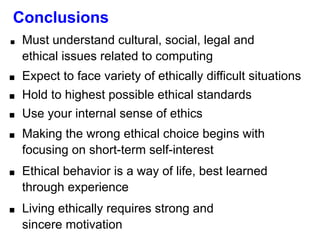
Conclusions
■ Must understandcultural, social, legal and
ethical issues related to computing
■ Expect to face variety of ethically difficult situations
■ Hold to highest possible ethical standards
■ Use your internal sense of ethics
■ Making the wrong ethical choice begins with
focusing on short-term self-interest
■ Ethical behavior is a way of life, best learned
through experience
■ Living ethically requires strong and
sincere motivation
36.
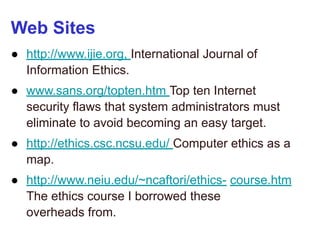
Web Sites
● http://www.ijie.org,International Journal of
Information Ethics.
● www.sans.org/topten.htm Top ten Internet
security flaws that system administrators must
eliminate to avoid becoming an easy target.
● http://ethics.csc.ncsu.edu/ Computer ethics as a
map.
● http://www.neiu.edu/~ncaftori/ethics- course.htm
The ethics course I borrowed these
overheads from.