GLORY K S
2019520202
INTRODUCTION
 Ethics is a set of moral principles that govern (control) the
behavior of a group or individual, likewise, computer
ethics is set of moral principles that regulate (control) the
use of computers.
Explanation
 Ethic refers to the standards and rules that "should" be
followed and it helps us to regulate our conduct in a
group or with a set of individuals. Since the term
Ethics is a relative term, it is branched under
philosophy, which states how users of World Wide
Web should make decisions regarding their conduct.
 Computer ethics is a new branch of ethics that is
growing and changing rapidly as computer technology
also grows anddevelops.
The Ten Commandments On Computer Ethics
1. Thou shalt not use a computer to harm other people.
2. Thou shalt not interfere with other people's computer work.
3. Thou shalt not snoop around in other people's computer files.
4. Thou shalt not use a computer to steal.
5. Thou shalt not use a computer to bear false witness.
6. Thou shalt not copy or use proprietary software for which you
have not paid.
7. Thou shalt not use other people's computer resources without
authorization or proper compensation.
8. Thou shalt not appropriate other people's intellectual(idea of
others) output.
9. Thou shalt think about the social consequences of the program
you are writing or the system you are designing.
10. Thou shalt always use a computer in ways that ensure
consideration (attention) and respect for your fellow humans.
Why do we need computer ethics?
 The growth of the WWW has created several novel
legal issues
 The existence of new questions that older laws
cannot answer
 Traditional laws are outdated/anachronistic in this
world
 A more coherent (clear) body of law is needed to
govern Internet and computers
Code of Ethics
 Information stored on the computer should be treated as
seriously as written or spoken word.
 Privacy should not be violated. In case of academic use, it is
known. plagiarism
 Information from public viewing should not be modified
or deleted or inaccessible since these are considered as
destructive acts.
 Intrusive (unpleasant) software such as "worms" and
"viruses" which are destructive to the computer system is also
illegal.
 Congesting (blocking) somebody’s system with a lot of
unwanted information is also unethical.
 Sending obscene and crude (indecent) messages through mail or
chat is also forbidden.
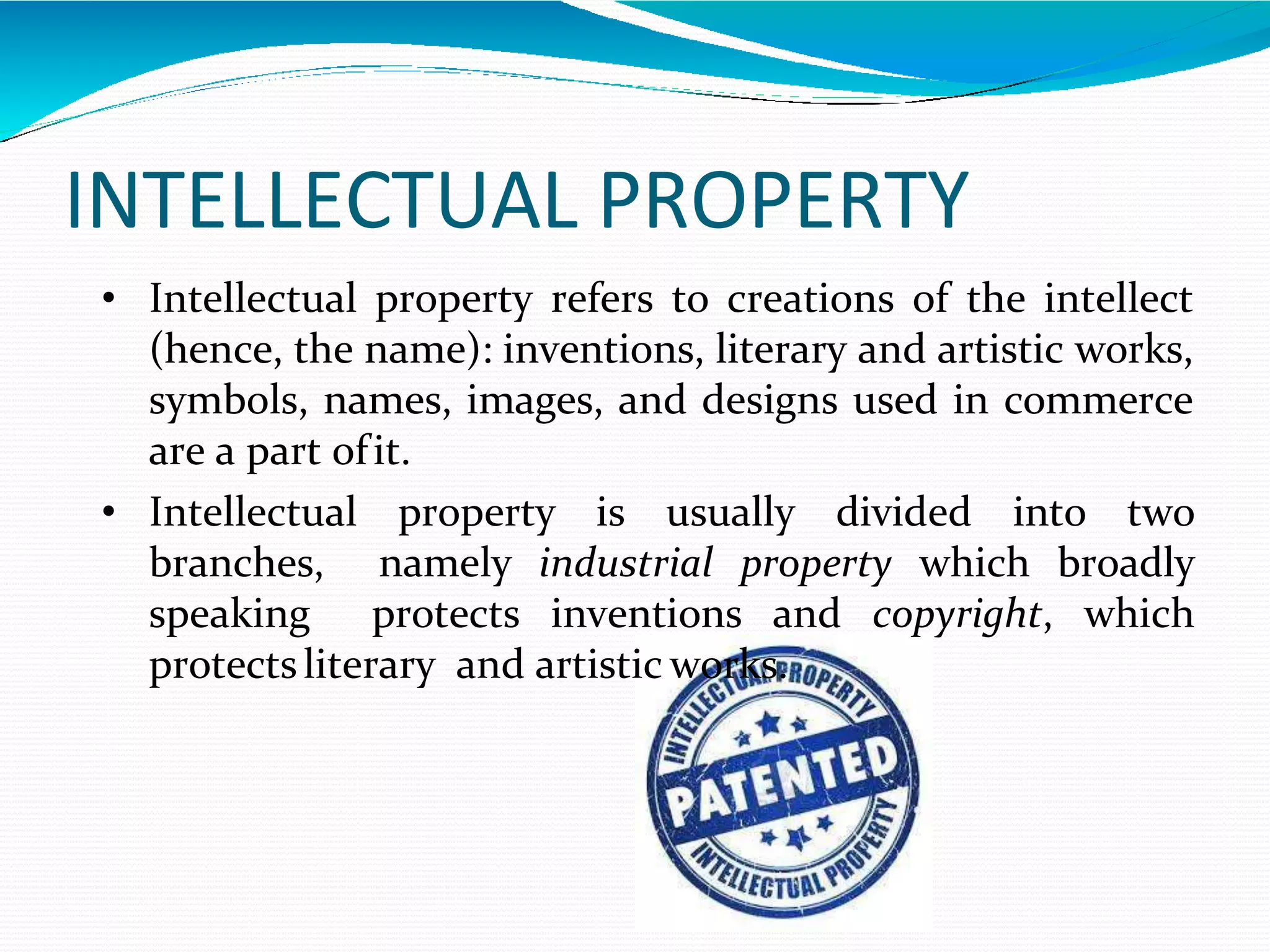
INTELLECTUAL PROPERTY
• Intellectual property refers to creations of the intellect
(hence, the name): inventions, literary and artistic works,
symbols, names, images, and designs used in commerce
are a part ofit.
• Intellectual property is usually divided into two
branches, namely industrial property which broadly
speaking protects inventions and copyright, which
protectsliterary and artistic works.
Categorizing Intellectual Property
 Intellectual property is divided into twocategories:
 Industrial property, which includes inventions(patents),
trademarks, industrial designs, commercial
designations and geographic indications
names,
(location
specific brands) etc.
 Copyright, which includes literary and artistic works such
as novels, poems and plays, films, musical works, artistic
works such as drawings, paintings, photographs,
sculptures, and architecturaldesigns.
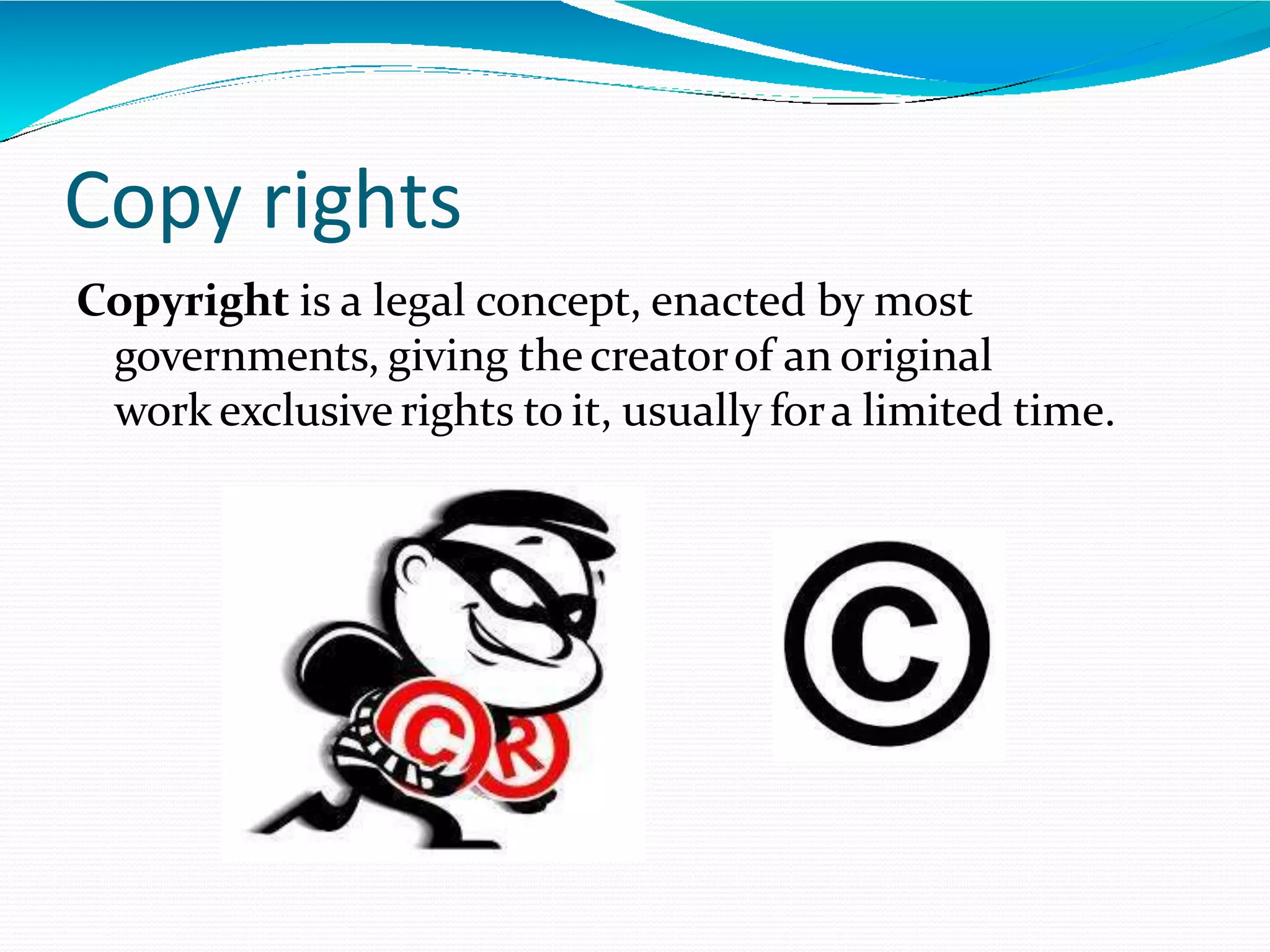
Copy rights
Copyright is a legal concept, enacted by most
governments, giving thecreatorof an original
work exclusive rights to it, usually fora limited time.
COPY RIGHT ON INTERNET
 But what of works made available to the public on the
Internet? Are they at all protected by copyright? Once
communications network (such as the Internet),
again, yes! For works made available over a
the
copyright protects originalauthorship.
 But, according to the Copyright Law, it does not protect
ideas, procedures, systems, or methods of operation. This
means that once such an online work has been made
public, nothing in the copyright laws prevents others
from developing another work based on similar
principles, or ideas.
NETIQUETTES
Netiquette are about the various risks related to using
the Internet.
It is about proper ways in which to use a network and to
determine whether information is reliable, while
emphasizing four important pointsgiven in nextslides.
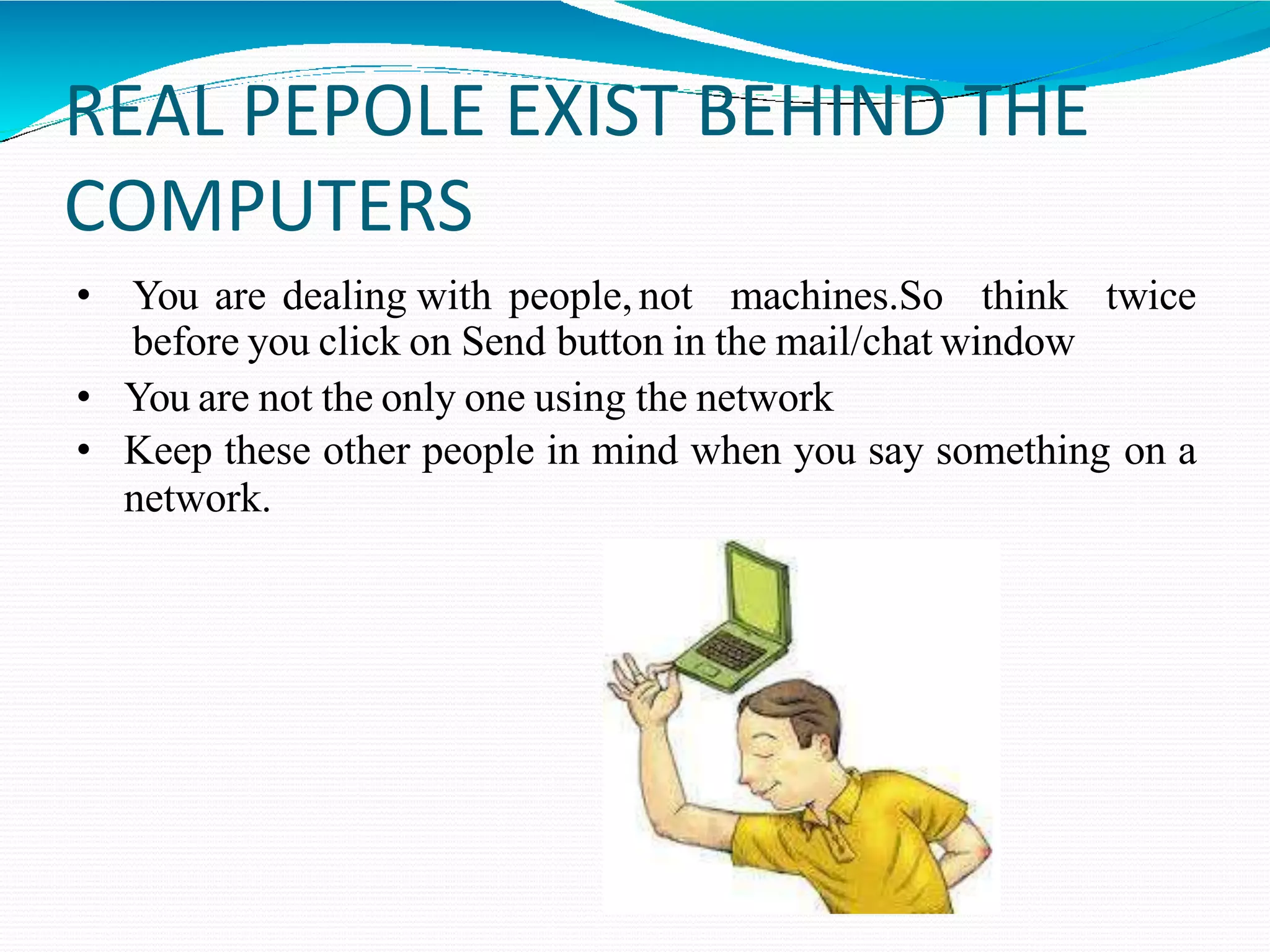
REAL PEPOLE EXIST BEHIND THE
COMPUTERS
• You are dealing with people,not machines.So think twice
before you click on Send button in the mail/chat window
• You are not the only one using the network
• Keep these other people in mind when you say something on a
network.
Ethical rules for computer users
 Do not use computer to harm other users.
 Do not use computers to steal other's information.
 Do not access files without the permission of owner.
Do not copy copyrighted software's without the authors
permission.
 Always respect copyright laws and policies.
 Respect the privacy of others, just as you expect the same from
 Do not use other user's computer resources with out their
permission.
.
• Use Internet ethically.
• Complain about illegal communication and activities, if
found, to Internet service Providers and local law enforcement
authorities
• Users are responsible for safeguarding their User Id and
passwords
• They should not write them on paper or anywhere else for
remembrance.
• Users should not intentionally use the computers to retrieve or
modify the information of others which may include password
information, files etc.
PROTECT YOUR PRIVACY
 Just as you would in the real world, be aware of risks, fraud
and false information which exists on the Internet. Use
common sense when deciding whether information is
valid. Don't trust or spread further any information about
which you are in doubt. Always try to obtain reliable
information.
 Protect your personal information to keep someone from
using it in an unethical way. (For example, when you enter a
prize contest, your name, address, and phone number may
be given toa dealerof personal information.)
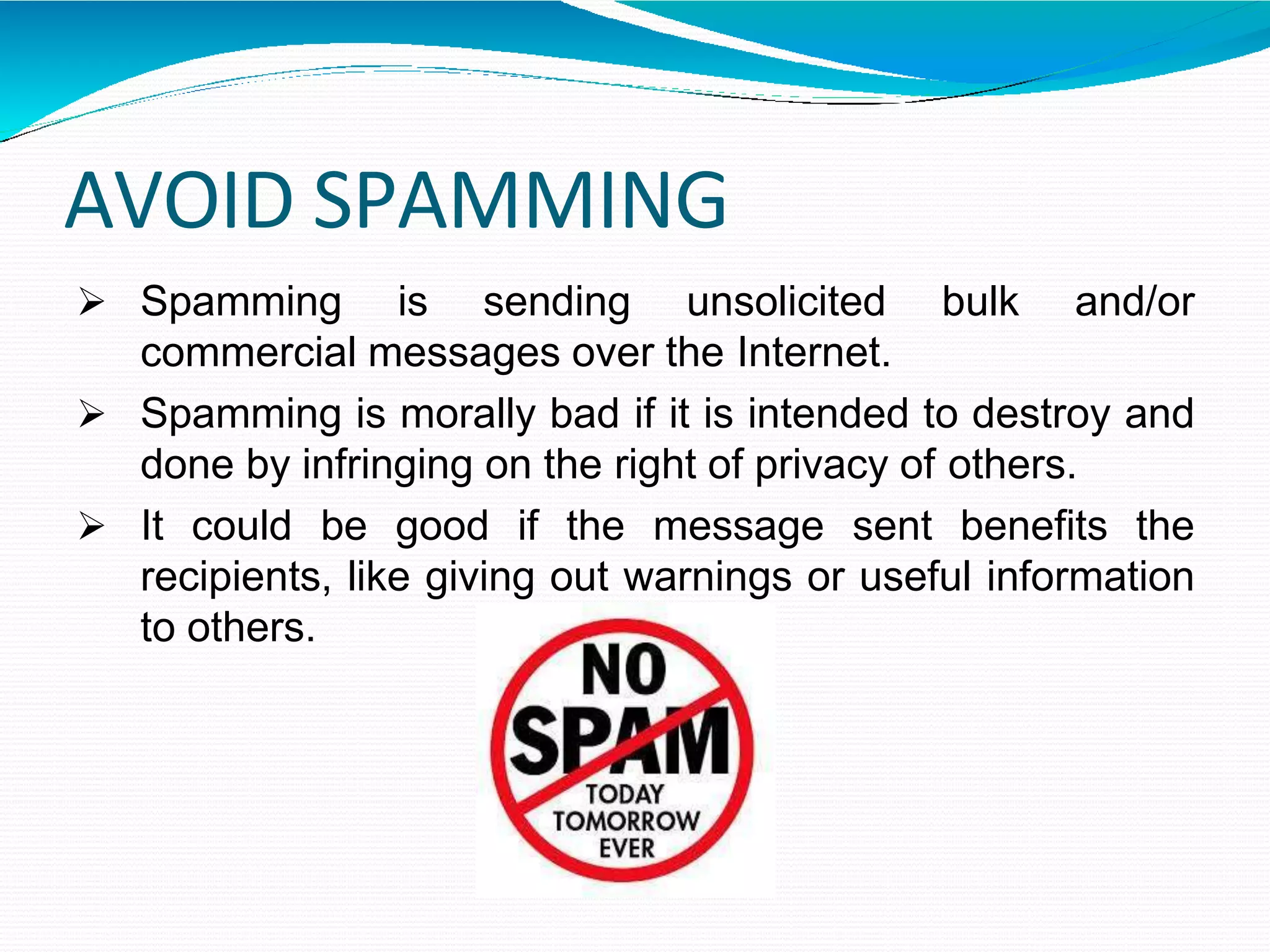
AVOID SPAMMING
 Spamming is sending unsolicited bulk and/or
commercial messages over the Internet.
 Spamming is morally bad if it is intended to destroy and
done by infringing on the right of privacy of others.
 It could be good if the message sent benefits the
recipients, like giving out warnings or useful information
to others.
SOFTWARE PRIVACY
 Software piracy is morally bad when someone
reproduces a copy of the software and sells it for
profit, produces exactly the same or similar version
without giving proper credit to the original author, or
simply produces it and distributes it toothers.
 It is not immoral to copy the software if someone who has
a licensed copy of the software and simply makes a
backup copy of the original. One back-up copy of the
commercial software can be made, but the back-up copy
cannot be used except when the original package fails or
is destroyed.
CREATION OF WORMS AND
COMPUTER VIRUS
 Creation of worms and computer viruses is morally bad
when it is intended for malicious purposes like to steal
information or destroying ofdata.
 However, it could be used like a vaccine – poison to kill
another poison – to cure or prevent a potentially
destructive system from wreaking havoc in the network.
The way some worms and viruses work could be used to
gather information that could help protect the majority of
computerusers.
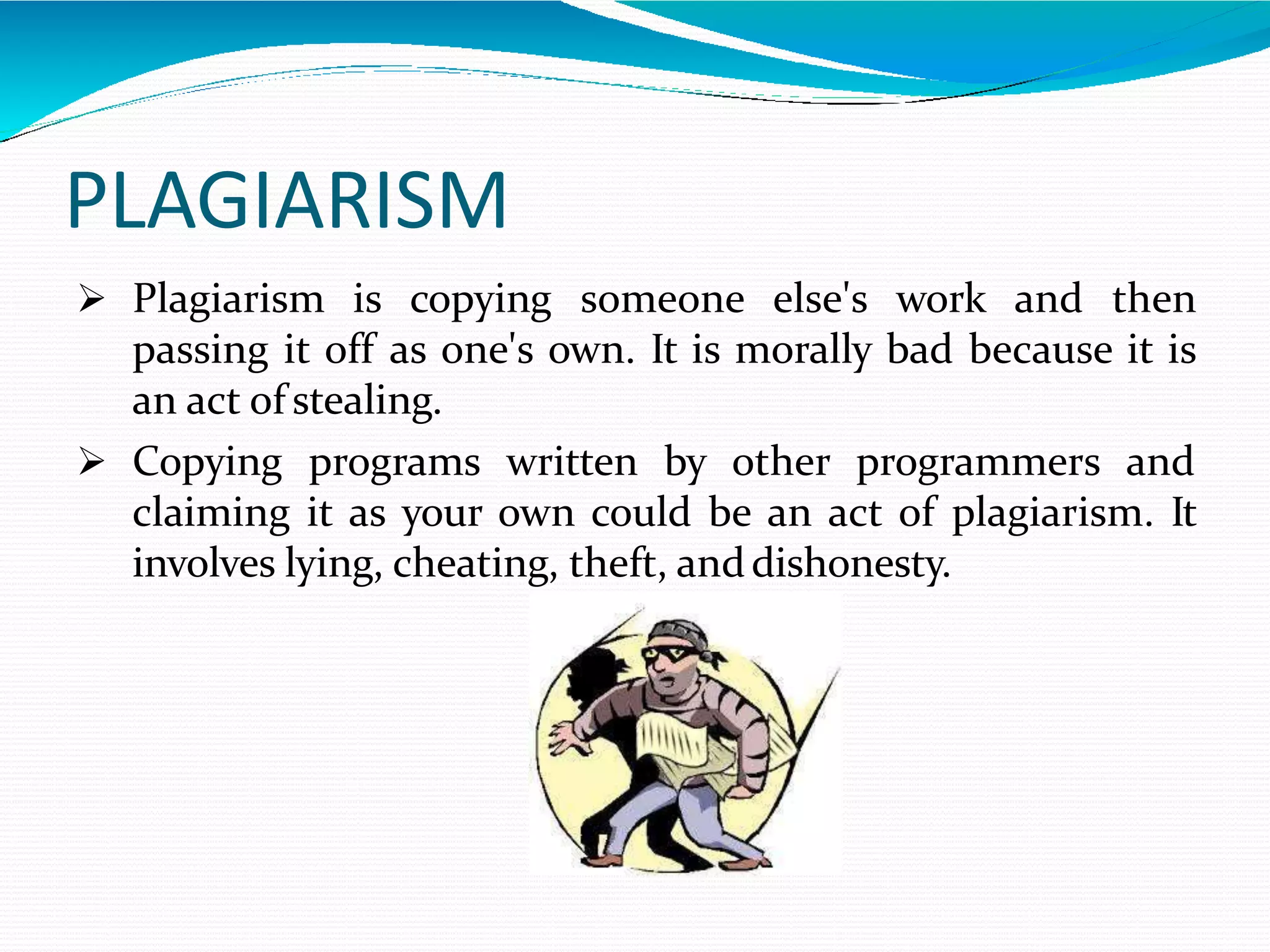
PLAGIARISM
 Plagiarism is copying someone else's work and then
passing it off as one's own. It is morally bad because it is
an act of stealing.
 Copying programs written by other programmers and
claiming it as your own could be an act of plagiarism. It
involves lying, cheating, theft, anddishonesty.
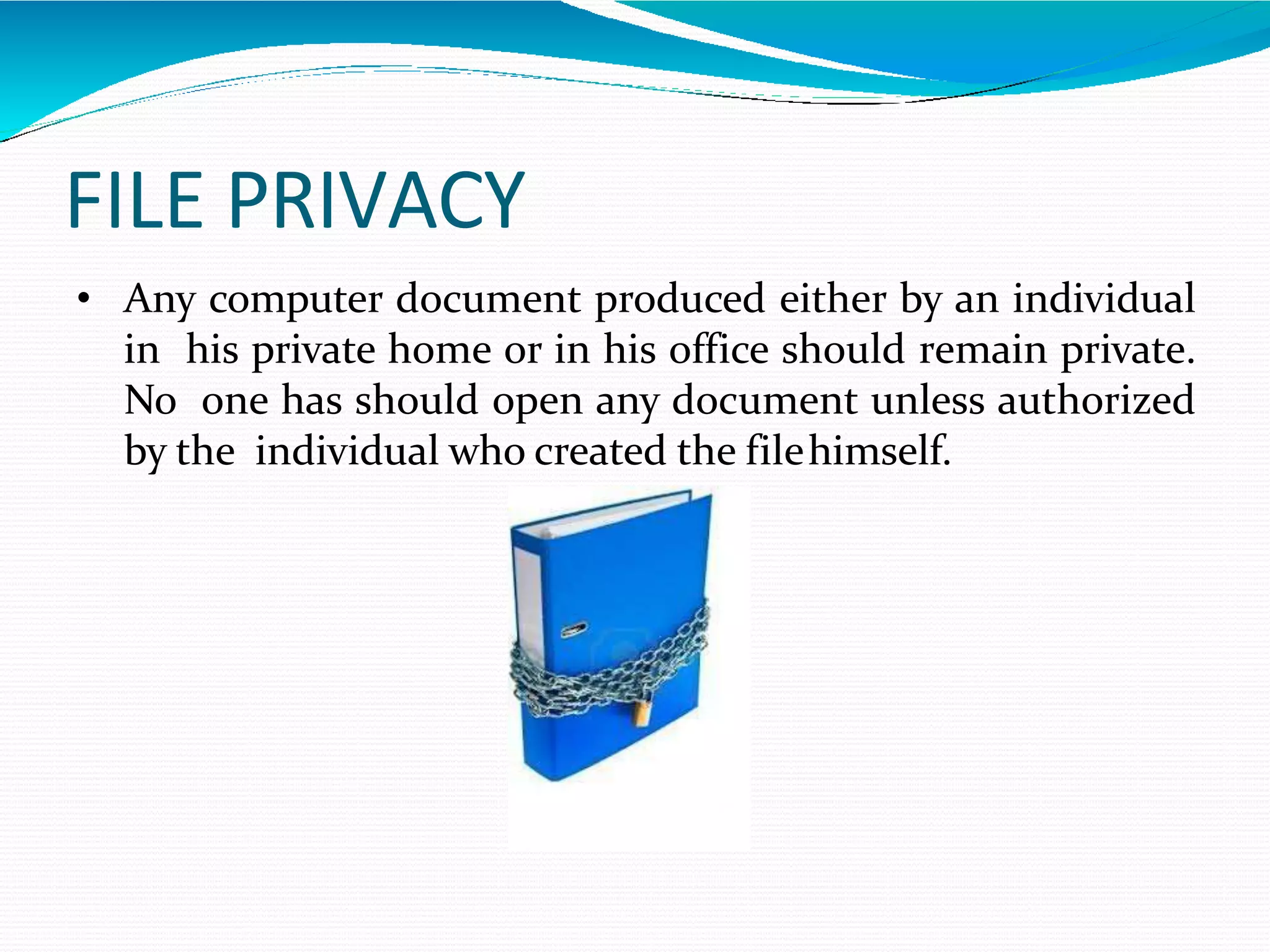
FILE PRIVACY
• Any computer document produced either by an individual
in his private home or in his office should remain private.
No one has should open any document unless authorized
by the individual who created the filehimself.
Computer ethical hacking
• An ethical hacker is usually employed by an
organization who trusts him or her to attempt to
penetrate networks and/or computer systems, using
the same methods as a hacker, for the purpose of
finding and fixing computer security vulnerabilities.
• Unauthorized hacking (i.e., gaining access to
computer systems without prior authorization from
the owner) is a crime in most countries, but
penetration testing done by request of the owner of
thevictim system or network is not.
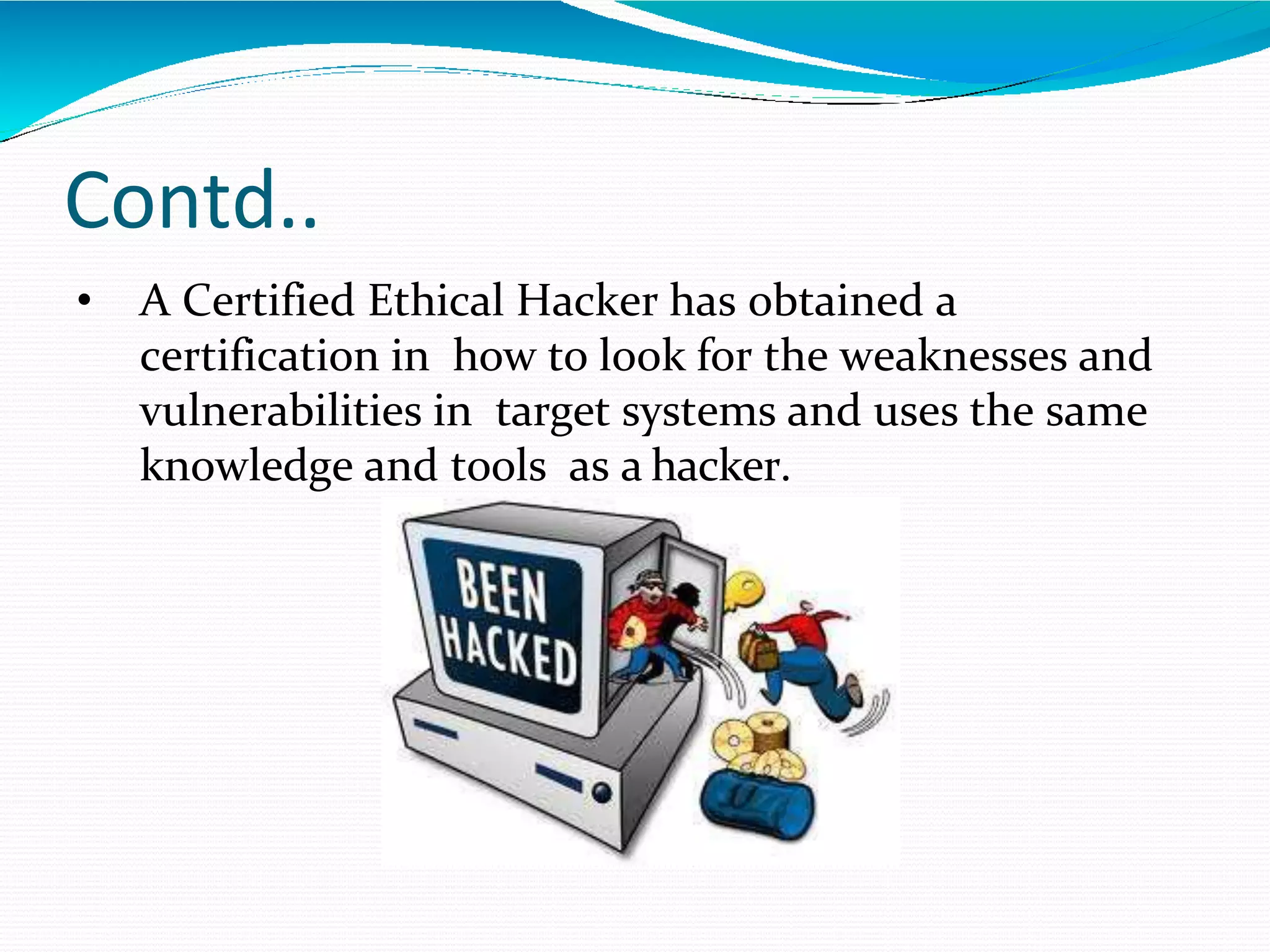
Contd..
• A Certified Ethical Hacker has obtained a
certification in how to look for the weaknesses and
vulnerabilities in target systems and uses the same
knowledge and tools as a hacker.
CONCLUSION
• As technology advances, computers continue to
have a greater impact on society. Therefore,
computer ethics promotes the discussion of how
much influence computers should have in areas
such as artificial intelligence and human
communication.
• As the world of computers evolves, computer
ethics continues to create ethical standards that
address new issues raised by new technologies.
THANK YOU!

computer ethics.pptx

  • 1.
  • 2.
    INTRODUCTION  Ethics isa set of moral principles that govern (control) the behavior of a group or individual, likewise, computer ethics is set of moral principles that regulate (control) the use of computers.
  • 3.
    Explanation  Ethic refersto the standards and rules that "should" be followed and it helps us to regulate our conduct in a group or with a set of individuals. Since the term Ethics is a relative term, it is branched under philosophy, which states how users of World Wide Web should make decisions regarding their conduct.  Computer ethics is a new branch of ethics that is growing and changing rapidly as computer technology also grows anddevelops.
  • 5.
    The Ten CommandmentsOn Computer Ethics 1. Thou shalt not use a computer to harm other people. 2. Thou shalt not interfere with other people's computer work. 3. Thou shalt not snoop around in other people's computer files. 4. Thou shalt not use a computer to steal. 5. Thou shalt not use a computer to bear false witness. 6. Thou shalt not copy or use proprietary software for which you have not paid. 7. Thou shalt not use other people's computer resources without authorization or proper compensation. 8. Thou shalt not appropriate other people's intellectual(idea of others) output. 9. Thou shalt think about the social consequences of the program you are writing or the system you are designing. 10. Thou shalt always use a computer in ways that ensure consideration (attention) and respect for your fellow humans.
  • 6.
    Why do weneed computer ethics?  The growth of the WWW has created several novel legal issues  The existence of new questions that older laws cannot answer  Traditional laws are outdated/anachronistic in this world  A more coherent (clear) body of law is needed to govern Internet and computers
  • 7.
    Code of Ethics Information stored on the computer should be treated as seriously as written or spoken word.  Privacy should not be violated. In case of academic use, it is known. plagiarism  Information from public viewing should not be modified or deleted or inaccessible since these are considered as destructive acts.  Intrusive (unpleasant) software such as "worms" and "viruses" which are destructive to the computer system is also illegal.  Congesting (blocking) somebody’s system with a lot of unwanted information is also unethical.  Sending obscene and crude (indecent) messages through mail or chat is also forbidden.
  • 8.
    INTELLECTUAL PROPERTY • Intellectualproperty refers to creations of the intellect (hence, the name): inventions, literary and artistic works, symbols, names, images, and designs used in commerce are a part ofit. • Intellectual property is usually divided into two branches, namely industrial property which broadly speaking protects inventions and copyright, which protectsliterary and artistic works.
  • 9.
    Categorizing Intellectual Property Intellectual property is divided into twocategories:  Industrial property, which includes inventions(patents), trademarks, industrial designs, commercial designations and geographic indications names, (location specific brands) etc.  Copyright, which includes literary and artistic works such as novels, poems and plays, films, musical works, artistic works such as drawings, paintings, photographs, sculptures, and architecturaldesigns.
  • 10.
    Copy rights Copyright isa legal concept, enacted by most governments, giving thecreatorof an original work exclusive rights to it, usually fora limited time.
  • 11.
    COPY RIGHT ONINTERNET  But what of works made available to the public on the Internet? Are they at all protected by copyright? Once communications network (such as the Internet), again, yes! For works made available over a the copyright protects originalauthorship.  But, according to the Copyright Law, it does not protect ideas, procedures, systems, or methods of operation. This means that once such an online work has been made public, nothing in the copyright laws prevents others from developing another work based on similar principles, or ideas.
  • 12.
    NETIQUETTES Netiquette are aboutthe various risks related to using the Internet. It is about proper ways in which to use a network and to determine whether information is reliable, while emphasizing four important pointsgiven in nextslides.
  • 13.
    REAL PEPOLE EXISTBEHIND THE COMPUTERS • You are dealing with people,not machines.So think twice before you click on Send button in the mail/chat window • You are not the only one using the network • Keep these other people in mind when you say something on a network.
  • 14.
    Ethical rules forcomputer users  Do not use computer to harm other users.  Do not use computers to steal other's information.  Do not access files without the permission of owner. Do not copy copyrighted software's without the authors permission.  Always respect copyright laws and policies.  Respect the privacy of others, just as you expect the same from  Do not use other user's computer resources with out their permission. .
  • 15.
    • Use Internetethically. • Complain about illegal communication and activities, if found, to Internet service Providers and local law enforcement authorities • Users are responsible for safeguarding their User Id and passwords • They should not write them on paper or anywhere else for remembrance. • Users should not intentionally use the computers to retrieve or modify the information of others which may include password information, files etc.
  • 16.
    PROTECT YOUR PRIVACY Just as you would in the real world, be aware of risks, fraud and false information which exists on the Internet. Use common sense when deciding whether information is valid. Don't trust or spread further any information about which you are in doubt. Always try to obtain reliable information.  Protect your personal information to keep someone from using it in an unethical way. (For example, when you enter a prize contest, your name, address, and phone number may be given toa dealerof personal information.)
  • 17.
    AVOID SPAMMING  Spammingis sending unsolicited bulk and/or commercial messages over the Internet.  Spamming is morally bad if it is intended to destroy and done by infringing on the right of privacy of others.  It could be good if the message sent benefits the recipients, like giving out warnings or useful information to others.
  • 18.
    SOFTWARE PRIVACY  Softwarepiracy is morally bad when someone reproduces a copy of the software and sells it for profit, produces exactly the same or similar version without giving proper credit to the original author, or simply produces it and distributes it toothers.  It is not immoral to copy the software if someone who has a licensed copy of the software and simply makes a backup copy of the original. One back-up copy of the commercial software can be made, but the back-up copy cannot be used except when the original package fails or is destroyed.
  • 19.
    CREATION OF WORMSAND COMPUTER VIRUS  Creation of worms and computer viruses is morally bad when it is intended for malicious purposes like to steal information or destroying ofdata.  However, it could be used like a vaccine – poison to kill another poison – to cure or prevent a potentially destructive system from wreaking havoc in the network. The way some worms and viruses work could be used to gather information that could help protect the majority of computerusers.
  • 20.
    PLAGIARISM  Plagiarism iscopying someone else's work and then passing it off as one's own. It is morally bad because it is an act of stealing.  Copying programs written by other programmers and claiming it as your own could be an act of plagiarism. It involves lying, cheating, theft, anddishonesty.
  • 21.
    FILE PRIVACY • Anycomputer document produced either by an individual in his private home or in his office should remain private. No one has should open any document unless authorized by the individual who created the filehimself.
  • 22.
    Computer ethical hacking •An ethical hacker is usually employed by an organization who trusts him or her to attempt to penetrate networks and/or computer systems, using the same methods as a hacker, for the purpose of finding and fixing computer security vulnerabilities. • Unauthorized hacking (i.e., gaining access to computer systems without prior authorization from the owner) is a crime in most countries, but penetration testing done by request of the owner of thevictim system or network is not.
  • 23.
    Contd.. • A CertifiedEthical Hacker has obtained a certification in how to look for the weaknesses and vulnerabilities in target systems and uses the same knowledge and tools as a hacker.
  • 24.
    CONCLUSION • As technologyadvances, computers continue to have a greater impact on society. Therefore, computer ethics promotes the discussion of how much influence computers should have in areas such as artificial intelligence and human communication. • As the world of computers evolves, computer ethics continues to create ethical standards that address new issues raised by new technologies.
  • 25.