Next Generation Small Form Factor
(NGSFF) SSD Proposal
David Wang, PhD
Samsung Semiconductor Inc.
Flash Memory Summit 2017
Santa Clara, CA 1
Disclaimer
Flash Memory Summit 2017
Santa Clara, CA 2
This presentation and/or accompanying oral statements by Samsung representatives collectively, the
“Presentation”) is intended to provide information concerning the SSD and memory industry and Samsung
Electronics Co., Ltd. and certain affiliates (collectively, “Samsung”). While Samsung strives to provide information
that is accurate and up-to-date, this Presentation may nonetheless contain inaccuracies or omissions. As a
consequence, Samsung does not in any way guarantee the accuracy or completeness of the information provided
in this Presentation.
This Presentation may include forward-looking statements, including, but not limited to, statements about any
matter that is not a historical fact; statements regarding Samsung’s intentions, beliefs or current expectations
concerning, among other things, market prospects, technological developments, growth, strategies, and the
industry in which Samsung operates; and statements regarding products or features that are still in
development. By their nature, forward-looking statements involve risks and uncertainties, because they relate to
events and depend on circumstances that may or may not occur in the future. Samsung cautions you that forward
looking statements are not guarantees of future performance and that the actual developments of Samsung, the
market, or industry in which Samsung operates may differ materially from those made or suggested by the
forward-looking statements in this Presentation. In addition, even if such forward-looking statements are shown to
be accurate, those developments may not be indicative of developments in future periods.
Agenda
Flash Memory Summit 2017
Santa Clara, CA 3
 Background and Justification for NGSFF
 Key points of NGSFF proposal
 Form Factor, Pin Assignment, Connector
 NGSFF System Usage
 Summary
Background
Flash Memory Summit 2017
Santa Clara, CA 4
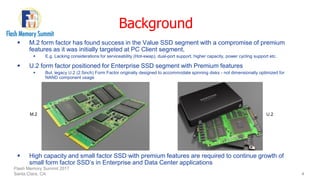
 M.2 form factor has found success in the Value SSD segment with a compromise of premium
features as it was initially targeted at PC Client segment,
 E.g. Lacking considerations for serviceability (Hot-swap), dual-port support, higher capacity, power cycling support etc.
 U.2 form factor positioned for Enterprise SSD segment with Premium features
 But, legacy U.2 (2.5inch) Form Factor originally designed to accommodate spinning disks - not dimensionally optimized for
NAND component usage
 High capacity and small factor SSD with premium features are required to continue growth of
small form factor SSD’s in Enterprise and Data Center applications
U.2M.2
Samsung’s NGSFF Proposal
Flash Memory Summit 2017
Santa Clara, CA 5
 Take the best qualities of U.2 and M.2, and make it better than both!
 Maintain evolutionary compatibility with M.2 where possible
 Height optimized for 1U servers (30.5 mm x 110 mm)
 Add new features to enable improvement of system level RAS and configurability
 Advantage 1: SSD volume optimized for NAND component usage
 M.2 (22 mm x 110 mm x 3.88 mm) = 9389.6 mm3;
 NGSFF (30.5 mm x 110 mm x 4.38 mm) = 14694.9 mm3; 2~4X capacity relative to M.2
 U.2 (69 mm x 100 mm x 7 mm) = 48300 mm3; 2~4X capacity relative to M.2
 Advantage 2: Some shared mechanical infrastructure with M.2
 Common connector – assign new signals to reserved pins to enable new features
 New Features: Dual Port options (2 port x 2 Lane, 1 port x 4 lane), 12V power, Power disable
 Advantage 3: Support front-side hot-swap capability for rackmount servers
 Presence detect pins and 12V pre-charge pins assigned to the reserved-pins of M.2 pin-out
 Hot-swap mating sequence defined
 Front accessibility optimized: 1) Indicator LED’s, 2) Lever, 3) Metal Guide
Form Factor / Size
Flash Memory Summit 2017
Santa Clara, CA 6
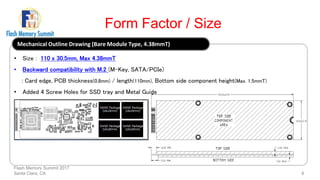
Mechanical Outline Drawing (Bare Module Type, 4.38mmT)
• Size : 110 x 30.5mm, Max 4.38mmT
• Backward compatibility with M.2 (M-Key, SATA/PCIe)
: Card edge, PCB thickness(0.8mm) / length(110mm), Bottom side component height(Max. 1.5mmT)
• Added 4 Screw Holes for SSD tray and Metal Guide
Pin Assignment (1/2)
Flash Memory Summit 2017
Santa Clara, CA 7
New signals
assigned to ‘N/C
pins of M.2
connector’ to
support enterprise
features in NGSFF
SATA PCIe Single Port x4Lane PCIe Dual port x 2Lane
Pin Assignment (2/2)
Flash Memory Summit 2017
Santa Clara, CA 8
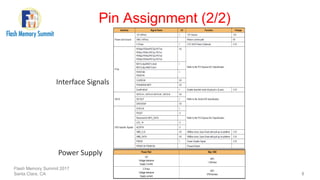
Interface Signals
Power Supply
Connector Illustration
Flash Memory Summit 2017
Santa Clara, CA 9
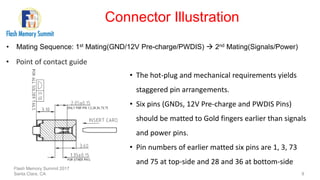
• Mating Sequence: 1st Mating(GND/12V Pre-charge/PWDIS)  2nd Mating(Signals/Power)
• The hot-plug and mechanical requirements yields
staggered pin arrangements.
• Six pins (GNDs, 12V Pre-charge and PWDIS Pins)
should be matted to Gold fingers earlier than signals
and power pins.
• Pin numbers of earlier matted six pins are 1, 3, 73
and 75 at top-side and 28 and 36 at bottom-side
• Point of contact guide
Connector Illustration 2
Flash Memory Summit 2017
Santa Clara, CA 10
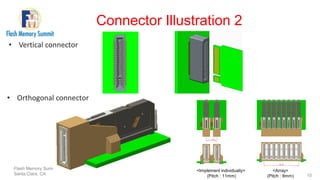
• Vertical connector
• Orthogonal connector
<Implement individually>
(Pitch : 11mm)
<Array>
(Pitch : 8mm)
NGSFF Usage
Flash Memory Summit 2017
Santa Clara, CA 11
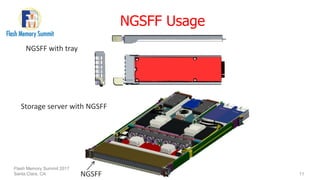
NGSFF with tray
Storage server with NGSFF
NGSFF
NGSFF Feature Summary
Flash Memory Summit 2017
Santa Clara, CA 12
NGSFF evolved from M.2 for familiarity and compatibility reasons
1. Adoption of the M.2 card edge allows a NGSFF SSD to be inserted into existing M.2 connector.
2. SSD length (110mm) and the component height of bottom-side (Max.1.5mmT) for NGSFF are same as M.2
• (**NGSFF form factor without metal guide and lever)
3. No-changes in M.2 power and signal pin-out. The new added signals and powers are assigned at reserved pin locations
Advantages when NGSFF form factor is utilized
1. With PCB width increase from 22mm to 30.5mm, max capacity increased by 2~4X
• Greatly improving SSD and system storage capacity
2. Essential features for enterprise class SSD’s such as dual-port and hot-swap are supported in the NGSFF specification
• Improving system reliability, availability and serviceability
3. NGSFF is optimized for 1U Server deployment
• Easy front side access - optimized (Metal Guide/Lever/Indicator LEDs) placements
4. Superior thermal characteristics compared to M.2

Next Generation Small Form Factor (NGSFF) SSD proposal

  • 1.
    Next Generation SmallForm Factor (NGSFF) SSD Proposal David Wang, PhD Samsung Semiconductor Inc. Flash Memory Summit 2017 Santa Clara, CA 1
  • 2.
    Disclaimer Flash Memory Summit2017 Santa Clara, CA 2 This presentation and/or accompanying oral statements by Samsung representatives collectively, the “Presentation”) is intended to provide information concerning the SSD and memory industry and Samsung Electronics Co., Ltd. and certain affiliates (collectively, “Samsung”). While Samsung strives to provide information that is accurate and up-to-date, this Presentation may nonetheless contain inaccuracies or omissions. As a consequence, Samsung does not in any way guarantee the accuracy or completeness of the information provided in this Presentation. This Presentation may include forward-looking statements, including, but not limited to, statements about any matter that is not a historical fact; statements regarding Samsung’s intentions, beliefs or current expectations concerning, among other things, market prospects, technological developments, growth, strategies, and the industry in which Samsung operates; and statements regarding products or features that are still in development. By their nature, forward-looking statements involve risks and uncertainties, because they relate to events and depend on circumstances that may or may not occur in the future. Samsung cautions you that forward looking statements are not guarantees of future performance and that the actual developments of Samsung, the market, or industry in which Samsung operates may differ materially from those made or suggested by the forward-looking statements in this Presentation. In addition, even if such forward-looking statements are shown to be accurate, those developments may not be indicative of developments in future periods.
  • 3.
    Agenda Flash Memory Summit2017 Santa Clara, CA 3  Background and Justification for NGSFF  Key points of NGSFF proposal  Form Factor, Pin Assignment, Connector  NGSFF System Usage  Summary
  • 4.
    Background Flash Memory Summit2017 Santa Clara, CA 4  M.2 form factor has found success in the Value SSD segment with a compromise of premium features as it was initially targeted at PC Client segment,  E.g. Lacking considerations for serviceability (Hot-swap), dual-port support, higher capacity, power cycling support etc.  U.2 form factor positioned for Enterprise SSD segment with Premium features  But, legacy U.2 (2.5inch) Form Factor originally designed to accommodate spinning disks - not dimensionally optimized for NAND component usage  High capacity and small factor SSD with premium features are required to continue growth of small form factor SSD’s in Enterprise and Data Center applications U.2M.2
  • 5.
    Samsung’s NGSFF Proposal FlashMemory Summit 2017 Santa Clara, CA 5  Take the best qualities of U.2 and M.2, and make it better than both!  Maintain evolutionary compatibility with M.2 where possible  Height optimized for 1U servers (30.5 mm x 110 mm)  Add new features to enable improvement of system level RAS and configurability  Advantage 1: SSD volume optimized for NAND component usage  M.2 (22 mm x 110 mm x 3.88 mm) = 9389.6 mm3;  NGSFF (30.5 mm x 110 mm x 4.38 mm) = 14694.9 mm3; 2~4X capacity relative to M.2  U.2 (69 mm x 100 mm x 7 mm) = 48300 mm3; 2~4X capacity relative to M.2  Advantage 2: Some shared mechanical infrastructure with M.2  Common connector – assign new signals to reserved pins to enable new features  New Features: Dual Port options (2 port x 2 Lane, 1 port x 4 lane), 12V power, Power disable  Advantage 3: Support front-side hot-swap capability for rackmount servers  Presence detect pins and 12V pre-charge pins assigned to the reserved-pins of M.2 pin-out  Hot-swap mating sequence defined  Front accessibility optimized: 1) Indicator LED’s, 2) Lever, 3) Metal Guide
  • 6.
    Form Factor /Size Flash Memory Summit 2017 Santa Clara, CA 6 Mechanical Outline Drawing (Bare Module Type, 4.38mmT) • Size : 110 x 30.5mm, Max 4.38mmT • Backward compatibility with M.2 (M-Key, SATA/PCIe) : Card edge, PCB thickness(0.8mm) / length(110mm), Bottom side component height(Max. 1.5mmT) • Added 4 Screw Holes for SSD tray and Metal Guide
  • 7.
    Pin Assignment (1/2) FlashMemory Summit 2017 Santa Clara, CA 7 New signals assigned to ‘N/C pins of M.2 connector’ to support enterprise features in NGSFF SATA PCIe Single Port x4Lane PCIe Dual port x 2Lane
  • 8.
    Pin Assignment (2/2) FlashMemory Summit 2017 Santa Clara, CA 8 Interface Signals Power Supply
  • 9.
    Connector Illustration Flash MemorySummit 2017 Santa Clara, CA 9 • Mating Sequence: 1st Mating(GND/12V Pre-charge/PWDIS)  2nd Mating(Signals/Power) • The hot-plug and mechanical requirements yields staggered pin arrangements. • Six pins (GNDs, 12V Pre-charge and PWDIS Pins) should be matted to Gold fingers earlier than signals and power pins. • Pin numbers of earlier matted six pins are 1, 3, 73 and 75 at top-side and 28 and 36 at bottom-side • Point of contact guide
  • 10.
    Connector Illustration 2 FlashMemory Summit 2017 Santa Clara, CA 10 • Vertical connector • Orthogonal connector <Implement individually> (Pitch : 11mm) <Array> (Pitch : 8mm)
  • 11.
    NGSFF Usage Flash MemorySummit 2017 Santa Clara, CA 11 NGSFF with tray Storage server with NGSFF NGSFF
  • 12.
    NGSFF Feature Summary FlashMemory Summit 2017 Santa Clara, CA 12 NGSFF evolved from M.2 for familiarity and compatibility reasons 1. Adoption of the M.2 card edge allows a NGSFF SSD to be inserted into existing M.2 connector. 2. SSD length (110mm) and the component height of bottom-side (Max.1.5mmT) for NGSFF are same as M.2 • (**NGSFF form factor without metal guide and lever) 3. No-changes in M.2 power and signal pin-out. The new added signals and powers are assigned at reserved pin locations Advantages when NGSFF form factor is utilized 1. With PCB width increase from 22mm to 30.5mm, max capacity increased by 2~4X • Greatly improving SSD and system storage capacity 2. Essential features for enterprise class SSD’s such as dual-port and hot-swap are supported in the NGSFF specification • Improving system reliability, availability and serviceability 3. NGSFF is optimized for 1U Server deployment • Easy front side access - optimized (Metal Guide/Lever/Indicator LEDs) placements 4. Superior thermal characteristics compared to M.2