Technology Impact on 
Computers 
24 September 2014 
Francis Thompson
Computer History 
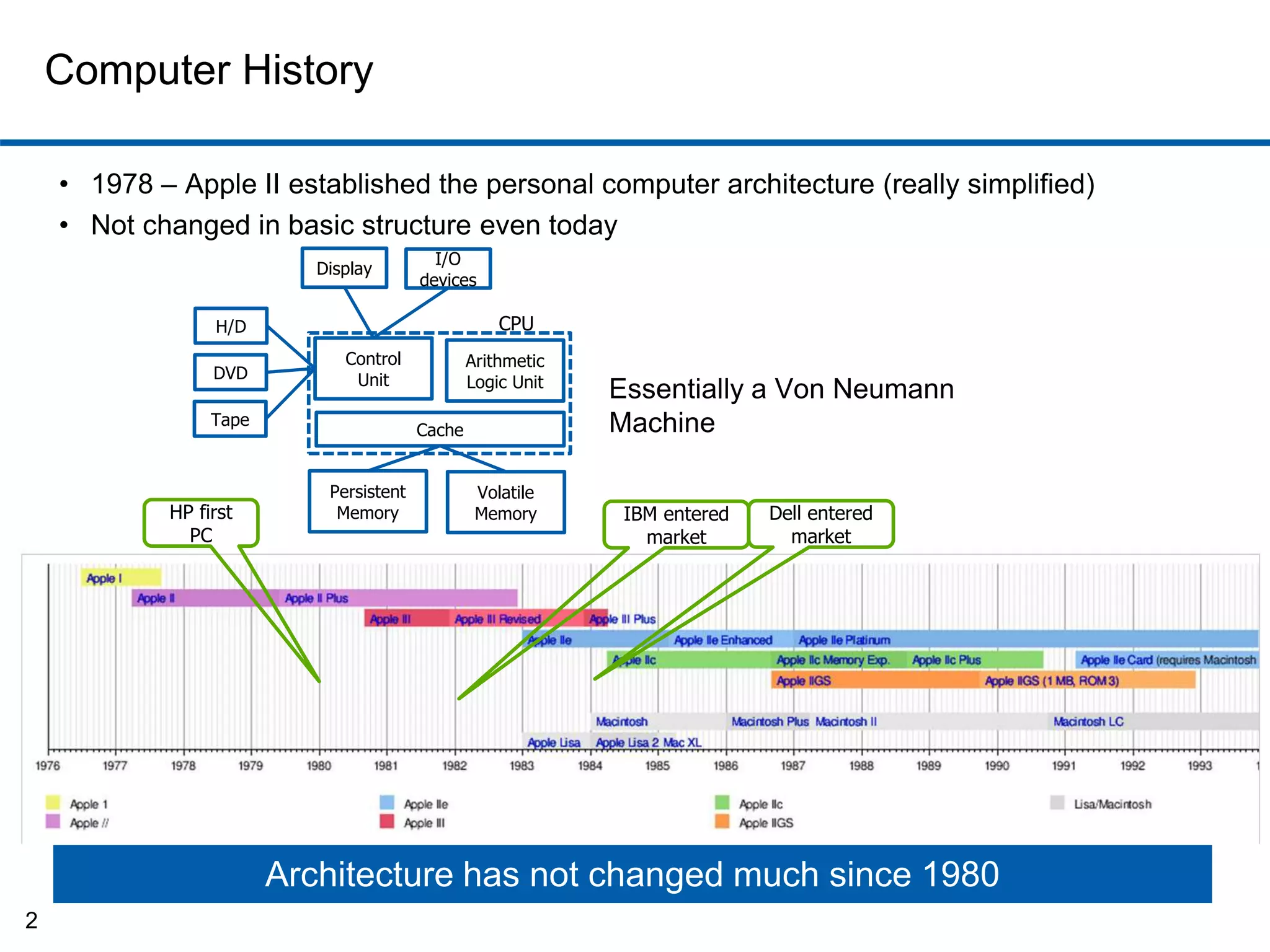
• 1978 – Apple II established the personal computer architecture (really simplified) 
• Not changed in basic structure even today 
2 
Control 
Unit 
CPU 
Arithmetic 
Logic Unit 
Cache 
Persistent 
Memory 
Volatile 
Memory 
Architecture has not changed much since 1980 
H/D 
DVD 
Tape 
Display 
I/O 
devices 
Essentially a Von Neumann 
Machine 
IBM entered 
market 
Dell entered 
market 
HP first 
PC
Changes since 1978 
• Processor Speed 
– 1MHz, 5MHz, 20MHz, 33MHz, 66MHz, 120MHz, 500MHz, 1GHz, 3.2GHz 
– Why not higher? (speed of light and memory bottle necks) 
– memory access – 8bit (256), 16bit (65K), 32bit (4B), 64bit (18^18), 128bit (340^36) 
• Processor Cores 
– 70s, 80s, 90s – single cores 
– Dual core – 2004/5, quad-core – 2006, today – 18 core Xenon (this year) 
• Volatile Memory (RAM) 
– 48K, 1M, 16M, 32M, 64M, 512M, 1G, 4G, 8G, 16G, 64G, 128G sim modules 
– Interfaces with the SIMs improved (large bandwidth) 
• Long Term Storage 
– Floppy Drives – 140K, 180K, 360K, 1.2M 
– H/D – 5M, 10M, 100M, 1G, 20G, 60G, 512G, 1T, 3T 
– H/D – spin – 5K, 7K, 10K, 15K RPM gave faster access time. 
– CDs/DVDs/double sided 
– Thumb drives/SSD 
• Displays 
– CRT – 9in, 11in, 15in, 18in, 21in, 24in, etc. 
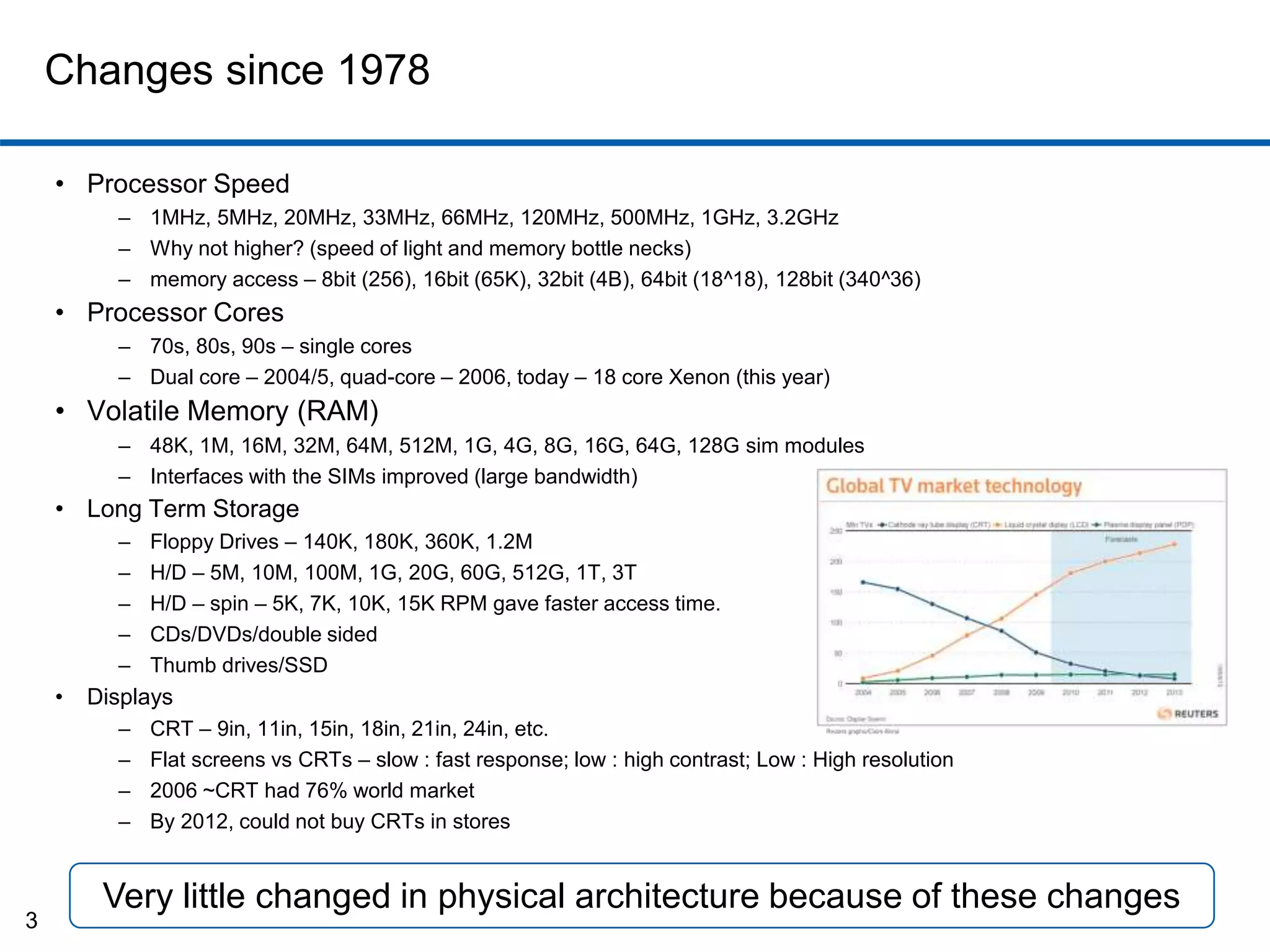
– Flat screens vs CRTs – slow : fast response; low : high contrast; Low : High resolution 
– 2006 ~CRT had 76% world market 
– By 2012, could not buy CRTs in stores 
Very little changed in physical architecture because of these changes 
3
S/W implementation changed but not architecture 
Code size considerations 
• 80s – used Boolean Algebra to reduce code to fit in memory 
• 2000 – No longer really care about code size 
Processing in memory 
• 80s used to swap between long term and volatile 
• 2000 – Work hard to live in the 16G or 32G volatile memory window per 
processor 
Code Distribution 
• Floppy, 3.5in floppy, CD, DVD, Internet 
4 
S/W development changed a lot in the 80s and 90s; Architecture did 
not change
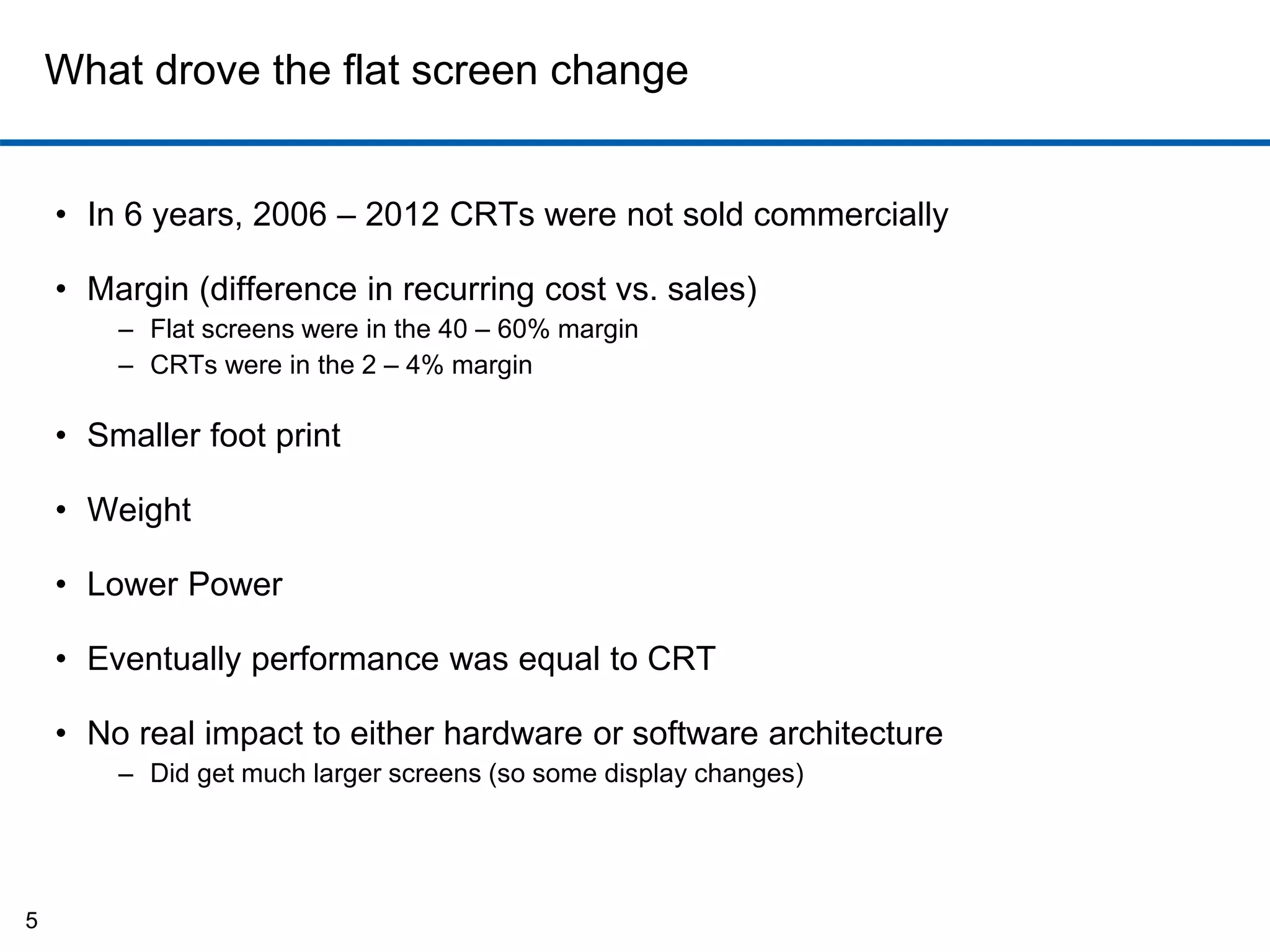
What drove the flat screen change 
• In 6 years, 2006 – 2012 CRTs were not sold commercially 
• Margin (difference in recurring cost vs. sales) 
– Flat screens were in the 40 – 60% margin 
– CRTs were in the 2 – 4% margin 
• Smaller foot print 
• Weight 
• Lower Power 
• Eventually performance was equal to CRT 
• No real impact to either hardware or software architecture 
– Did get much larger screens (so some display changes) 
5
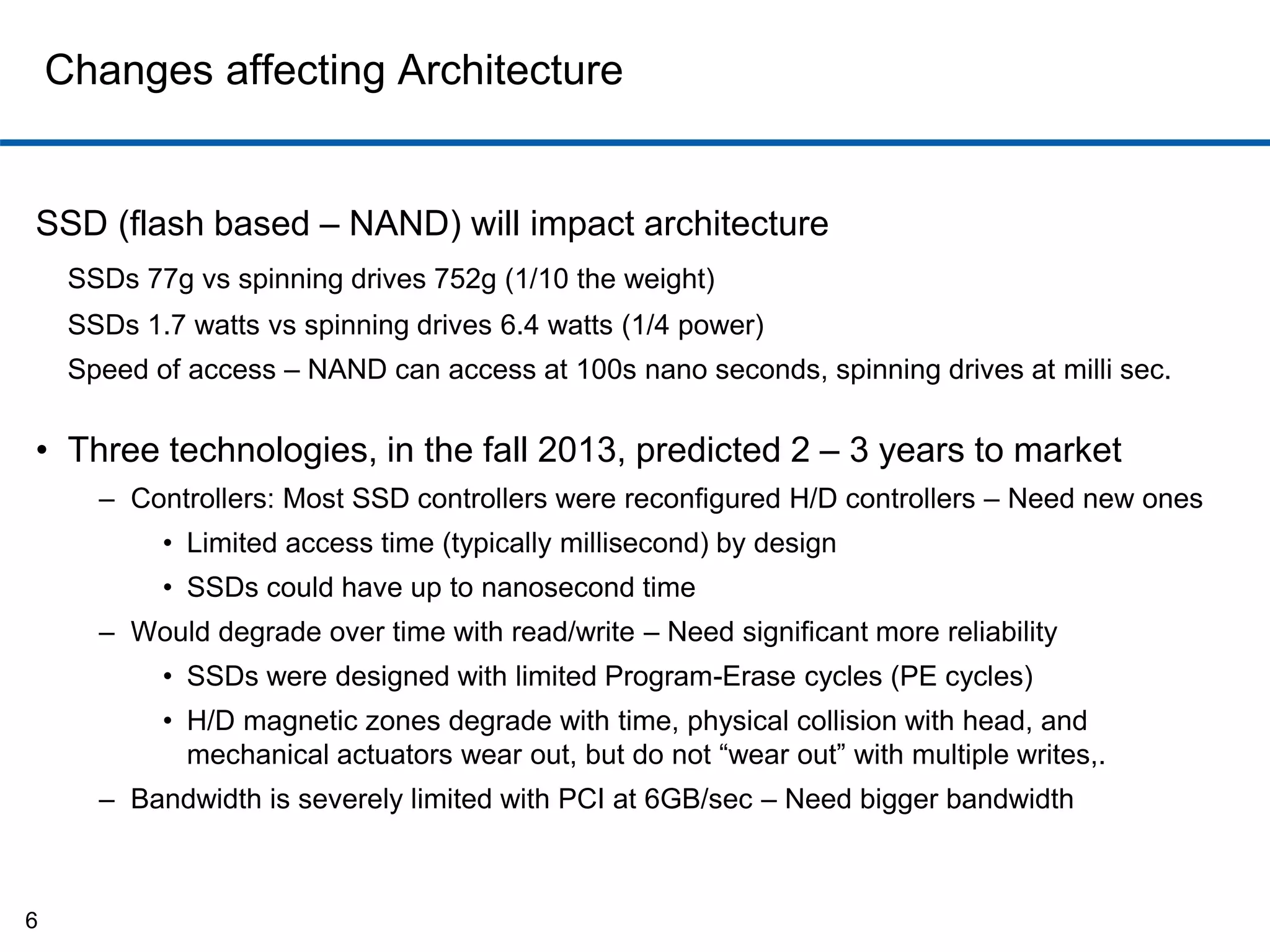
Changes affecting Architecture 
SSD (flash based – NAND) will impact architecture 
SSDs 77g vs spinning drives 752g (1/10 the weight) 
SSDs 1.7 watts vs spinning drives 6.4 watts (1/4 power) 
Speed of access – NAND can access at 100s nano seconds, spinning drives at milli sec. 
• Three technologies, in the fall 2013, predicted 2 – 3 years to market 
– Controllers: Most SSD controllers were reconfigured H/D controllers – Need new ones 
• Limited access time (typically millisecond) by design 
• SSDs could have up to nanosecond time 
– Would degrade over time with read/write – Need significant more reliability 
• SSDs were designed with limited Program-Erase cycles (PE cycles) 
• H/D magnetic zones degrade with time, physical collision with head, and 
mechanical actuators wear out, but do not “wear out” with multiple writes,. 
– Bandwidth is severely limited with PCI at 6GB/sec – Need bigger bandwidth 
6
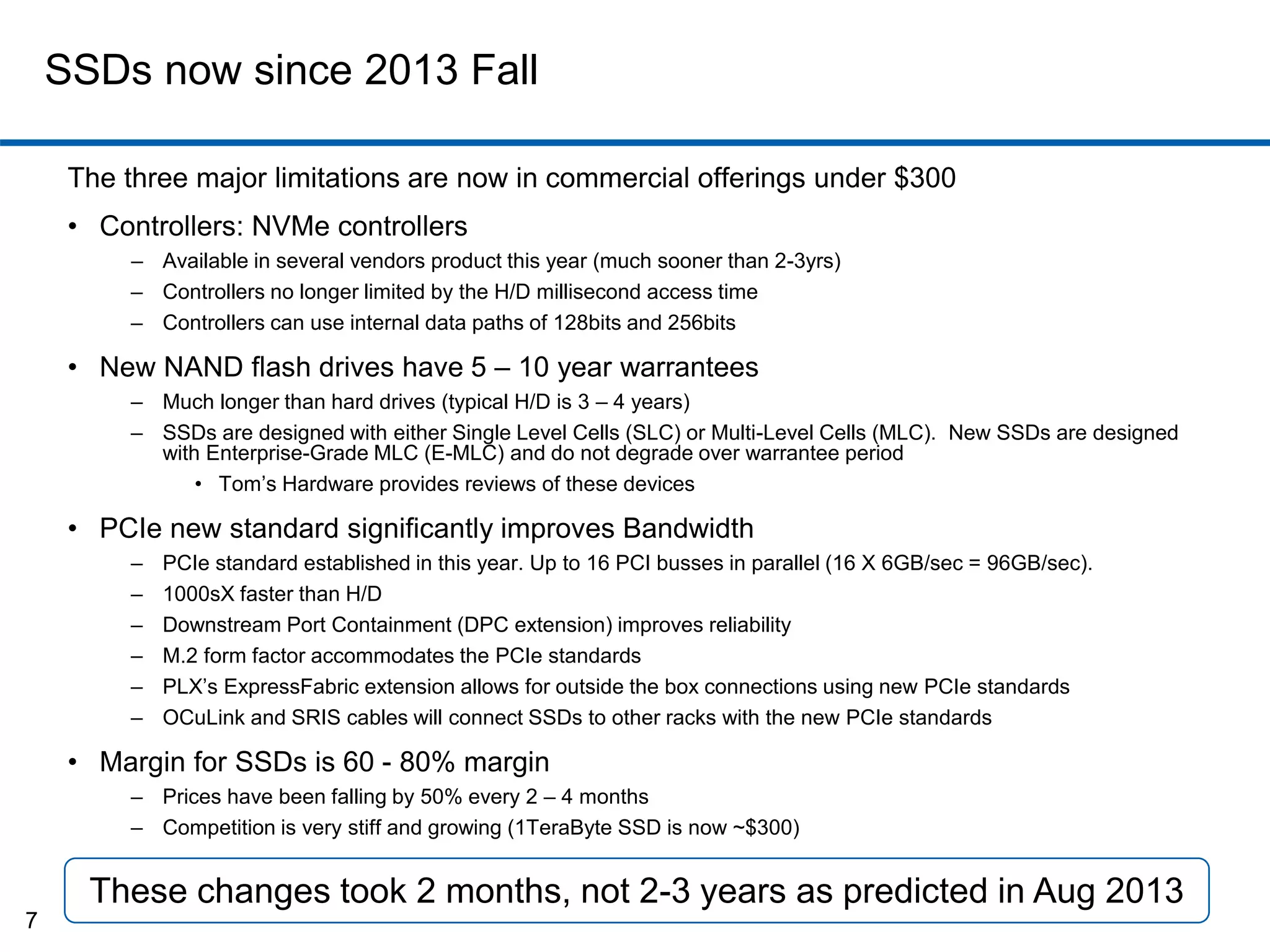
SSDs now since 2013 Fall 
The three major limitations are now in commercial offerings under $300 
• Controllers: NVMe controllers 
– Available in several vendors product this year (much sooner than 2-3yrs) 
– Controllers no longer limited by the H/D millisecond access time 
– Controllers can use internal data paths of 128bits and 256bits 
• New NAND flash drives have 5 – 10 year warrantees 
– Much longer than hard drives (typical H/D is 3 – 4 years) 
– SSDs are designed with either Single Level Cells (SLC) or Multi-Level Cells (MLC). New SSDs are designed 
with Enterprise-Grade MLC (E-MLC) and do not degrade over warrantee period 
• Tom’s Hardware provides reviews of these devices 
• PCIe new standard significantly improves Bandwidth 
– PCIe standard established in this year. Up to 16 PCI busses in parallel (16 X 6GB/sec = 96GB/sec). 
– 1000sX faster than H/D 
– Downstream Port Containment (DPC extension) improves reliability 
– M.2 form factor accommodates the PCIe standards 
– PLX’s ExpressFabric extension allows for outside the box connections using new PCIe standards 
– OCuLink and SRIS cables will connect SSDs to other racks with the new PCIe standards 
• Margin for SSDs is 60 - 80% margin 
– Prices have been falling by 50% every 2 – 4 months 
– Competition is very stiff and growing (1TeraByte SSD is now ~$300) 
7 
These changes took 2 months, not 2-3 years as predicted in Aug 2013
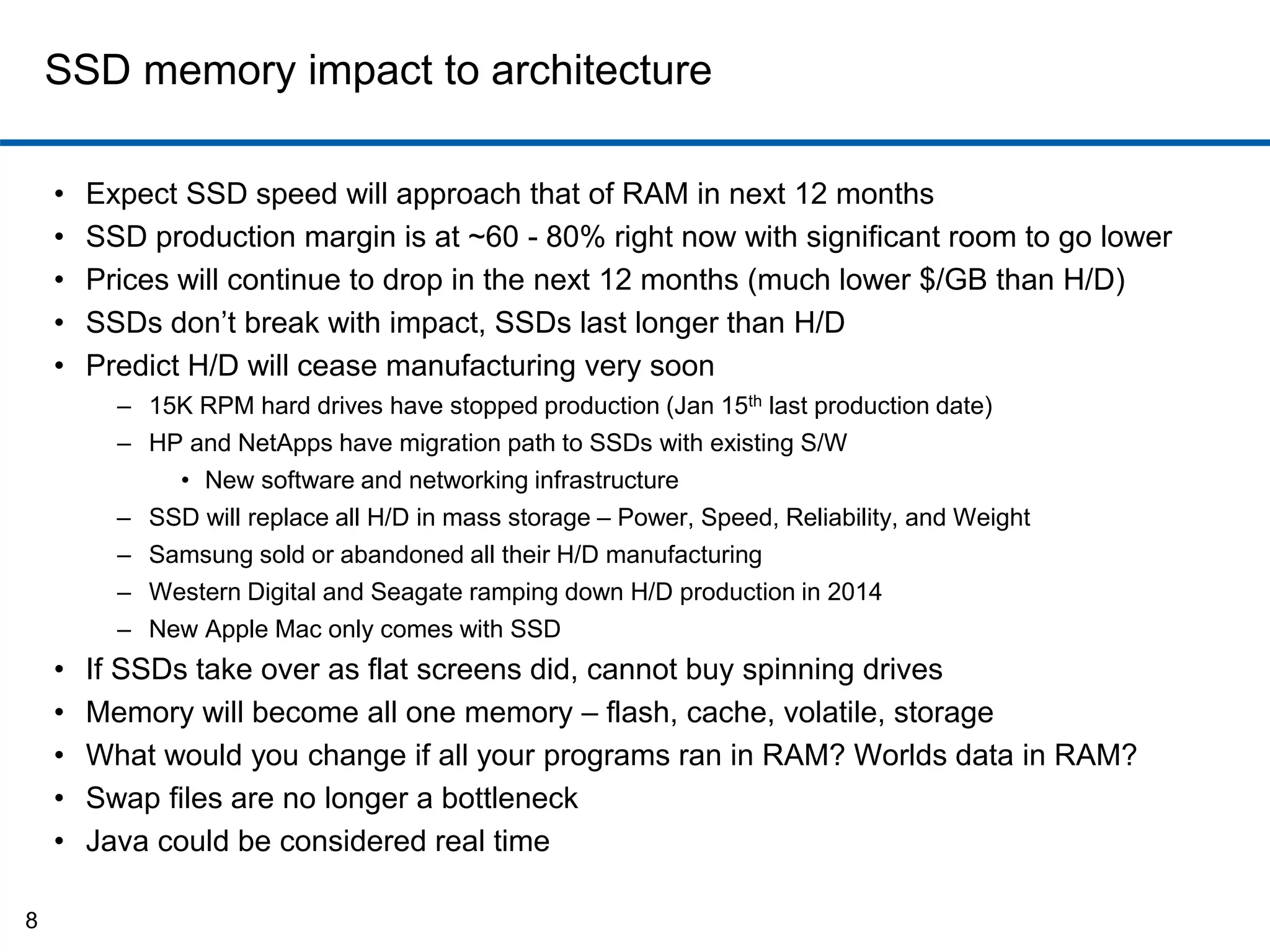
SSD memory impact to architecture 
• Expect SSD speed will approach that of RAM in next 12 months 
• SSD production margin is at ~60 - 80% right now with significant room to go lower 
• Prices will continue to drop in the next 12 months (much lower $/GB than H/D) 
• SSDs don’t break with impact, SSDs last longer than H/D 
• Predict H/D will cease manufacturing very soon 
– 15K RPM hard drives have stopped production (Jan 15th last production date) 
– HP and NetApps have migration path to SSDs with existing S/W 
• New software and networking infrastructure 
– SSD will replace all H/D in mass storage – Power, Speed, Reliability, and Weight 
– Samsung sold or abandoned all their H/D manufacturing 
– Western Digital and Seagate ramping down H/D production in 2014 
– New Apple Mac only comes with SSD 
• If SSDs take over as flat screens did, cannot buy spinning drives 
• Memory will become all one memory – flash, cache, volatile, storage 
• What would you change if all your programs ran in RAM? Worlds data in RAM? 
• Swap files are no longer a bottleneck 
• Java could be considered real time 
8
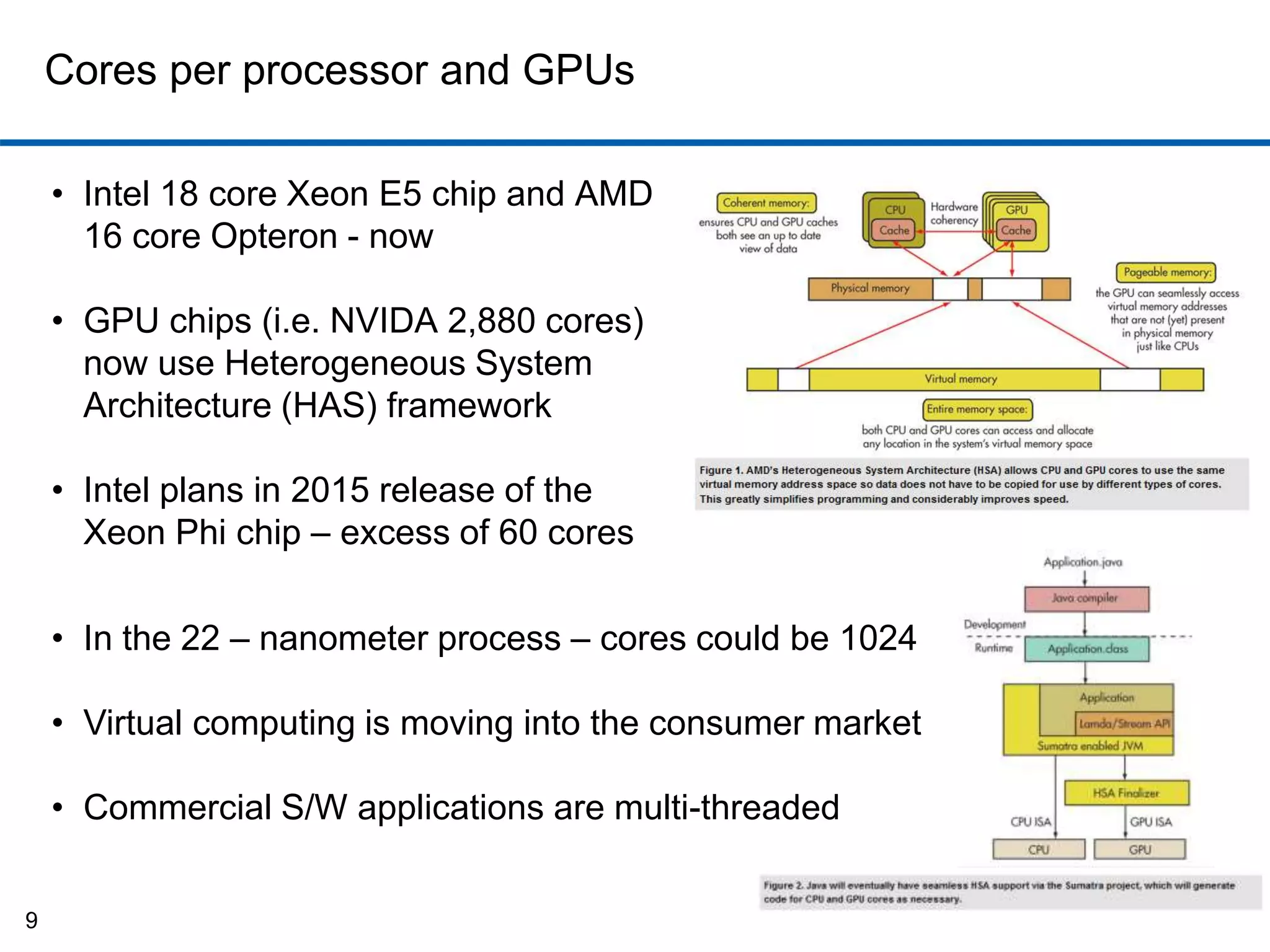
Cores per processor and GPUs 
• Intel 18 core Xeon E5 chip and AMD 
16 core Opteron - now 
• GPU chips (i.e. NVIDA 2,880 cores) 
now use Heterogeneous System 
Architecture (HAS) framework 
• Intel plans in 2015 release of the 
Xeon Phi chip – excess of 60 cores 
9 
• In the 22 – nanometer process – cores could be 1024 
• Virtual computing is moving into the consumer market 
• Commercial S/W applications are multi-threaded
Conclusions 
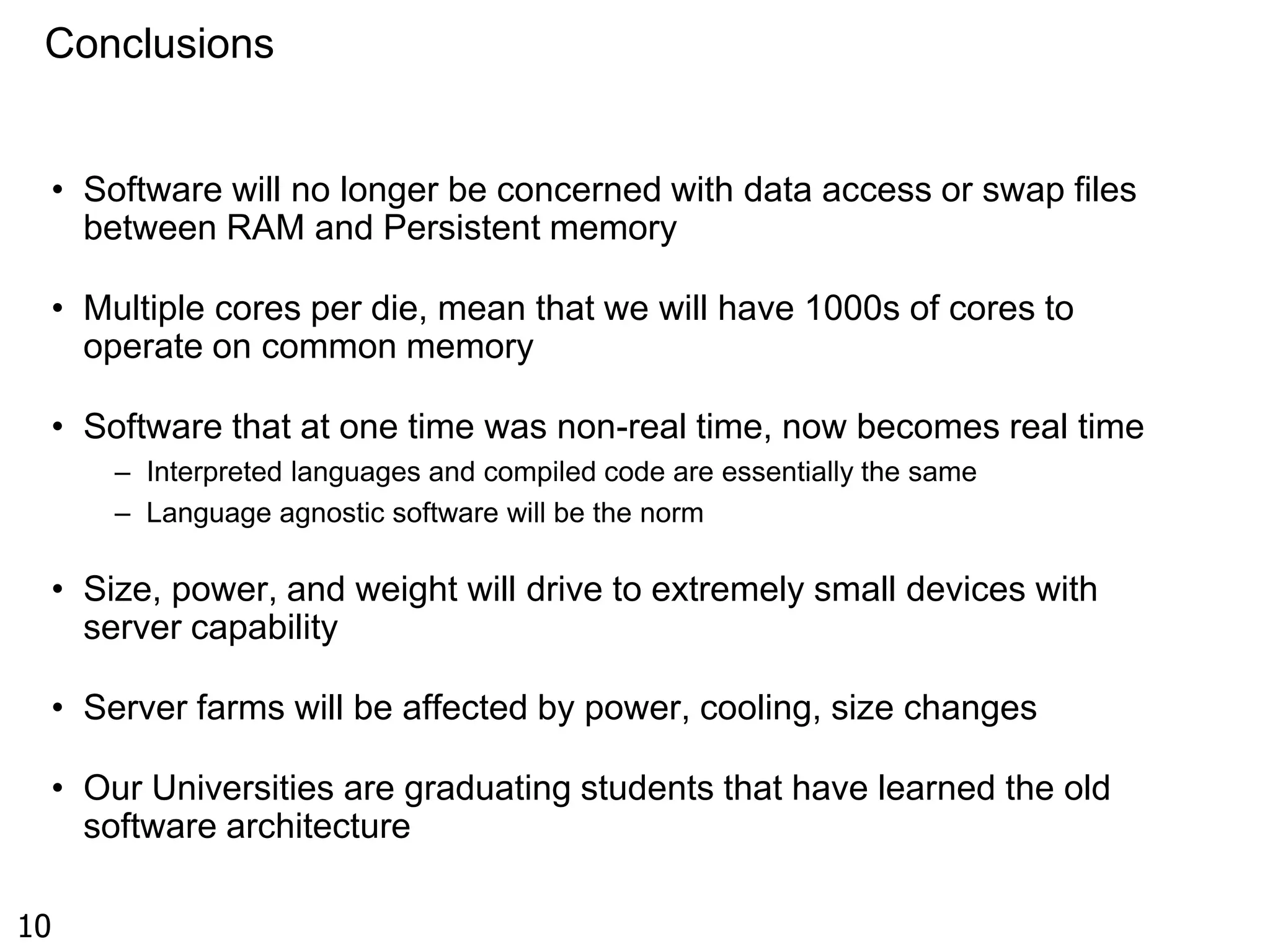
• Software will no longer be concerned with data access or swap files 
between RAM and Persistent memory 
• Multiple cores per die, mean that we will have 1000s of cores to 
operate on common memory 
• Software that at one time was non-real time, now becomes real time 
– Interpreted languages and compiled code are essentially the same 
– Language agnostic software will be the norm 
• Size, power, and weight will drive to extremely small devices with 
server capability 
• Server farms will be affected by power, cooling, size changes 
• Our Universities are graduating students that have learned the old 
software architecture 
10

INCOSE Colorado Front Range Chapter Presentation - Technology Impact on Computers

  • 1.
    Technology Impact on Computers 24 September 2014 Francis Thompson
  • 2.
    Computer History •1978 – Apple II established the personal computer architecture (really simplified) • Not changed in basic structure even today 2 Control Unit CPU Arithmetic Logic Unit Cache Persistent Memory Volatile Memory Architecture has not changed much since 1980 H/D DVD Tape Display I/O devices Essentially a Von Neumann Machine IBM entered market Dell entered market HP first PC
  • 3.
    Changes since 1978 • Processor Speed – 1MHz, 5MHz, 20MHz, 33MHz, 66MHz, 120MHz, 500MHz, 1GHz, 3.2GHz – Why not higher? (speed of light and memory bottle necks) – memory access – 8bit (256), 16bit (65K), 32bit (4B), 64bit (18^18), 128bit (340^36) • Processor Cores – 70s, 80s, 90s – single cores – Dual core – 2004/5, quad-core – 2006, today – 18 core Xenon (this year) • Volatile Memory (RAM) – 48K, 1M, 16M, 32M, 64M, 512M, 1G, 4G, 8G, 16G, 64G, 128G sim modules – Interfaces with the SIMs improved (large bandwidth) • Long Term Storage – Floppy Drives – 140K, 180K, 360K, 1.2M – H/D – 5M, 10M, 100M, 1G, 20G, 60G, 512G, 1T, 3T – H/D – spin – 5K, 7K, 10K, 15K RPM gave faster access time. – CDs/DVDs/double sided – Thumb drives/SSD • Displays – CRT – 9in, 11in, 15in, 18in, 21in, 24in, etc. – Flat screens vs CRTs – slow : fast response; low : high contrast; Low : High resolution – 2006 ~CRT had 76% world market – By 2012, could not buy CRTs in stores Very little changed in physical architecture because of these changes 3
  • 4.
    S/W implementation changedbut not architecture Code size considerations • 80s – used Boolean Algebra to reduce code to fit in memory • 2000 – No longer really care about code size Processing in memory • 80s used to swap between long term and volatile • 2000 – Work hard to live in the 16G or 32G volatile memory window per processor Code Distribution • Floppy, 3.5in floppy, CD, DVD, Internet 4 S/W development changed a lot in the 80s and 90s; Architecture did not change
  • 5.
    What drove theflat screen change • In 6 years, 2006 – 2012 CRTs were not sold commercially • Margin (difference in recurring cost vs. sales) – Flat screens were in the 40 – 60% margin – CRTs were in the 2 – 4% margin • Smaller foot print • Weight • Lower Power • Eventually performance was equal to CRT • No real impact to either hardware or software architecture – Did get much larger screens (so some display changes) 5
  • 6.
    Changes affecting Architecture SSD (flash based – NAND) will impact architecture SSDs 77g vs spinning drives 752g (1/10 the weight) SSDs 1.7 watts vs spinning drives 6.4 watts (1/4 power) Speed of access – NAND can access at 100s nano seconds, spinning drives at milli sec. • Three technologies, in the fall 2013, predicted 2 – 3 years to market – Controllers: Most SSD controllers were reconfigured H/D controllers – Need new ones • Limited access time (typically millisecond) by design • SSDs could have up to nanosecond time – Would degrade over time with read/write – Need significant more reliability • SSDs were designed with limited Program-Erase cycles (PE cycles) • H/D magnetic zones degrade with time, physical collision with head, and mechanical actuators wear out, but do not “wear out” with multiple writes,. – Bandwidth is severely limited with PCI at 6GB/sec – Need bigger bandwidth 6
  • 7.
    SSDs now since2013 Fall The three major limitations are now in commercial offerings under $300 • Controllers: NVMe controllers – Available in several vendors product this year (much sooner than 2-3yrs) – Controllers no longer limited by the H/D millisecond access time – Controllers can use internal data paths of 128bits and 256bits • New NAND flash drives have 5 – 10 year warrantees – Much longer than hard drives (typical H/D is 3 – 4 years) – SSDs are designed with either Single Level Cells (SLC) or Multi-Level Cells (MLC). New SSDs are designed with Enterprise-Grade MLC (E-MLC) and do not degrade over warrantee period • Tom’s Hardware provides reviews of these devices • PCIe new standard significantly improves Bandwidth – PCIe standard established in this year. Up to 16 PCI busses in parallel (16 X 6GB/sec = 96GB/sec). – 1000sX faster than H/D – Downstream Port Containment (DPC extension) improves reliability – M.2 form factor accommodates the PCIe standards – PLX’s ExpressFabric extension allows for outside the box connections using new PCIe standards – OCuLink and SRIS cables will connect SSDs to other racks with the new PCIe standards • Margin for SSDs is 60 - 80% margin – Prices have been falling by 50% every 2 – 4 months – Competition is very stiff and growing (1TeraByte SSD is now ~$300) 7 These changes took 2 months, not 2-3 years as predicted in Aug 2013
  • 8.
    SSD memory impactto architecture • Expect SSD speed will approach that of RAM in next 12 months • SSD production margin is at ~60 - 80% right now with significant room to go lower • Prices will continue to drop in the next 12 months (much lower $/GB than H/D) • SSDs don’t break with impact, SSDs last longer than H/D • Predict H/D will cease manufacturing very soon – 15K RPM hard drives have stopped production (Jan 15th last production date) – HP and NetApps have migration path to SSDs with existing S/W • New software and networking infrastructure – SSD will replace all H/D in mass storage – Power, Speed, Reliability, and Weight – Samsung sold or abandoned all their H/D manufacturing – Western Digital and Seagate ramping down H/D production in 2014 – New Apple Mac only comes with SSD • If SSDs take over as flat screens did, cannot buy spinning drives • Memory will become all one memory – flash, cache, volatile, storage • What would you change if all your programs ran in RAM? Worlds data in RAM? • Swap files are no longer a bottleneck • Java could be considered real time 8
  • 9.
    Cores per processorand GPUs • Intel 18 core Xeon E5 chip and AMD 16 core Opteron - now • GPU chips (i.e. NVIDA 2,880 cores) now use Heterogeneous System Architecture (HAS) framework • Intel plans in 2015 release of the Xeon Phi chip – excess of 60 cores 9 • In the 22 – nanometer process – cores could be 1024 • Virtual computing is moving into the consumer market • Commercial S/W applications are multi-threaded
  • 10.
    Conclusions • Softwarewill no longer be concerned with data access or swap files between RAM and Persistent memory • Multiple cores per die, mean that we will have 1000s of cores to operate on common memory • Software that at one time was non-real time, now becomes real time – Interpreted languages and compiled code are essentially the same – Language agnostic software will be the norm • Size, power, and weight will drive to extremely small devices with server capability • Server farms will be affected by power, cooling, size changes • Our Universities are graduating students that have learned the old software architecture 10